Slime Moulds by Barry Webb FRPS
Rare sightings |
New to Buckinghamshire |
New to UK |
A B C D E F G H I J K L M N O P Q R S T U V W X Y Z
SEARCH Index by Latin name
| Barry Webb FRPS | |
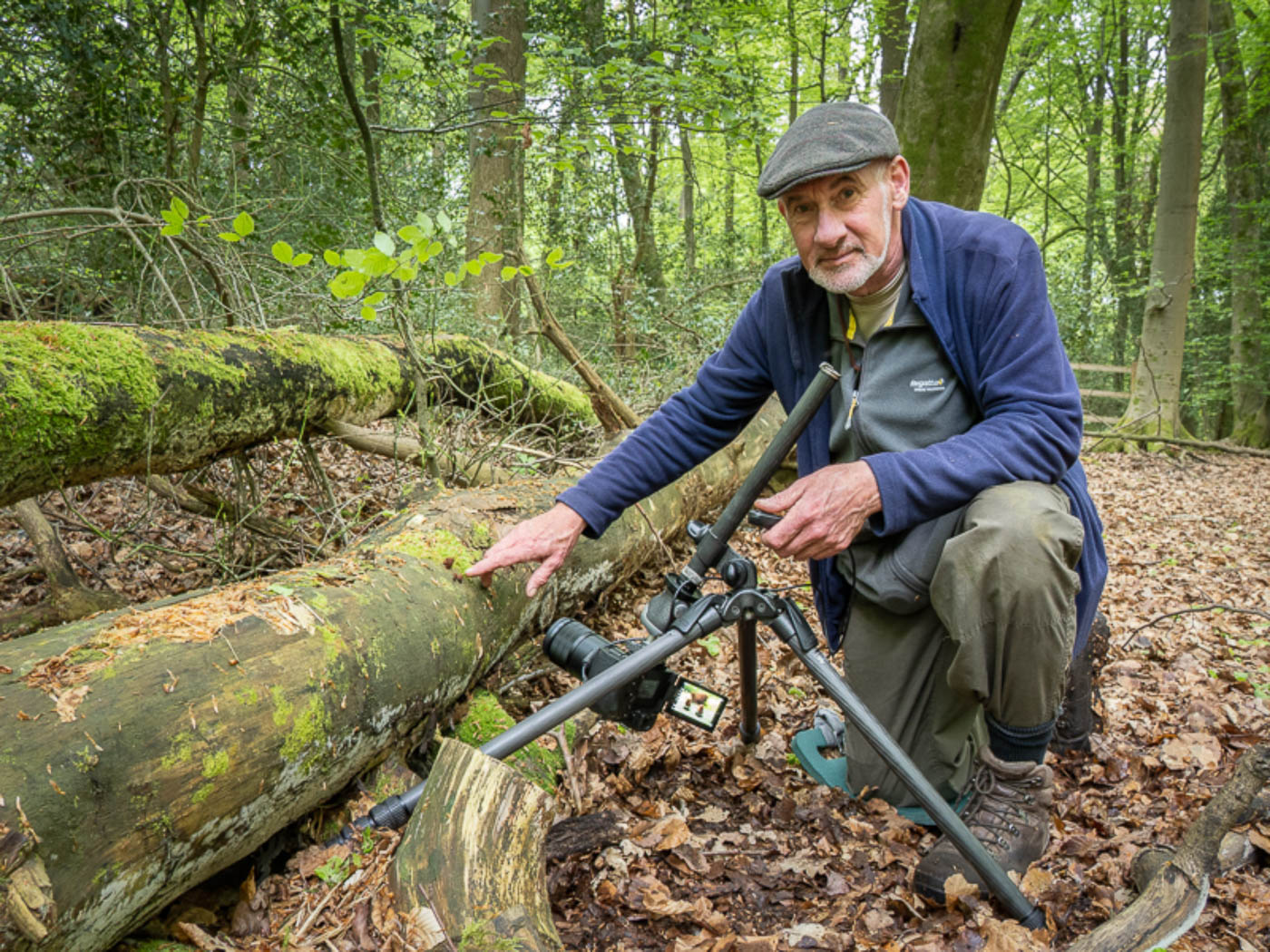 |
Barry joined BFG in 2018 with his wife Gill, both novices at studying fungi but keen for opportunities for further wildlife photography - already a serious hobby for them both. On our walks it was not long before he became enthralled, then utterly captivated by slime moulds - a new miniature world beckoned, one which he embraced enthusiastically and which quickly became his main interest and passion. His skills at photographing these tiny organisms rapidly developed, as did his abilities to find and identify them, and he was soon winning national and international photographic competitions culminating in his being honoured with FRPS after his name (Fellow of the Royal Photographic Society) in 2023. His book, 'Slime Mould - revealing an unseen world', is due to be published in Summer / Autumn 2027, and he has his own website at https://www.barrywebbimages.co.uk/where further delights can be enjoyed. Despite his growing international reputation he and Gill come out regularly with BFG and he continues to provide many wonderful images, both slime moulds and fungi, for Penny's reports. We are indeed proud and fortunate to have Barry as such an active and keen supporter of BFG. (His photo here was taken by Gill.) |
| A |
|
  |
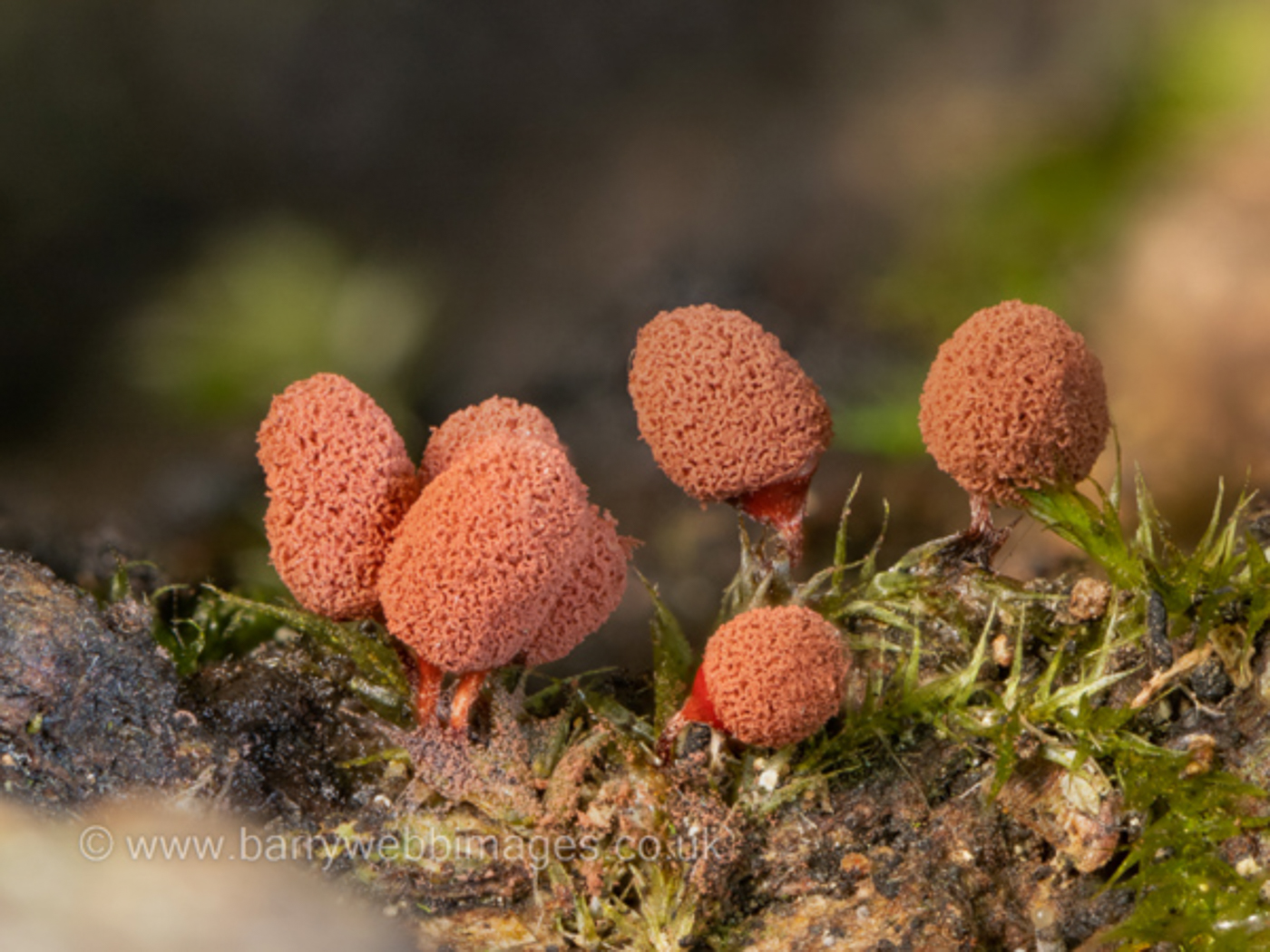
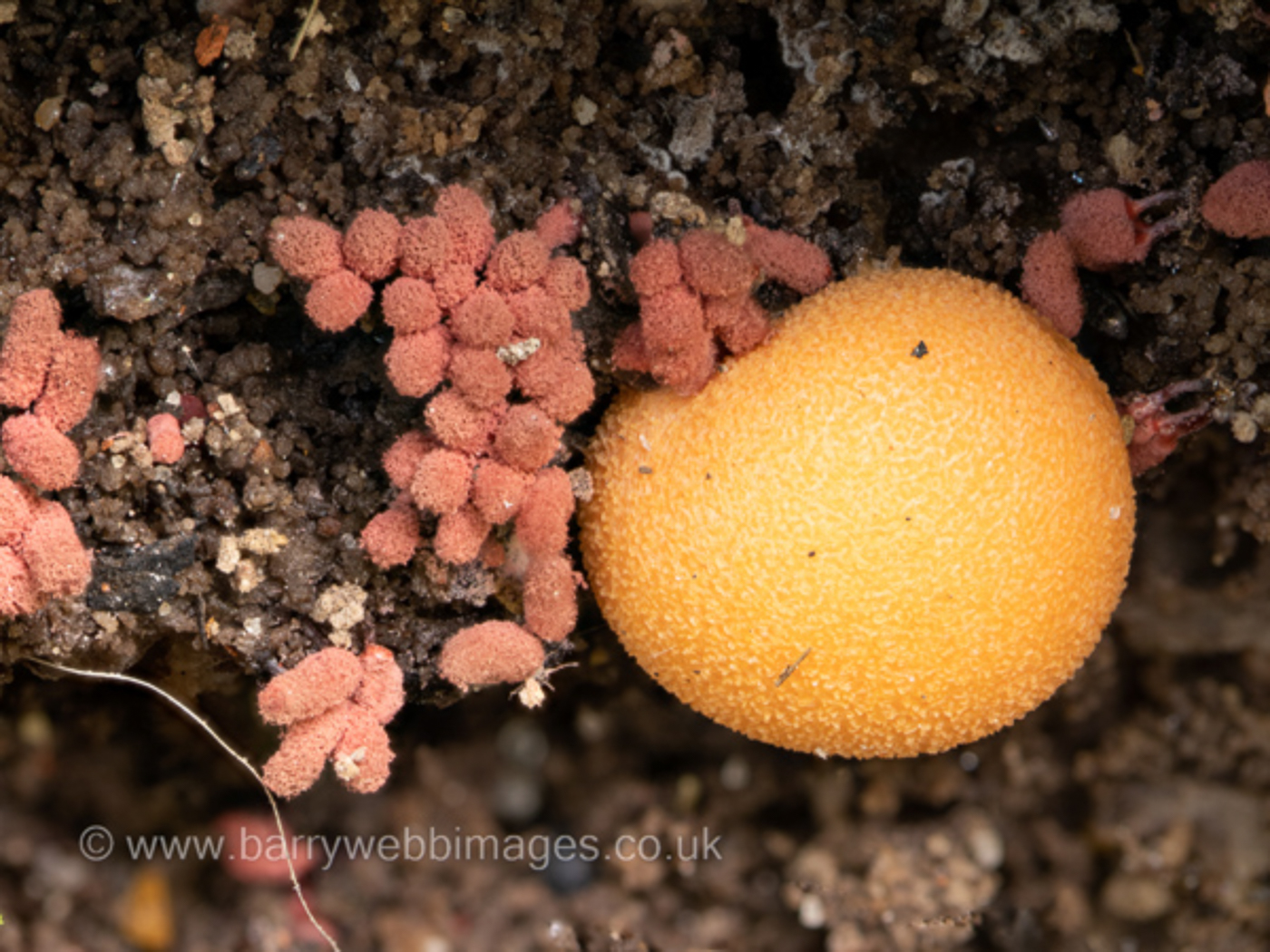
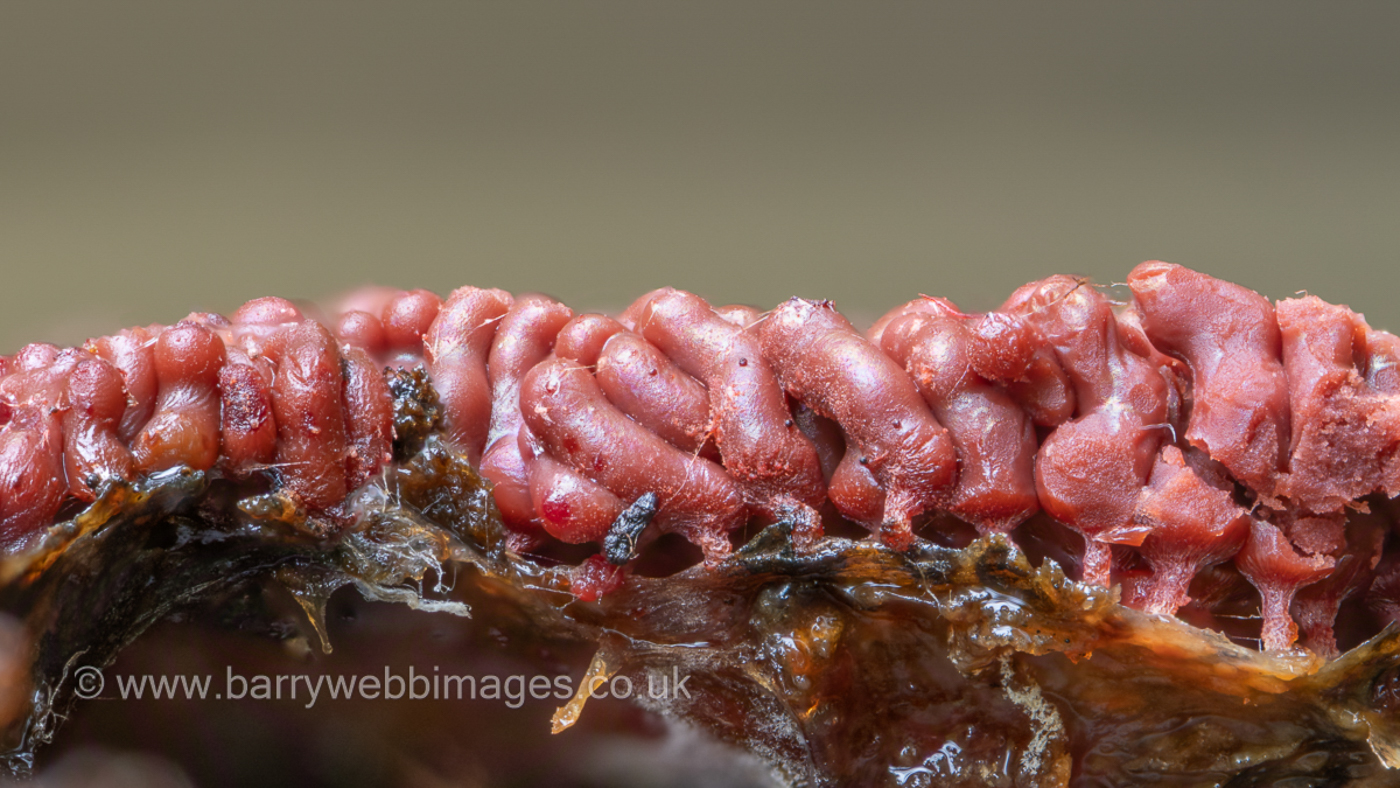
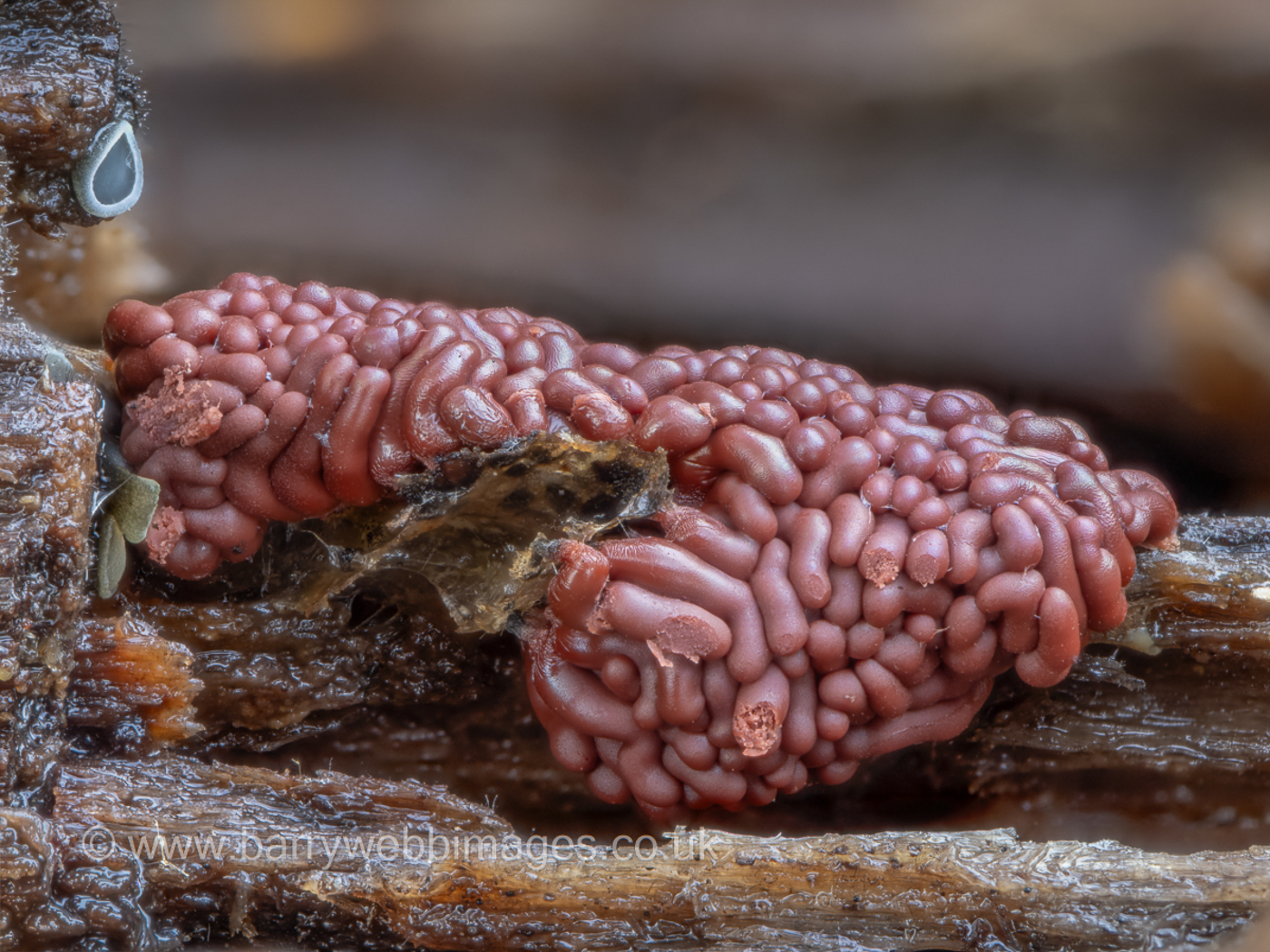
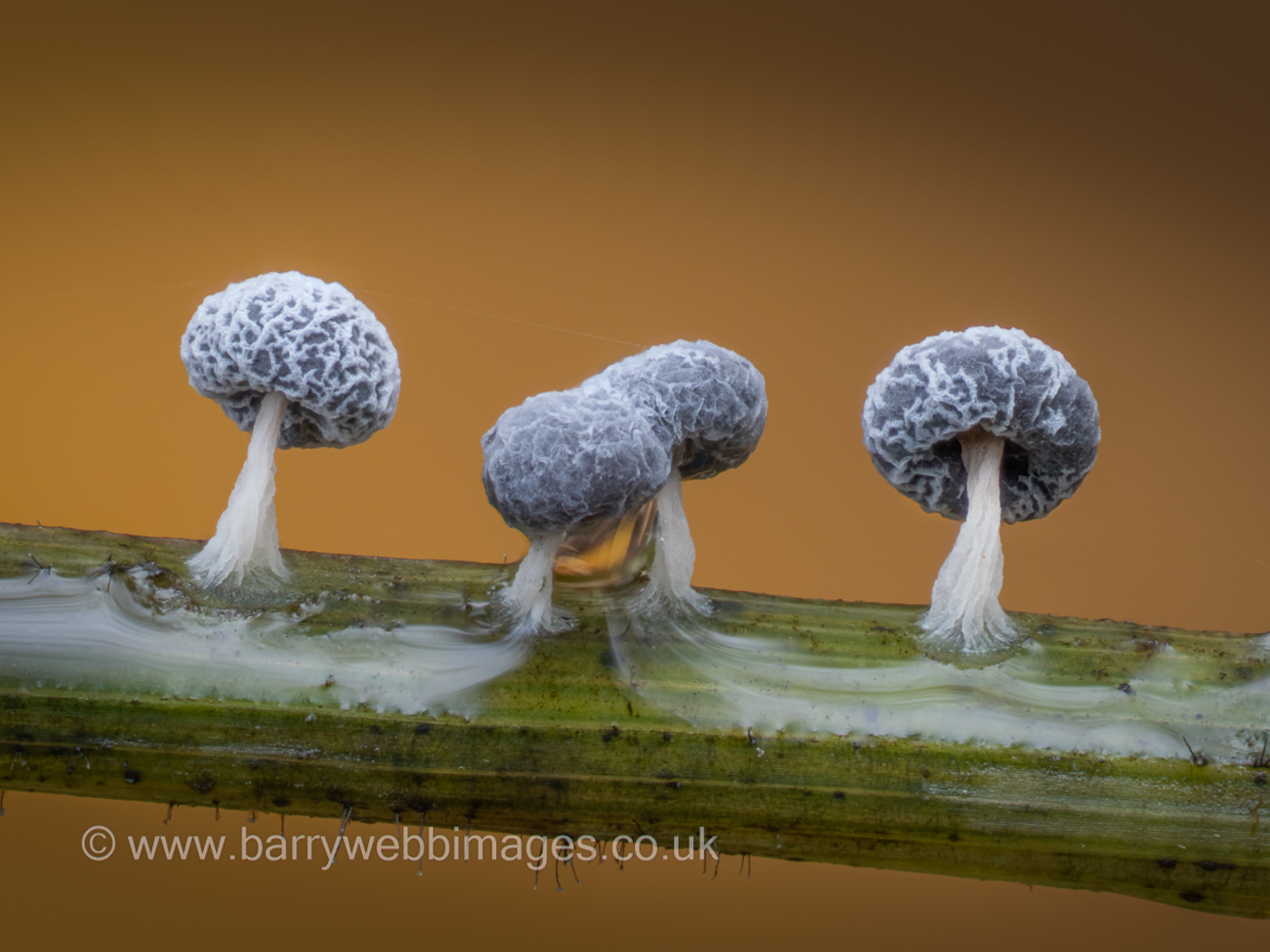
Amaurochaete atra Aug 3, 2025. On fallen Pine at Burnham Beeches Barry Webb found this unusual slime mould - one which appears to be new both to the site and the county though described as quite common. Barry explains that it starts out looking very similar to Enteridium lycoperdon (Moon Poo for some) - ie a pale quite large (for a slime mould) blob often on standing but dying trunks - but soon rapidly changes colour through pink to brown to black, then disrupts forming a reticulation of fine lines, the surface flaking off to reveal the spore mass beneath. Barry's two photos show both stages of development. The species apparently favours recently felled Pine. |


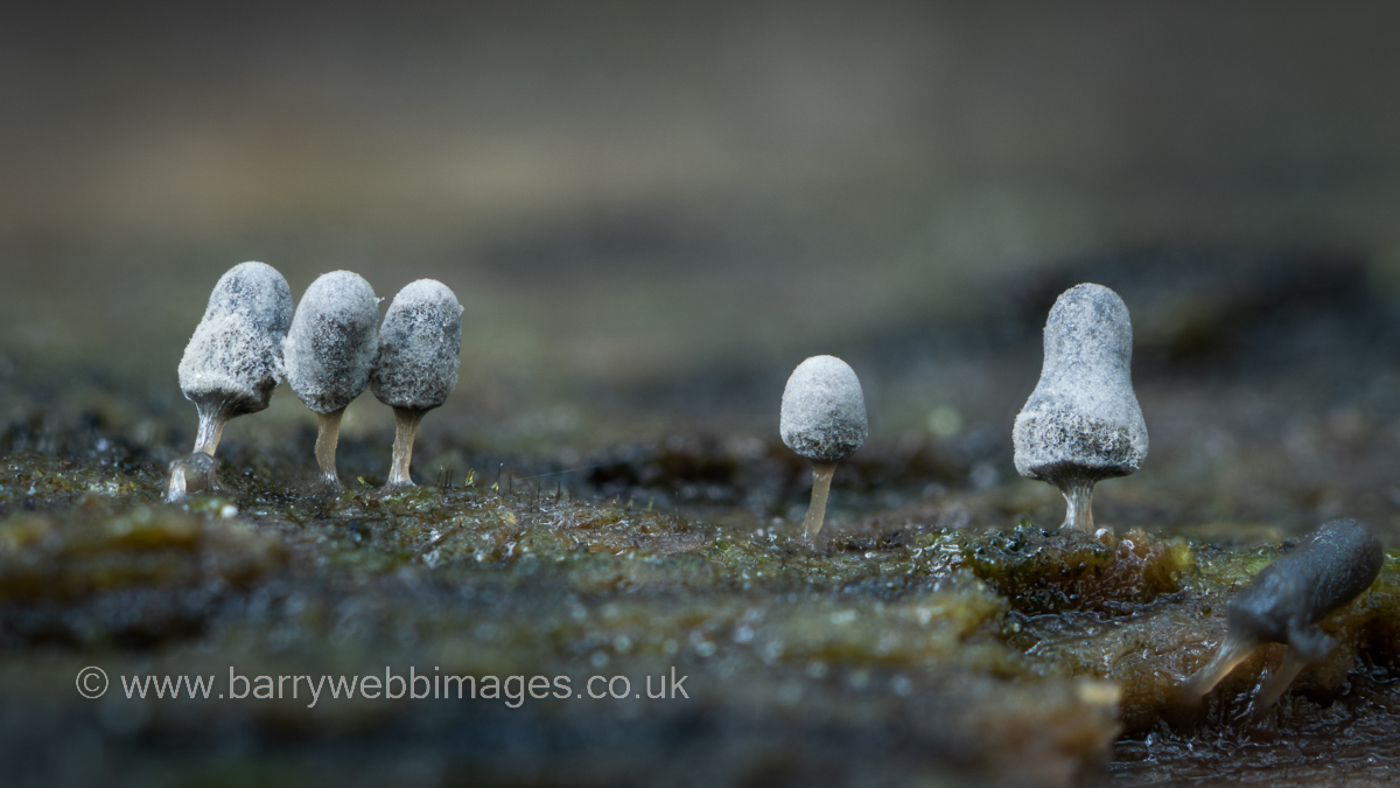 |
Arcyria cinerea Nov 10, 2022. In Round Spring Wood, Dancersend, Barry Webb found several Slime Moulds, this being one particularly photogenic little group. These are fully mature, past the slimy stage and like minature loofahs sitting on tiny cups, the whole probably less than 5 mm tall. There are many different species of Arcyria, this one being recognisable from its shape and colour. It appears to be a first for Finds though Barry's separate page has further examples. Aug 19, 2020. Barry found this quite common species in Burnham Beeches on fallen Birch. Arcyria is an attractive and distinctive genus, producing sporangia shaped like tiny loofahs on stalks though their plasmodium - mostly patches of white sticky blobs like many slime mould genera - gives away nothing of its final shape once it matures. This particular species is unique within the genus being off white to pale grey when mature - hence its species name and making it an easy one to recognise in the field. Photo 2 is of a collection made at the same site the following year (10.06.2021). Photos 3 and 4 are of collections made at Bernwood Forest (29.08 2021) showing both immature and mature examples. Photo 5 is from Stoke Common (29.10.2022) |


|
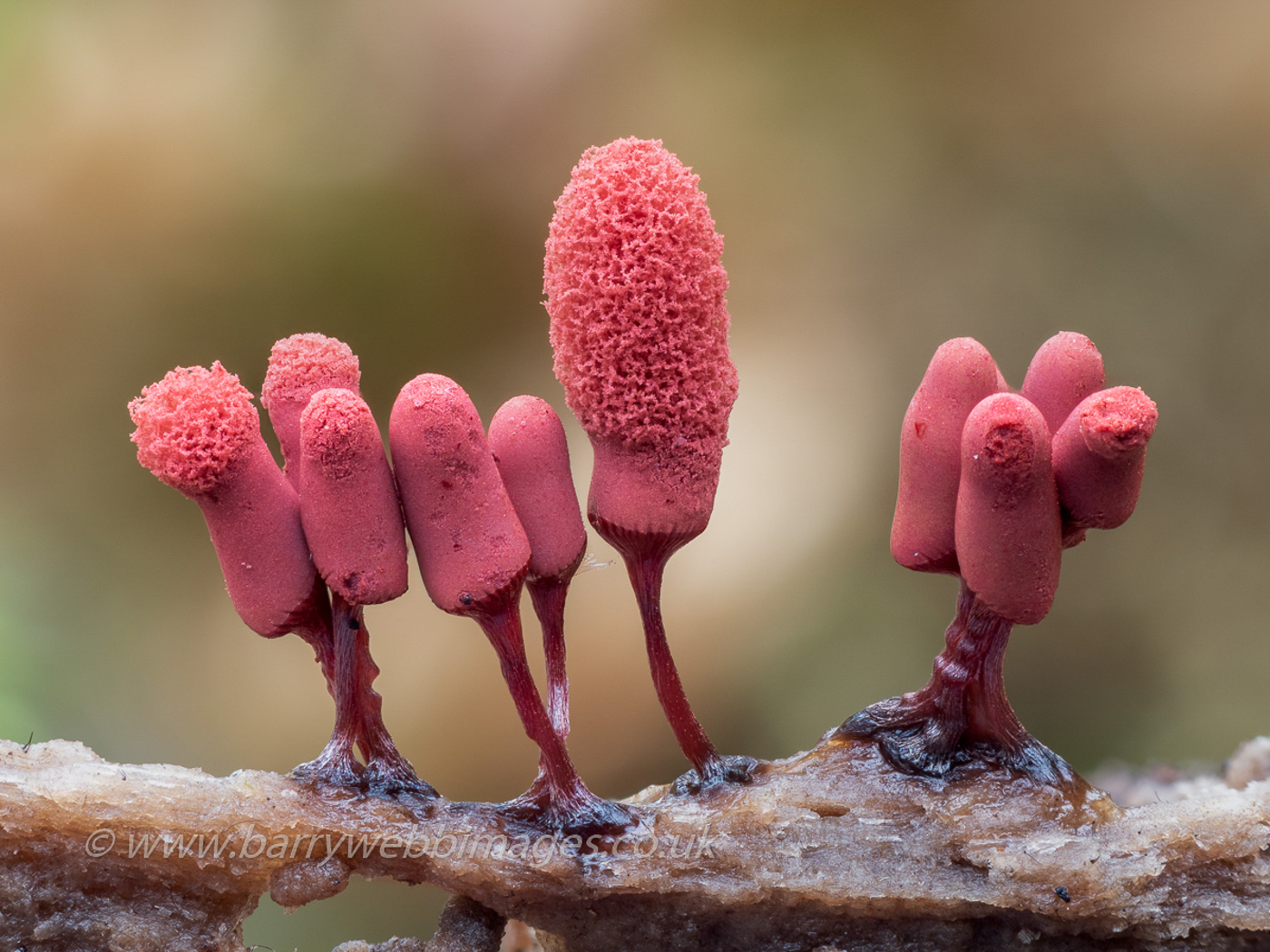
Arcyria denudata Jul 26, 2023. In Burnham Beeches Barry Webb found this little beauty on some very wet soggy rotten wood. The species is quite common if you know where to look and are prepared to search for tiny things with a x 10 lens and a torch! Photo 2 was a stunning earlier collection he found at the same site (12.10.2020); photo 3 was the following year (28.09.2021) and photos 4 and 5 from a Hodgemoor Wood collection (18.09.2022) include one with Lycogala terrestre alongside giving a good idea of scale. Oct 12, 2020. This stunning photo was taken by Barry Webb of a collection on fallen Beech in Burnham Beeches. Like most Slime Moulds, this species starts out as a cluster of slimy white blobs (the plasmodium stage) when identification even to genus is not possible. As it matures it dries off and forms these remarkable miniature 'loofahs' on shiny red stalks, the whole being 6 mms high at most! There are quite a few species of Arcyria, some rare, some common as is this one, but none are quite so eye-catching. Note how the stalk develops into a cup which supports the spore mass column, seen here in various stages of maturity. |




 |
Arcyria stipata Sep 26, 2021. In Hodgemoor Wood Barry Webb found this unfamiliar tight cluster on some damp deciduous fallen rotting wood and realised that though it was developing a similar colour to A. denudata - quite a common species - its formation of large densely crowded fruiting bodies with very short stalks was different. At home he worked out that this was the much rarer A. stipata and also new to the county. This was immature material and the species becomes a brighter copper-pink colour as it matures, as shown in photo 3 - a collection found in Penn Wood 6 weeks later. Photo 4: Round Spring Wood, Dancersend 29.10.2023 Photo 5: Stoke Common 17.11.2024 Photo 6: Burnham Beeches 19.10.2025 Photo 7: Stoke Common 12.11.2025 |
| B |
|


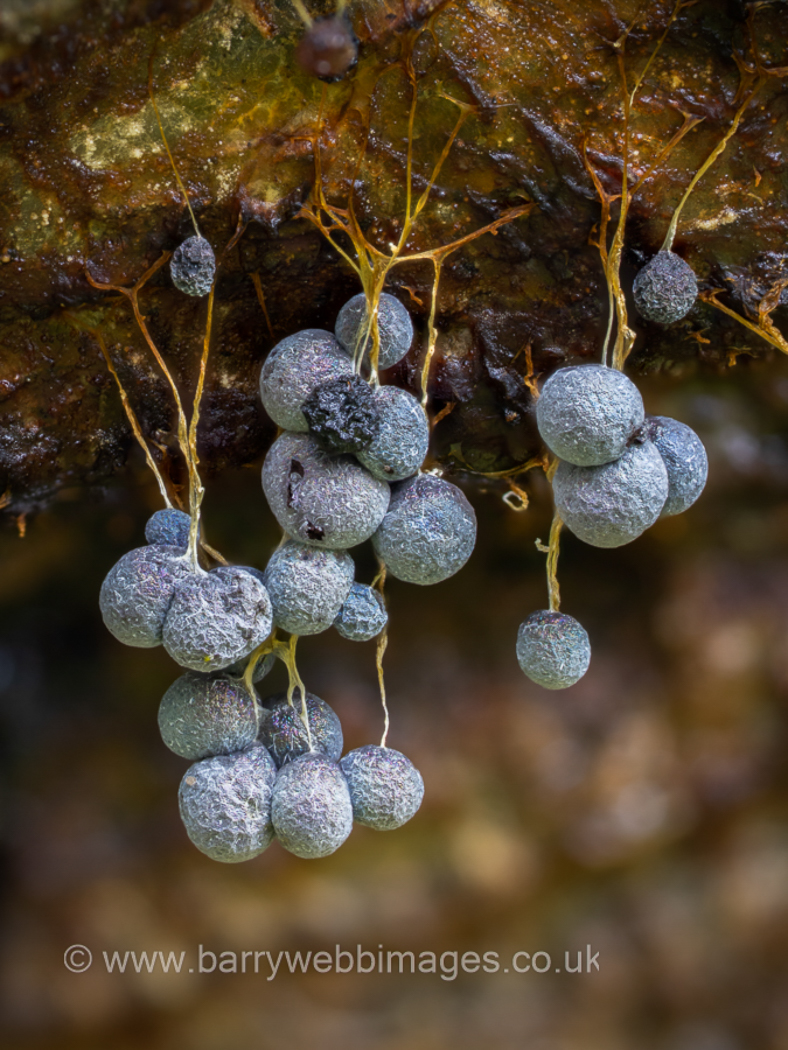 |
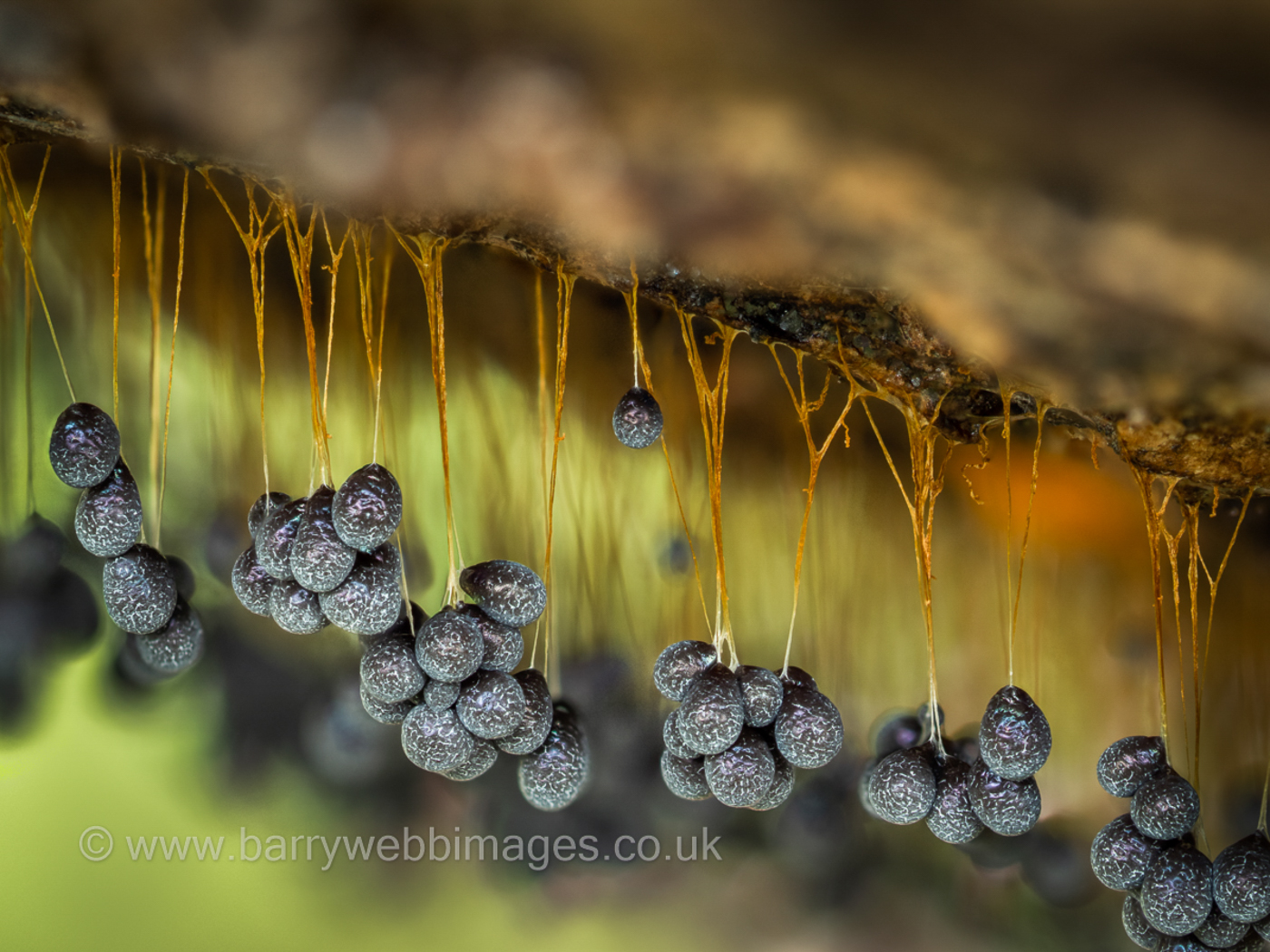
Badhamia utricularis Dec 30, 2021. In Hodgemoor Woods Barry and Gill Webb found a pile of cut up lichen-covered Birch branches which provided them with two species of slime mould, this being one of them. Photo 1 shows the yellow jelly-like plasmodium stage (plus a tiny Lycogala terrestre just developing); photo 2 is the same species further developed; photo 3 is of fully developed material. We have just 4 previous county records, the last being Barry's from Penn Wood in 2020. Photo 4: Penn Wood (15.01.2022). Photo 5: (03.04.2023). |
| C |
|

 |
Calomyxa metallica Mar 24, 2024. Whilst on our BFG walk at Rushbeds Wood Barry Webb collected a slime mould unfamiliar to him and was unable to identify it later. He hung on to it and a few weeks later investigated it a bit further, putting his photos on to the slime mould facebook page for help. Back came the name from both John Holden and Edvin Johannesen (both recognised specialists) and comparing other images online etc this ID looks extremely likely. Not a rarity with over 100 FRDBI entries, it is however new to the county. |


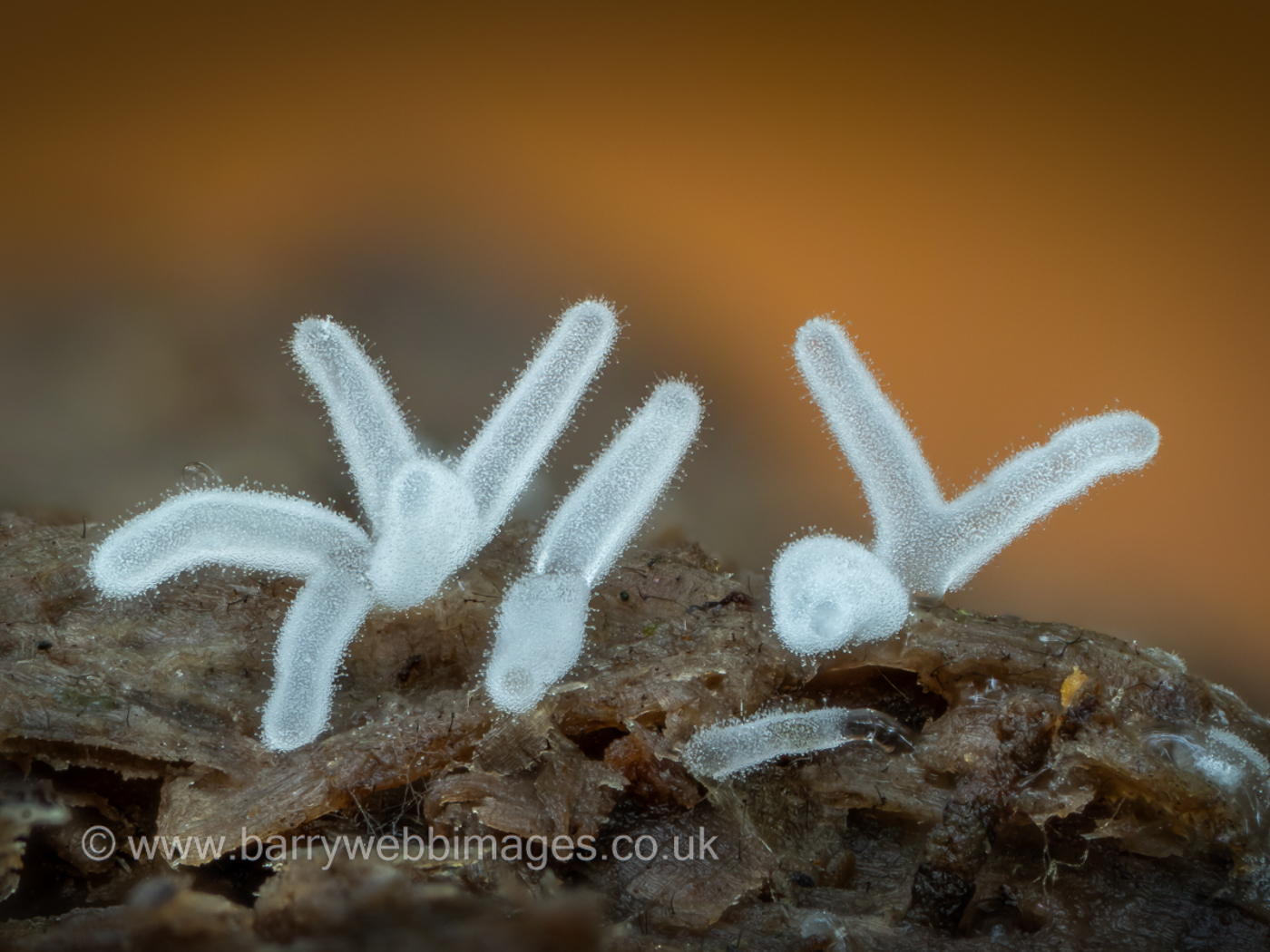 |
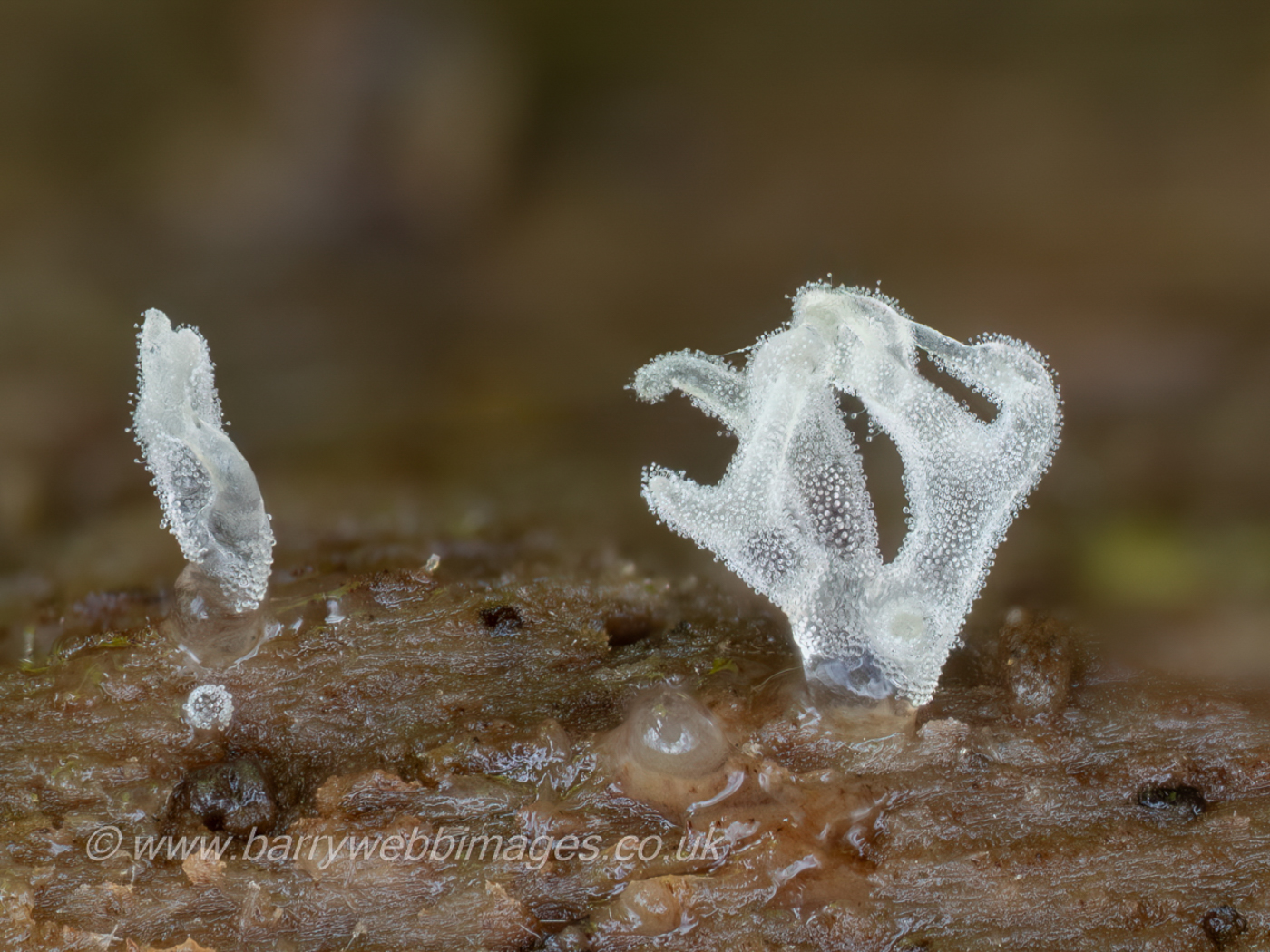
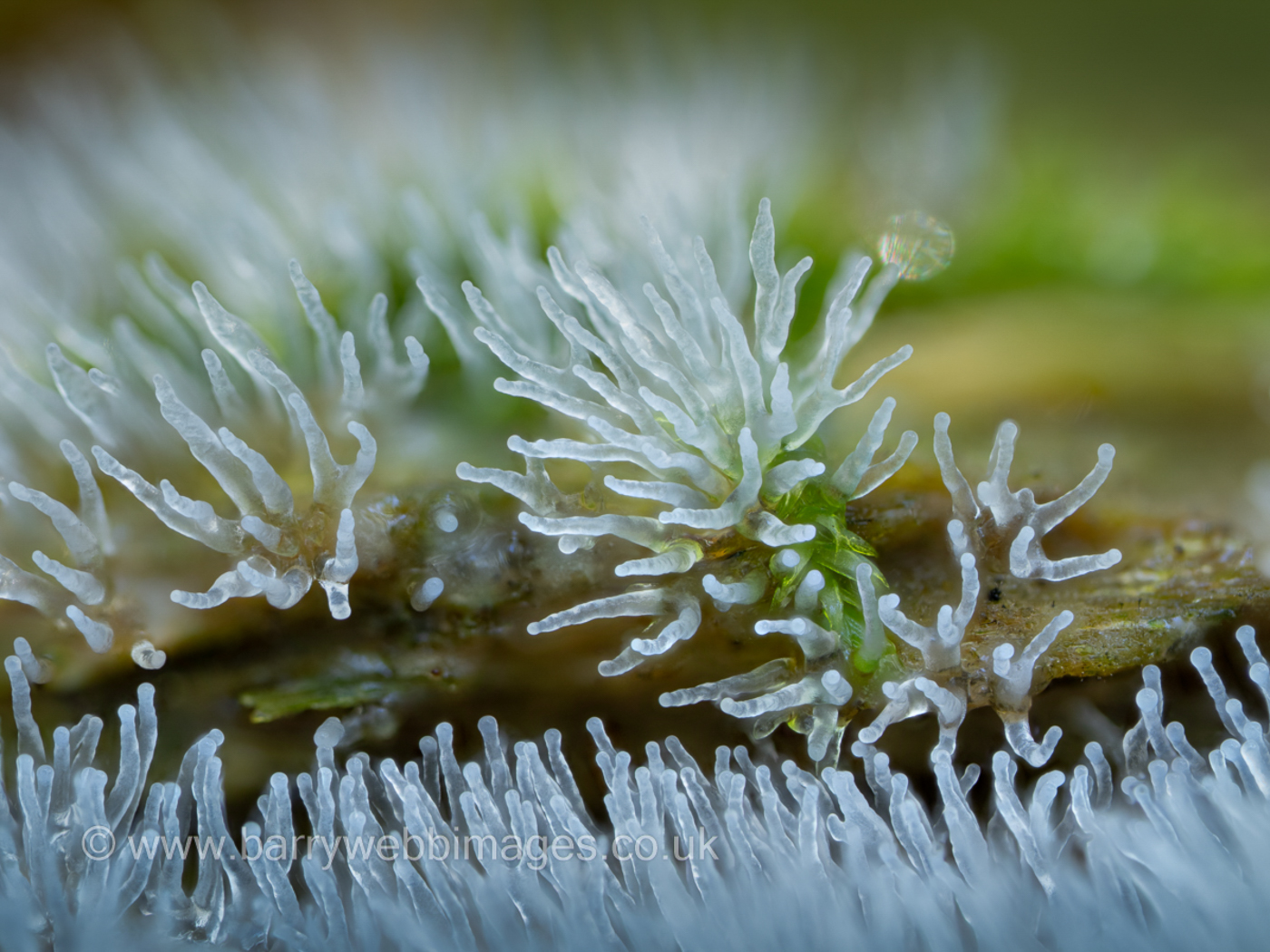
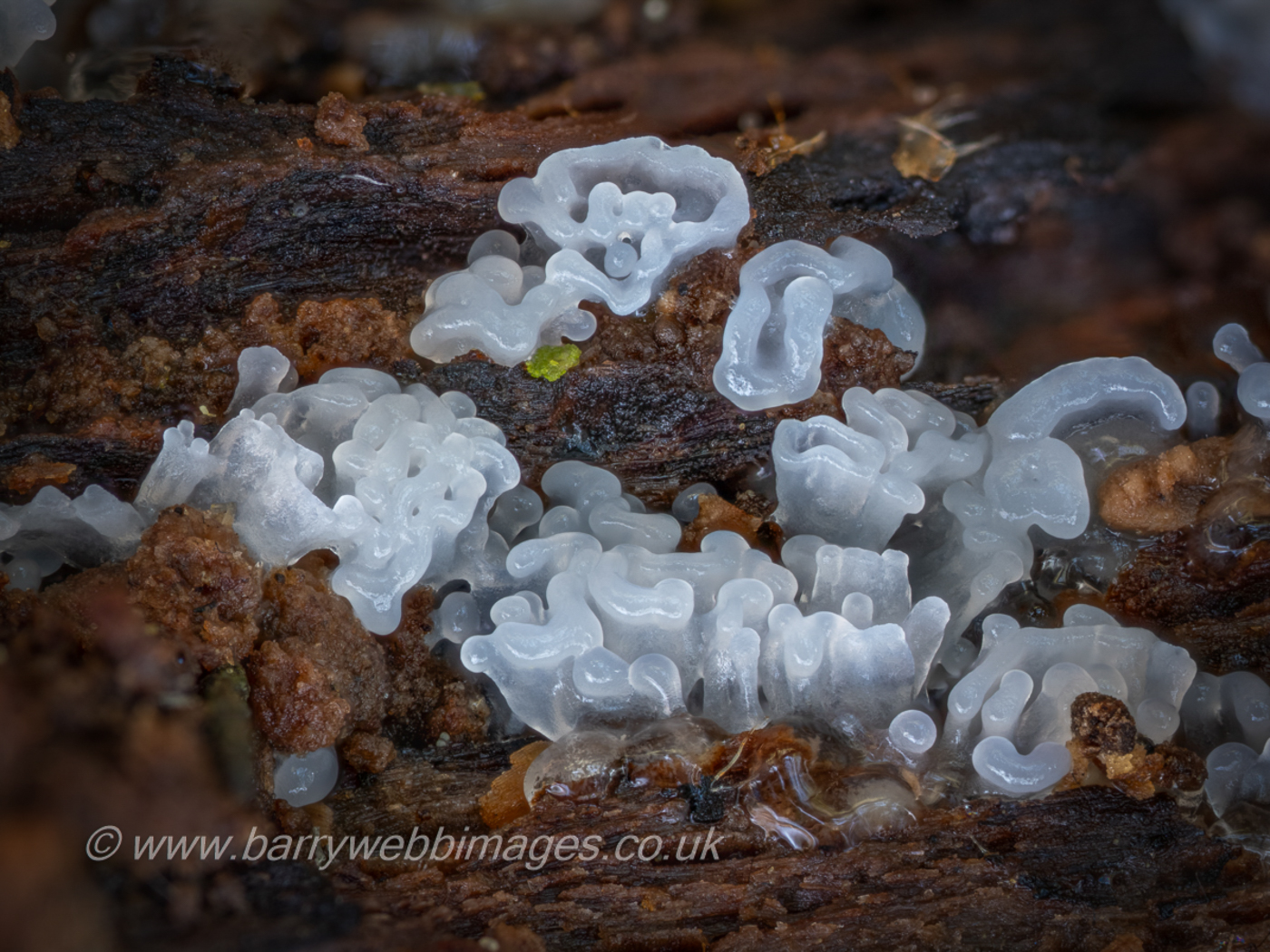
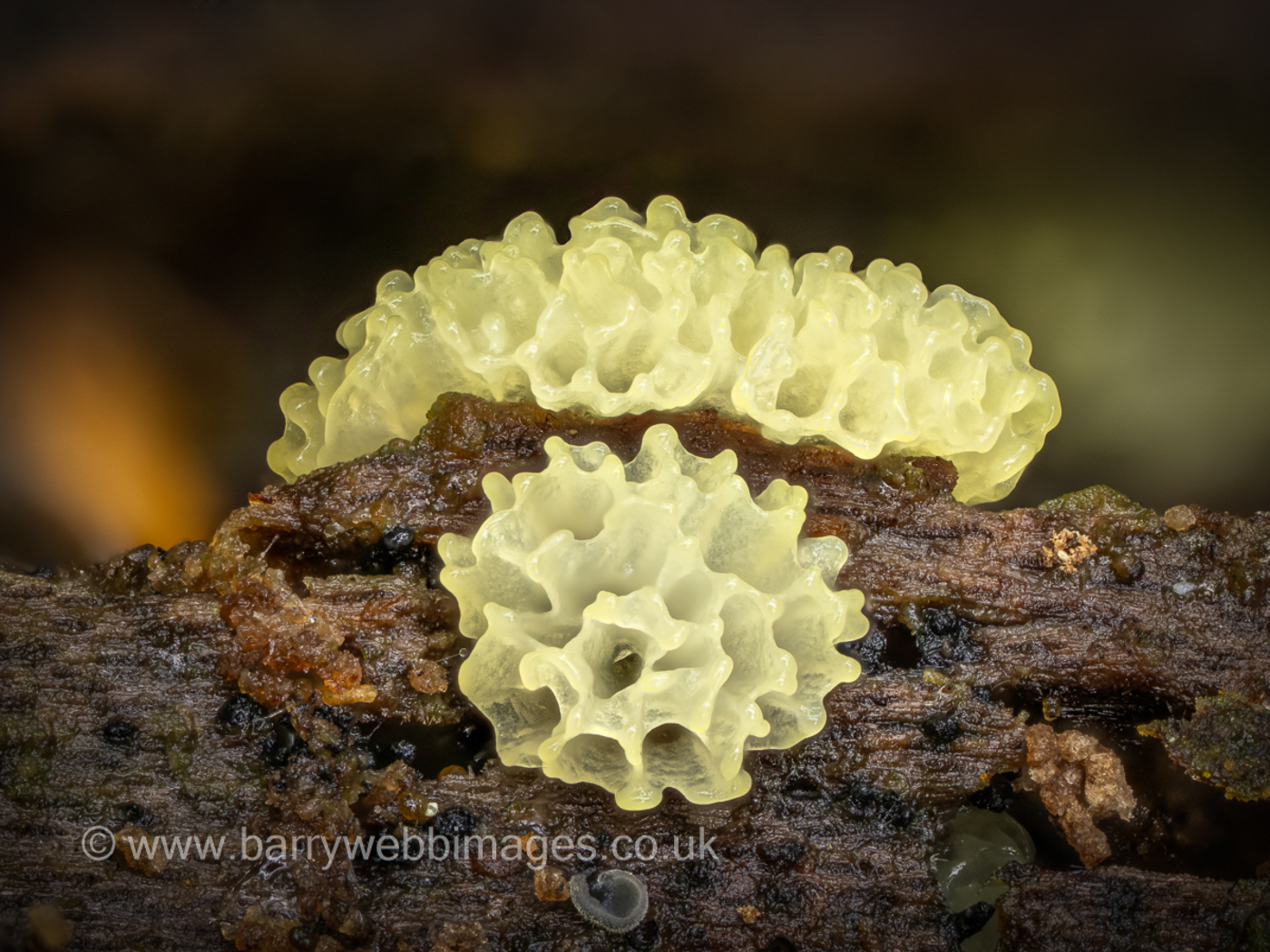
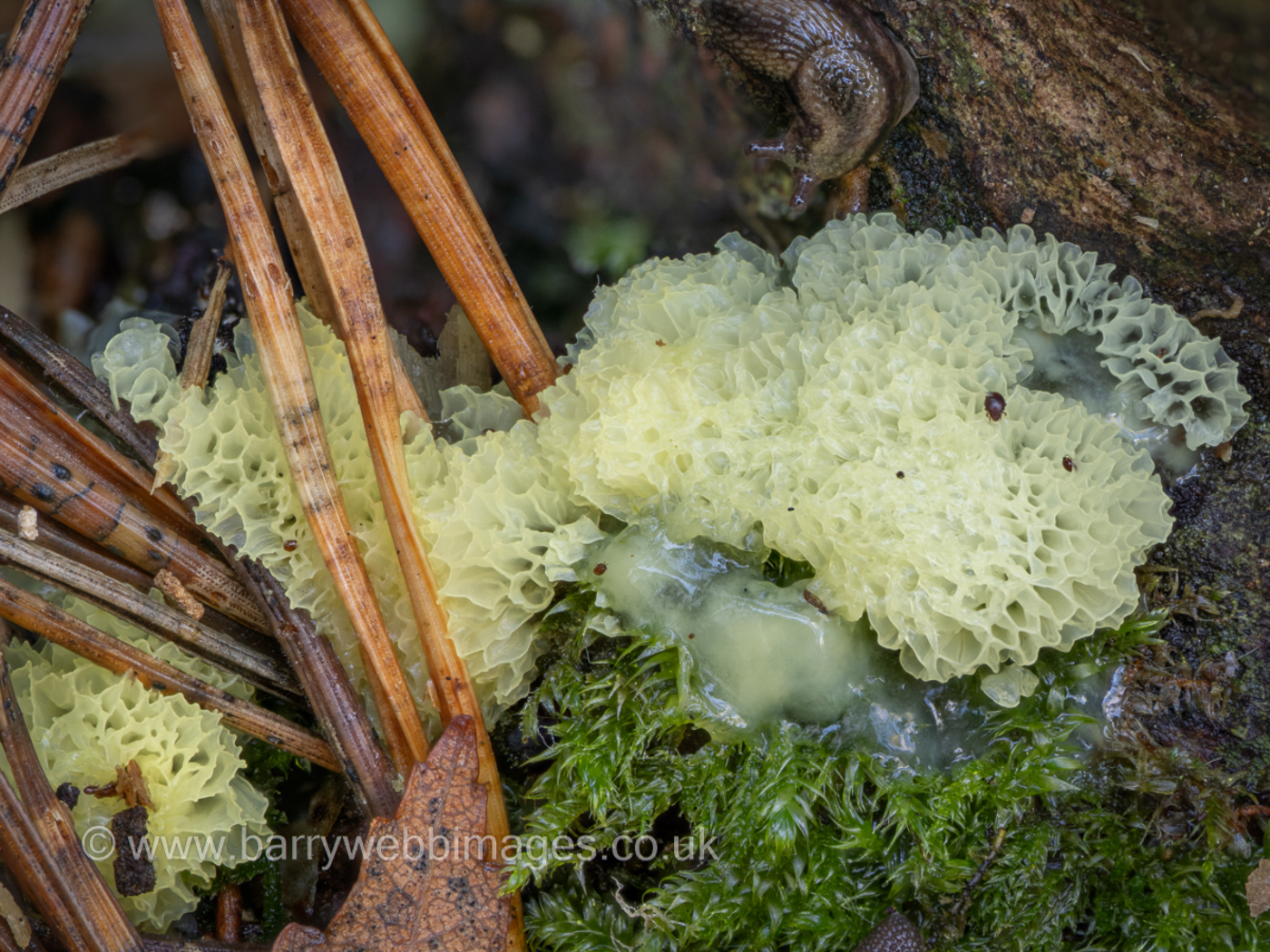
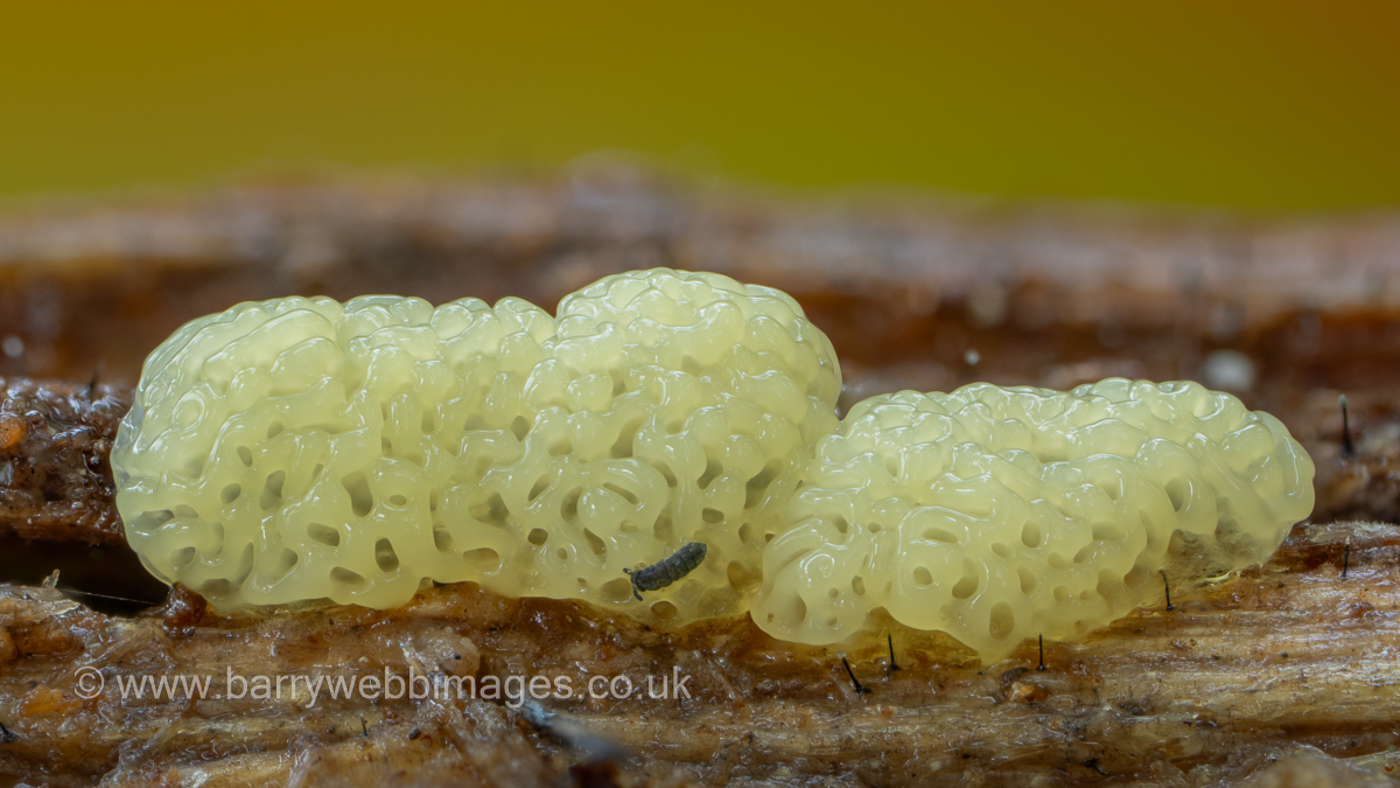
Ceratiomyxa fruticulosa (Coral Slime) May 31, 2021. Barry Webb took these beautiful photos of this tiny but quite common Slime Mould on a damp Pine stump in Burnham Beeches. The individual delicate watery white branches are usually less than 5mm high and a handlens is needed to appreciate their beauty. It can form quite large clusters up to 10 cm across, most commonly on conifer stumps but sometimes on other woods. Photo 3: Burnham Beeches 13.03.2024 where it is growing out of the black plasmodium of Metatrichia floriformis Photo 4: Rushbeds Wood 24.03.2024 Photo 5: Hodgemoor Wood 23.09.2023; Photo 6: Burnham Beeches 17.04.2024 showing the plasmodium stage before development Photo 7: Northhill Dancersend 15.10.2025 |


 |
Ceratiomyxa porioides Aug 29, 2020. In Bernwood Forest on our first BFG walk of the year Gill Ferguson noticed some tiny white domes on rotten fallen Pine. Both she and Barry recognised it as this rare species, closely related to the common C. fruticulosa (see above) and until recently considered a variety of that species. Its delicate frilly poroid surface is remarkable. In 2020 the species had only a few British records, one previously from Bucks, but is apparently now spreading and becoming much less rare. Photo 2: Burnham Beeches 07.10.2023 Photo 3: Hodgemoor Wood 18.09.2022 Photo 4: Stoke Common (date to be added) Photo 5: Pullingshill Wood 02.10.2024 |


 |
Collaria arcyrionema Jul 21, 2023. In Burnham Beeches Barry Webb had a field day together with Gill Ferguson and Stephen Plummer, finding 20 different species of Slime Mould including this one on rotten wood. Members of this genus are notable for their iridescent glinting colours as they mature, and this delightful photo conveniently shows the species at two different and equally beautiful stages. They may look as big as puffballs here but in fact are less than 2.5mm high! This is a new species for Finds. Jul 10, 2023. At Burnham Beeches on the same Pine stump where he's found it in two previous years, Barry Webb spotted a row of this tiny iridescent species, each individual no more than 3 mm high. The species within the genus Lamproderma which form a tiny collar just underneath the globe are now moved into the genus Collaria. Jul 6, 2021. On fallen rotting Pine in Burnham Beeches Barry Webb found this pretty little sparkling species, a rare find which is new not only to the site but also to the county. This genus, four species of which are British, is split off from the similar Lamproderma on account of the small skirtlike collar which remains at the base of the sporangium (fruiting head - see photo 3) The iridescent heads are at first silvery, then become more bronze in colour. Photo 2 (taken of a collection found 6 days later in the same area on a different Pine) is more mature and thus bronze. Bear in mind that the entire sporocarp is at most 2.5 mm high! |

 |
Collaria (previously Comatricha) lurida Mar 29, 2021. Barry Webb found this very rare Myxomycete in Burnham Beeches on Holly and Beech leaves in a woodchip pile. The species is, however, extremely similar to the much less rare C. elegans, so Penny was a bit sceptical about this determination (made from Barry's excellent photos by a Myxomycete expert online) until Barry said he'd been asked to include a photo of a specimen with the spore mass blown away, revealing the distinctive shape of the columella within (like the skeleton) as well as the collar which forms beneath. The two species are easily separated by their individually shaped columellas, also C. lurida occurs on deciduous leaves, particularly Holly as here, whereas C. elegans occurs on conifer wood - not present in this woodchip pile. Case closed! Not only is this a notable find for the county but there are very few UK records of this species. |


 |
Collaria rubens Jan 6, 2022. In Hodgemoor Woods Barry Webb found no less than six different species (all slime moulds except for Marasmius hudsonii) within one foot of each other under a Holly bush when looking for the Marasmius. C. rubens was the most interesting of them but he was unsure of its identification until Myxo expert Edvin Johannesen confirmed it from Barry's exquisite photos. He then found this rare species again in Naphill Common a week later. Photo1 (Hodgemoor) shows the tiny collar just under the sporangia typical of the species. Photos 2 and 3 (Naphill) show both immature and mature specimens. The species is described as occurring in leaf litter, especially Ivy and Holly as here. This is yet another Slime Mould new to the county. |
 |
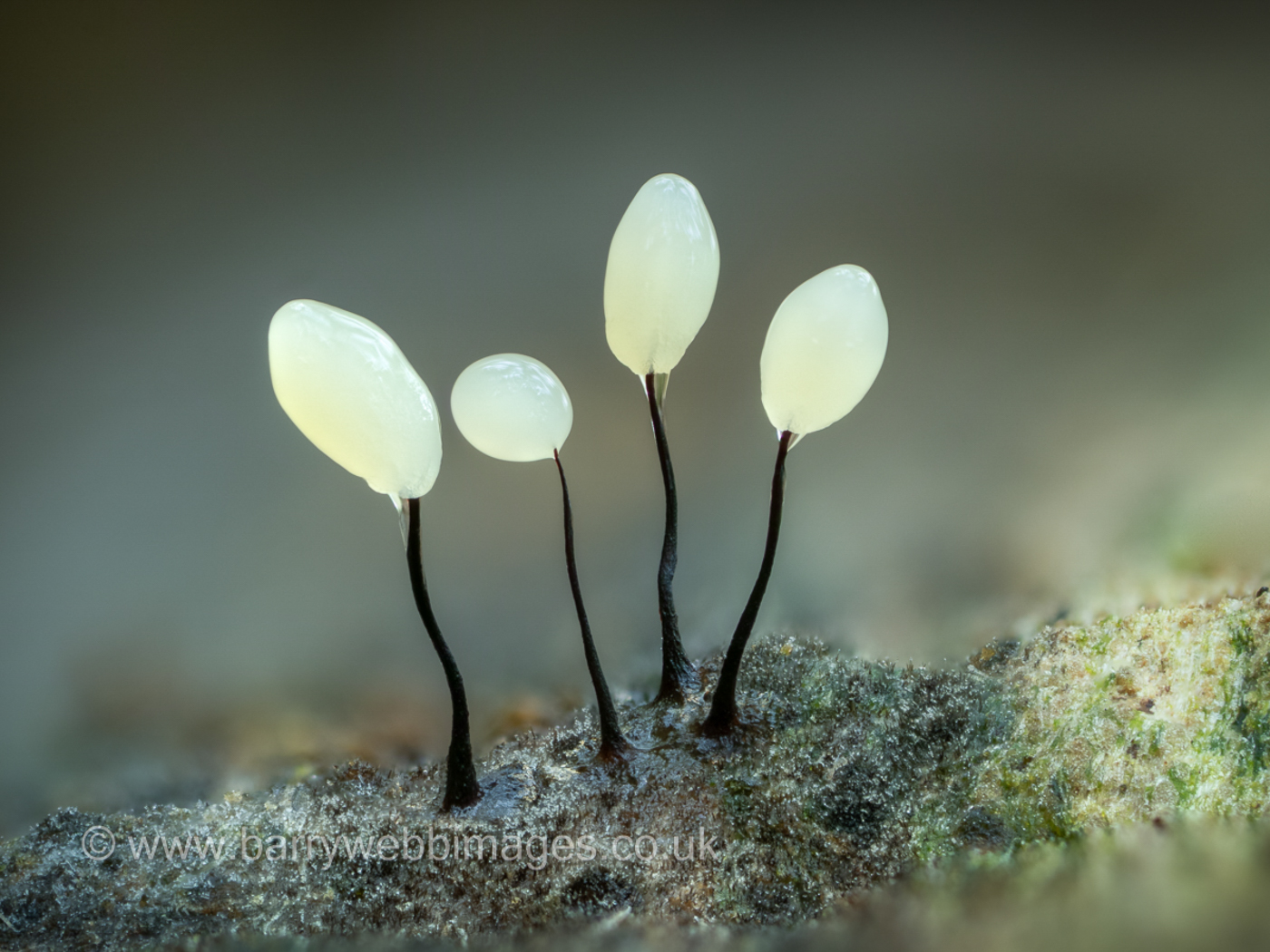
Comatricha alta Dec 5, 2023. In Burnham Beeches on a large fallen rotten Beech Barry Webb found this delicate, tiny and rare species which was identified for him from his photo by Myxomycete expert Edvin Johannesen. The photo shows sporangia in various stages of development, each organism less than 5mm tall. This is new to the county as well as to Finds. |
.jpg "Photo © Barry Webb")
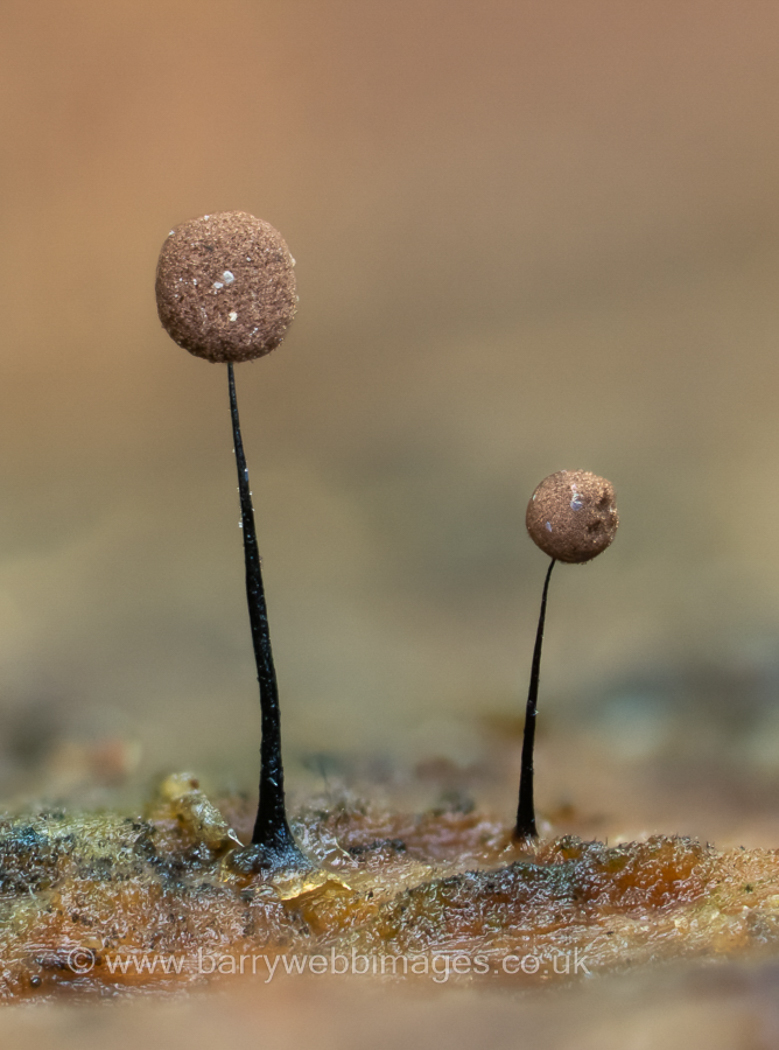 |
Comatricha nigra Oct 23, 2024. Mousells Wood. |
 |
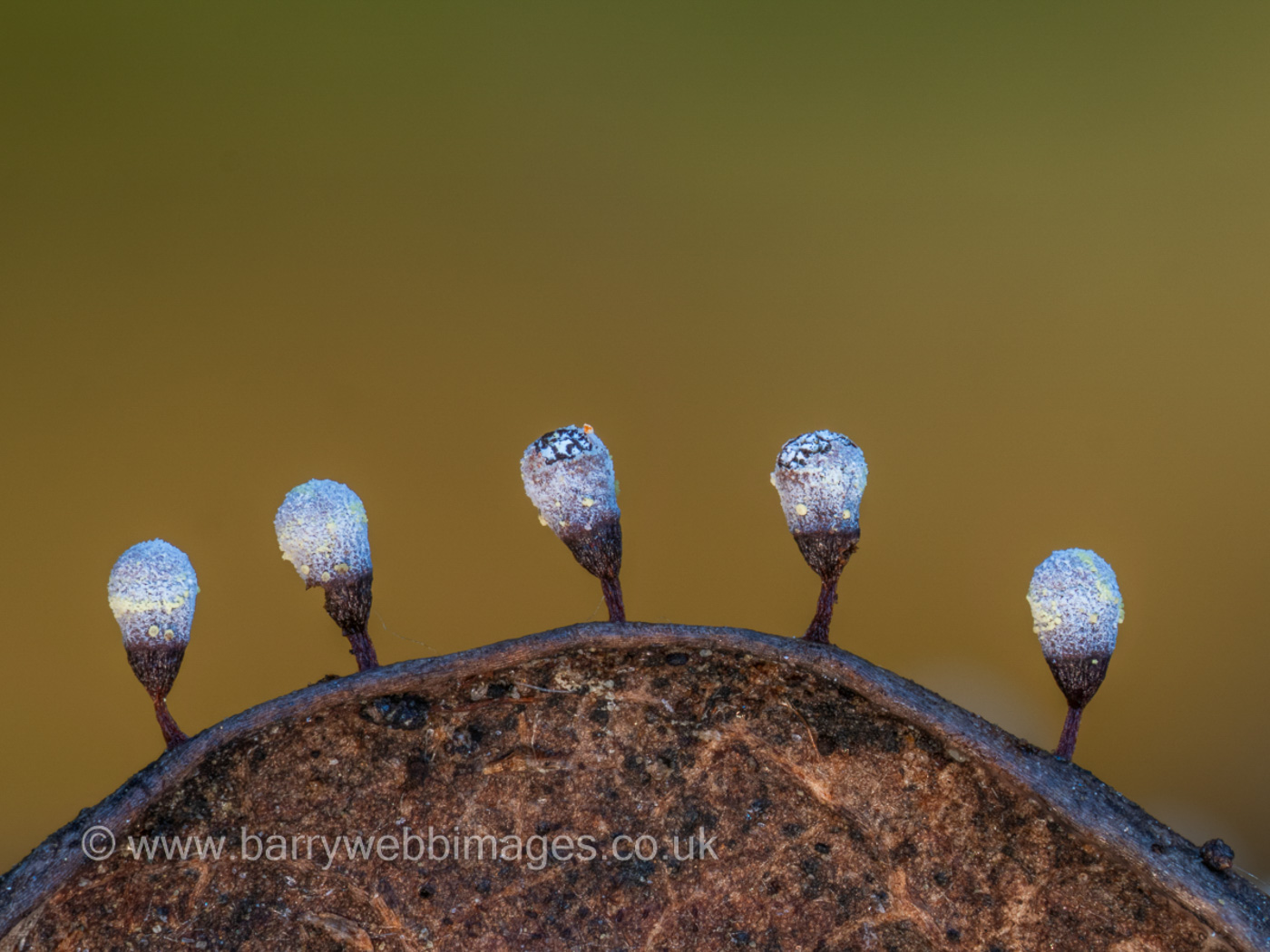
Comatricha pulchella or anomala? A beautiful photo, by Barry Webb, of a species which, however, needs confirmation using a microscope which was unfortunately not able to be carried out here. |

 |
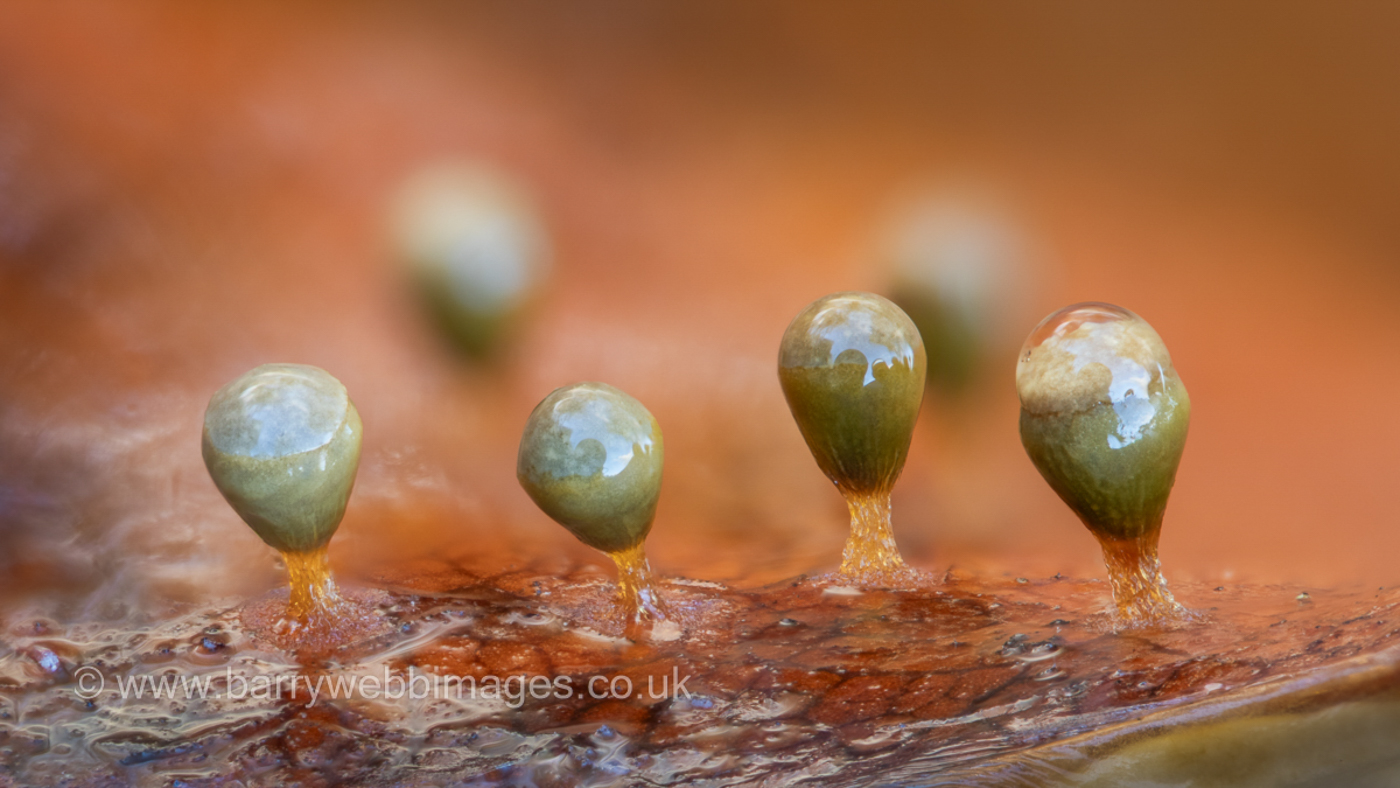
Craterium leucocephalum Nov 10, 2022. In Round Spring Wood, Dancersend, Barry Webb was delighted when Stephen Plummer found these tiny forms on wood because it was a species he'd never encountered before. To distinguish it from others in the genus it has a red brown stalk with the 'cup' holding the fluffy spore bearing part forming about half its total height. The species is relatively rare and we have just one previous county record made by Myxomycete guru Bruce Ing in 1991 from Salcey Forest. As most of that area is in fact in Northants it is tempting to count this as a first for the county! It is certainly a first for Finds. Photo 2: Hodgemoor Wood 23.09.2025 |


 |
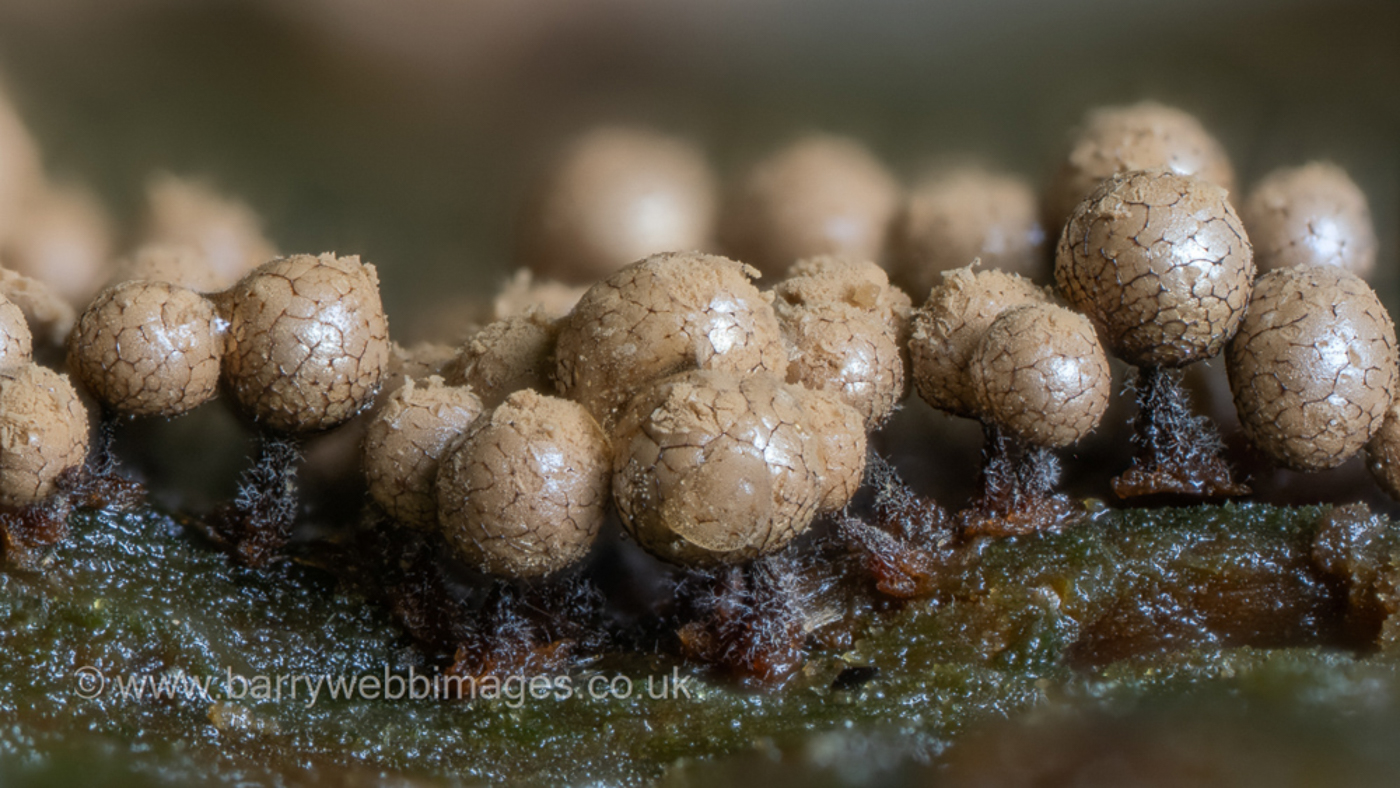
Craterium minutum Mar 14, 2021. Barry Webb found these tiny little beauties in Burnham Beeches on a woodchip pile. These miniscule wine goblets are only about 1 mm high, each initially covered by a flat lid which in the RH sporangium in photo 2 can be seen just lifting off to reveal the spore mass beneath. This is a distinctive species, its shape together with the ochre colour and lid making it recognisable in the field. We have just two previous county records though this appears to be a first for Burnham Beeches. Photo 3: Stampwell Farm 05.11.2025 showing an early stage of development |



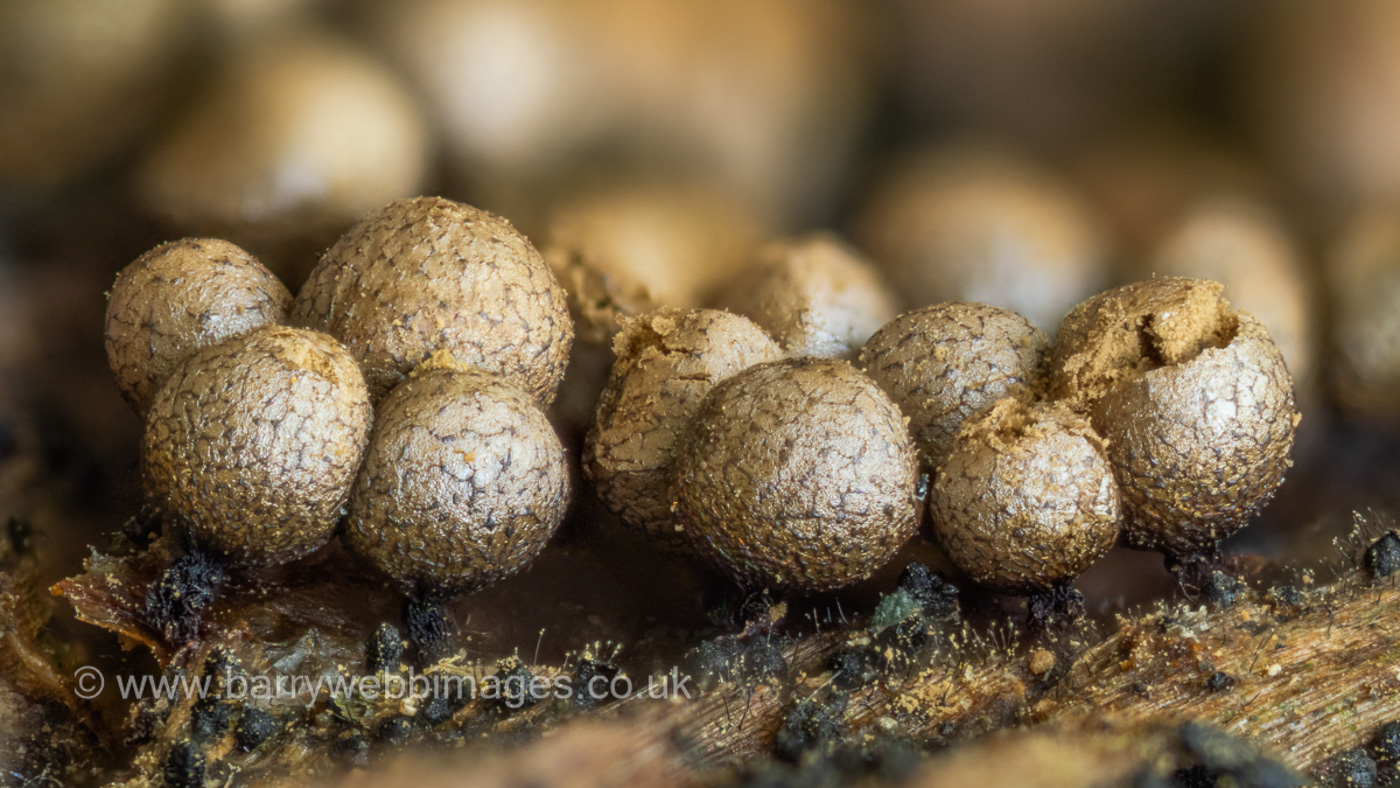 |
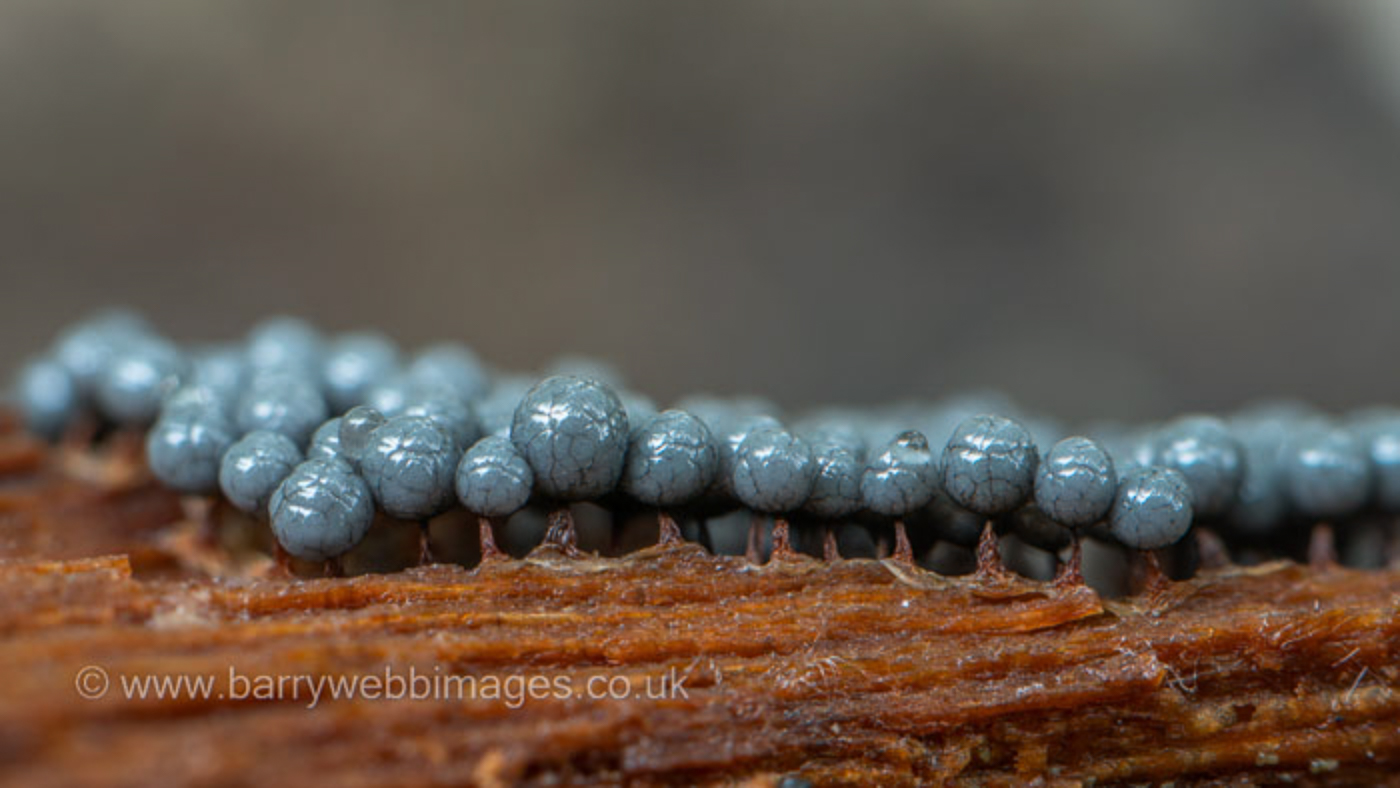
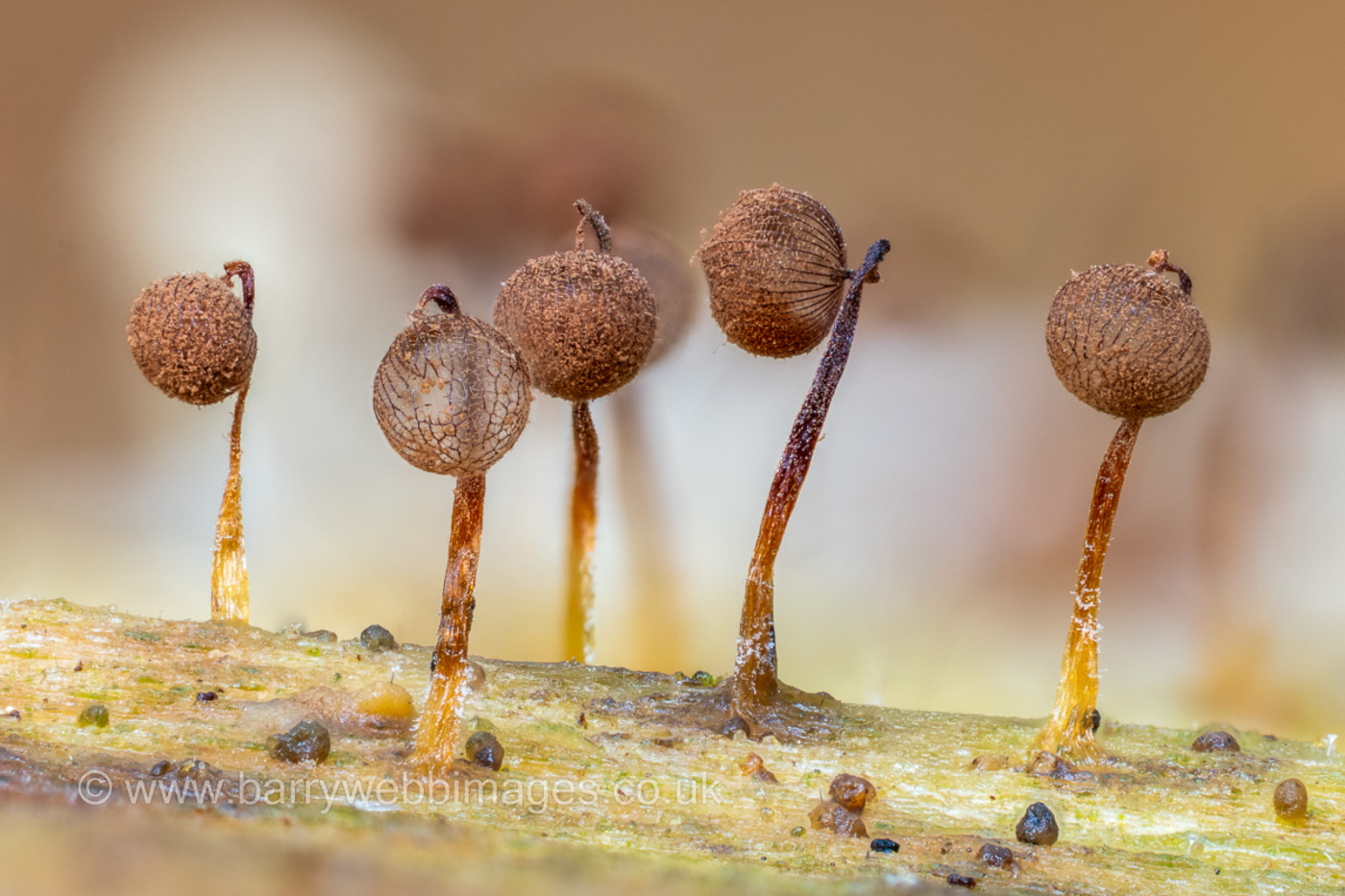
Cribraria argillacea Sep 7, 2020. In Burnham Beeches Barry found this cluster (photo 1) just developing from its plasmodium on rotting Birch and typically slate blue and shiny. Photos 2 and 3 are slightly further developed with a more complete network visible on the sporangia; photo 4 shows the mature ochraceous to clay sporangia, hence the species name meaning clay coloured. The species is characterised by having very short stalks and forming large closely packed colonies. At the time of this collection we had just three previous records in the county but this was a first for the Beeches. Since then Barry has found this apparently very common species on many occasions in many different sites. Photos 2 and 3: Burnham Beeches 02.08.2021 on rotting Pine Photo 4: Burnham Beeches 09.06.2021 on rotting Birch Photos 5-8: Stoke Common 18.09.2021 a large colony where it was new to the site Photo 9: Hockeridge Wood 09.10.2024 Photo 10: Ivinghoe Common 10.9.2022 Photo 11: Stoke Common 17.11.2024 showing the white spikes of the fungus Stilbella byssiseda which can quite often be found affecting mature specimens of this particular species of Cribraria Photo 12: Oakley Wood, Bernwood Forest showing another mature collection though still with the patterned surface typical of the species |


 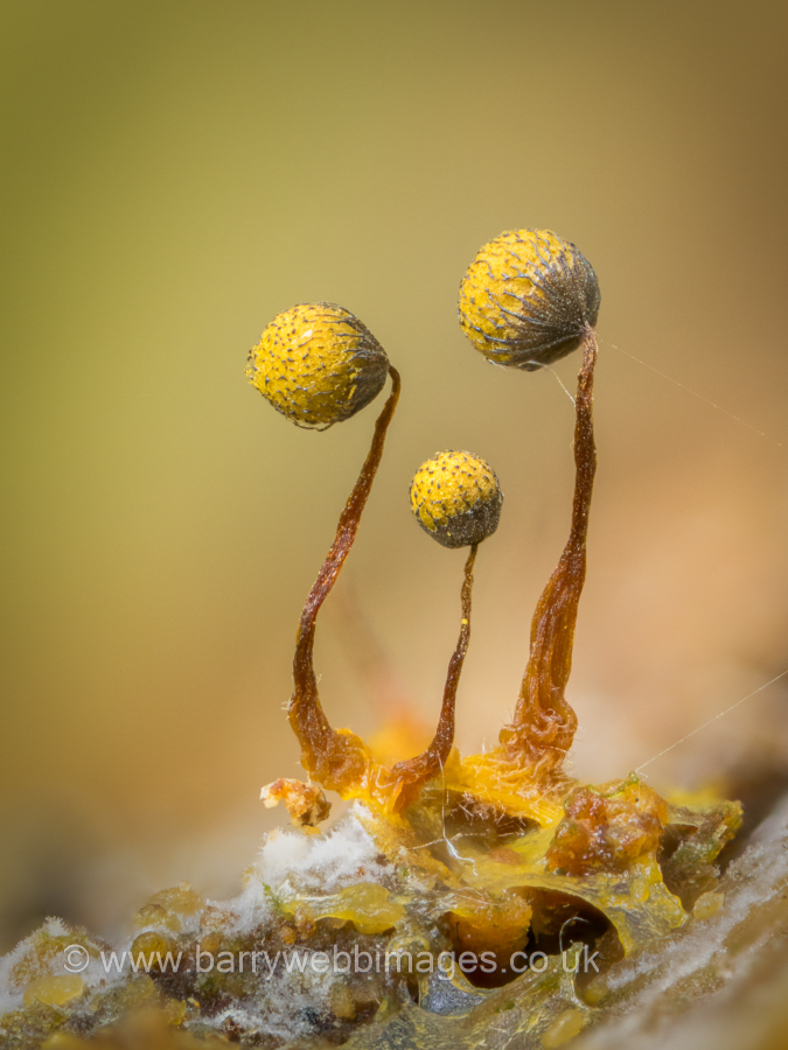 |
Cribraria aurantiaca Aug 28, 2020. In Burnham Beeches on fallen rotting Birch Barry found these exquisite little specimens of what is described as a common species though we appear to have no previous county records. The markedly tapering bright reddish brown stalk is typical, also the bright green plasmodium which can persist at the base. The round sporangia develop through green to blue then eventually ochre orange when mature, retaining this amazing meshlike network which characterises the genus (like a crib or cradle?). The whole fruiting body is only 2 mm tall. Photo 2: Burnham Beeches 19.06.2021 Photo 3: Burnham Beeches 22.02.2021 Photo 4: Burnham Beeches 02.08.2021 - more mature material on rotting Pine Photos 5 and 6: Burnham Beeches 13.07.2023 |
 



 |
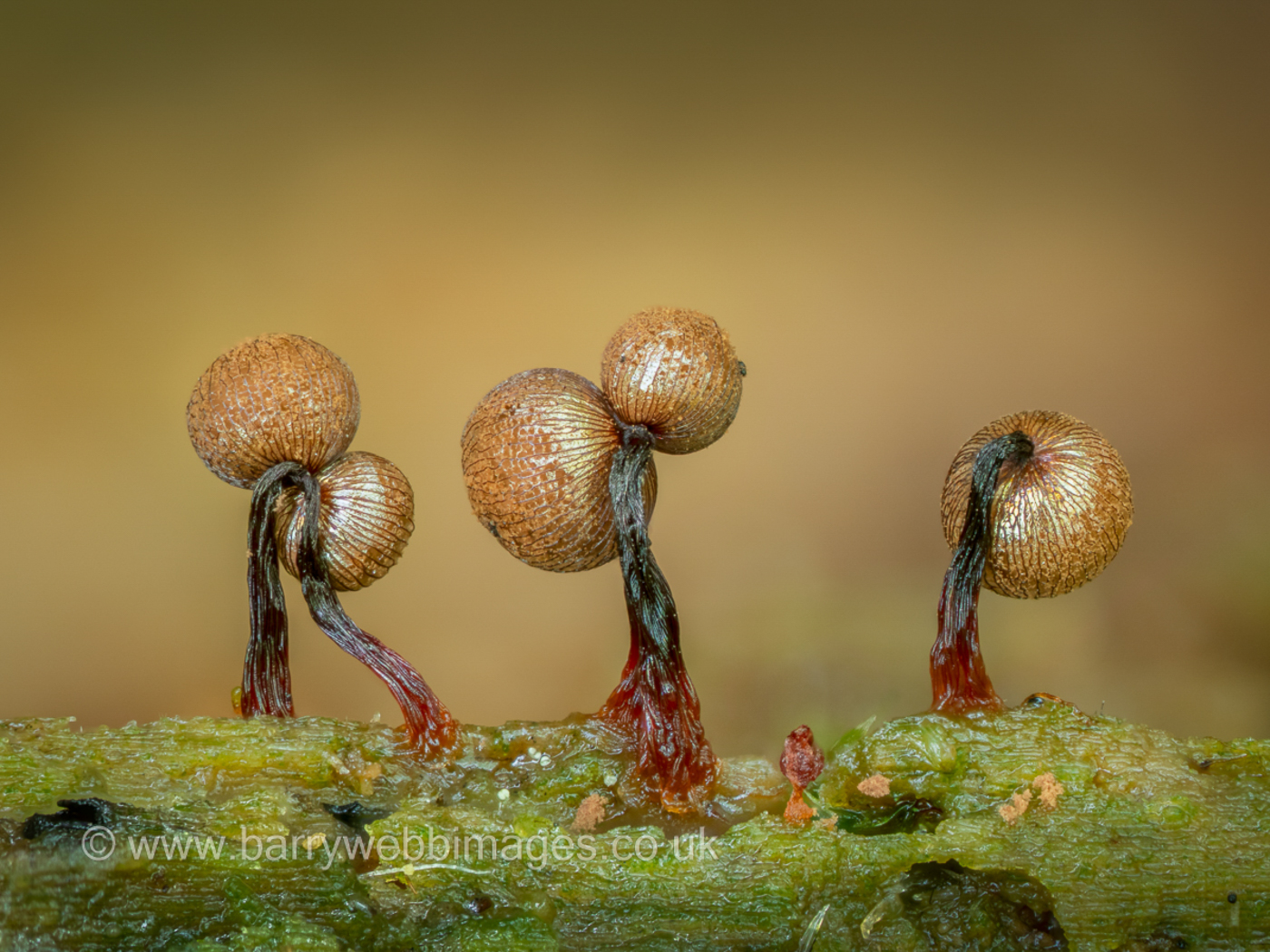
Cribraria cancellata Jul 6, 2021. In Burnham Beeches on rotting fallen Pine Barry found this tiny but beautiful species which was new to the site and with just one previous county record - notably found by the distinguished Myxomycete specialist Bruce Ing from Salcey Forest, 1991. All species in the genus have this amazing meshlike network surrounding the head, particularly marked in this exquisite species which, however, lacks a 'cup' at the base of the mesh which is present in most species. (In particular, compare photo 3 with photos of C. cancellata var. fusca below where the sporangia appear amazingly similar but show a distinct cup adjacent to the stalk apex.) C. cancellata has purple black plasmodium and typically develops a long dark tapering stalk as seen in photo 1. Photos 2 and 3: Stoke Common 18.09.2021, new to the site. Photo 4: Burnham Beeches 14.08.2023 together with the much larger but undeveloped blobs of Arcyria cinerea Photo 5: Burnham Beeches 02.07.2023 Photo 6: Wotton Park Estate 24.09.2025 Photo 7: Oakley Wood Bernwood Forest 23.09.2026, new to the site, a mature group, the foremost of which having almost lost all its spores leaving a perfect empty cage |


 |
Cribraria cancellata var. fusca Aug 13, 2021. In Penn Wood Barry found this rare species on fallen Pine (photos 1 and 2), new to the county and with few British records though the type species (see just above) is apparently more common. This variety differs from the type by having a well marked cup at the base of the sporangia (lacking in the type). Both species have many longditudinal ribs around the sporangia linked by ladder-like threads, seen well in the detailed photo 4. Bear in mind that each individual fruiting body is no more than 3mm high and the heads no more than 0.7mm in diameter!, Photos 3 and 4: Burnham Beeches 16.08.2021, also on Pine. Photo 5: Burnham Beeches 15.08.2023 |


 |
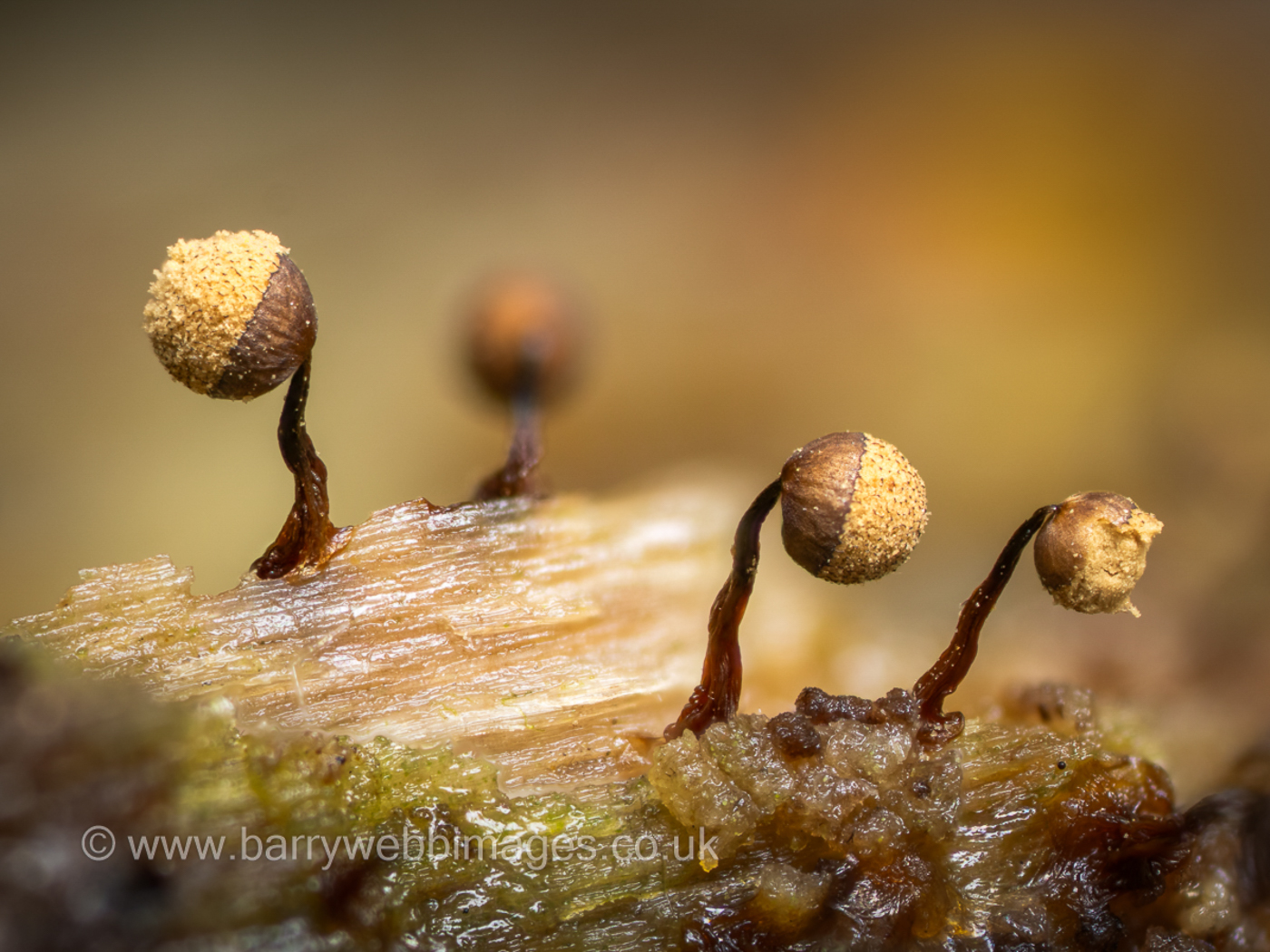
Cribraria mirabilis Aug 16, 2021. On rotten fallen Pine in Burnham Beeches Barry found this beautiful and rare species, one with under 10 national records and new to the county. (The identification was verified online from these photos by Norwegian expert Edvin Johanssen.) Only up to 1.5 mm tall and 0.8mm wide, it is similar to C. cancellata in lacking a cup and having a cage of longditudinal ribs but is irridescent in early stages. The three photos show it immature, maturing and finally mature. (There seems to be some confusion over previous records, Edvin informing Barry that the last record was UK expert Bruce Ing's from Bucks in 1968. However, our national database shows that record was from Scotland with others after it, none from Bucks.) Photo 4: Burnham Beeches 29.07.2023 |


 |
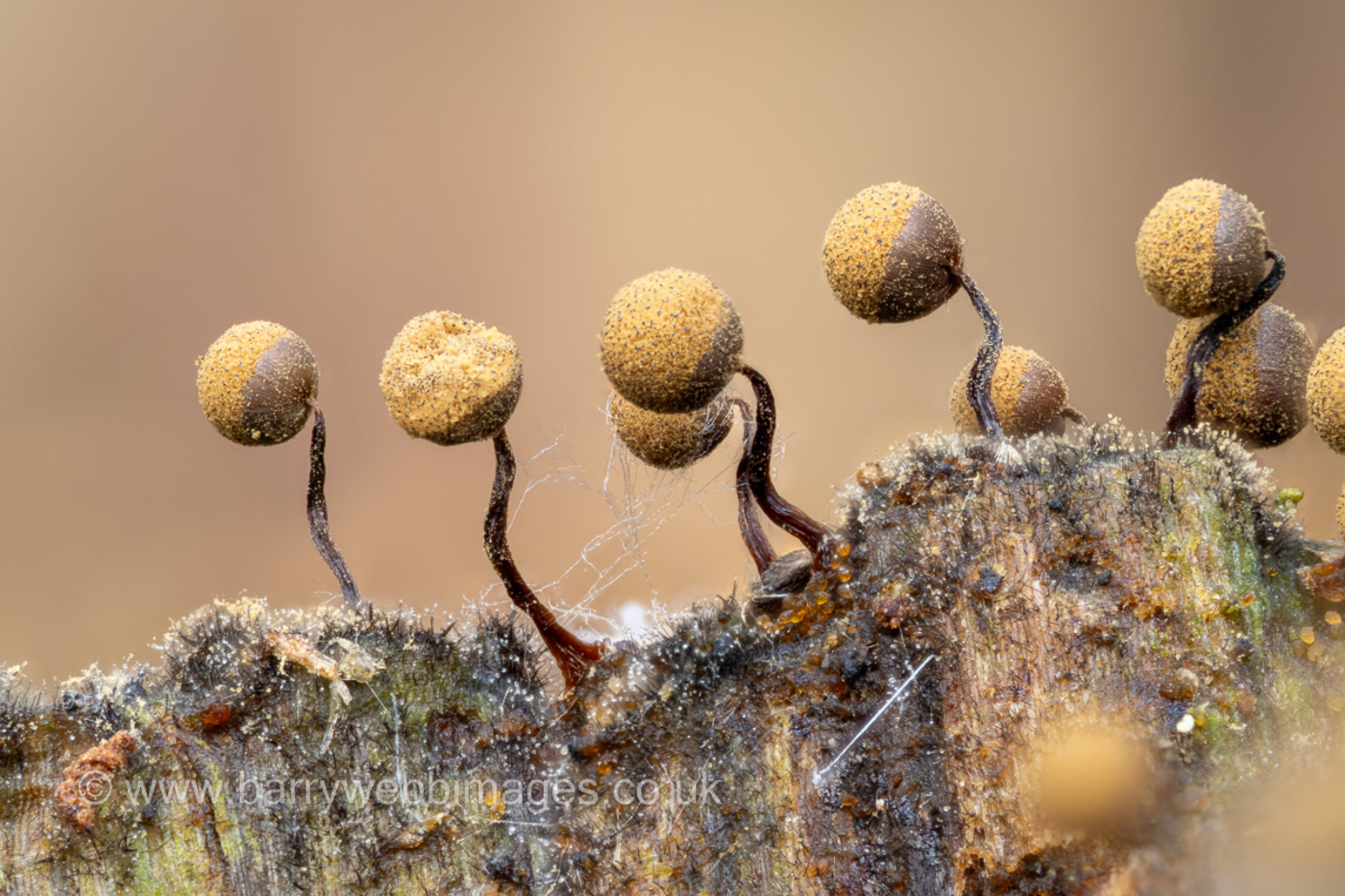
Cribraria persoonia Aug 18, 2021. In Burnham Beeches on fallen Pine Barry found this species, new to the county and with not many British records despite being described as common in the literature. The initial determination, made online from the photos, is now verified by Penny having examined the material. This is another tiny and delicate species no more than 1.5 mm high with a tapering brown stalk and having a wrinkled cup at the base of the sporangia which is about a third of the whole. Photo 3: Burnham Beeches 07.10.2023 |
 |
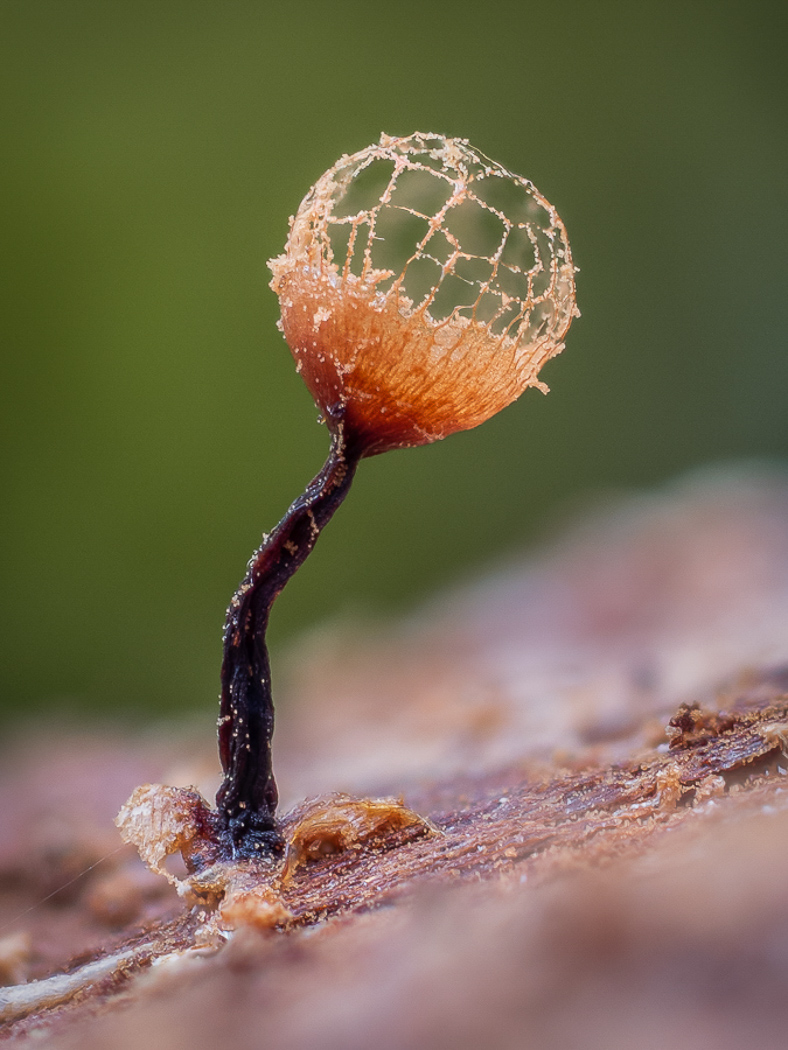
Cribraria cf. piriformis Sep 23, 2026. In Oakley Wood, Bernwood Forest, Barry found this rare species on some rotting bare conifer - a new species to him, to the site and to the county. The small round heads having a large basal cup are certainly distinctive, though both he and Jackie Mackenzie-Dodds who worked on the microscopy of this collection have some doubt as both of them are unfamiliar with this particular species of Cribraria, hence the cf. included in the name. |


 |
Cribraria rufa Sep 20, 2020. In Penn Wood Barry Webb found this tiny singleton specimen (photo 1) on fallen rotten Pine, the spore mass having blown away to reveal the perfect and delicate framework. Photo 2 is of a slightly less developed cluster found at the same time. About 20 species of this beautiful genus occur in the UK, mostly found on rotting conifer wood, and C. rufa has apparently become much more common with the increase in plantations. It is characterised by its short black stalk and widely spaced mesh network surrounding the globe having a prominent striate basal cup (though this can reduce with maturity as the network becomes more pronounced). As can be seen in many of the photos, when immature the globe is almost white as the network starts to develop. This 2020 collection was the first county record and Barry has found it a remarkable number of times since then. Photos 3 and 4: Burnham Beeches 09.07.2021 and 10.07.2021, new to the site, also on Pine showing development over 24 hours Photo 5: Burnham Beeches 02.08.2021 Photo 6: Ivinghoe Common 13.09.2021. new to the site, on fallen rotten conifer and showing an early stage of development Photo 7: Burnham Beeches 10.07.2023 alongside the newly described mushroom Hydropus inopinatus (search this name for more information). |


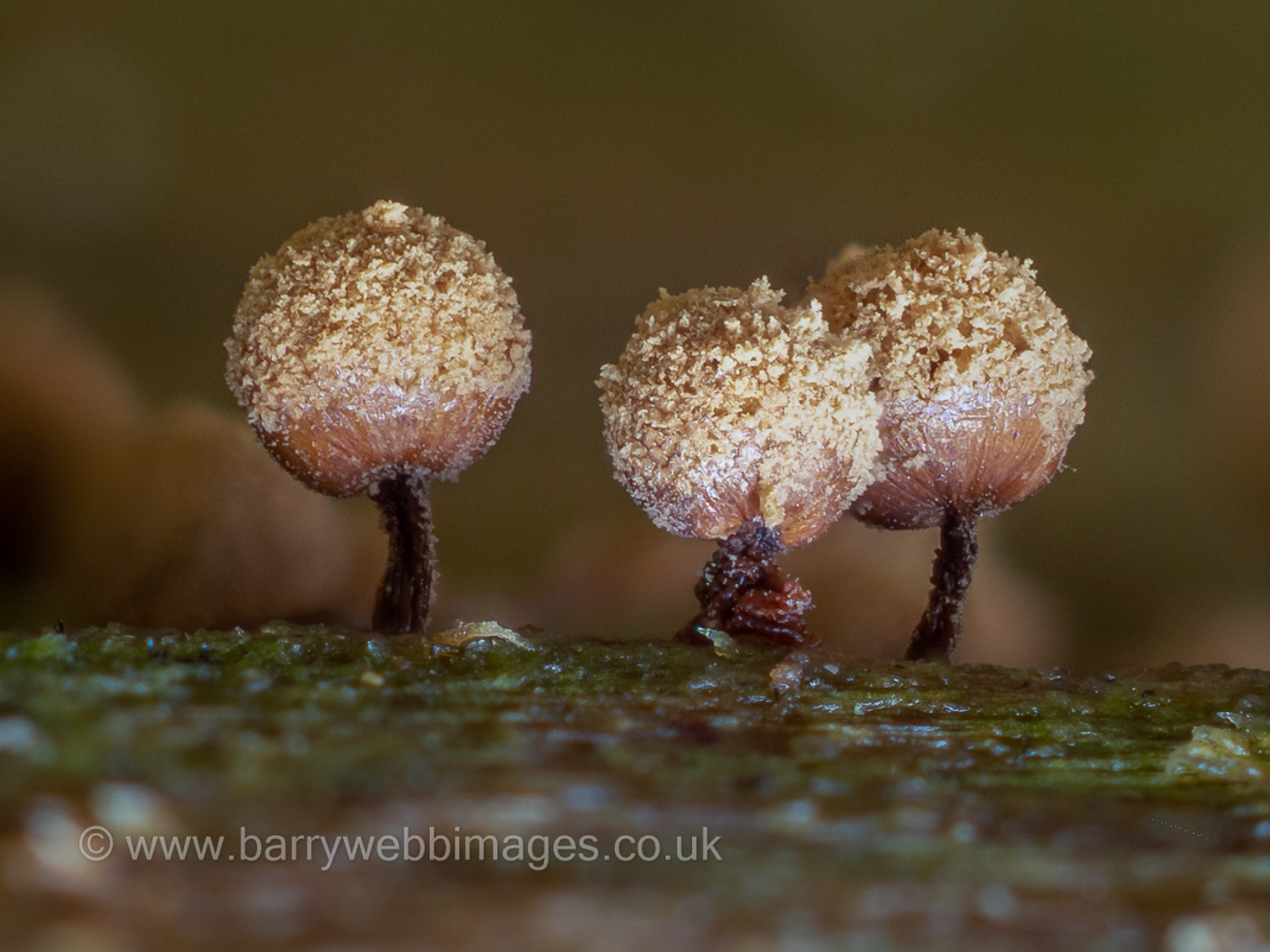 |
Cribraria vulgaris Jun 6, 2021. In Burnham Beeches on fallen damp Pine Barry found these minute (even for a slime mould) specimens which were only 0.5 mm across! (The determination was confirmed online by Norwegian expert Edvin Johannesen.) A rare species with few national records, this was an exciting find. The single record for the county dates back to 1923 (at Burnham Beeches) with both collector and identifier as 'Anon', so probably best overlooked, making Barry's find new to Bucks. Photo 2: Bernwood Forest 29.08.2021 (verified by Penny) Photo 3: Ivinghoe Common 04.09.2021 (verified by Penny) Photo 4: Wotton Park Estate 23.10.2021 |
| D |
|
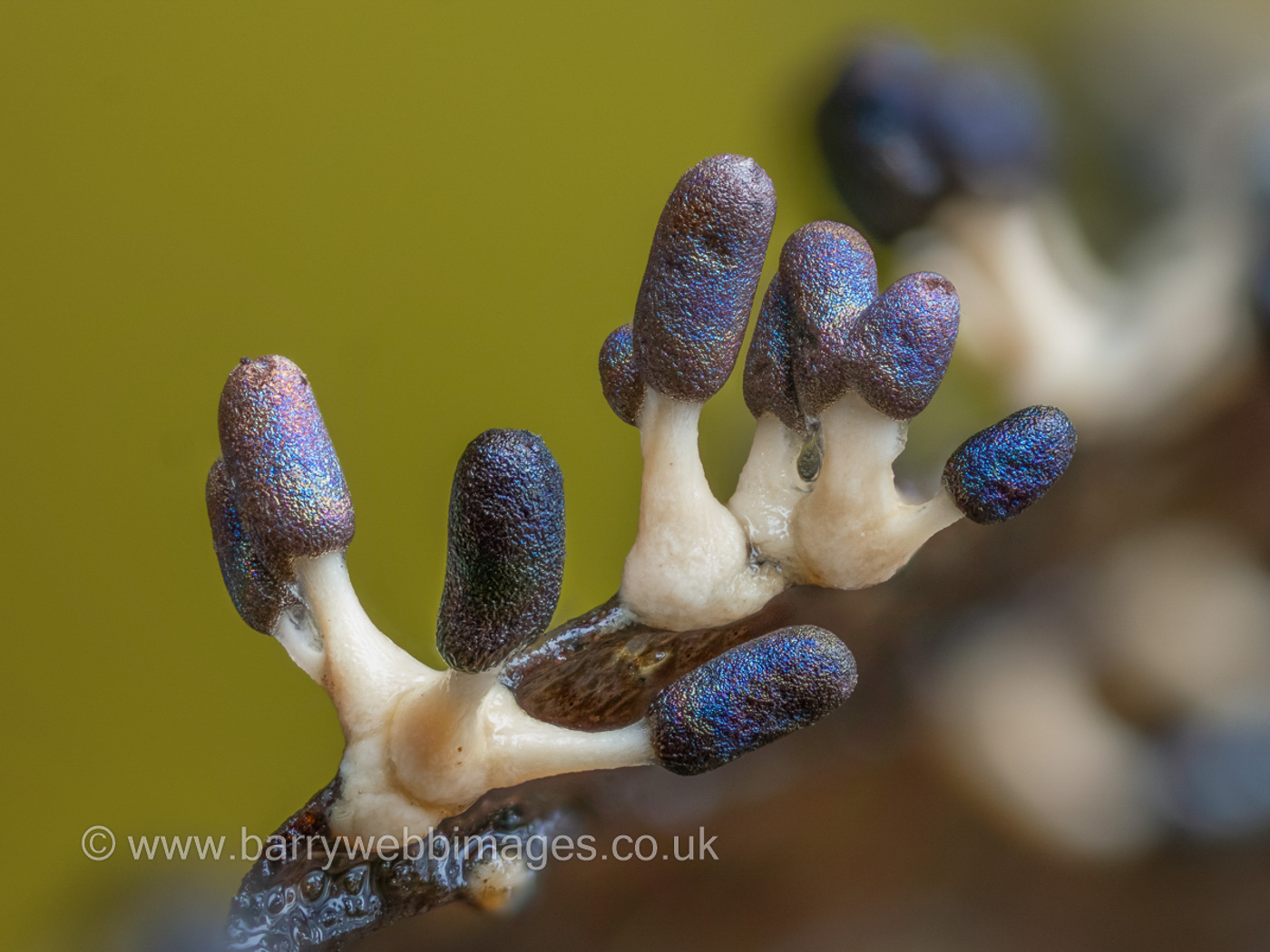 |
Diachea leucopodia Nov 7, 2024. At Stoke Poges Memorial Gardens Barry and Gill were on the hunt for slime moulds and came across a beautiful swarm of these tiny little stunners on the edge of a leafy compost heap together with several other interesting slime moulds and fungi. The glistening irridescence contrasting with white stalk of this particular species makes it an easy one to identify but though described as common in the south this is a first for the county and there appear to be only a handful of records on FRDBI. |
 
 |
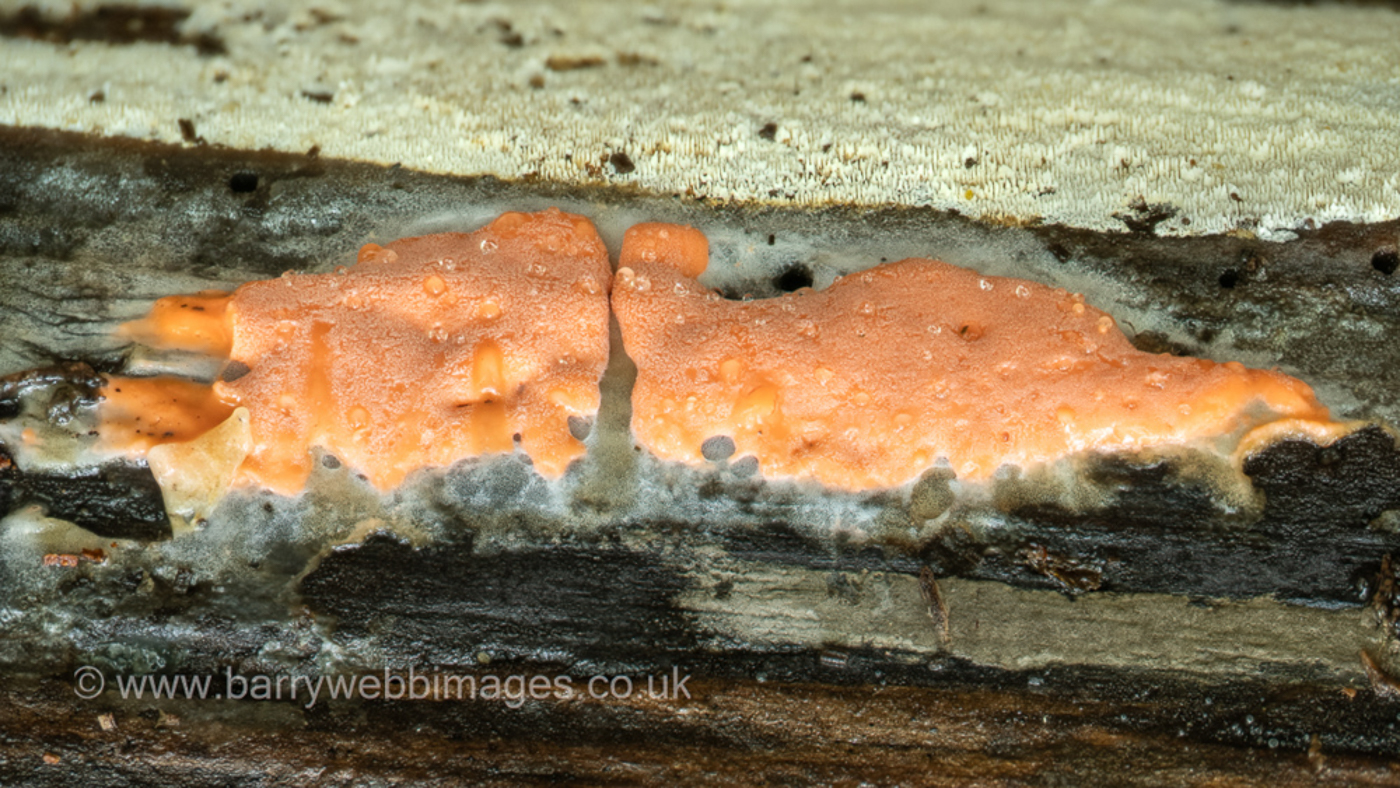
Dictydiaethalium plumbeum Dec 30, 2021.On the same Birch pile in Hodgemoor Woods Barry and Gill Webb also found this species though it is more commonly found on fallen Beech. For more notes and another image see Barry's separate page in Members' Finds. June 23rd, 2021. In Burnham Beeches Barry and Gill Webb found this species on fallen Beech, new to the site though not to the county. The plasmodium of this slime mould is bright pink to orange (similar to that of Tubifera ferruginosa); it then turns first grey (hence its Latin species name) then yellow-brown and forms flattened patches up to 5 cm long x 1 cm thick on rotting wood. It is worth noting that this species occurs on deciduous wood whereas T. ferruginosa occurs mainly on rotting confer, very occasionally on Alder or Birch, also once developed the two species have a very different appearance. Photo 2: Hodgemoor Wood 30.12.2021 on fallen Birch Photo 3: Hockeridge Wood 09.10.2024 Photo 4: Hodgemoor Wood 02.05.2026 |


 |
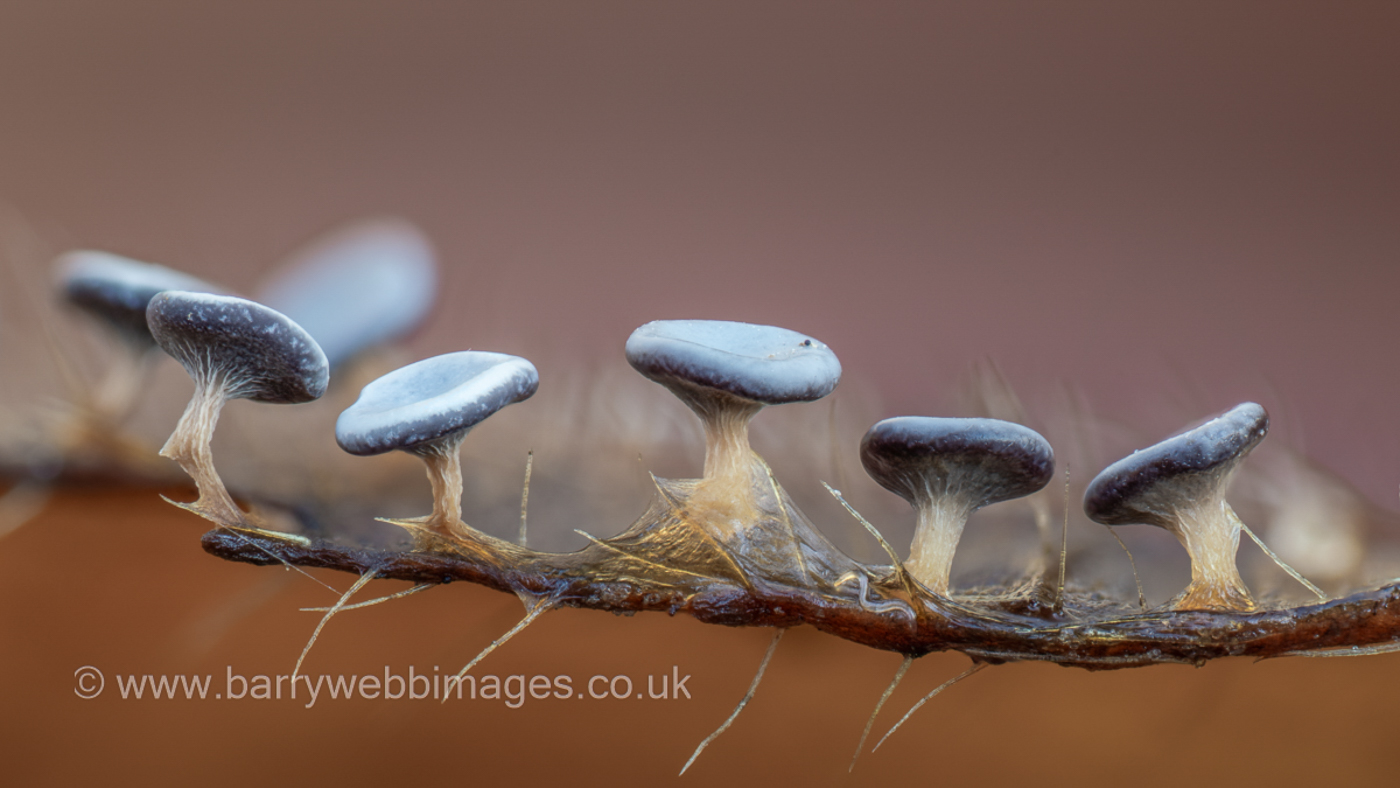
Diderma floriforme Sep 4, 2021. In Ivinghoe Common on our BFG walk member Stephen Plummer spotted a cluster of these tiny little beauties on a very rotten log, probably Beech - a species new to Barry with just two previous county records. The distinctive pearl grey round heads are coated with a two-tone double layer of calcareous crust (clearly visible here) which breaks open to reveal the contrasting dark ripening spore mass within. Photos 3 and 4: Deangarden Wood 17.09.2023 |
 |
Diderma hemisphaericum Nov 8, 2025. At Stampwell Farm Barry found this distinctive species amongst some rotting vegetation and recognised it from its remarkable flat top. He'd found it the previous year at Burnham Beeches, also late season, when confirmed by Jackie Mackenzie-Dodds and this is just our third county record. |
 
|
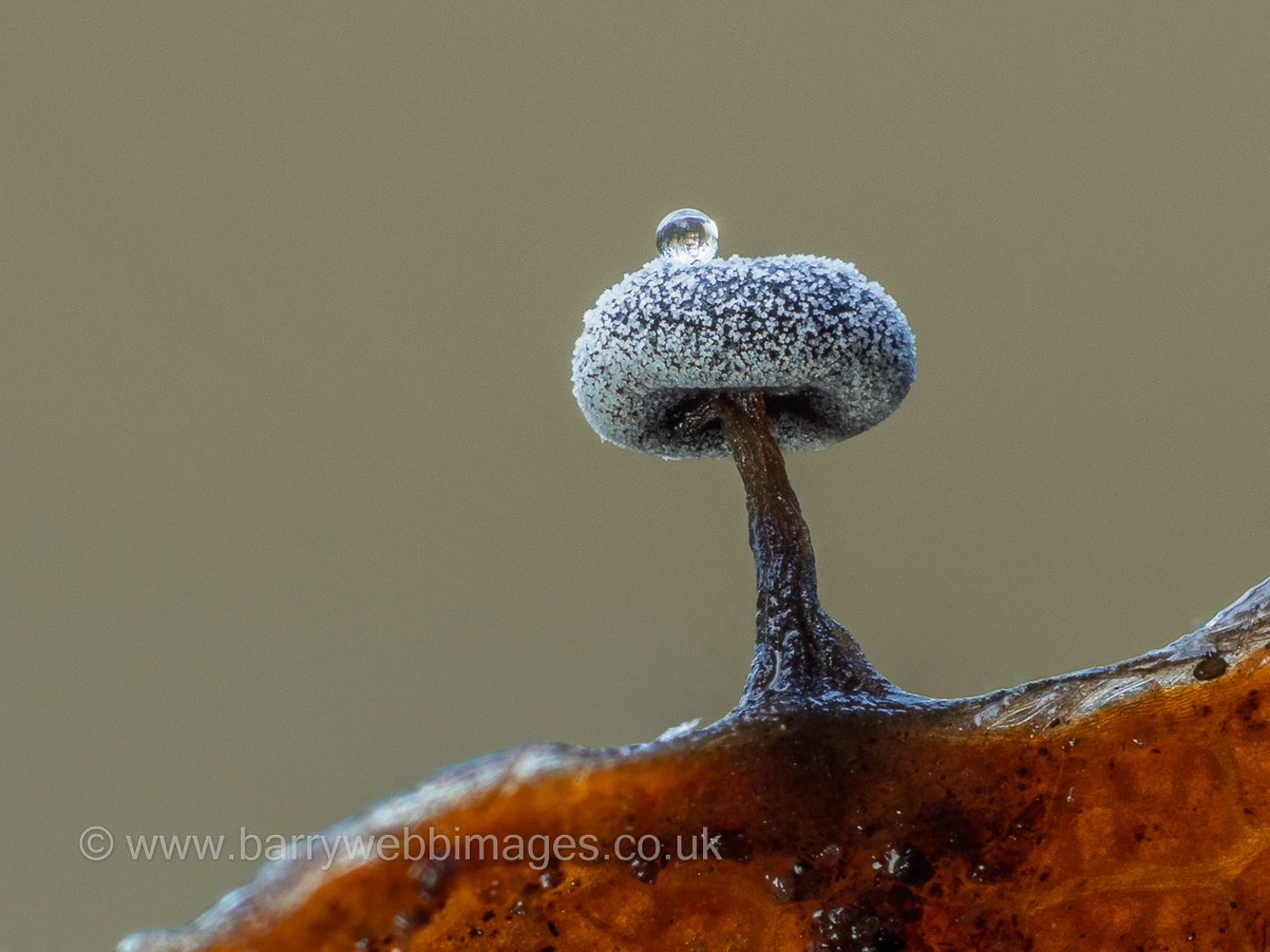
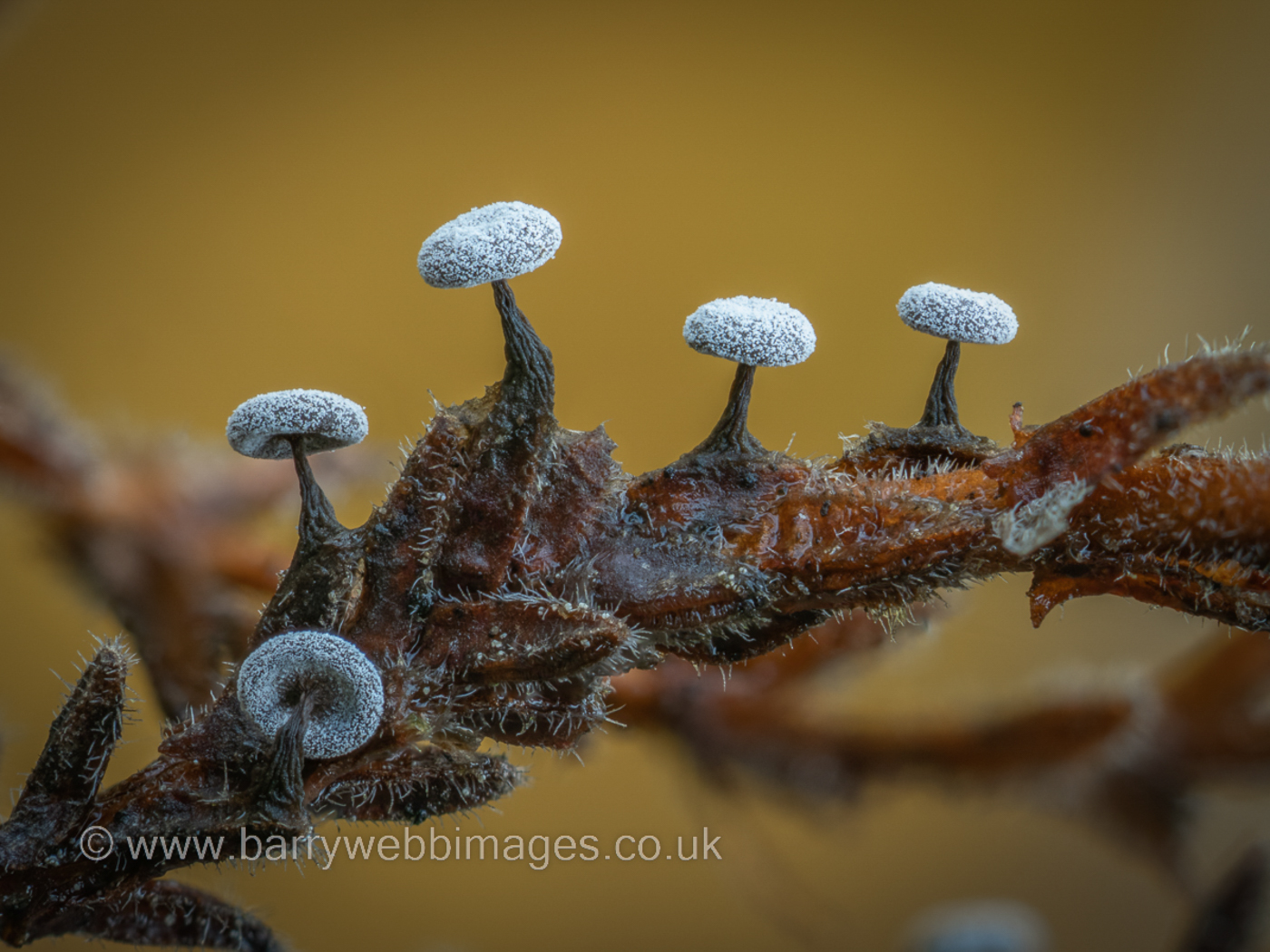
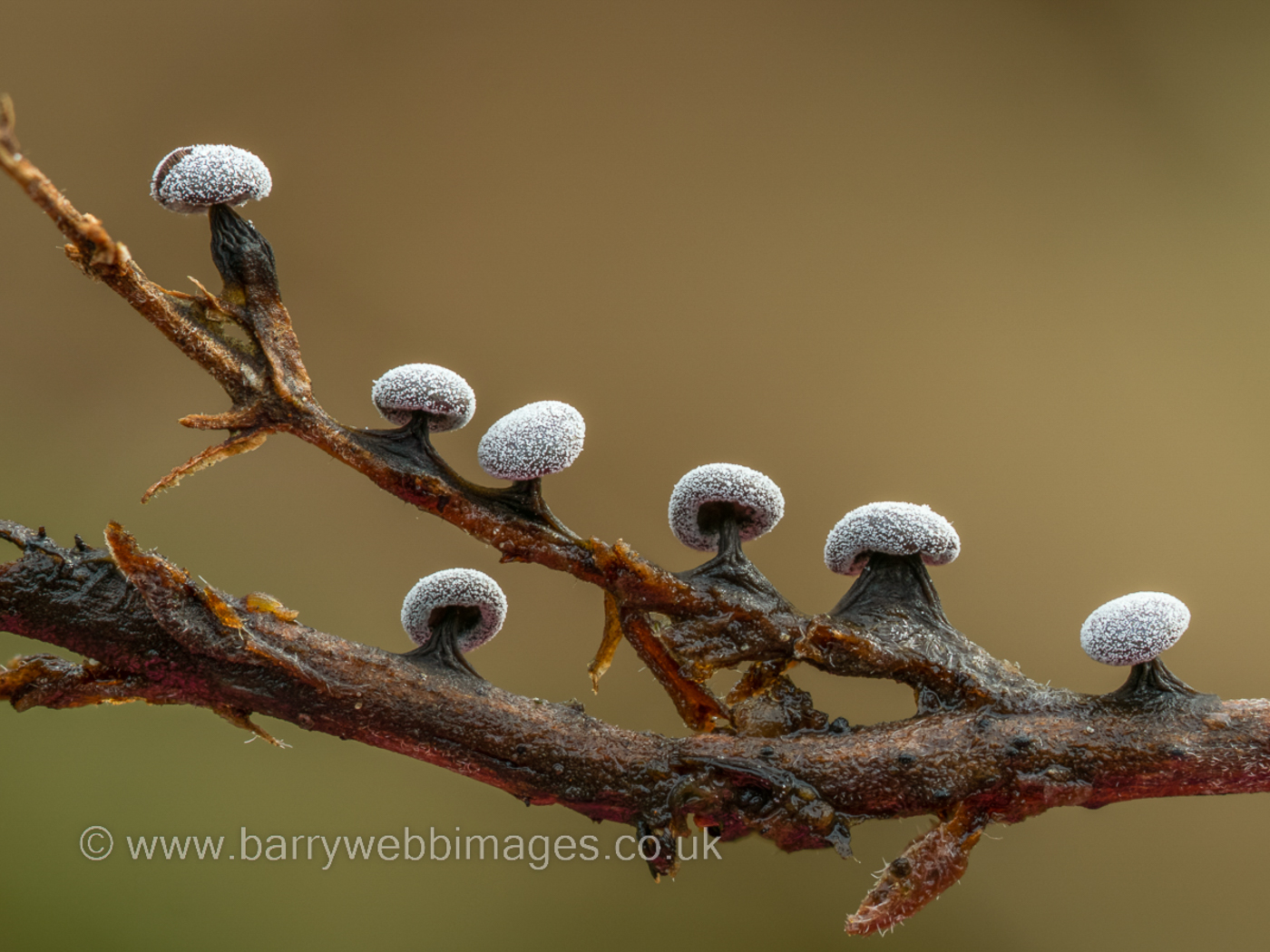
Diderma umbilicatum Jan 6, 2022. In Hodgemoor Woods Barry Webb found this species on an oak twig in leaf litter. Though not rare this was new to the county. Diderma is a large genus of 70 odd species characterised by their crusty coating of lime crystals. Today's species is quite large for a slime mould - up to 1.3 mm across(!) - with pale shiny heads and a thick short orange umbilicate stalk beneath. Photo 2: Burnham Beeches 30.11.2022 on twigs in deciduous leaf litter |
 |
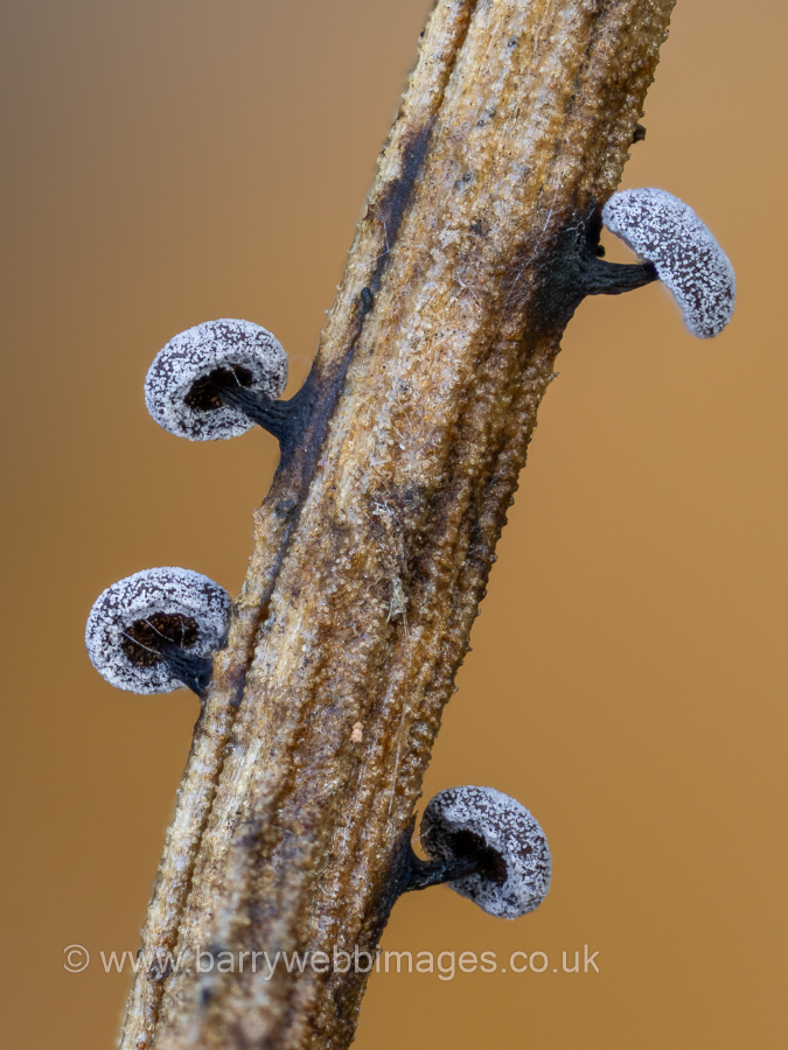
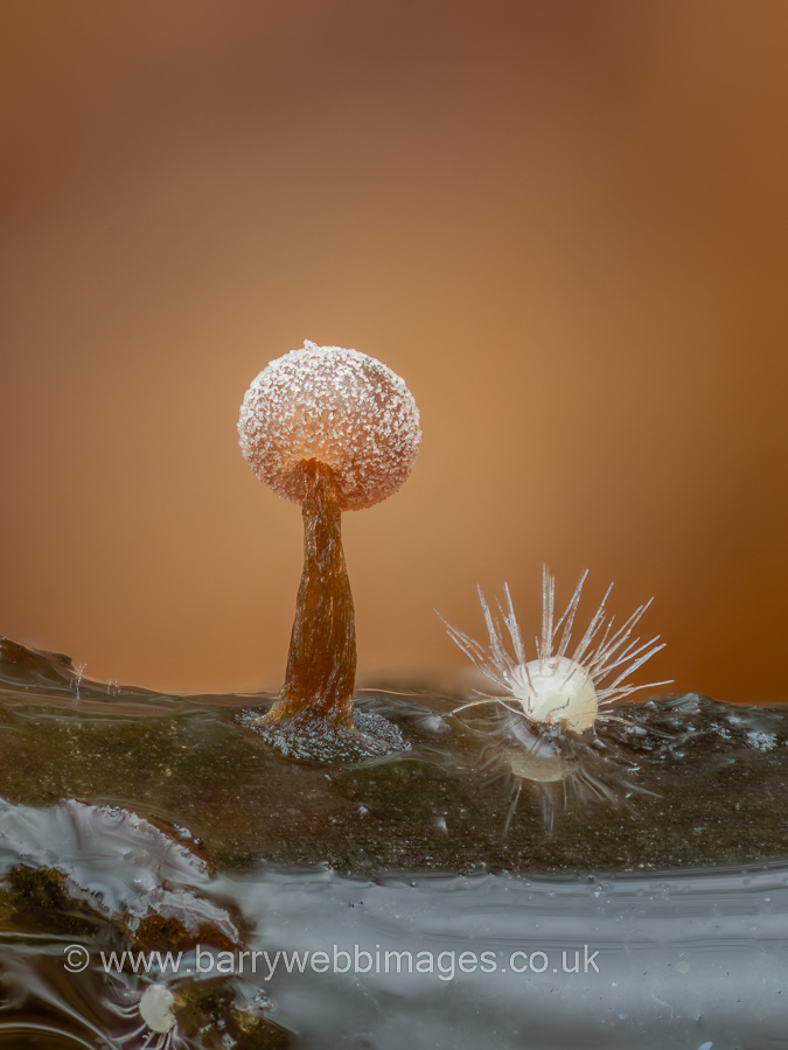
Didymium clavus Dec 30, 2020. Barry Webb found this tiny specimen in deciduous leaf litter in Burnham Beeches - a new record for the site and also for the county. (The determination was confirmed online by Myxo expert Edvin Johannesen.) Didymium is a large and tricky genus, many species of which look extremely similar. They are characterised by having a covering of calcium carbonate crystals, either as an egg-shell crust or a dusting as here, either with or without a stalk - the relative length of which, if present, is significant together with its shape and colour.The top spore-bearing part can be globose or discoid (more flattened) as here. Despite our lack of records, this is described as a common species occurring on deciduous leaf litter. Photos 2 and 3: Stoke Common 29.10.2022 Photo 4: Stoke Common 17.11.2024 |
 |
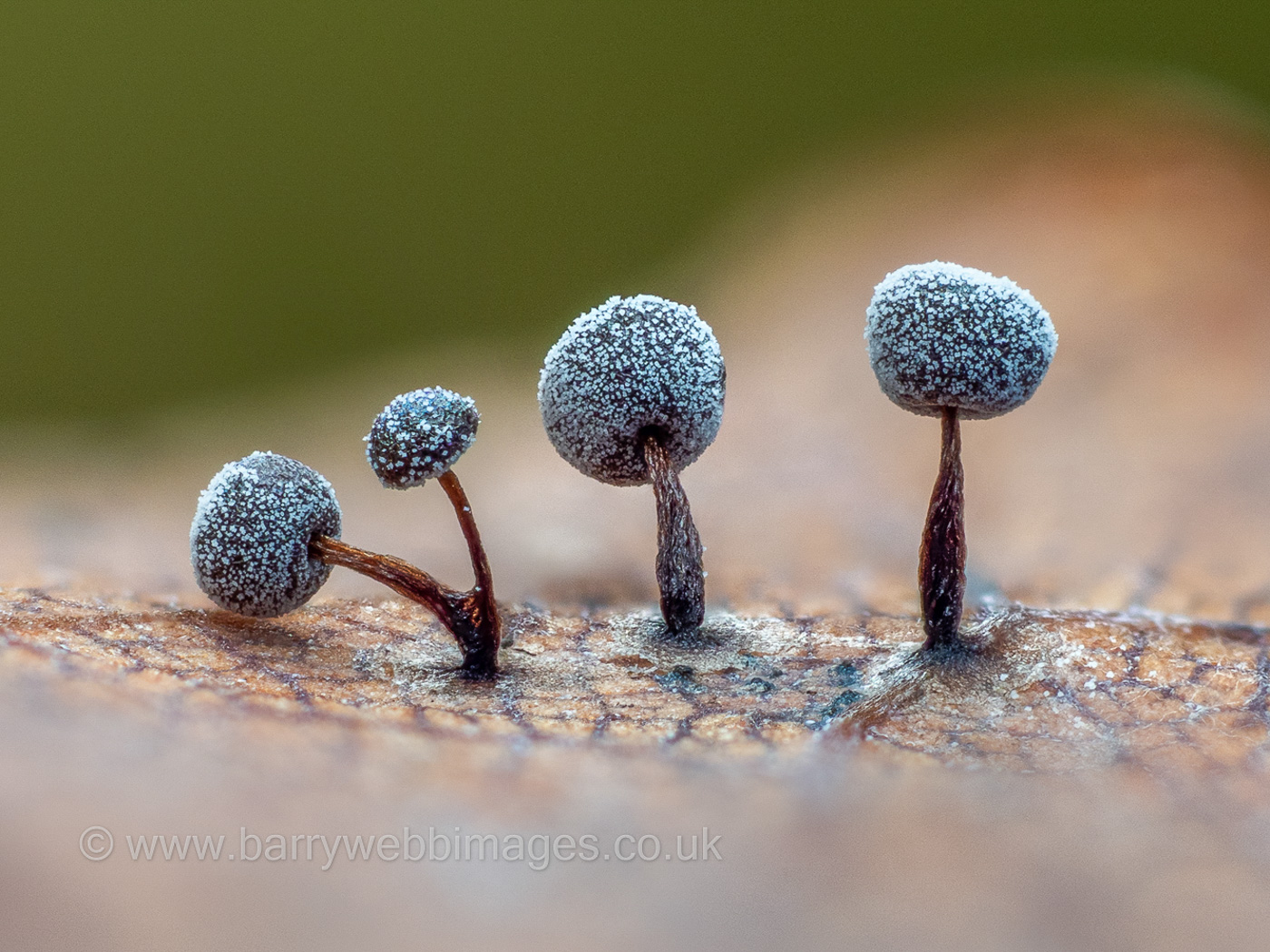
Didymium eximium Nov 17th, 2024. Barry found this uncommon species, new to him and to the county, at Stoke Common in leaf litter. It was subsequently identified by Jackie Mackenzie-Dodds. Photo 2: Burnham Beeches 04.12.2024 together with the remarkably hairy and even tinier ascomycete Volutella ciliata, found in a pile of wet woody debris |
 |
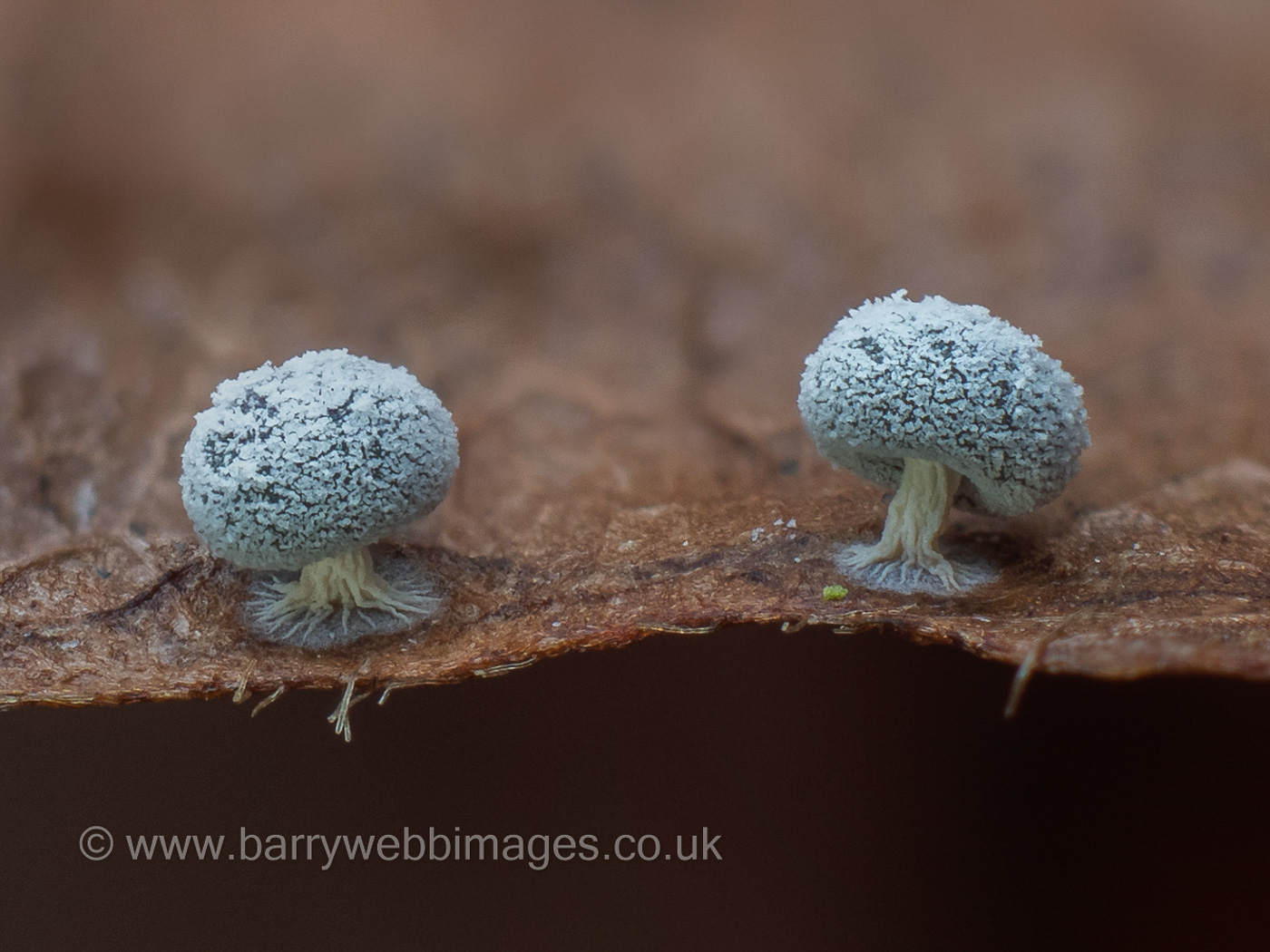
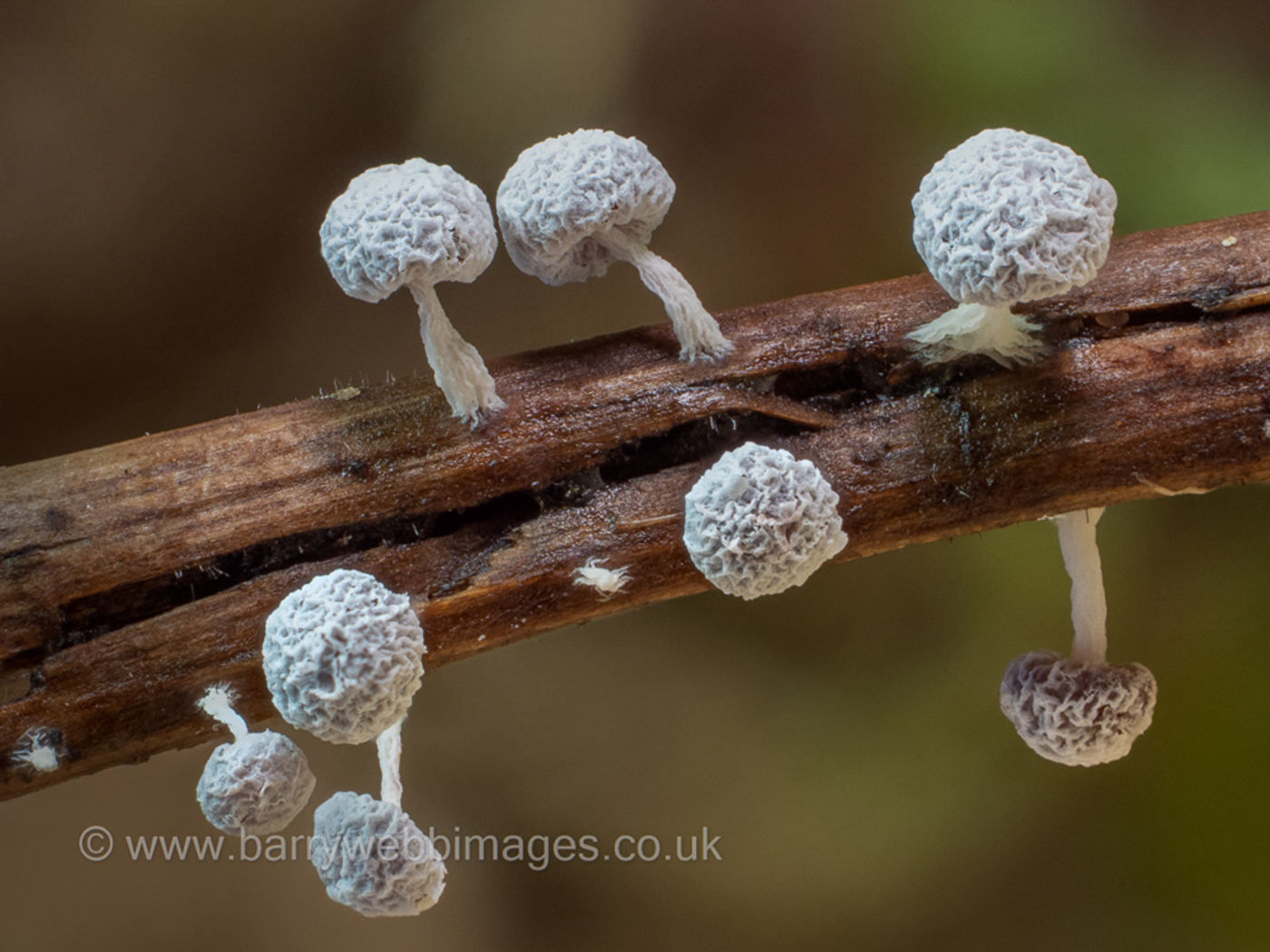
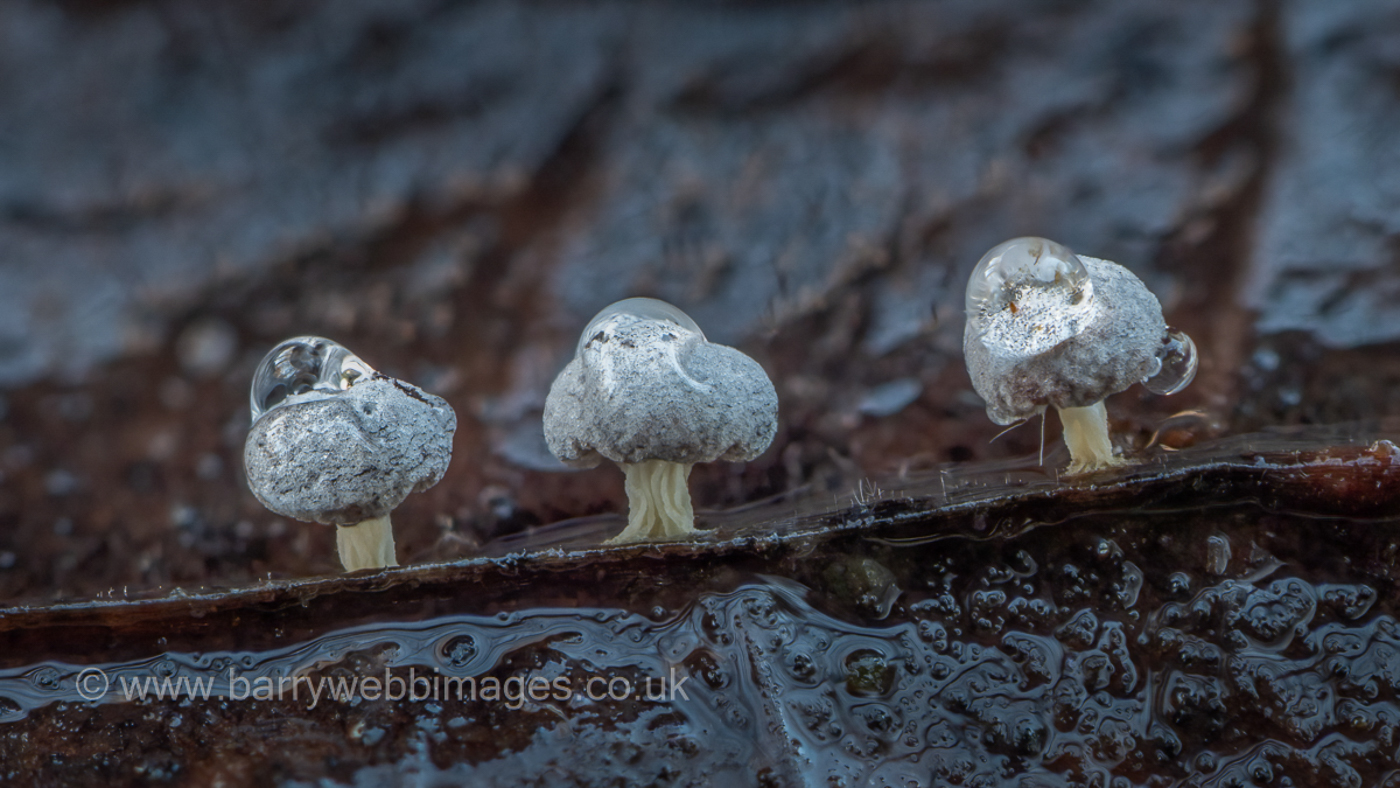
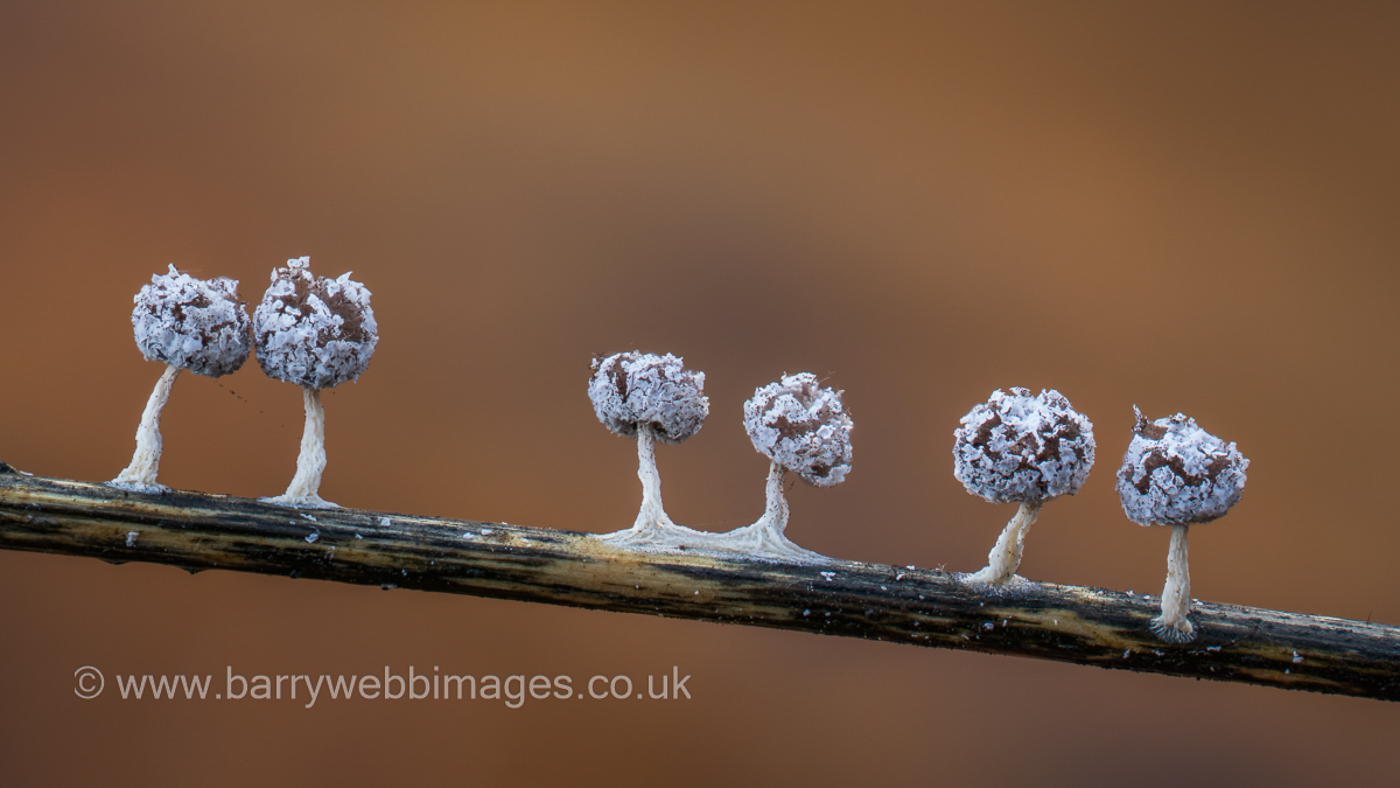
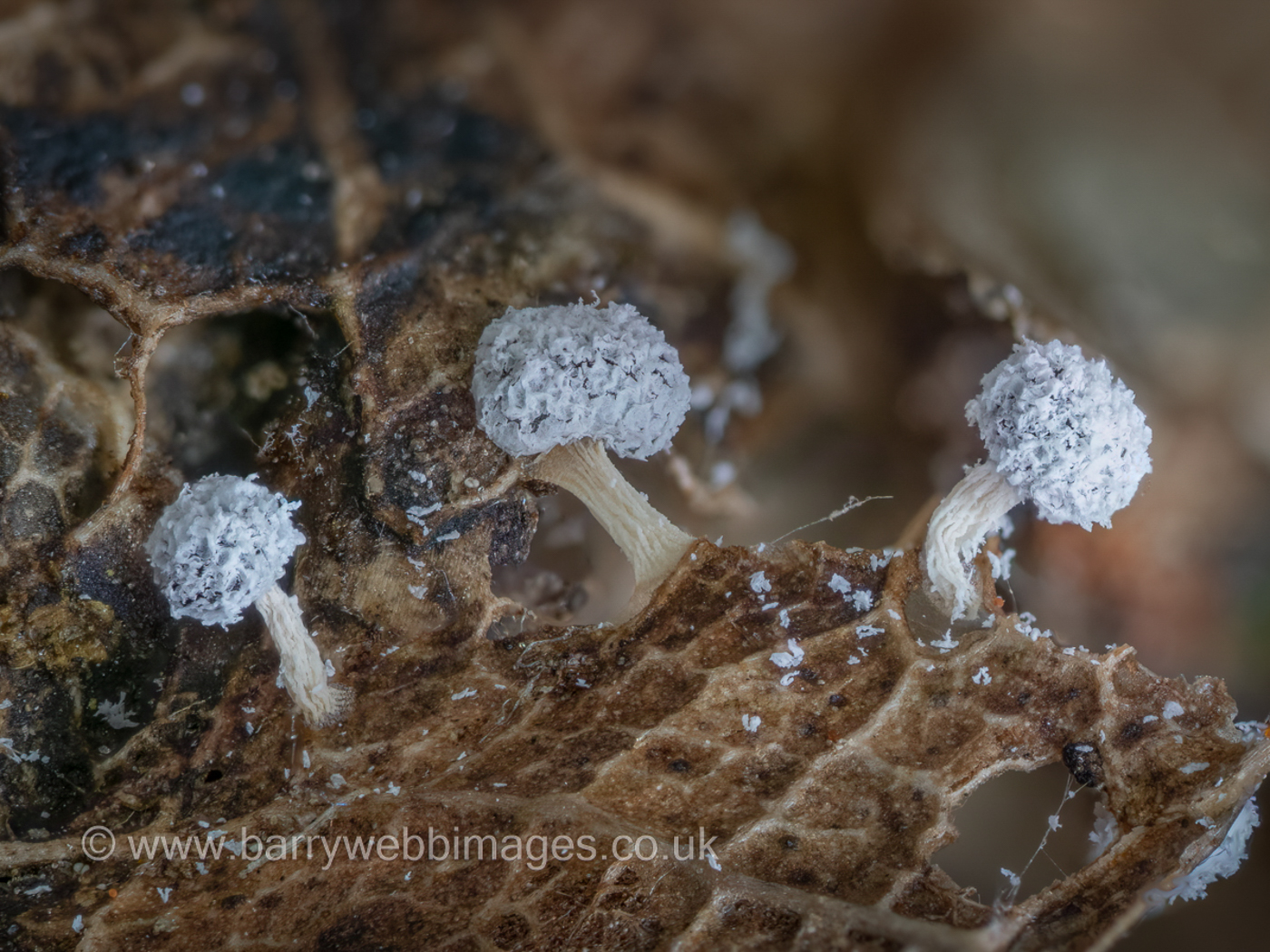
Didymium nigripes Sep 18, 2020. Barry Webb found this tiny slime mould in deciduous leaf litter in Burnham Beeches where it was new for the site though we have only one previous county record. (The determination was confirmed online by Myxo expert Fred Spiegel.) It is described as quite common across the country though most records seem to be from the south. See notes for D. clavus for general comments on the genus. The relatively long dark narrowing stalk and globose spore-bearing head are characteristic of this particular species. |


 |
Didymium squamulosum Dec 28, 2020. Barry Webb found this beautiful slime mould in deciduous leaf litter in Burnham Beeches, the determination being confirmed online by Myxo expert Paco Moreno. This is one of the commonest species of Didymium and we have plenty of county records though amazingly only one previously for this site back in 1923! The short white stalk and subglobose grey spore-bearing head coated in crystals are characteristic of this particular species which favours leaf litter and herbaceous material of all kinds. We have a wealth of Barry's photos to chose from giving views showing a range of different stages of development and appearance. Photo 2: Burnham Beeches 09.05.2021 on a woodchip pile and showing the lime crystals on the surface Photo 3: Rushbeds Wood 20.11.2021 Photo 4: Hodgemoor Wood 30.12.2021 found under Holly, showing the early pink stage of development Photo 5: Naphill 12.01.2022 Photo 6: Hodgemoor Wood 14.01.2024 again under Holly, showing the grey stage plus spiders' webs with droplets attached Photo 7: Stoke Common 17.11,2024 Photo 8: Wotton Park Estate 24.09.2025 showing crystals have dropped off onto the leaf below Photo 9: Stoke Common 12.11.2025 |
| E |
|



 |
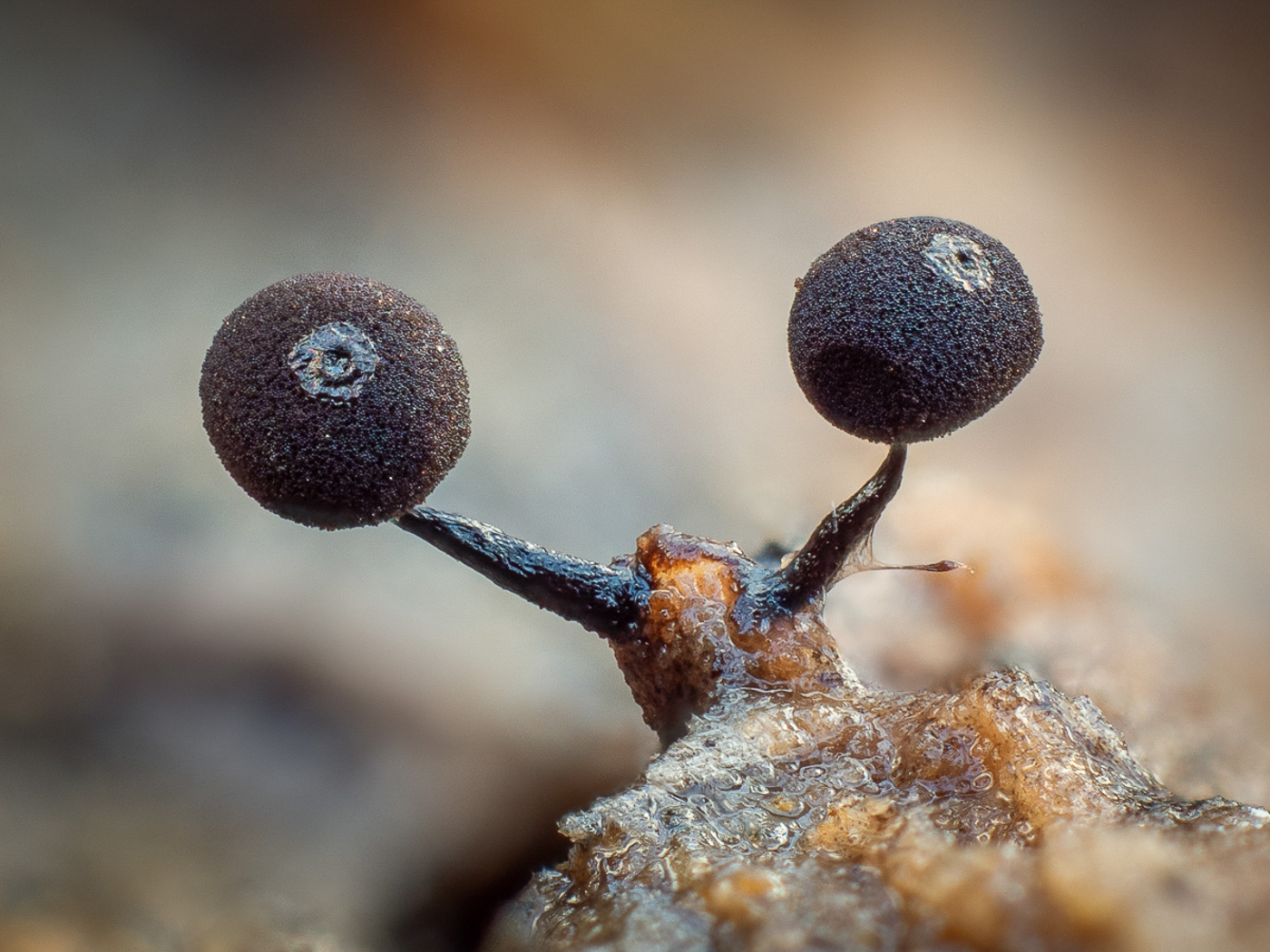
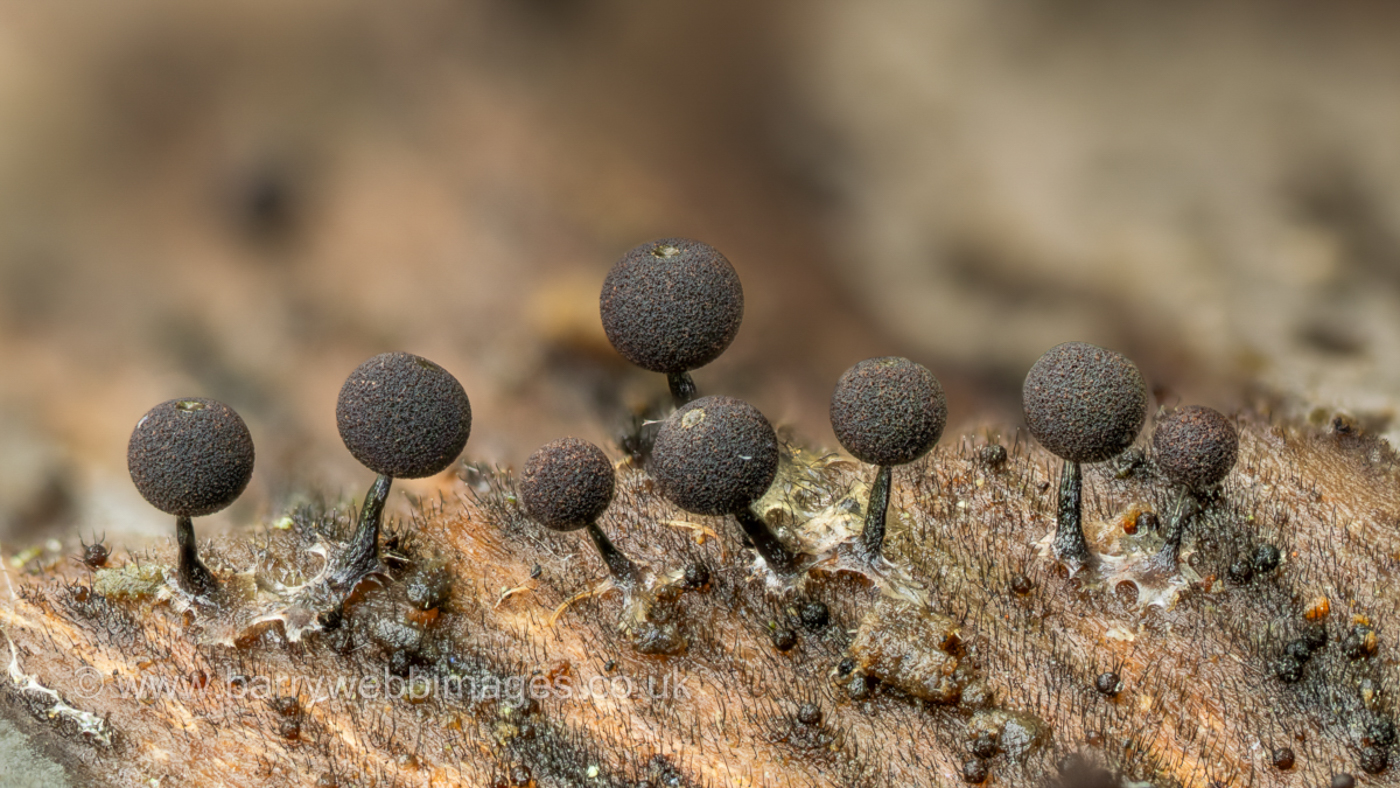
Enerthenema papillatum Aug 22, 2020. In Penn Wood Barry Webb found these tiny specimens growing on rotting fallen Beech. This is the only species of the genus found in the UK and though apparently common we had just three previous records from the north of the county, the most recent made by Myxo expert Bruce Ing in 2001. The distinctive flattened slightly indented top with shiny central disc and black stalk narrowing at the top make this species recognisable in the field. The central disc can be seen already forming in the immature specimens in photo 2. Photo 3: Hodgemoor Wood 30.12.2021 on fallen Beech Photo 4: Mousells Wood 23.10.2024 Photo 5: Burnham Beeches 03.08.2025 Photo 6: Stoke Common 12.11.2025 |
| F |
|

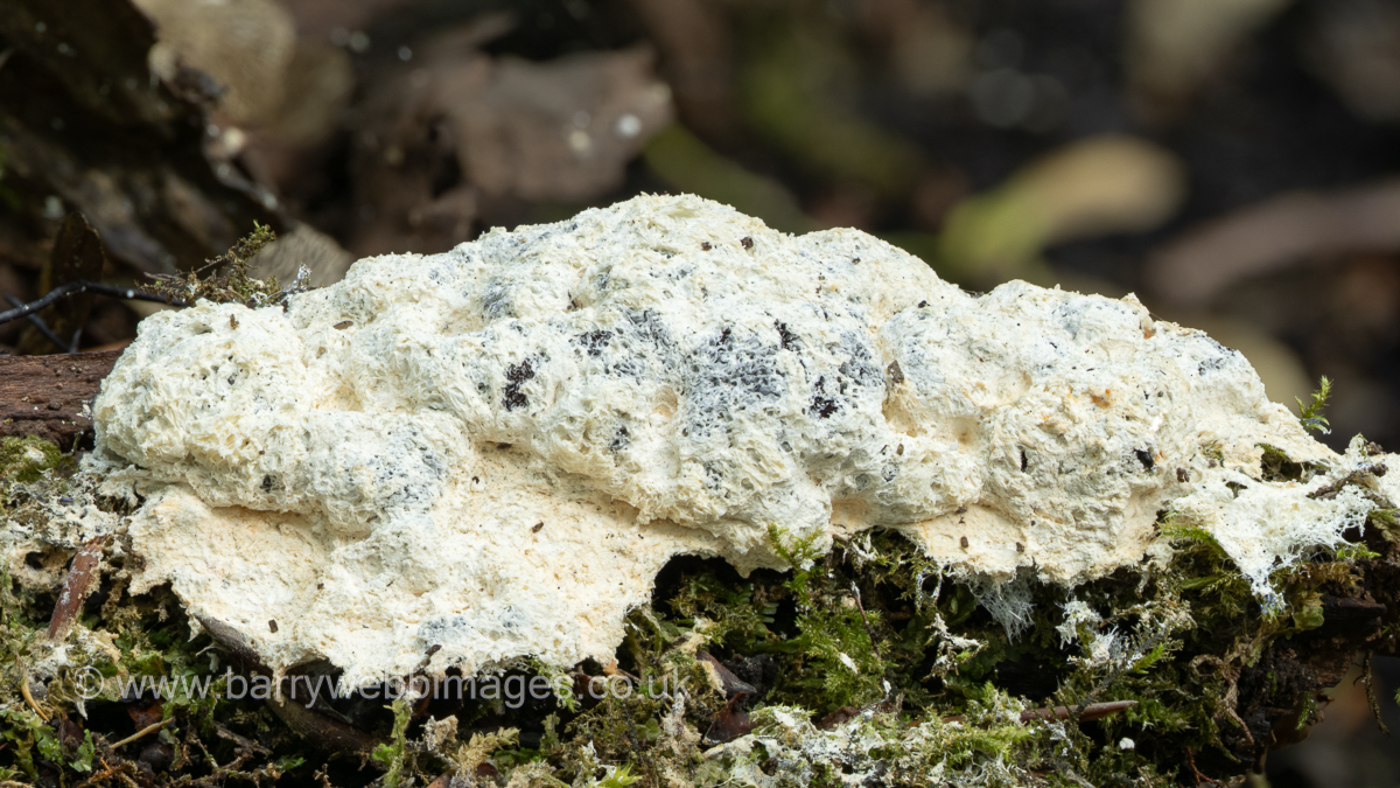 |
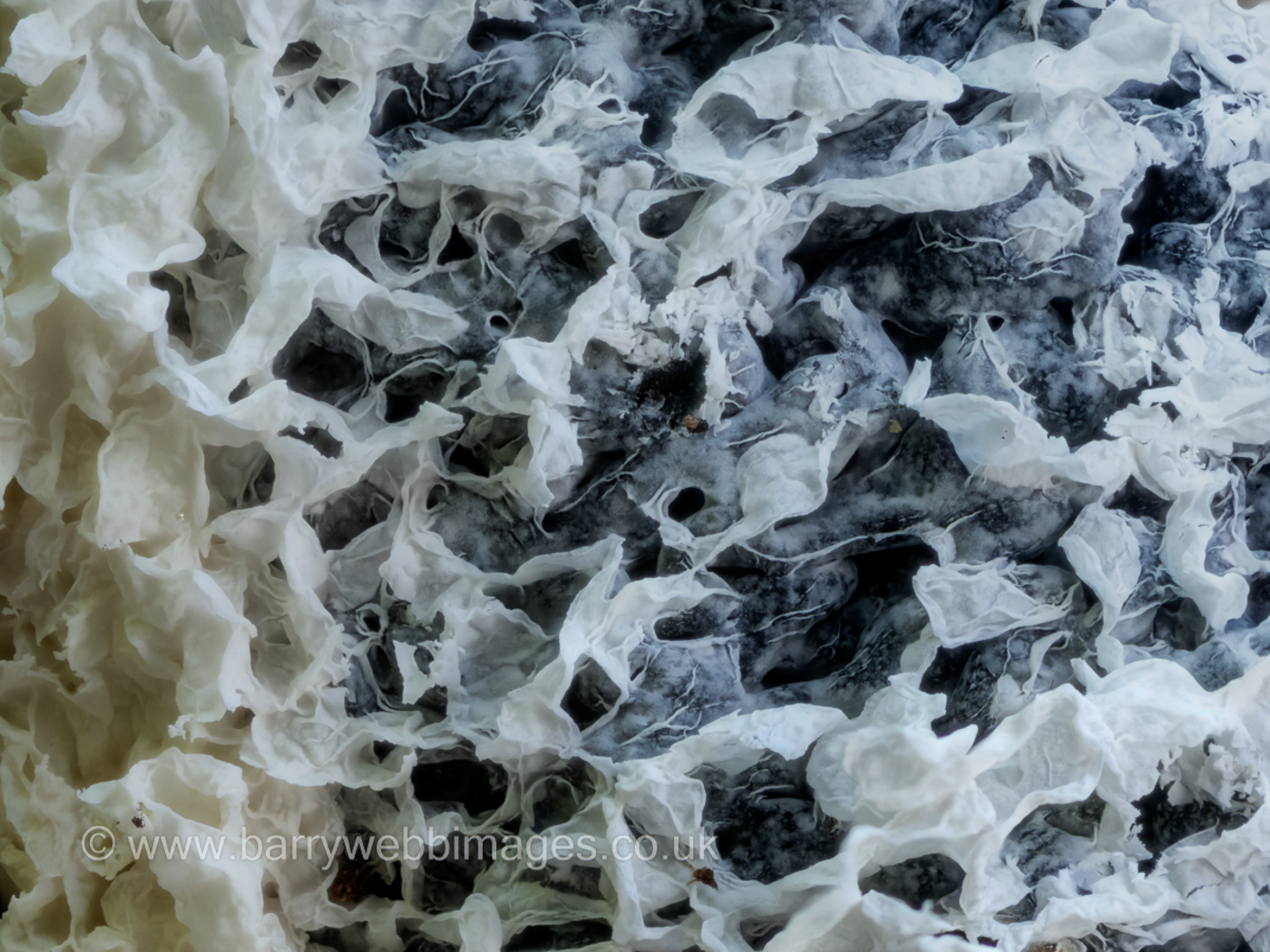
Fuligo candida Aug 07, 2022. (Burnham Beeches). This species is best described as a white version of the extremely common and bright yellow Fuligo septica var. flava - in fact until recently both species were known as varieties of F. septica though F. candida has now been raised to species status. It is by no means as common, however, with very few county records and favours very similar substrates as its yellow relative. Photo 2: Burnham Beeches 13.07.2023 Photo 3: Burnham Beeches 26.07.2025 |

 |
Fuligo rufa Jul 01, 2024. Barry found this species new to the county in Burnham Beeches. It is by far the rarest of the three Fuligo species illustrated here though as it has yellow mycelium, only developing this rusty terra-cotta colour later in development, it could possibly be mistaken for F. septica var. flava in earlier stages. It favours very rotten wood, also woodchips and straw, often in exposed sunny positions. Photo 2: Burnham Beeches 27.06.2025 |


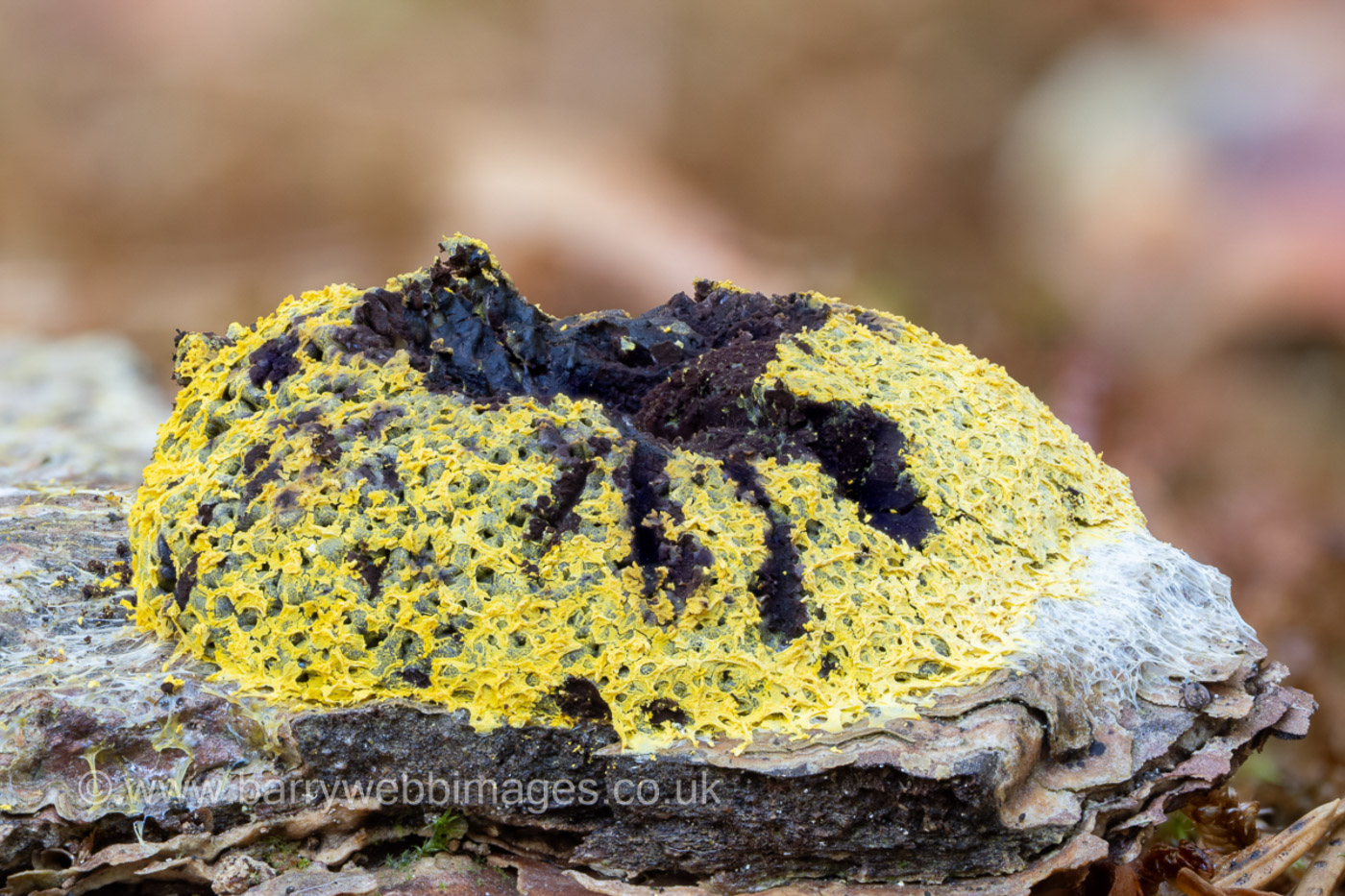 |
Fuligo septica var. flava Sep 23, 2023. In Hodgemoor Wood Barry found this extremely common species just settling down on a patch of moss and beginning to take shape from the mycelium stage. It is arguably our most familiar slime mould, aided by its often large and conspicuously brilliant yellow developments which in time turn greyish black and crumbly as spores are distributed. It favours rotten wood of all sorts, also mossy vegetation and any sort of woody remnants. (Incidentally there exists a species Fuligo septica which is less brightly coloured and considerably less common.) Photo 2: Burnham Beeches 26.08.2025 Photo 3: Oakley Wood, Bernwood Forest 23.09.2026 showing a more mature example where the bright yellow surface is disrupting to reveal the dark spore mass beneath. |
| G |
|
 |
Gulielmina vermicularis Nov 21, 2025. In Egypt Wood in the northern perimeter of Burnham Beeches Barry Webb found this slime mould on some unidentified wood and believes it is likely to be this species, though it awaits microscopic inspection by Jackie Mackenzie-Dodds to confirm it (hence the cf' in the name here). There are around 50 UK records on FRDBI but this is a first for the county. The previous genus name was Perichaena and still recognised as this in FRDBI though it was renamed as above in 2022 (see Species Fungorum). |
| H |
|


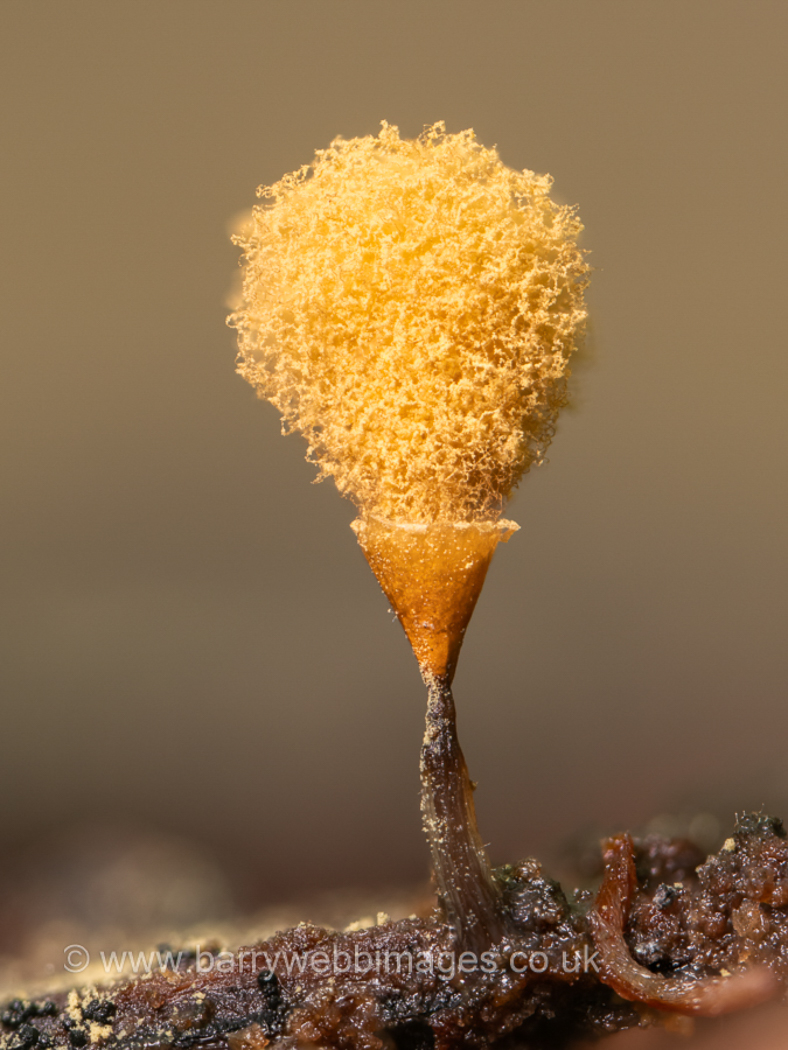 |
Hemitrichia calyculata March 09, 2021. Barry found this beautiful slime mould on fallen rotting Birch in Common Wood - photos 1 and 2. Though described as a common species in the south, this appears to be our first county record, reflecting the general lack of local expertise and interest in slime moulds until Barry put this right and started producing his amazing photos.The dark solid stalk suddenly flaring out at the top together with the tear-drop shaped sporangium (spore bearing mass) having a shallow conical shiny cup typically with frayed edges are the diagnostic features. Photo 3: Burnham Beeches 02.10. 2021 Photo 4: Burnham Beeches 23.03.2022 on rotting fallen Birch Photo 5: Burnham Beeches 21.08.2023 on rotting fallen Birch |
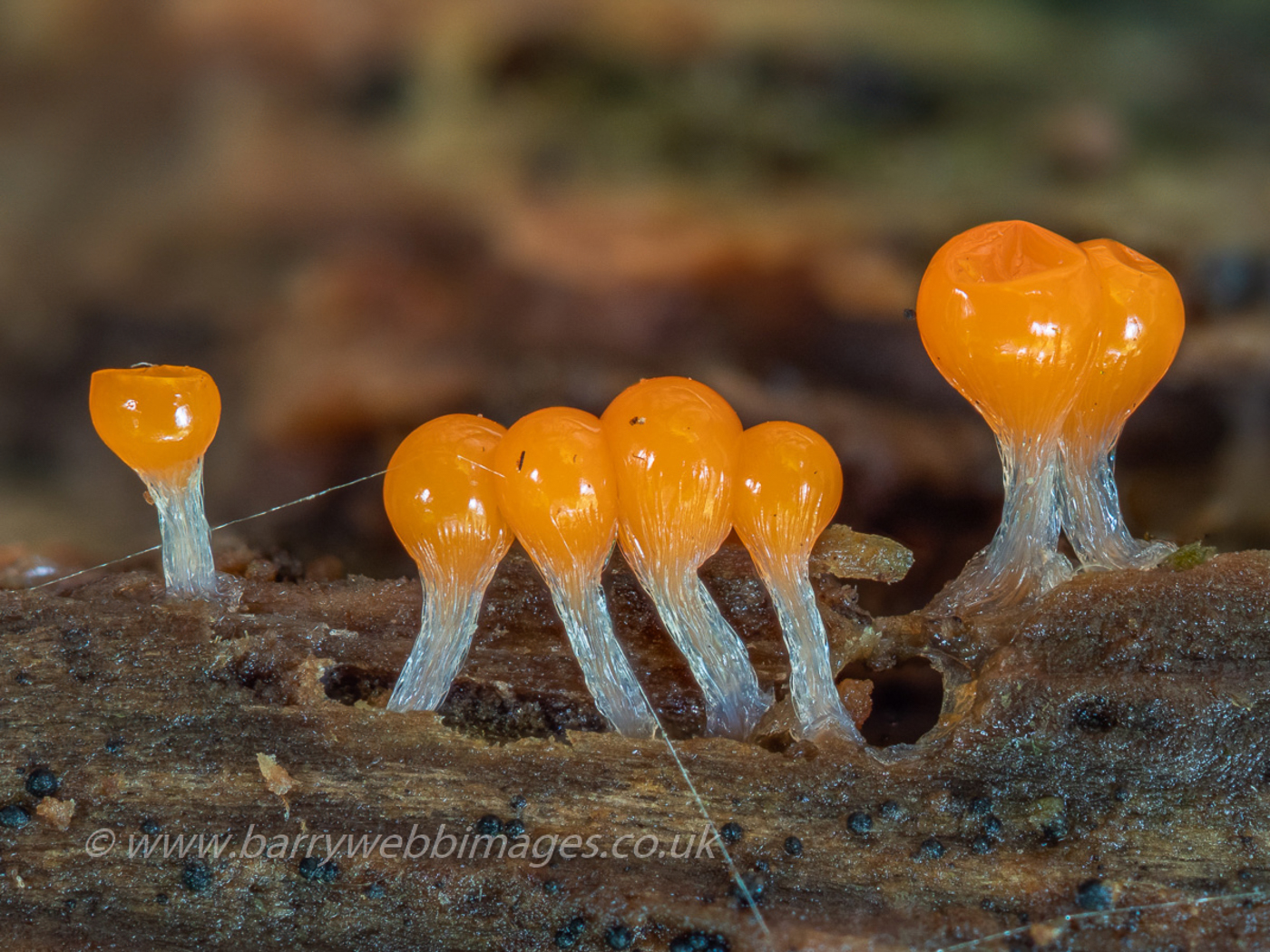

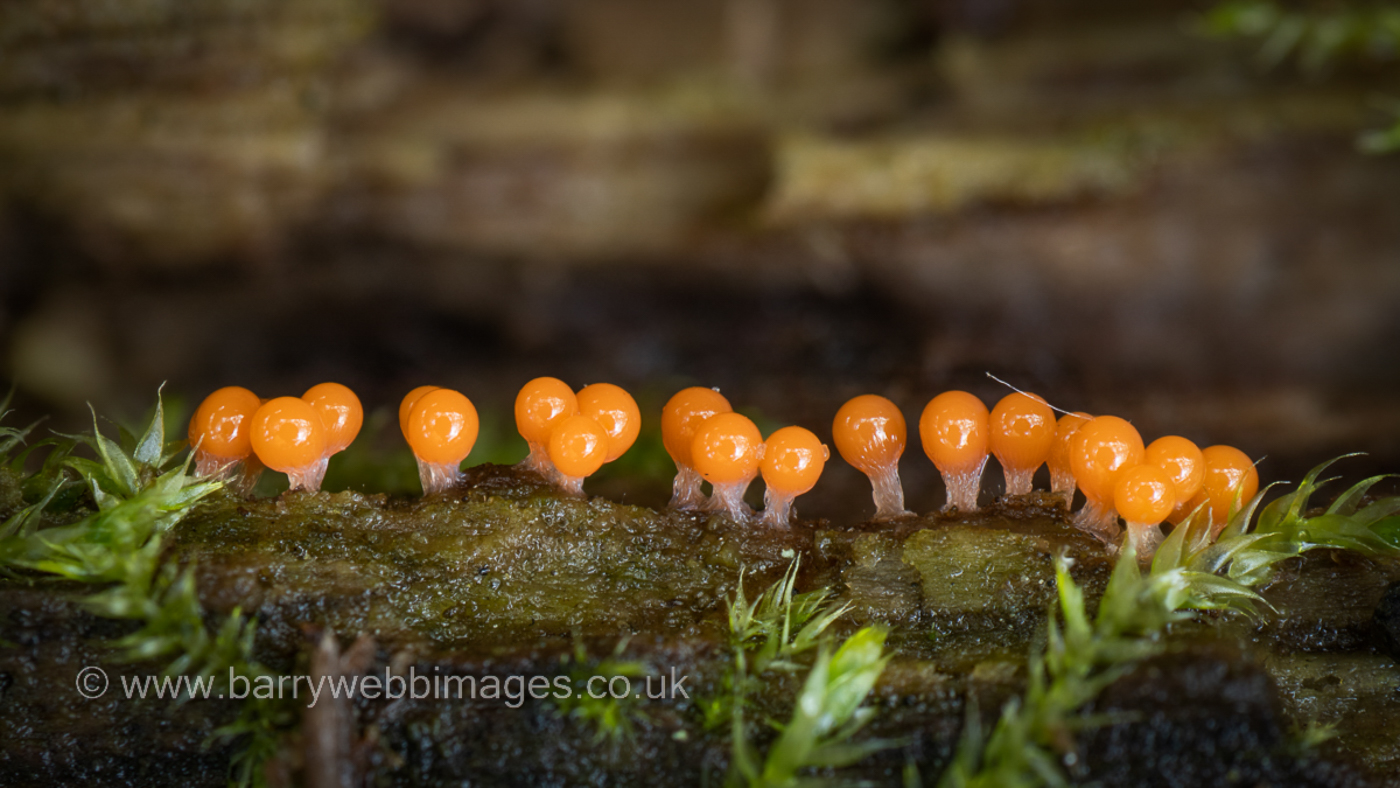
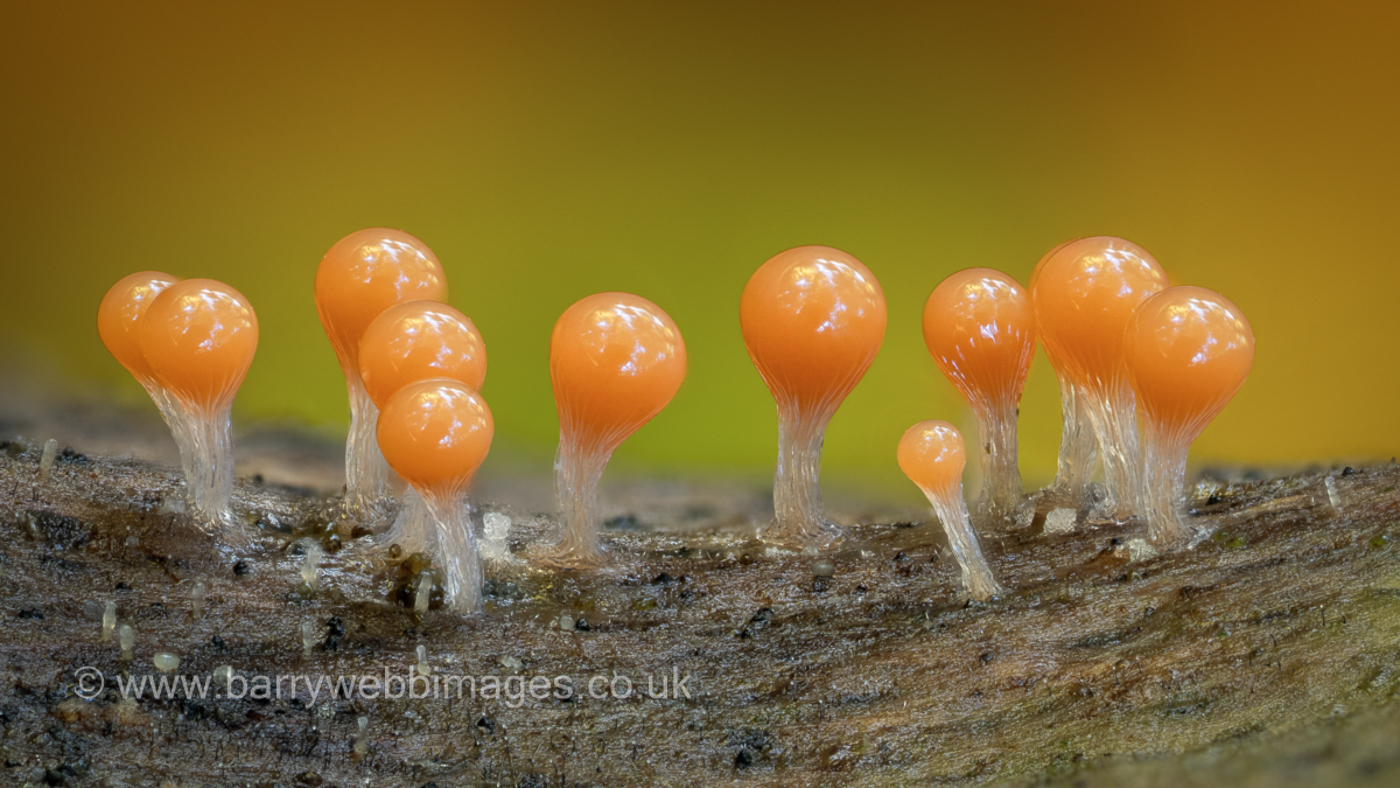
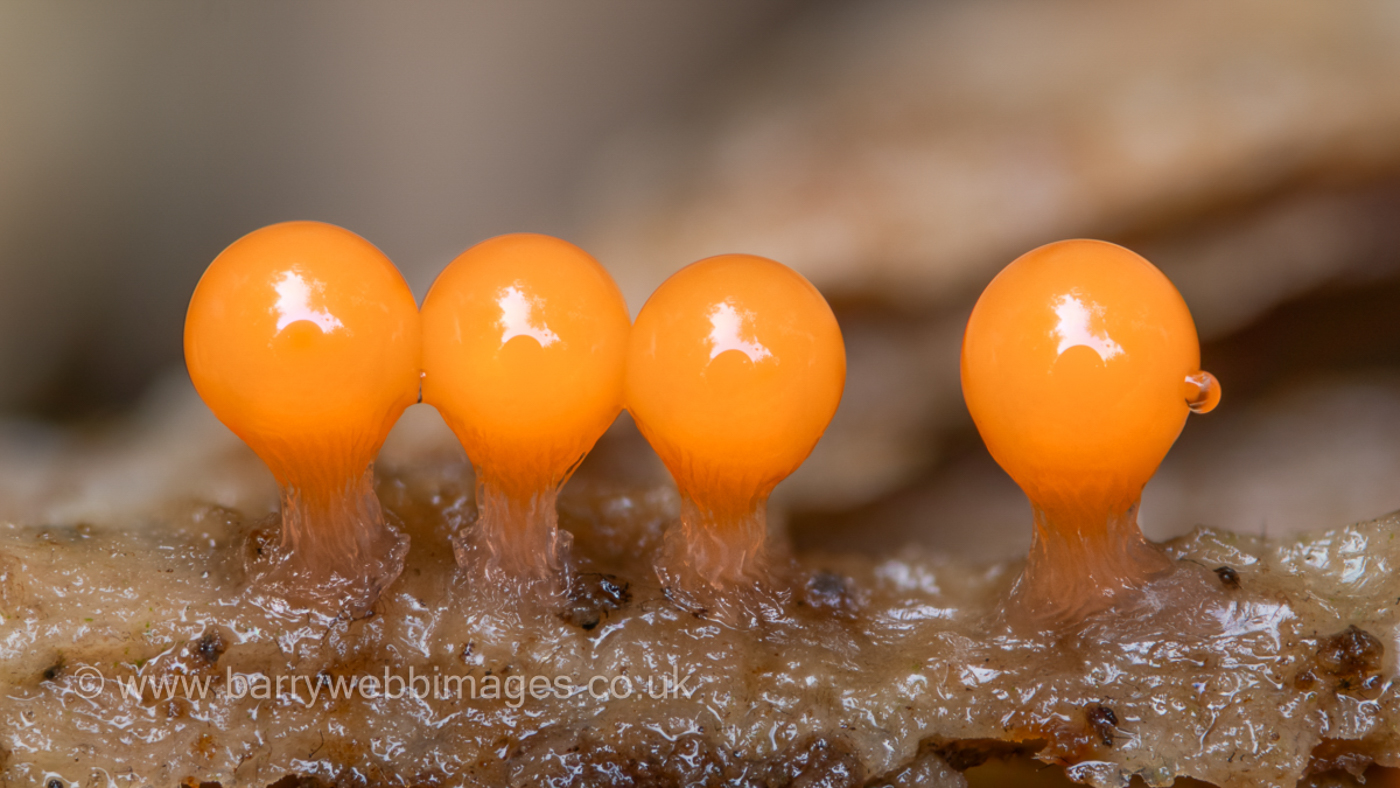 |
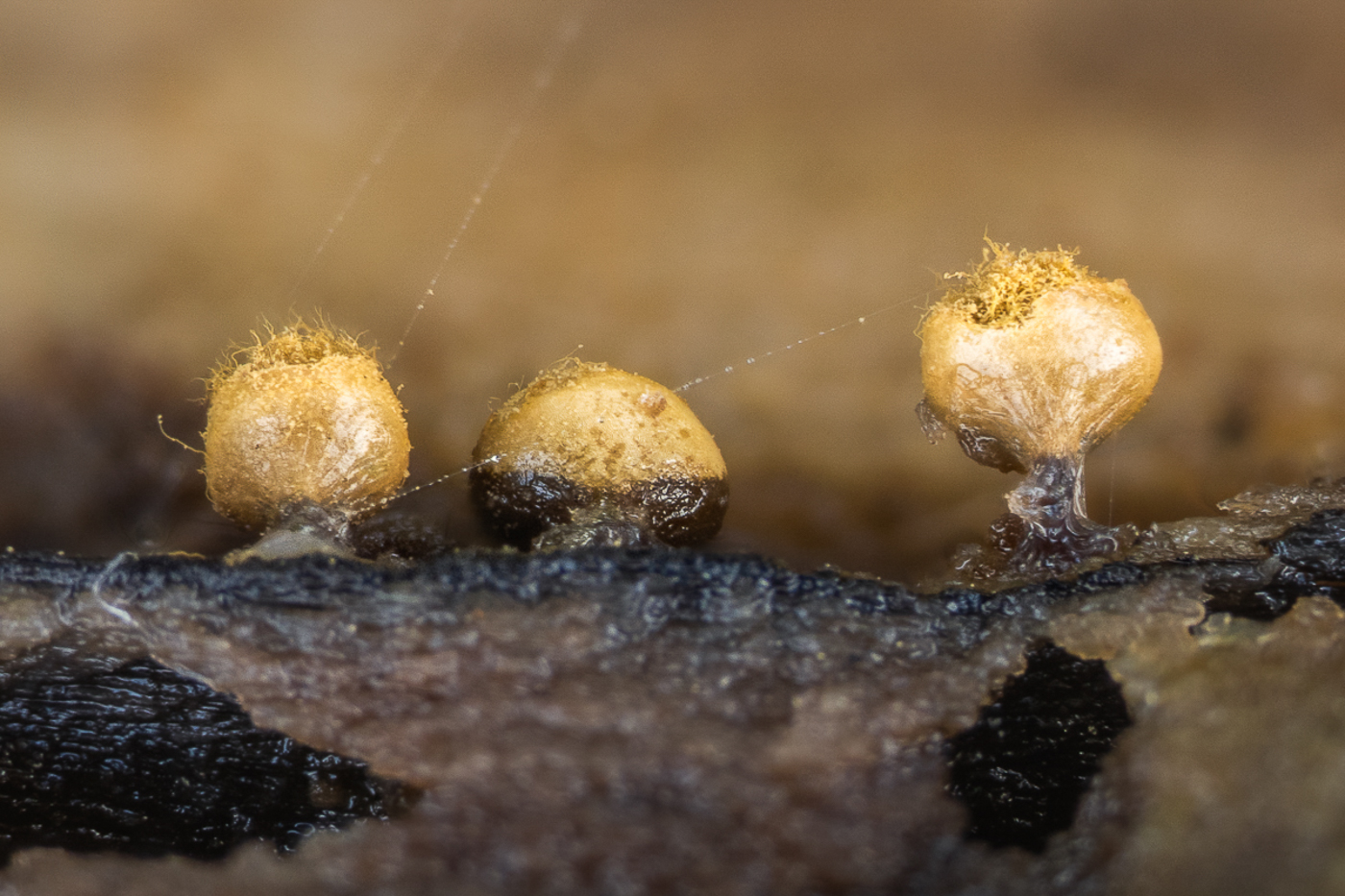
Hemitrichia deciplens Dec 08, 2019. Barry found this mature cluster on a piece of unidentified wood at Brill Common - an unusual photo in that it shows the mature stage of development because the species is one of few slime moulds with an earlier stage which is distinctive and recognisable therefore the most often observed. The vast majority have white plasmodium which at that stage cannot be named even to genus, but H. decipiens (previously in genus Trichia) soon develops these orange blobs on short white stalks which distinguish it from the many other species in Trichiaceae. (Penny has often tried carefully collecting samples at this slimy stage in the hope of watching their development, but they regularly fail ending up just shrivelled with no sign of the sporangia maturing.) Photo 2: Burnham Beeches 19.10.2020 on rotting fallen Beech Photo 3: Penn Wood 01.11.2020 showing a maturing example though still not developed enough to produce spores Photo 4: Stoke Common 29.10.2022 Photo 5: Mousells Wood 22.10.2023 Photo 6: Great Bois Wood 15.10.2025 |
 |
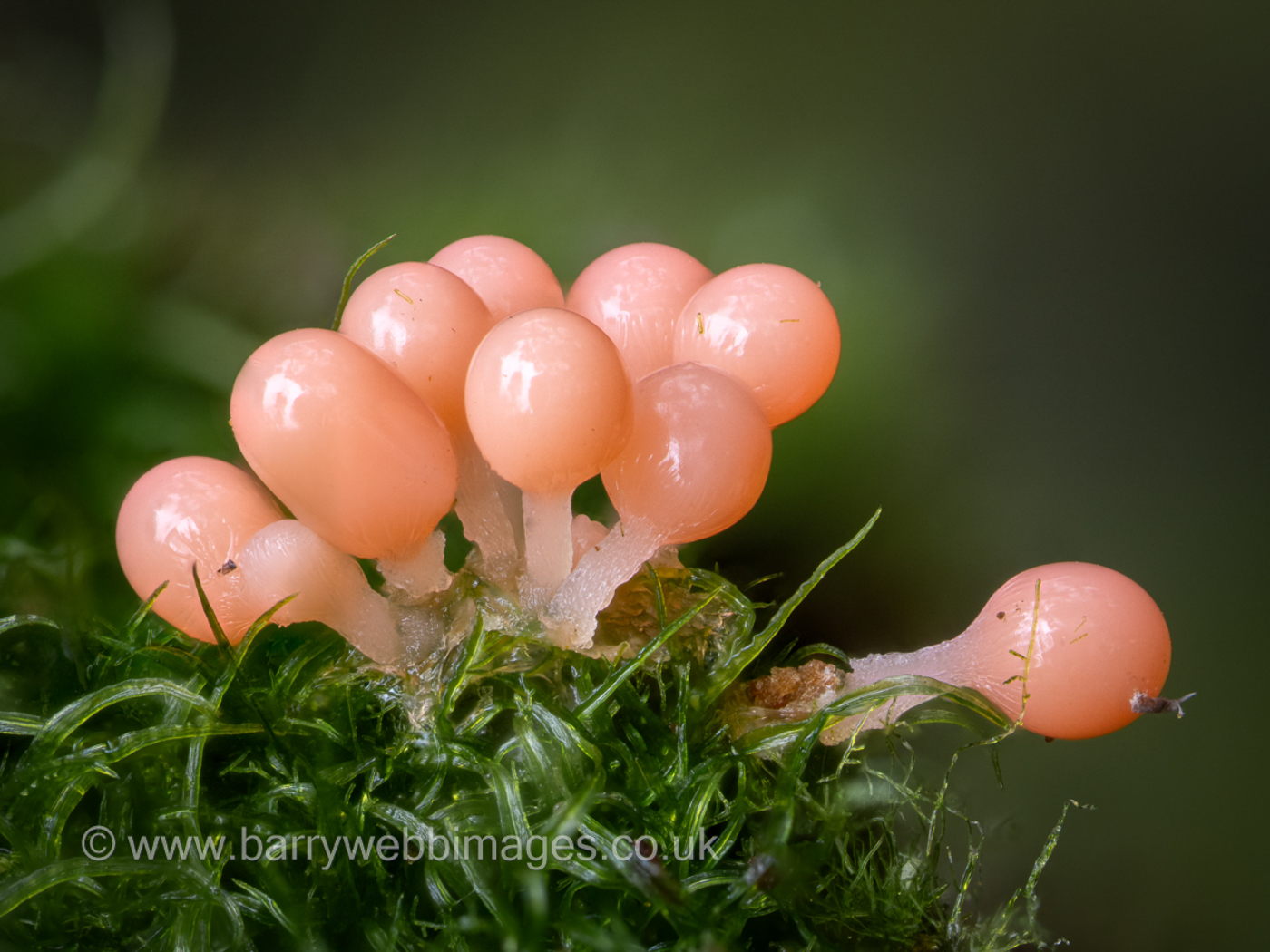
Hemitrichia serpula Dec 1, 2022. At Hedgerley Green Barry Webb was excited to find this rare species growing on a fallen Laurel leaf. Not only new to the county, it is a species with few UK records though with climate change it is beginning to occur naturally in woodland rather than in hothouses. Its shape and form certainly make it distinctive and to Penny it is reminiscent of a tiny Cadbury's 'Curly Wurly'! |

 |
Heterotrichia (previously Arcyria) ferruginea Mar 13, 2024. At Burnham Beeches a small group of us found this slime mould to which Barry Webb returned to check its identity and take his photo. This is a typical example of the mature stage of this group of slime moulds when no longer slimy and showing in the background the fine mesh of fluffy 'elaters' which form the protective framework containing the spores which here have almost entirely blown away. Note also the now empty 'cups' - all that is left of the entire sporangia (fruiting body) once the rest has blown away. (The genus change occurred in 2024) Photo 2 - Stowe Landscape Gardens 19.11.2023 showing a much earlier stage of development. |

 |
Heterotrichia (previously Arcyria) obvelata Aug 1, 2020. Barry found this quite common species in Burnham Beeches on rotten Beech, though we have only two previous county records. It is an easy one to recognise when mature being alone amongst this group of species in having a somewhat drooping shape, also a rather loose mesh and a very short stalk; the cream yellow colour is another distinctive feature though one or two other species can also be this colour (but not also this shape). (The genus change occurred in 2024) Photo 2: Hodgemoor Wood 18.09.2022 showing its typical droopy habit rather better. |
 |
Heterotrichia (previously Arcyria) oerstedii  Apr 29, 2023. At Burnham Beeches prior to our BFG Walk Barry Webb found this somewhat drooping species on some damp bare fallen wood. He suspected right away that it was unusual as the only other similar species known to droop, H. obvelata - a fairly common species he knows well, is yellow with no pink as seen here. Myxo guru Edvin Johanessen, when consulted and on seeing the photo, suggested it might be A. (now H.) oerstedii which Barry then confirmed by checking the microscopic details. This is new to the county with only 60 UK records on FRDBI but was identified too late to make Penny's Burnham Beeches report, hence its inclusion here.(The genus change occurred in 2024) |
| L |
|
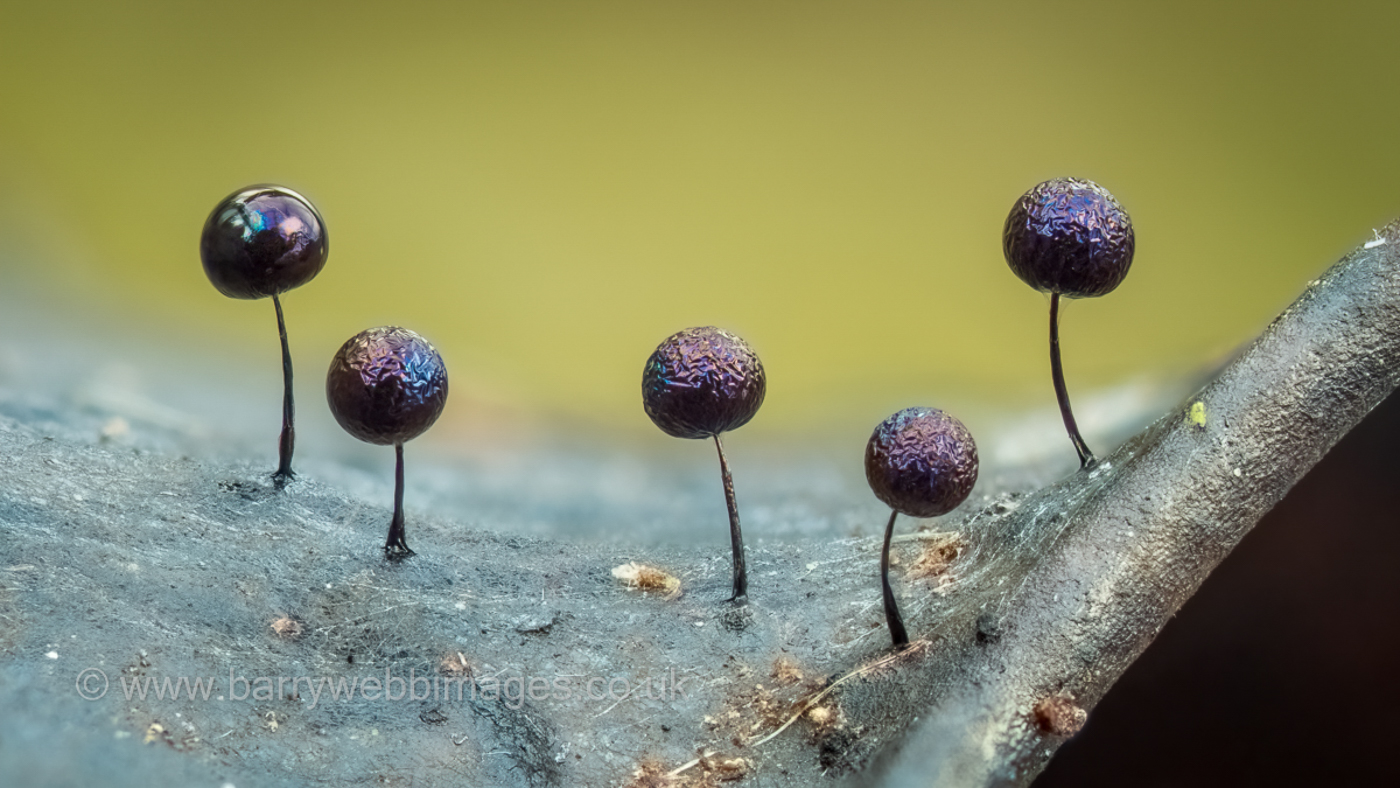

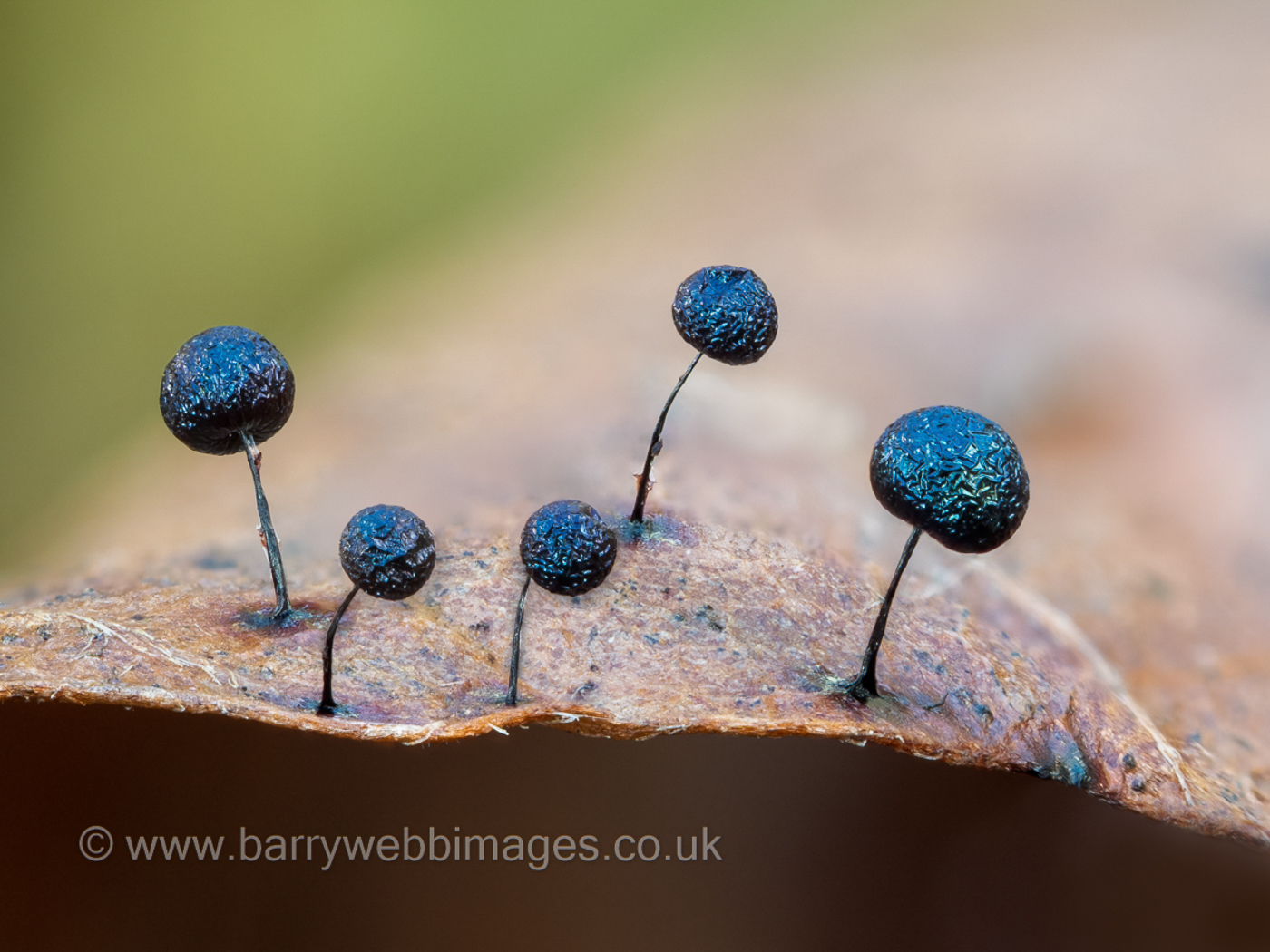

|
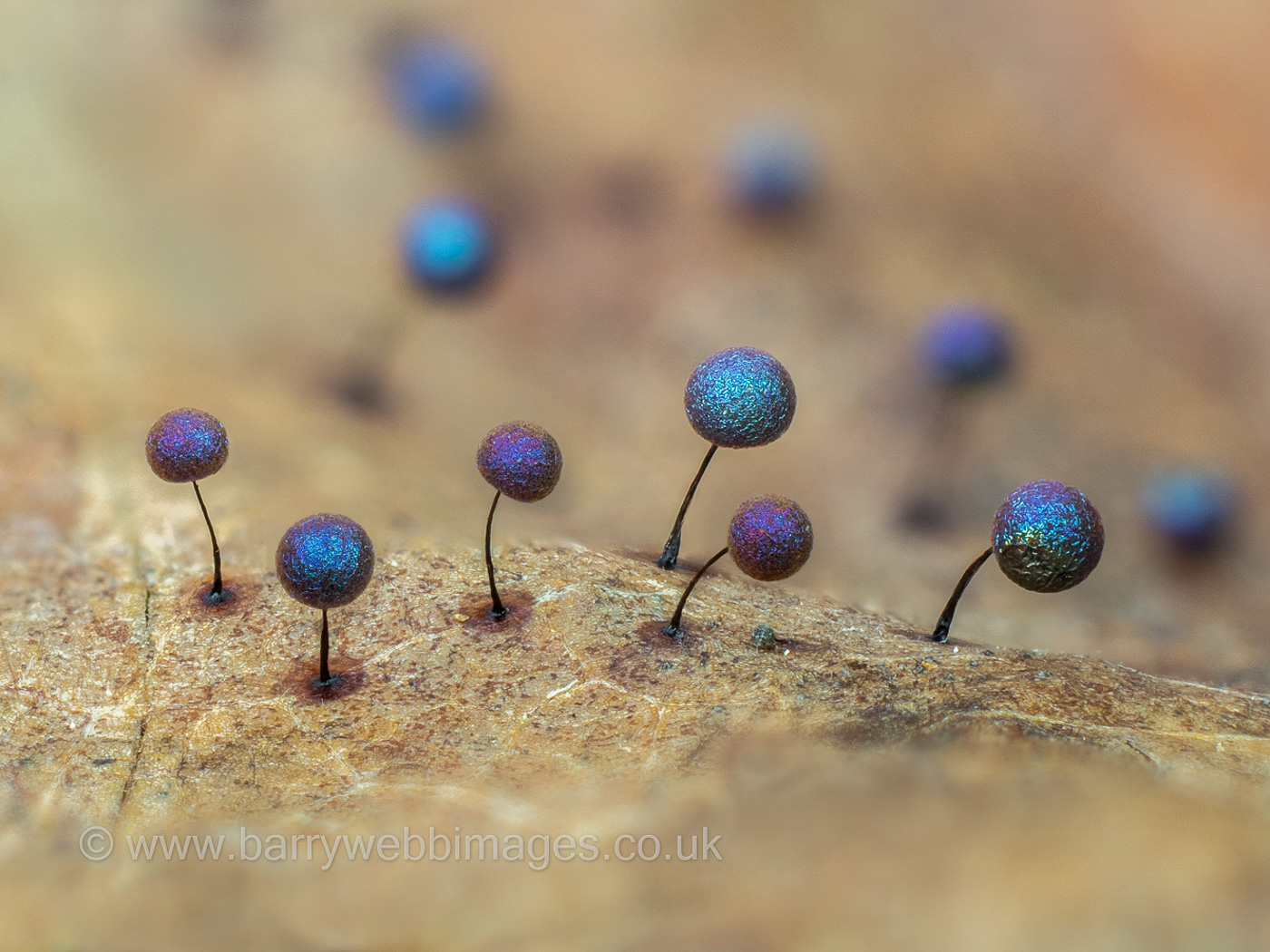
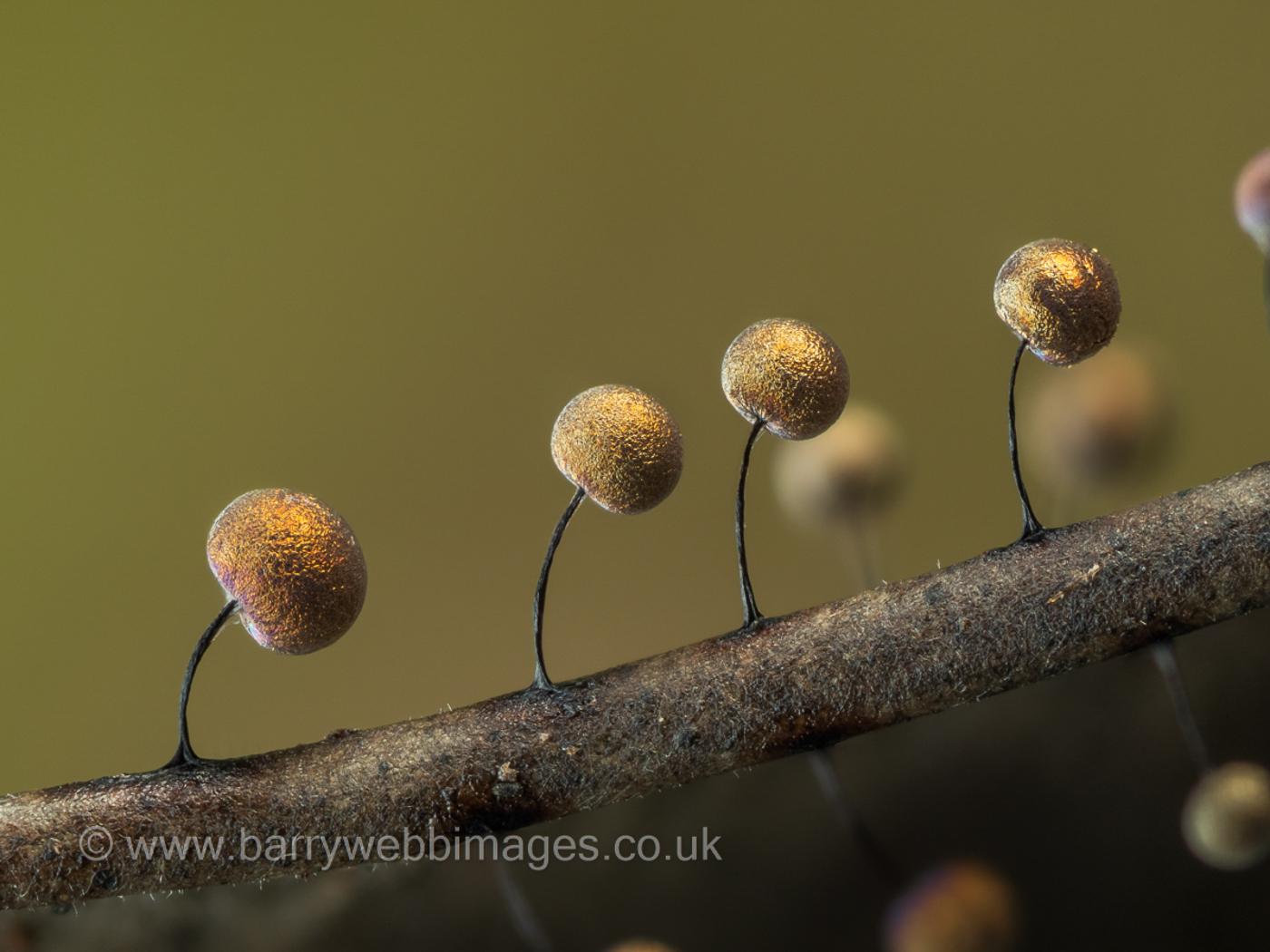
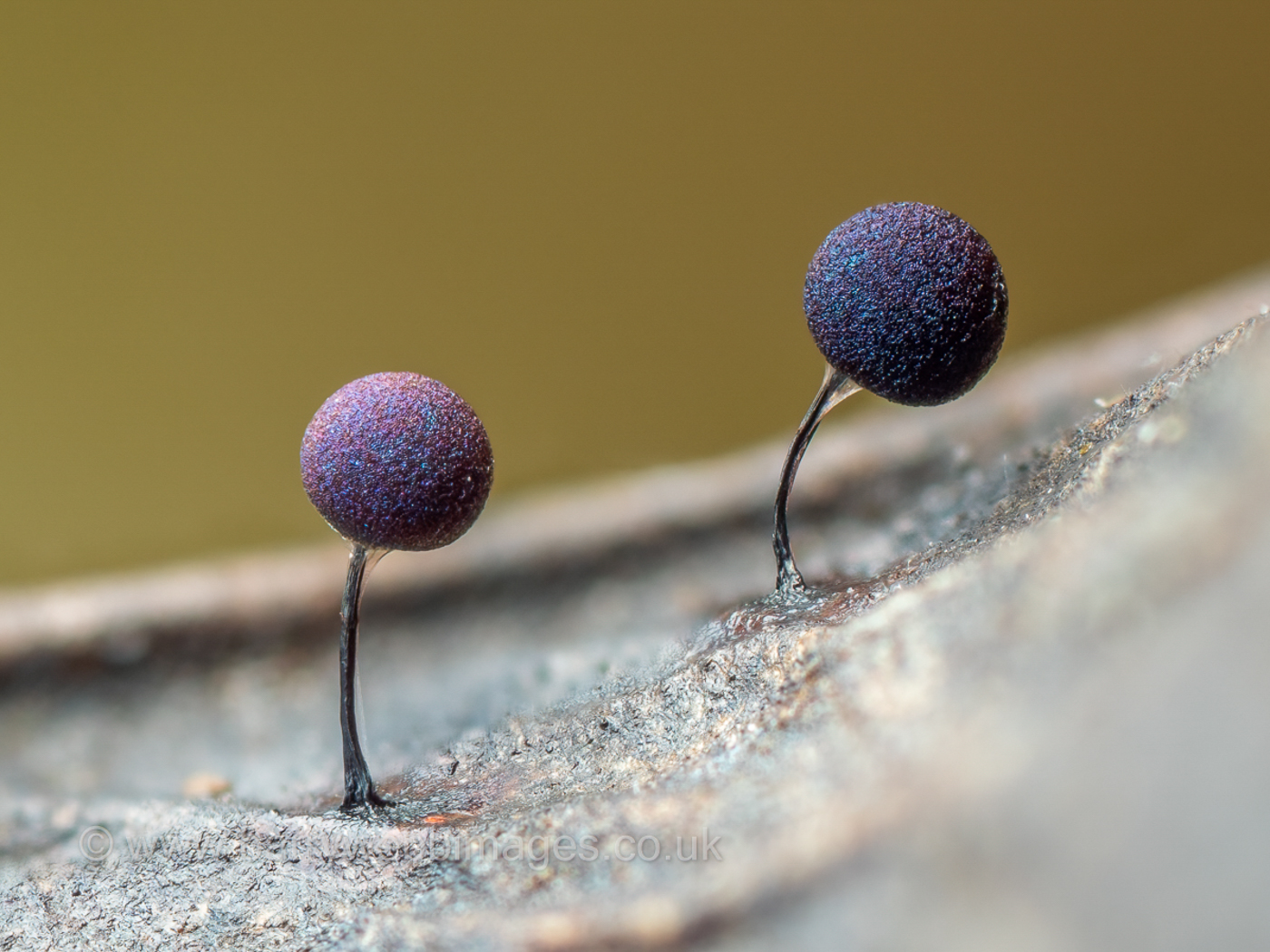
Lamproderma scintillans Dec 24, 2020. Barry Webb found these well named glistening little beauties (only 1-2 mm high) in Burnham Beeches in deciduous leaf litter, not only new to the site but also to the county. (The determination was confirmed by Andy Sands from Barry's excellent photo.) The iridescent colours and metallic glint are typical of the genus, all species of which are very small and often missed thus somewhat under-recorded. Since this first collection Barry has made many other finds of these sparkling miniature Christmas baubles, often on fallen dead Holly leaves which appear to be a favourite substrate. Photos 2 and 3 : Hodgemoor Wood 03.01.2022 Photo 4: Hodgemoor Wood 04.01.2022 Photo 5 and 6: Naphill Common 12.01.2022, the pink stage showing a less mature example Photo 7: Hodgemoor Wood 12.01.2024, the Holly prickle at one end giving a good sense of perspective! |
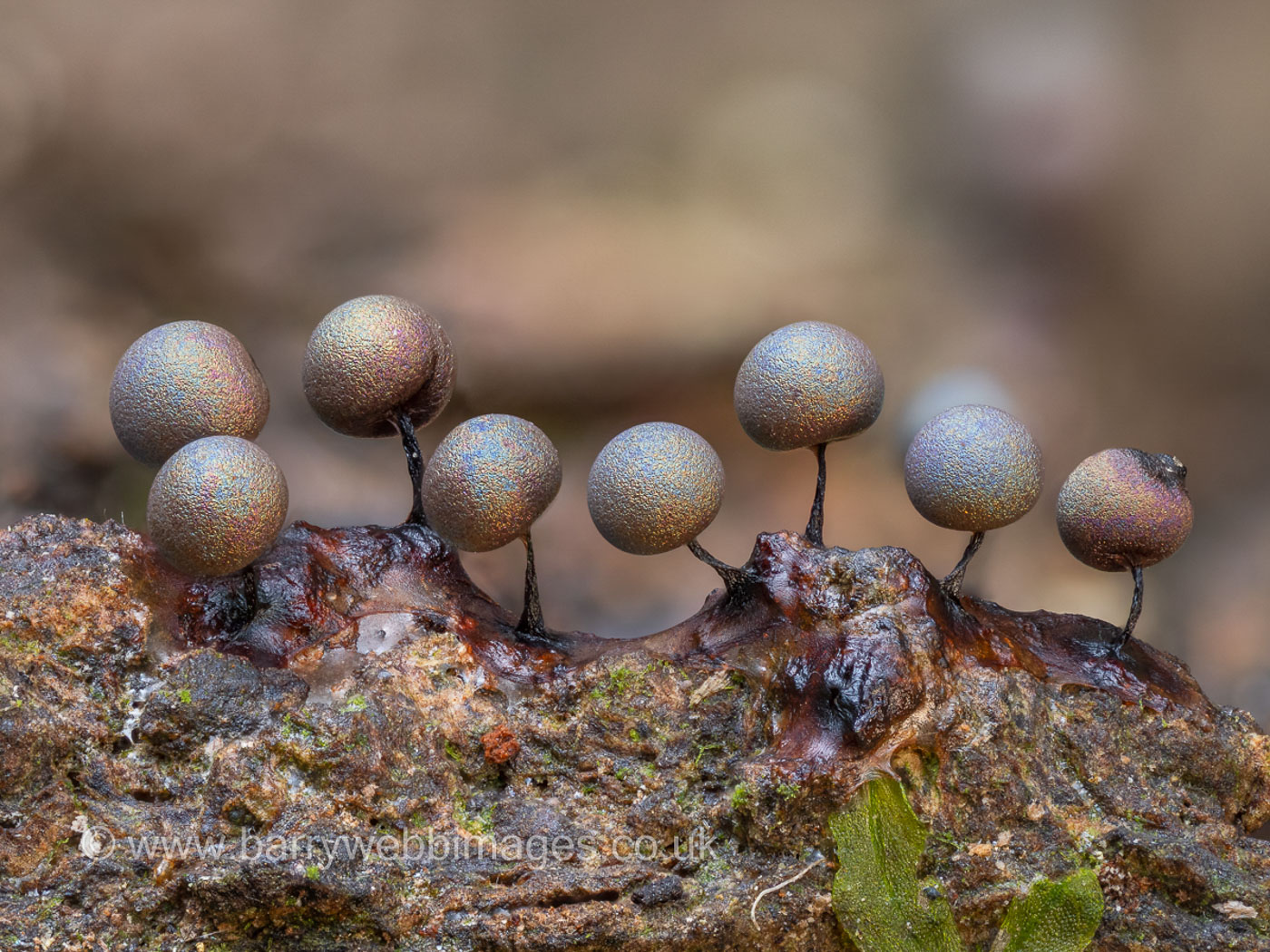
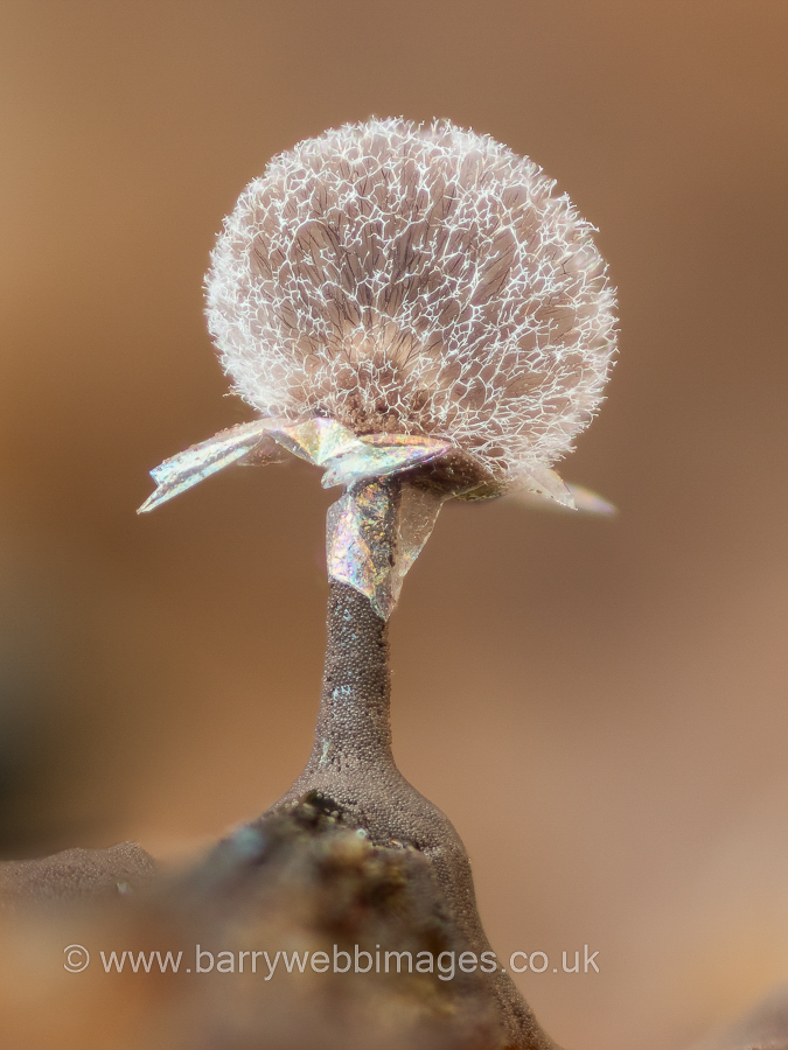 |
Lamproderma violaceum Nov 22, 2023. In Burnham Beeches on a large fallen rotten Beech Barry Webb was even more pleased to find this tiny little species which was identified for him from his photos by Myxomycete expert Edvin Johannesen. Previously L. arcyrioides it shows the typical glistening irridescence of the genus and photo 2 shows it once it splits open for spore distribution to occur (dehiscence). We have just one previous county record from Salcey Forest in 1990. This is a new entry for Finds. |


 |
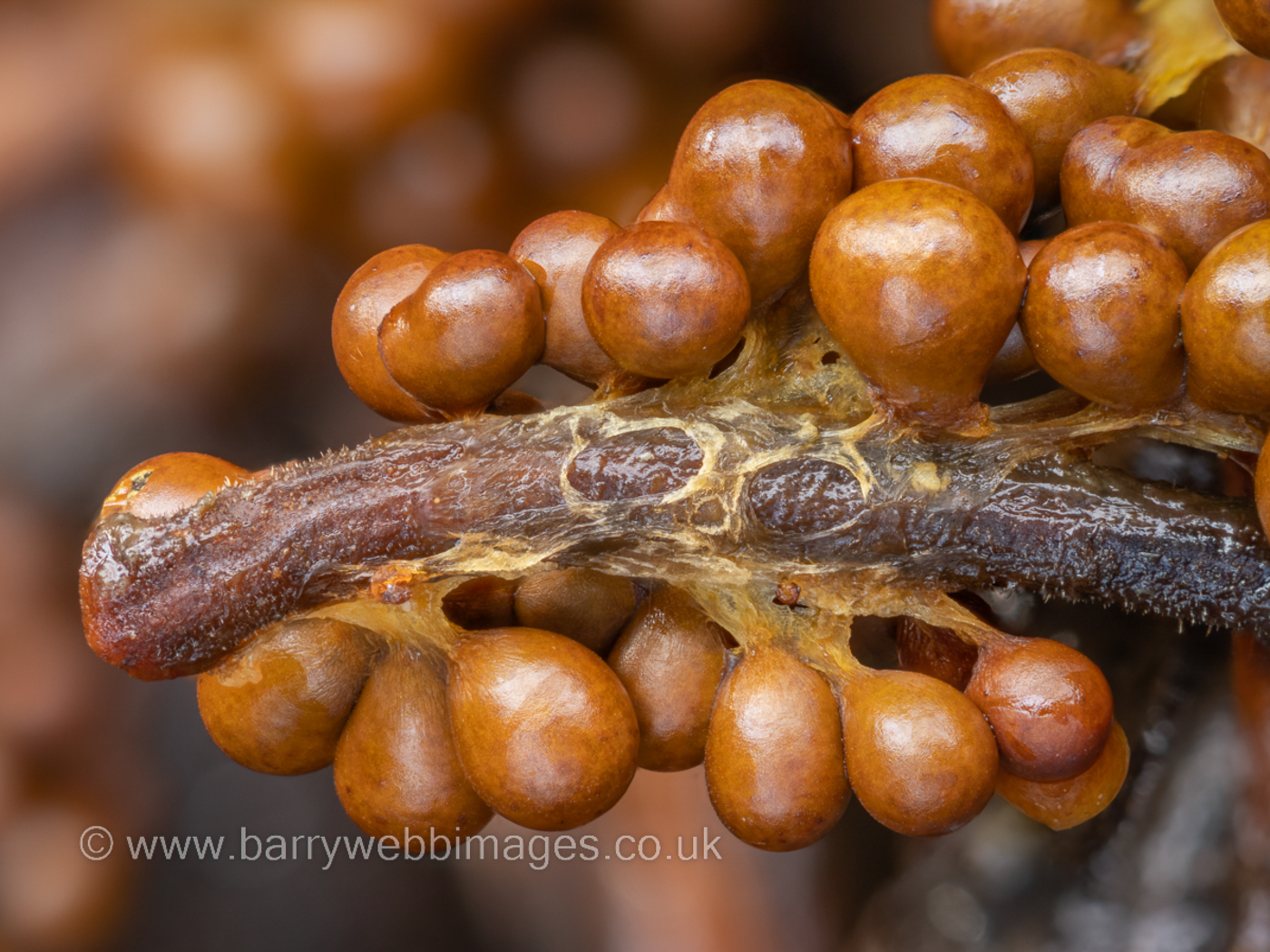
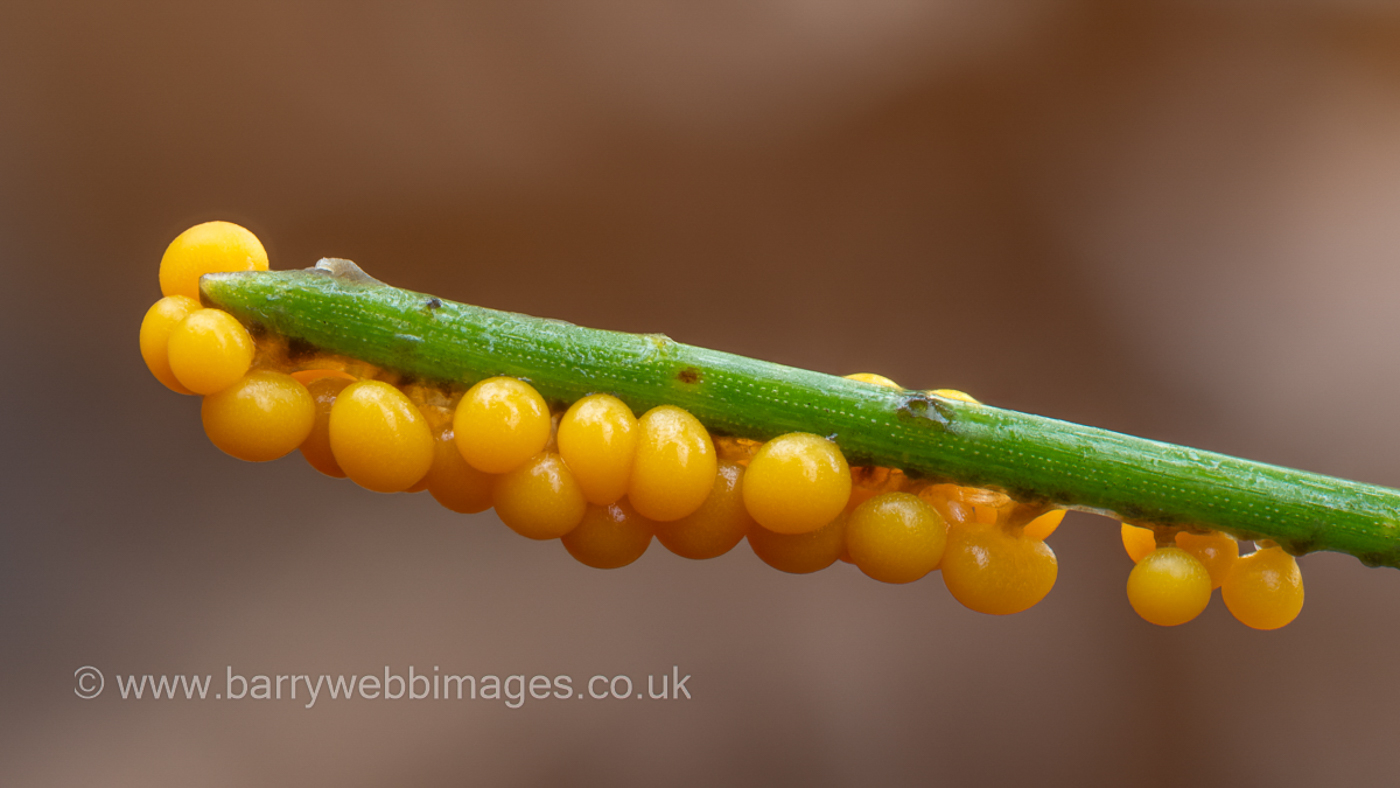
Leocarpus fragilis Nov 28. 2022. Both photos are from a maturing collection Barry found at Burnham Beeches. This is a common and often spectacular species forming large patches of mustard yellow plasmodium spreading over vegetation before settling down to develop these distinctive grape-like bunches, yellow at first then gradually darkening to brown. It favours conifers and gorse but can be spotted in many different habitats. Photo 3: Stoke Common 12.11.2025 Photos 4 and 5: Burnham Beeches 08.12.2025 showing both the plasmodium and mature stages |
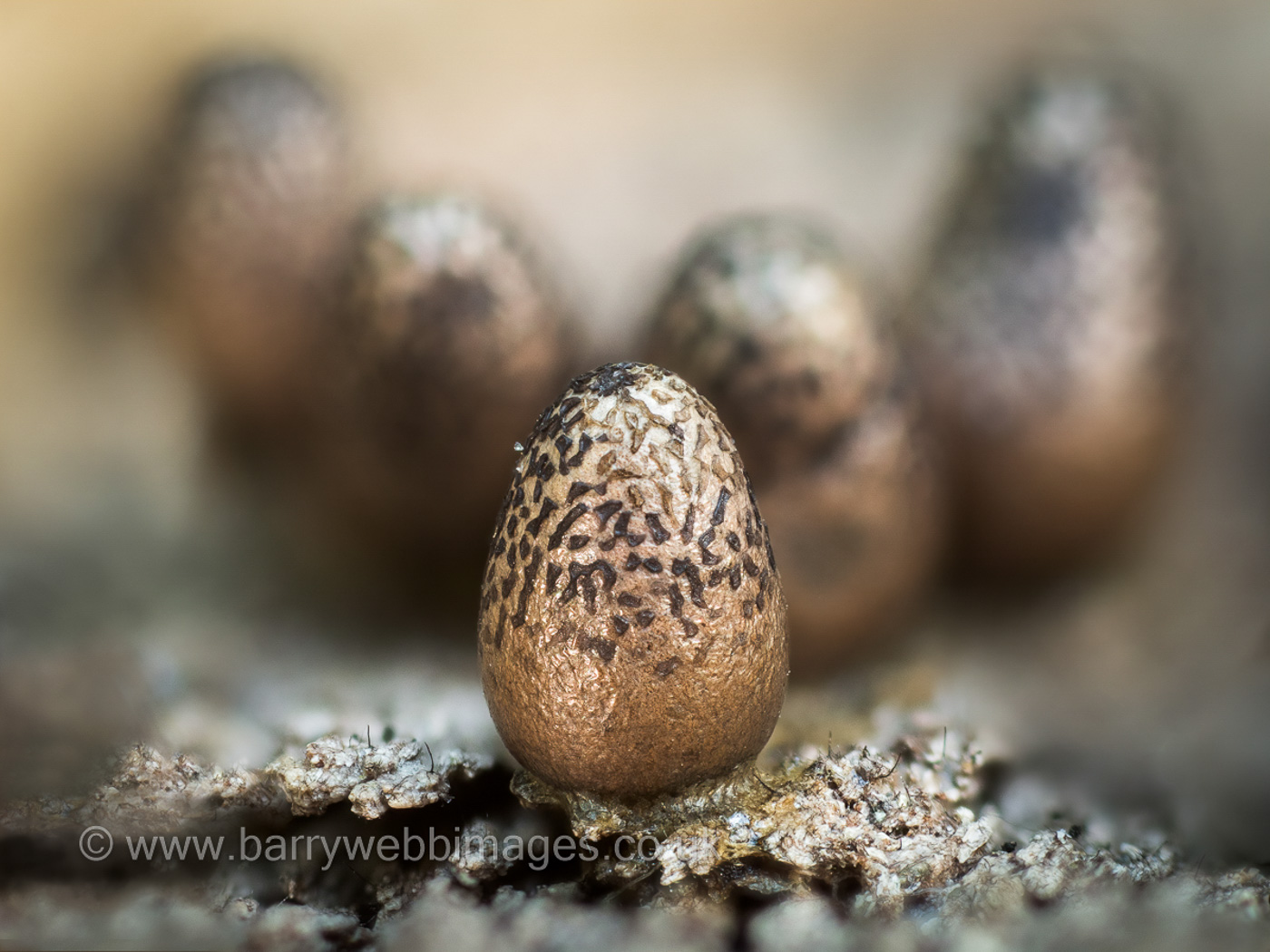 |
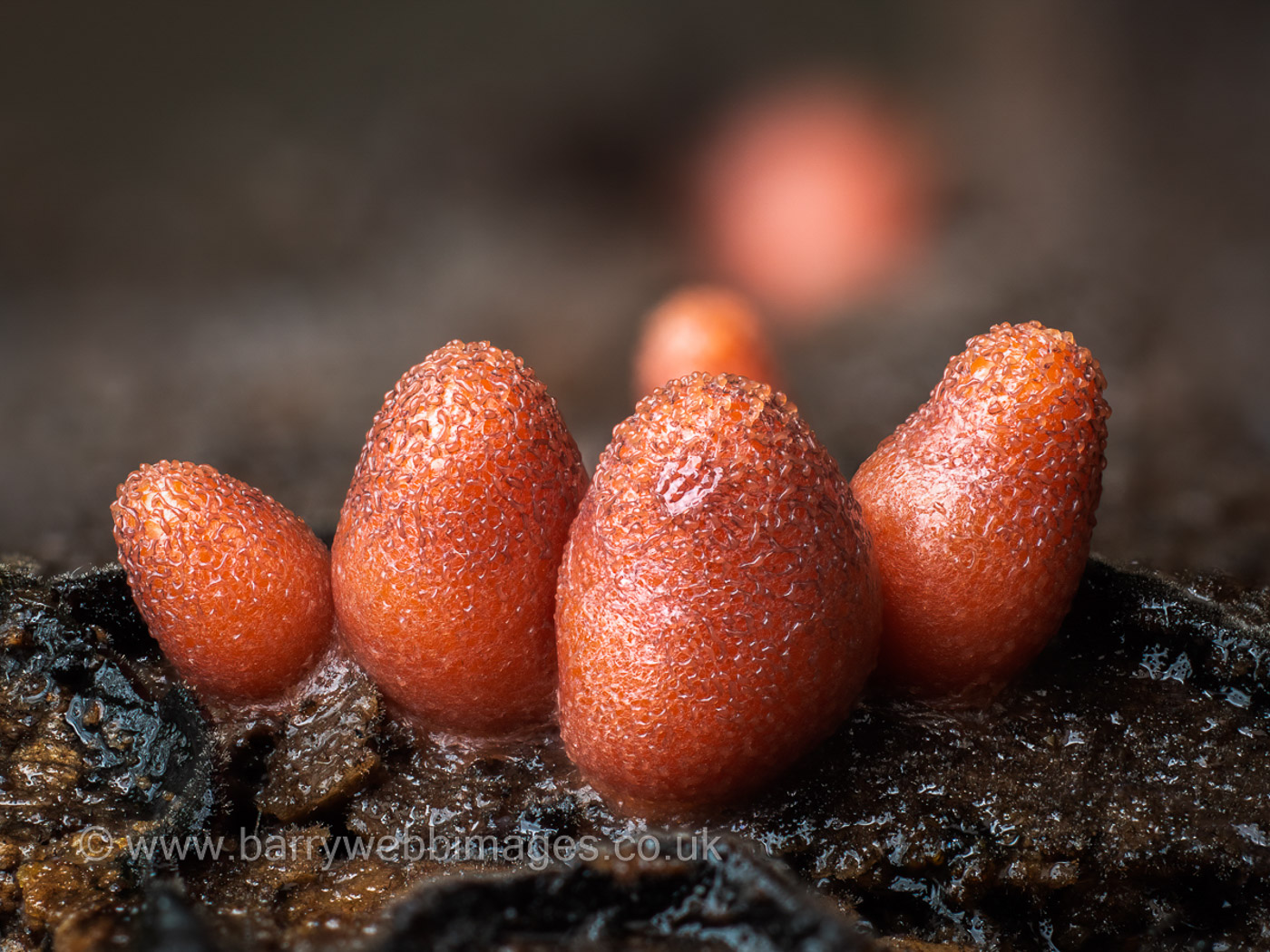
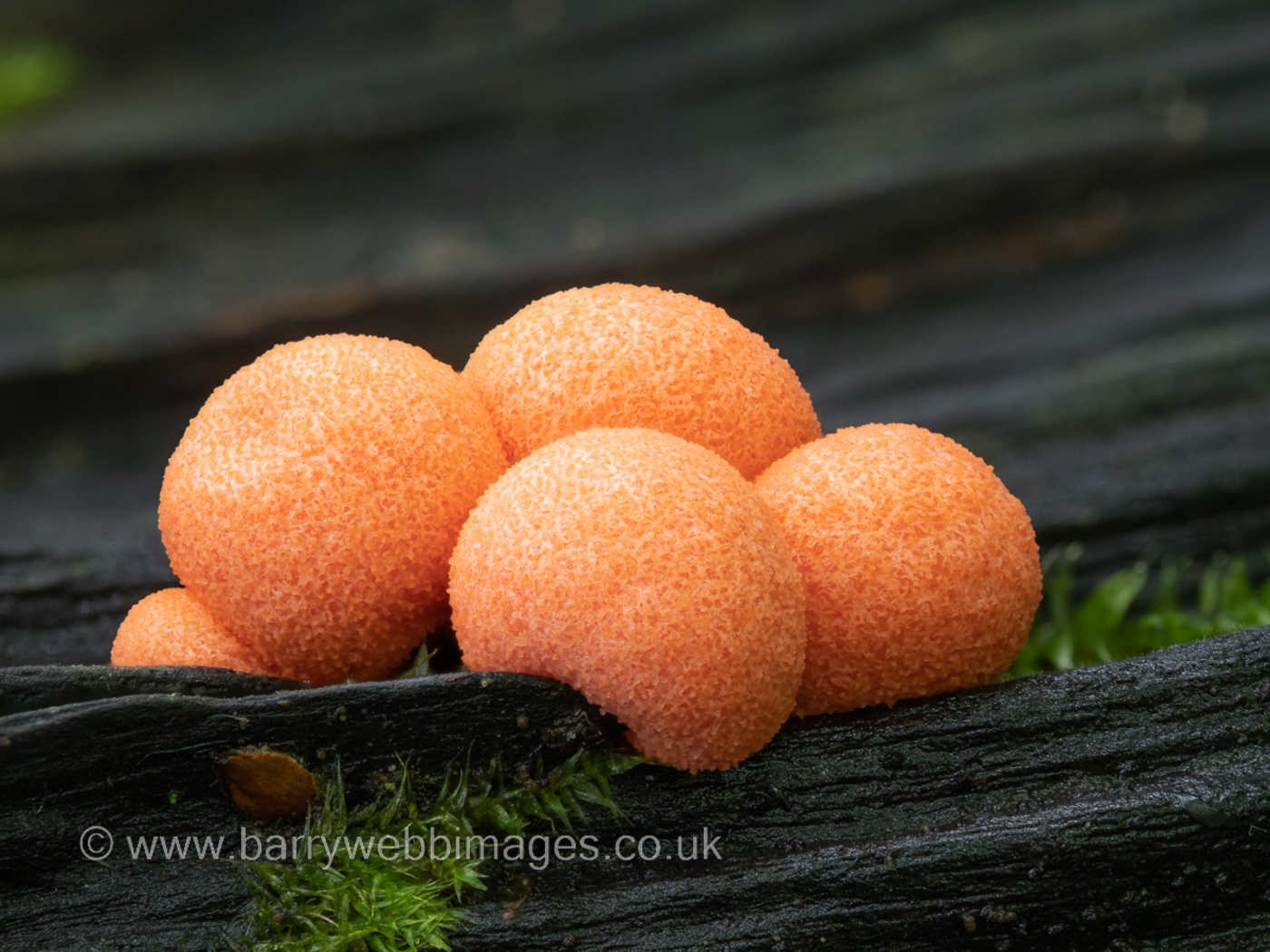
Lycogala conicum Jul 6, 2021. In Burnham Beeches on rotting fallen Birch Barry found this rare species, similar to the very common and familiar L. terrestre (Wolf's Milk) but instantly separable from it by its very distinctive conical egg shape. As with the (much) commoner species the plasmodium stage is pink, as are the developing sporocarps (fruiting bodies) which as they mature and dry off become gradually grey buff. Photo 2 (taken of a collection on a different Birch nearby found 10 days later) shows mature sporocarps. New to the site and the county, there appear to be under 20 national records of this species. |
 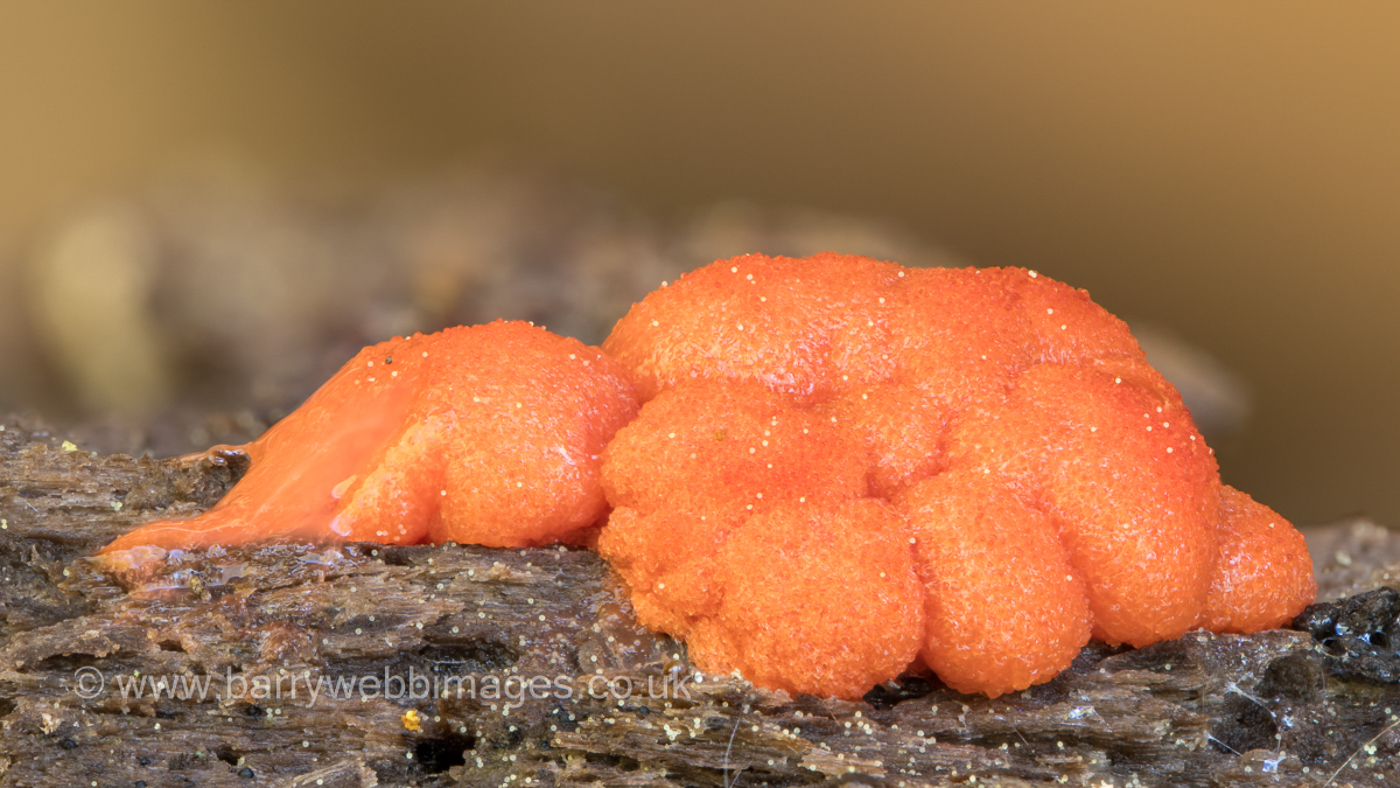 |
Lycogala terrestre complex Sept 10, 2022. Barry's photo of this species complex comes from Ivinghoe Common. This is arguably the most common and familiar slime mould (competing for this honour with Fuligo septica var. flava or possibly Reticularia lycoperdon!). However, in recent years DNA has shown that there are many species involved in this complex appearing amazingly similar, thus we can no longer name brightly coloured blobs with any confidence even with the aid of microscopic examination. There has long been confusion over whether collections belonged to L. terrestre or L. epidendrum but now there are many more names thrown into the mix. Hopefully this situation will gradually change with differences possibly in colour, substrate and association etc becoming more apparent with further research and knowledge. Photo 2: Stoke Common 20.05.2023 Photo 3: Burnham Beeches 19.04.2026 |
M |


|
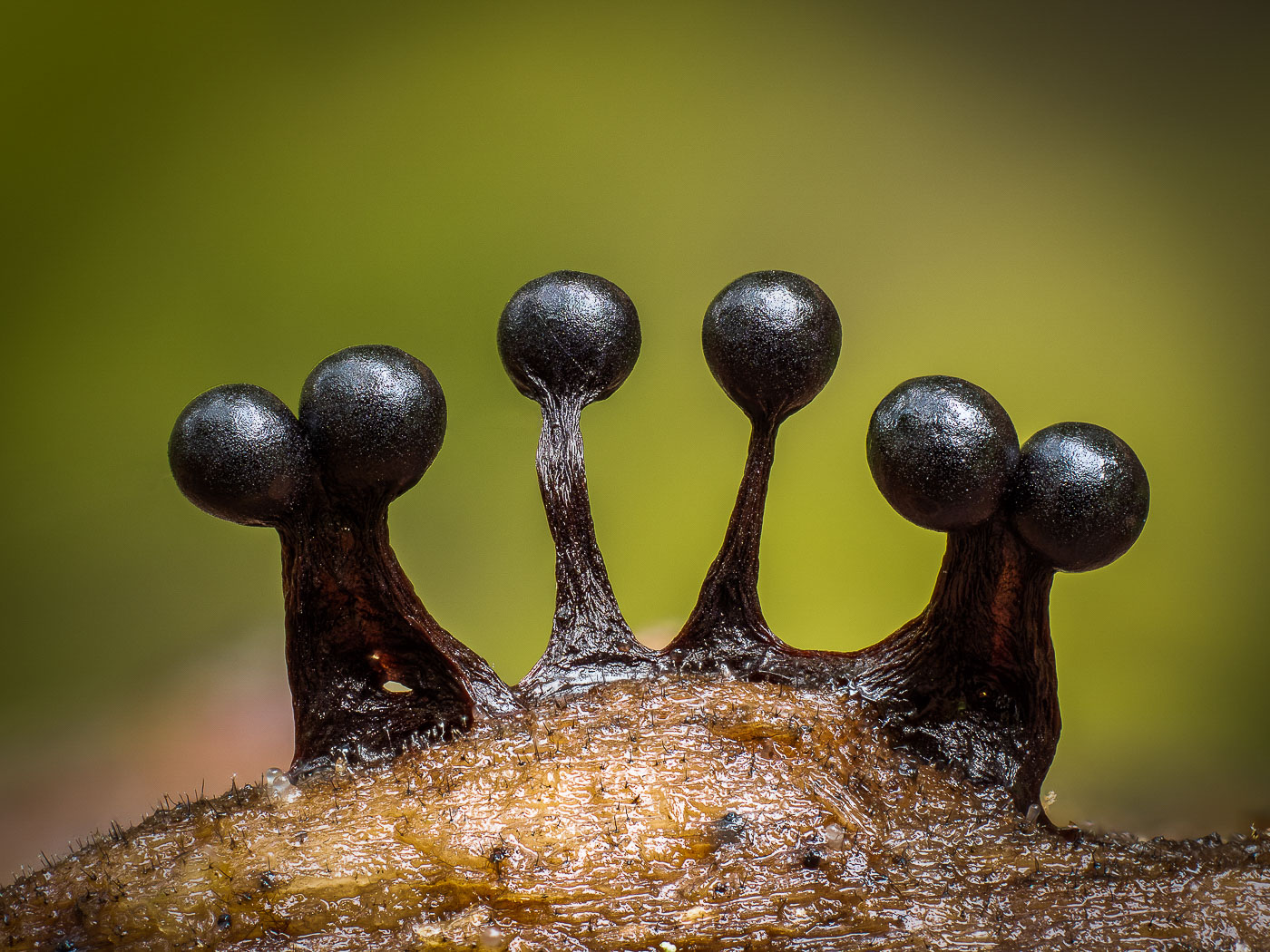
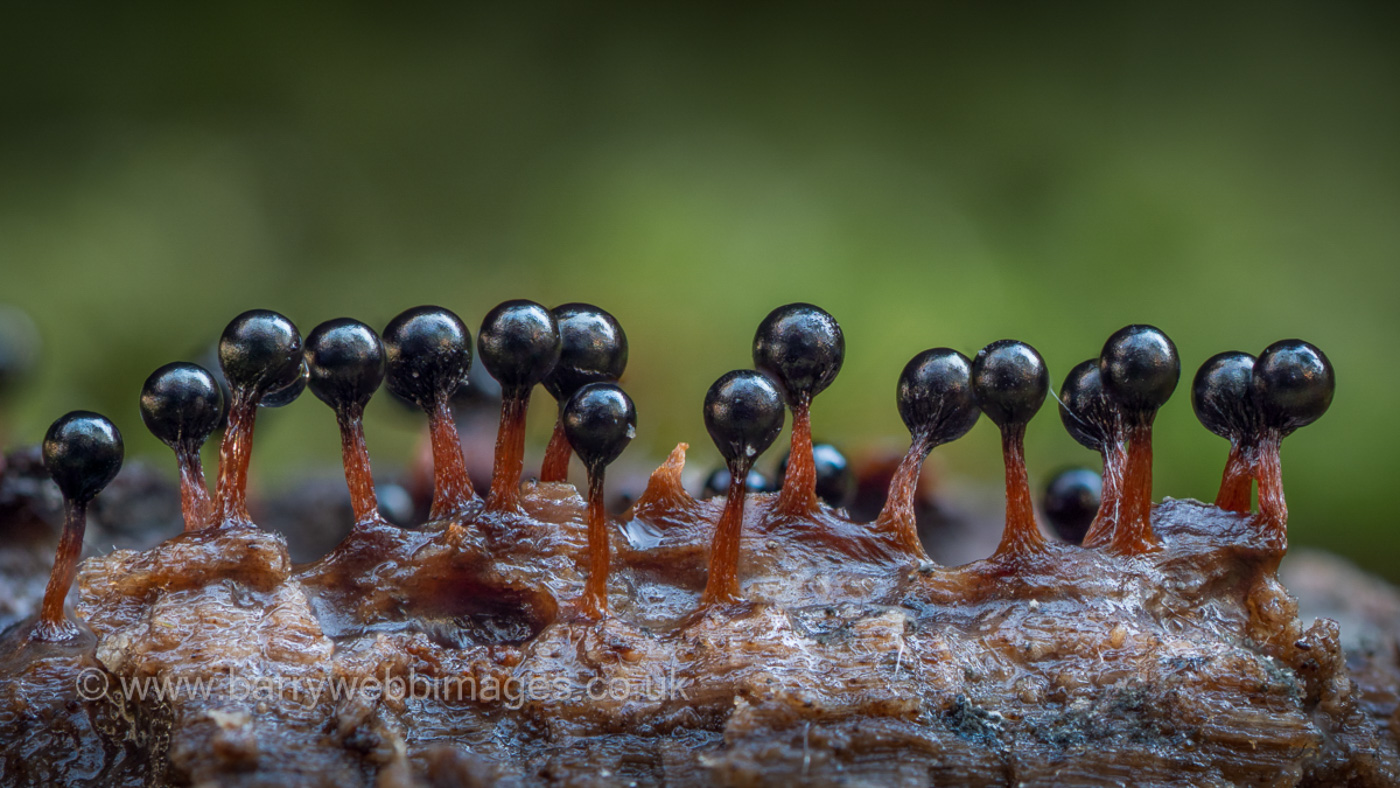
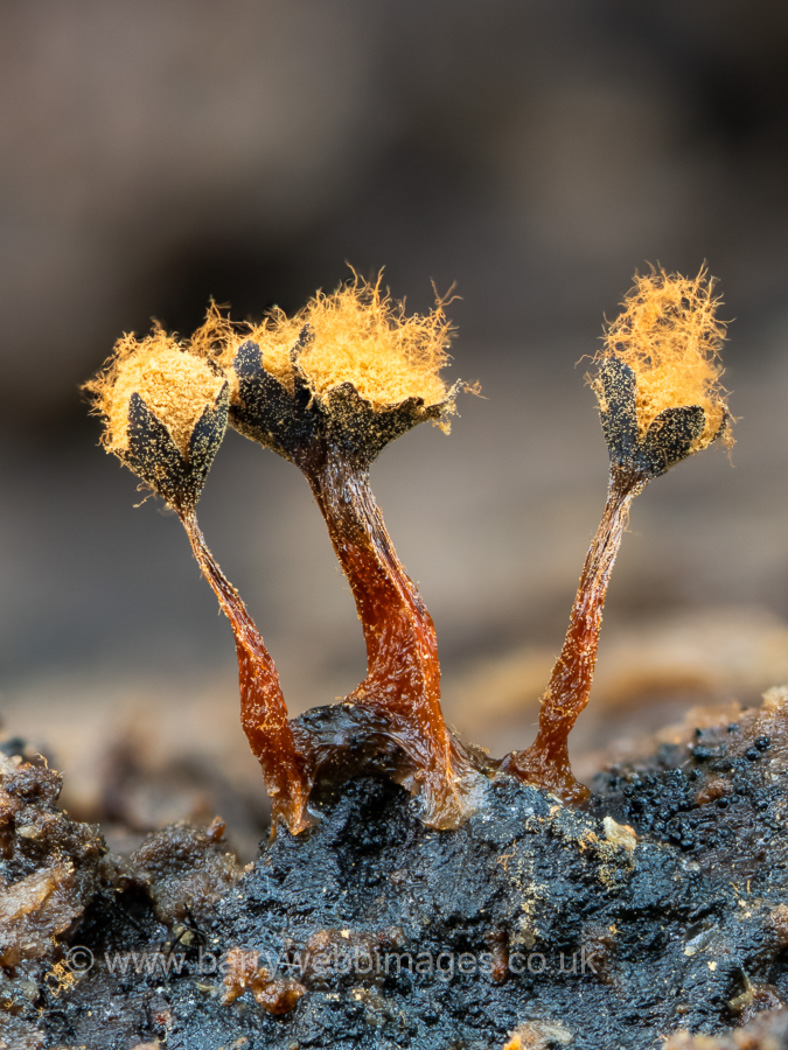
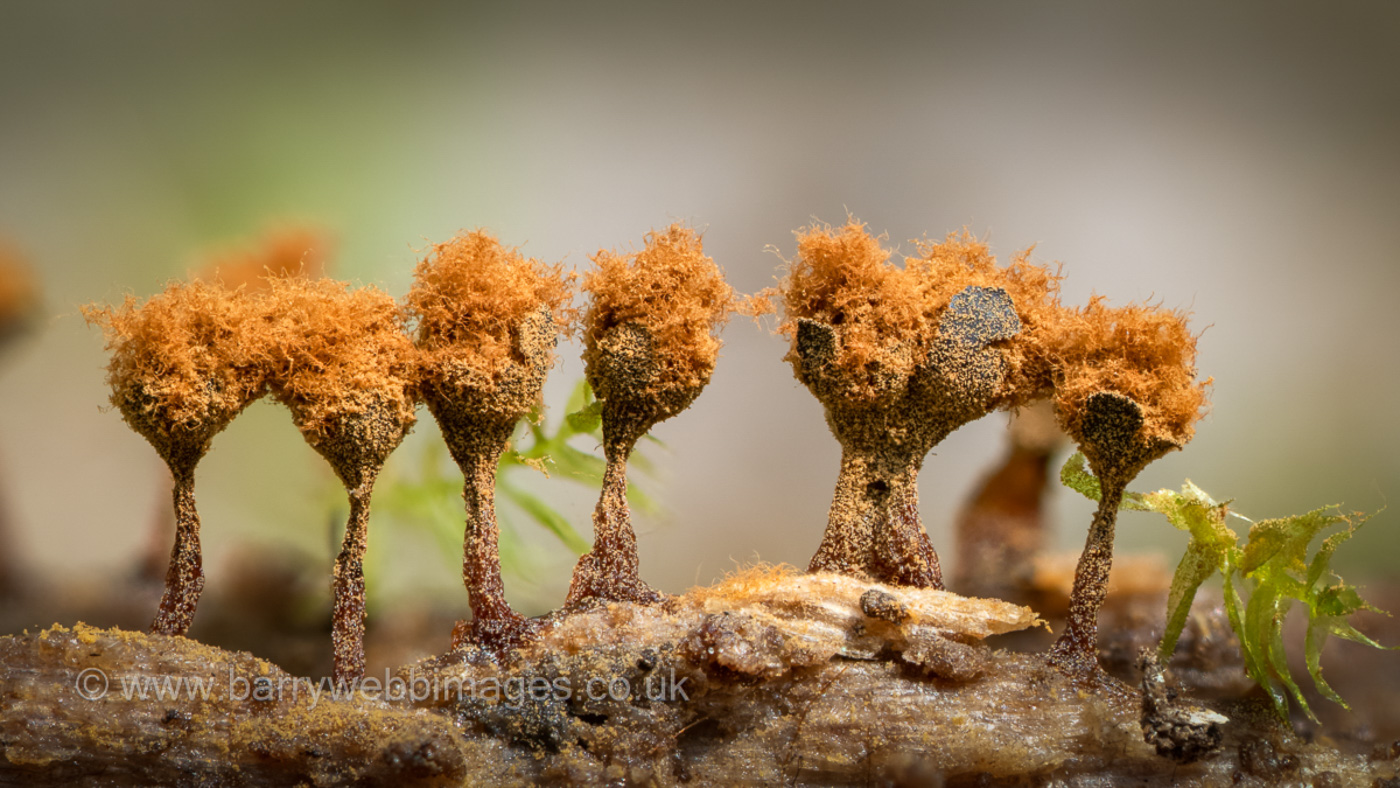
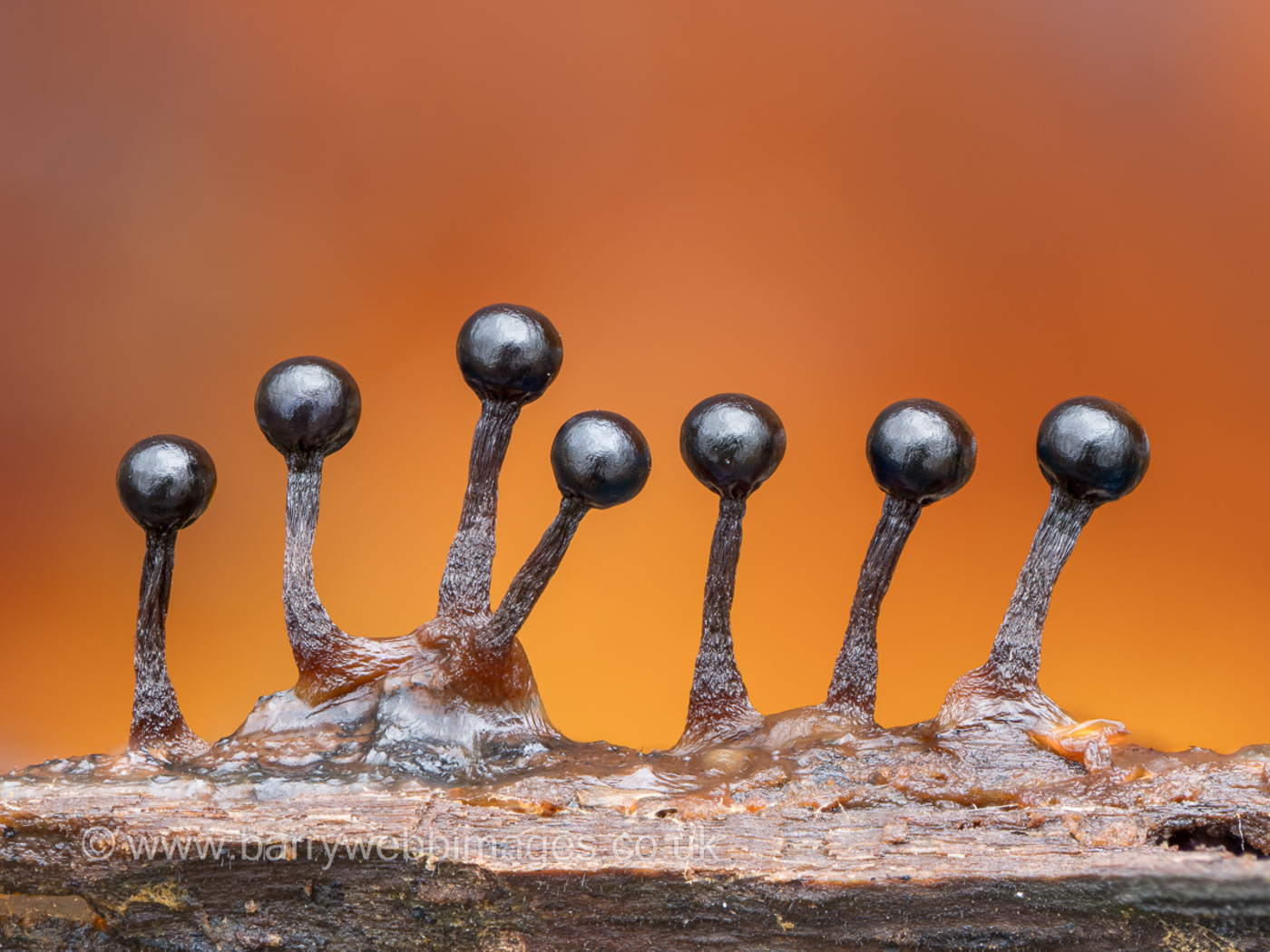
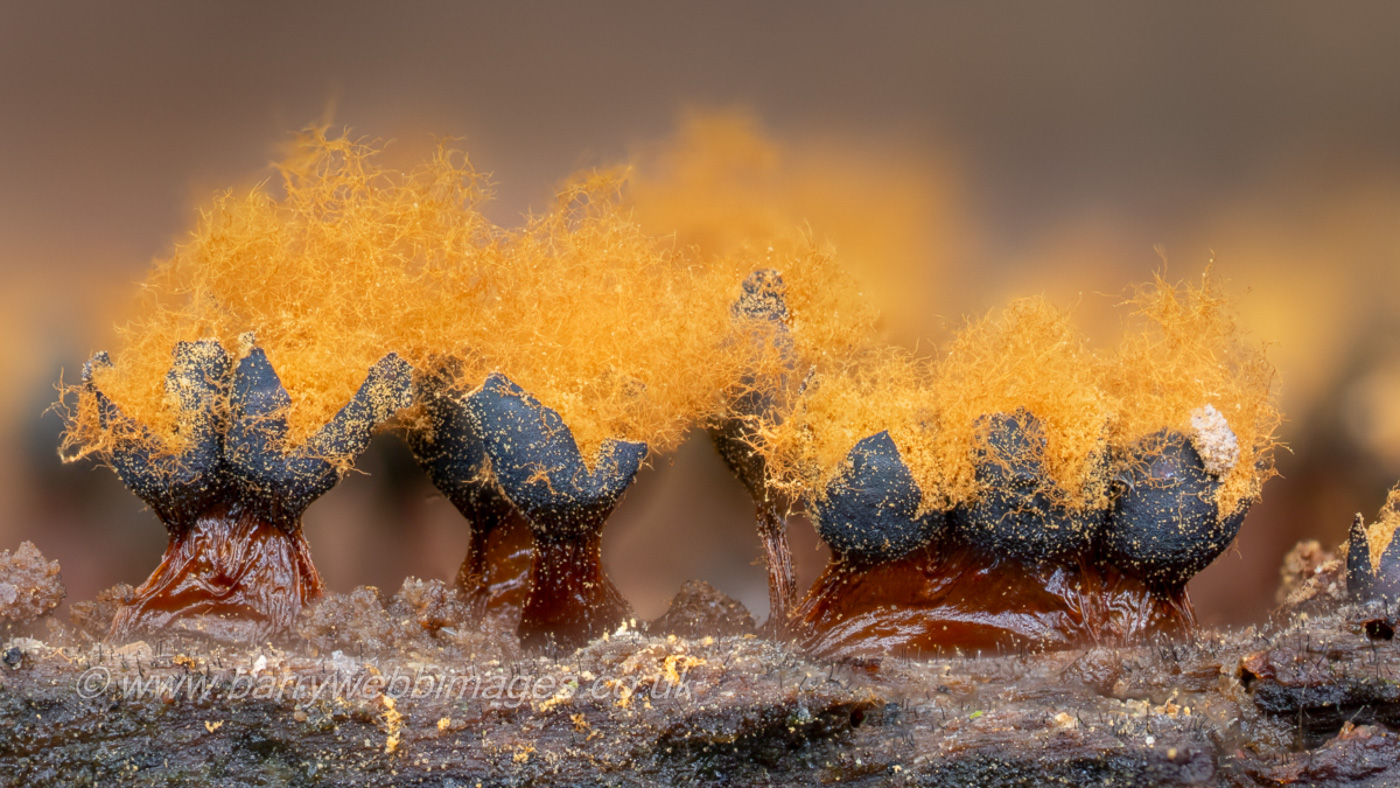
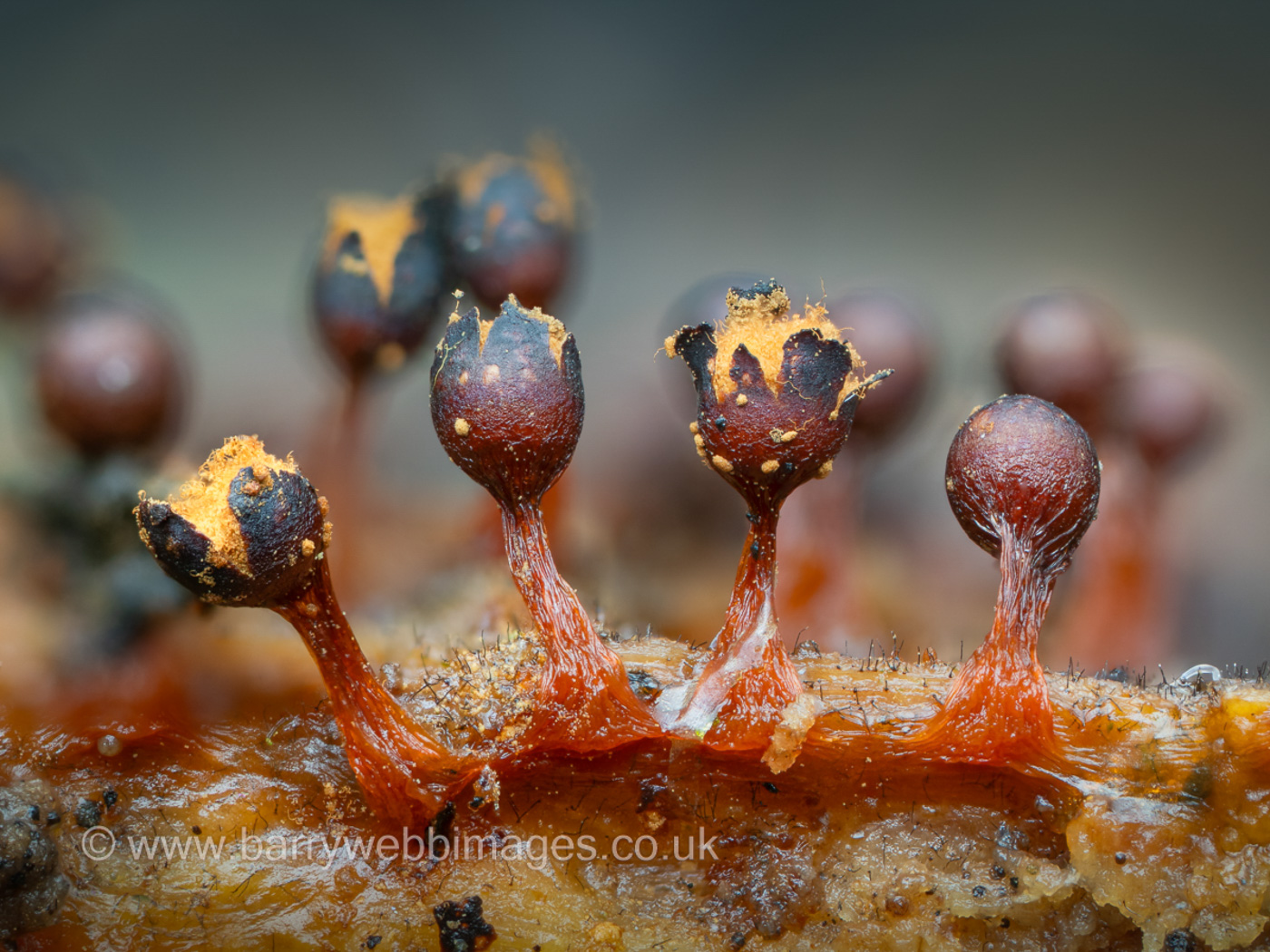
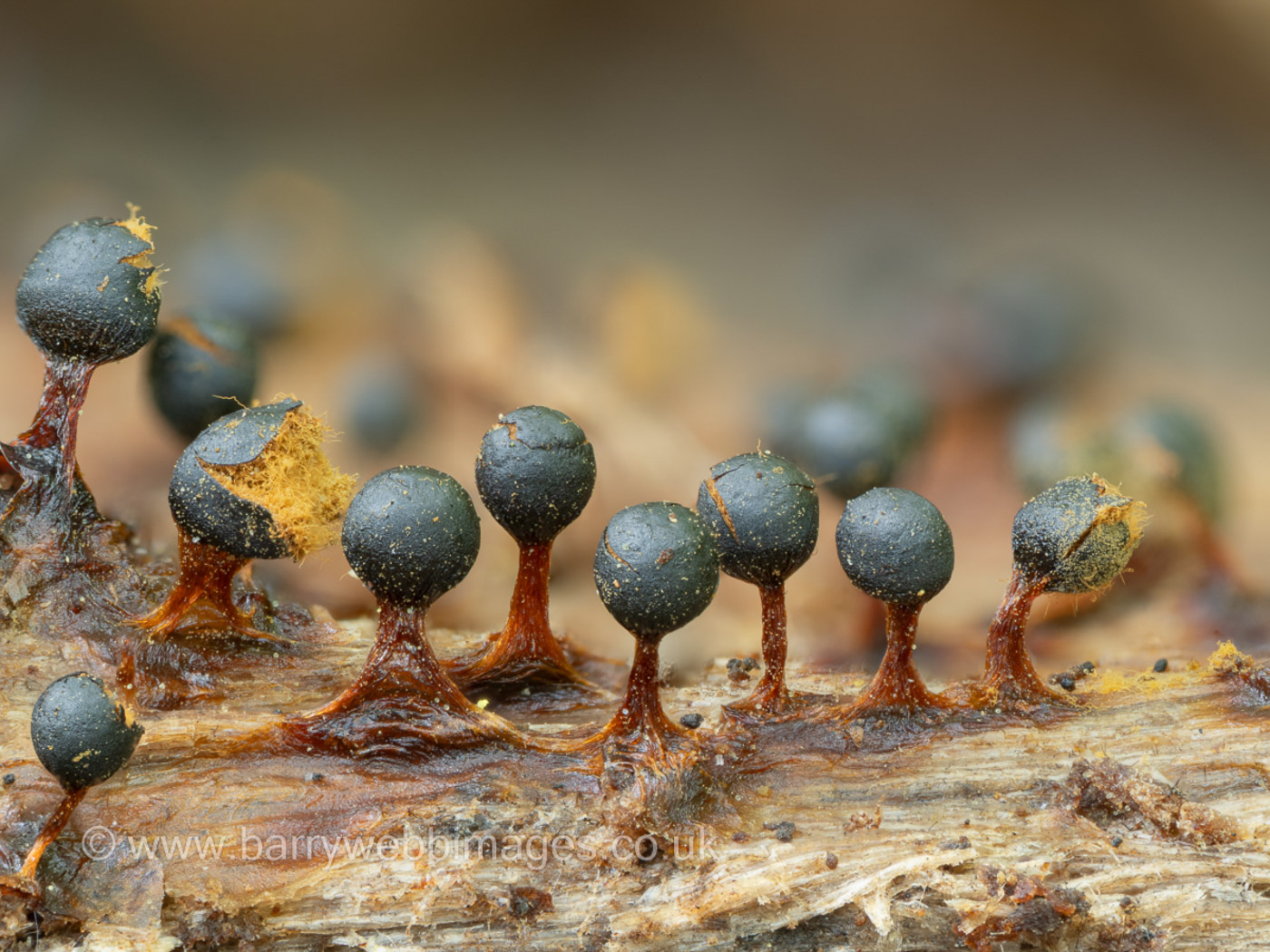
Metatrichia floriformis Oct 17, 2020. Barry Webb took Photo 1 in Penn Wood, part of a colony of this tiny very common slime mould which (like many other species) grows on rotting damp fallen wood. The plasmodium of this particular species is dark red to black, then it gradually 'mutates', developing into these black blobs on stalks less than 4 mm high which then split open forming a flower-like shape (hence its species name) and from which the orange spore mass disperses. Photo 2: Penn Wood (2019 - date not known) showing a line of mature specimens Photos 3 and 4: Ivinghoe Common 04.09.2021 showing lines of both immature and mature specimens Photo 5: Naphill Common 12.01.2022 showing an impressively large immature cluster with red stalks and black heads Photo 6: Burnham Beeches 23.03.2022, a mature threesome Photo 7: Rushbeds Wood 16.04.2022, showing a dusting of mature spores having been largely dispersed Photo 8: Hodgemoor Wood 08.01.2024, an immature line found under Holly Photo 9: Burnham Beeches 17.04.2024 with flower shape and spore dispersal well underway Photo 10: Burnham Beeches 12.12.2024 with orange red colouring still apparent Photo 11: Hodgemoor Wood 26.04.2025 with heads just about to burst open |
 |
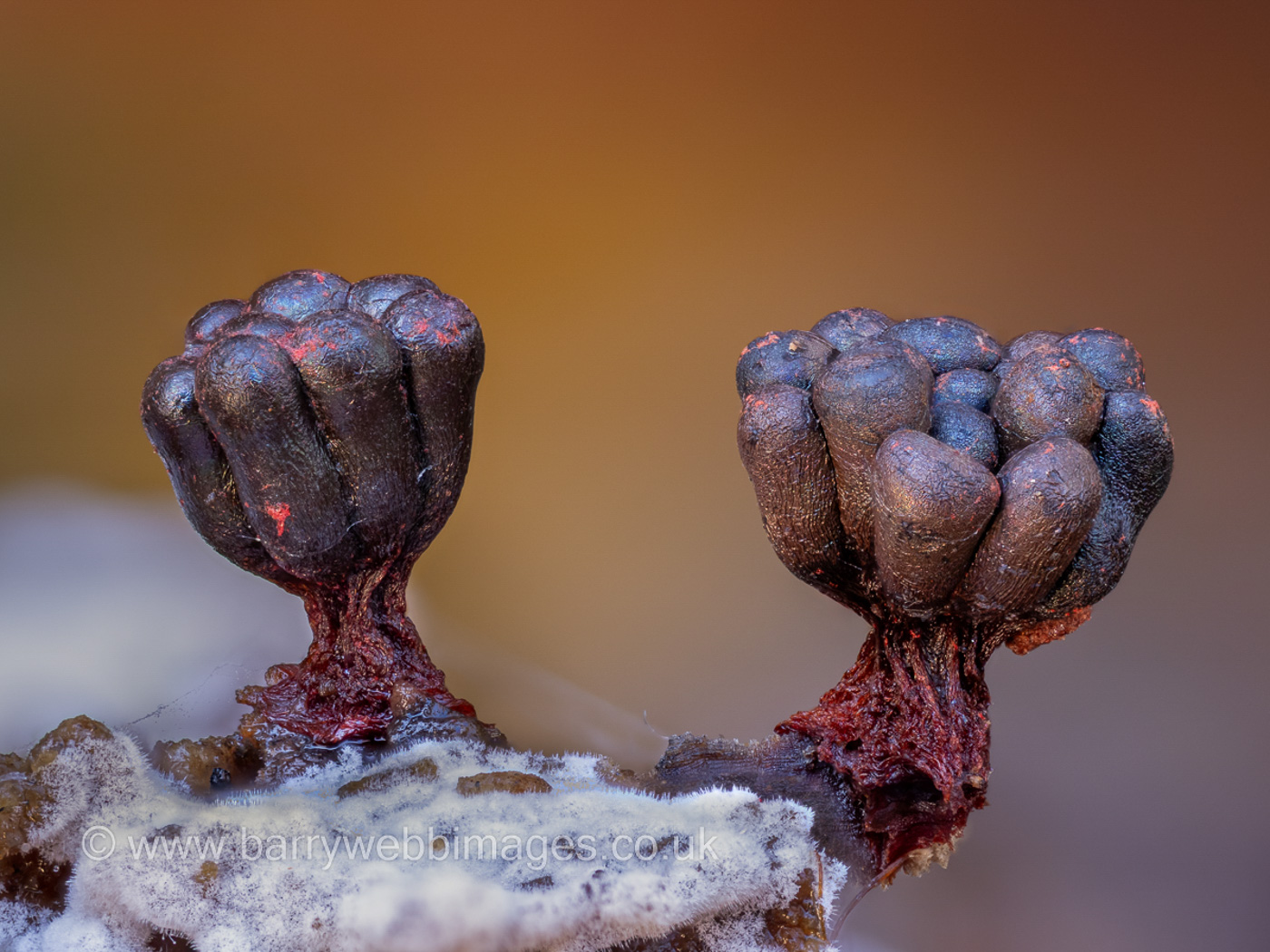
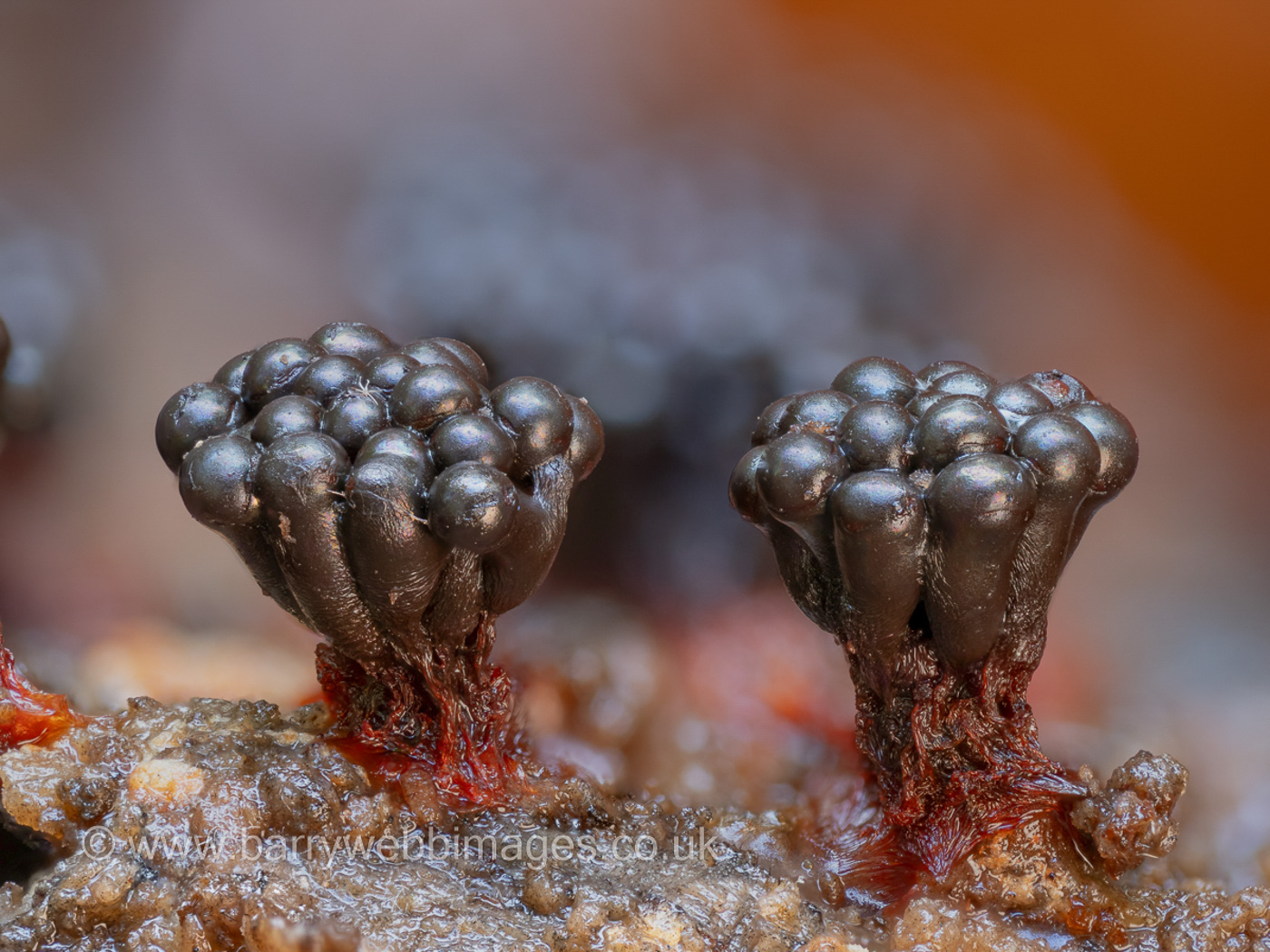
Metatrichia vesparium Nov 22, 2023. In Burnham Beeches on a large fallen rotten Beech Barry Webb was pleased to spot this particular species as it was one that had been eluding him (and Penny) despite not being described as rare. He found it recently on a visit to the New Forest but this today's find was a new record for Bucks. When mature as seen here it is distinctive enough to be recognised and named in the field, the tightly clustered groups of sporangia bearing a distinct resemblance to a wasp's nest (hence its Latin species name) despite being tiny. Photo 2: Burnham Beeches 20.10.2024 Photo 3: Burnham Beeches 18.12.2024 |
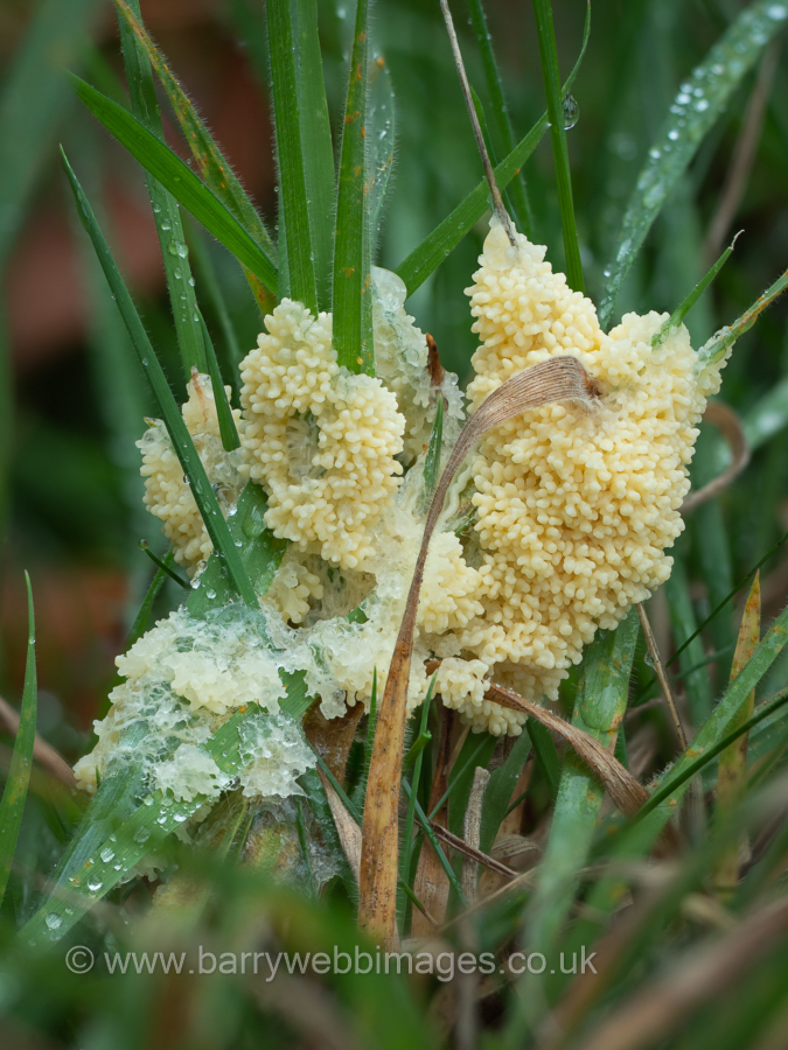 |
Mucilago crustacea Nov 14, 2021. In Penn Street churchyard Barry spotted this relatively common slime mould spreading up some grass stems and still 'on the move' at the transitional stage between plasmodium and maturity. It favours grassy areas particularly in calcareous soils and once settled down it quickly dries off becoming crusty and crumbly, hence its Latin species name. (Incidentally this is the species allotted the affectionate name 'Dog's vomit' for obvious reasons, and not Fuligo septica var. flava to which some people now incorrectly attach that name!) |
| O |
|
 |
Oligonema (previously Trichia) favoginea Sep 22, 2023. On fallen rotten Birch at Burnham Beeches Barry Webb found this rare species. This is one of several members of genus Trichia moved to genus Oligonema in 2022 and when mature as here it forms tiny yellow tightly clustered blobs which unusually are more cylindrical than round and also have virtually no stalk. On the lowest four sporangia at the far right can be seen how they burst open to release spores which are held amongst many 'elaters' - tiny long snaking strands, the shape, width and spiral markings of which are useful tools in identification. This was a nice find and is new to the county with not that many national records. |
| P |
|

|
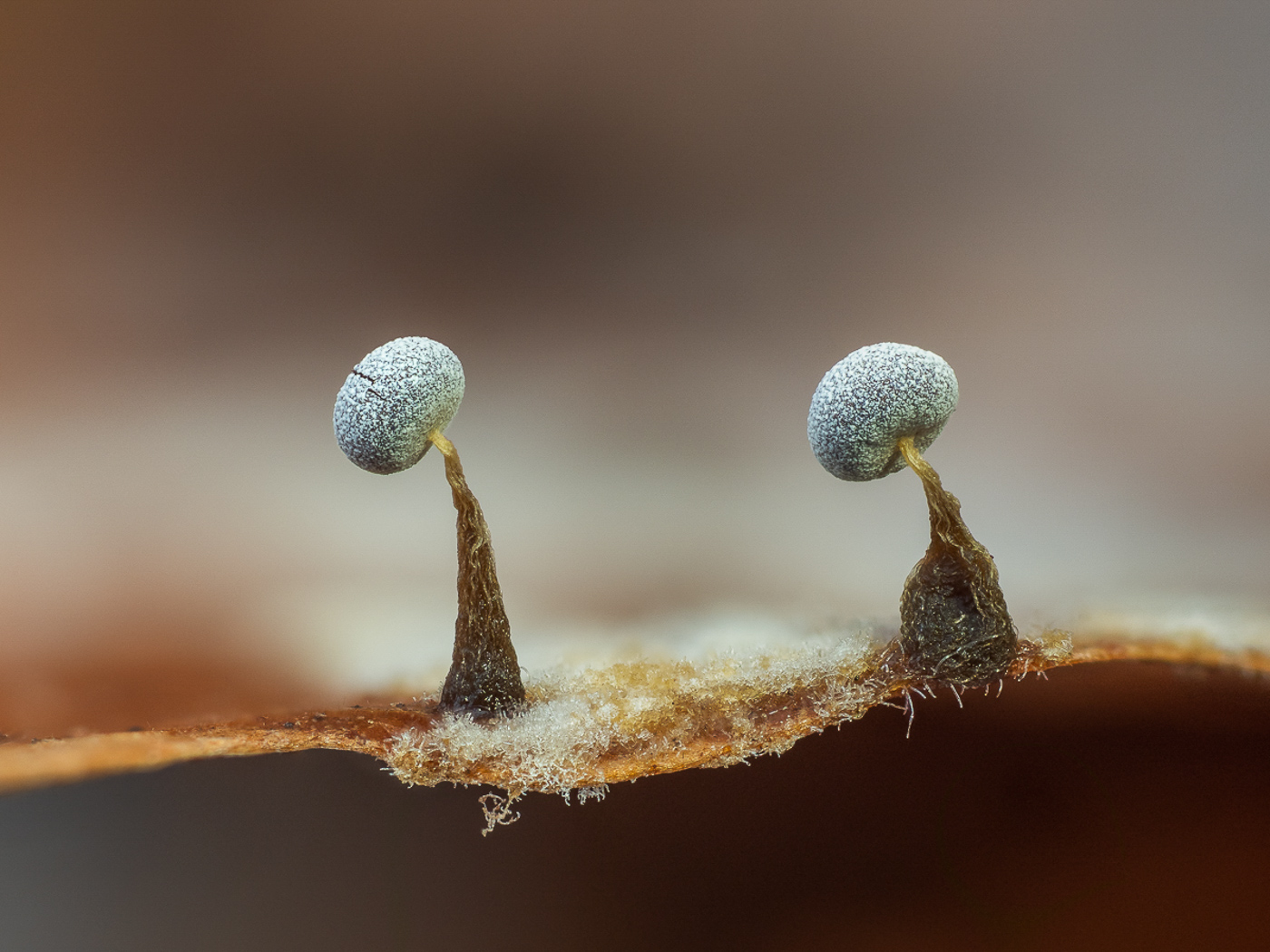
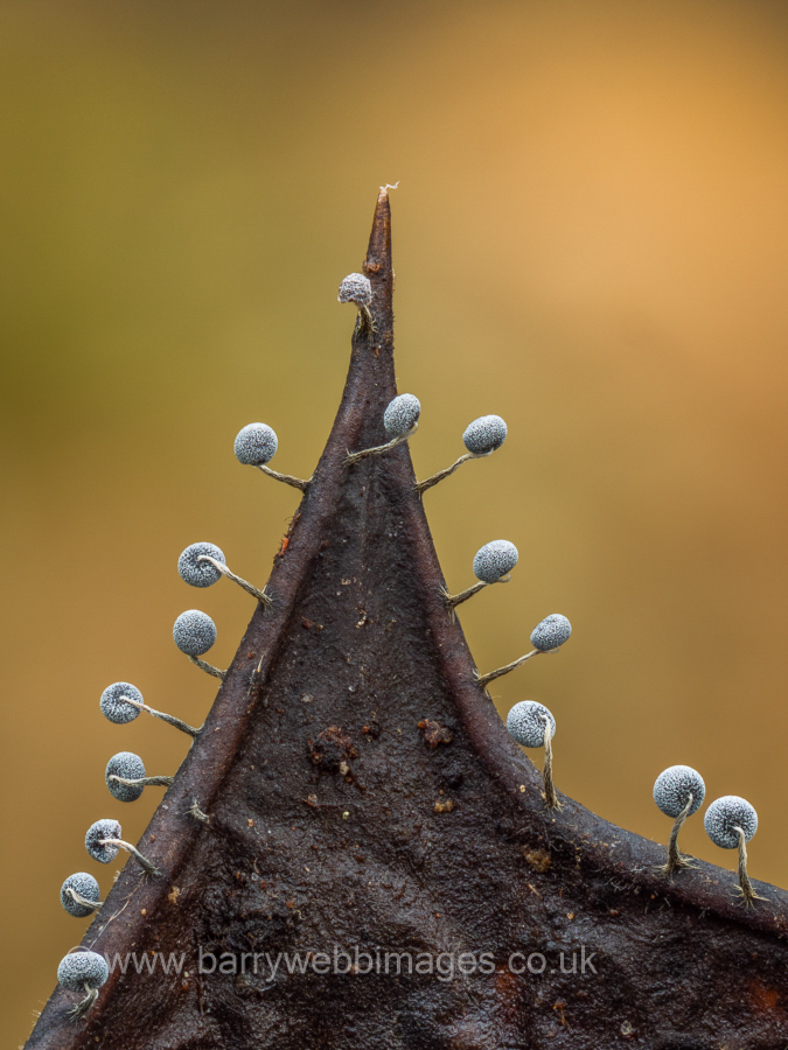
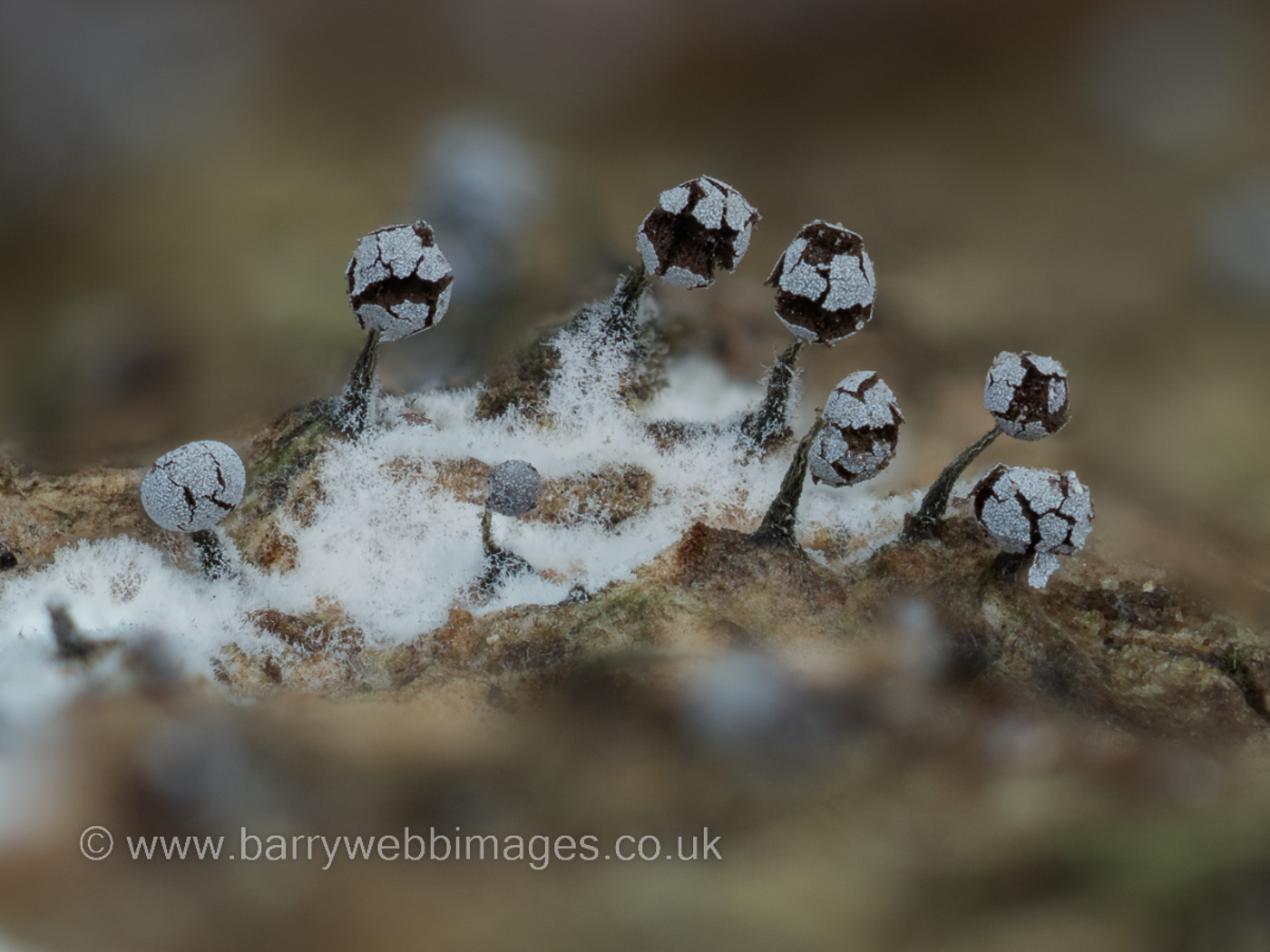
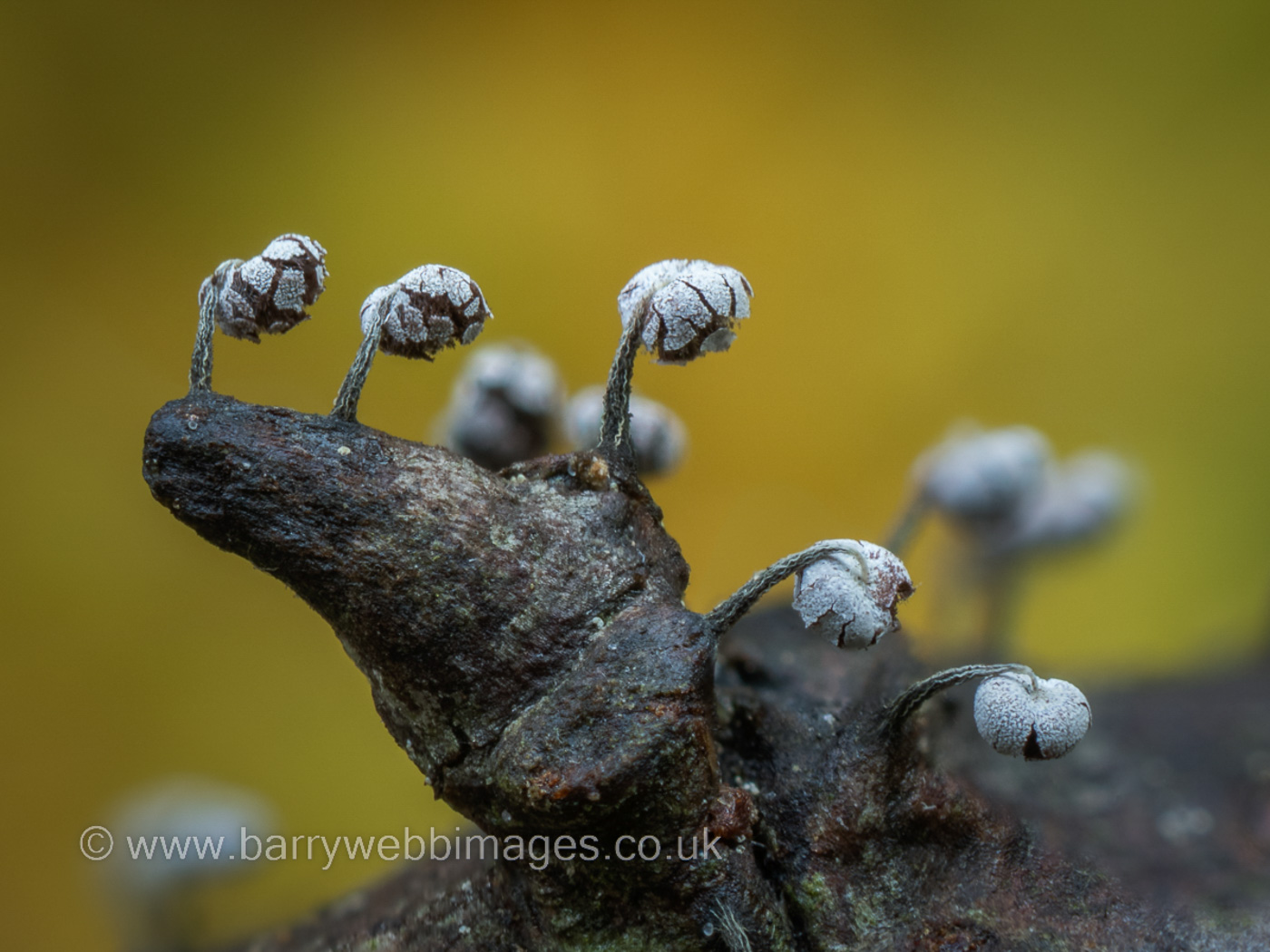
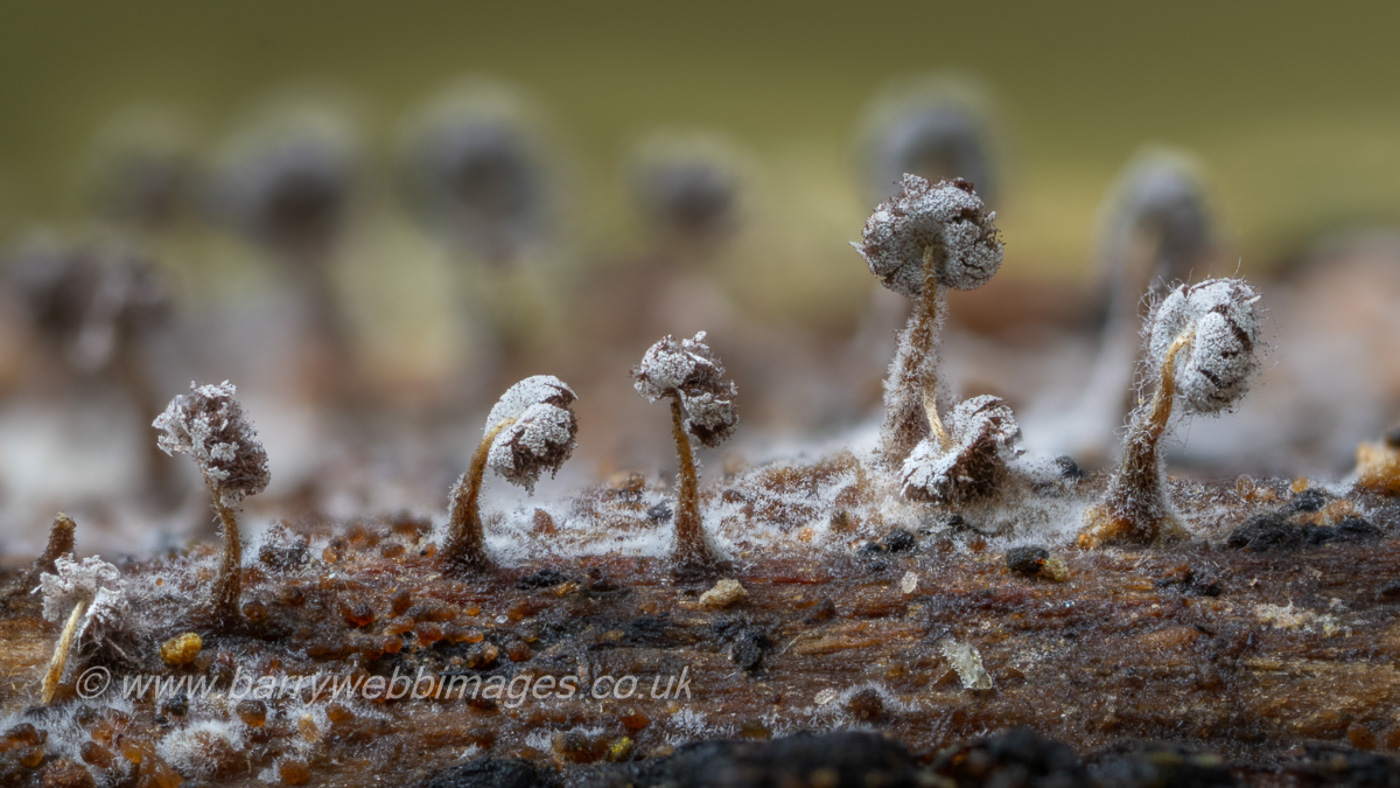
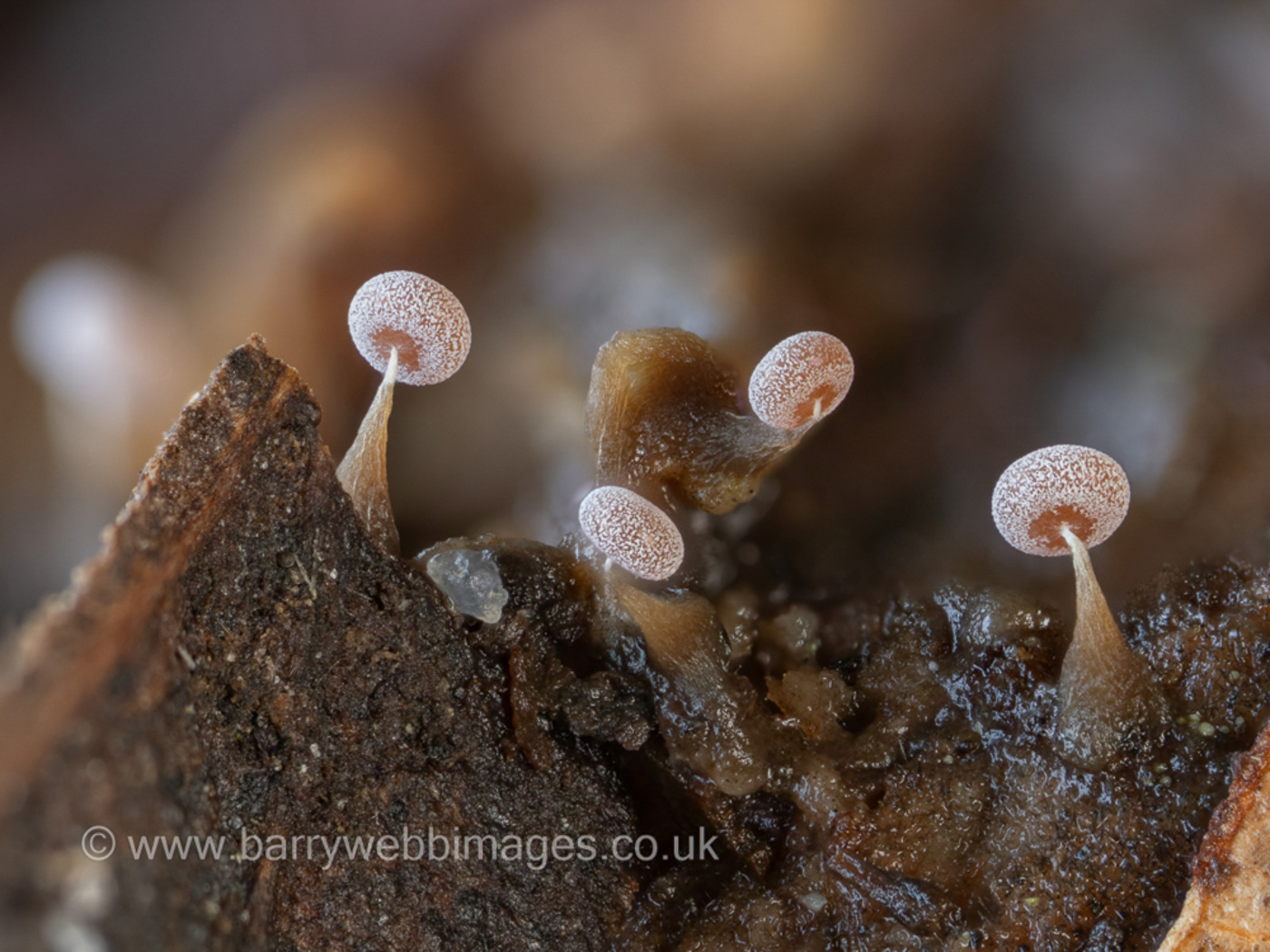
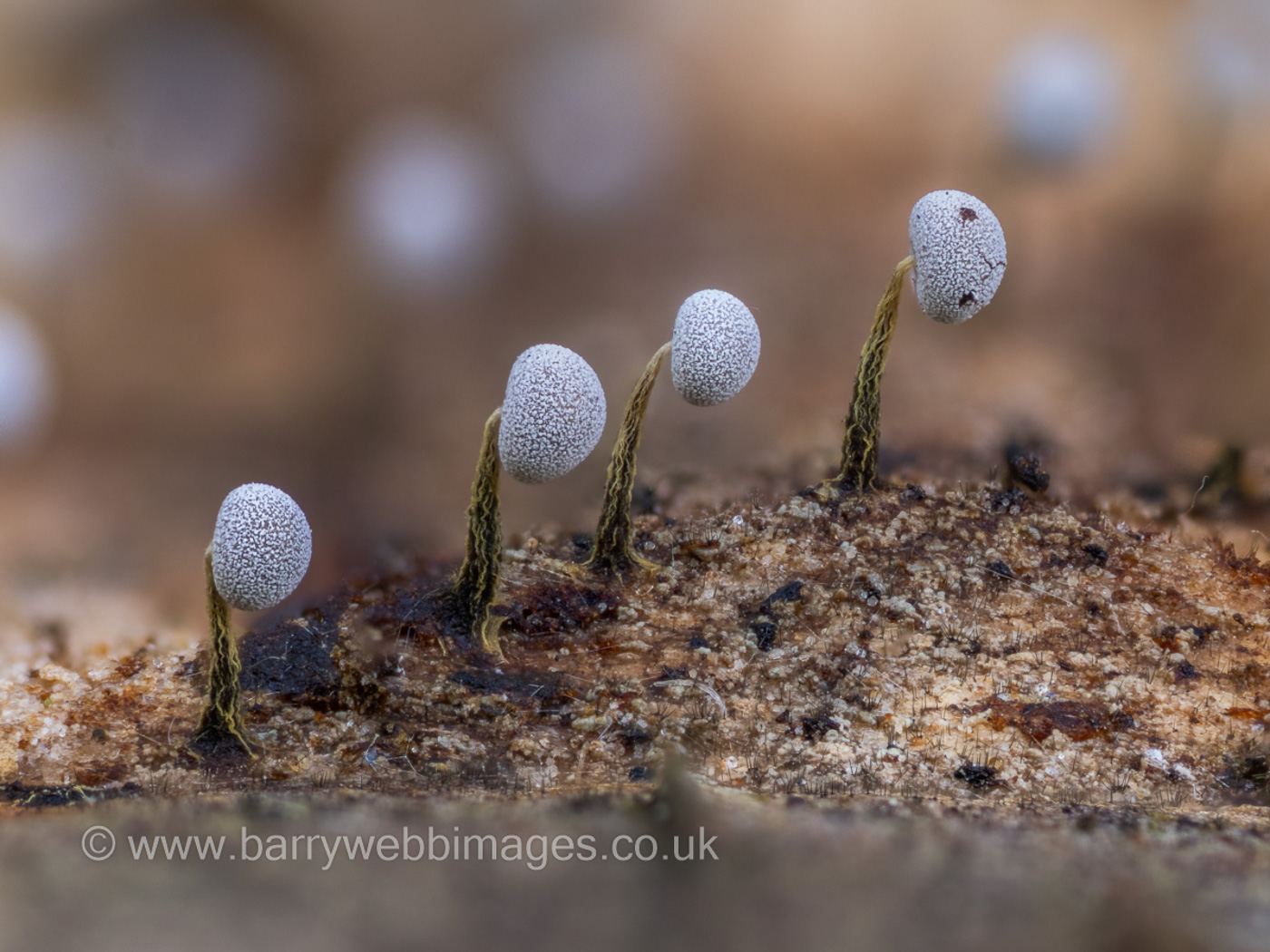
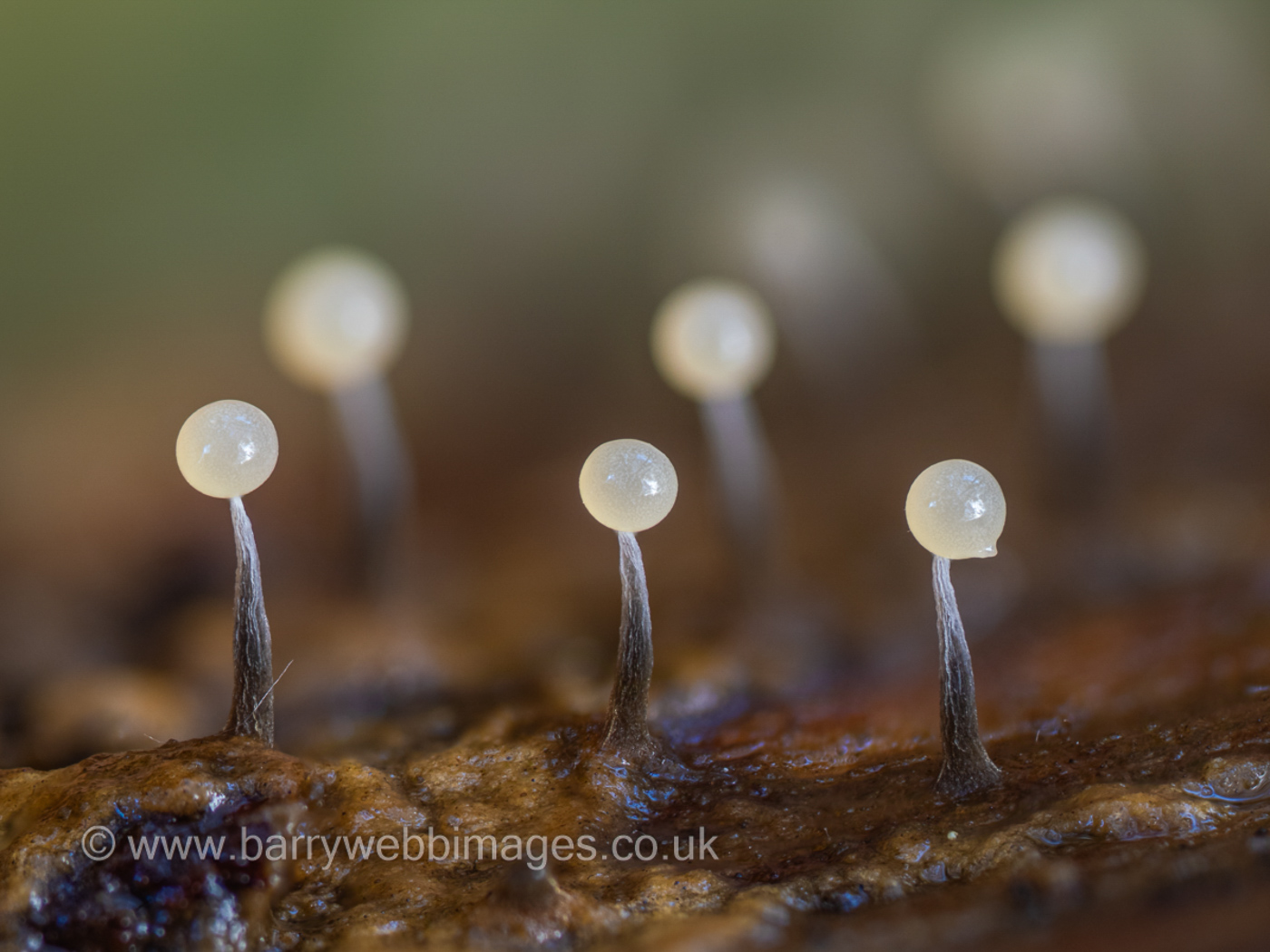
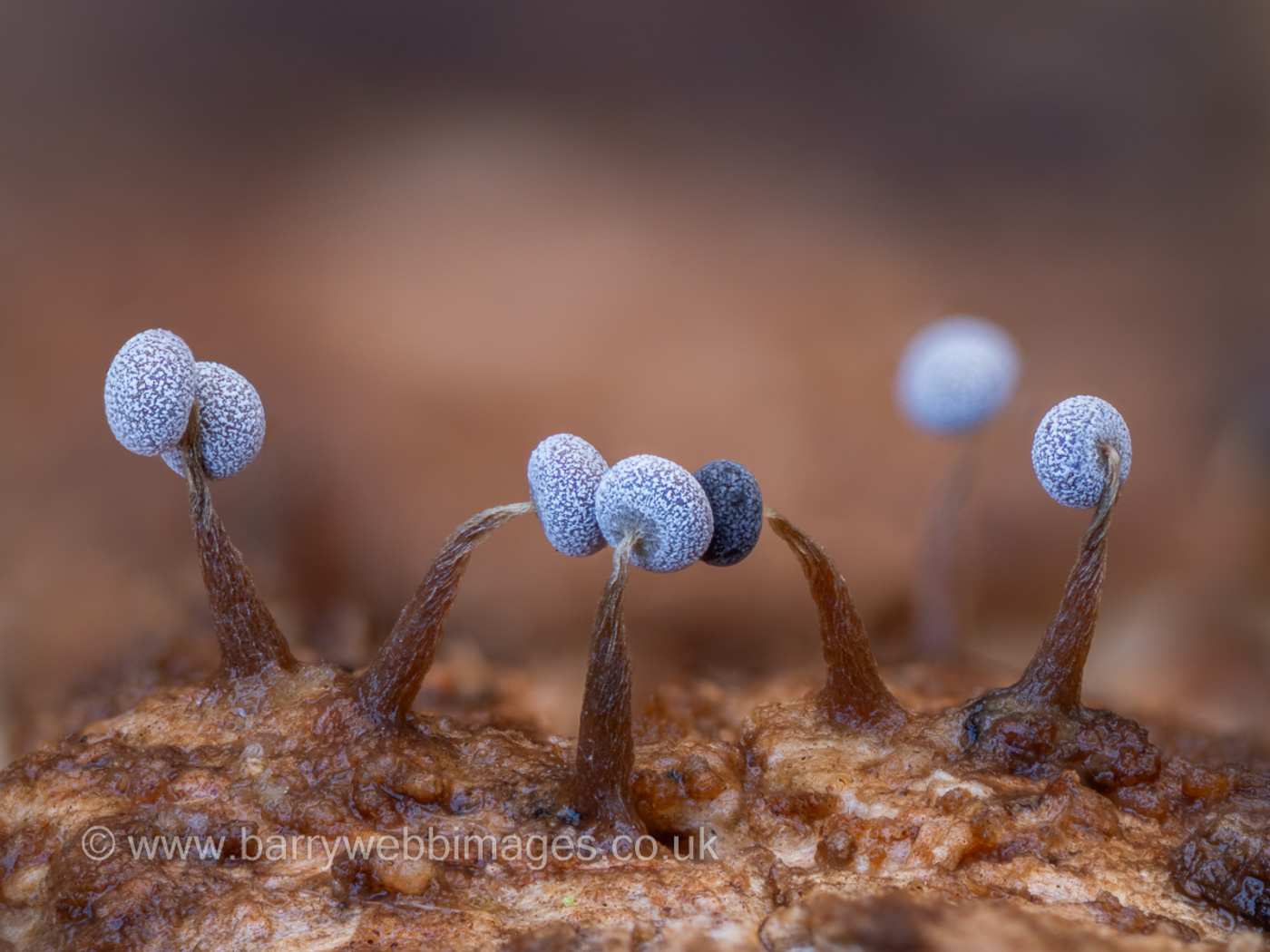
Physarum album Nov 1, 2020. Barry Webb found this relativiely common species (previously known as P. nutans) growing in Beech litter at Burnham Beeches. A member of a large and difficult genus to identify to species, this particular species can with experience be named in the field from its 'nodding' habit: when mature the heads, covered in white crystals, tend to droop and loll over to one side. Found sometimes in large colonies dead wood or bark, also on dead leaves or moss, each sporocarp (fruiting body) is no taller than 1 cm. Photo 2: Ivinghoe Common 04.09.2021 Photo 3: Hodgemoor Wood 06.01.2022 an exceptionally photogenic pose on a Holly leaf Photo 4: Hodgemoor Wood 18.09.2022 showing maturity with splitting crystals Photo 5: Stoke Common 29.10.2022 with really droopy heads Photo 6: Burnham Beeches 17.04.2024 showing advanced maturity Photo 7: Hockeridge Wood 09.10.2024 showing an immature stage Photo 8: Wotton House Estate 24.09.2025 Photo 9: Penn Wood 02.11.2025 showing a very early stage prior to crystals developing Photo 10: Stampwell Farm 08.11.2025 |
 |
Physarum bivalve Dec 8, 2022. In leaf litter at Burnham Beeches Barry Webb found this tiny strip of a slime mould species, new to him and to the site and with just one previous county record when identified by expert Bruce Ing from a specimen sent him by Penny in 2014 from Carpenters Wood. Barry's collection was identified by expert Edvin Johannesen from his macro- and microphotos. |

 |
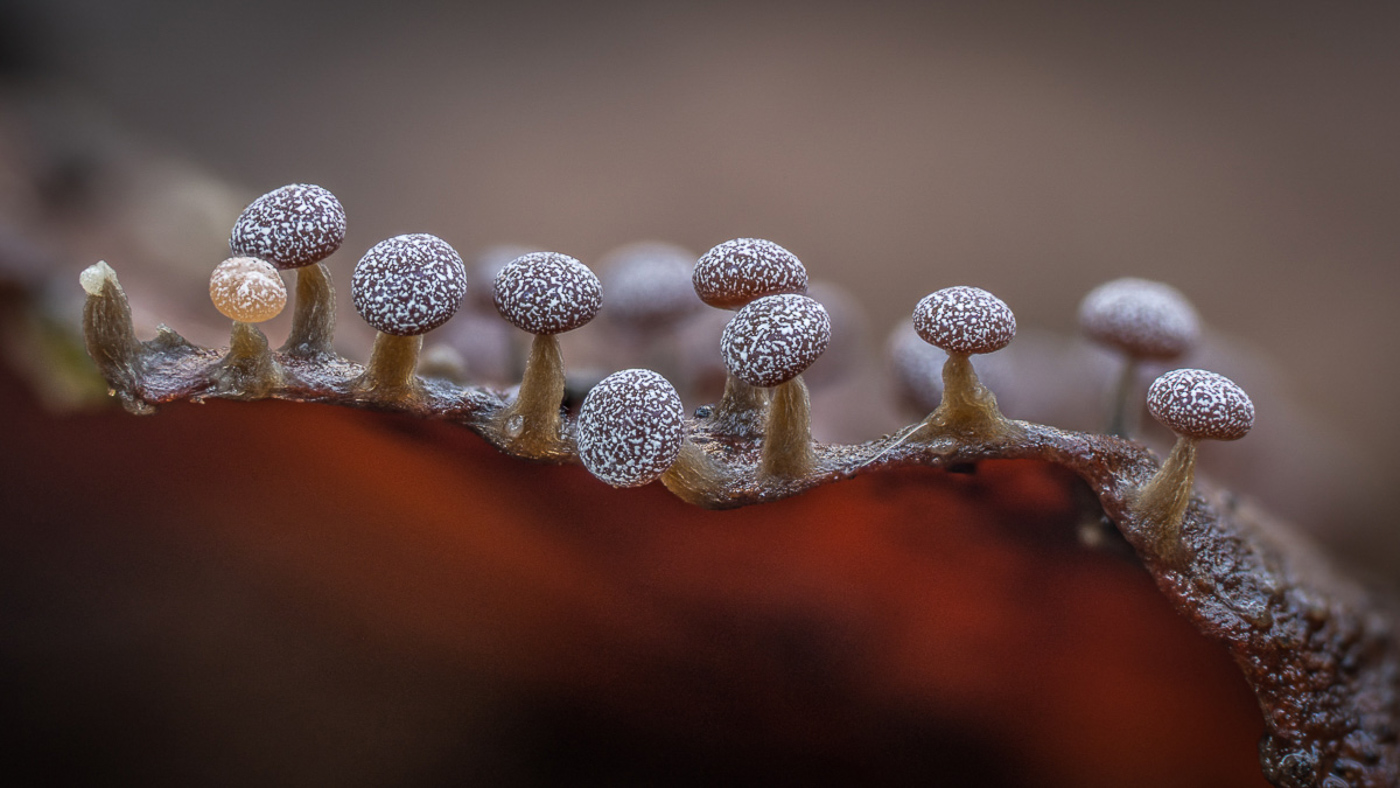
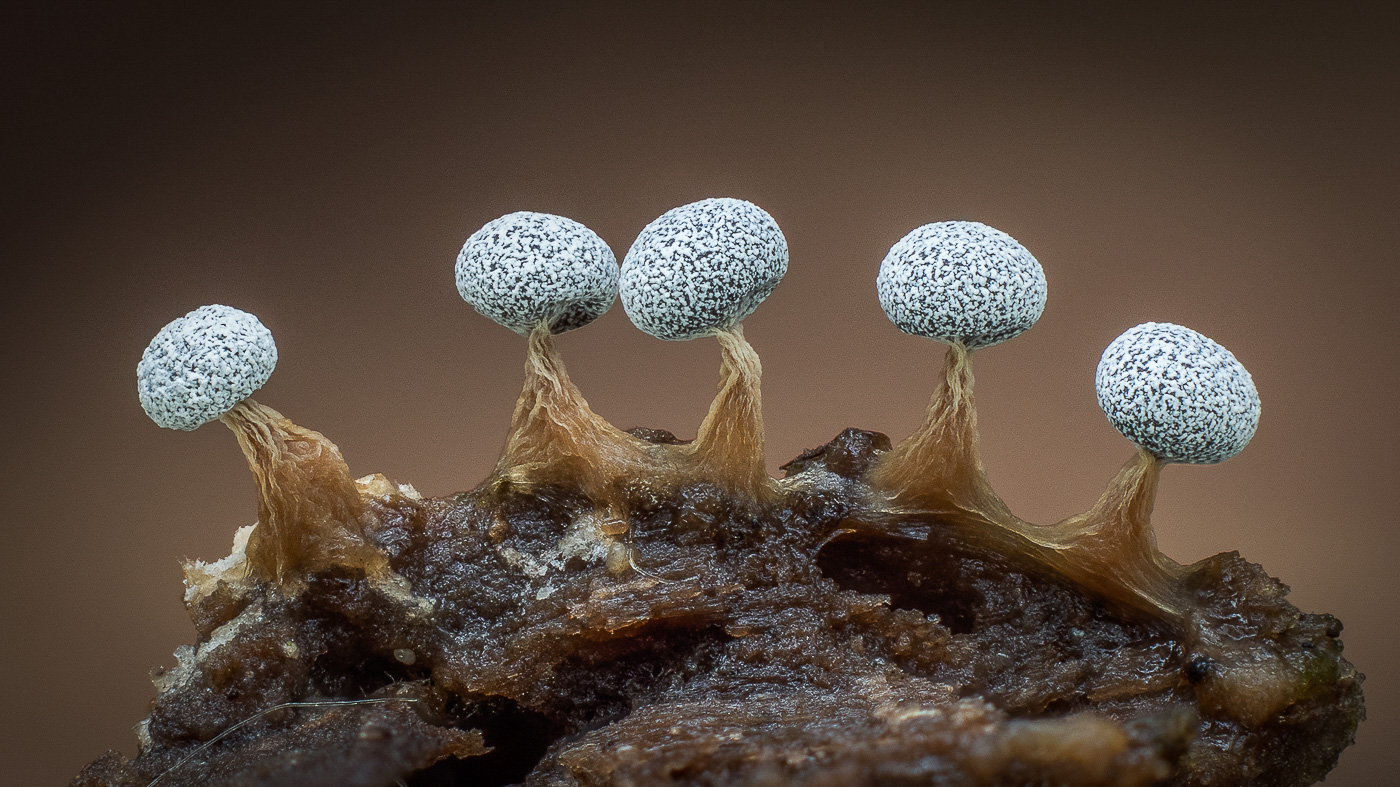
Physarum compressum Mar 16, 2021. Barry Webb found this delightful line of tiny blobs in Burnham Beeches on a woodchip pile. (The determination was confirmed online by Myxo expert Edvin Johannesen.) This particular species has a very dumpy short stalk (not called a stem or stipe as in fungi) and over all is no more than 1 mm tall. Though described as quite common, this is our first record for the county. |
 |
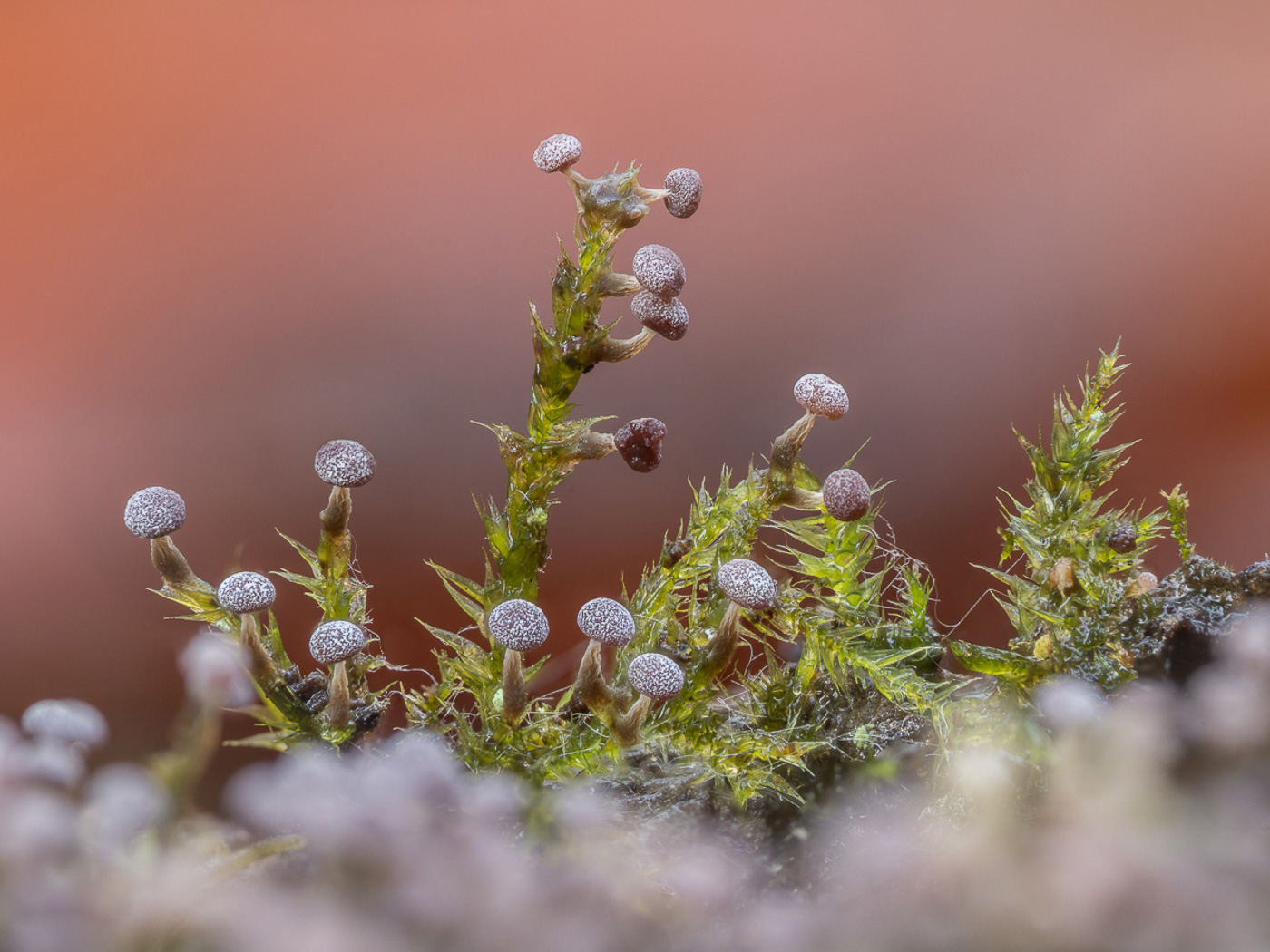
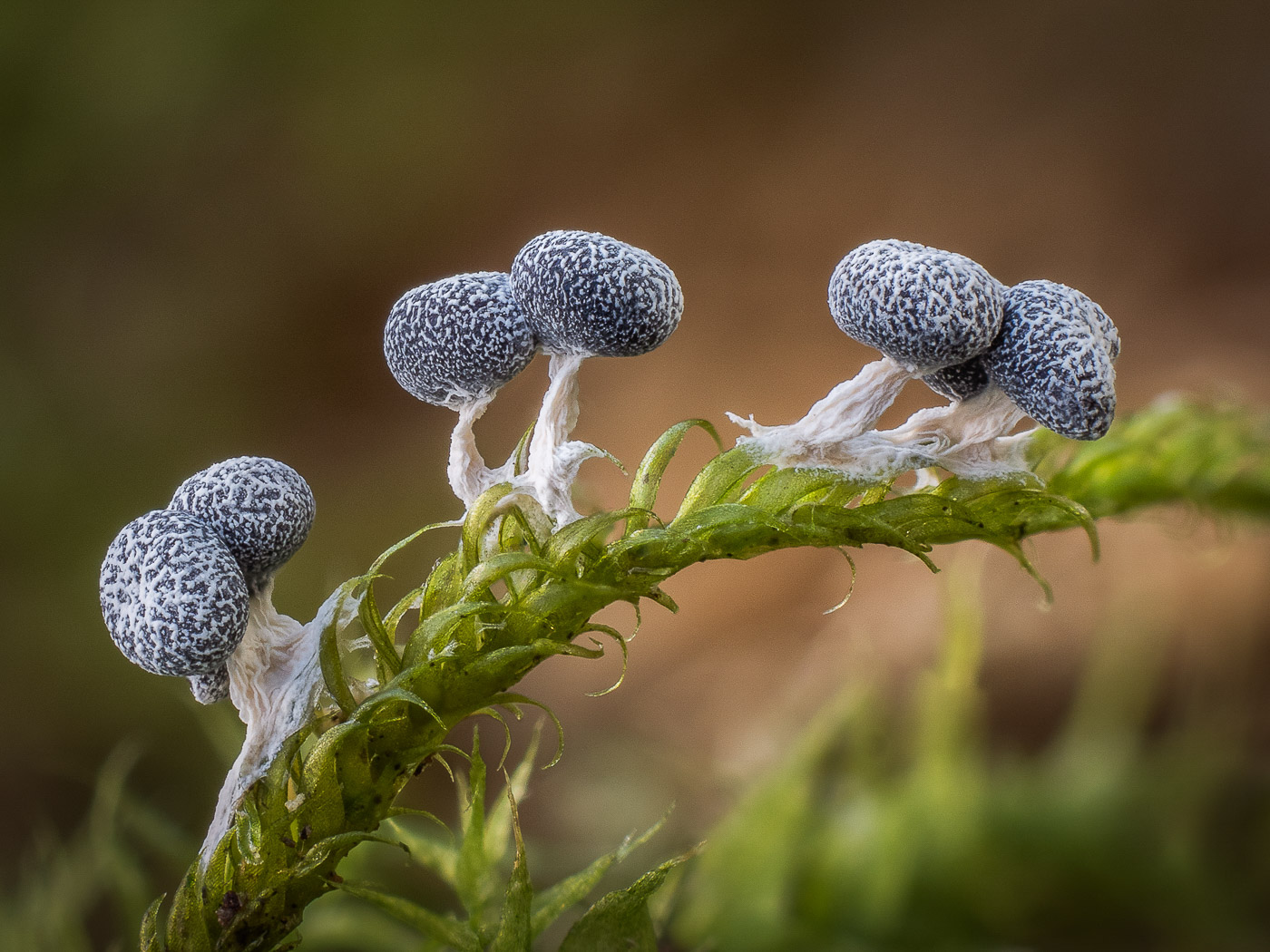
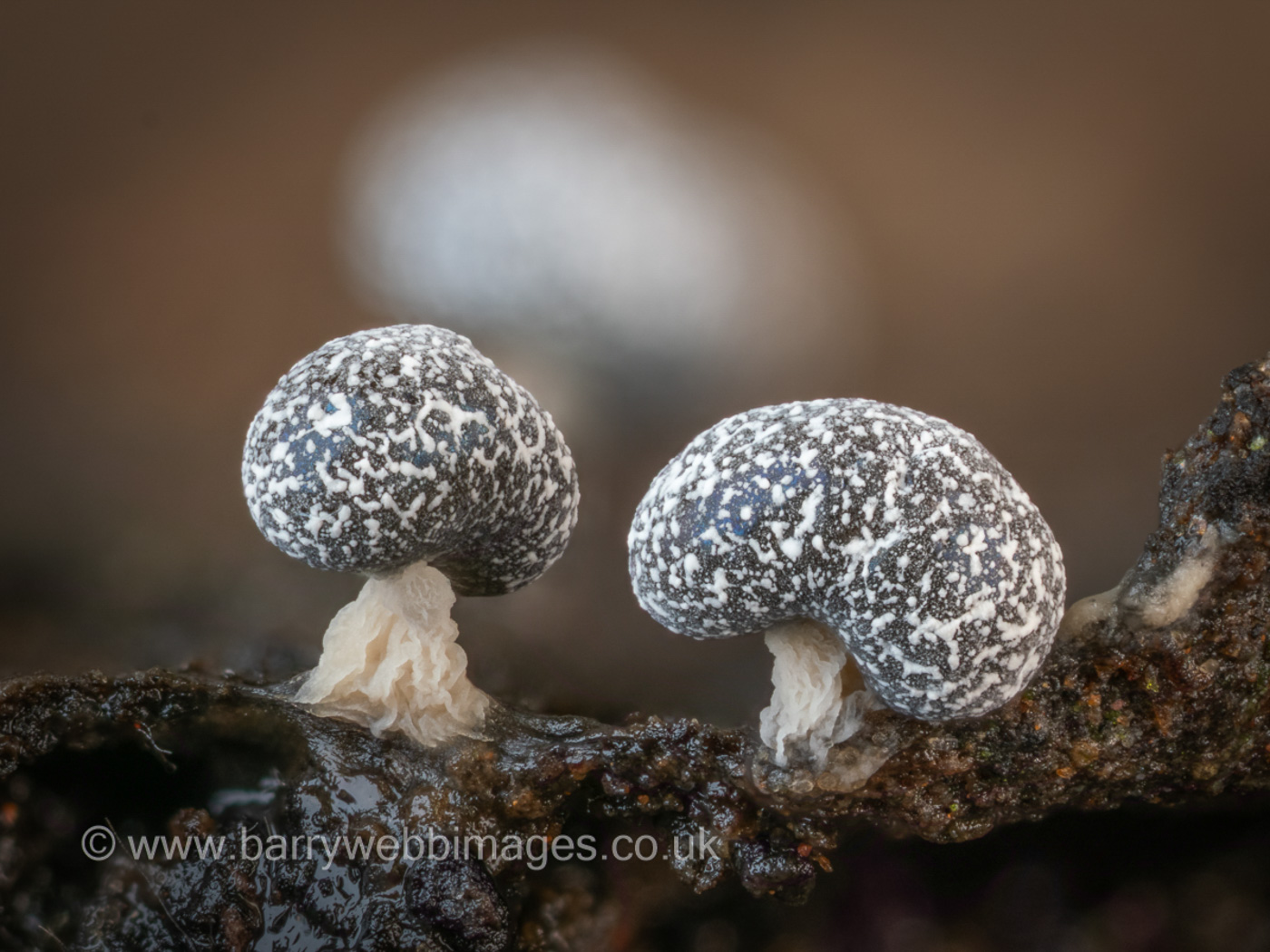
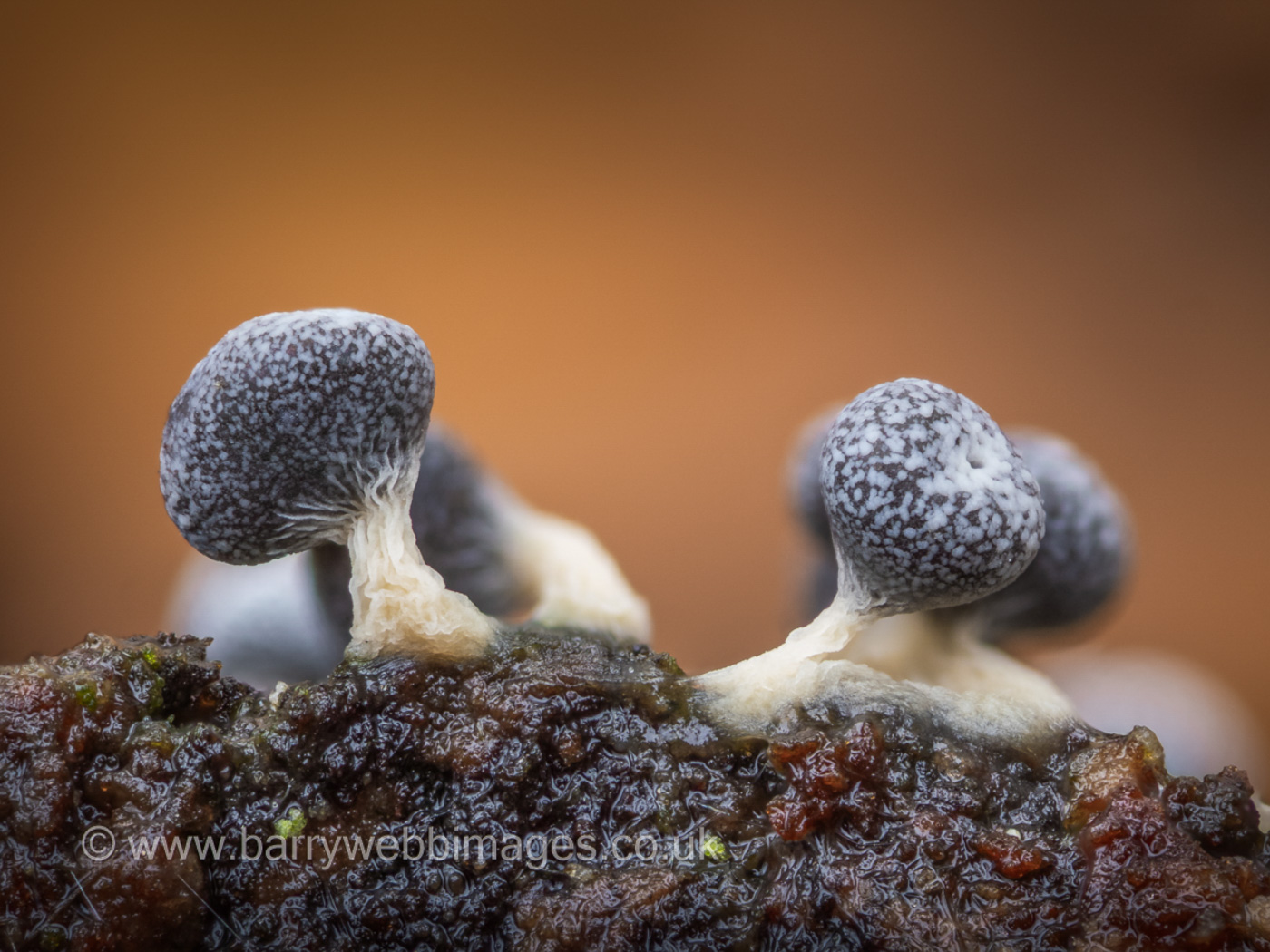
Physarum leucophaeum Nov 29, 2019. In Burnham Beeches Barry came across these tiny gems on a piece of rotten woody debris, also on some nearby moss (photo 2), and was intrigued - this being his first experience of this genus. Much scratching of heads went on re identification which was eventually made for him by several people with experience on the Facebook Myxomycete ID page. Physarum is a large and tricky genus, the many members of which have a protective coating of calcareous crystals or granules giving the appearance of a dusting of icing sugar. At the time of this collection we had just two county records reflecting the rarity of expertise amongst recorders rather than of this apparently quite common species. Photo 3: Burnham Beeches 16.10.2020 on rotting fallen Beech |
 |
Physarum leucopus Oct 16, 2020. Barry Webb found this uncommon slime mould growing in moss on a Beech log in Burnham Beeches. Clearly very similar to P. leucophaeum, also found on the same day here (see above), it inhabits woodland debris rather than wood itself and has a distinctive white stalk, hence its species name. This is new not only to the site but also to the county. Photo 2: Cowcroft Wood 22.10.2025 Photo 3: Stampwell Farm 08.11.2025 |

 |
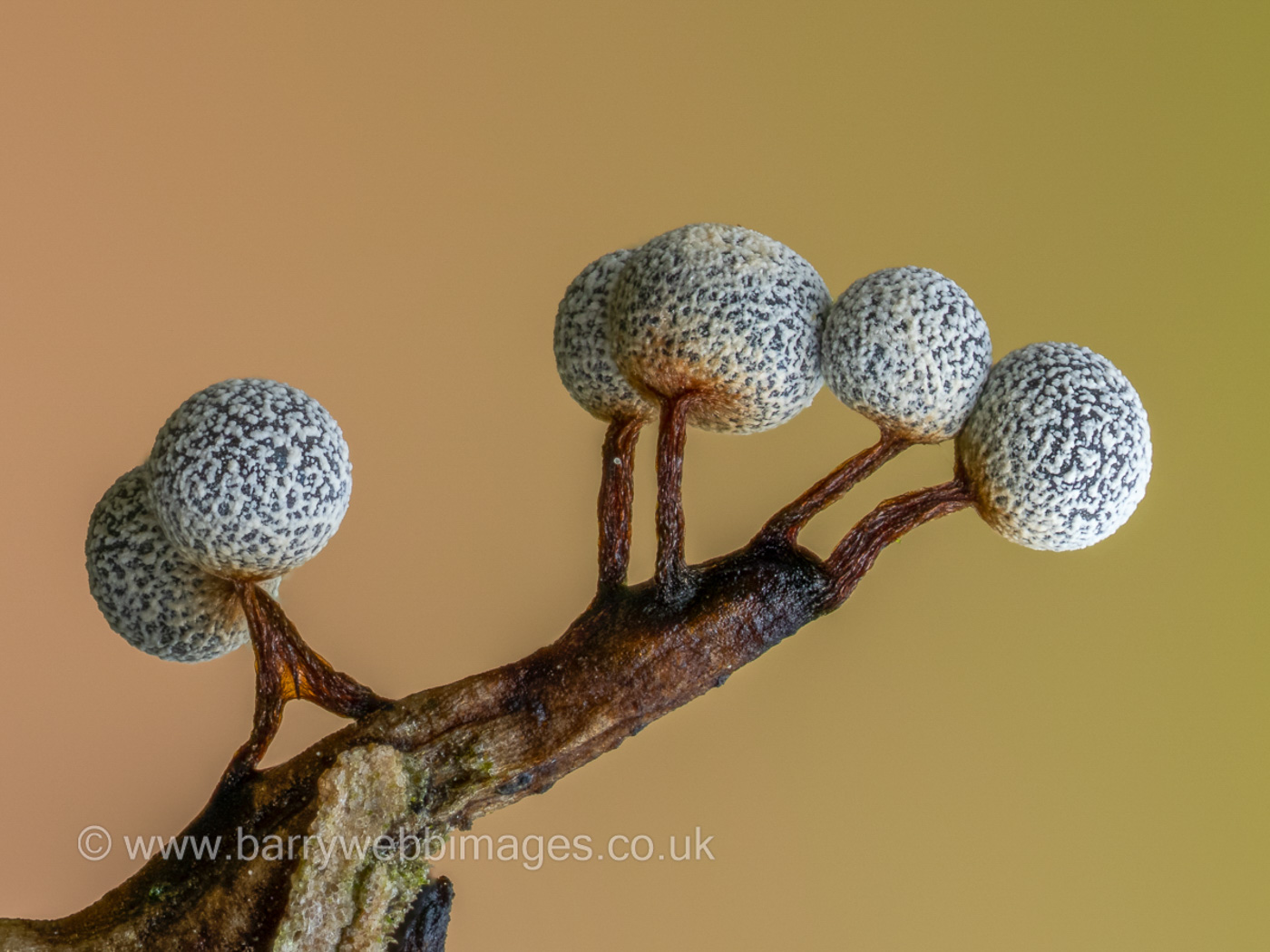
Physarum psittacinum Jul 11, 2023. At Penn Wood on fallen rotting Beech Barry Webb found this beautiful and distinctive but rare species, new to the county. Only at most 1.2mm high, it is notable for its brilliant orange stalk, iridescent bronze sporangia with both blue and orange reflections - all these elements clearly visible in Barry's amazing photo and making it easy to recognise - the tricky bit being finding it in the first place! Photo 2: Penn Wood 28.08.2023 showing a more mature collection |


 |
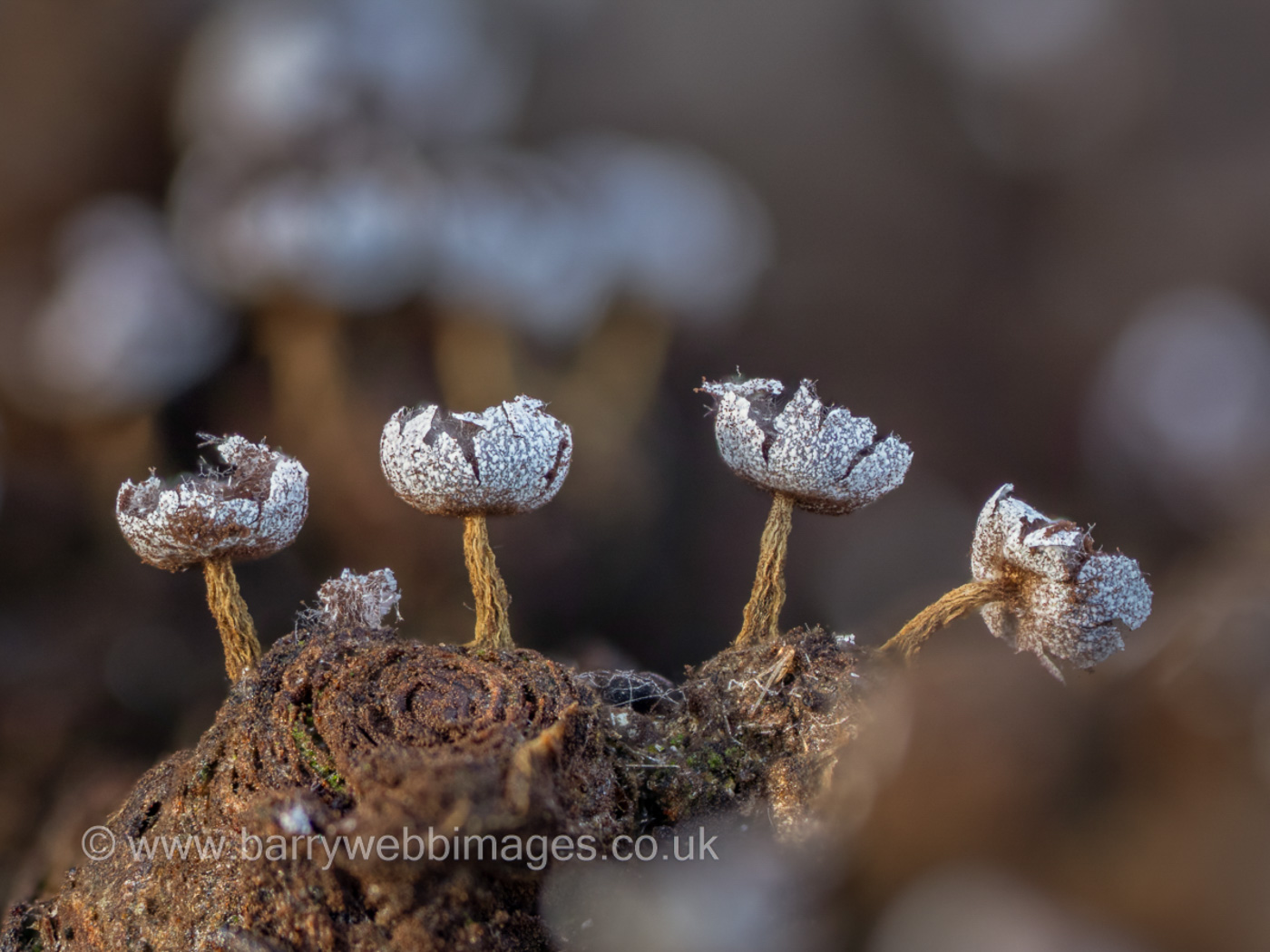
Physarum pusillum Mar 29, 2021. Barry Webb found this inconspicuous species in Burnham Beeches on a woodchip pile (photos 1 and 2). (The determination was confirmed online by Myxo expert Edvin Johannesen.) This particular species is distinguished by its relatively tall and slender reddish brown stalk, the whole sporangia being only up to 2mm tall. Though described as quite common, this was yet another first record for the county. Photo 3: Rushbeds Wood on a twig Photo 4: Burnham Beeches 04.12.2024 on a rotting head of woody debris |
 |
Physarum robustum Nov 17, 2024. Barry found this unusual species, new to the site and the county, in Stoke Common on some indeterminate woody debris. This was a new species to him and was confirmed from the microscopy by Jackie Mackenzie-Dodds. It is apparently characterised by the rather short stalk - no longer that the sporangia diameter, this being rather flattened subglobose rather than the typical globose shape of other genus members. |


|
Physarum viride Nov 14, 2022. At Burnham Beeches Barry Webb found this stunning little species on a rotten Oak log - one he'd not seen before but easily recognised by its distinctive greenish yellow colour. As the only county record for the species (apparently from Burnham Beeches) was in 1923, ID anon, we'll count this as new to the county! Photos 2, 3 and 4: Hedgerley Common 27.07.2023 found on a piece of Apple wood and then cultured in Barry's greeenhouse to see what might appear on it! This enabled him to follow its development with this unique set of photos |
| R |
|
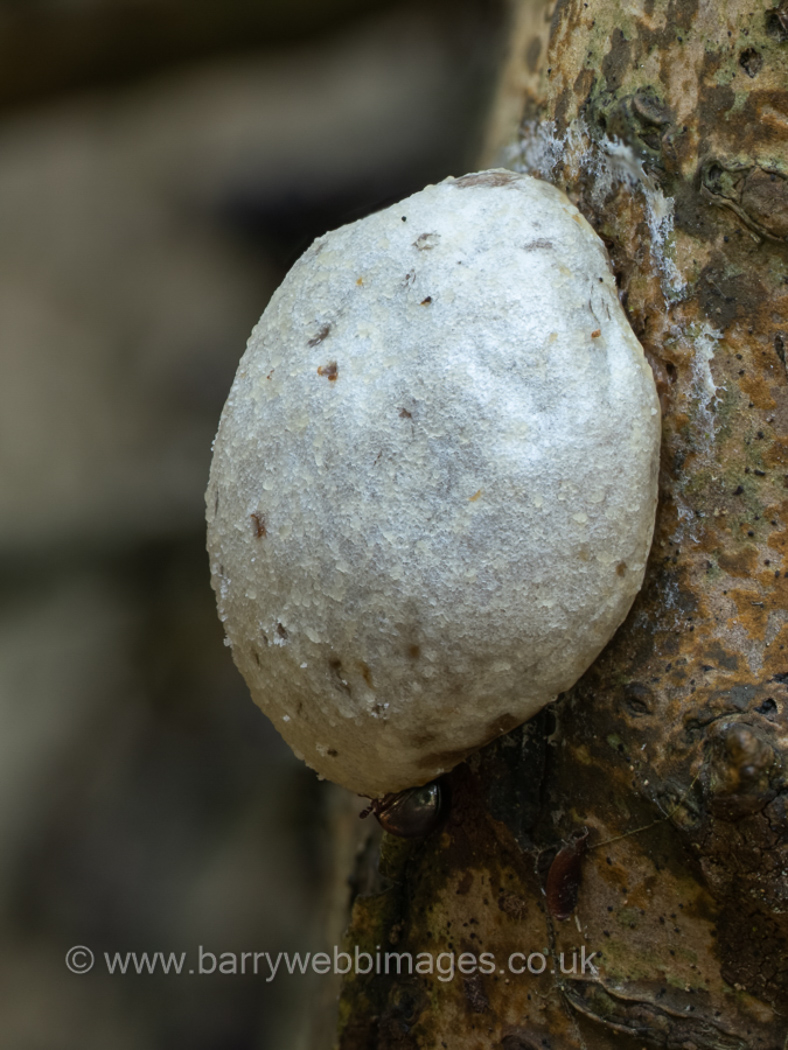
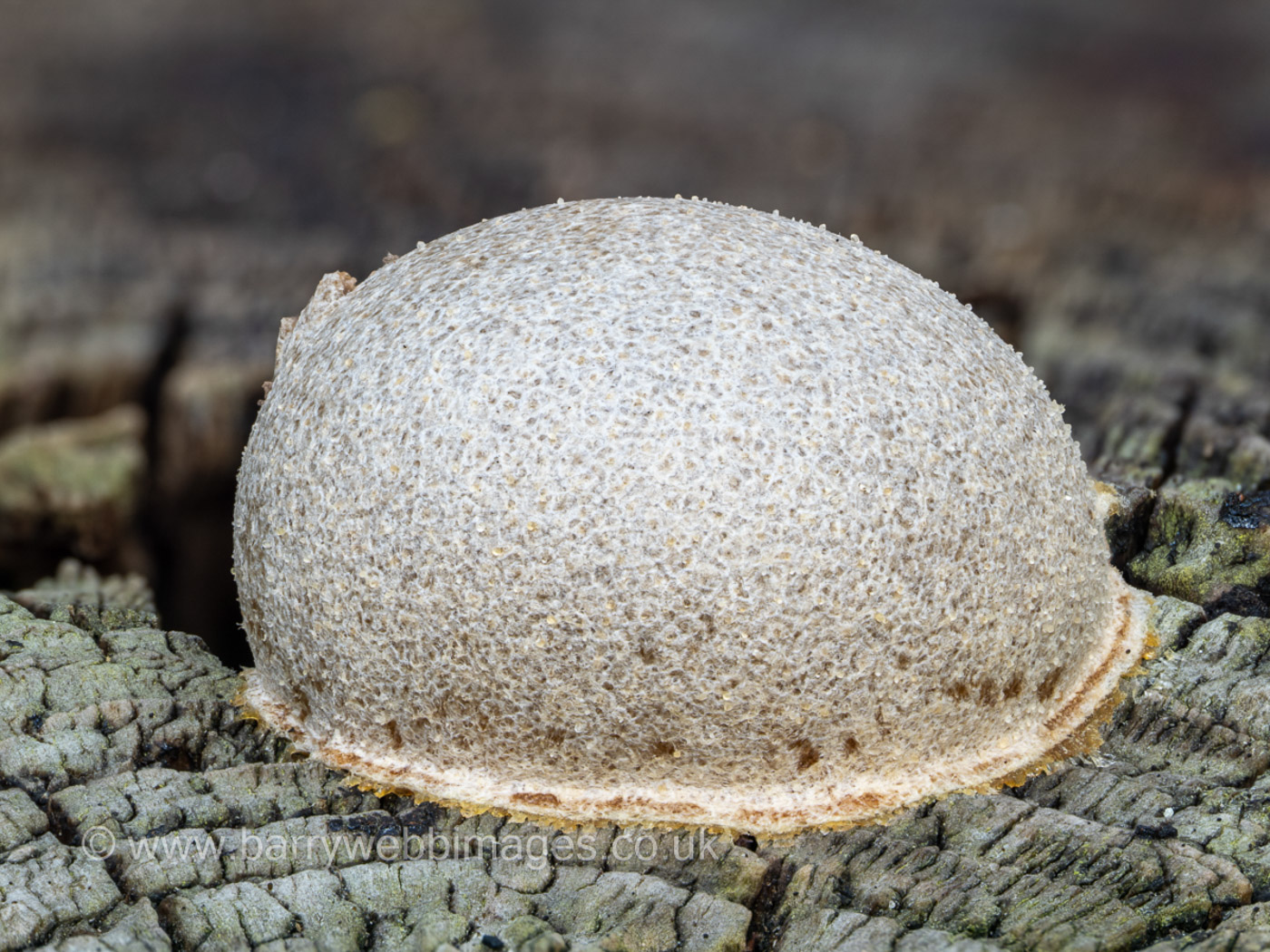
| Reticularia lycoperdon Apr 16, 2024. At Rushbeds Wood Barry took this photo of a very common slime mould which, however, appears so different and considerably larger than the myriad of tiny species he delights in focusing upon, and Members' Finds is not short of photos of this species taken by others and demonstrating its various stages of development. It occurs on the trunks of many different trees both broadleaved and coniferous, forming creamy white blobs of anything up to 4-5 cms across before cracking open to disperse its cocoa brown spores. The species name reflects its similarity to a puffball. Photo 2: Oakley Wood, Bernwood Forest 23.09.2026, fruiting on a conifer stump. |
| S |
|

 |
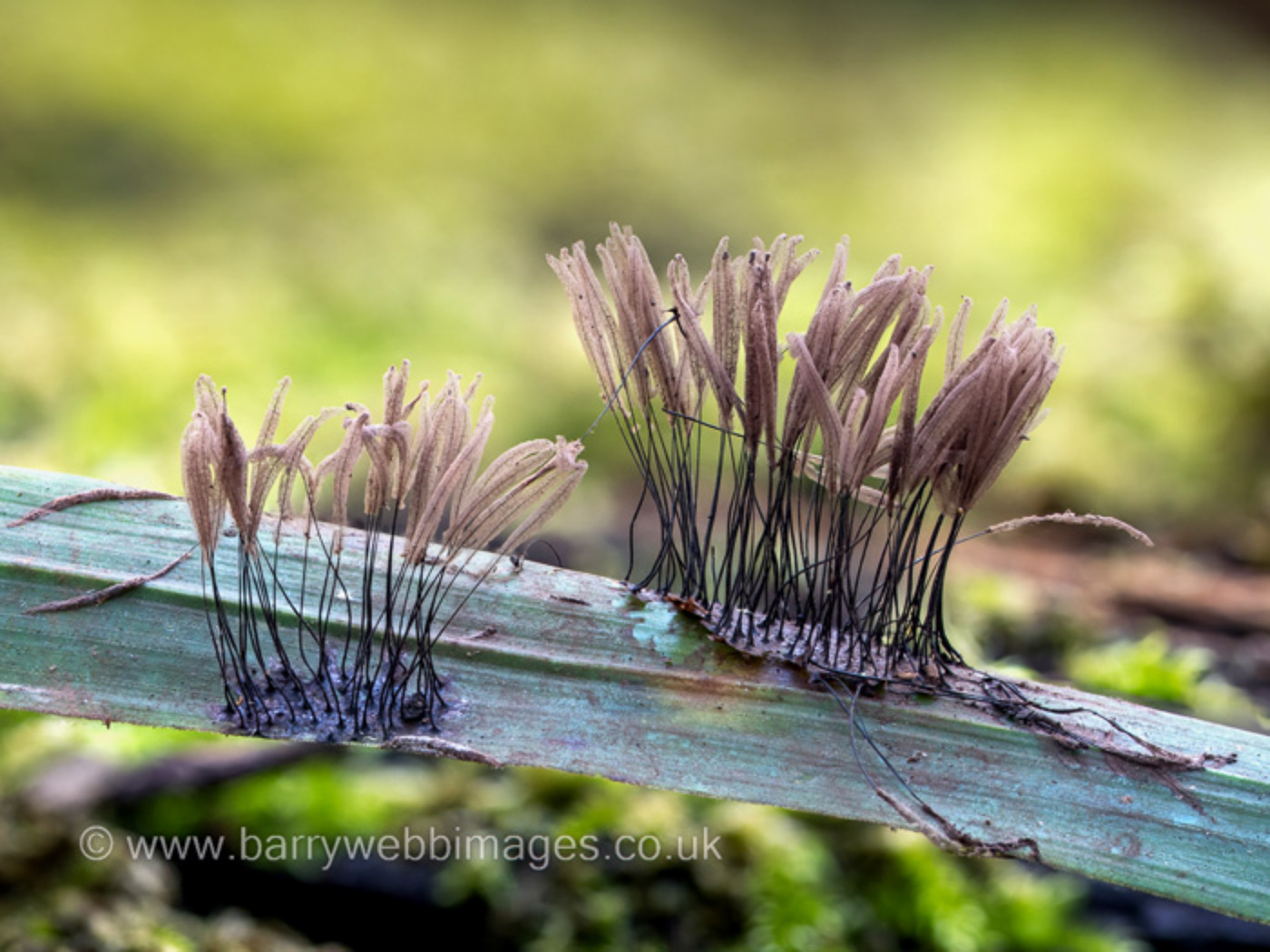
Stemonitis axifera Jul 28, 2021. In Burnham Beeches on damp rotting deciduous wood Barry found this small cluster of tiny 'pipe-cleaners', the sporangia being mature enough for Penny to be able to identify it at home. The tiny smooth spores together with its rather pale general colour compared to other species in the genus are the diagnostic features. Though the species is not considered rare, this was new to the site and we appear to have only one previous county record. Photo 2: Burnham Beeches 10.08.2025 found by Jordan Payne on fallen indeterminate wood during our microscope workshop, then identified jointly by Barry and Jackie Mackenzie-Dodds. |


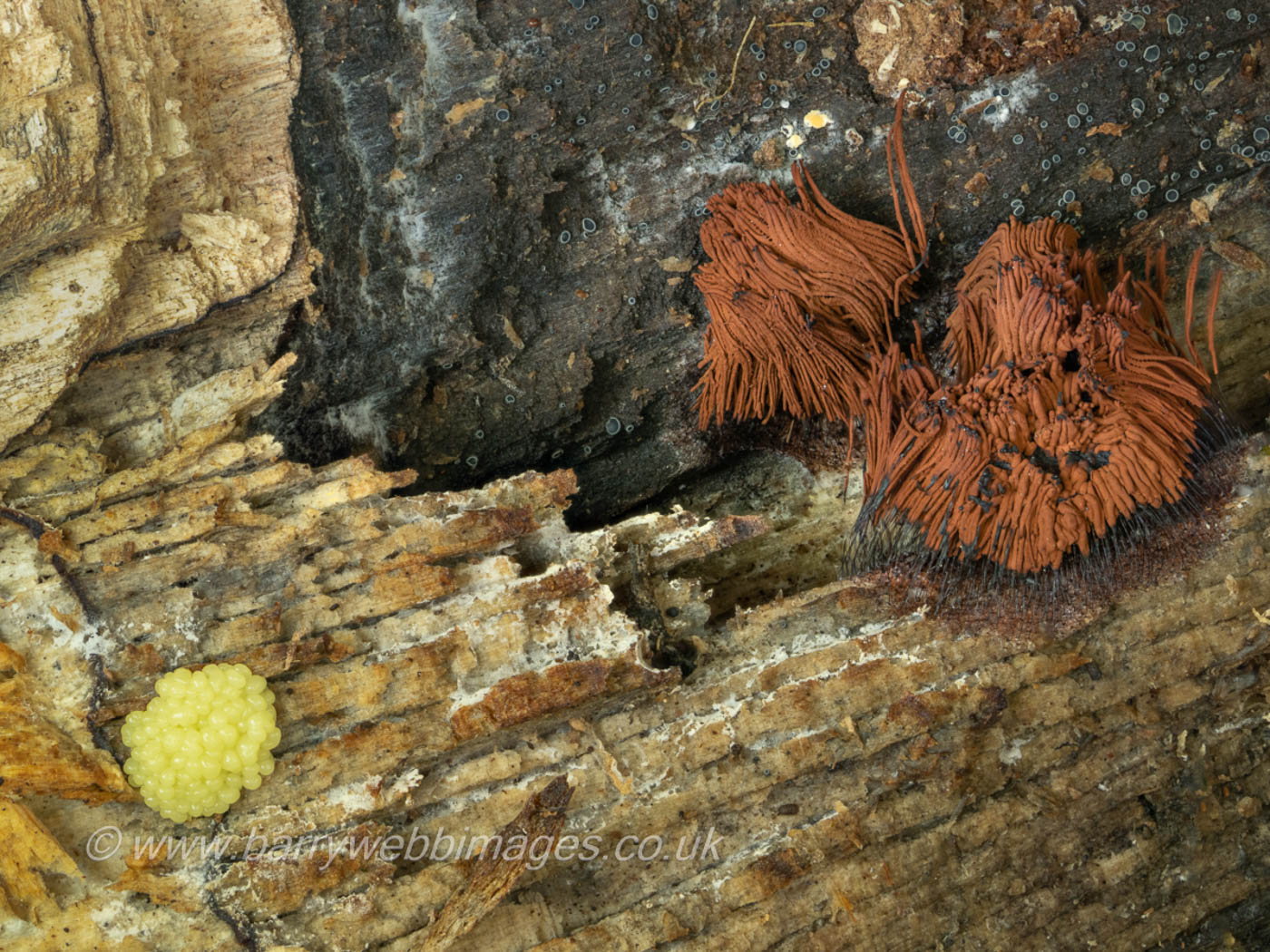 |
Stemonitis flavogenita Sep 6, 2021. Barry Webb found a rotting fallen Birch trunk in Burnham Beeches with this Stemonitis species, at this stage unidentifiable and just starting to develop from the plasmodium (slimy) stage when the transformation in colour, shape and texture can be quite dramatic. He took this amazing set of 4 photos over the space of several hours. Photo 5 was taken 3 days later when Penny collected a now fully mature specimen to identify to species using a scope (only possible at this mature stage). S. flavogenita is alone in the genus in having bright yellow plasmodium rather than the normal white (as its Latin species name reflects), but if not seen at this really early stage when just a slimy fragile shapeless mound, this useful colour clue is missed because as development takes place once the stalks and pipe-cleaner shape have formed, all species tend to go through the same colour changes: first yellowish then gradually pinkish and eventually some shade of cocoa brown. This can happen in a matter of a few hours once the process starts, and eventually the mini forest of sporangia dry off completely as seen in the final photo here. The species is not rare but best described as uncommon. Photo 6: Burnham Beeches 17.04.2024 showing both the unique yellow early plasmodium stage (bottom left looking like a pile of insect or slug eggs) and the mature mini forest. |

|
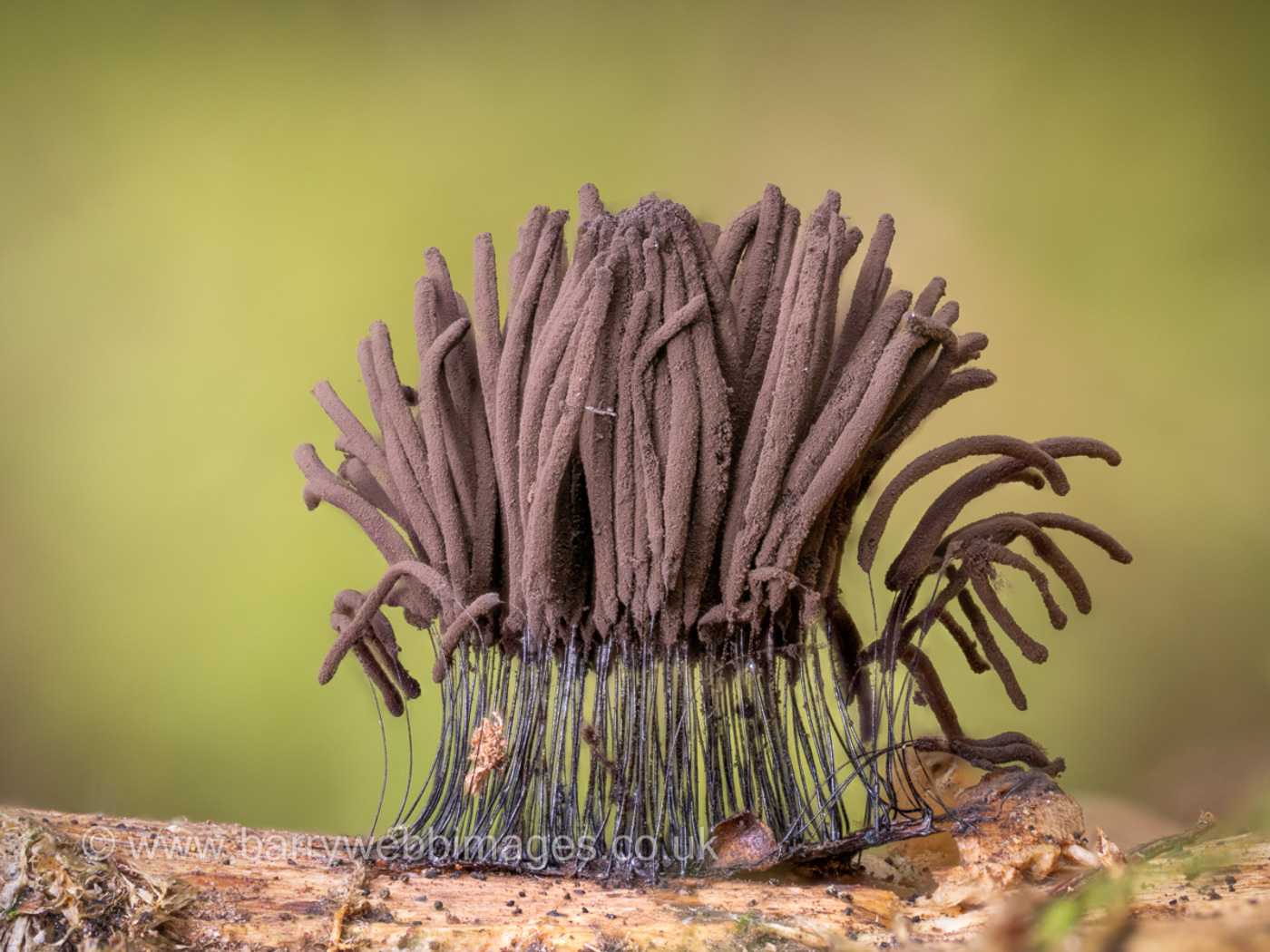
Stemonitis fusca Jun 9, 2021. On a rotting bare Birch trunk in Burnham Beeches Gill Ferguson found these little clusters of chocolate 'pipe-cleaners'. Penny checked the microscopic characters to confirm though this, by far the commonest species in the genus, has two distinctive field characters which help to separate it in the field: it has a notably shiny black stalk which is up to half the total height - ie notably longer than most others, and it's mature colour is a richer deeper brown - ie more fuscous as the species name reflects. Photo 2: Naphill Common 16.10.2022 showing a collection having already lost most of its spores therefore revealing the delicate skeleton formation which can be very useful in determining the different species within the genus. Photo 3: Hockeridge Wood 27.09.2025 |
 |
Stemonitis sp (an unidentified species of the Slime Mould genus Stemonitis) Sep 28, 2020. Growing on fallen Beech in Burnham Beeches Barry found this typical undeveloped example of this very distinctive genus. At this early stage before it has dried off and developed the brown spore mass above the stalk it is not possible to name to species though the genus itself is easily recognised once it has formed this tight 'forest' of pipe-cleaner-like tufts. |
  |
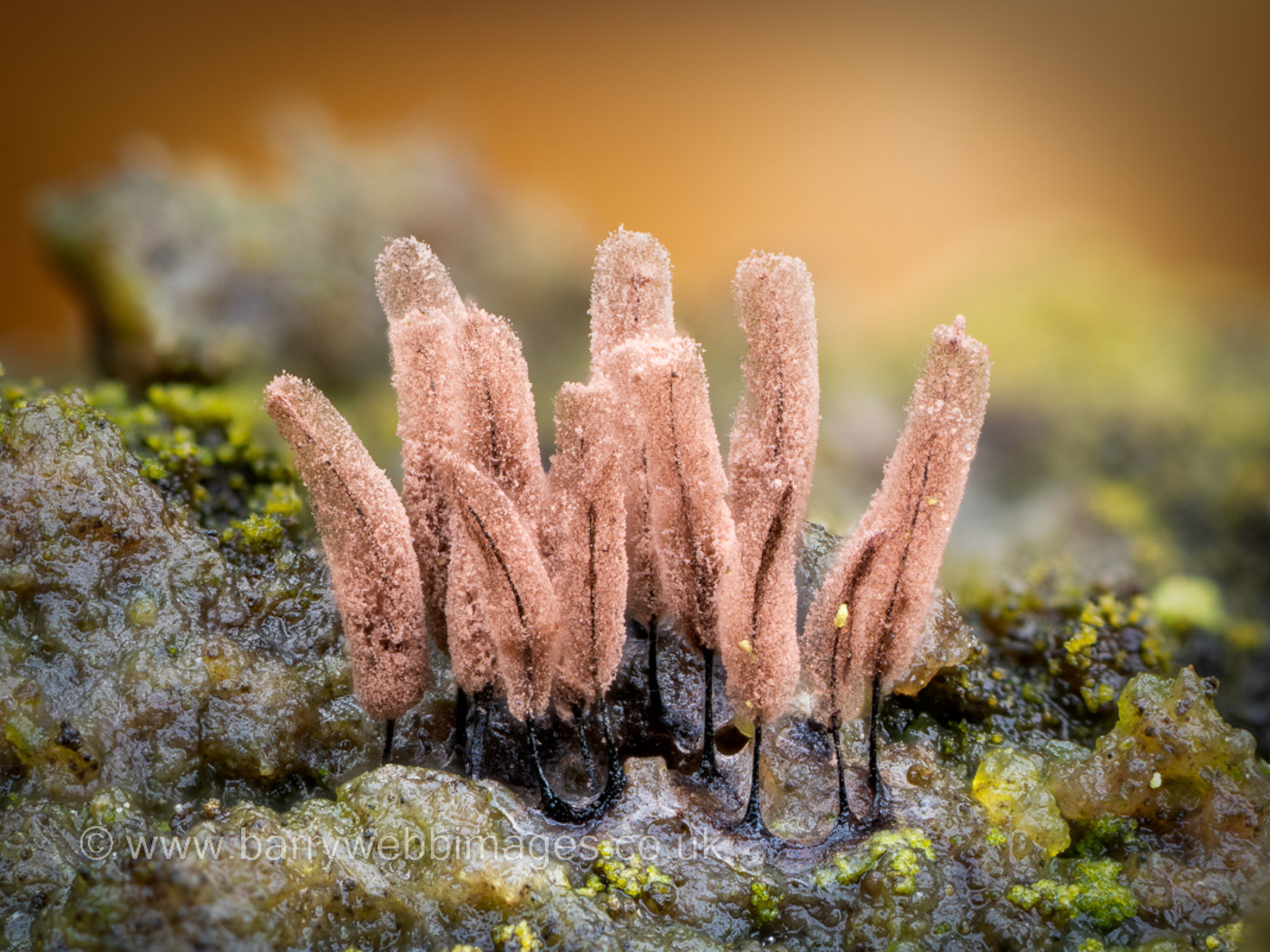
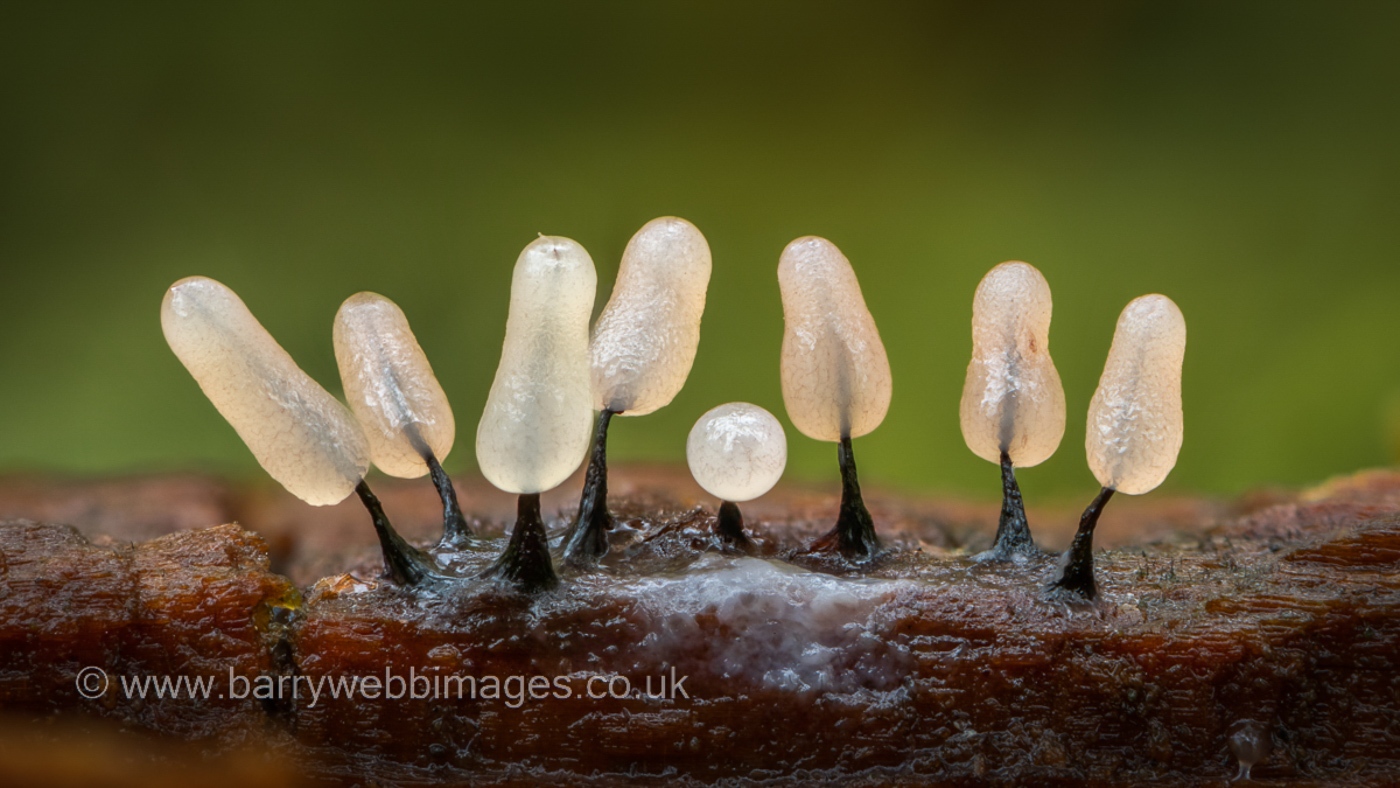
Stemonitis virginiensis Jul 15, 2023. In Burnham Beeches on fallen moss covered Beech Barry Webb found this still immature Stemonitis (at this stage not identifiable) and returned later to take photo 2 when it had matured. Features to note in this rare species are its short and shiny black stalks and brown colour with a lilac tint compared to others in the genus when mature. It also has rather smaller spores which have a clear reticulation as well as some spines, This is new to the site and to the county. |

 |
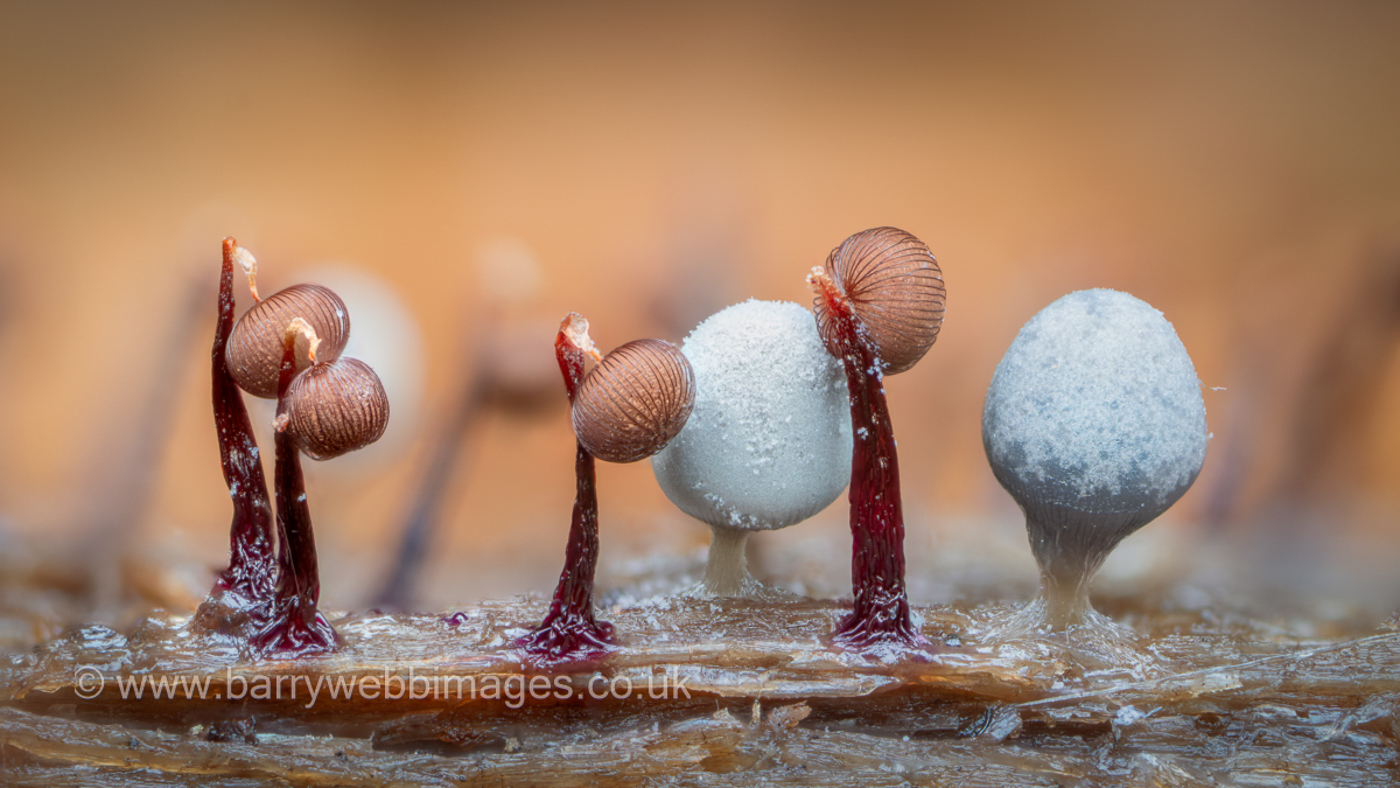
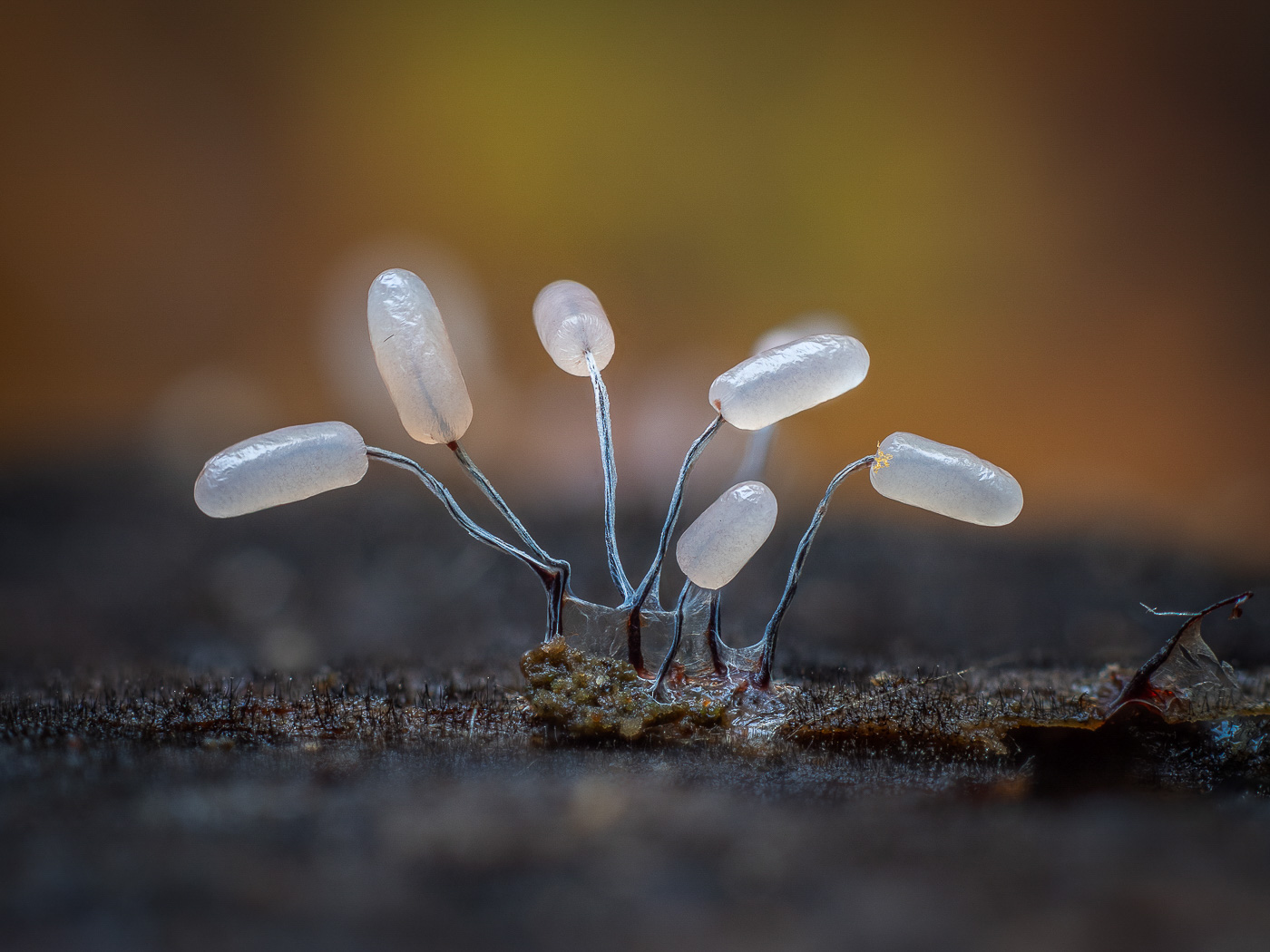
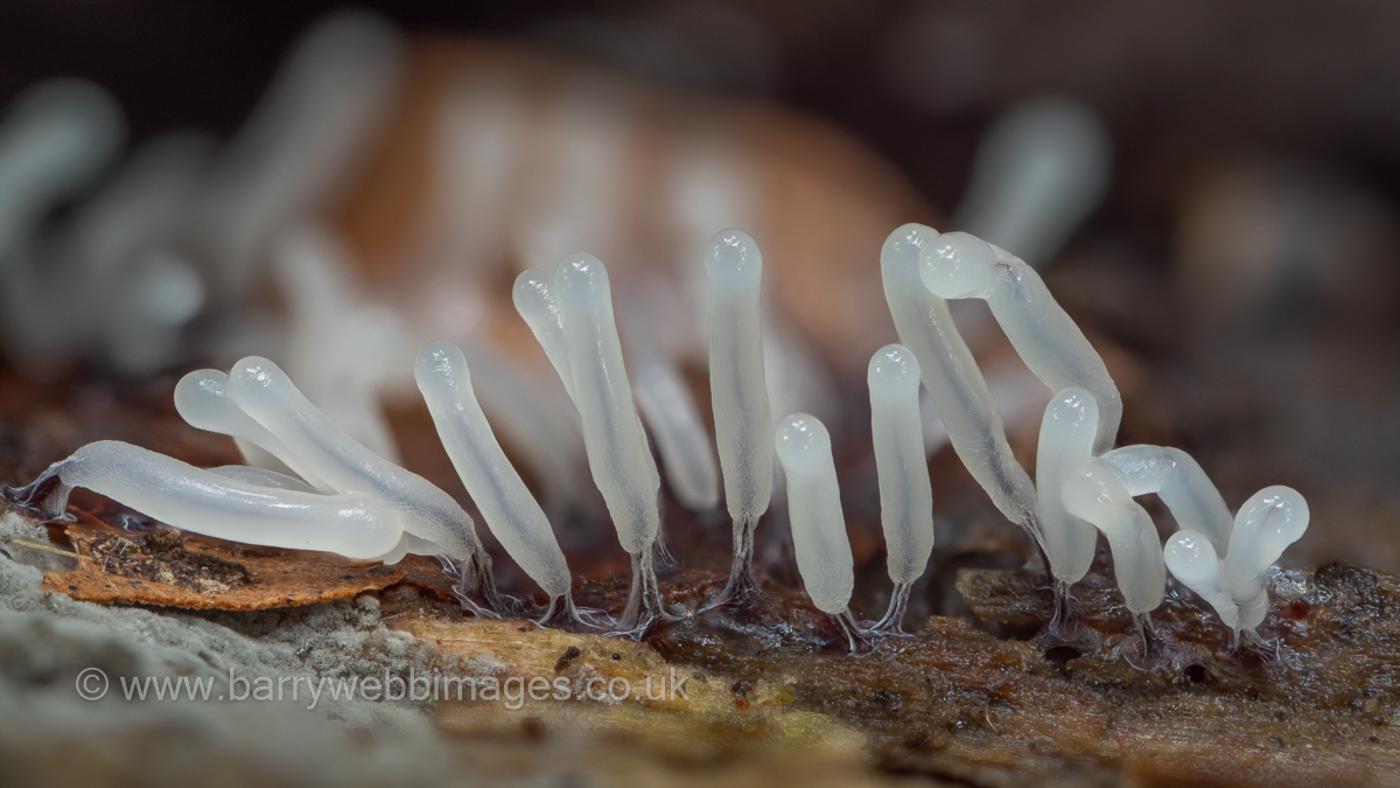
Stemonitopsis sp (possibly S. hyperopta, S. amoena or maybe even Comatricha pulchella!) Sep 15, 2020. Barry found this photogenic little collection on fallen Apple at Hedgerley Green but all were too young to be identified. The white specimens on the left are just developing from the (presumably white) plasmodium stage. As they mature they gradually darken, becoming at first pink then later reddish brown before drying off as the spores ripen. Only at this later stage can they be microscopically examined to identify and even then this process is not always straightforward. So this stunning photo plus the two beneath it (both captioned Stemonitopsis sp.) serve to illustrate just how tricky these organisms can be to name to species. Photos 2 and 3: Stoke Common 29.10.2022 Photo 4: Round Spring Wood, Dancersend 10.11.2022 |
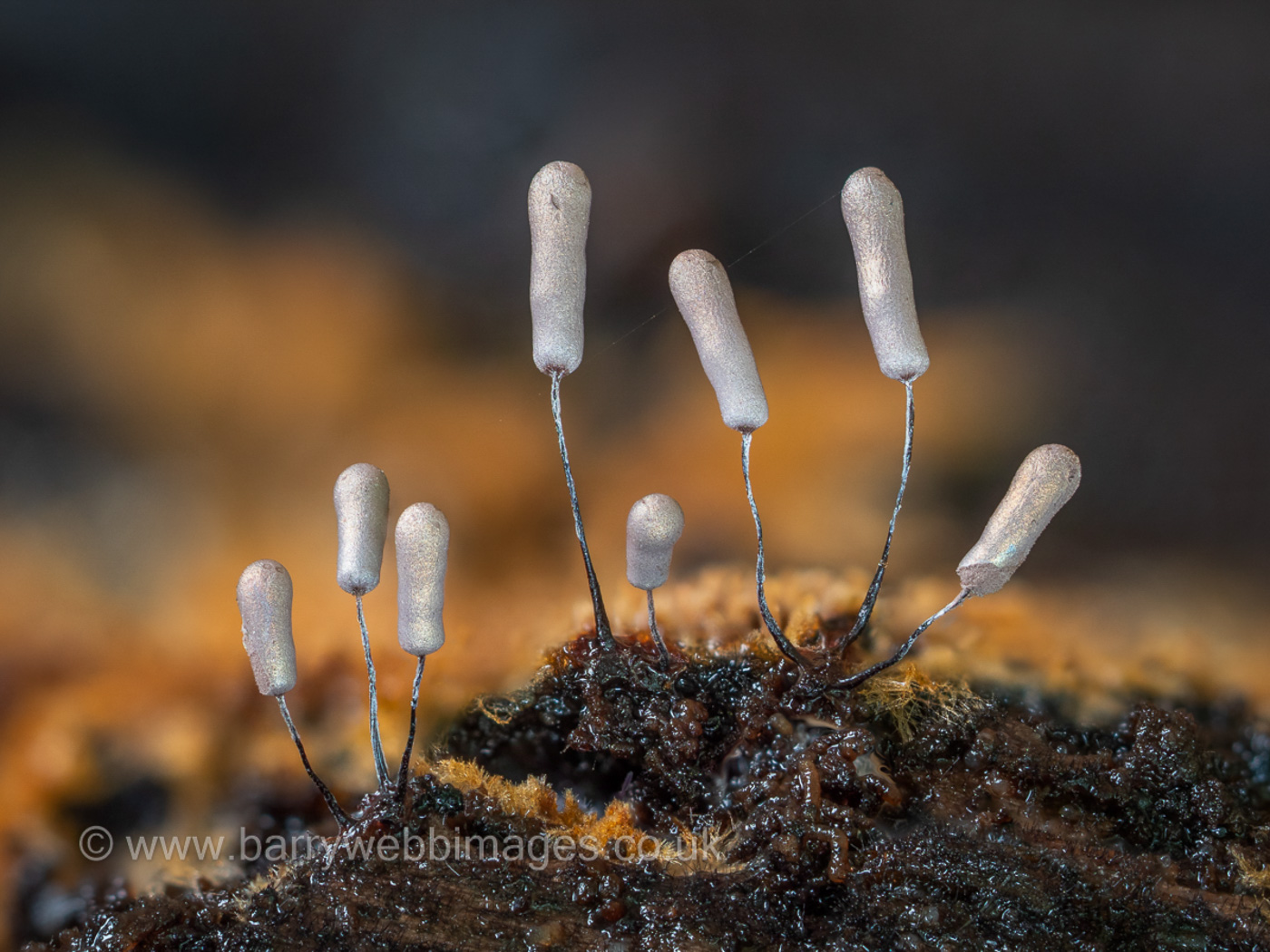
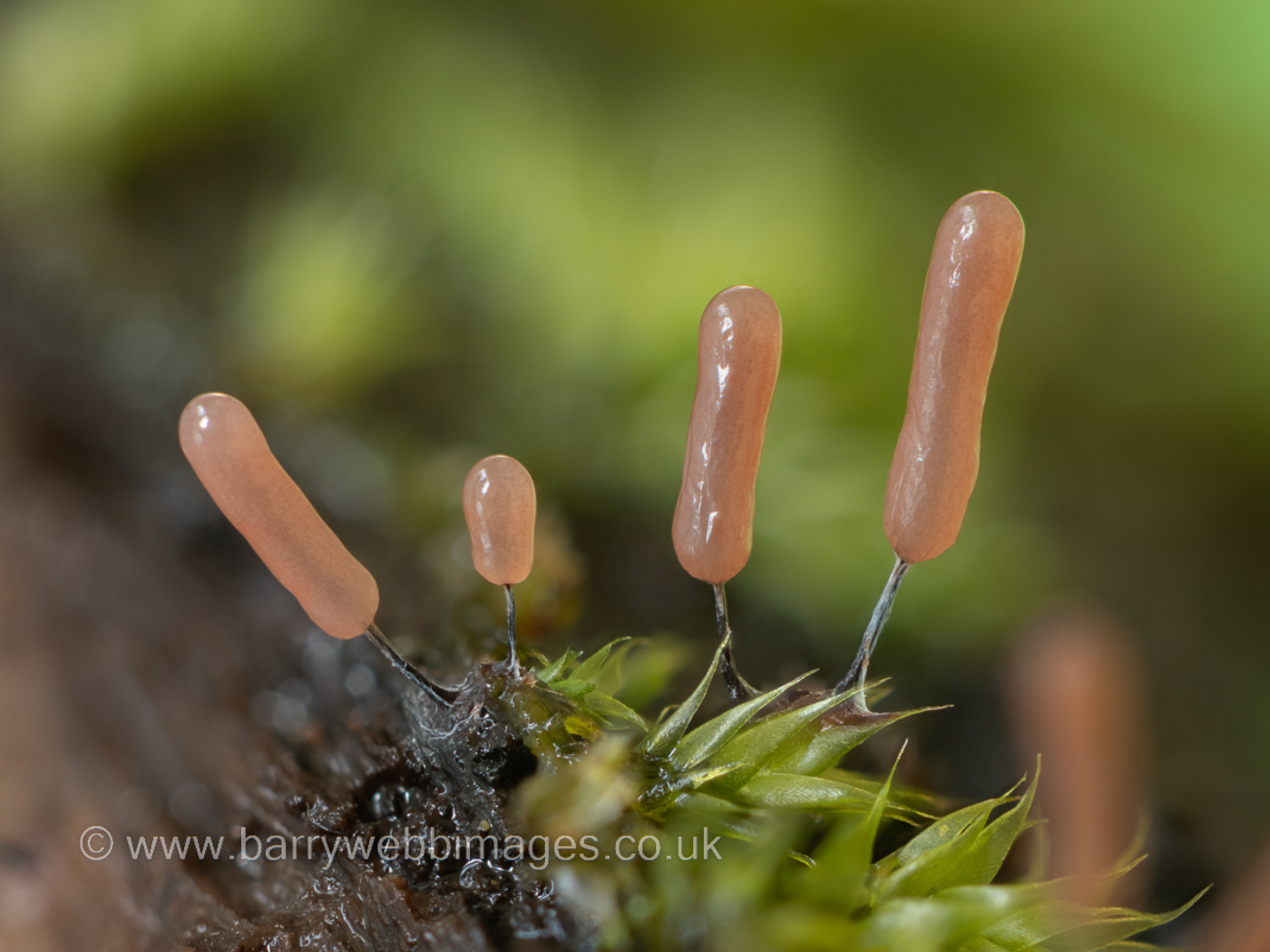
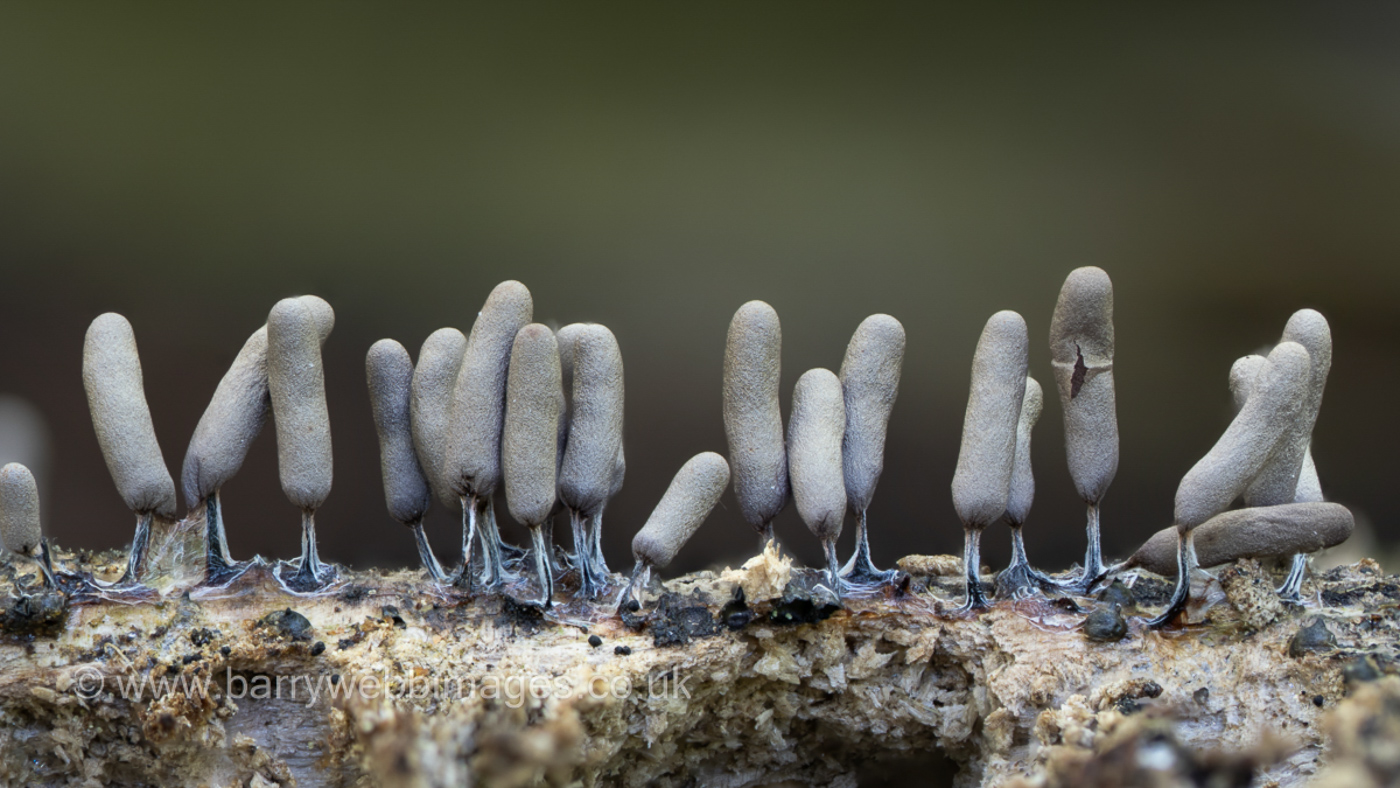
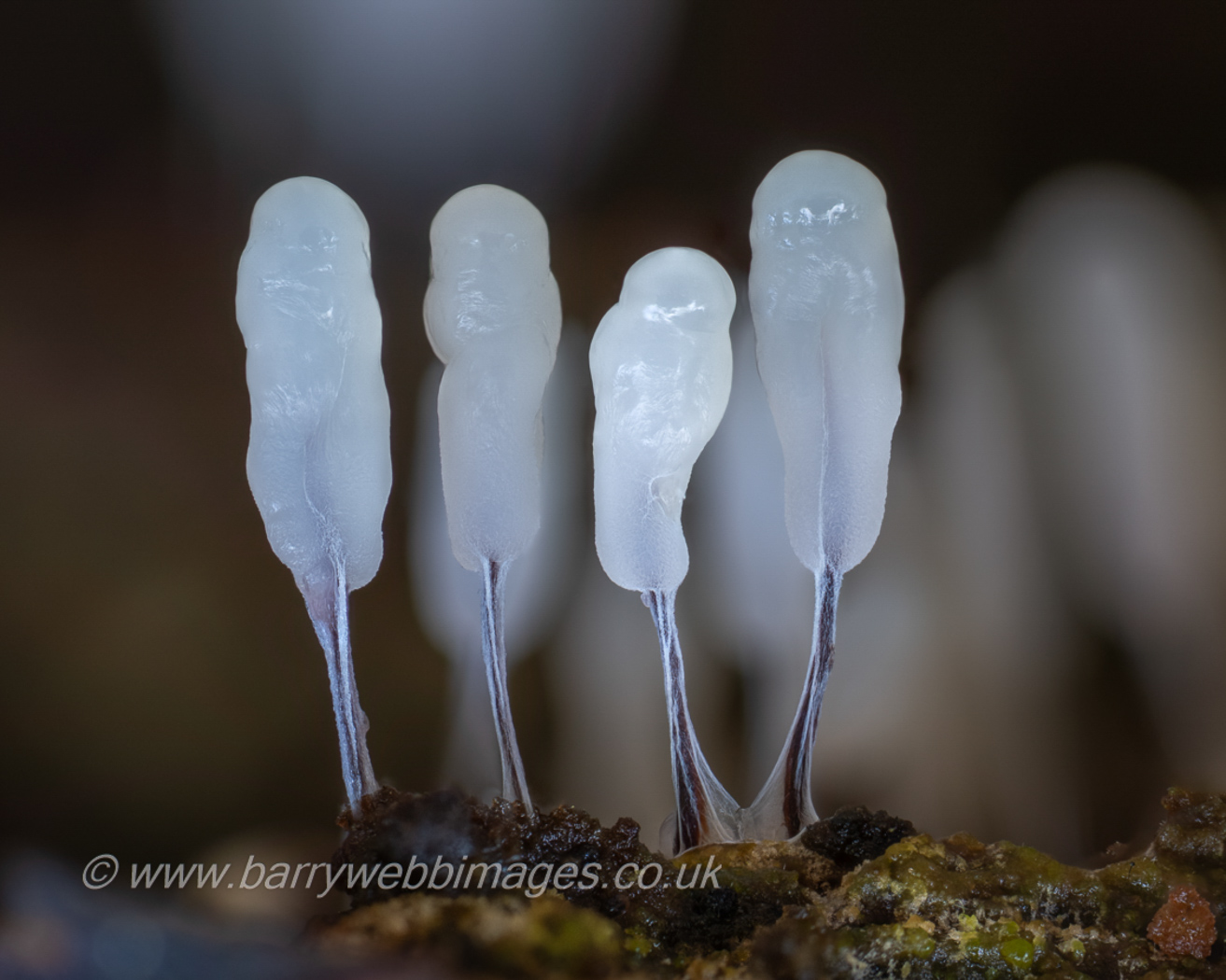
 |
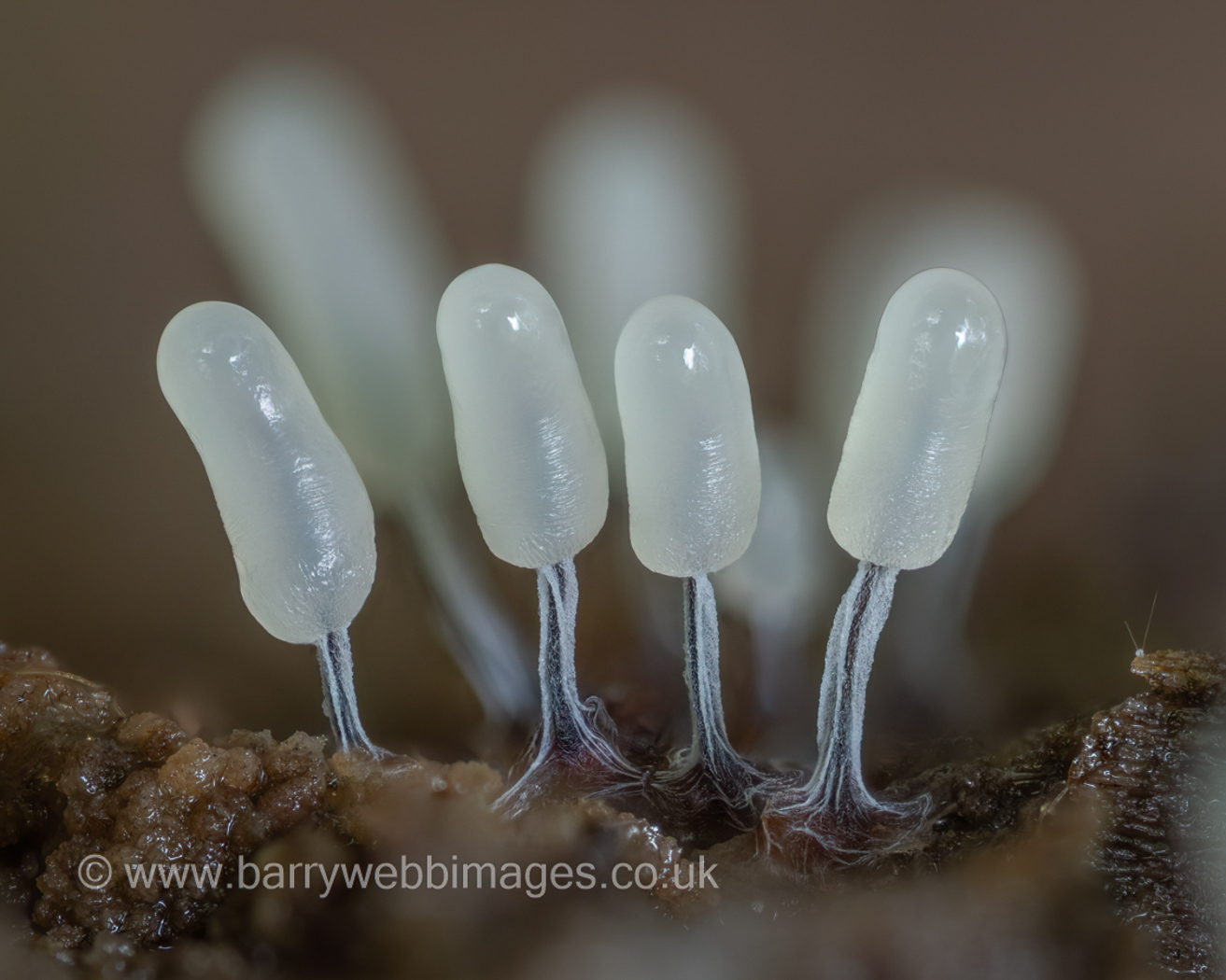
Stemonitopsis typhina Oct 19, 2020. Barry Webb took this photo of a common slime mould found on a damp Beech branch in Burnham Beeches. Each sporocarp (fruiting body) is no more than 5 mm high and its shape closely resembles the similar genus Stemonitis but the species is characterised by its persistently silvery shining cylindrical heads and beneath them a long stalk with central black core and glistening coating reminiscent of old fashioned stockings with a seam! Furthermore the clusters are not as densely packed as those belonging to genus Stemonitis. Once having developed a stalk the heads go through the usual pattern of white then coral pink then eventually drying off to brown though the glistening surface tends to remain long into maturity. The range of photos here demonstrate the various stages of development of this charismatic species. Photo 2: Pullingshill Wood 12.09.2021 Photo 3: Wotton Park Estate 23.10.2021 Photo 4: Ivinghoe Common 10.09.2022 Photo 5: Gussetts Wood 18.07.2023 Photo 6: Burnham Beeches 17.04.2024 Photo 7: Hodgemoor Wood 29.09.2024 Photo 8: Burnham Beeches 10.08.2025 |
 |
Symphytocarpus amaurochaetoides Sep 13, 2023. On fallen rotting Beech at Burnham Beeches Barry found this rare species, one that Penny had never heard of. As can be seen from its shape and habit, the genus is related to Stemonitis and until 1967 was thought to be part of that genus but just malformed; It was then recognised that its few members were consistently different resulting in their move to genus Symphytocarpus. The apparent long stalk on the lowest cluster here is in fact a sliver of wood flaking off the log - the tight clusters are stalkless and no more than 5mm tall. This was a nice find and was new to the county with few national records. |
 |
Symphytocarpus flaccidus Aug 3, 2025. On fallen Pine at Burnham Beeches Barry found this unusual slime mould - one which appears to be new both to the site and the county though described as quite common. The genus, related to Stemonitis, resembles a squashed or collapsed not fully formed species of that genus but has distinct differences. There are nine species, five of which are known to be British, and the field character to note is the either rudimentary or entire lack of a stalk, thus separating it from the genus Stemonitis. S. flaccidus occurs on fallen pine and S. amaurochaetoides on broadleaf wood. |
| T |
|
 |
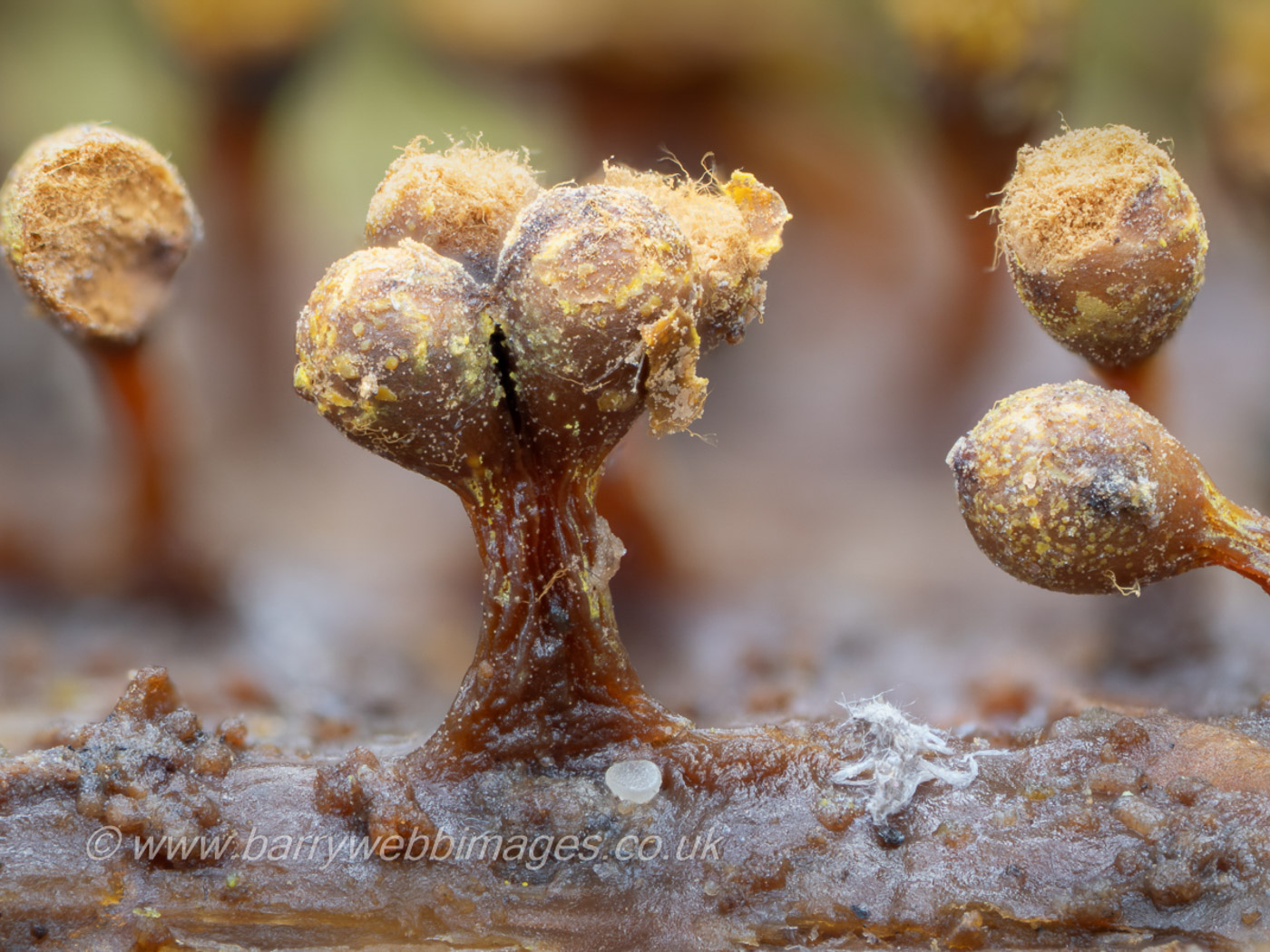
Trichia cf ambigua Dec 4, 2024. At Burnham Beeches on some rotting woody debris Barry found these distinctive tiny orange clustered blobs, and is confident that they will be confirmed as this species, described in 2023 in a paper reporting recent work the Trichia botrytis complex. However, T. ambigua is not yet in FRDBI or Species Fungorum, but once the name is accepted this find will be the first for the UK, hence the blue box here. Watch this space ............... Photo 2: Stoke Common 12.11.2025 |

 |
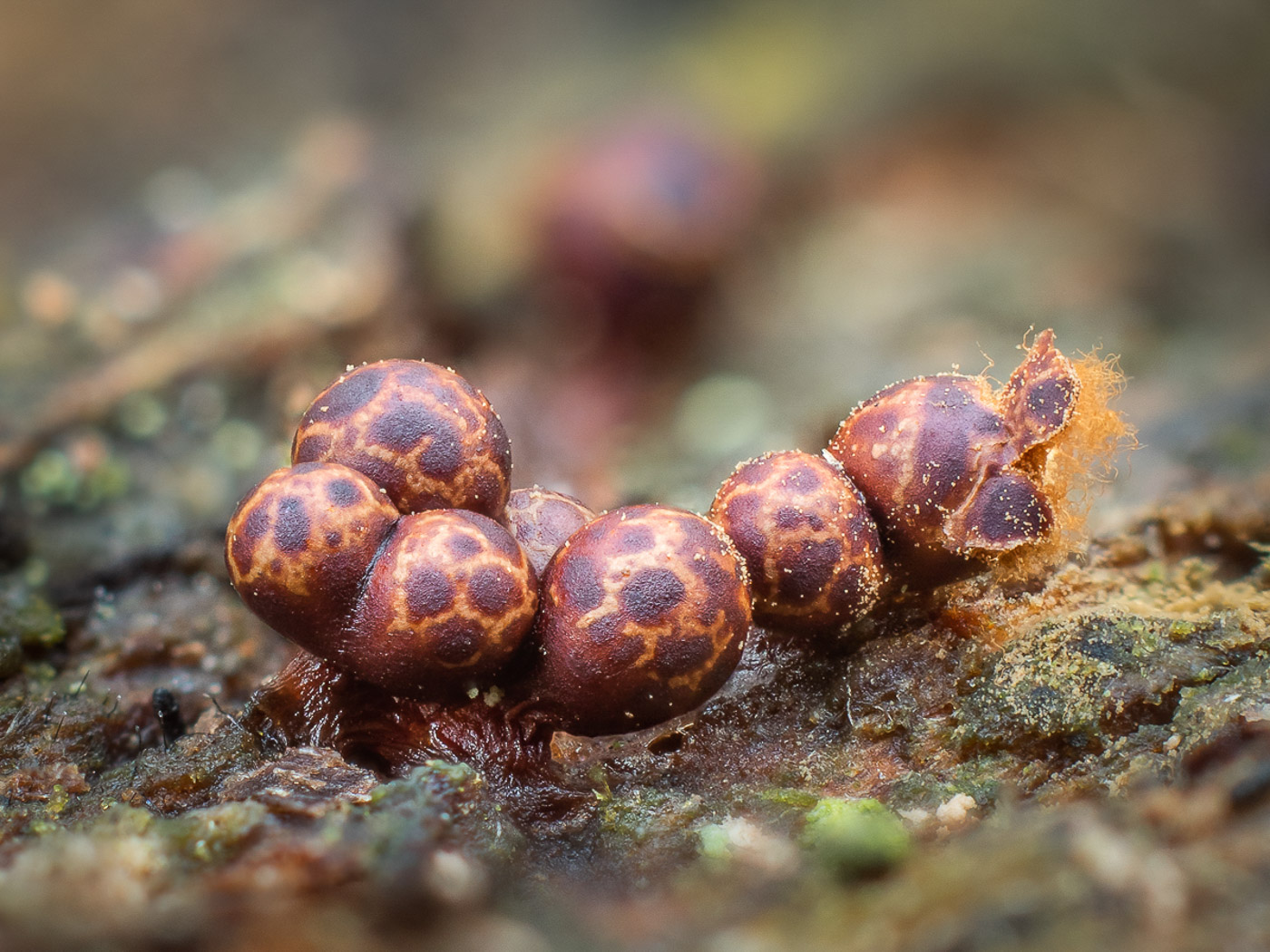
Trichia botrytis Nov 21, 2020. In Penn Wood Barry found this cluster of tiny specimens fruiting on fallen Oak. There are many species of Trichia and a scope is nearly always needed to name them but the very distinctive mottled markings seen here are enough to separate it from others in the field. Photo 2: Hodgemoor Wood 29.09.2021 Photo 3: Rushbeds Wood 24.03.2024 showing a fully mature example |

 |
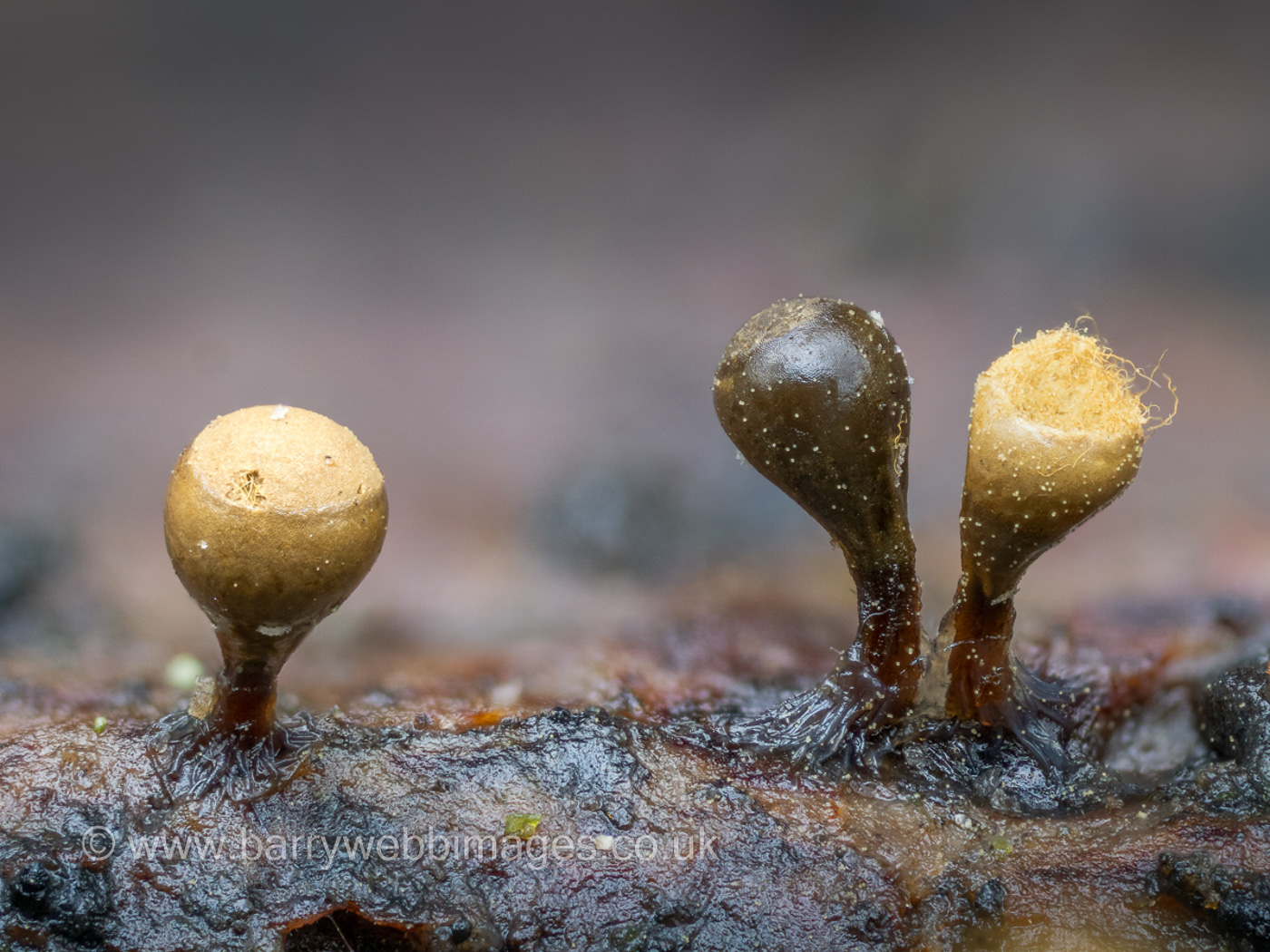
Trichia contorta var. attenuata Dec 14, 2022. Barry noticed this tiny species growing low down on live Heather stems at Stoke Common with snow still on the ground. He then sent both macro and micro photos to Myxomycete expert Edvin Johannesen who was able to identify it straight away from his images. We have two previous county records for T. contorta var. contorta but this is a first for this very rare variety for which there appear to be extremely few national records. |

 |
Trichia crateriformis Dec 12, 2024. At Burnham Beeches a small group of us met up specifically to look for slime moulds and we were rewarded with about 10 different species of which this unusual species was one. Originally known as T. decipiens var. olivacea, then as T. meylanii, it is now a species within its own right, and for a full descriptions see https://en.wikipedia.org/wiki/Trichia_crateriformis. This is a new county record and is also a new entry for Finds. |
 |
Trichia flavicoma Dec 24, 2022. On a pile of old prunings (Osmanthus, Laurel, Yew) at Hedgerley Green Barry spotted this really tiny species - less that 1mm tall. It is rarely recorded (no doubt due to its miniscule size) and is new to the county. Barry's identification was confirmed when he sent both macro- and microphotos to expert Edvin Johannesen. |
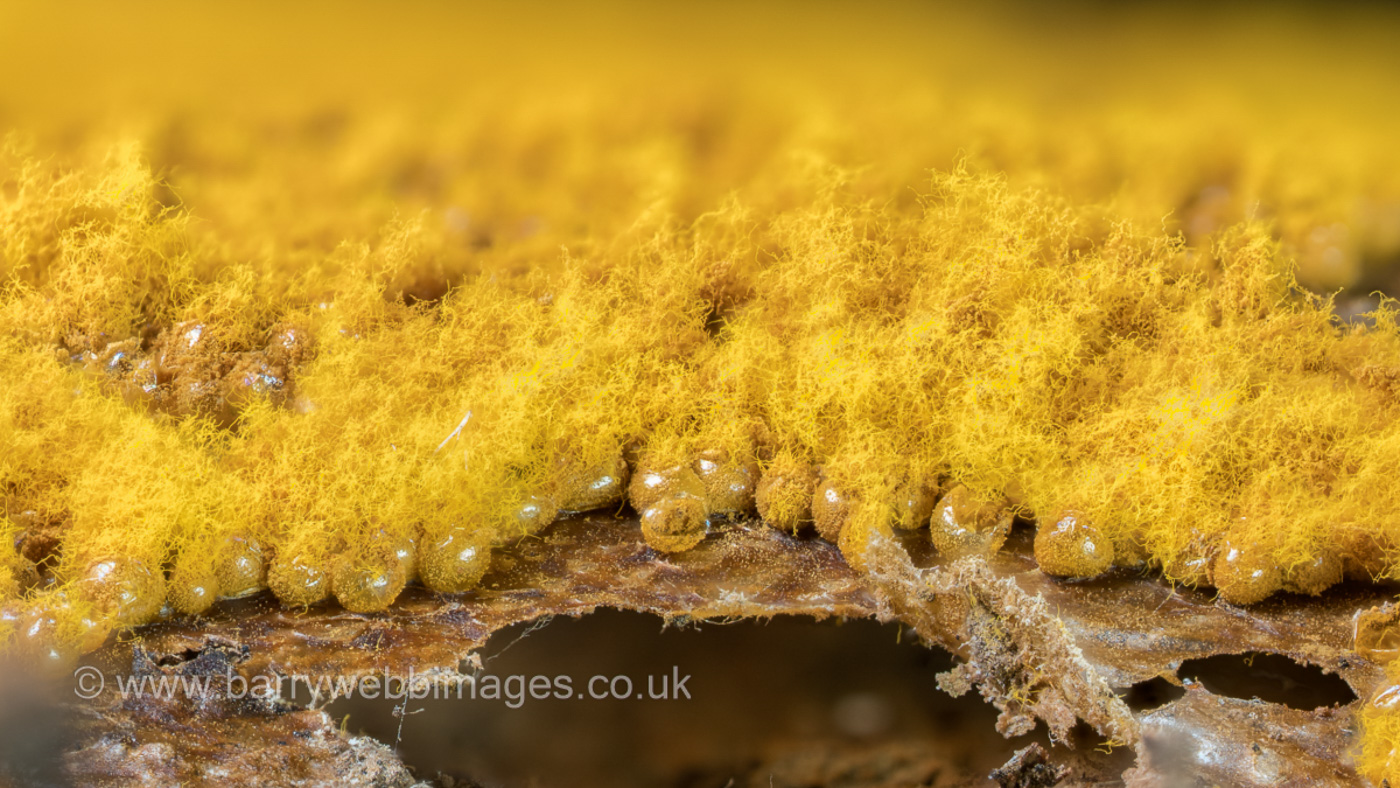 |
Trichia scabra Aug 11, 2024. In Burnham Beeches Barry found this colony on fallen indeterminate wood. A species superficially very similar to the very common T. varia, it also forms large tight sessile colonies of bright yellow but develops from a brown honeycomb-like mat and has distinctly different microscopic characters which help to separate it. It is not uncommon on deciduous rotten damp wood. |

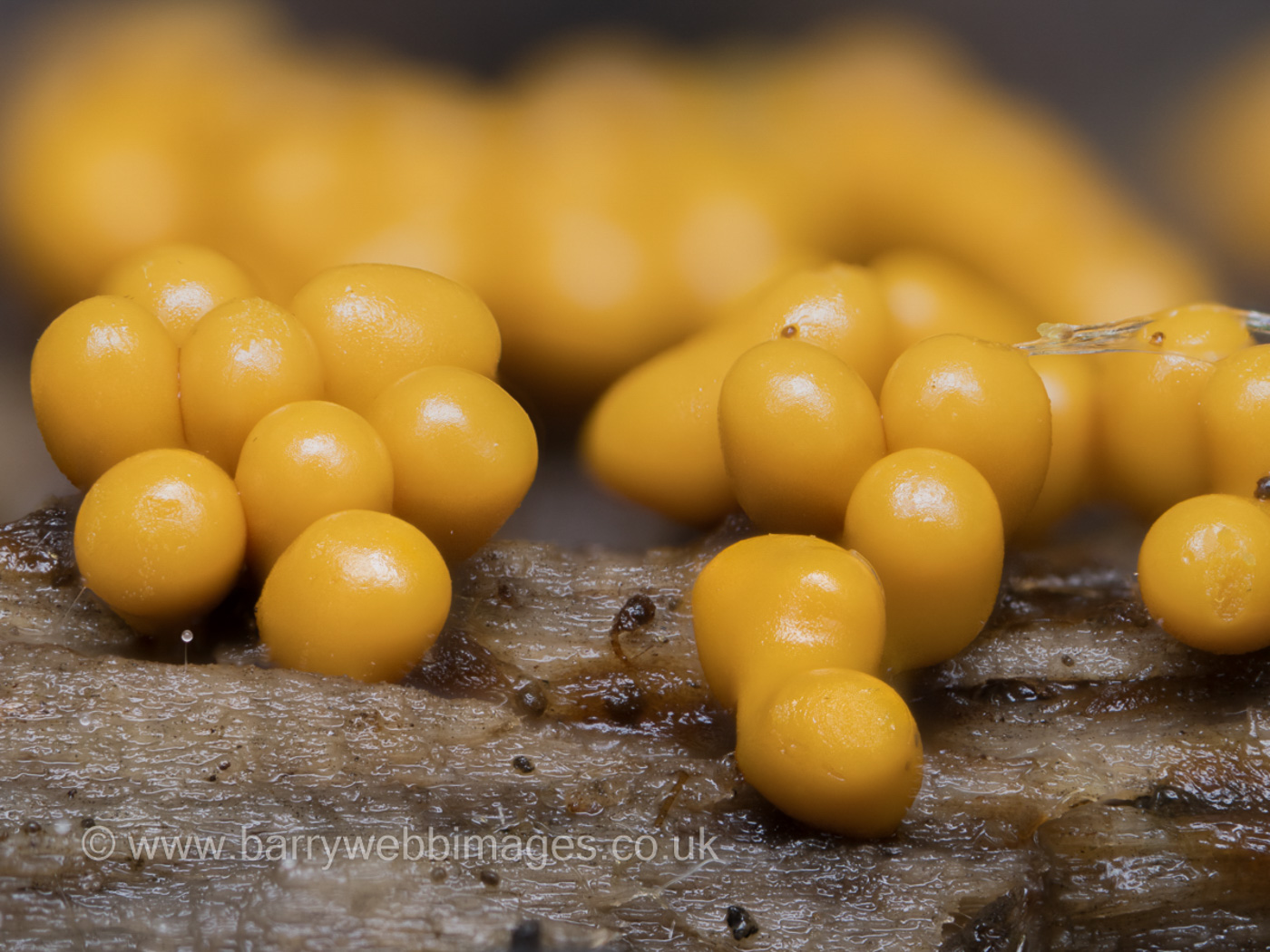 |
Trichia varia Jul 28, 2021. In Burnham Beeches on damp rotting deciduous wood Barry found this colony of one of the commonest species of Trichia which was mature enough for Penny to be able to identify it at home. This is a genus with many somewhat similar species, most of which start out as a small patch of white blobby plasmodium which gradually turns yellow then dries off to form tight clusters of sporangia, some species having a short stalk, some not as here. Photo 2: Gt. Bois Wood 25.10.2025 showing a less mature colony. |


|
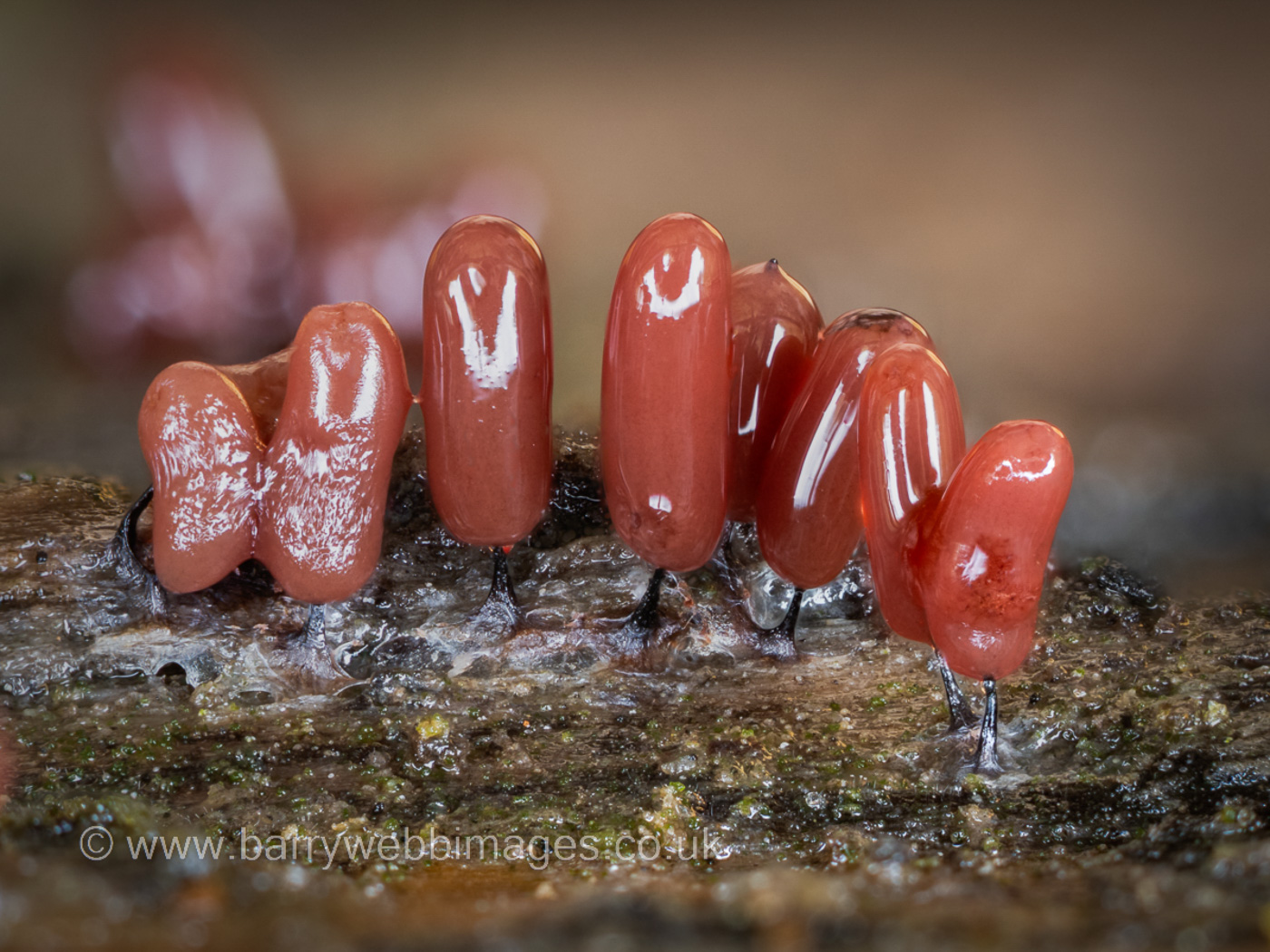
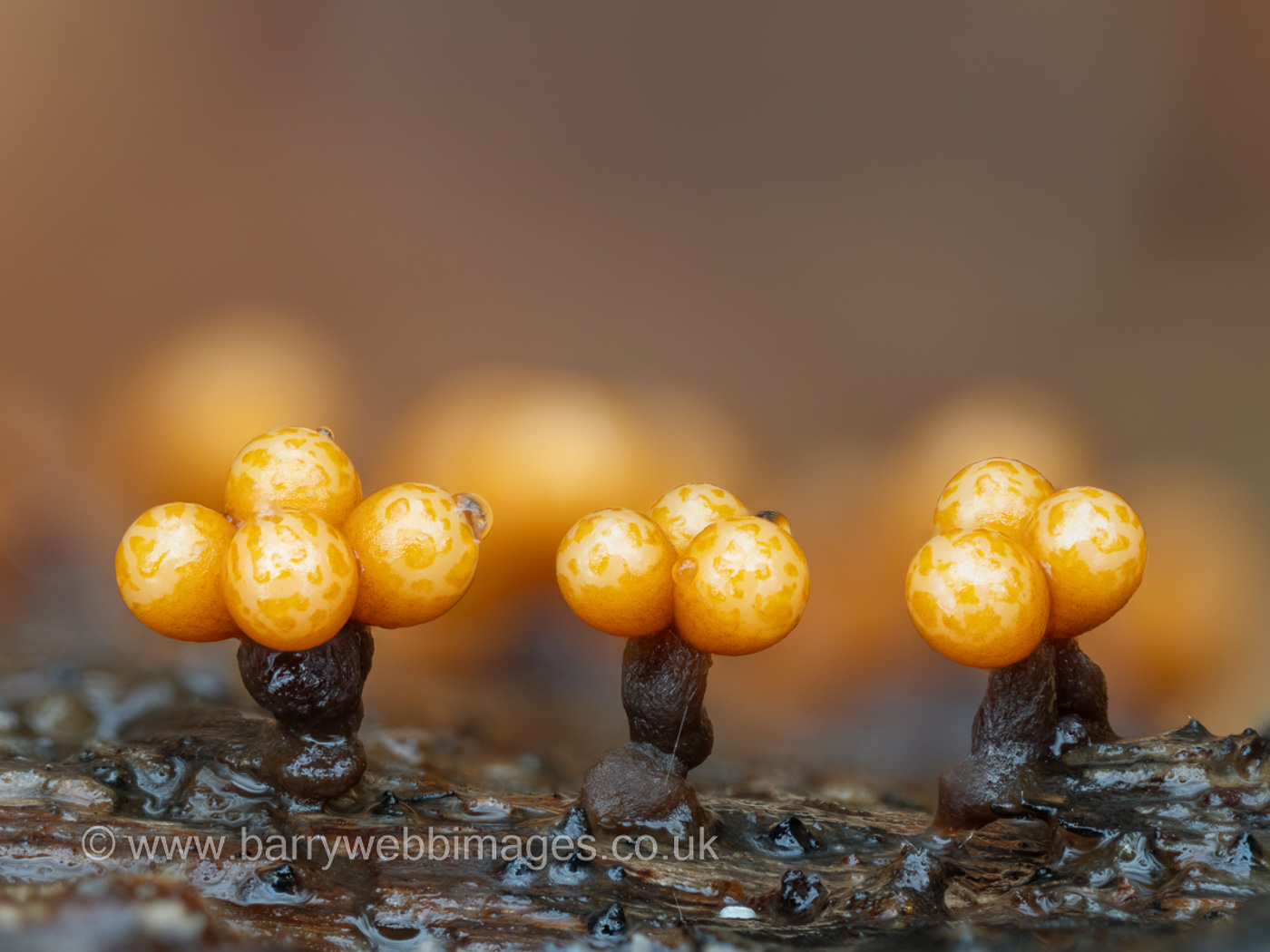
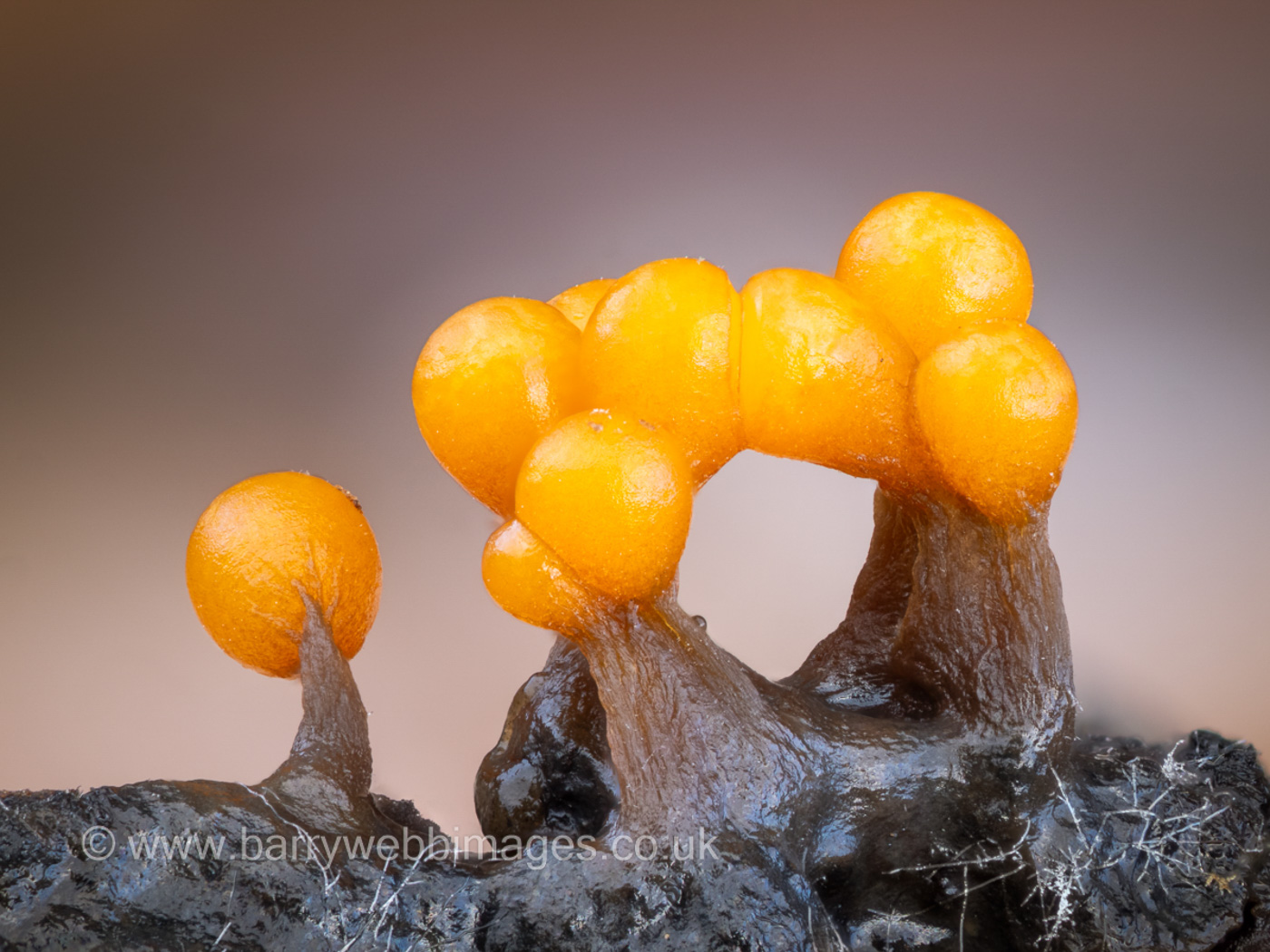
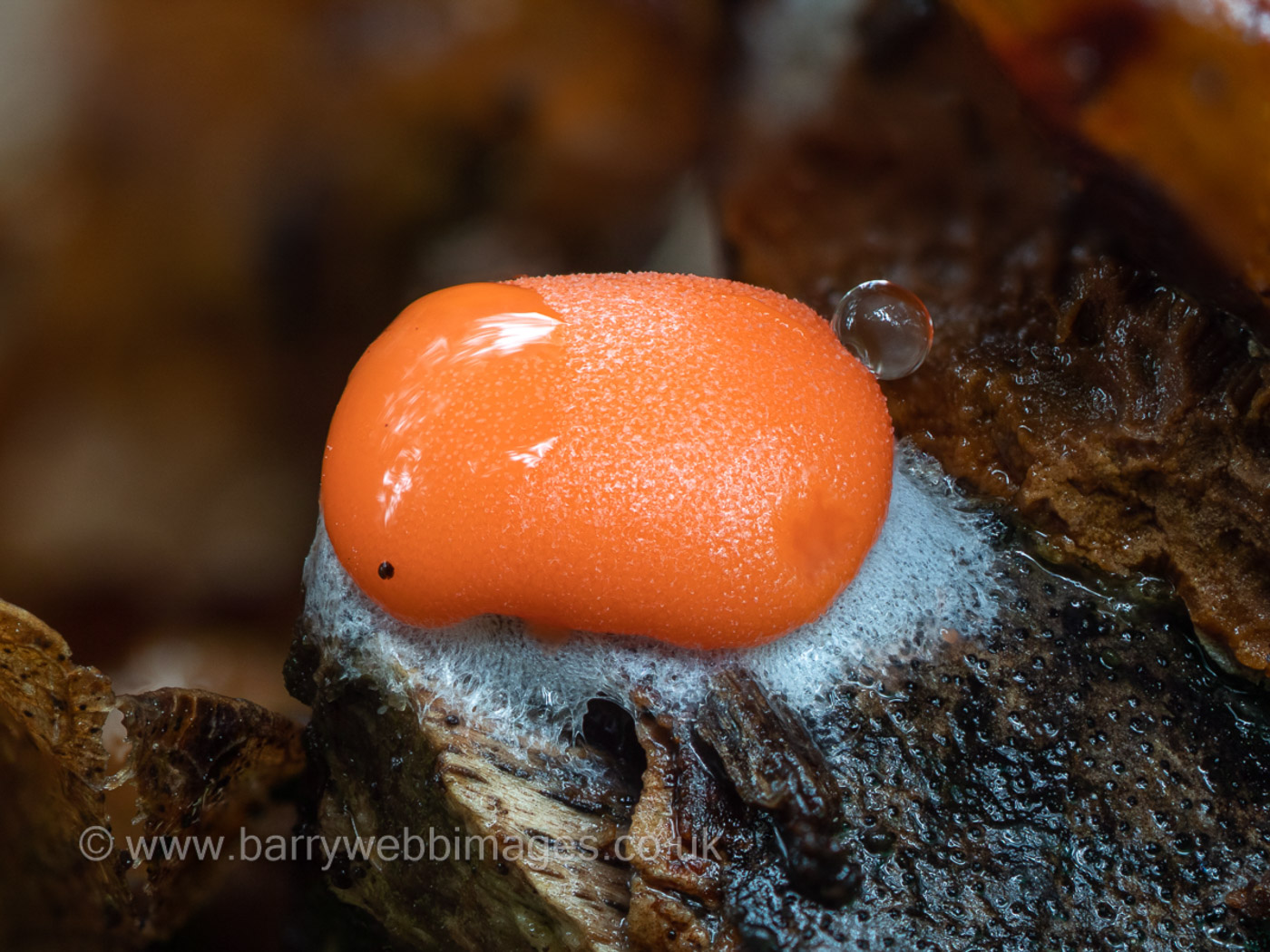
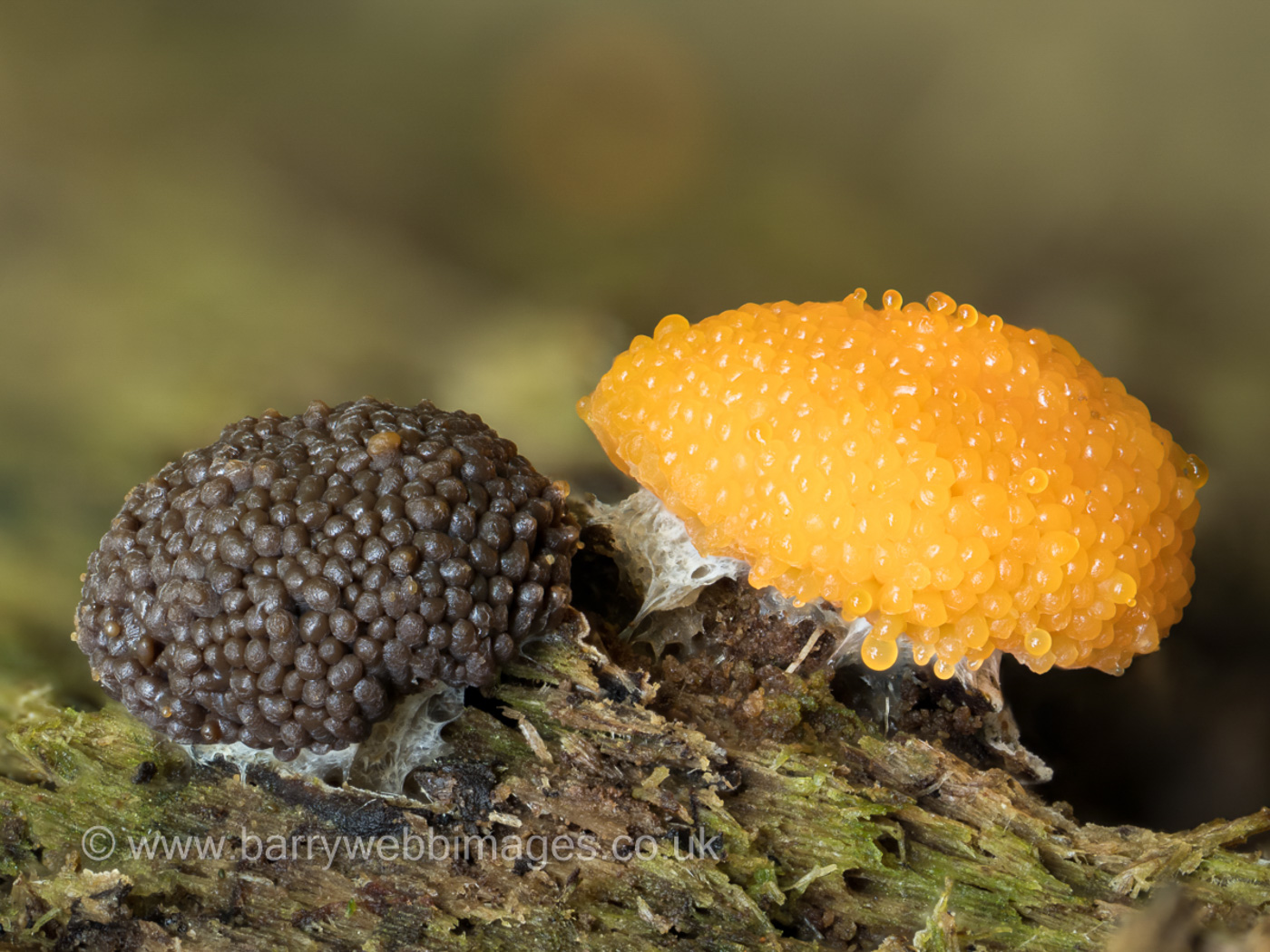
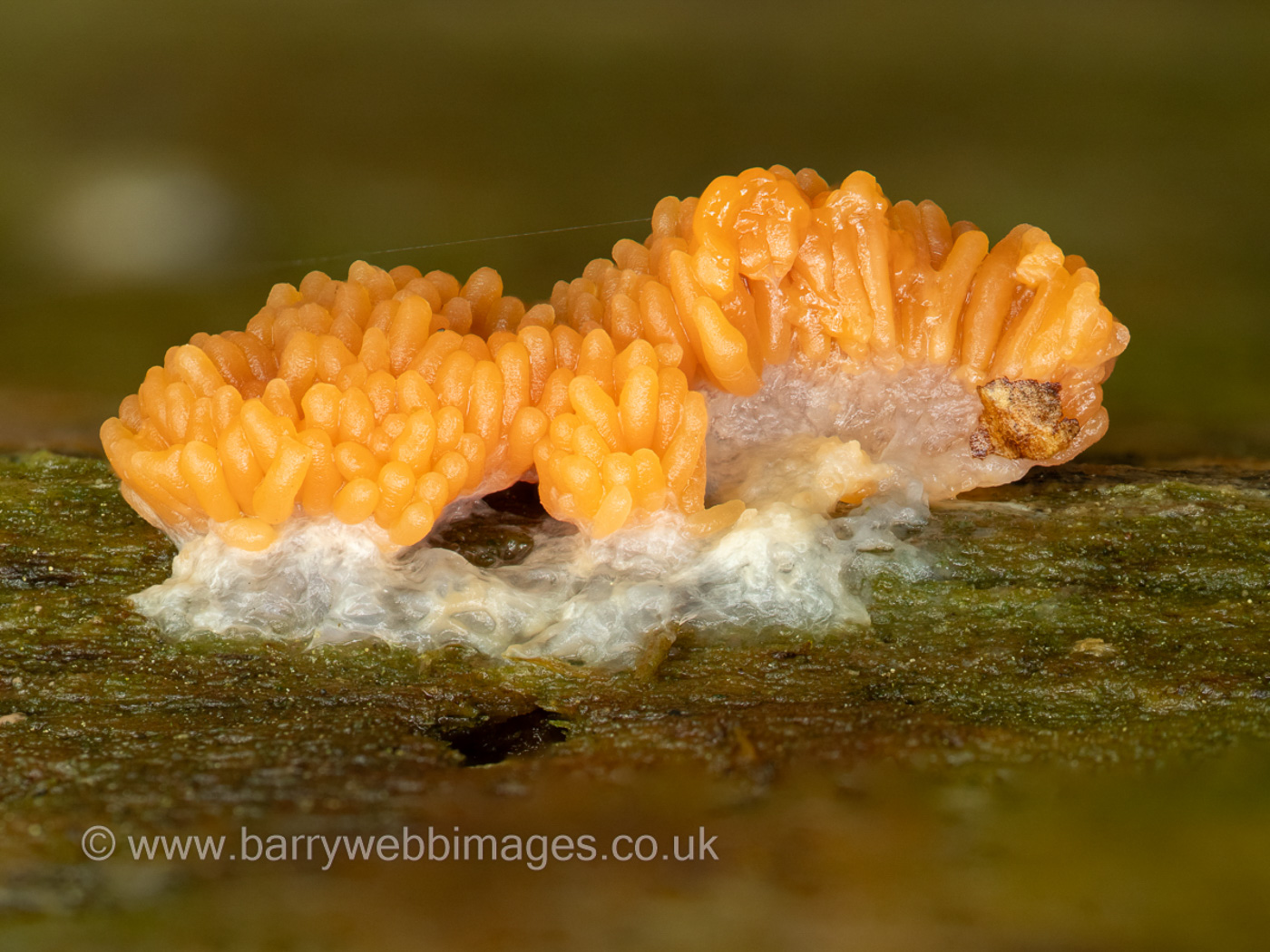
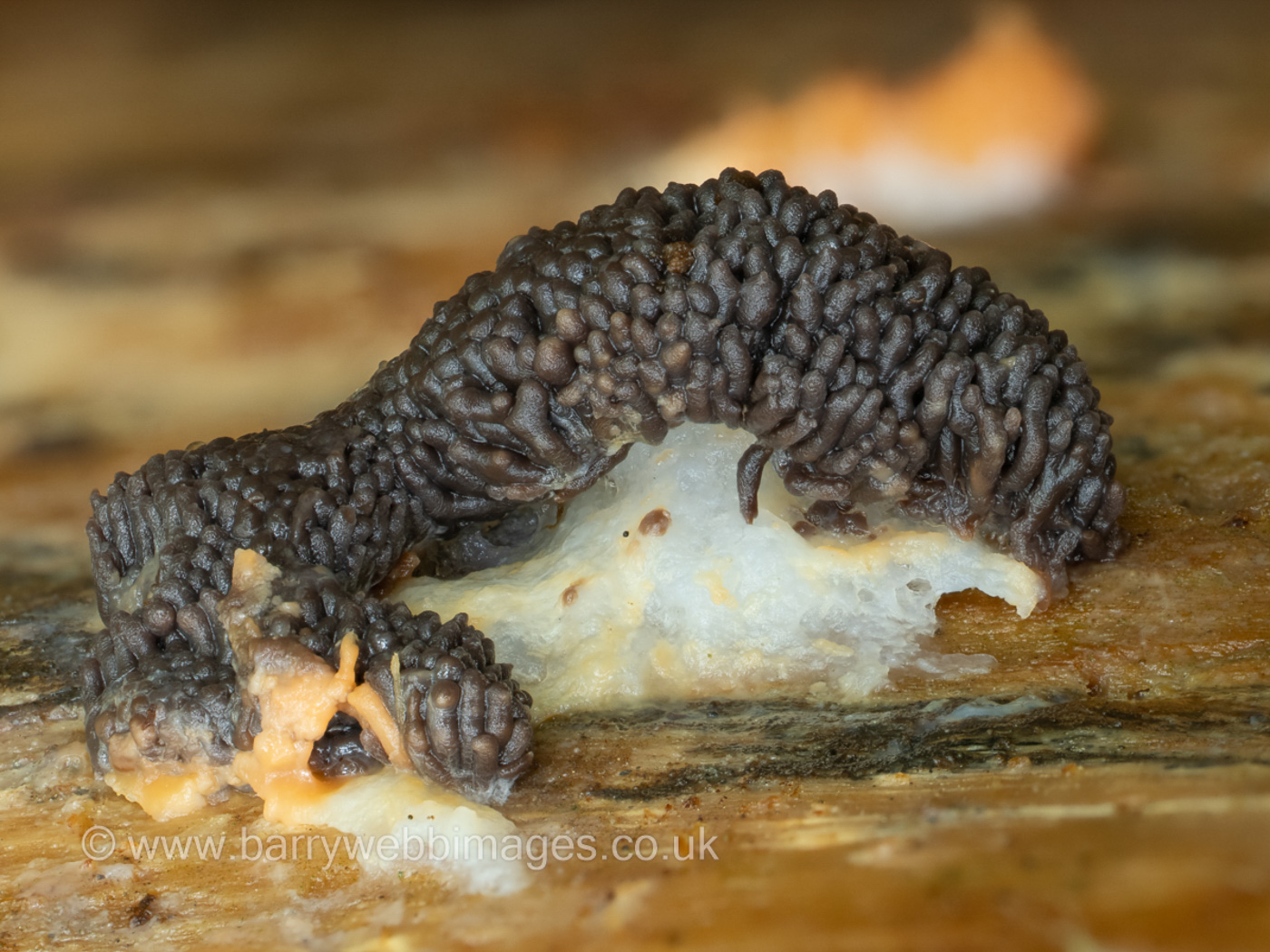
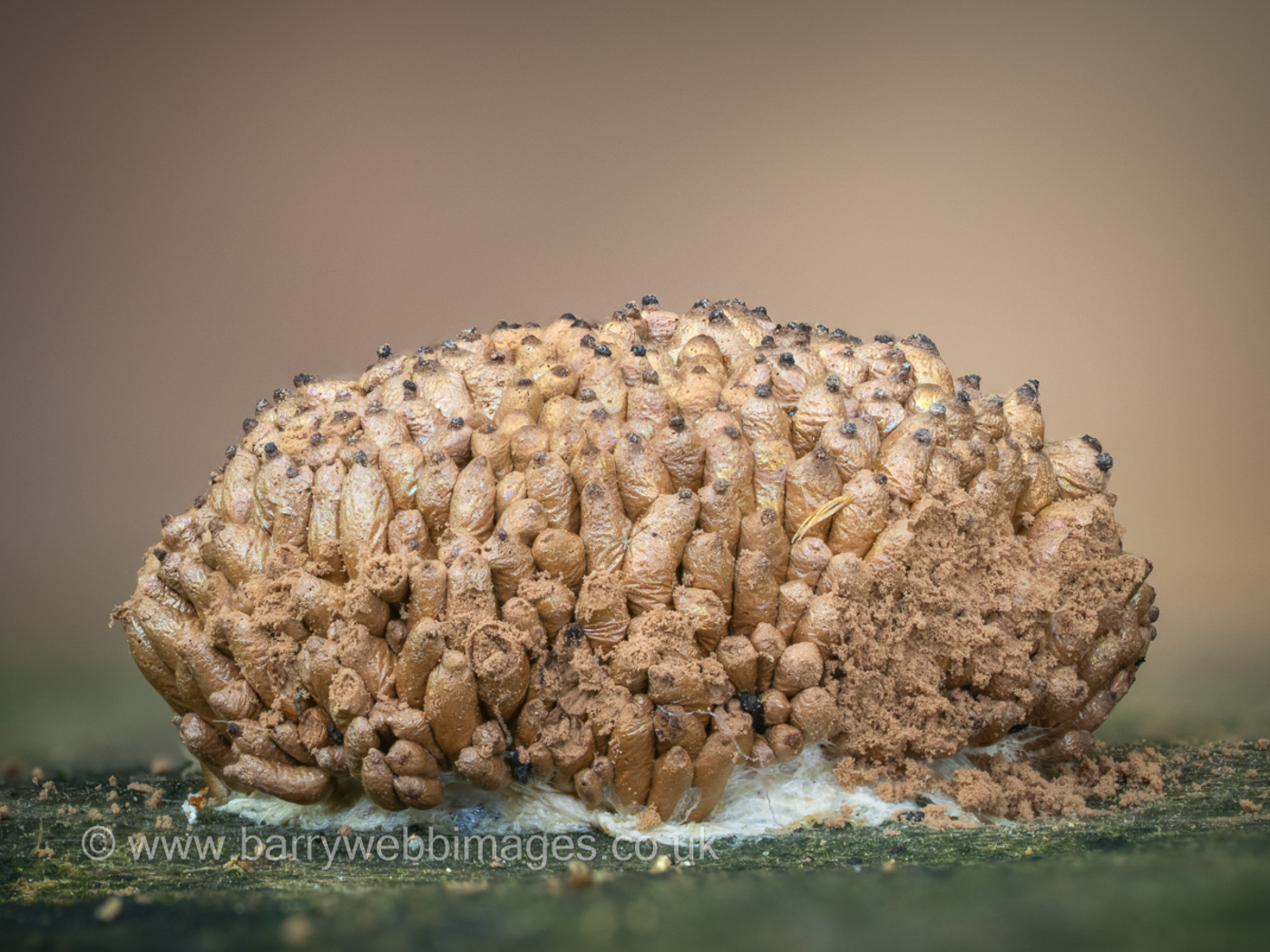
Tubifera ferruginosa Sep 7, 2020. Barry found this very common species in Burnham Beeches on fallen Birch though it most commonly occurs on fallen Pine. It has possibly the brightest plasmodium of all slime moulds: coloured brilliant orange, apricot or pink (hence its unofficial English name Raspberry Slime) and leaving little doubt as to species especially when found on Pine where no other slime mould plasmodium can match this colour. Photo 2 shows a patch found nearby and rapidly maturing when it becomes dull brown and comparatively inconspicuous. Photo 3: Ivinghoe Common 13.09.2021 found on fallen rotten conifer and just beginning to form the tightly clustered columns which eventually turn brown. Photo 4: Burnham Beeches 02.10.2021 showing a really early stage shown here Photo 5: Burnham Beeches 21.07.2023 showing two separate little moulds, the LH mould further developed and drying off Photos 6 and 7: Hockeridge Wood 09.10.2024 showing two separate collections on fallen Pine again at different stages of development Photo 8: Hockeridge Wood 27.09.2025 on unidentified wood and the most mature of all the images included here |