Members’ Finds 2026
SEARCH all entries via Masterlist Index of Latin or English names
SEARCH all entries by month
BROWSE previous years' entries: 2025 2024 2023 2022 2021 2020
How to submit your photos and Viewing Tips
How Members' Finds started
Acknowledgements and Disclaimer
Rare sightings New to Buckinghamshire New to UK New to Science
Jan Feb Mar Apr May Jun Jul Aug Sep Oct Nov Dec
Number of species on Members' Finds to date: 1308
| Image | Details |
|---|
October 13th 2026
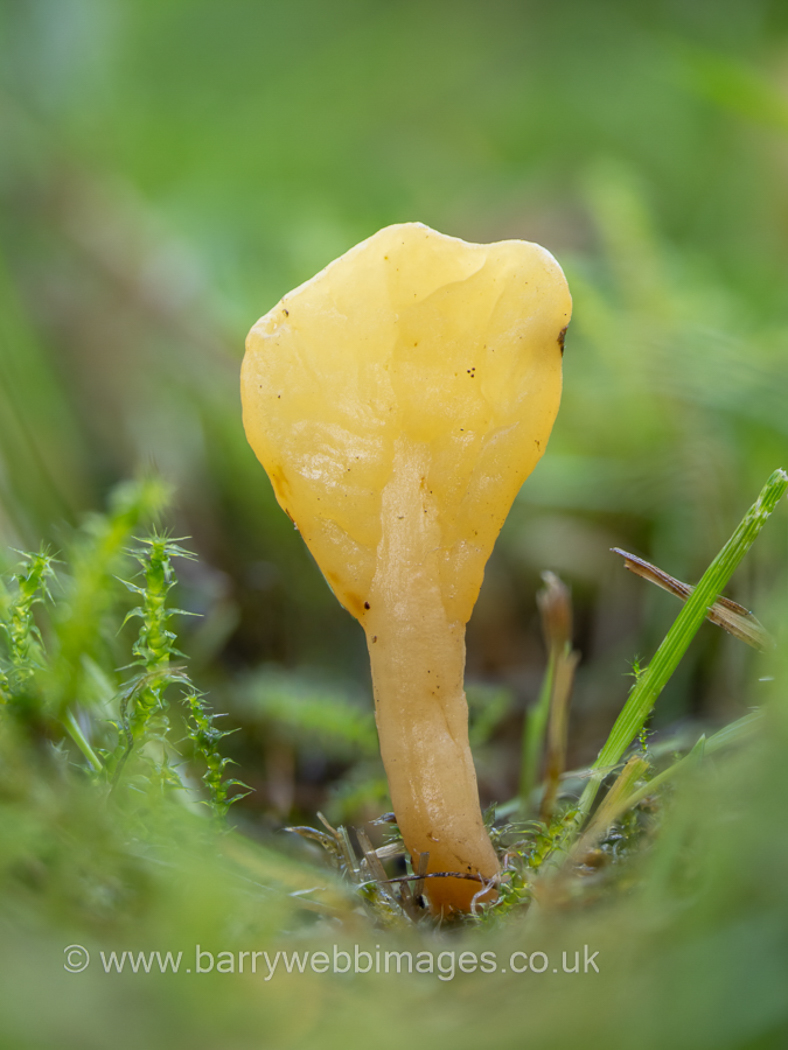 |
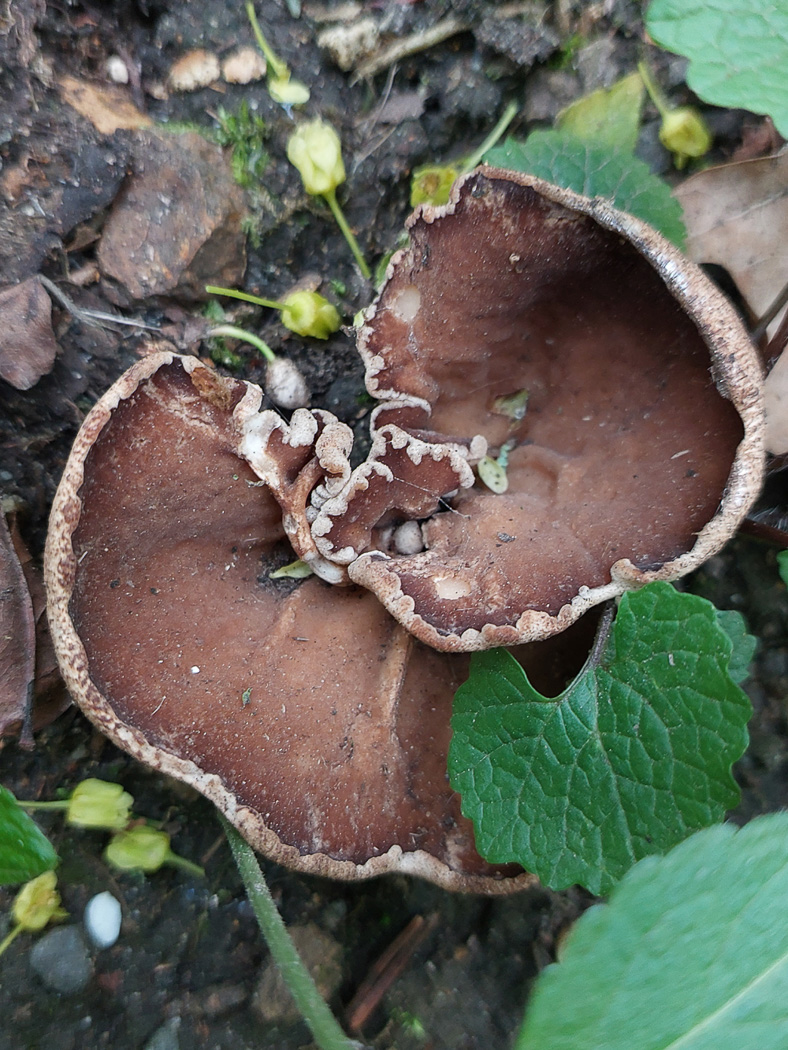
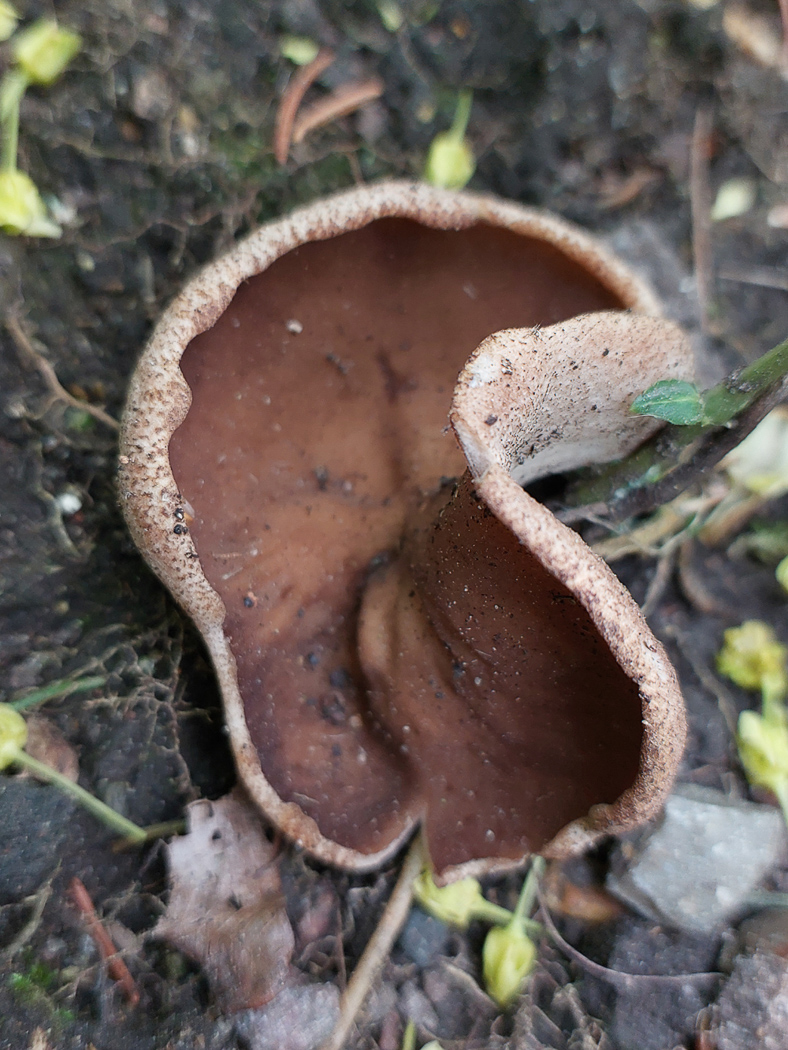
October 13th Spathularia flavida (Yellow Fan) On a quick visit to Penn St churchyard Barry Webb spotted this unusual asco in the grass near a large conifer. This is a species Penny first discovered in the woodland here under Larch back in 1999 when new to the county and a very unusual find for as far south as this though it is not uncommon in Scotland. She then found it in the churchyard here in 2005, since when it has appeared here on and off in the intervening years though we last recorded it here in 2021, but it seems to have died out in the woodland. We now have a couple of other county sites since that time perhaps indicating that the species in on the move southwards, so one to look out for in conifer needle litter. Previous finds |

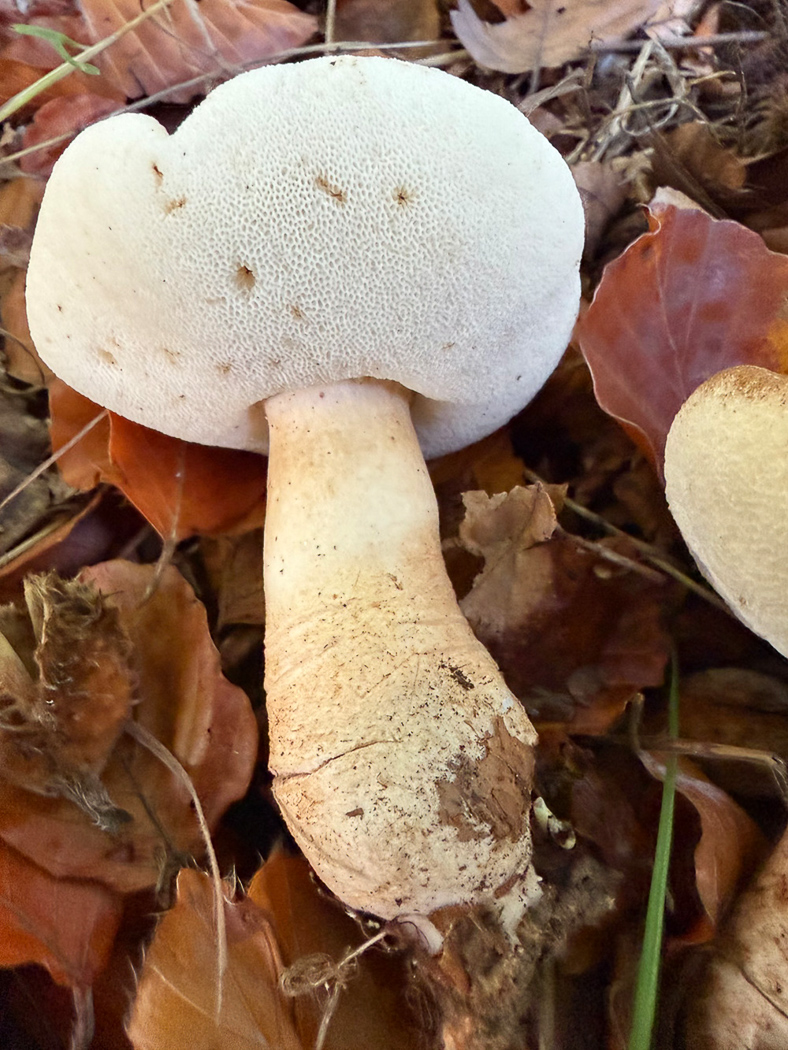 |
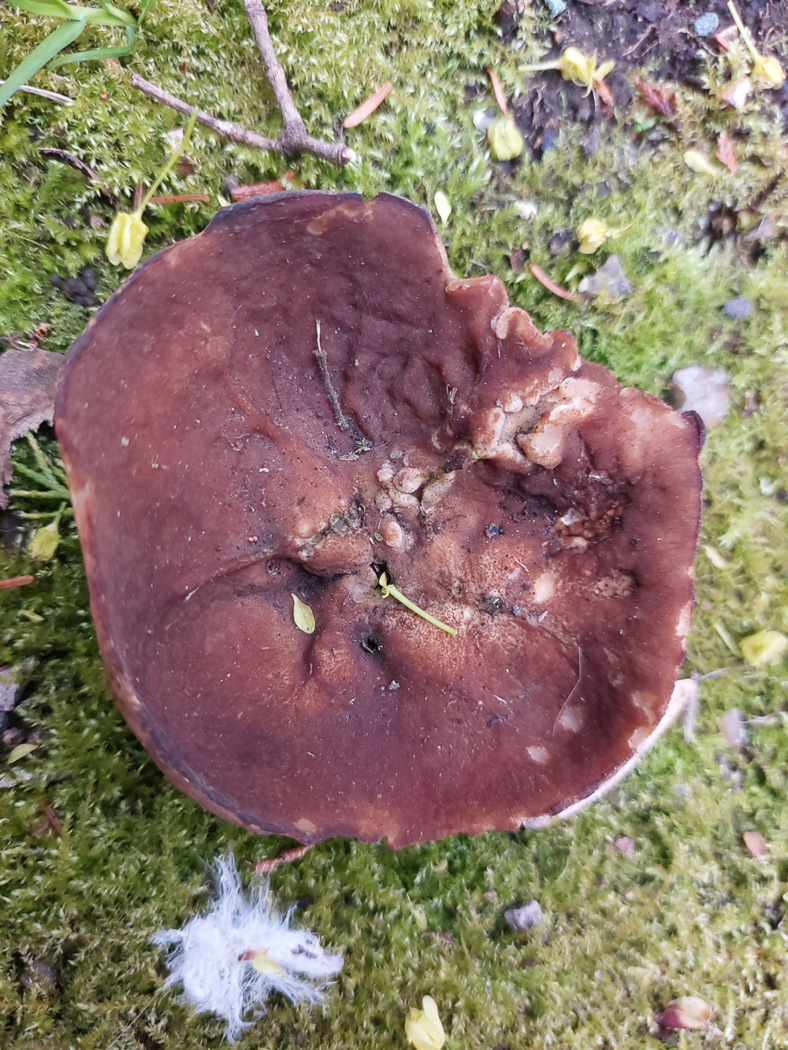
October 13th Gyroporus castaneus (Chestnut Bolete) In Naphill Common Sarah Ebon spotted this attractive and distinctive mushroom under Beech. This is a bolete instantly recognisable in the field from its combination of colours: chestnut brown cap, creamy whitish pores (which don't stain when pressed) and stem concolorous with cap or a bit paler. When mature the cap tends to upturn at the margin with convex underside exactly as seen here, also the stem becomes hollow typically developing cavities, seen if split lengthways. By far its commonest host is Oak (and I wonder if Oak was nearby here?) and if you find one there are often a few more close by. Previous finds |
October 11th 2026

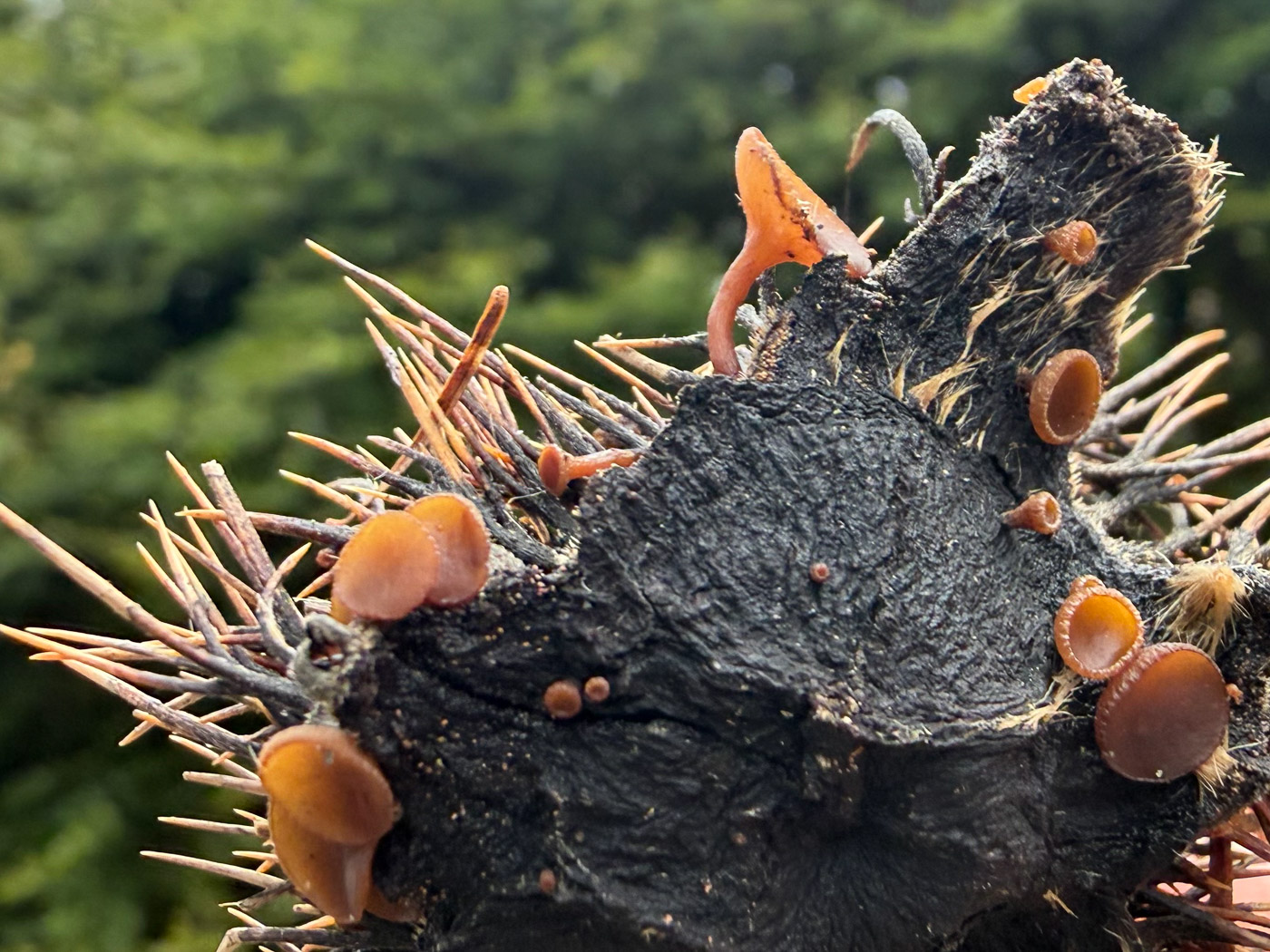 |
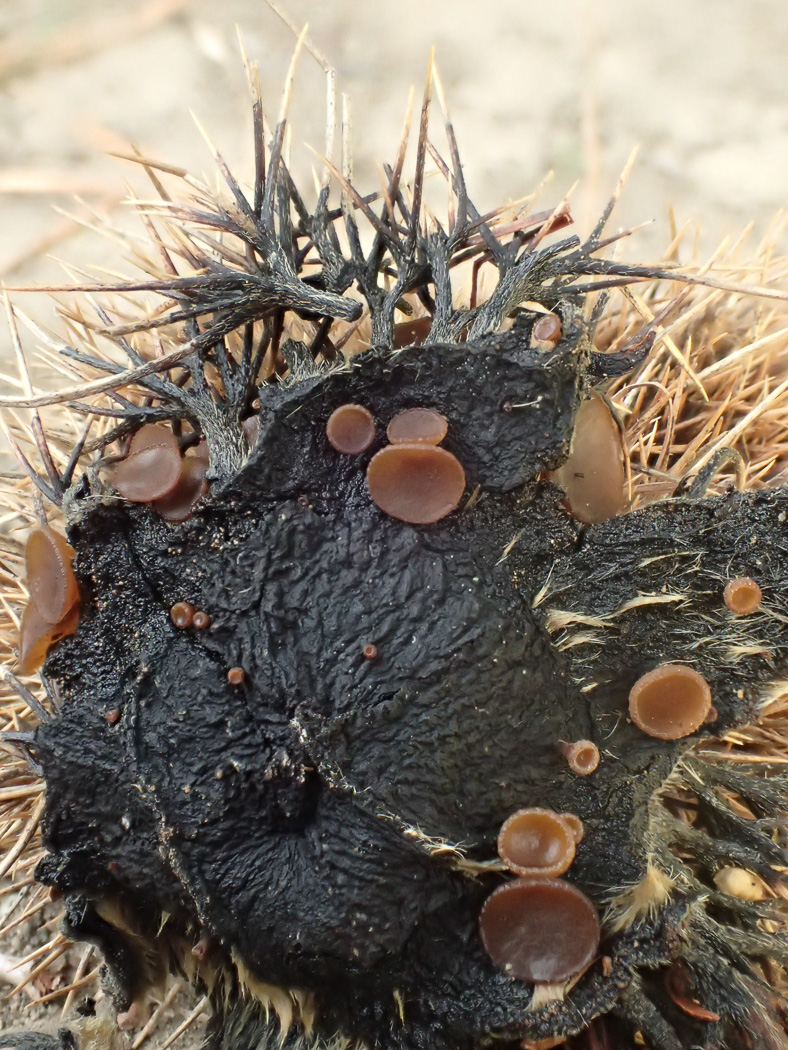
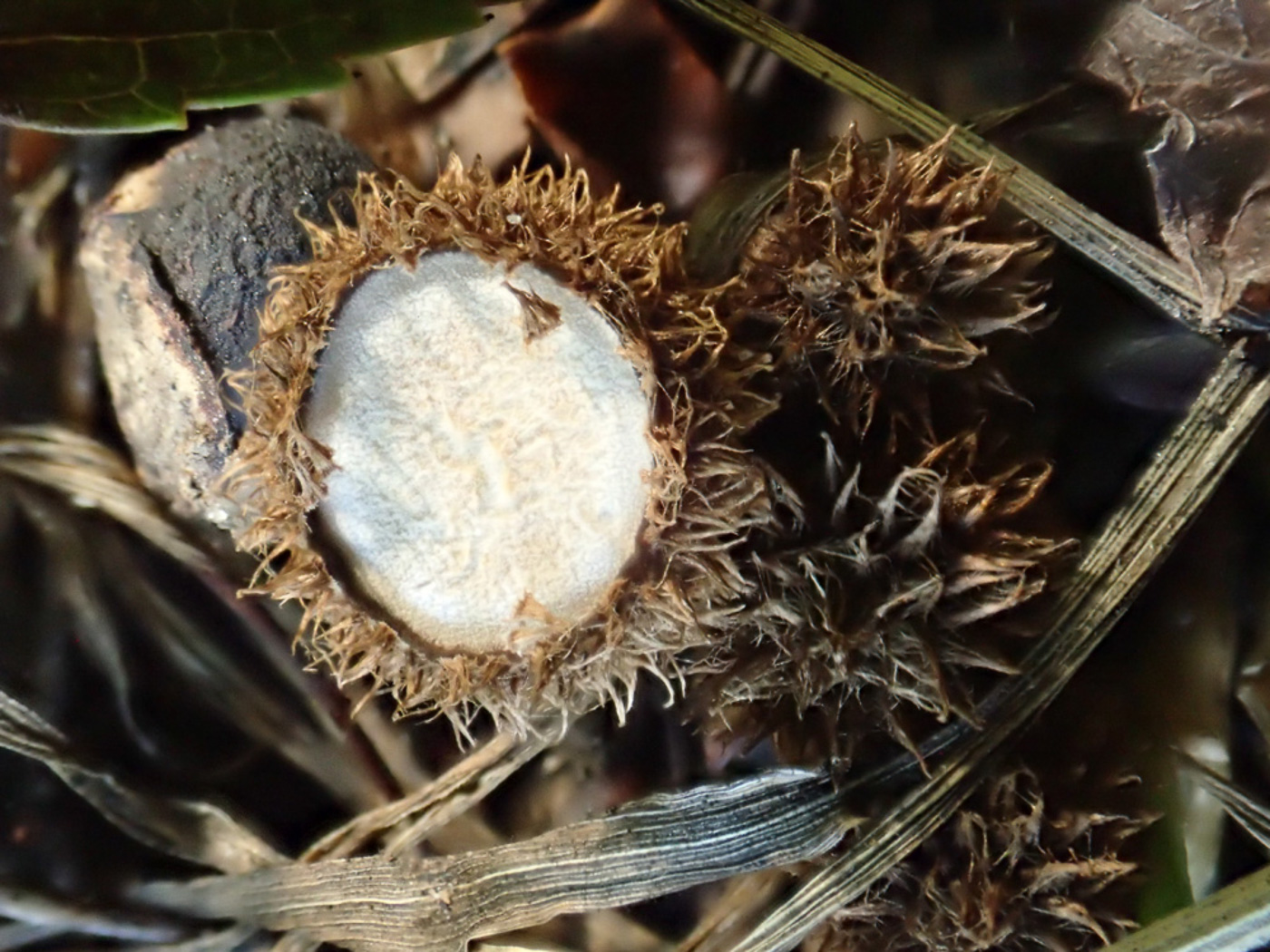
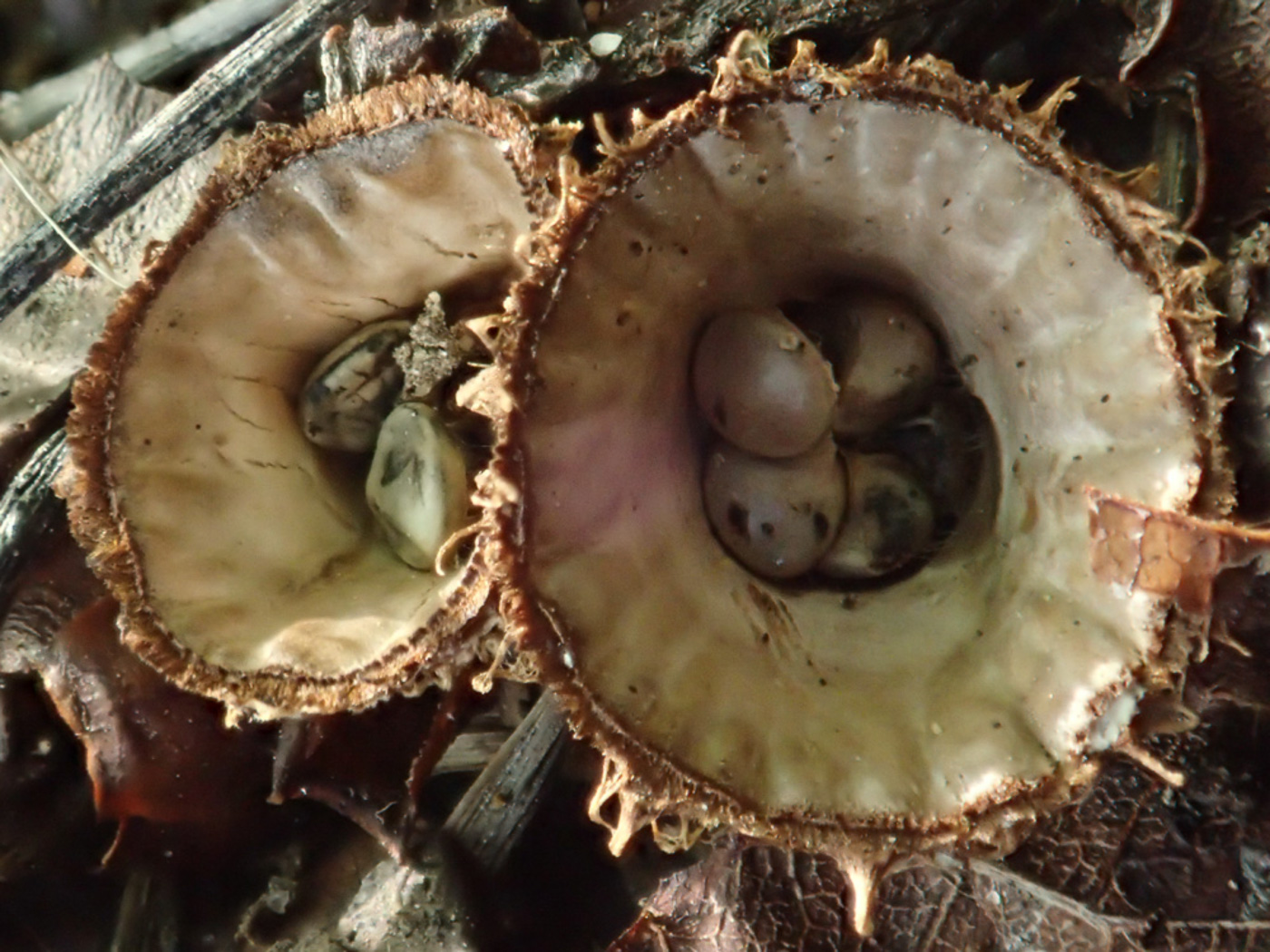
October 11th Lanzia echinophila (Hairy Nuts Disco) In Old Wavendon Heath (nr Milton Keynes) Sarah Ebdon noted the many fallen Sweet Chestnut husks on the ground and decided to have a good search to see if she could locate the small cup fungus which grows on them. Success! In fact she found one old husk which had 24 individual cups on it! Despite some recent rain they were pretty shrivelled and dehydrated (photo 1) but having successfully rehydrated this species when found on one of our walks recently she popped them in a pot with some moisture and by the time she got home they had suitably recovered for her photos. These tiny cups are only found on old rotting spiny or hairy husks and one of our few previous records was actually on Turkey Oak acorn cups which of course are also suitably hairy. This is a new records for Finds. Members' Finds New Species no. 1308 |
October 8th 2026
.jpg "Photo © Sarah Ebdon")
 |
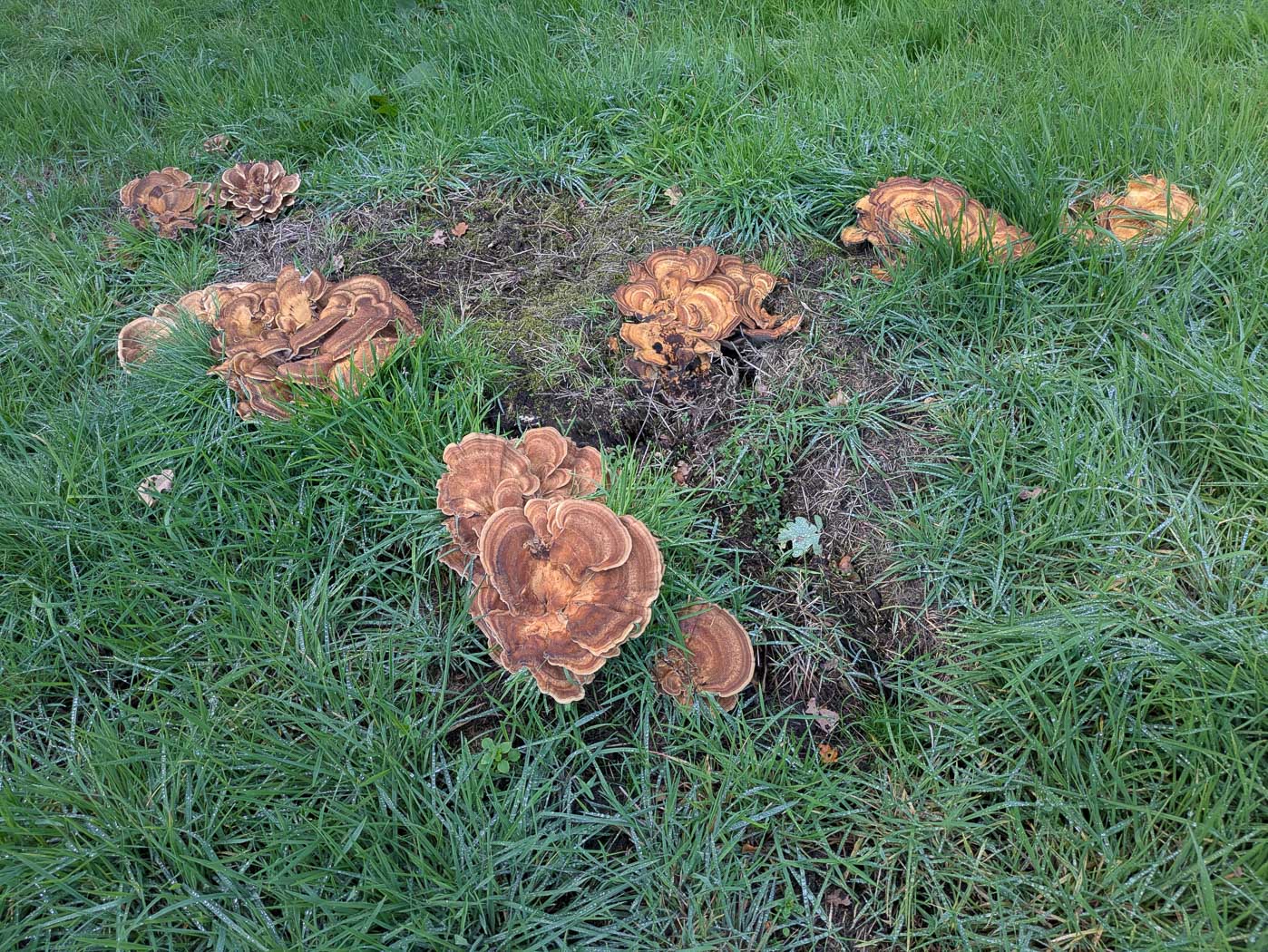
October 8th Meripilus giganteus (Giant Polypore) In a grassy area of Naphill Common Chris Miller came across this impressive sight surrounding an old Beech stump, each floret of the fungus probably about a foot across so the whole covering a wide area. Clearly though the stump was felled a while ago there is enough of it still underground for the fungus to feed off it and grow, no doubt accelerating the rate of decomposition beneath. This is an impressive species and very common under and around Beech and can get to a considerable size. Previous finds |
October 5th 2026
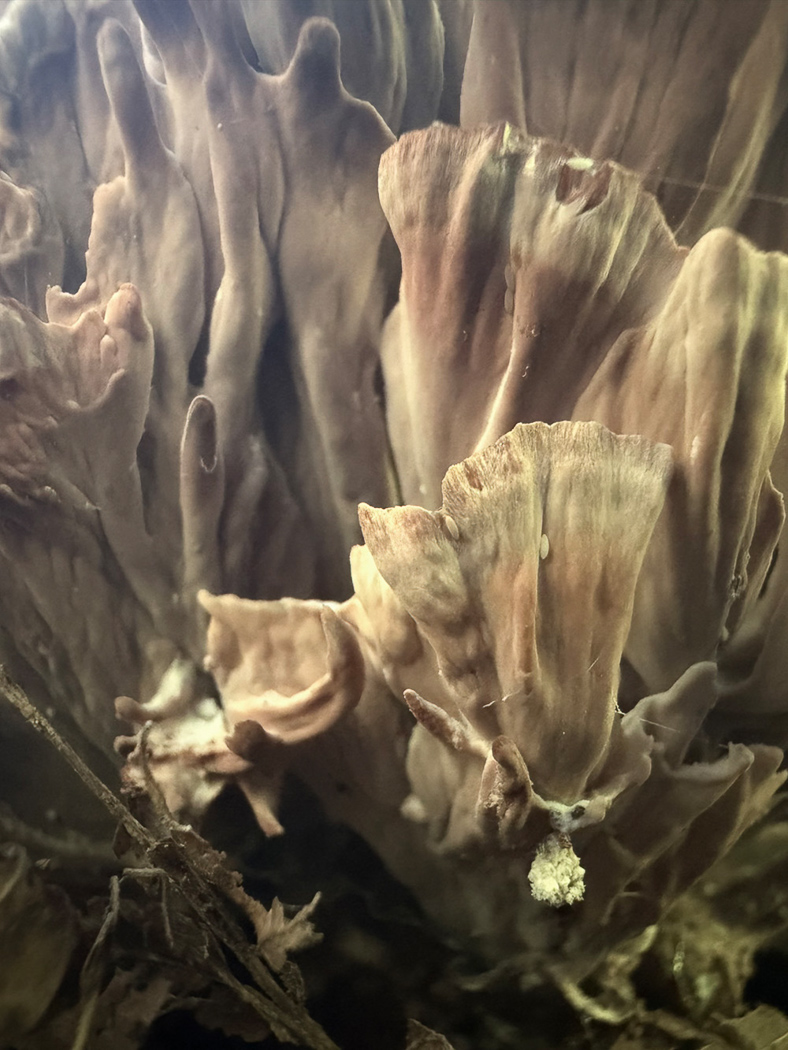 |
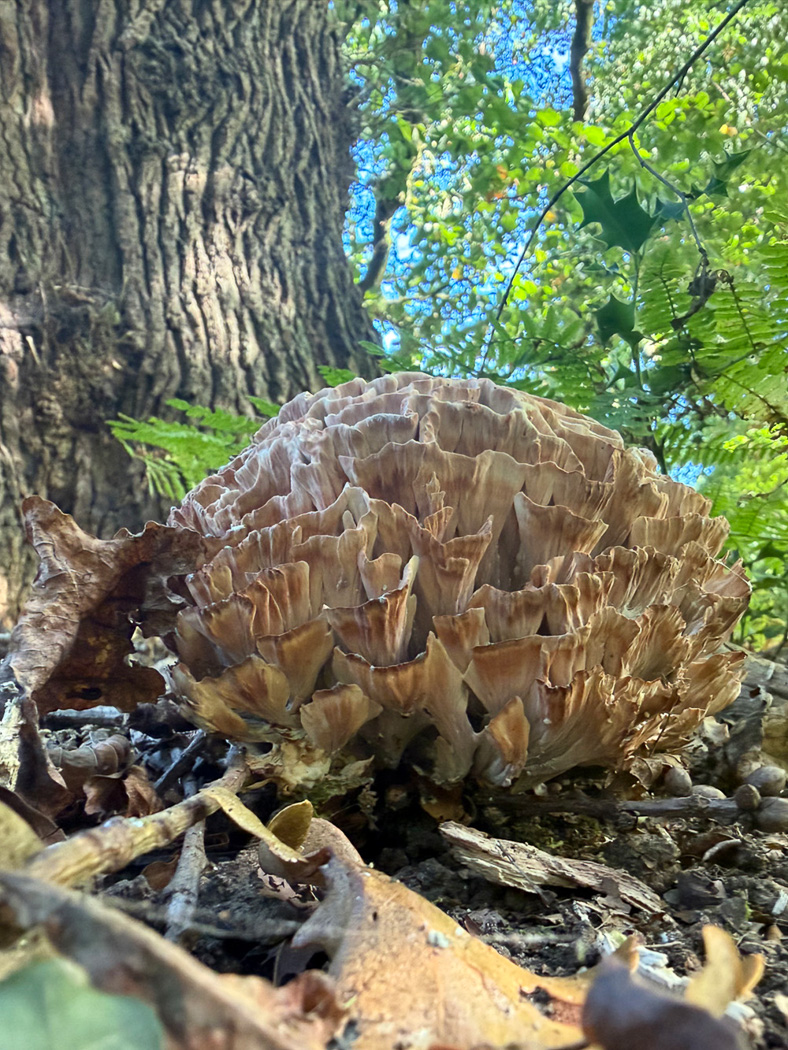
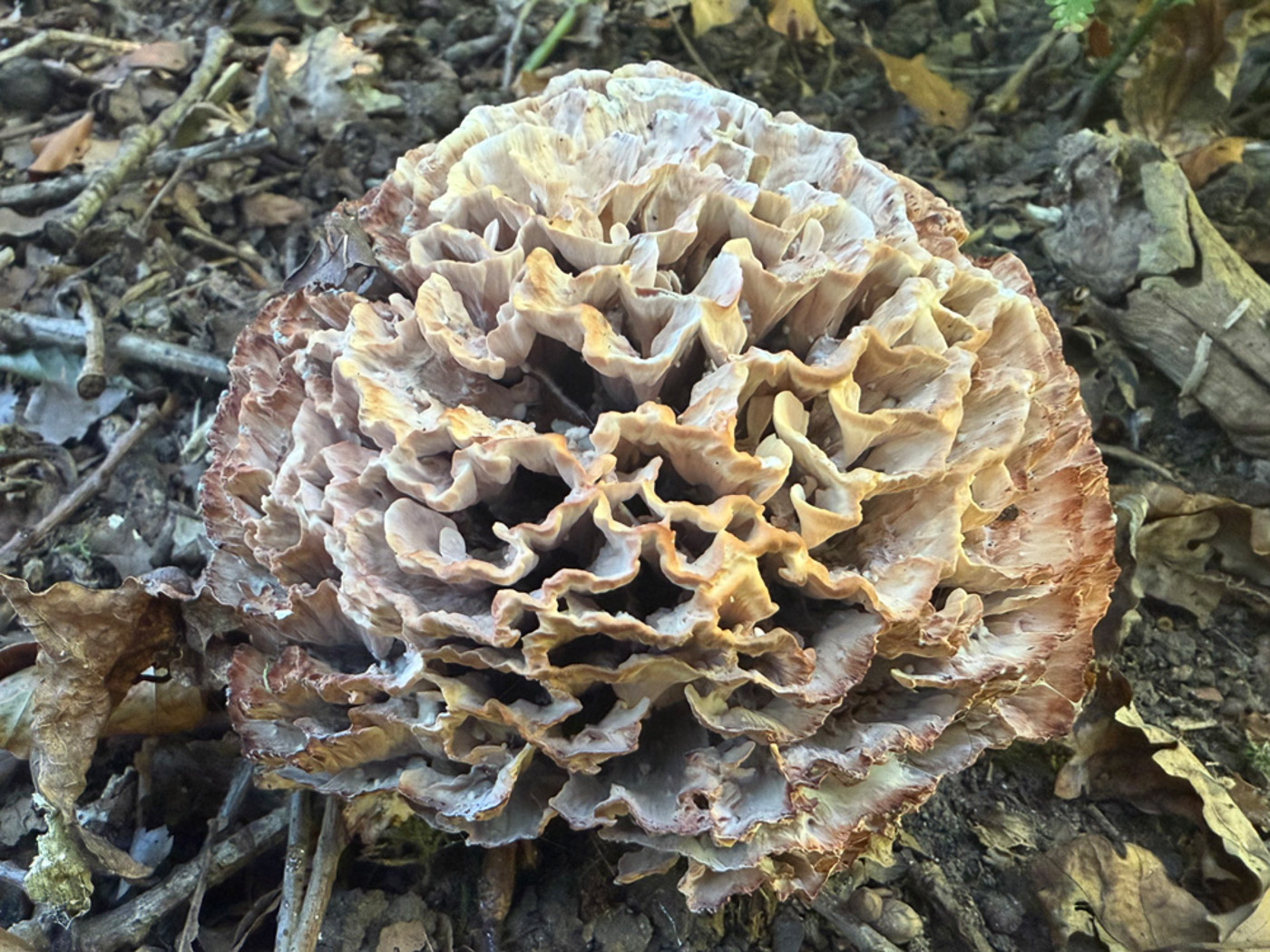
October 5th Podoscypha multizonata (Zoned Rosette)  Peter Davis reported that a neighbour had spotted a weird looking fungus under a huge Oak in Naphill Common and, wondering what it was, he'd checked it with a phone app which had come up with the genus Thelephora (apparently an older name for Podoscypha, though Penny's advice would be not to trust such apps: Kingdom Fungi is just too vast and difficult for such a system to be accurate or trustworthy). Peter sent a photo to Sarah who then went to investigate and though this was a somewhat small though mature specimen - only `15 cm across whereas it can get to as much as 40 cm across - she was convinced it was P. multizonata and later the microscopy confirmed it. This is an uncommon species which grows under mature Oak and our only other Finds entry, made in 2024, was just our 3rd county record. Today's find is new for Naphill Common. The photos are Sarah's. Previous finds |
.jpg "Photo © Jackie Ewan") |
October 5th Rhodocybe gemina (Tan Pinkgill) At Stampwell Farm Jackie Ewan checked the woodchip pile where last year Clathrus archeri 'ran amok' but found no signs of it though it was overrun with thistles. What she did find nearby, however, was R. gemina just appearing amongst nettles under Hawthorn in the same spot where it was new to the site and to her last year. This is a chunky sturdy species, similar to a large Entoloma and which used to be considered quite rare but seems to be on the increase in our area. Previous finds |
.jpg "Photo © Jackie Ewan") |
October 5th Clathrus archeri (Devil's Fingers) Time was when this species was a really special find but it is now a regular at Stampwell Farm and often seen in large numbers. Today Jackie Ewan was surprised to find it appearing on bought compost in a bed planted with tomatoes! Previous finds |
.jpg "Photo © Jackie Ewan")
 |
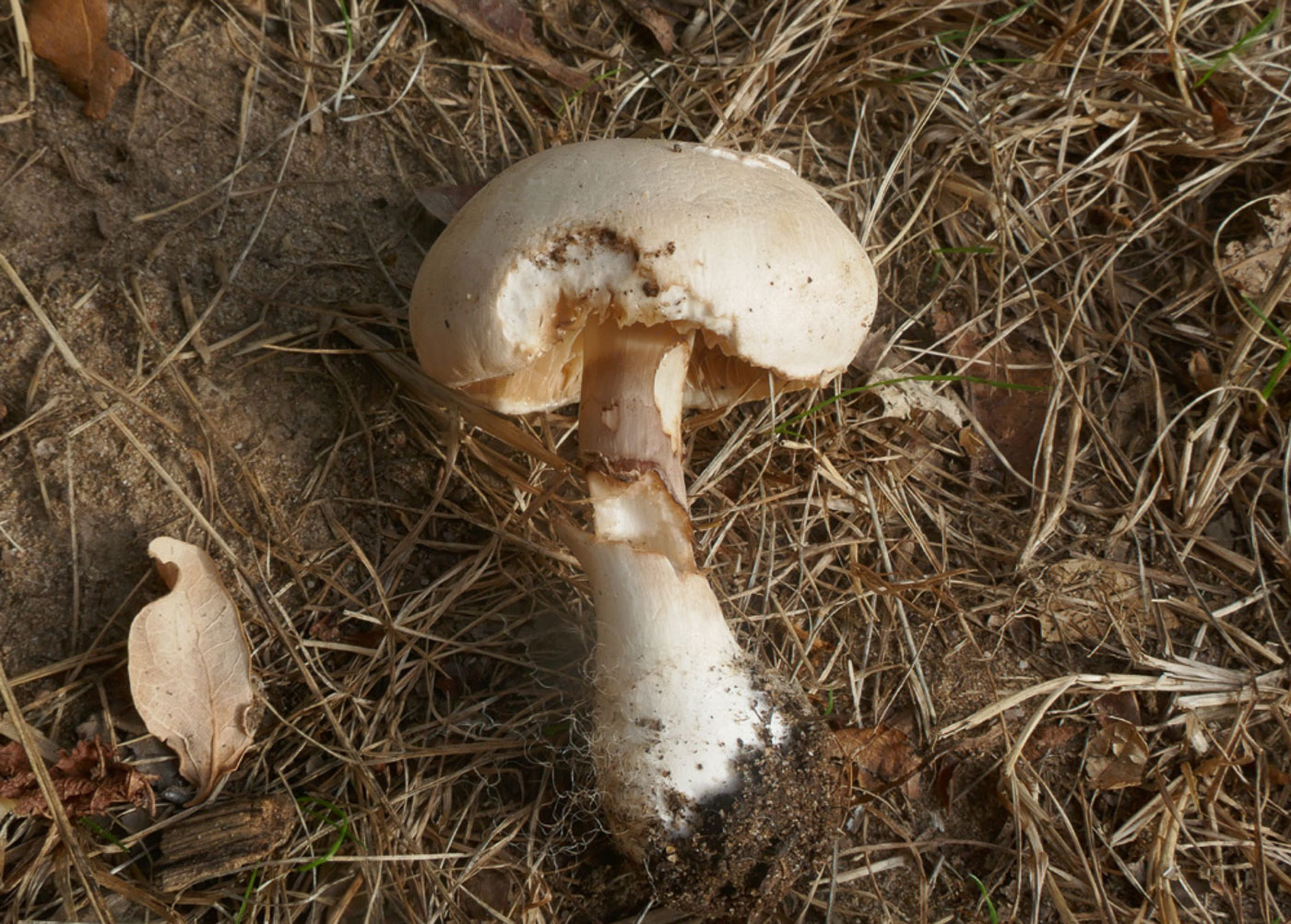
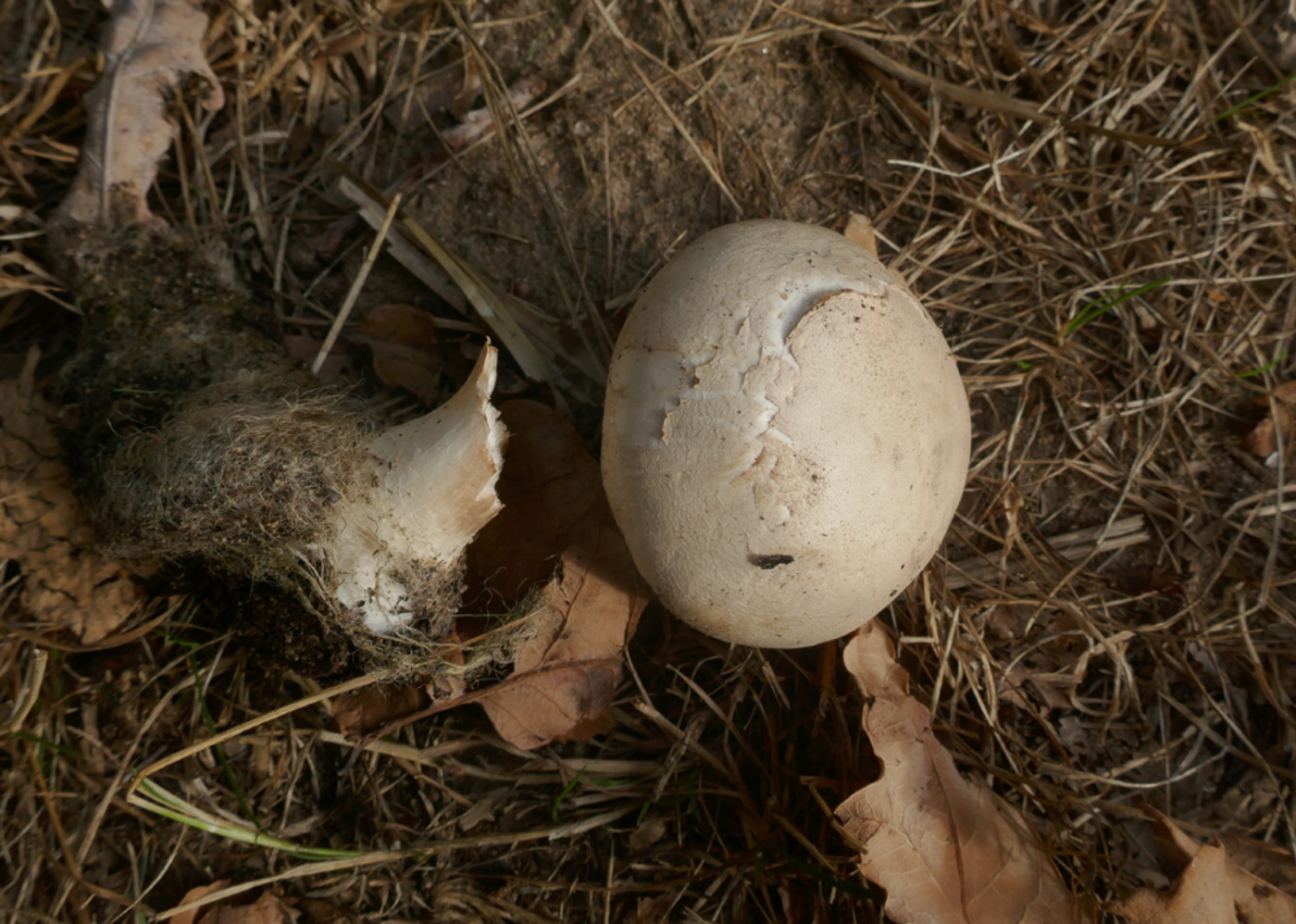
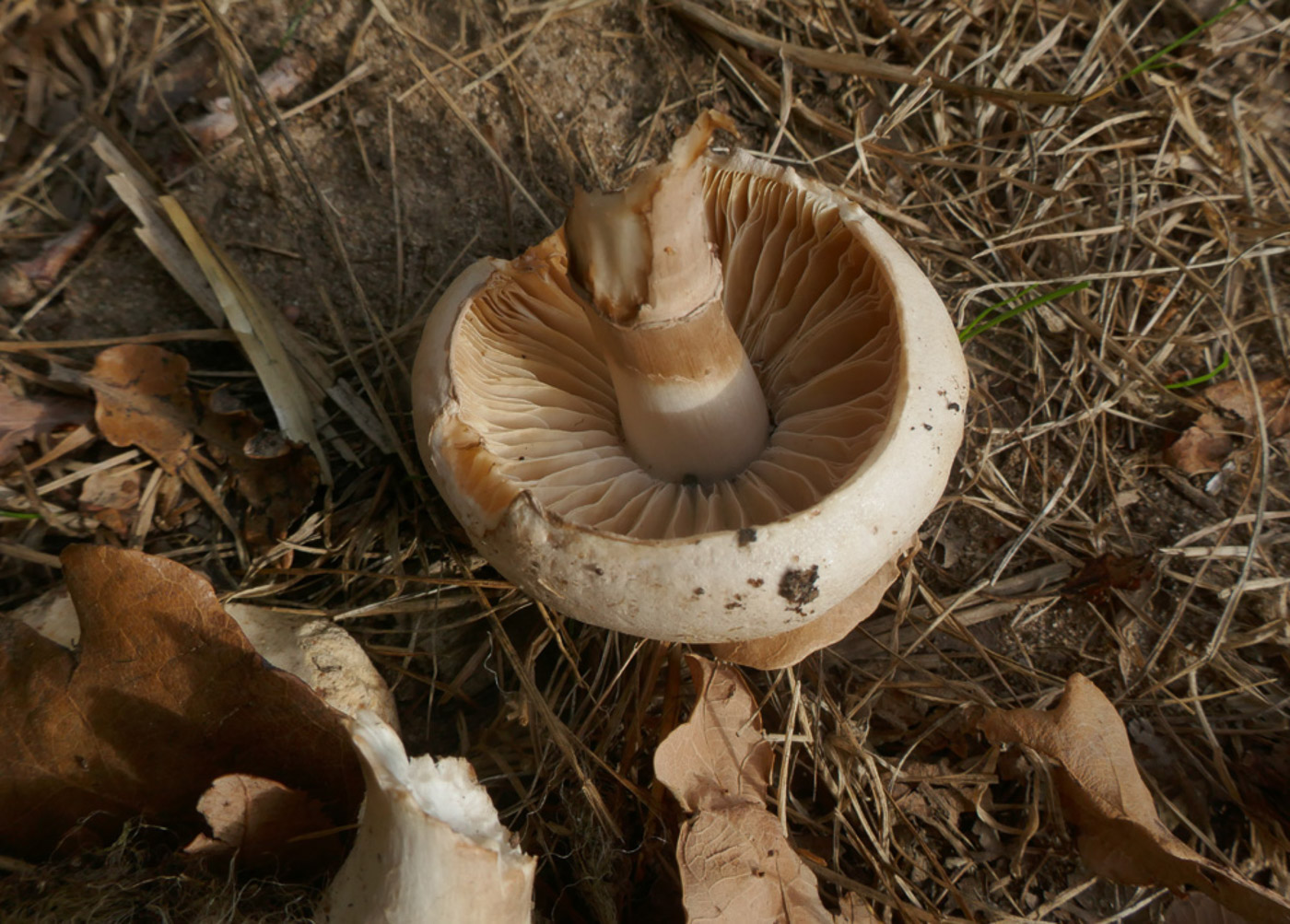
October 5th Chlorophyllum brunneum (Brown Parasol) In a goat paddock at Stampwell Farm Jackie Ewan found this Parasol and at first thought it was the common C. rhacodes as it lacked the snakeskin stem markings but then realised that it differed from that species in several ways. Firstly the large abruptly bulbous stem base, secondly the only faint tendency to stain orange when bruised, thirdly the distinctly brown cap scales in contrast to the paler undersurface, and finally the stem ring with dark brown underside. This species is much less common than C. rhacodes though is likely to be misidentified as that species being less familiar. Previous finds |
October 1st 2026
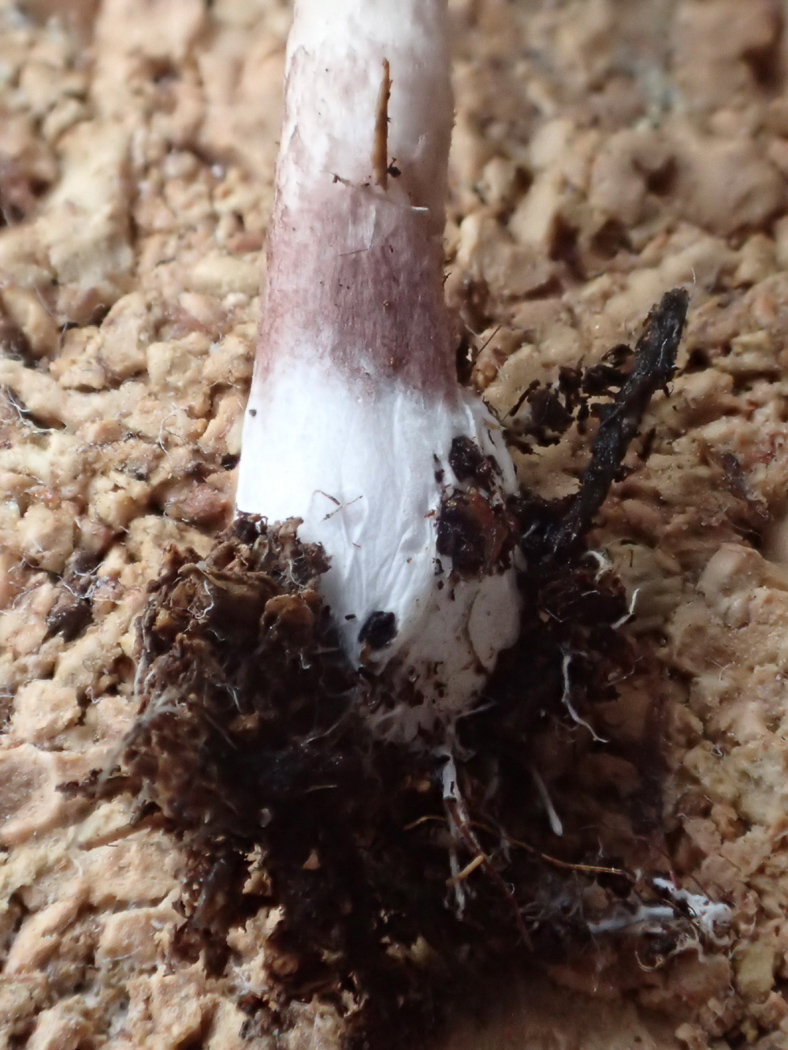 |
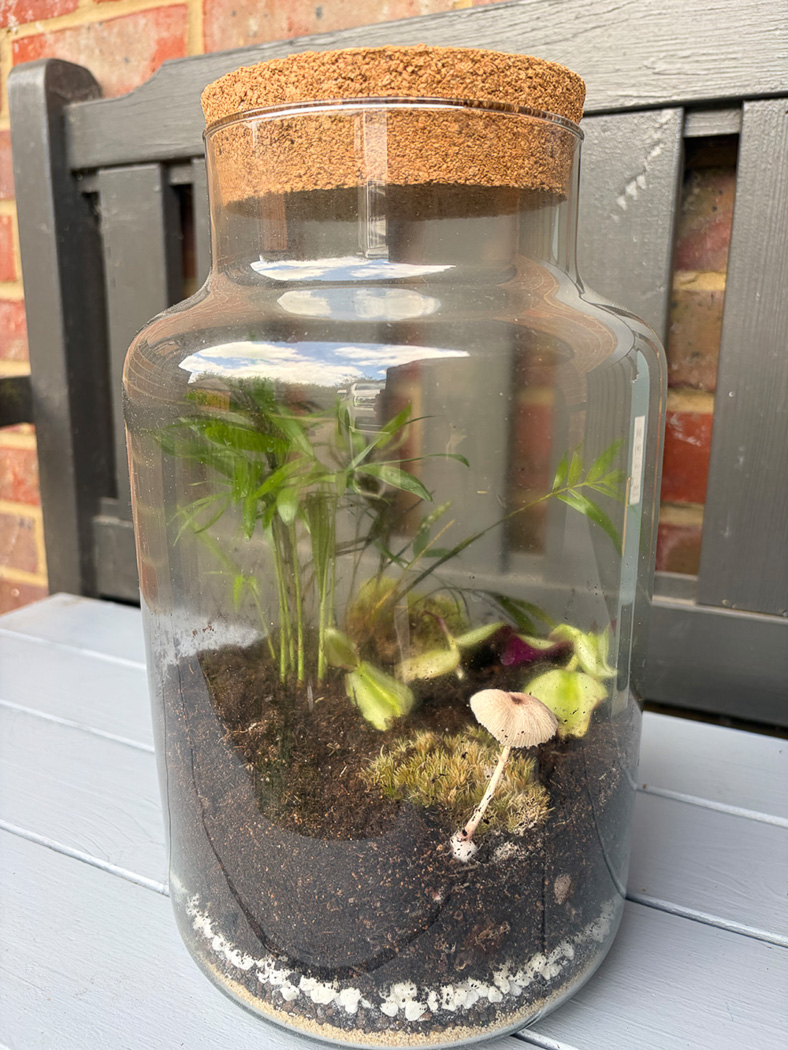
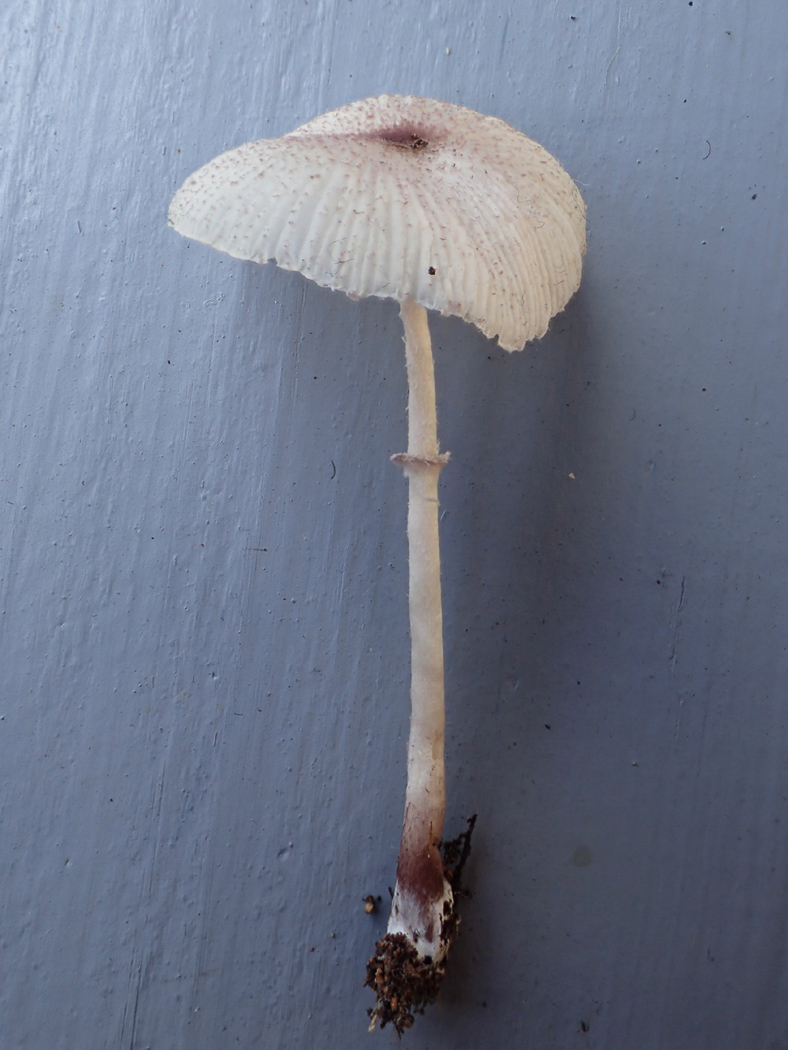
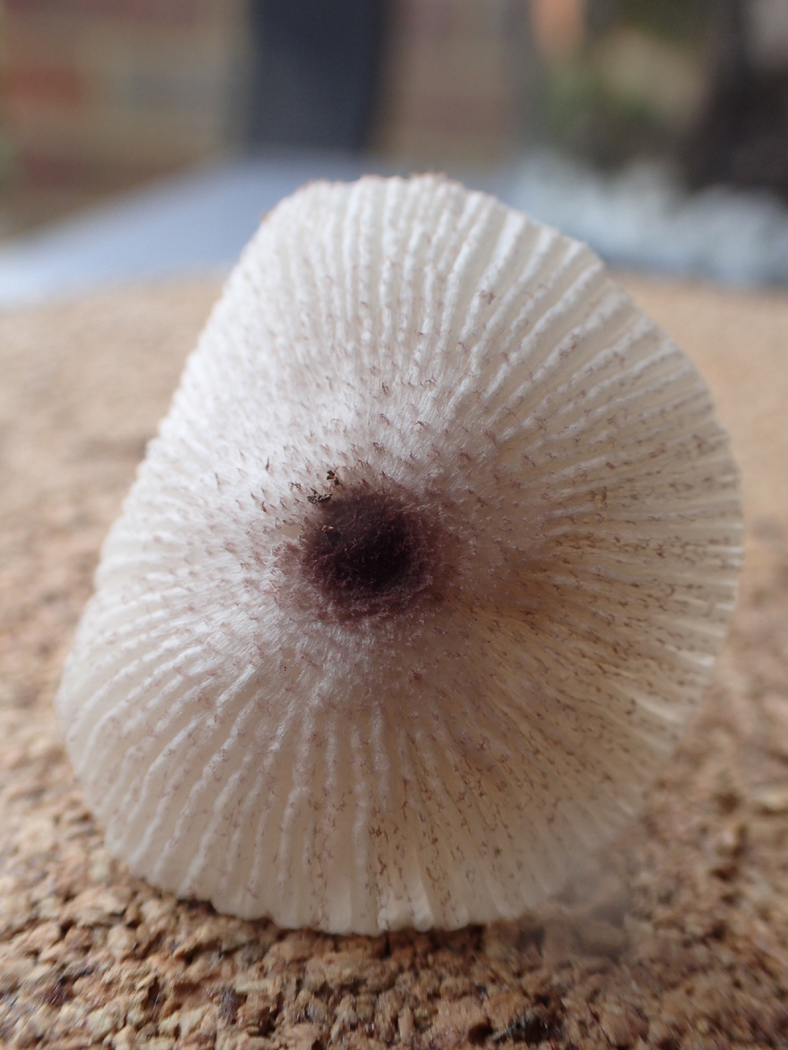
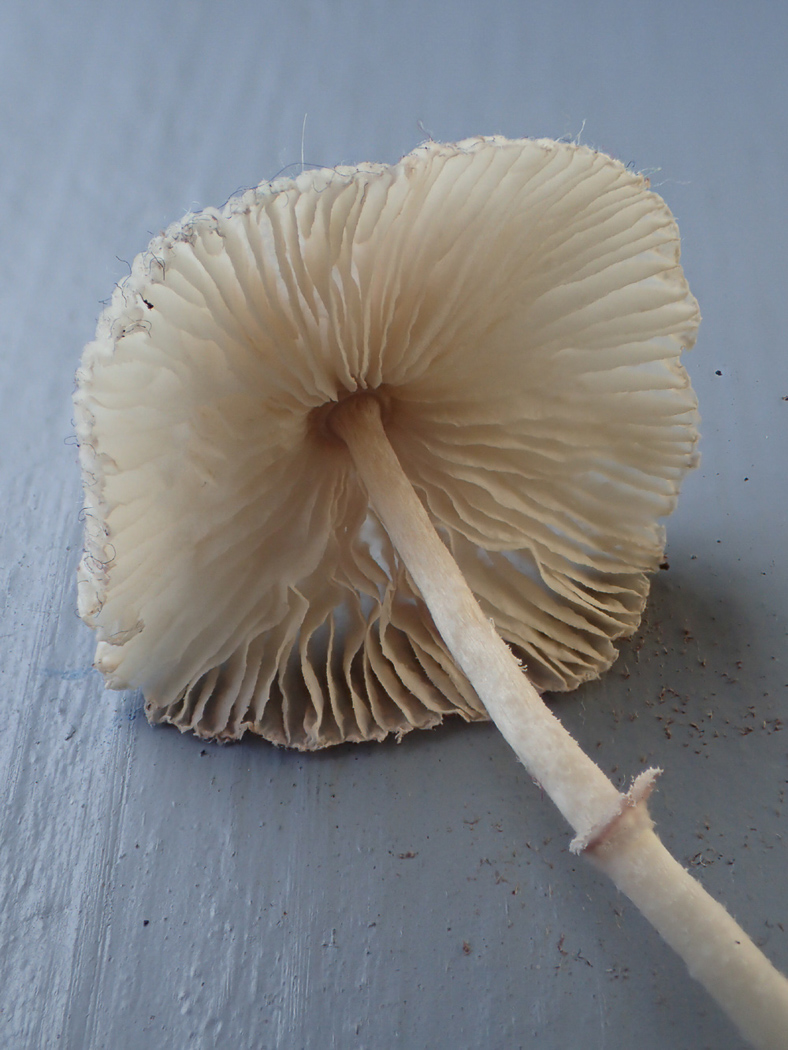
October 1st Leucocoprinus ianthinus (a rare Dapperling with no English name) In Sarah's Ebdon's terrarium - a Mother's Day gift this year - this rare species of Dapperling appeared in the compost (see also the entry dated August 20th for another rare Dapperling she found at home!). She reports that fruitbodies are extremely shortlived and had been popping up then quickly disappearing over the last couple of weeks but she managed to catch this one just in time. She at first assumed it was likely to be L. birnbaumii but soon realised that the lack of yellow tones and presence of distinct violaceous tones clearly made this something different. Both species are tropical, very delicate and flimsy and in the UK virtually restricted to greenhouses or conservatories, and there are just 18 records on FRDBI for L. ianthinus, mostly from Kew gardens or similar. What next is going to come up in Sarah's home?! Members' Finds New Species no. 1307 |
September 30th 2026
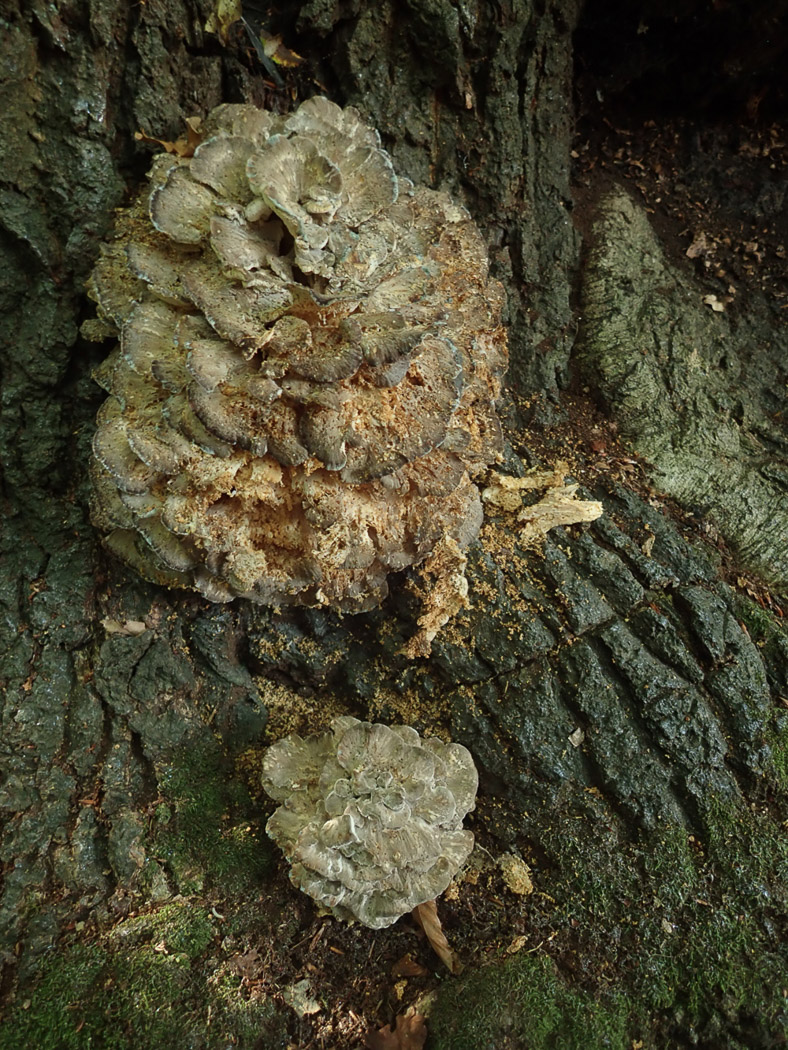 |
September 30th Grifola frondosa (Hen of the Woods) At Cadmore End a couple of weeks previously Penny had noticed the beginnings of some bracketlike fungus just showing at the base of a large Oak. On returning to check it today she found no less than four large clusters plus a few smaller ones, but sadly all were well past their best. This is an occasional fruiter and when at its peak forms these beautiful tiers on deciduous trunks, though she'd never seen more than one or two specimens together like this before. Such a shame she didn't check it a week earlier ............. Previous finds |
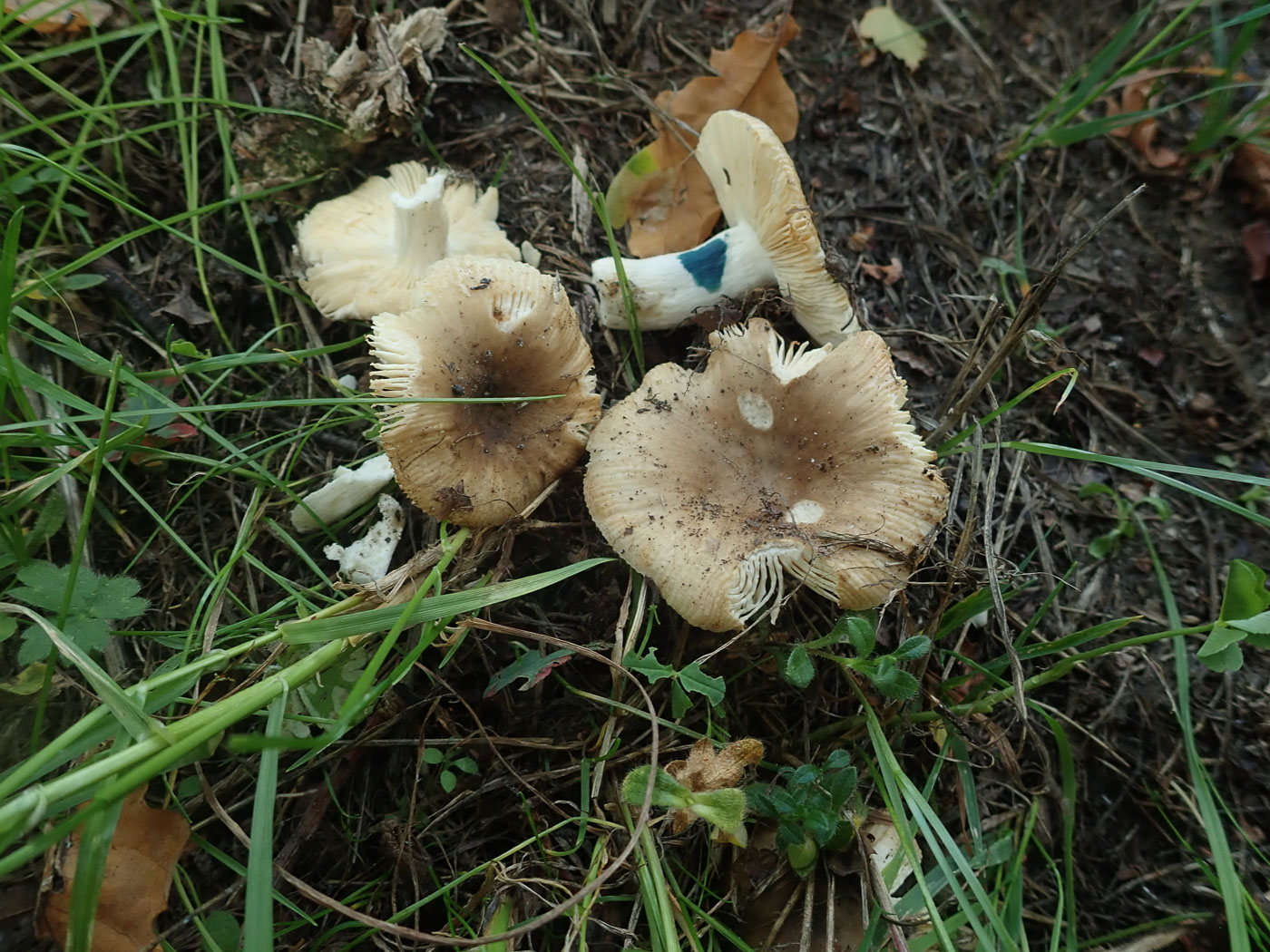 |
September 30th Russula amoenolens (Camembert Brittlegill) Under Oak at Cadmore End Penny found this group and promptly took out her bottle of guaiac, placing a drop on the stem and counting to 10 (secs) to see if the bright blue reaction happened within this time. It did! This helps to separate the species from the much less common R. sororia which has a slightly different smell and a very slow reaction to guaiac. Previous finds |
September 29th 2026
.jpg "Photo © Neil Fletcher") |
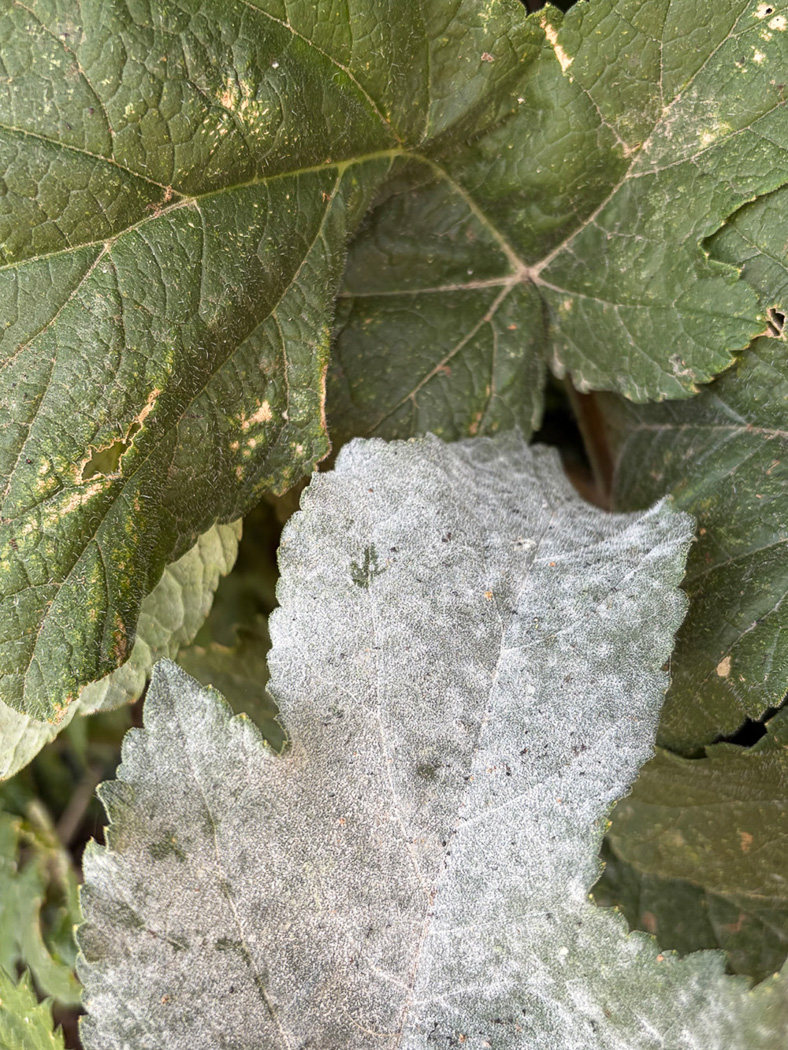
September 29th Golovinomyces montagnei (a powdery mildew with no English name) In Walters Ash the sharp eyed Neil Fletcher spotted this mildew on the leaves of Common Knapweed, then late checked which species of mildew affects that particular plant, discovering that G. montagnei (previously in genus Erysiphe) can be found on various plants related to the Thistle family, of which this is one. It is no surprise that no-one in BFG has previously bothered to record this species though several members of the group are now on the case thus the county list is clearly on the increase as a result. Members' Finds New Species no. 1306 |
September 28th 2026
.jpg "Photo © Jesper Launder") |
September 28th Pholiota limonella (Lemon Scalycap) On Gerrard Cross Common Jesper Launder spotted this attractive cluster growing on a Sycamore stump. Though very similar to the more common P. adiposa, this species has slightly smaller spores so a quick scope check in needed to separate them. Both species have golden yellowish sticky brown caps though the scales are darker brown and also coat the stem which has a ring. Beech is their preference but they are not host specific and found on other hardwood trees as here. Previous finds |
September 27th 2026
.jpg "Photo © Jesper Launder") |
September 27th Hericium coralloides (Coral Tooth) Jesper Launder heard reports of this elusive and beautiful species fruiting in private grounds near Little Chalfont - one he'd long wanted to see. There he found no less than 17 distinct clusters in varying stages of development on a mature fallen Beech trunk - what a display! Reportedly this species, one of three in the genus, is thought to fruit only once on its host tree whereas we know from experience that H. erinaceus recurs for several years on the same trunk, so it would be useful to return another year now this site is known to see if this theory is proven or not. We have just 5 previous county sightings this century, two of which were at Burnham Beeches - no surprise there as this genus only occurs on mature Beech, less often on Ash or Elm. Previous finds |
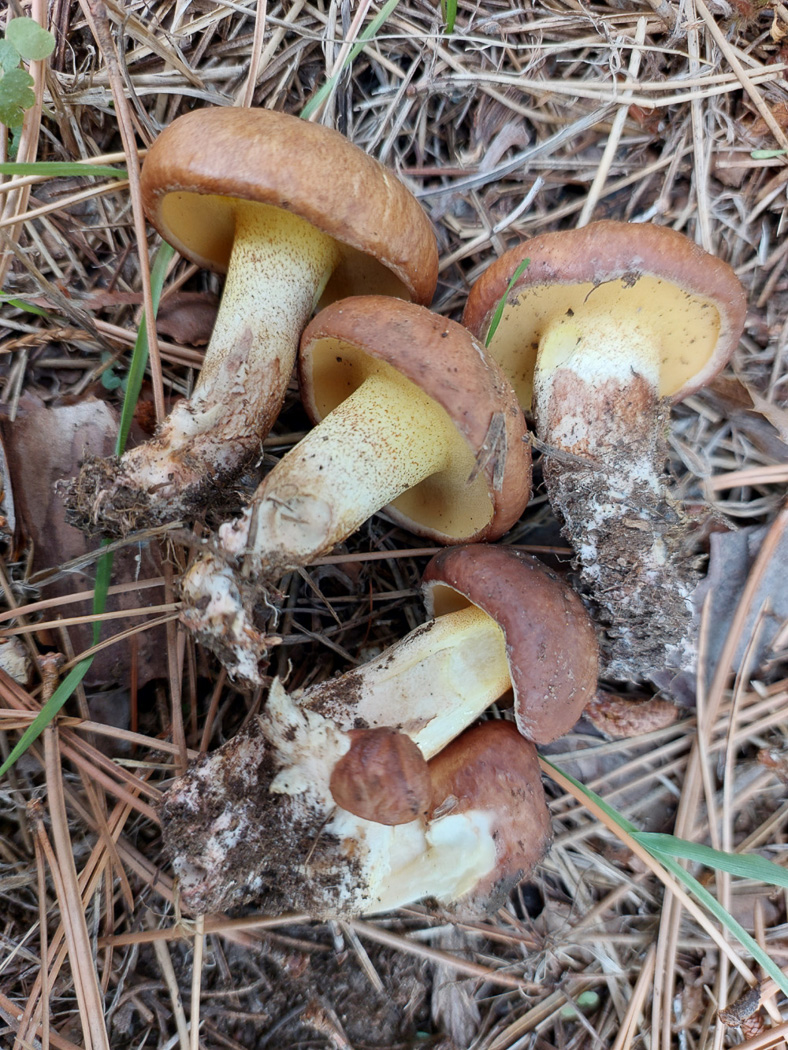 |
September 27th Suillus collinitus (an unusual Bolete with no English name) In private grounds near Little Chalfont Jesper Launder noticed this nice cluster of Boletes under Pine - a species he's familiar with from the Gerrards Cross area. The cap colour is quite similar to that of the much commoner S. luteus (Slippery Jack), another Pine associate as most of this genus are, but the stem lacks a ring, has distinctive brownish granular markings and also tapers at the base where the mycelial threads are pale pink (though this feature is often hard to capture on camera). Previous finds |
September 25th 2026
.jpg "Photo © Jackie Ewan") |
September 25th Lepiota cristata (Stinking Dapperling) At Stampwell Farm Jackie Ewan was pleased to see this attractive little cluster in a veg patch - a common species but conspicuous by its absence so far this year and not seen at the Farm since 2023. A small to medium sized Dapperling, it displays all the typical characters of the genus including white free crowded gills, a cap with dark central zone and spots of this colour spreading radially outwards though the stem ring is often fleeting. The smell is certainly distinctive (though hardly actually 'stinking') but it is worth noting that several other similar species share this smell though not as markedly. Previous finds |
September 22nd 2026
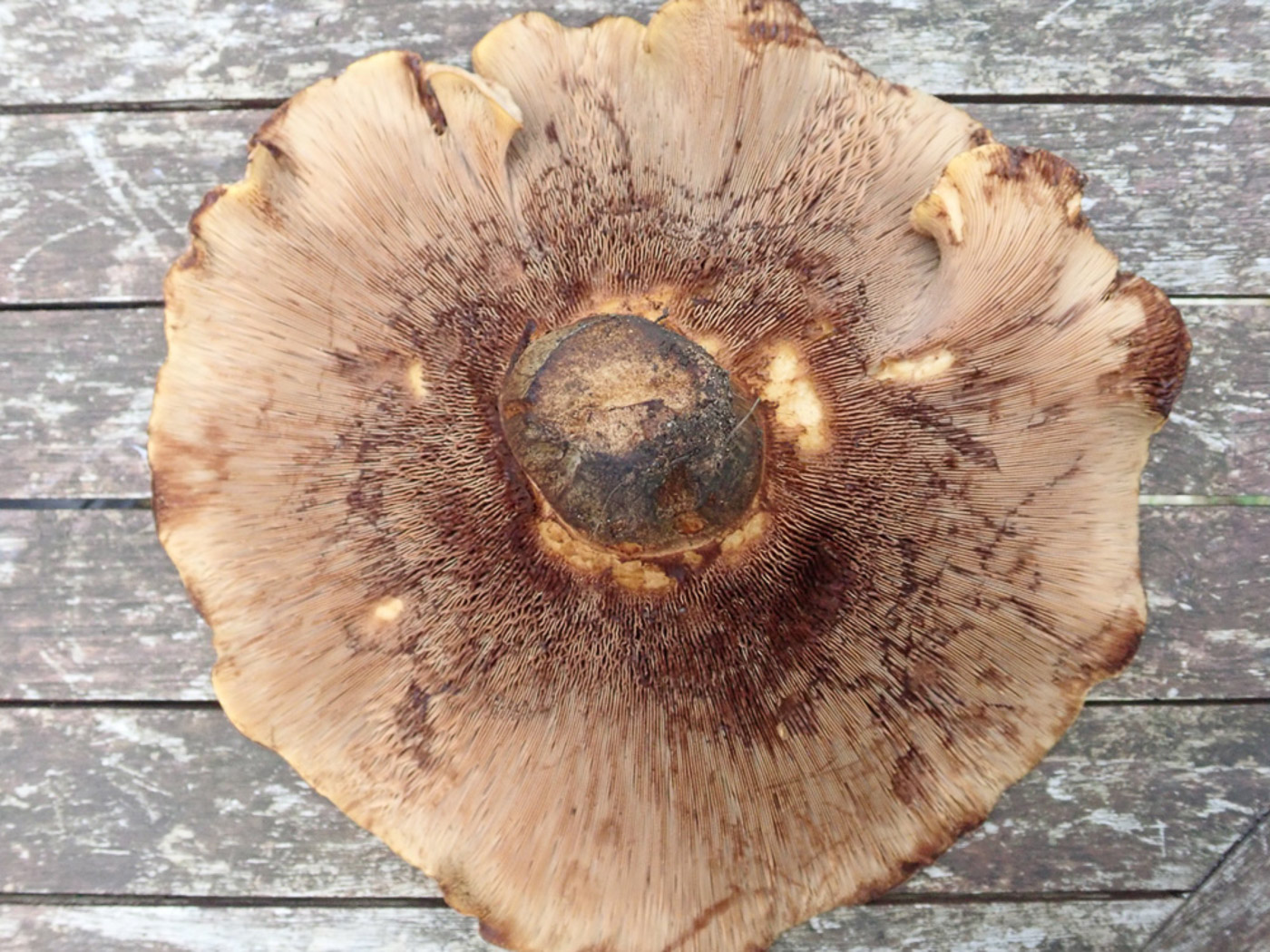 |
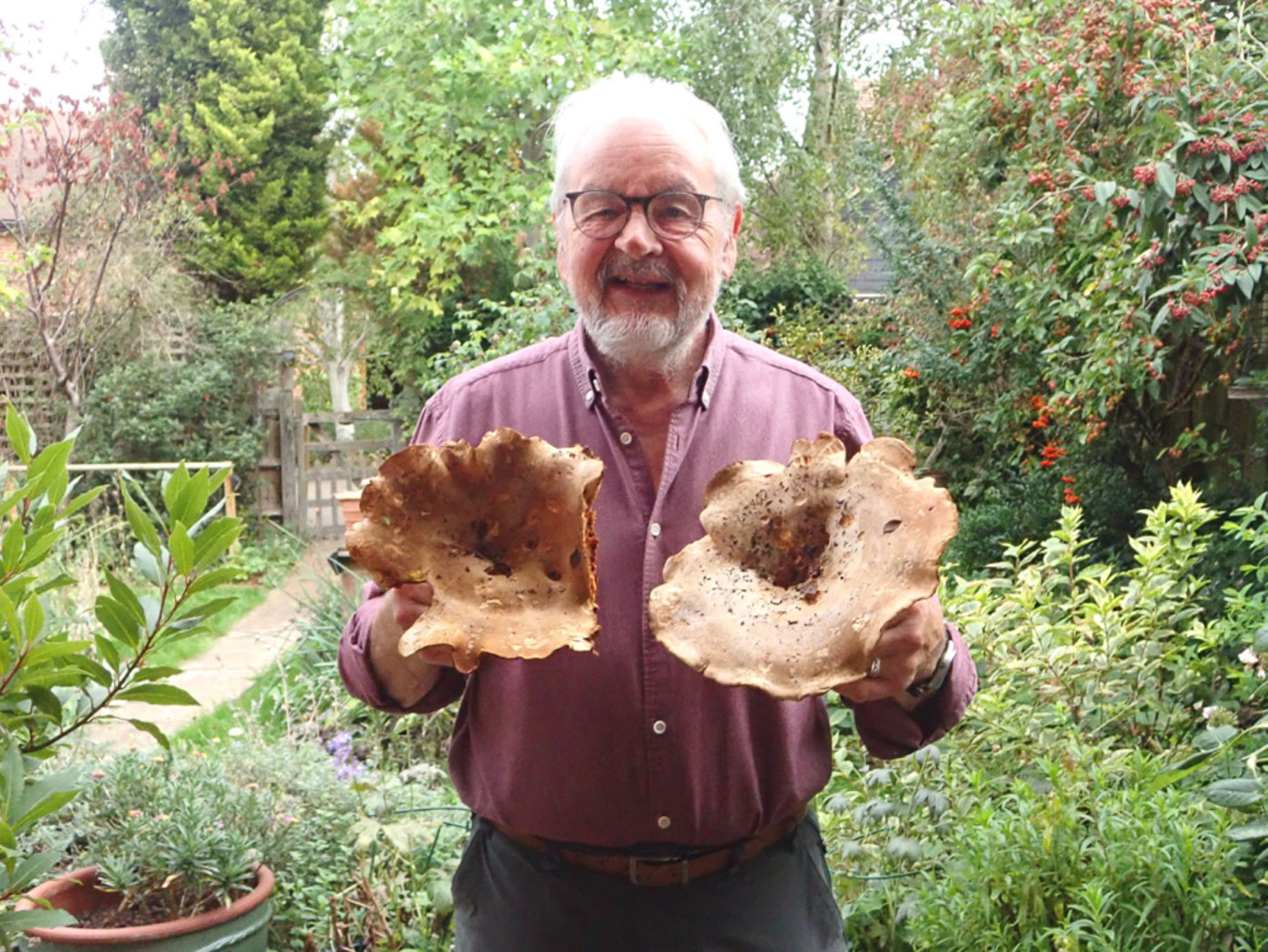
September 22nd Paxillus cf. involutus (Brown Rollrim) In his garden in Mursley Mick Jones could hardly believe the size of these monsters which measured 25 cm across! What whoppers! He's familiar with them fruiting here in previous years under Birch and Cherry but this year he found himself doubting if it could be the same species because of their size, hence the cf. included here. There is another possibility, P. obscurisporus, which reportedly can get to as much as 30 cm across though it favours Oak, Lime and Poplar rather than Birch here and favoured by P. paxillus. However, telling the two apart is no easy task. Perhaps this is a good candidate for sequencing.......... Previous finds |
September 17th 2026
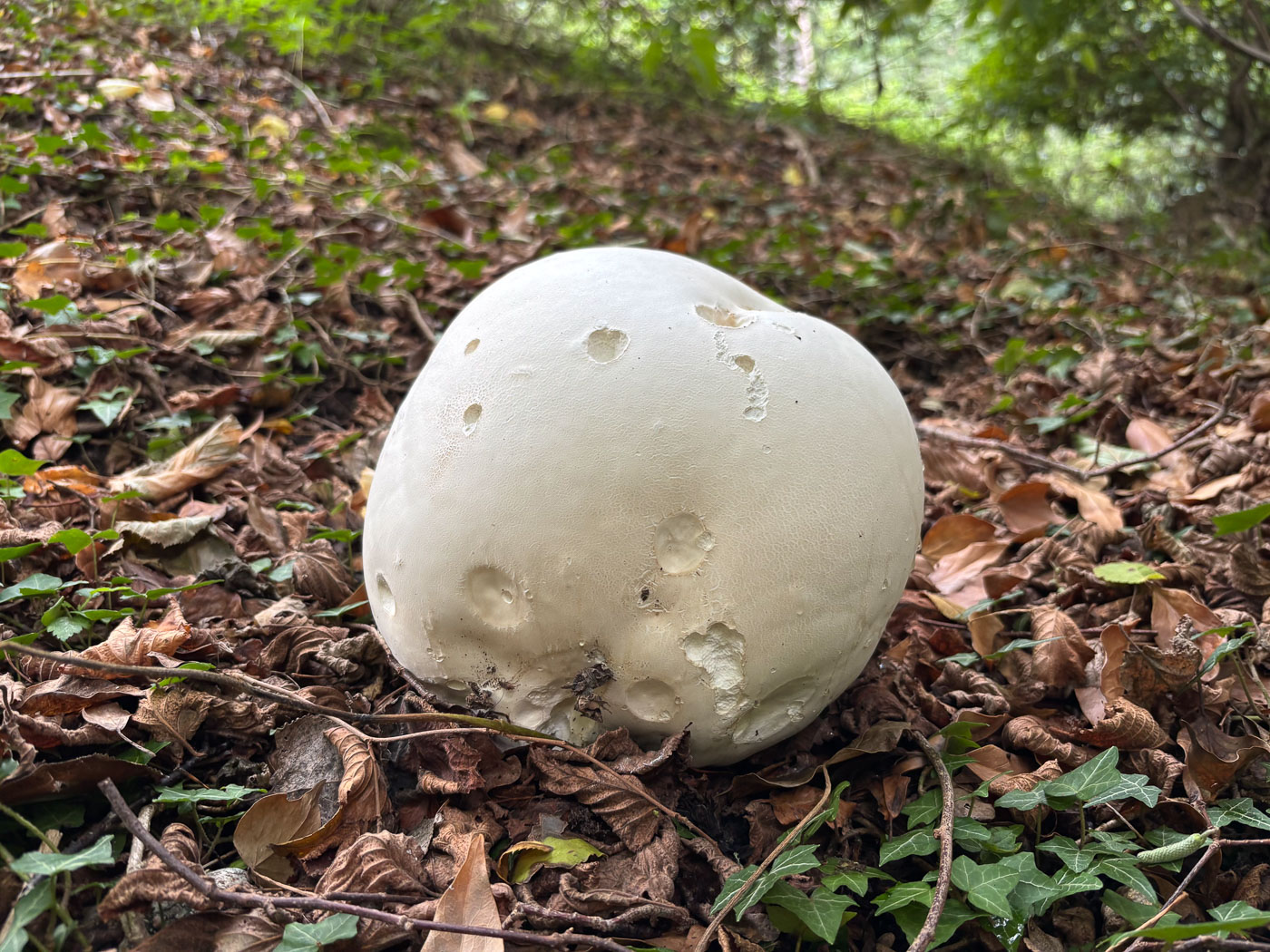 |
September 17th Calvatia gigantia (Giant Puffball) Chris Morris - Burnham Beeches Senior Ranger - sent this photo in to Penny, having just found this charismatic species in the outskirts of the Beeches. What a beauty! Often these huge fungi get rough treatment and are kicked to bits, leaving just the remnants for us to find, so let's hope this one survives long enough to achieve its full enormous potential.............. Previous finds |
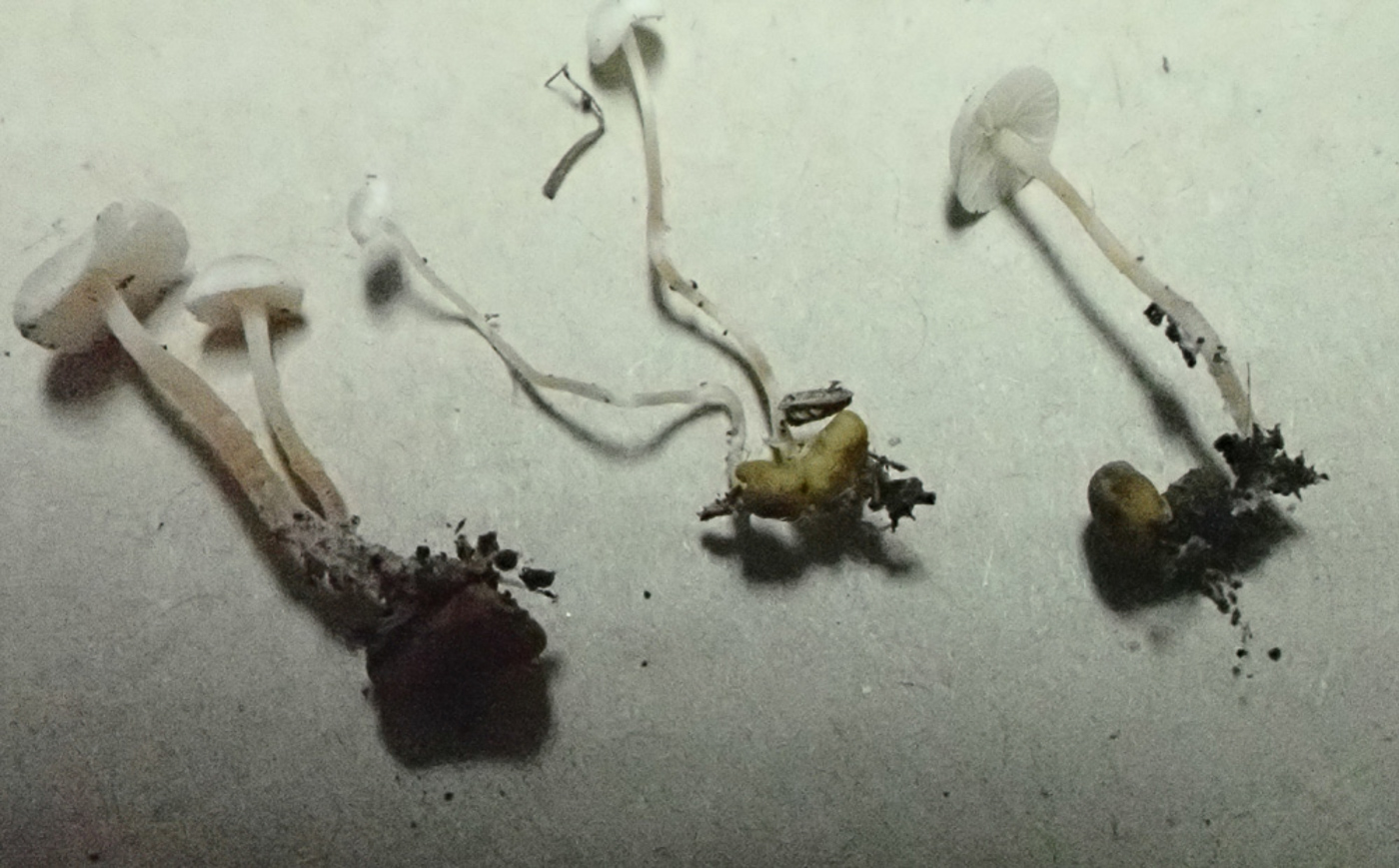 |
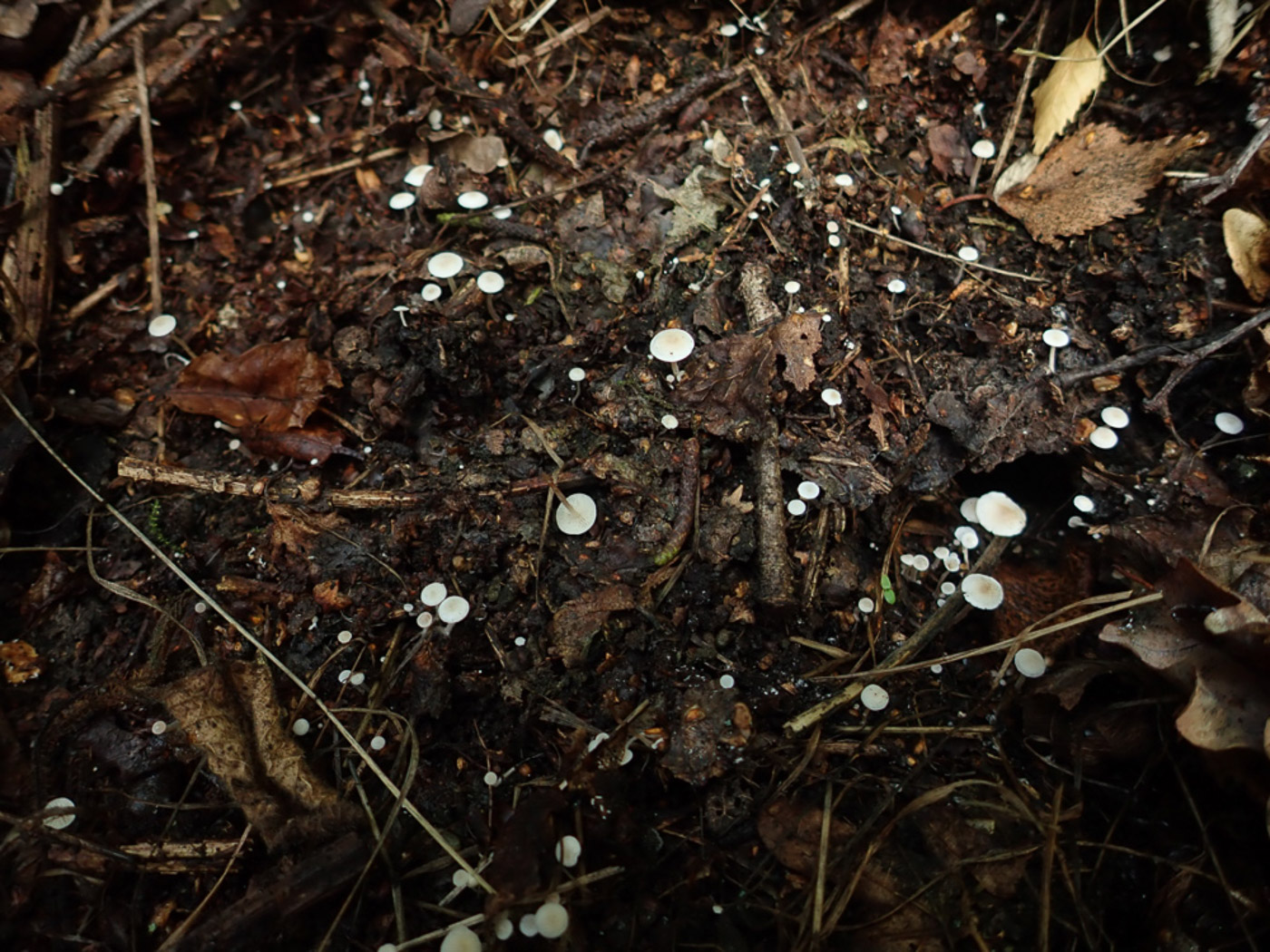
September 17th Collybia cookei (Splitpea Shanklet) This find made Penny's otherwise disappointing visit to Coombe Hill worthwhile! Amongst rotting matter at a woodland path edge she spotted these tiny whitish mycenoid caps, and having recently seen many collections of this genus up in Scotland when on rotting fungal remains she recognised them straight away. Key to making a successful ID lies in careful collection in the field: it's vital to keep in tact the litter remnants attached to the stem base where lurks the evidence to separate the three almost identical genuine Collybia species - all of which grow on old rotting fungal remains. Her Scottish finds had all lacked evidence of a sclerotium (tiny tuber) at the stem base and therefore were C. cirrhata (Piggyback Shanklet) - by far the commonest of the three species. Once home and examining carefully under a dissecting scope today she was rewarded with clear evidence of tiny round ochre-brown sclerotia still clearly attached to many of the specimens (photo 2) making it C. cookei with no questions asked! The third species (C. tuberosa) also has sclerotia but they are elongate and dark reddish brown thus easily separated as long as one has retained enough of the substrate with the collection to include the evidence! We have a few county records of C. cookei and even fewer of C. tuberosa (all from Bernwood Forest where we visit next week!). Our one previous Finds entry, named cf cookei as Penny had doubts because the collection lacked the necessary substrate, unfortunately failed when sequenced, so today's collection definitely makes up for that. Previous finds |
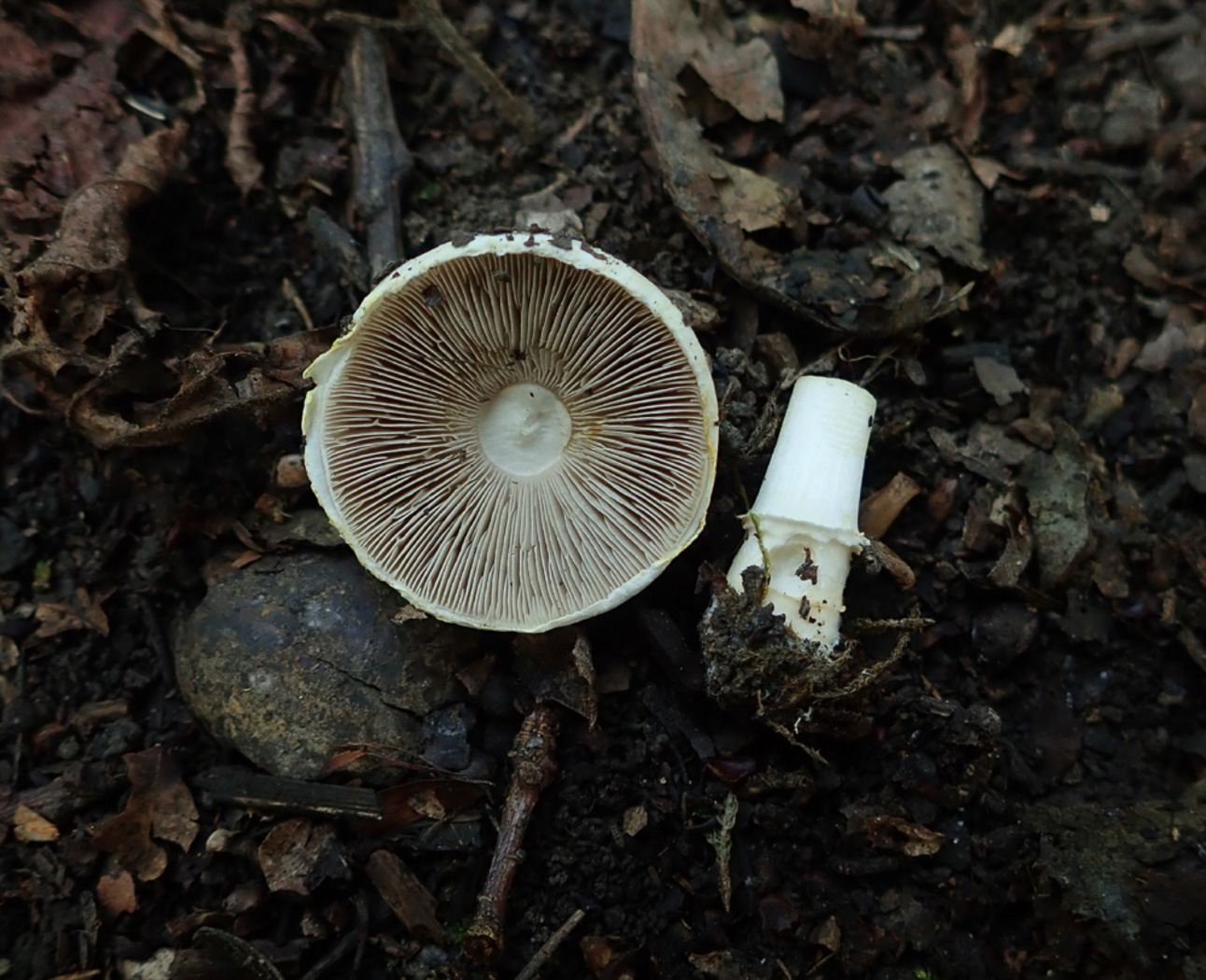 |
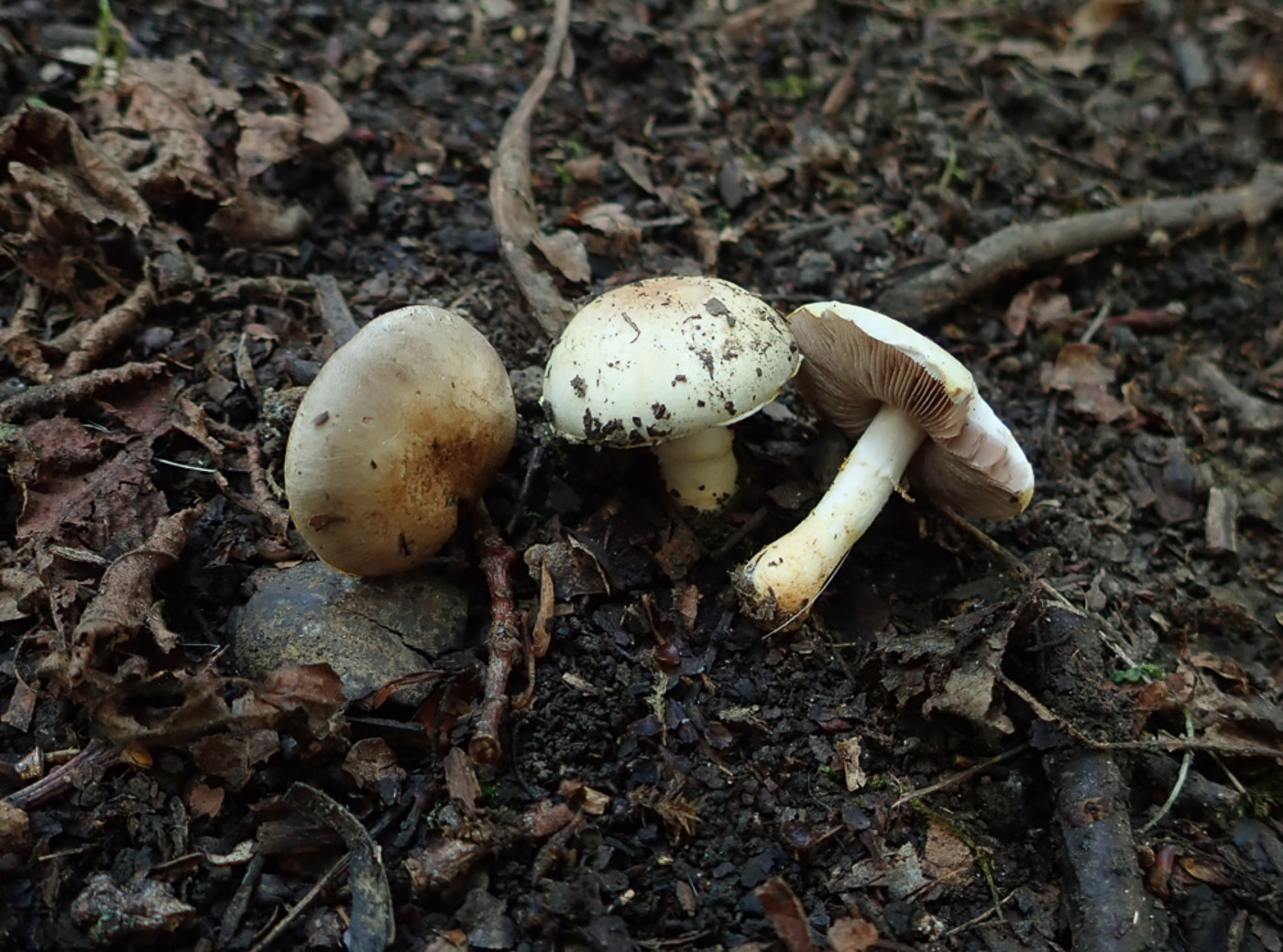
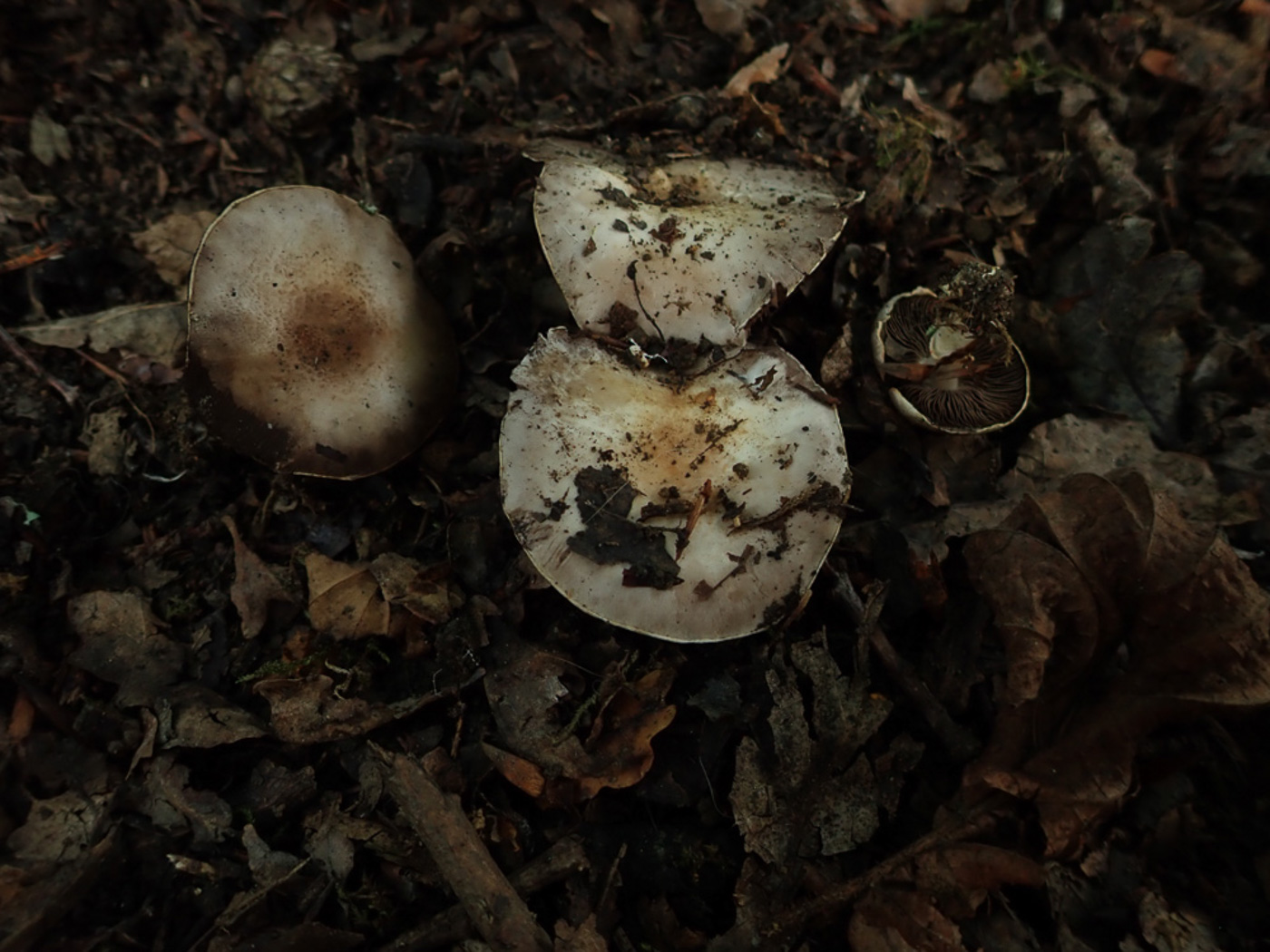
September 17th Agaricus dulcidulus (Rosy Wood Mushroom) This was one of very few finds made at Coombe Hill today by Penny who was hoping for Helianthemum boletes (reportedly now fruiting in good numbers further along the Chiltern escarpment but in Oxfordshire). A member of the tricky Minores group of genus Agaricus - so named for their small delicate stature and also small spores which lack a germ pore - A. dulcidulus has several very similar close woodland relatives which tend to yellow (seen here in several places) and also have a positive (yellow) reaction on the cap to a drop of KOH. This collection was found in soil under Oak, showed the characteristic purplish tint in the cap centre, the spores were mainly just under 5 um long and it appeared to lack the gill edge cystidia forming chains reported in other Minores species - all pointing to A. dulcidulus. However, Penny would not be surprised if sequencing showed this to be something different because it is recognised that this is a species complex far from being satisfactorily resolved. A sample has therefore been dried. Previous finds |
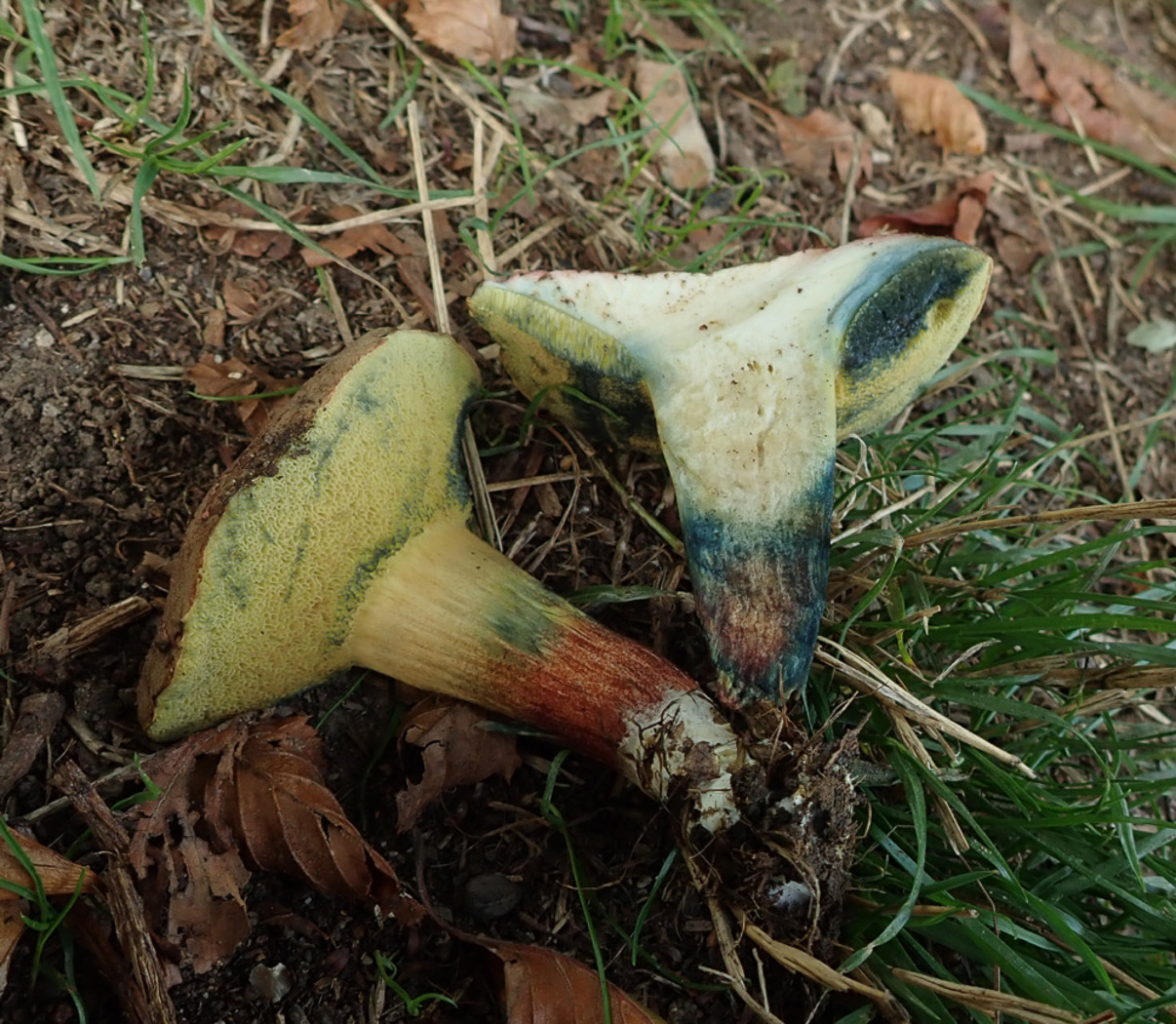 |
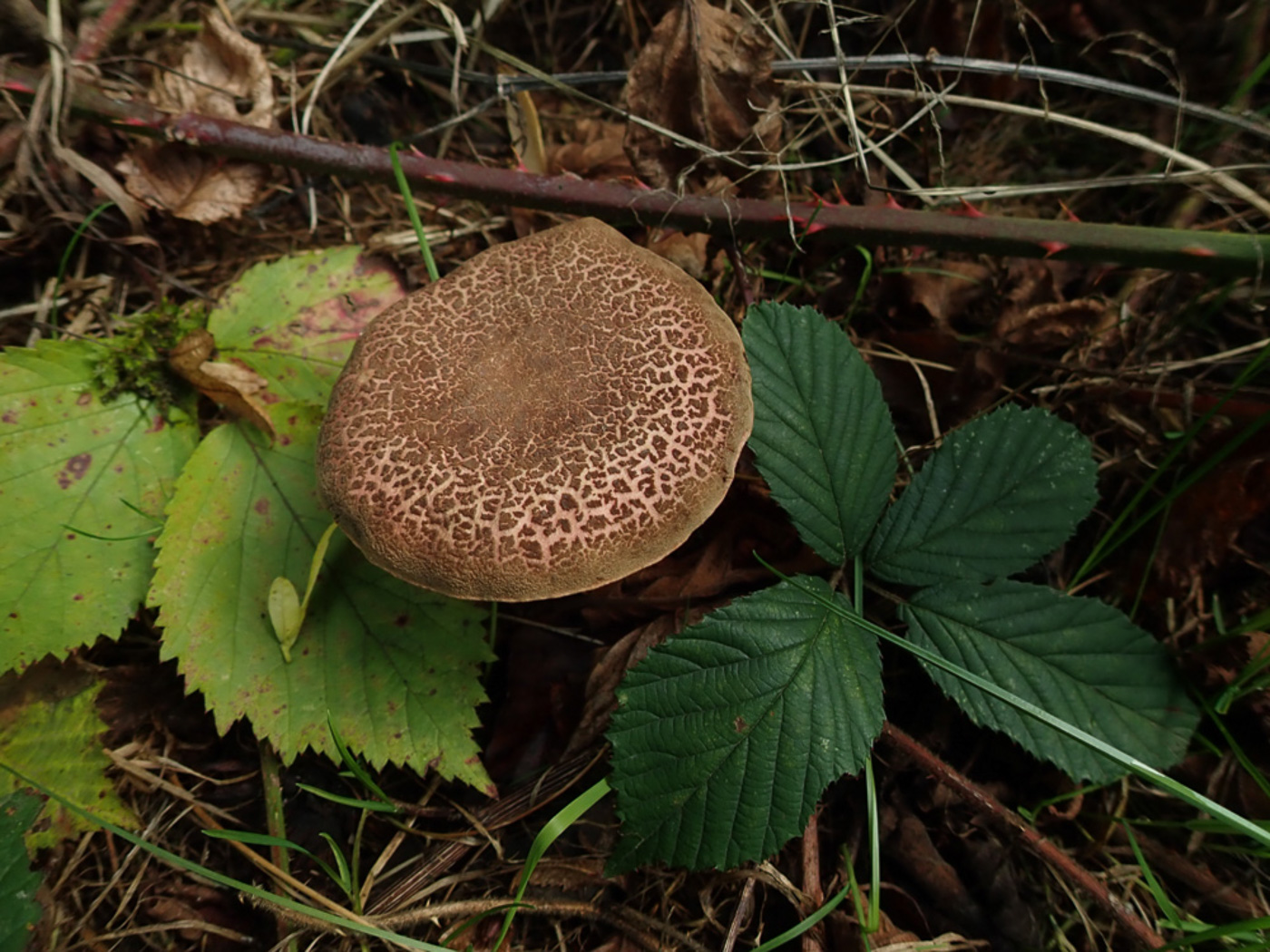
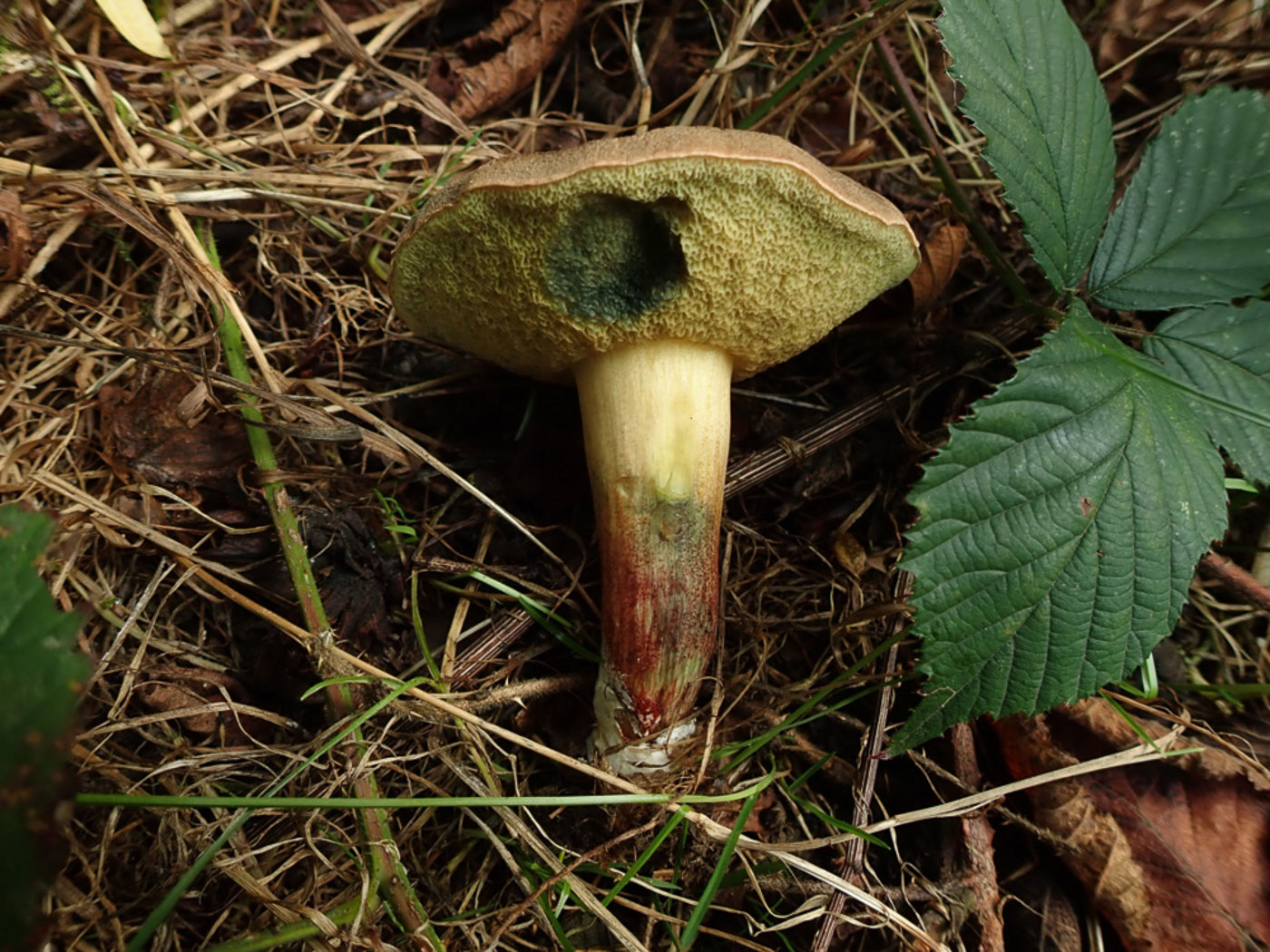
September 17th Xerocomellus cisalpinus (Bluefoot Bolete) In the wooded part of Coombe Hill amongst deciduous trees and vegetation Penny spotted this nicely red-cracking cap which gave it away as this genus of Bolete before even turning it over to see the pores. The pores obligingly blued rapidly when pressed, and the onset of blueing when sliced lengthwise was equally rapid, thus eliminating other similar contenders which tend to have a much slower reaction when the flesh is exposed to air. Previous finds |
.jpg "Photo © Jackie Ewan") |
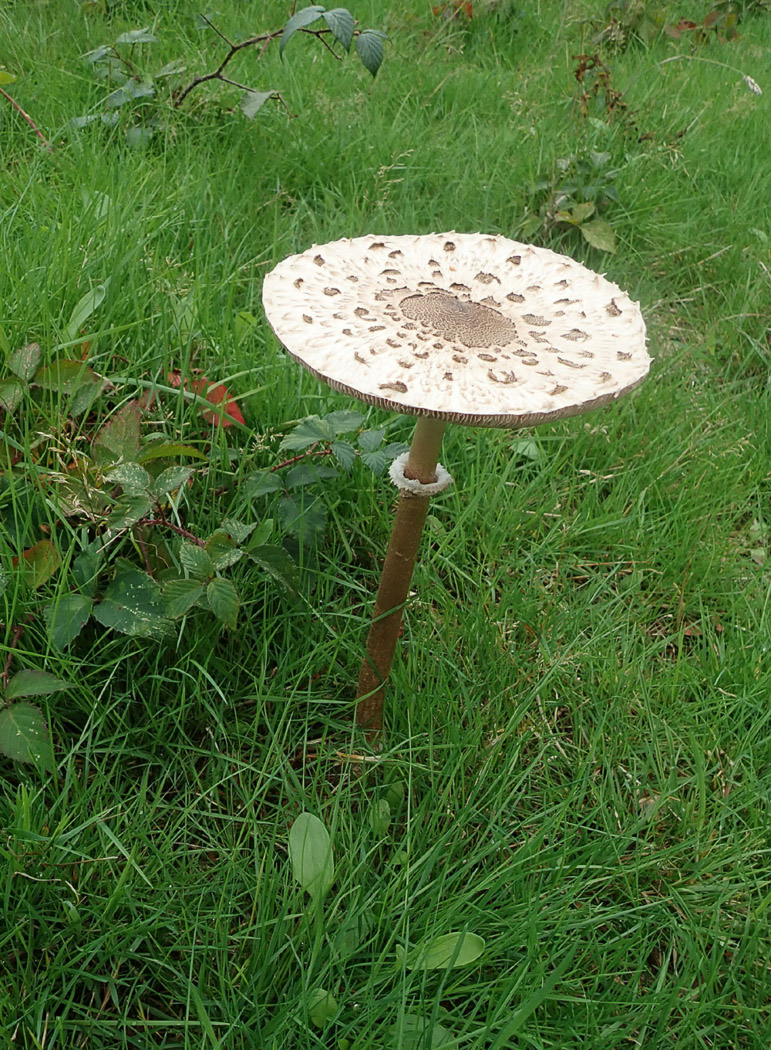
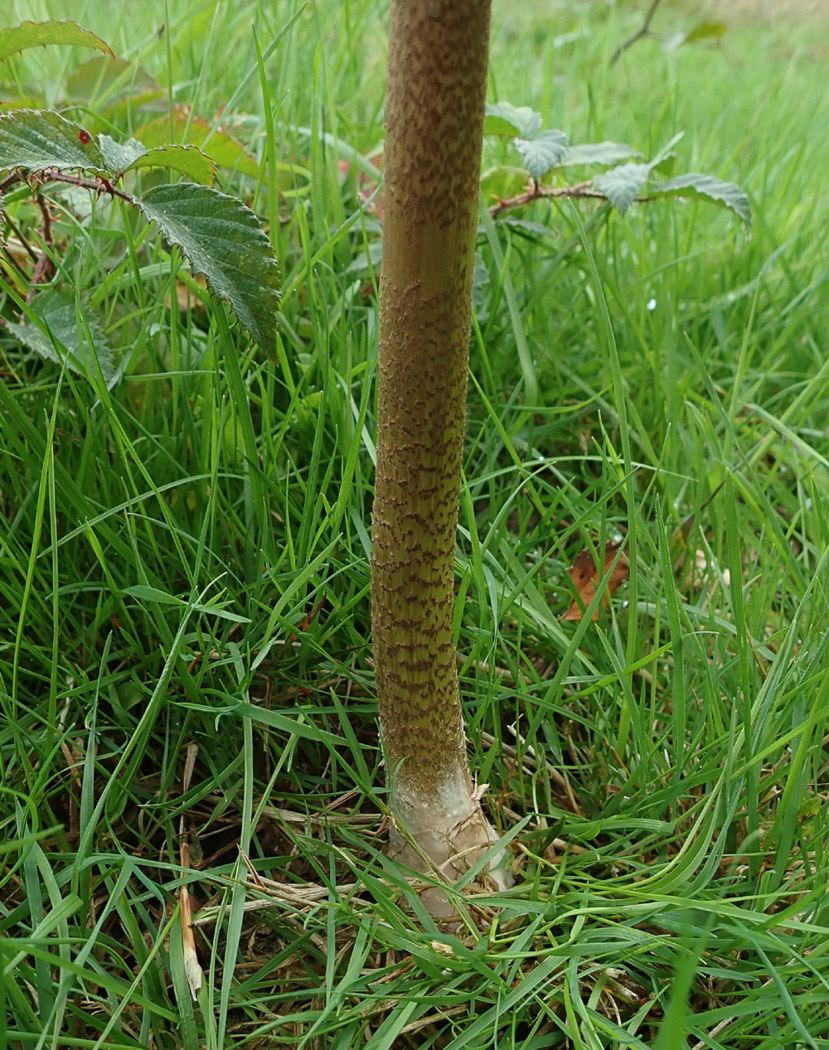
September 17th Macrolepiota procera (Parasol) At Coombe Hill having almost given up on the chances of finding anything much of interest, Penny stumbled across this one lone specimen in an open area. It was displaying its typical characteristics nicely including the brown stem markings with movable ring and whitish swollen stem base. Photo 3 is of a perfect specimen sent in by Jackie Ewan from Stampwell Farm a few days later. Previous finds |
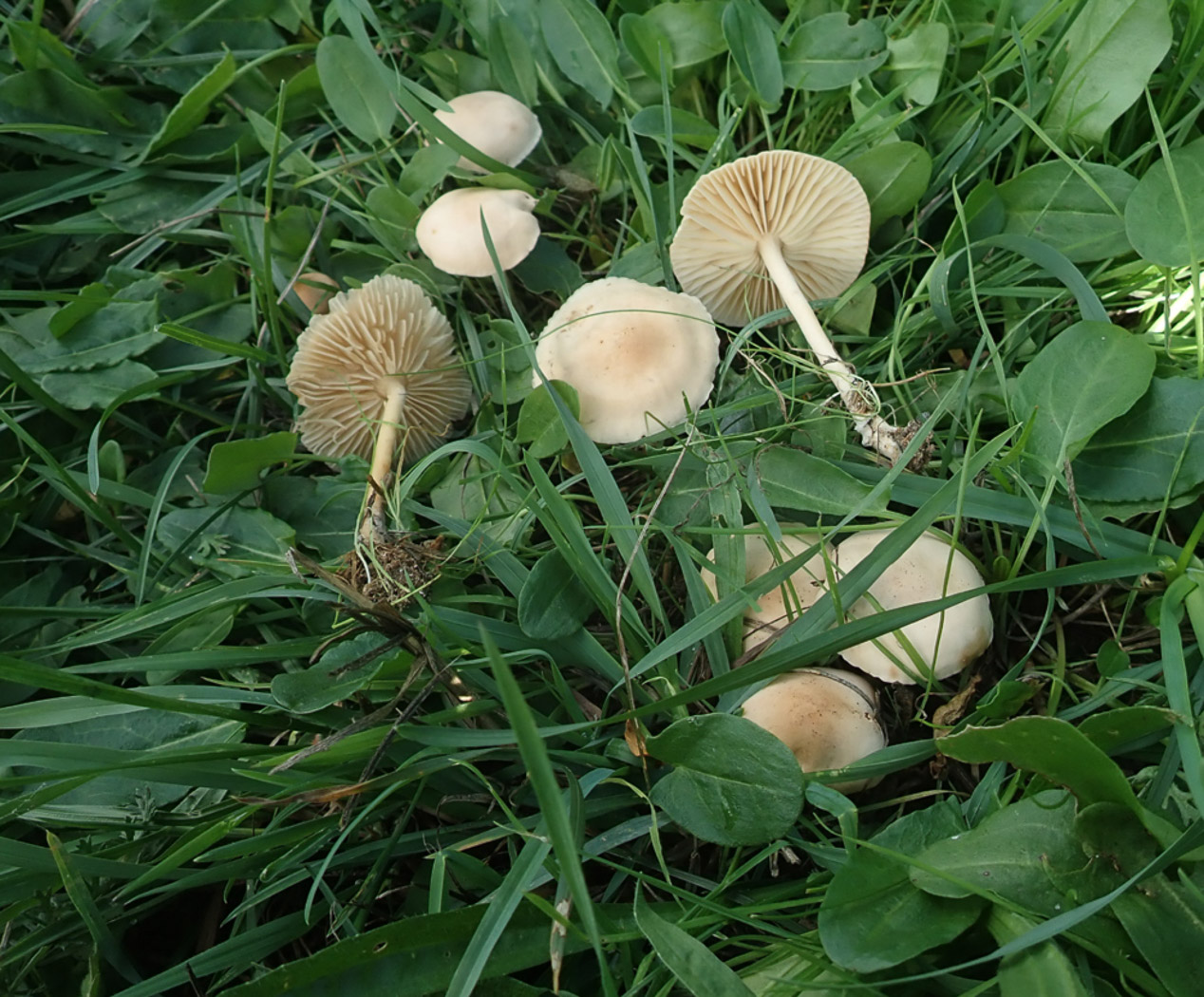 |
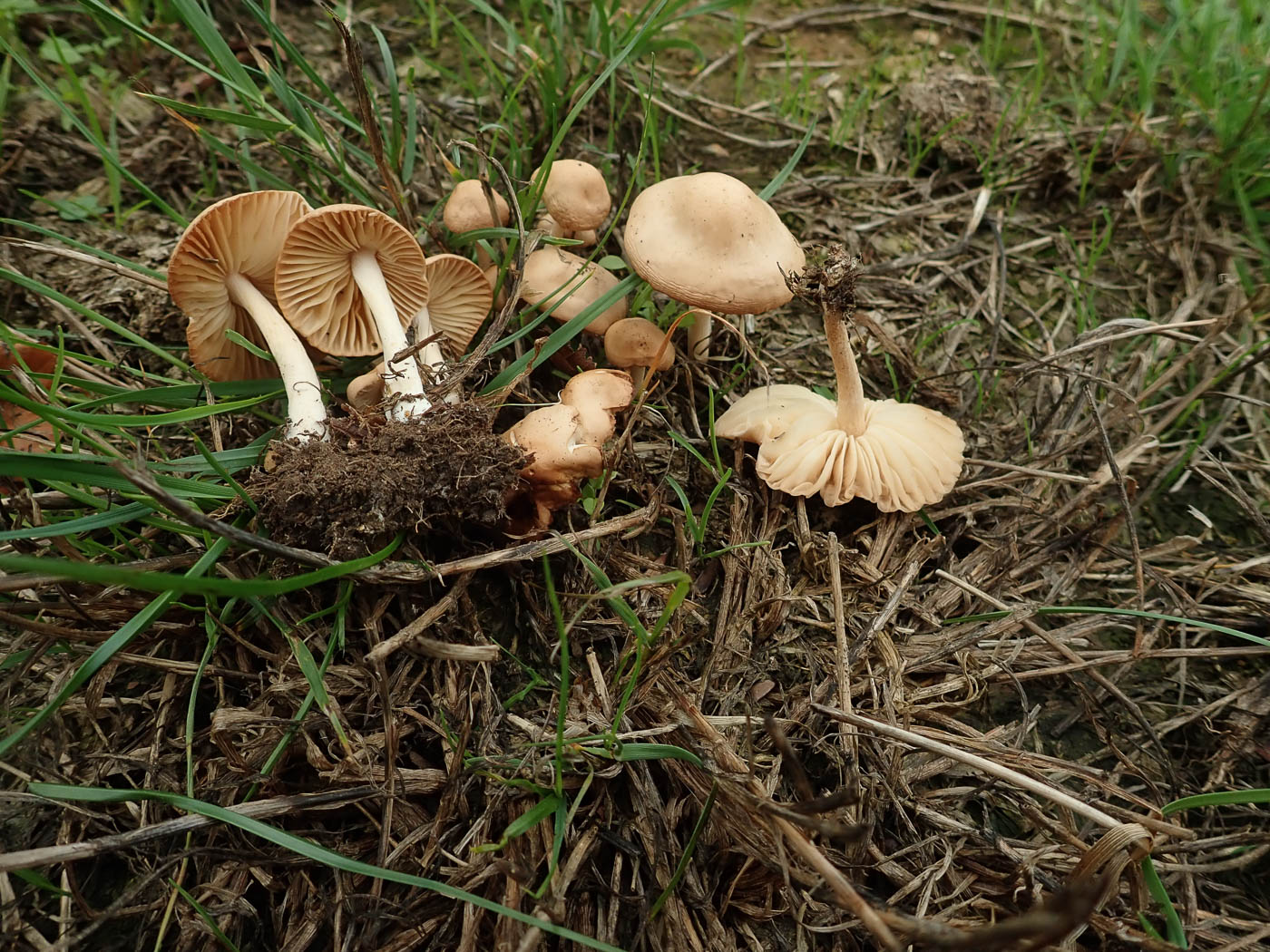
September 17th Marasmius oreades (Fairy Ring Champignon) At Coombe Hill Penny found quite a few clusters of this grassland species coming up in a rough patch where the grass was just beginning to recover (though there's been no sign of this common fungus on her lawn at home as yet). The widely spaced gills and rubbery bendy texture are good characters to confirm the ID though the smell - described variously as of bitter almonds or spicy - was not very apparent today. Photo 2 is of a collection made 2 weeks later in longish grass at Cadmore End. Previous finds |
September 15th 2026
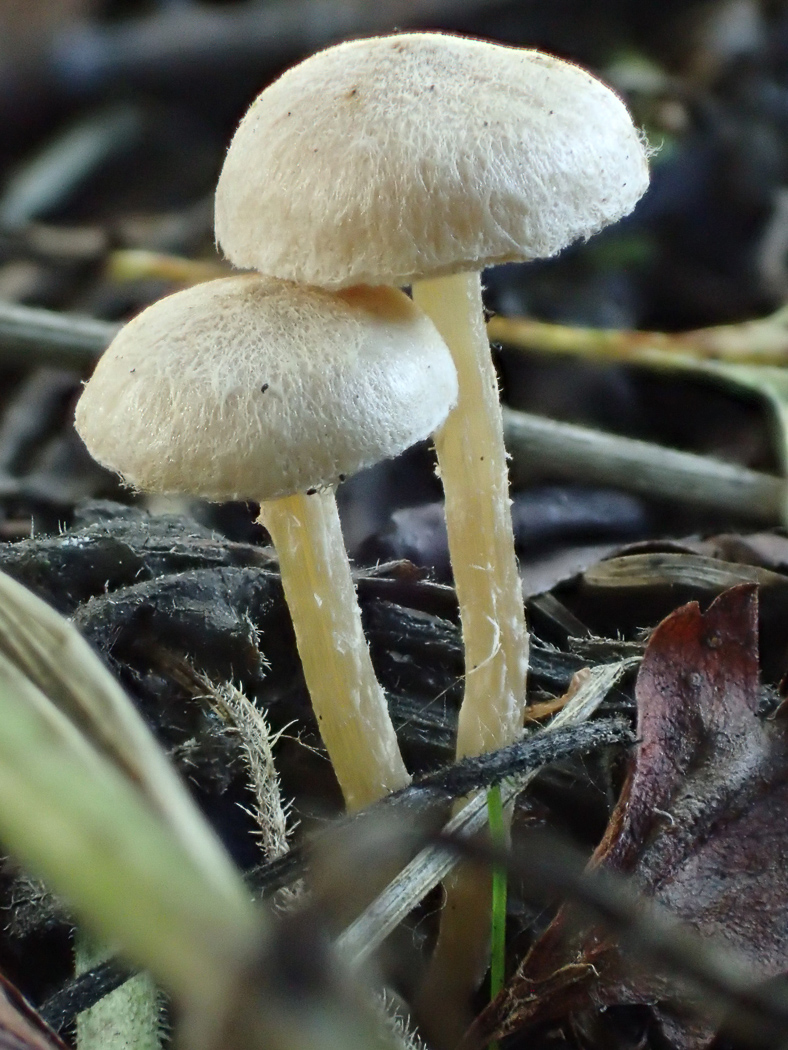 |
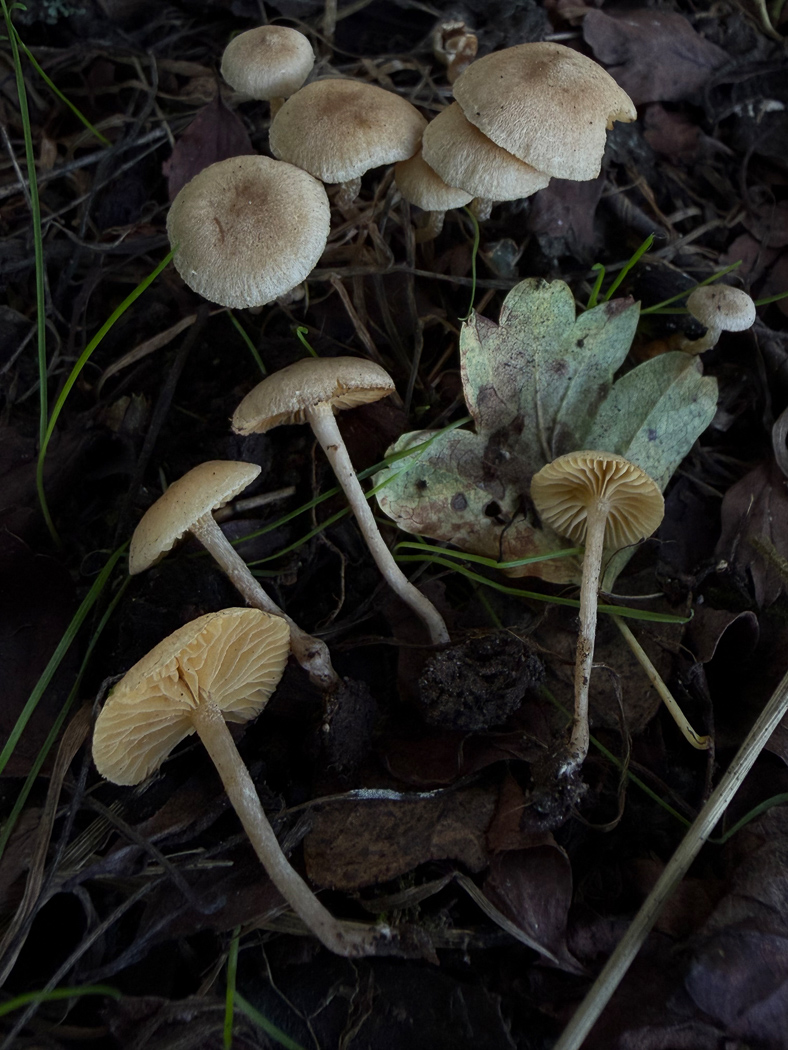
September 15th Tubaria dispersa (Hawthorn Twiglet) On the edge of Naphill Common Sarah Ebdon found these small pale mushrooms under Hawthorn, this host tree immediately alerting her to the possibility of this particular species. She recalled being shown it by Derek not far from this spot on one of our walks here. Unlike the much more common T. furfuracea and T. conspersa - both Twiglet LBJs which we regularly record from woody litter of all sorts, this species only occurs on the old rotting fruits (haws) of Hawthorn and in some years we never seem to find it. It has a much paler cap than the two commoner species and the gills are decidedly yellowish, though Sarah questioned her ID at the time because the caps appeared almost fluffy-streaky which is not included in some descriptions. However, she then carefully extricated a few and found the haws clearly still attached at the stem base, thus leaving no doubts. Previous finds |
 |
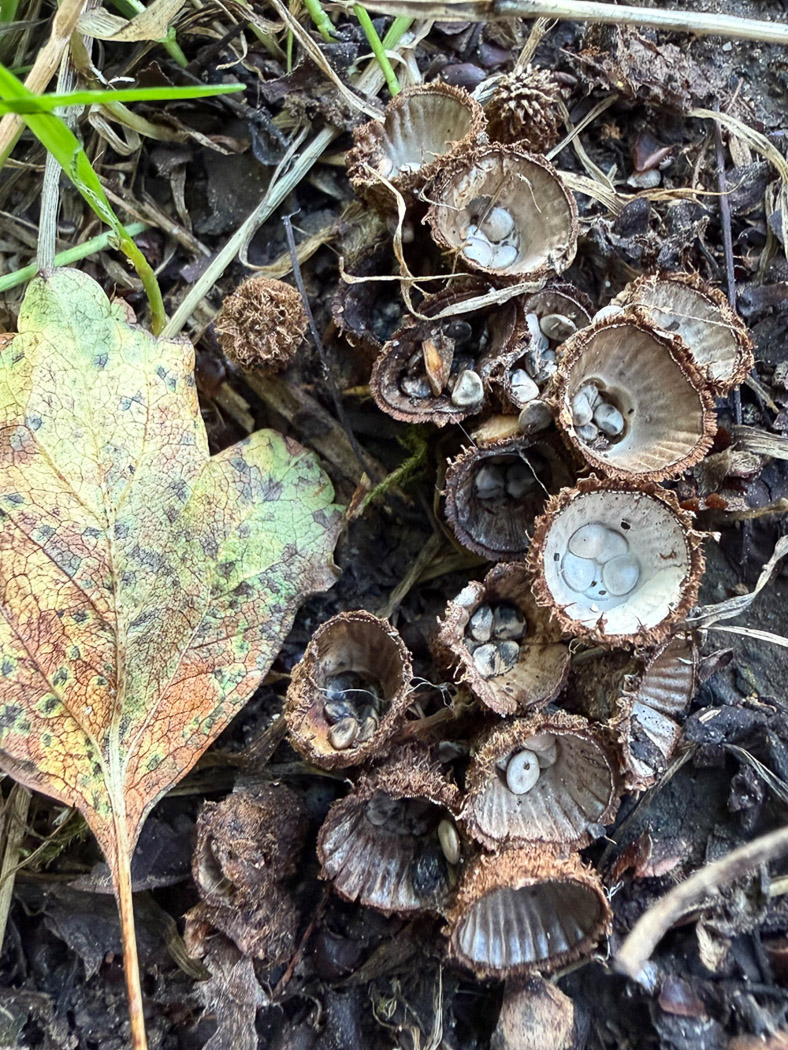
September 15th Cyathus striatus (Fluted Birdsnest) This tiny species was one of Sarah Ebdon's spots on the edge of Naphill Common lurking amongst the rotting woody pathside litter. It is a species which never fails to bring a smile to one's face when you find it, especially when displaying all stages of development as here, including the immature closed brown hairy balls still with the white protective lid firmly attached (photo 2) and the wide open 'nests' with fluted inner sides and containing the 'egg' sacks still attached by a long thread and containing the spores ready for dispersal by a raindrop (photo 3). This appears to be another species new to the Common today. Previous finds |
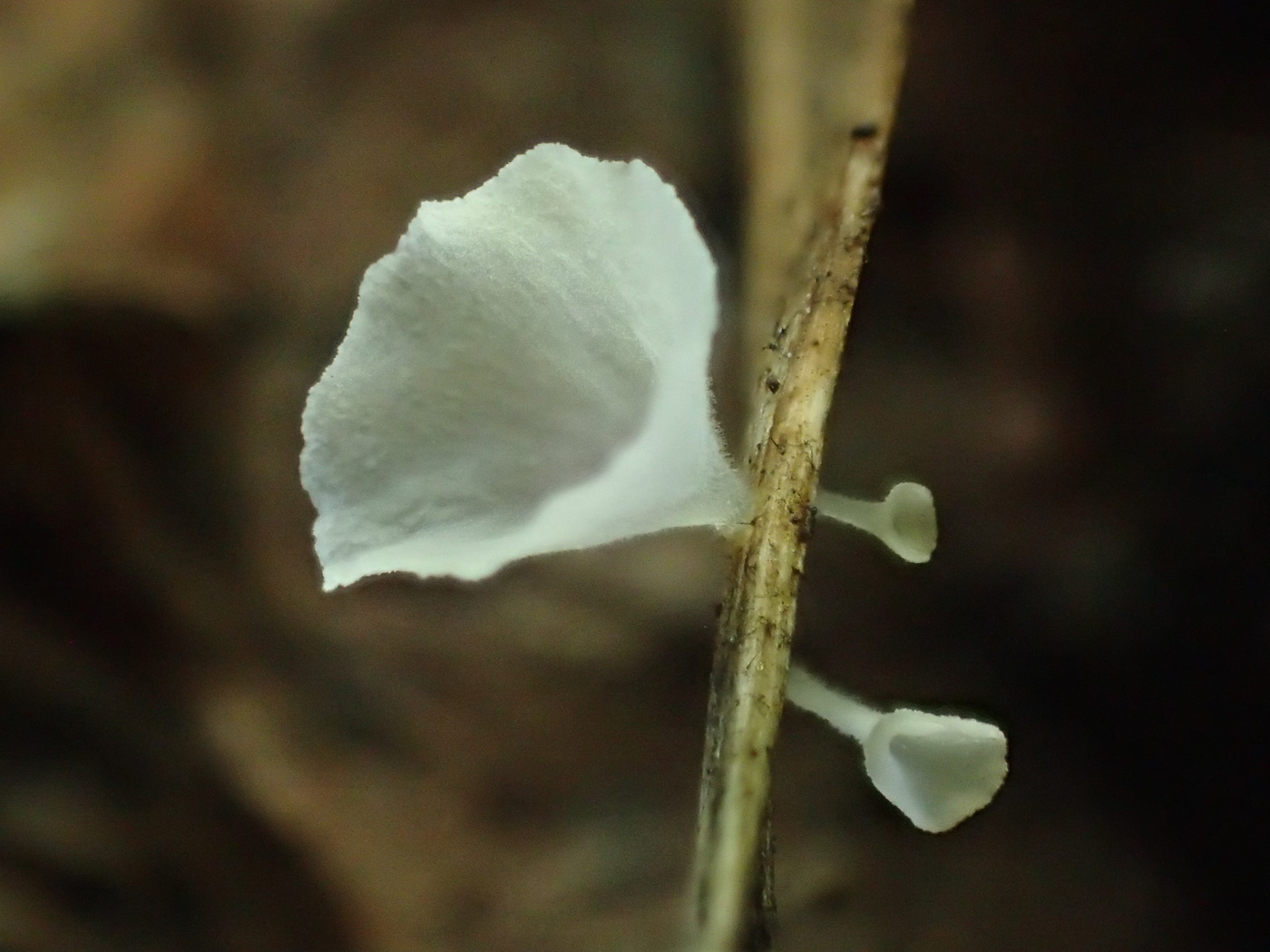 |
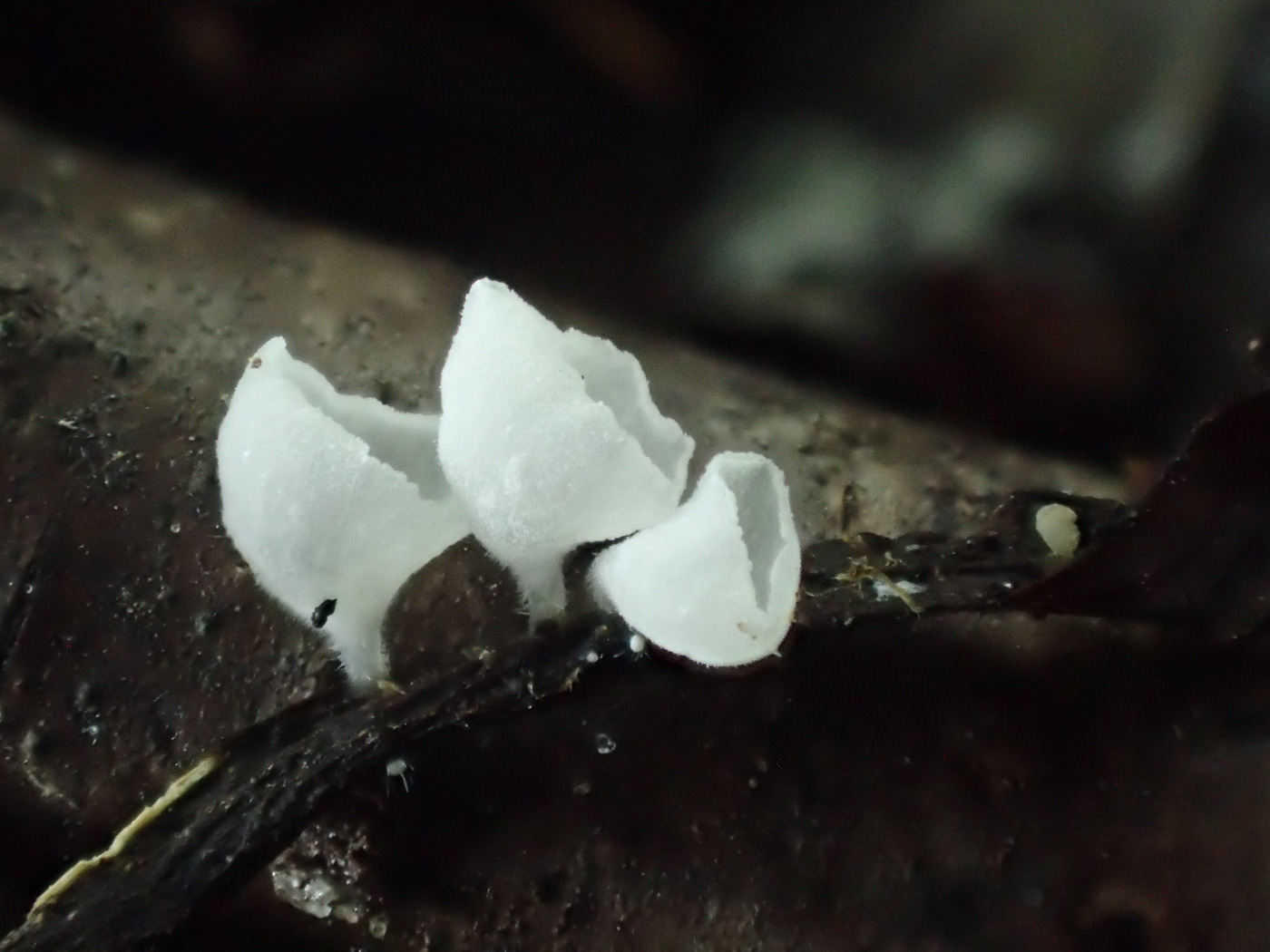
September 15th Calyptella capula (Bowl Hoodie) On the edge of Naphill Common Sarah Ebdon spotted these tiny white stalked cups growing on various different rotting stems of vegetation. Not easy subjects to photograph but well captured here, they are not that common and probably often overlooked, also this atypical shape for a basidiomycete could easily be mistaken for an ascomycete. We have around a dozen county records but this quite extensive fruiting appears to be new to the Common. Previous finds |
September 14th 2026
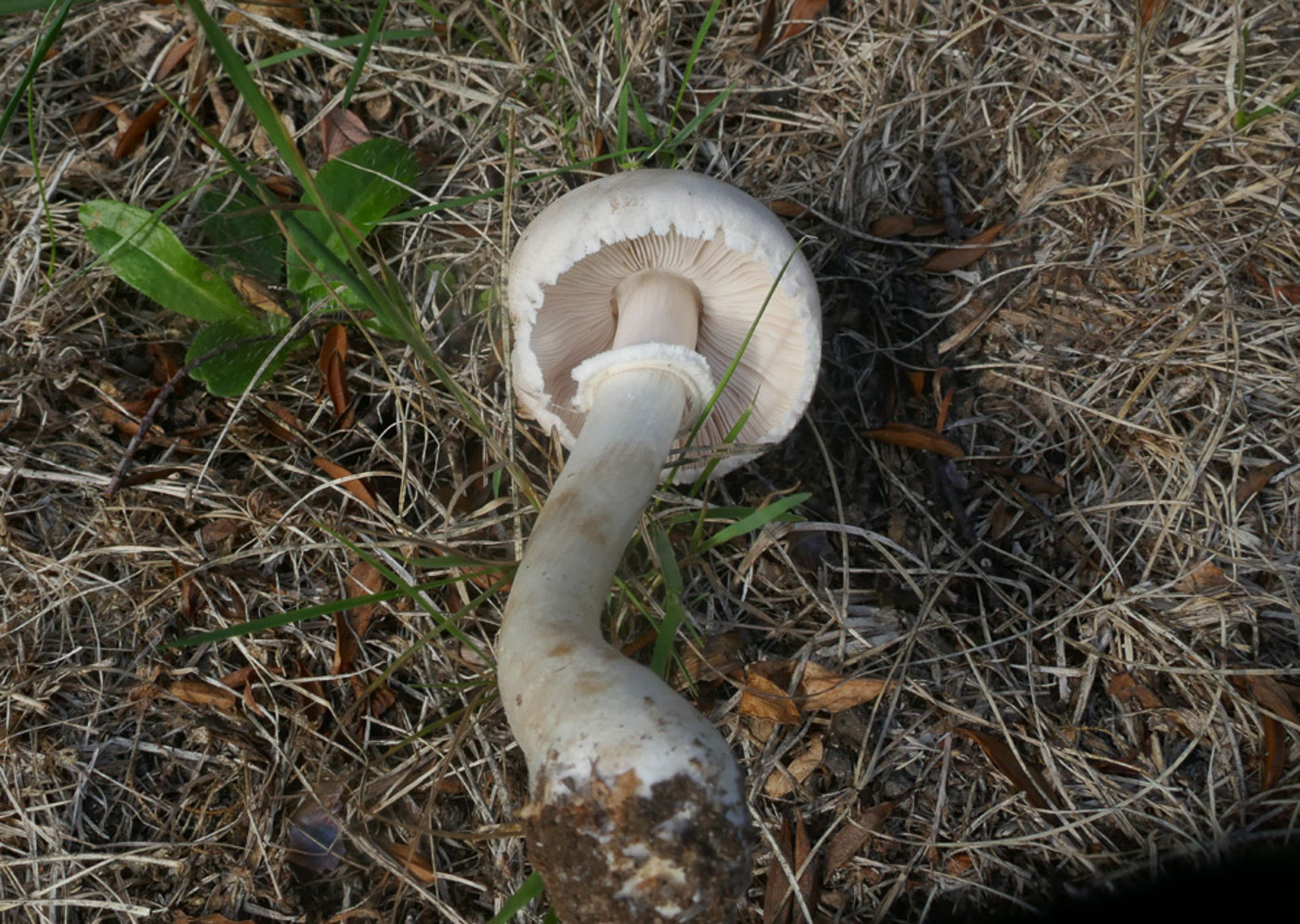 |
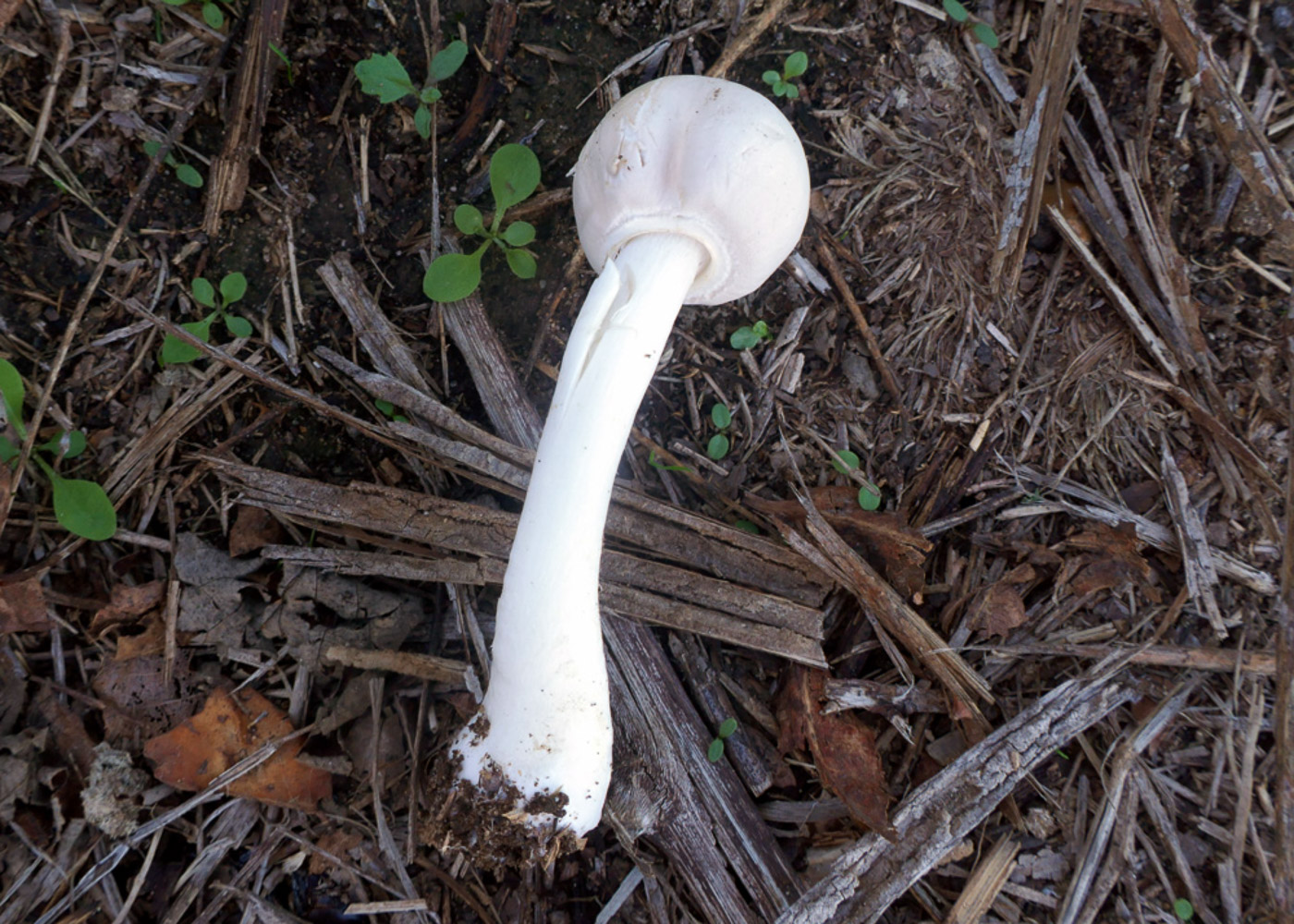
September 14th Leucoagaricus leucothites (White Dapperling) At Stampwell Farm Jackie Ewan noticed this immature singleton coming up in exactly the spot where she's found this species in previous years. Photo 2 taken the following morning shows nicely how the protective tissue covering the young gills of a mushroom then breaks away to form what we call the ring on the stem. See also the notes for Jackie's entry for a possibly different species of Leucoagaricus dated September 7th. Previous finds |
.jpg "Photo © Jackie Ewan") |
September 14th Panaeolina foenisecii (Brown Mottlegill) This is the time of year when this common grassland species starts popping up in garden lawns though it seems to have been a bit reluctant to appear so far. Here, at Stampwell Farm, Jackie Ewan noticed it in some rough grass clearly just recovering from our hot dry summer. Note how the hygrophanous cap has become faded and streaky in the sun leaving a ring of brown around the cap rim, typical of this species which when pristine is entirely red-brown. Previous finds |
.jpg "Photo © Jackie Ewan")
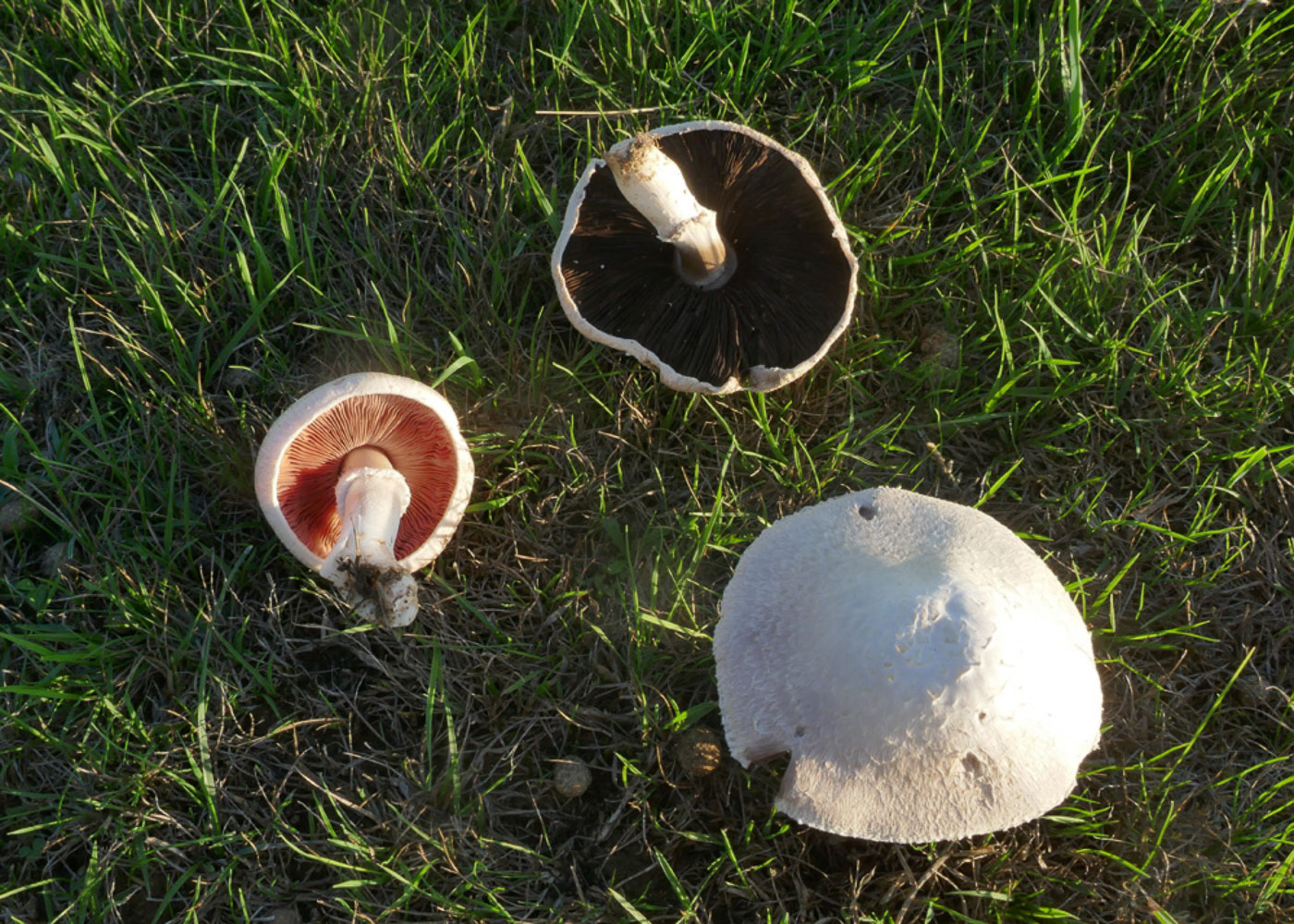 |
September 14th Agaricus campestris (Field Mushroom) In a field at Stampwell Farm Jackie Ewan found this grassland species forming an attractive semicircle. Photo 2 highlights the somewhat confusing difference in gill colour which occurs in virtually all dark spored mushrooms depending on maturity but is particularly notable in genus Agaricus. Previous finds |
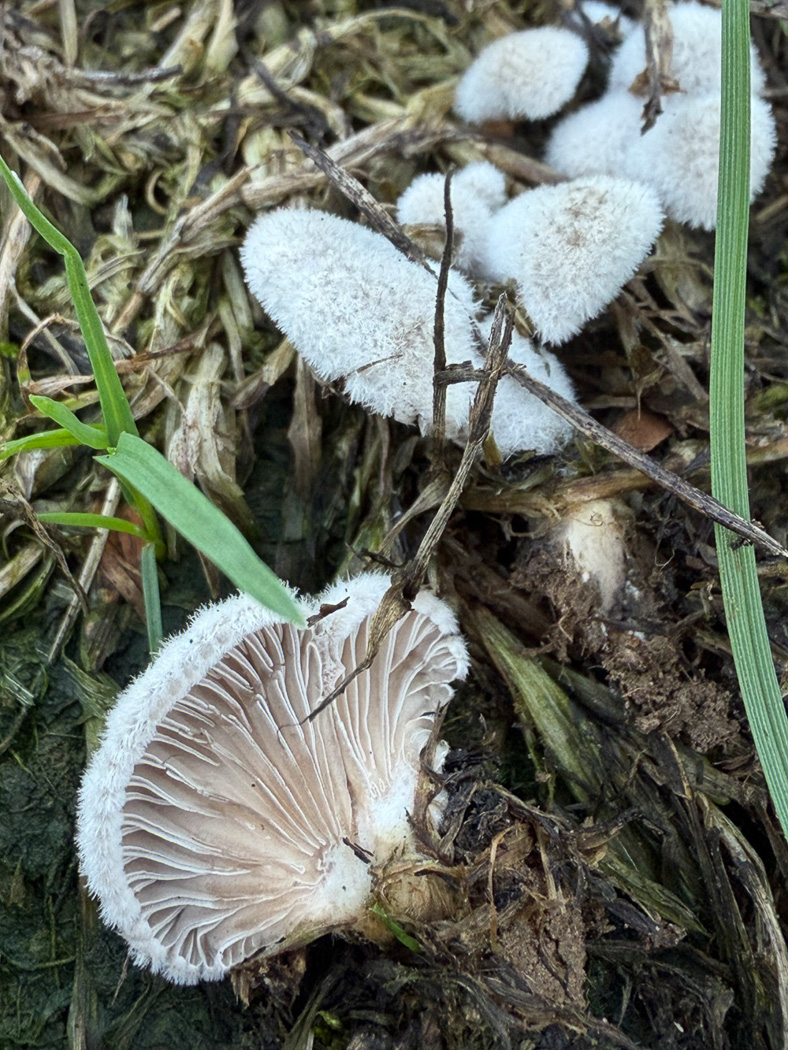 |
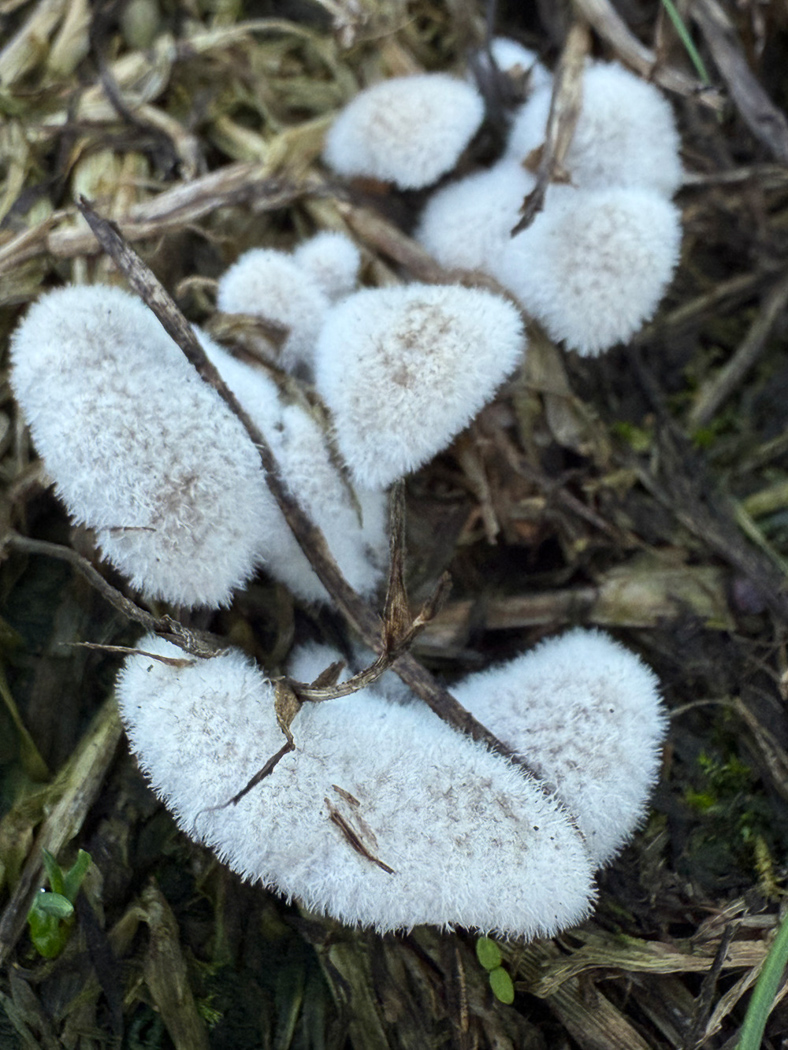
September 14th Schizophyllum commune (Splitgill) On foot to the post office in Naphill Sarah Ebdon spotted these tiny white furry blobs in some decomposing woody litter in the recreation ground and curiosity demanded further inspection! Turning one over revealed all: the distinctive underside of this species - more often found in good numbers on the sawn off ends of deciduous logs - was unmistakeable (seen in photo 2). Glancing through our range of photos of this species will confirm the white furry upper surface and unique gill shape beneath which make it such an easy one to recognise. Previous finds |
September 13th 2026

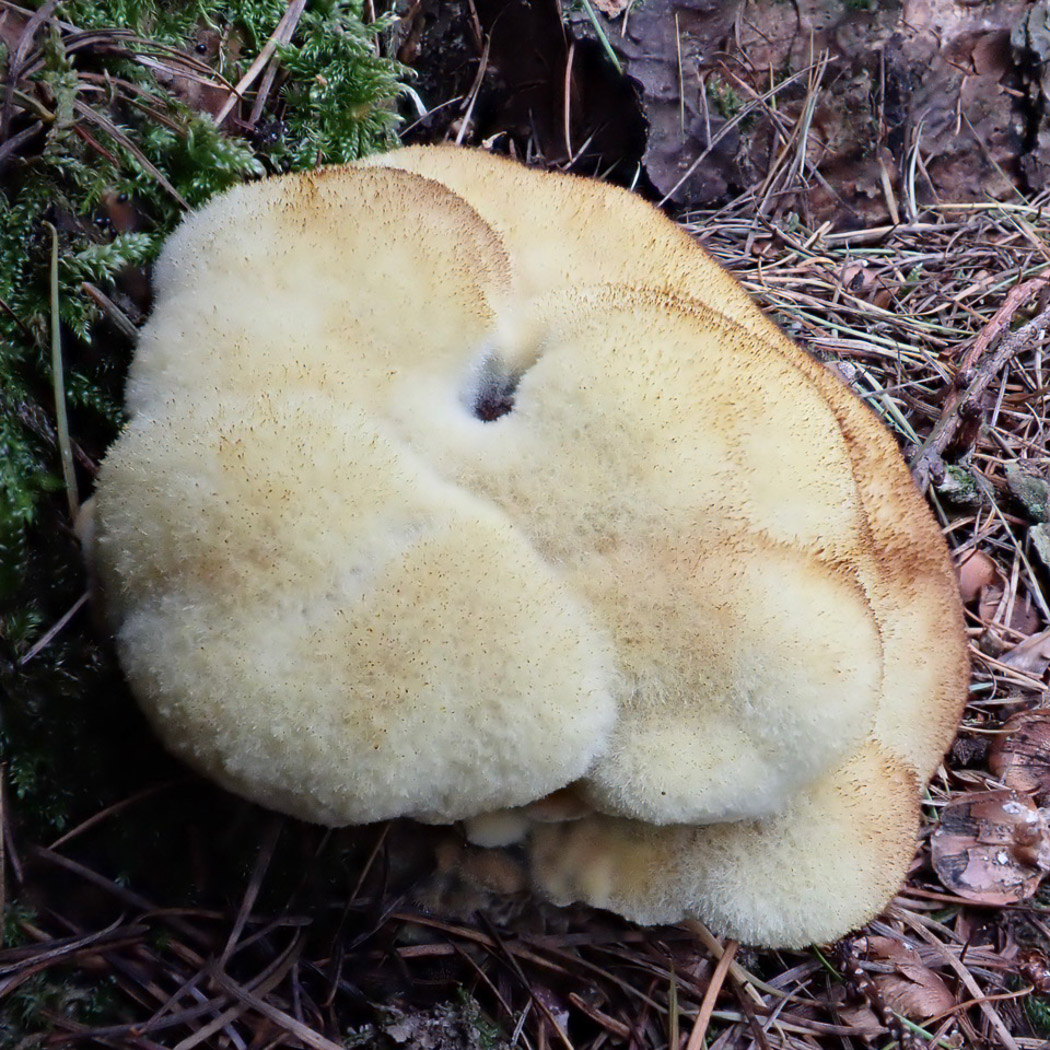 |
September 13th Phaeolus schweinitzii (Dyer's Mazegill) At Burnham Beeches Barry Webb had been noticing several yellow fluffy patches at the base of conifers which mystified him. Then at our microscope workshop at the Amersham Field Centre yesterday we noticed the same patches at the base of Larch but this time recognised by Penny as the early stages of the bracket P. schweinitzii (photo 2 taken by Linda Seward). So when Barry's photo of a slightly more developed example from The Beeches arrived today (photo 1) it further confirmed what his yellow patches were. This bracket can get huge, dinner plate sized and rich red brown with yellow remaining only at the margin. Hopefully Barry will send in a fully developed whopper if / when one of the examples is fully developed because though we have quite a few examples in Finds a perfect 'dinner plate' would complete our range of photos. So look out for this species now, always at the base of conifers. Previous finds |
September 12th 2026
.jpg "Photo © Sarah Ebdon") |
September 12th Periconia byssoides (an asco with no English name) During our microscope workshop at the Amersham Field Centre (near Mop End) this unusual and tiny species was found by Sarah Ebdon on a dead Nettle stem and having just acquired a new book which covers such species she was then able to identify it. Though not at all rare it appears to be new to the county and is also therefore another new species for Finds. Members' Finds New Species no. 1305 |
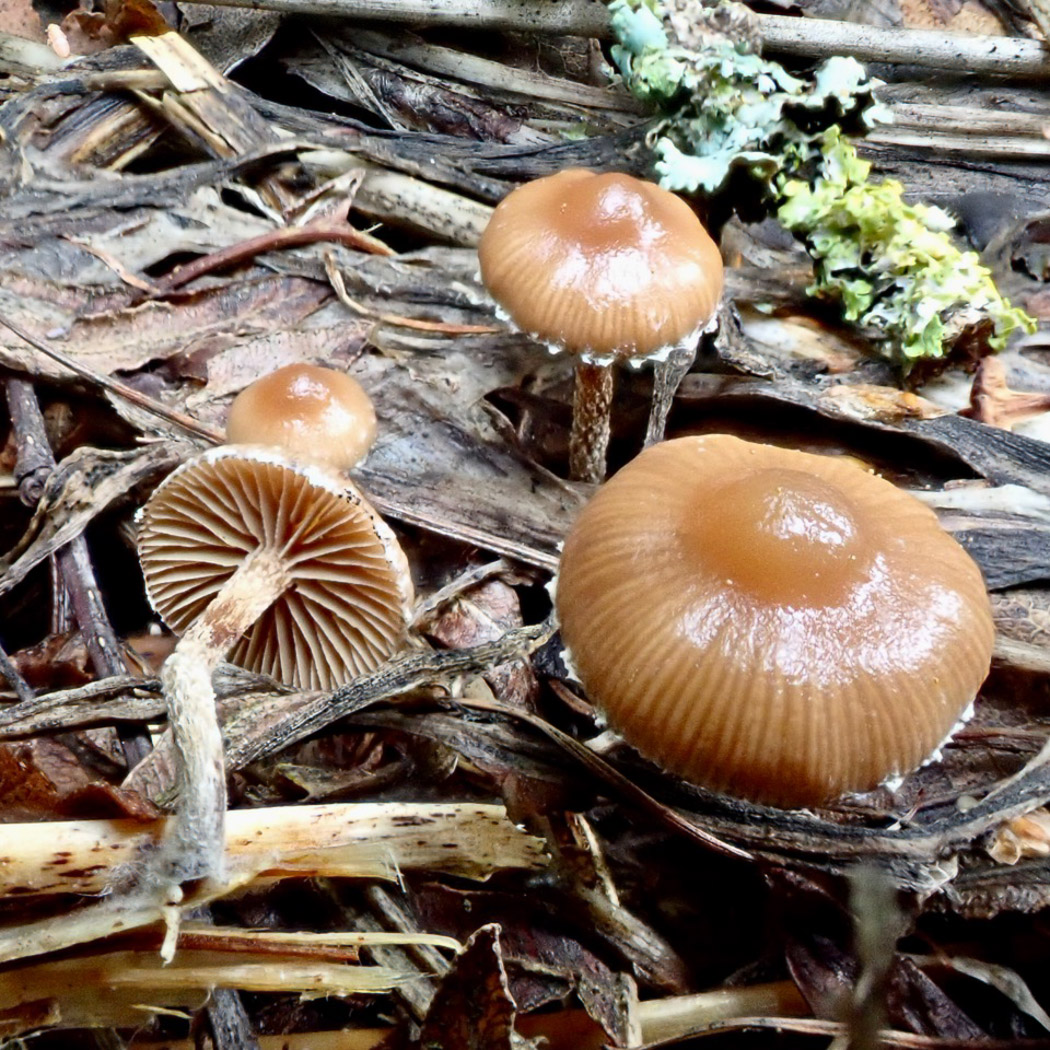 |
September 12th Deconica crobula (a Brownie with no English name) During our microscope workshop at the Amersham Field Centre (near Mop End) this tiny LBJ was one we found to work on and was growing in the damp rotting pathside vegetation. The distinctive veil remnants adhering to the cap margin are a particular feature of the species (previously in genus Psilocybe) and the microscopic features fitted perfectly when keyed out by Jesper Launder. Not a common species but we have about 9 county records. (The photo is Linda Seward's.) Previous finds |
.jpg "Photo © Sarah Ebdon") |
September 12th Parasola auricoma (Golderhaired Inkcap) During our microscope workshop at the Amersham Field Centre (near Mop End) this was one of the species we found to work on and was growing in a damp grassy verge. On collection Penny suspected from its rather large size (the cap was around 3 cm across) that it would be this species, and sure enough a quick check with the scope at a cap cuticle section revealed the distinctive and unique long orangey 'hairs' which separate this species from other often very similar species within this genus. (The photo is Sarah Ebdon's.) Previous finds |
September 11th 2026
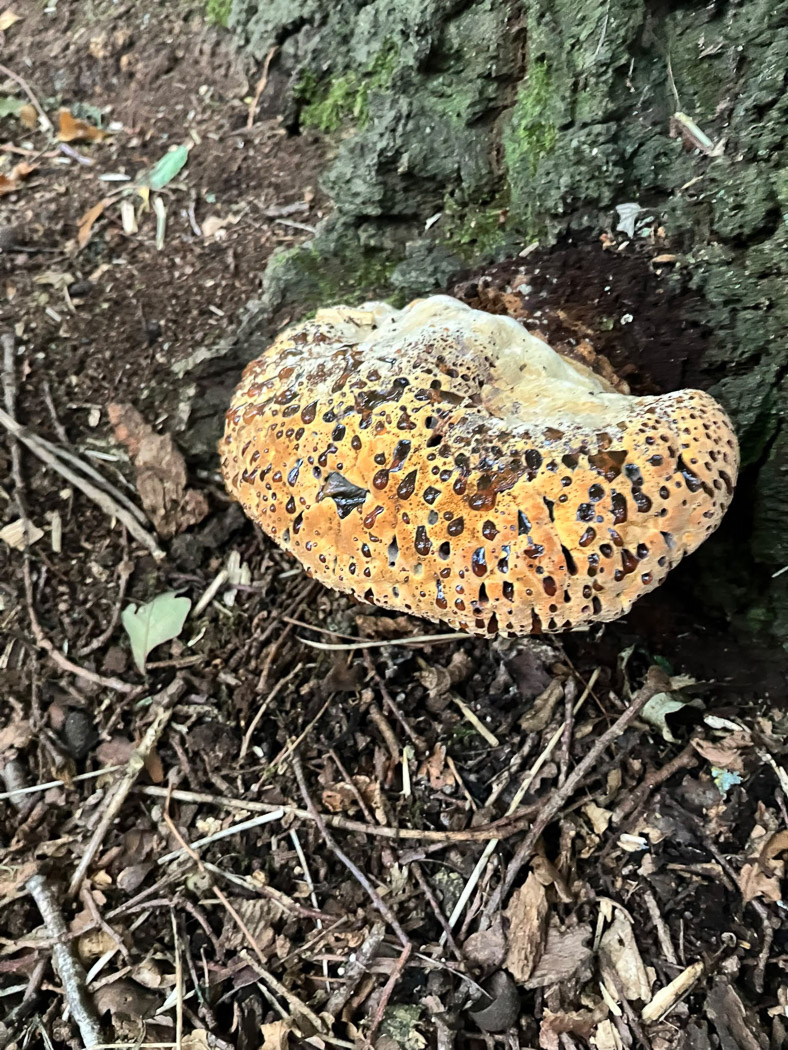 |
September 11th Pseudoinonotus dryadeus (Oak Bracket) In Munces Wood nr Marlow Mark Harris spotted this swollen lump of bracket at the base of an Oak and covered in gory droplets, then sent his photo to Penny for ID. He said he'd found examples of Ganoderma on this tree previously so assumed this was probably also that genus, but not so. The shape and texture is not that of Ganoderma, also these droplets if present are the give-away feature of this species (previously in genus Inonotus) though older mature specimens will lack them. Note also that Ganoderma has brown spores and the pores when scratched turn brown whereas Pseudoinonotus has white spores and unchanging pores when scratched. Previous finds |
September 9th 2026
.jpg "Photo © Jackie Ewan") |
September 9th Agrocybe pediades (Common Fieldcap) The genus Agrocybe tends to appear in the summer months and several members are grassland fruiters, A. pediades being a really common mushroom at Stampwell Farm - spotted here by Jackie Ewan. Some species have a persistent ring on the stem though several tend to lose this feature early on, so if missing as seen here it can be a useful character to note in the field because A. pediades is one which soon loses its ring if present at all. Previous finds |

 |
September 9th Gymnopus dryophilus (Russet Toughshank) This common woodland species, here coming up under Oak at Stampwell Farm and sent in by Jackie Ewan, is often one of the first to appear in early autumn. True to form this year it has been much in evidence through September, seen in loose troops in woodland leafy litter. Previous finds |
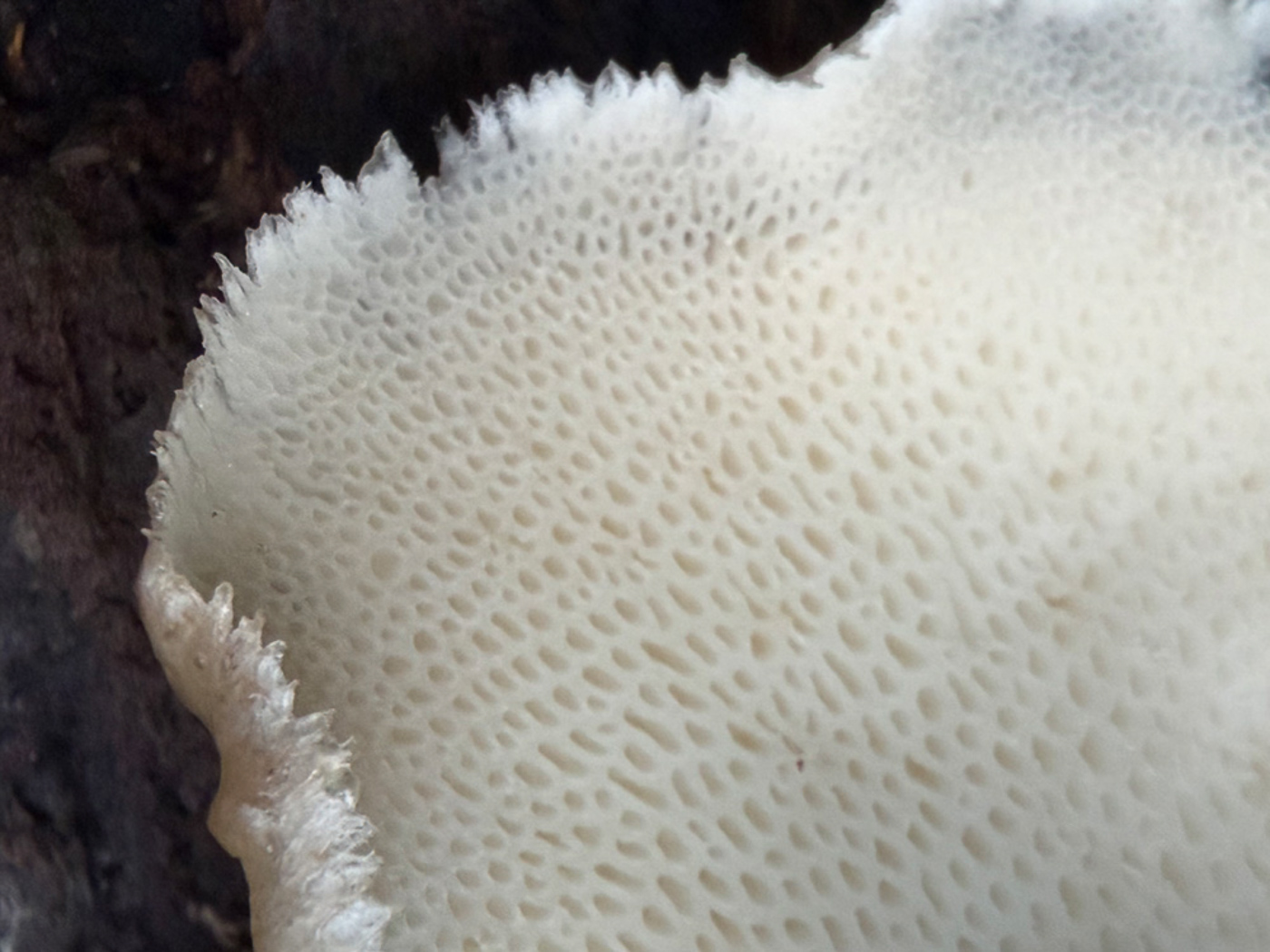 |
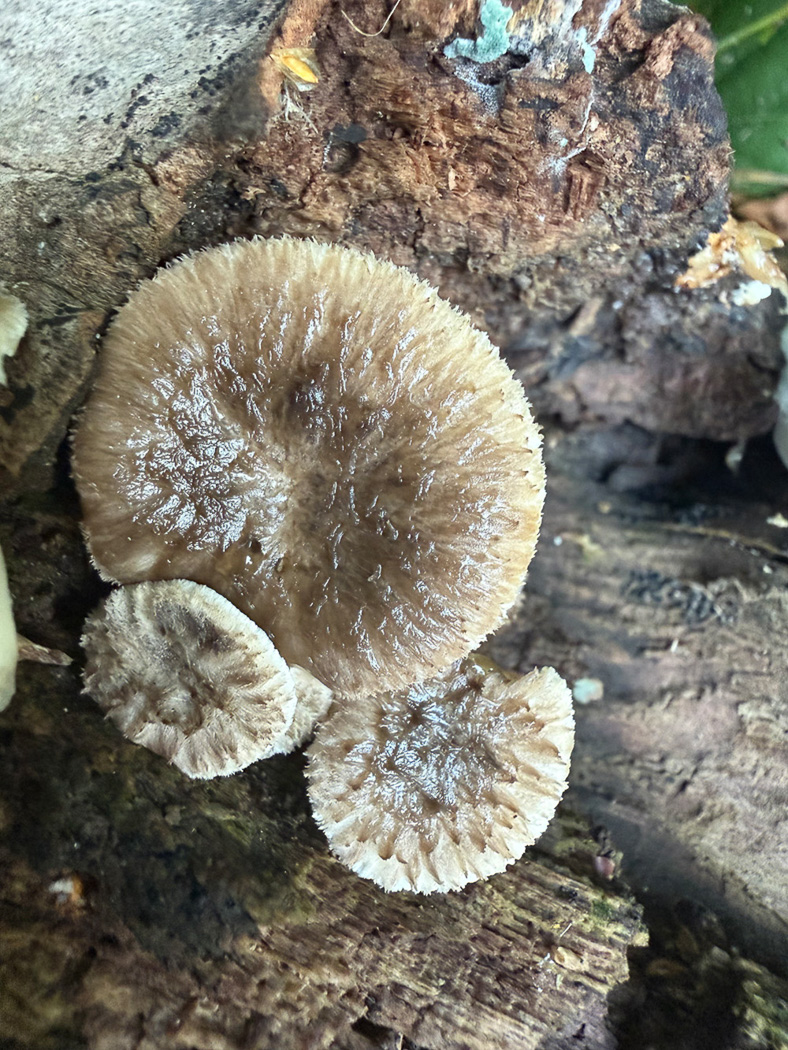
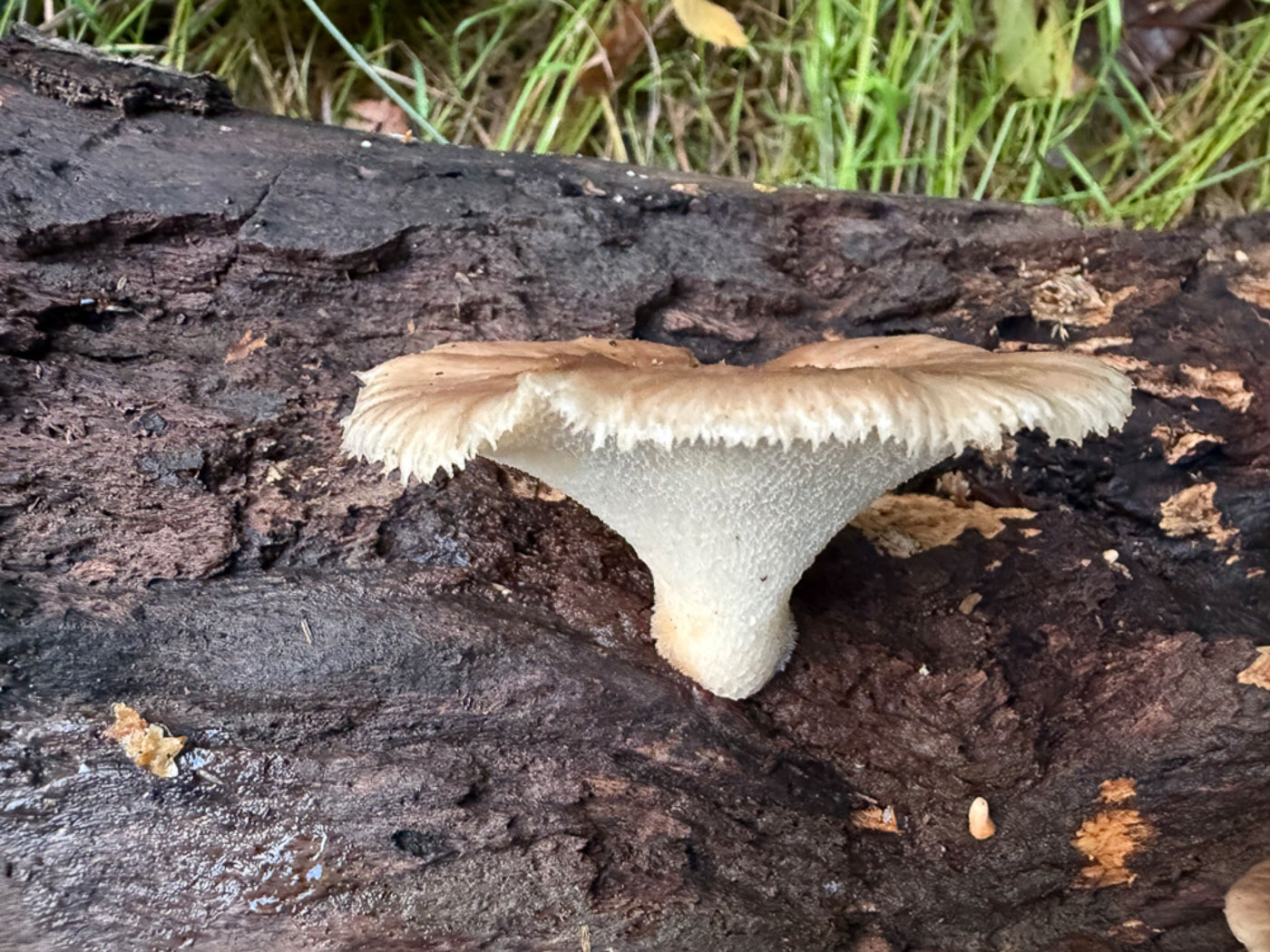
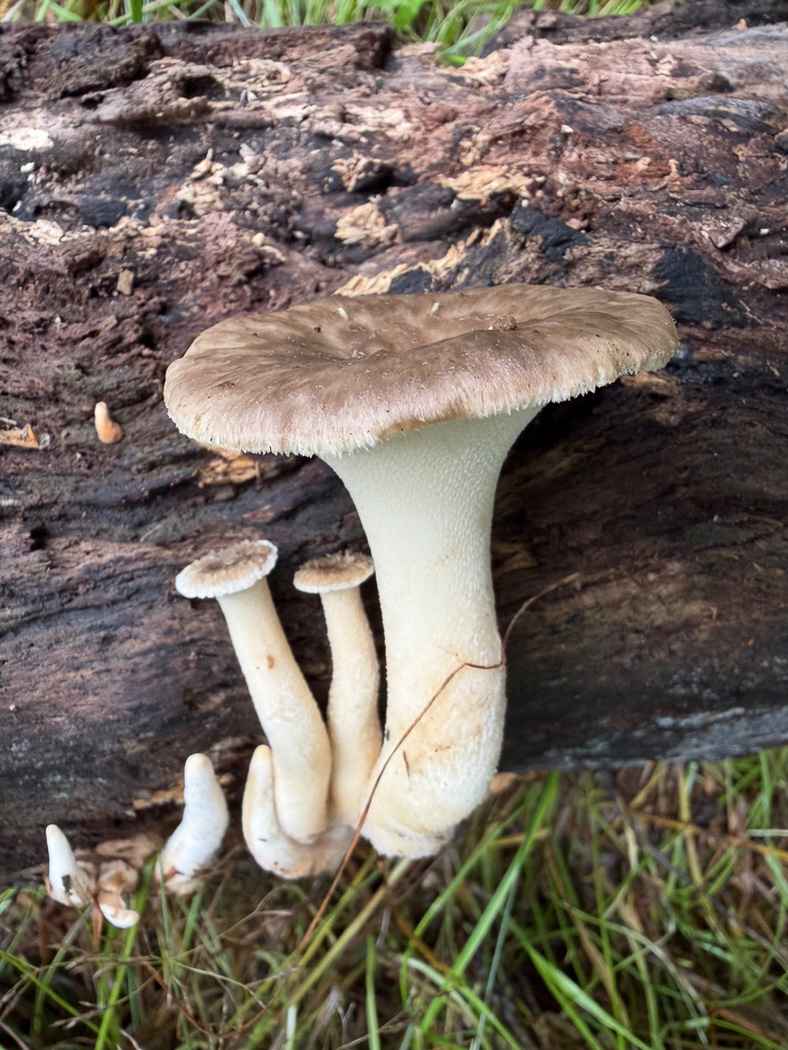
September 9th Polyporus tuberaster (Tuberous Polypore) Over the space of five days Sarah Ebdon watched the development and took photos of this puzzling Polypore on fallen deciduous wood in Naphill Common. The feature which struck her was the notably ciliate (frilly, fringed) cap margin which pointed to Lentinus substrictus (previously P. ciliatus and often a summer fruiter) but the spores were much too long for that species or indeed any other similar Polypore except for P. tuberaster. The greyish brown colour and rather flattened scaly surface seen here are not that typical, however, but the spore size really eliminates all others apart from the much more substantial and obviously scaly Cerioporus squamosus (Dryad's Saddle) which it clearly isn't! Note also the rather large pores which also help to confirm this ID. Previous finds |
September 8th 2026
| Just in February 7th |
Encoelia furfuracea (Spring Hazelcup) Click here |
September 7th 2026

|
September 7th Leucoagaricus cf. carneifolius (a rare Dapperling with no English name) At Stampwell Farm Jackie Ewan came across this singleton in a vegetable garden amongst some parsnips! The spot was not far from where she'd previously found the pure white L. leucothites - in other respects like an Agaricus but with white gills and spores - so first impressions here were that it would be that species. However, she found the spores were a bit too large, also the hollow stem with clavate base and rather indistinct ring didn't seem to fit. Searching around for an alternative led her to Penny's 2024 entry for L. carneifolius in Finds, though that entry was also not that confident and marked cf., especially as even sequencing had failed to resolve it though it hadn't matched L. leucothites. In any case there appears to be disagreement as to the correct name and placing of L. carneifolius, with Index Fungorum now synonymising these two species and placing them in genus Leucocoprinus. If material is available we'll get it sequenced though this may well not help us to arrive at a name in this case ....... Previous finds |
September 5th 2026
.jpg "Photo © Chris Miller")
.jpg "Photo © Sarah Ebdon")
.jpg "Photo © Sarah Ebdon")
.jpg "Photo © Sarah Ebdon")
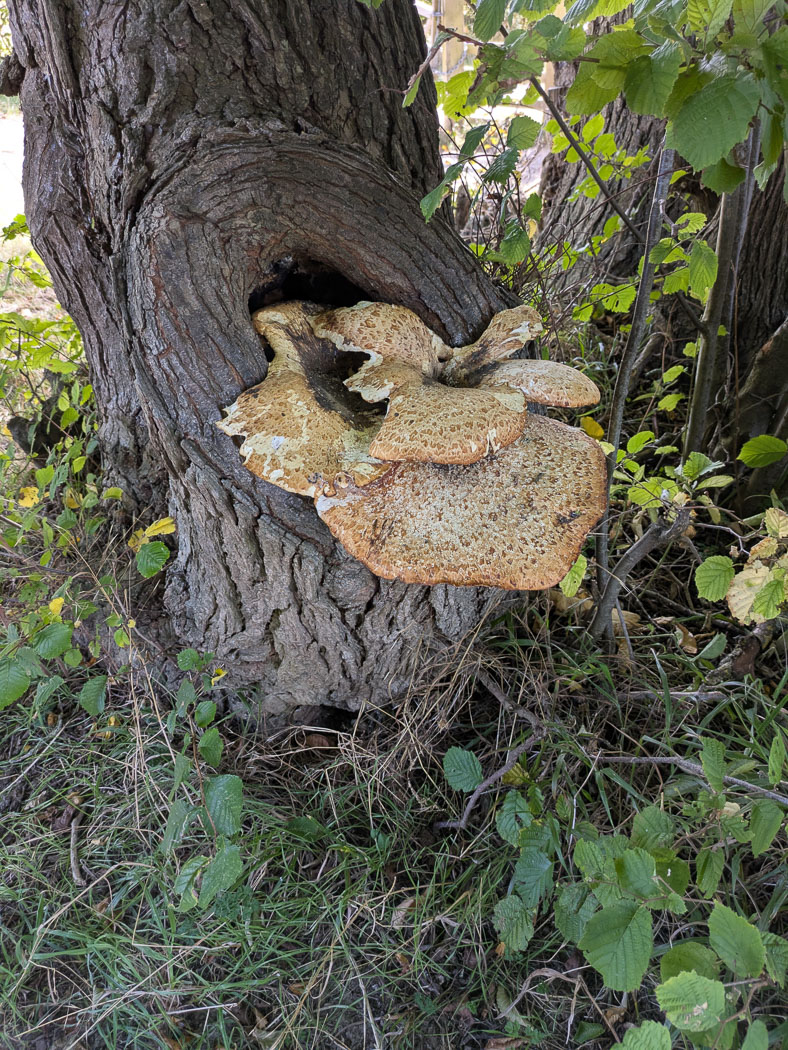 |
September 5th Cerioporus squamosus (Dryad's Saddle) In Naphill Common Chris Miller came across this Elm bole with these unmistakeable brackets just beginning to emerge (photo 1). Sarah Ebdon then went to check on their development two days later and was amazed how quickly they'd grown! (photos 2-4) Photo 5 taken 3 weeks later by Chris shows the mature version. Previous finds |
August 20th 2026
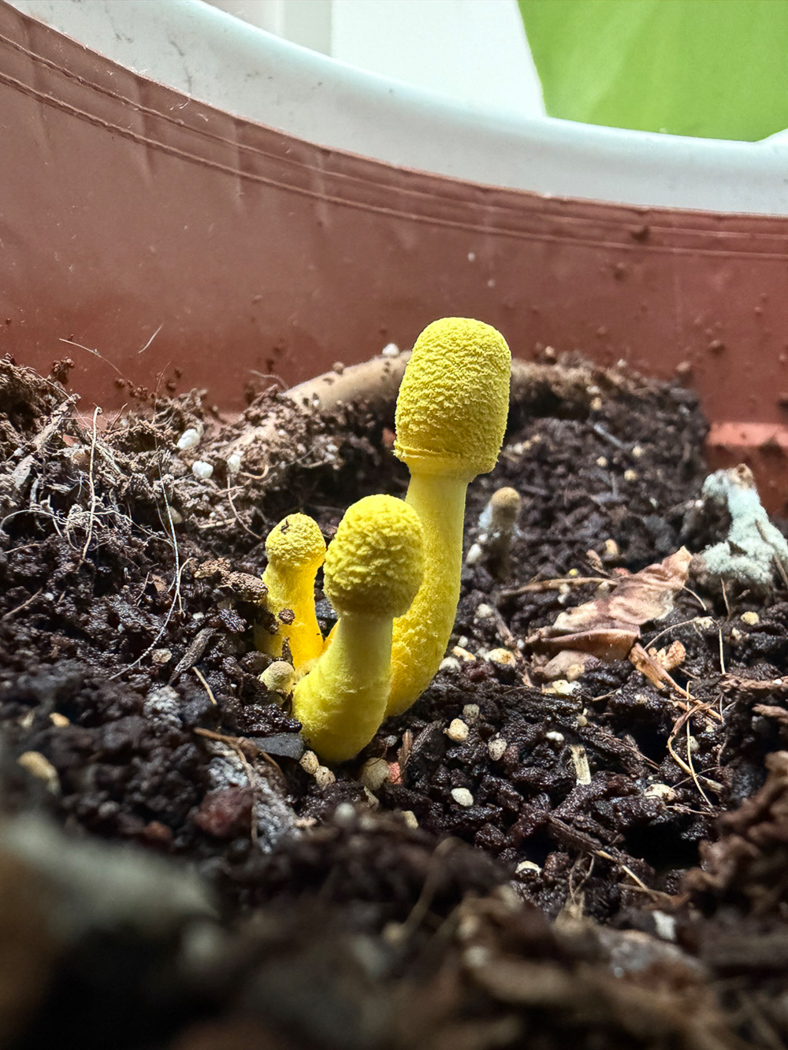
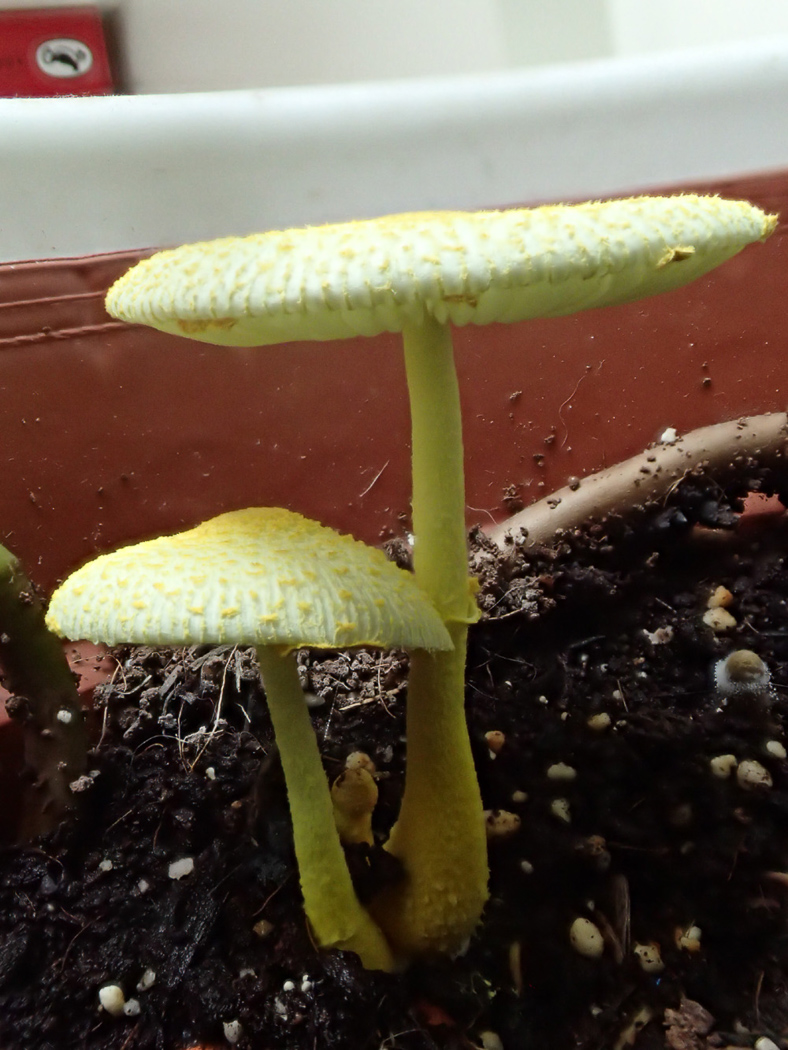
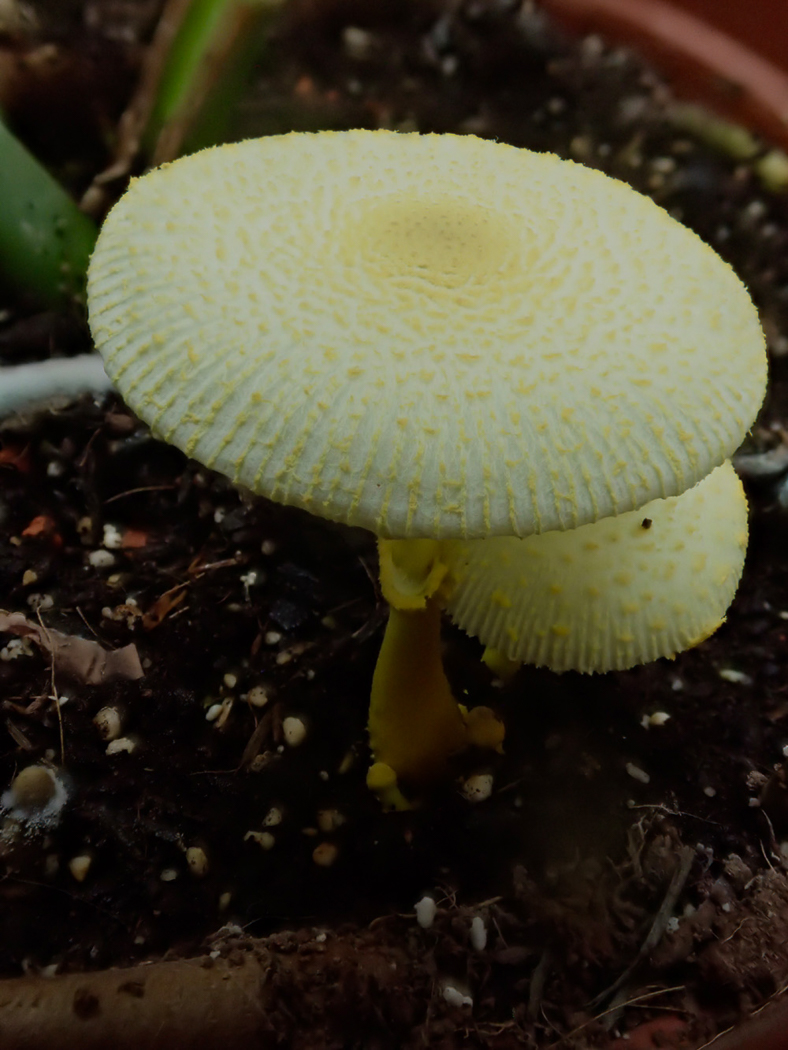
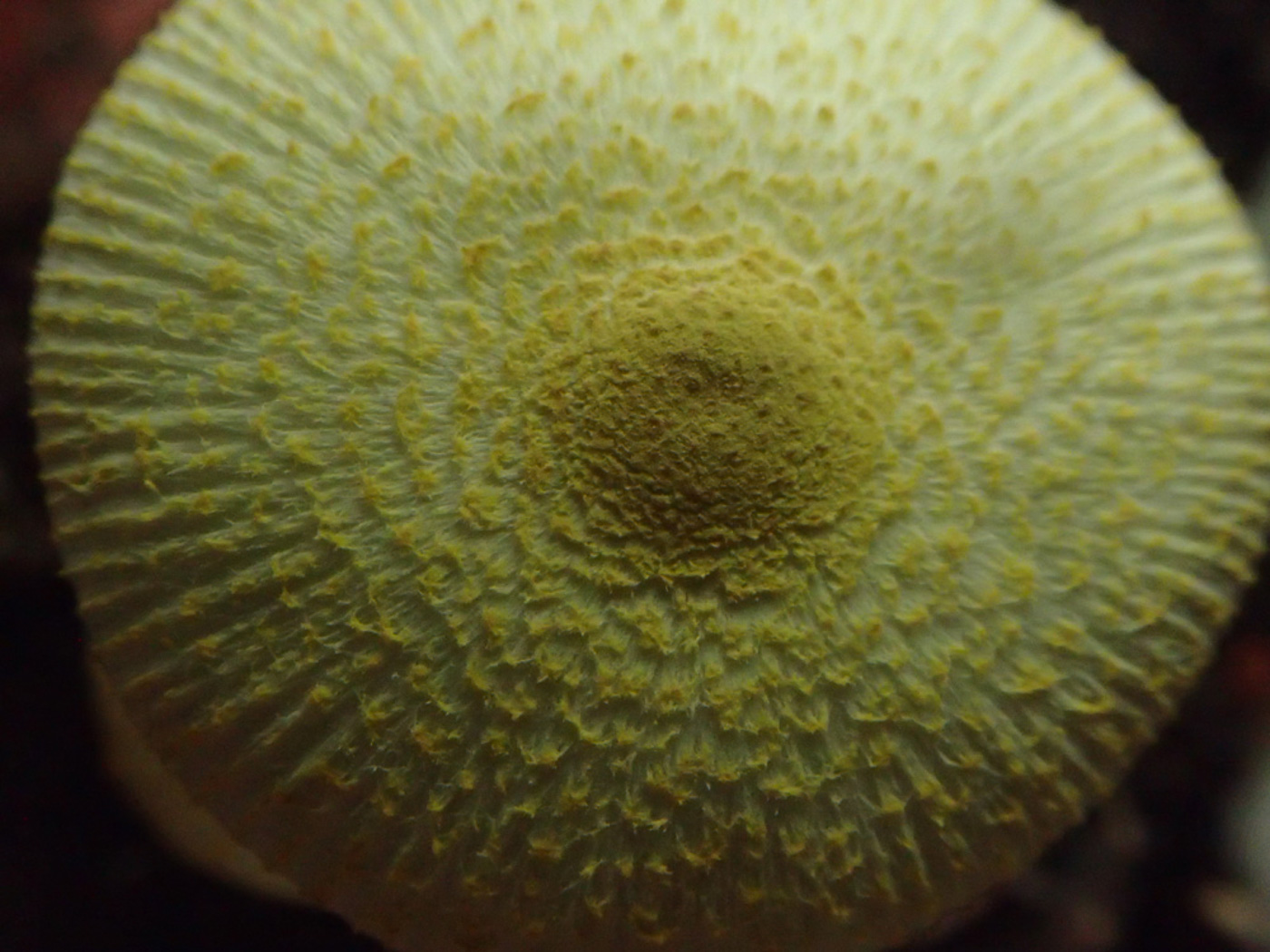
 |
August 20th Leucocoprinus birnbaumii (Potplant Dapperling) Sarah Ebdon reports that on several occasions this summer she'd spotted a tiny undeveloped fungus still at the 'pin' stage appearing in the compost of her Monstera (Swiss Cheese Plant) indoors at home in Naphill. She knew of the rare and beautiful L. birnbaumii from literature - common in the tropics but in the UK virtually restricted to greenhouses or similar - and was hoping this might be it but as developing to maturity appeared to take only a matter of hours she was never around at the right moment to actually see it properly until today! Photo 1 was taken the previous evening, subsequent photos being taken at 7.30 am and by midmorning they were apparently well past their sell-by date! FRDBI reveals three previous county records, all from Milton Keynes (1975 by the eminent mycologist Derek Reid and two in 1991 by Jerry Cooper, also very highly respected) so Sarah is in good company and the gap of 36 years surely qualifies the yellow box here. What a little beauty and a very special find. Members' Finds New Species no. 1304 |
August 19th 2026
| Just in July 14th |
Rosellinia britannica (an unusual pyrenomycete asco with no English name) Click here |
August 15th 2026
.jpg "Photo © Jesper Launder") |
August 15th Ustilago maydis (Corn Smut) When passing a field of sweetcorn near Chalfont St. Giles, Jesper Launder was prompted to check for signs of this relatively common plant pathogen for which we have no records. He had to search hard for it but sure enough it was present, this being the most photogenic example he came across. The English name is taken from the web but is not on the official recommended list as yet. Members' Finds New Species no. 1303 |
August 3rd 2026
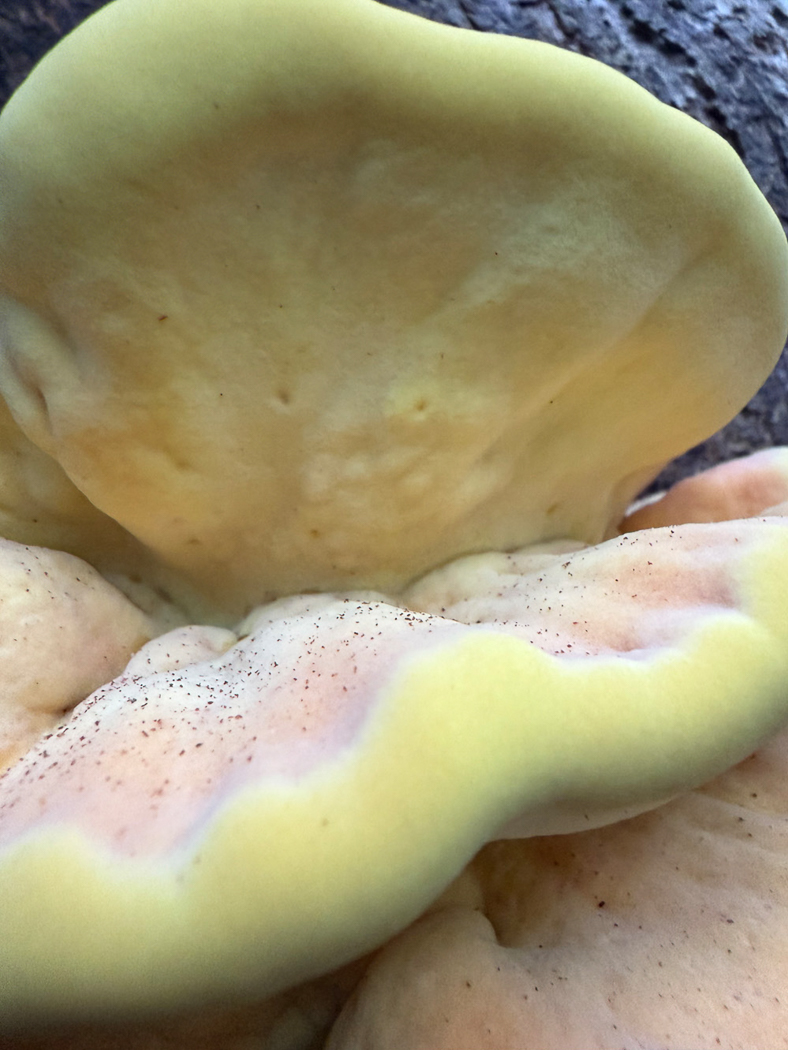 |
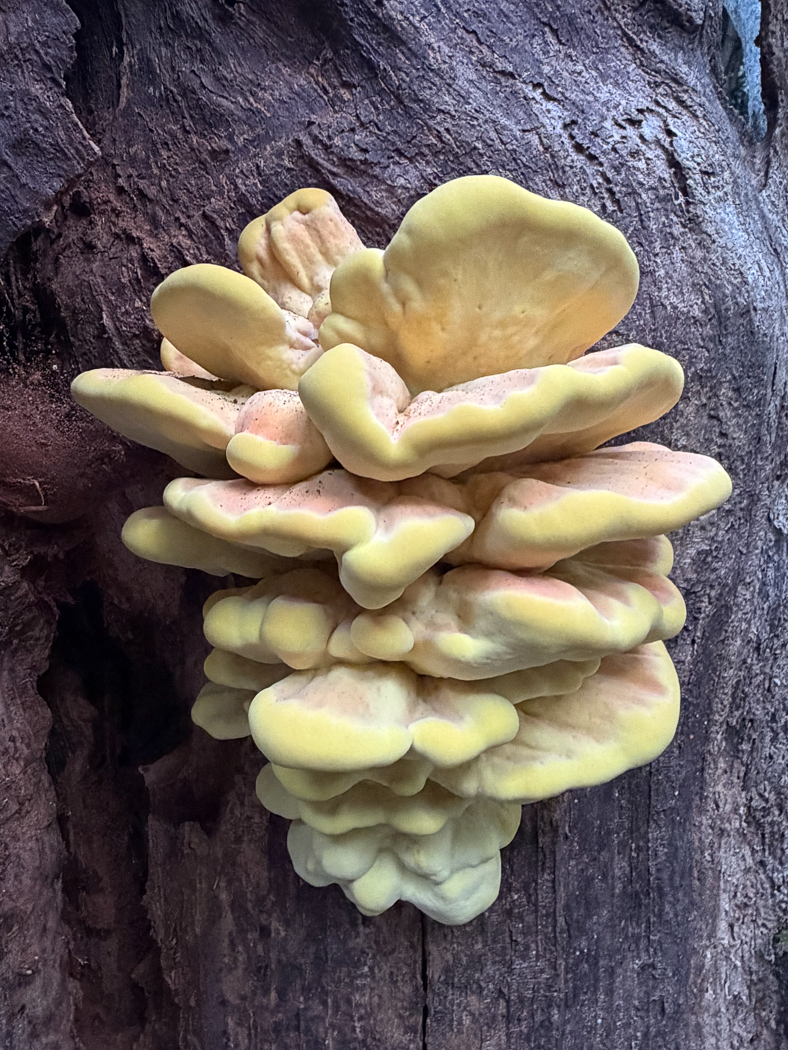
August 3rd Laetiporus sulphureus (Chicken of the Woods) Any pristine fungi is a treat to come across at the moment, given our exceptional summer weather, so Sarah Ebdon was delighted to spot this attractive bracket on the edge of Naphill Common on a dead standing Cherry trunk. Note the fresh sulphur yellow colour showing on the outer rim and underside in her close-up photo. Cherry is one of the most common hosts for this species in our area though it is not unusual on other trees including Yew (though this may in time prove to be a separate species..............) Previous finds |
July 31st 2026

 |
July 31st Golovinomyces sonchicola (a powdery mildew with no English name) In Walters Ash Neil Fletcher noticed this mildew affecting Prickly Sow-thistle and did some research to find that the fungus previously known as Erysiphe cichoracearum with a range of different host plants has now been split into around 10 different species according to host specifity, today's species amongst them (Ing 2024). We do have records for this previous name on various different hosts including Sow-thistle though none since 1991 (Ing also) despite this being a very common species, so can safely assume that it is not officially a new record though this name will not have been recorded in Bucks before. Members' Finds New Species no. 1301 |
July 25th 2026

 |
July 25th Golovinomyces asperifoliorum (a downy mildew with no English name) At Linford Lakes (near Milton Keynes) Neil Fletcher noticed this mildew heavily affecting its host plant, Common Comfrey. Though apparently very common, it is new to our county records (having checked for this name and both possible earlier names in our database), giving Members' Finds its 1300th species - something of a milestone. Thank you, Neil! Members' Finds New Species no. 1300 |
July 24th 2026
.jpg "Photo © Sarah Ebdon")
 |
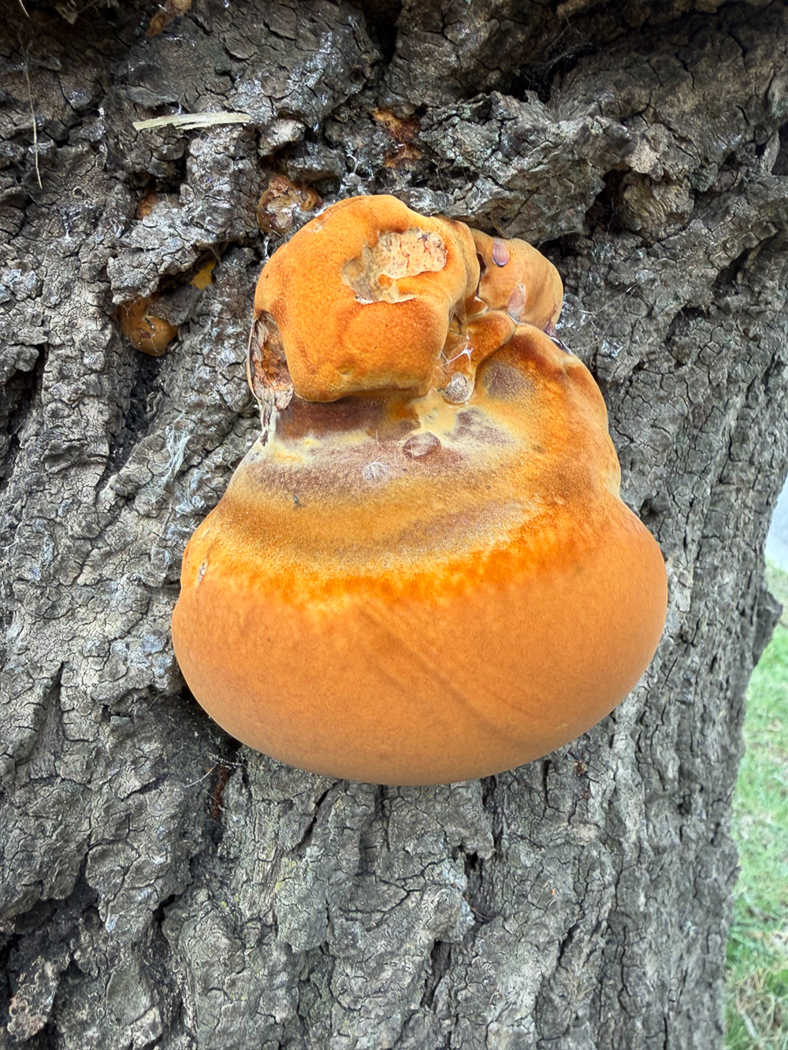
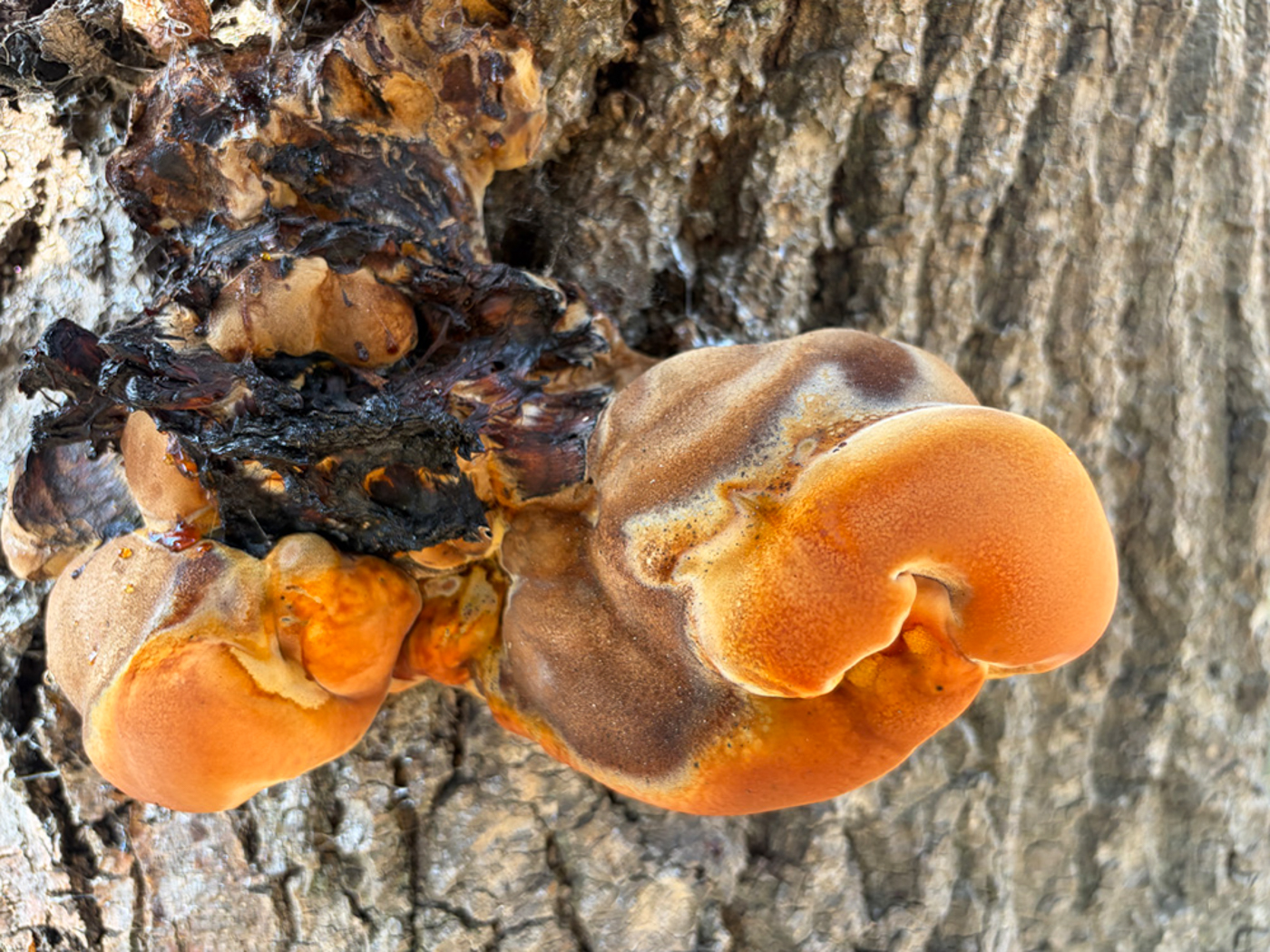
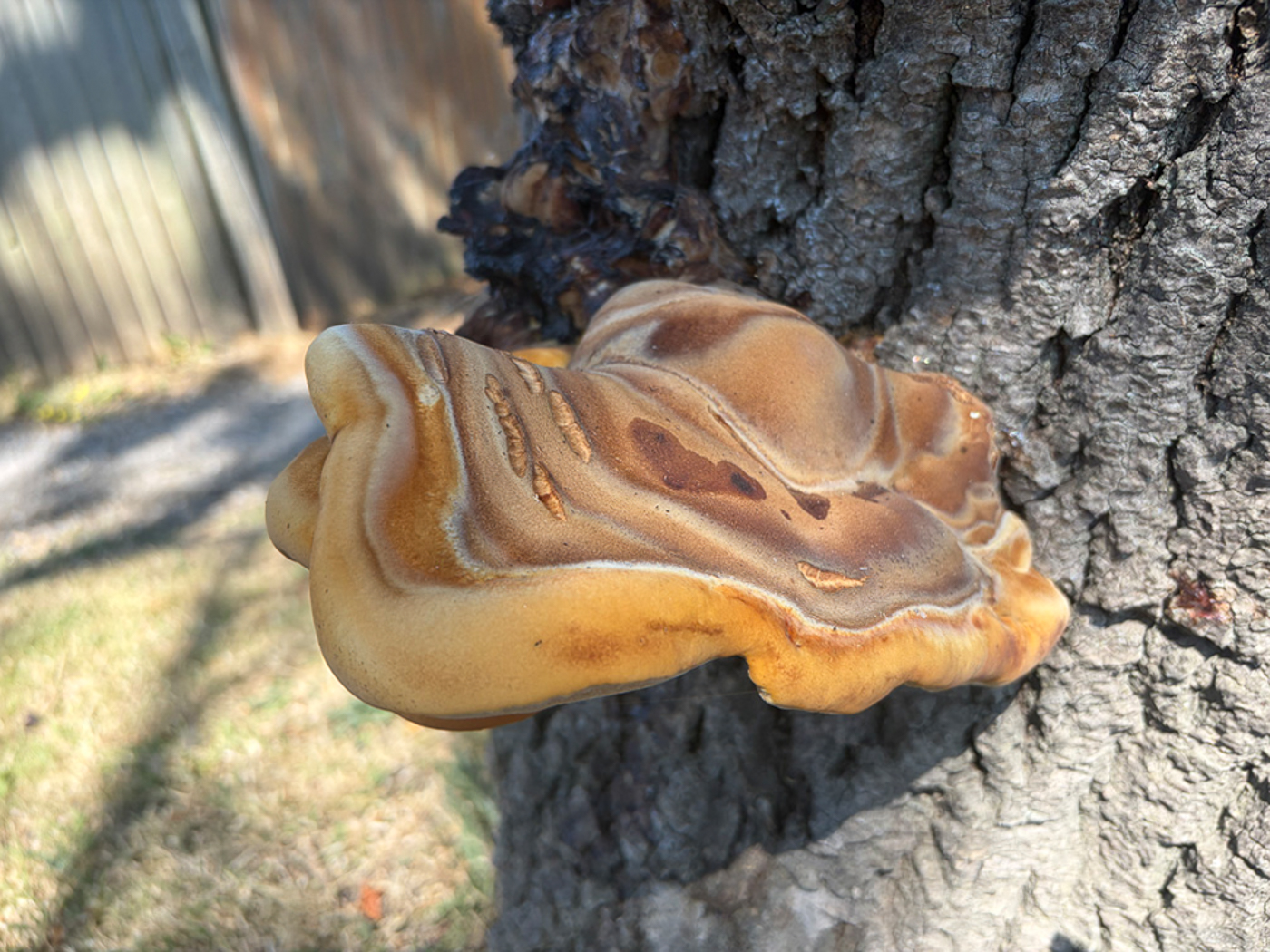
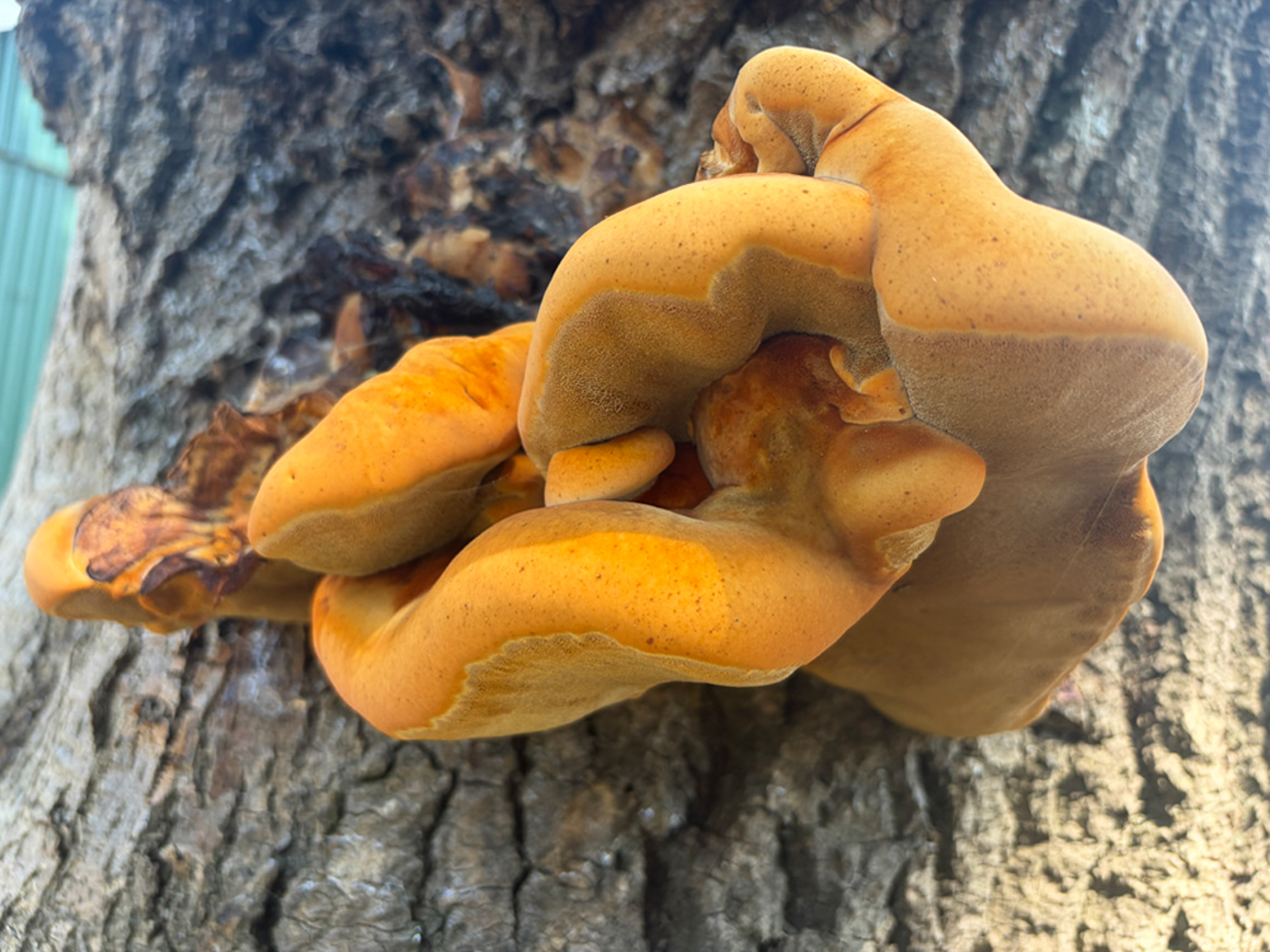
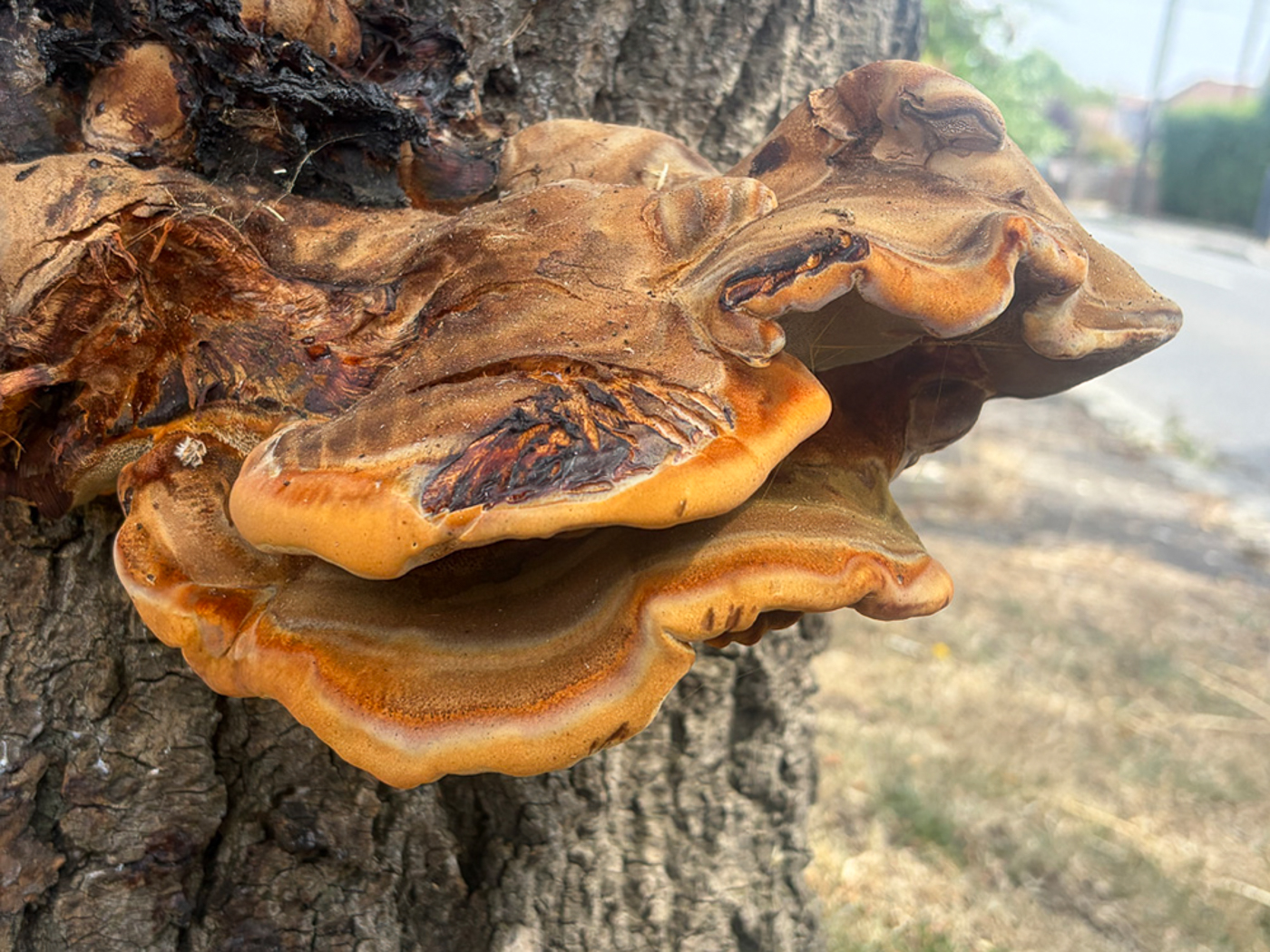
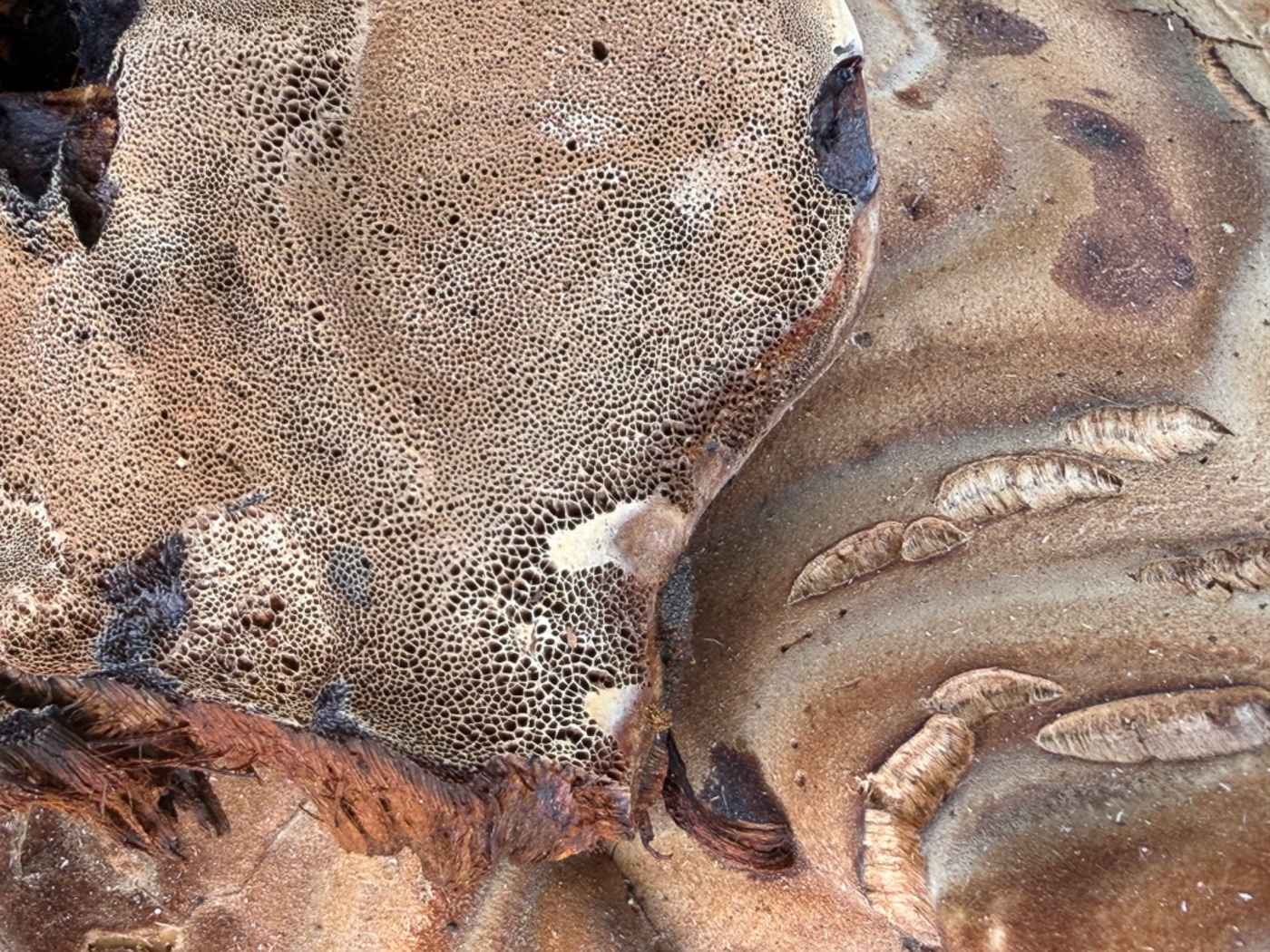
July 24th Inonotus hispidus (Shaggy Bracket) Here we have an interesting and useful range of views of this common bracket which often fruits on Ash, as here. Sarah Ebdon first noticed this orange furry lump (photo 1) almost a month earlier on a tree in Widmer End - where she'd first observed it fruiting two years ago almost to the day (see previous entry). She's been keeping an eye on its development since then, with photo 2 taken two weeks later, then photos 3 and 4 three weeks later, and finally photos 5 and 6 today. Photo 6 shows the underside on a piece she found broken off on the ground. One is often asked how long a fungus takes to develop to maturity - a difficult question to answer, but in this case Sarah has given us the evidence we need! (Postscript added 10 days later: Sarah's photos 7 and 8 show this same bracket distributing its bright yellow spores and liberally dusting the attached cobweb strands in the process!) Previous finds |
July 22nd 2026
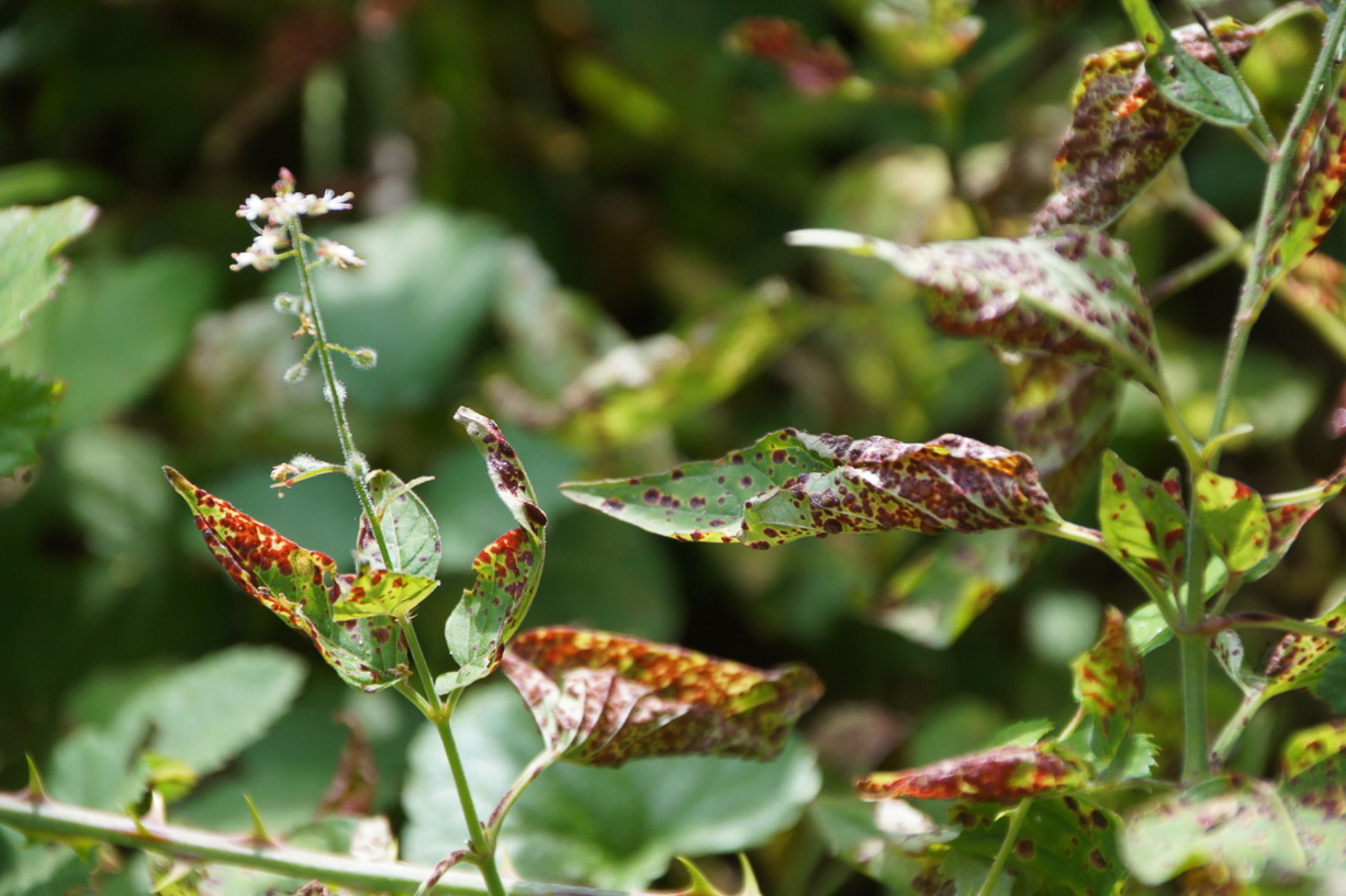
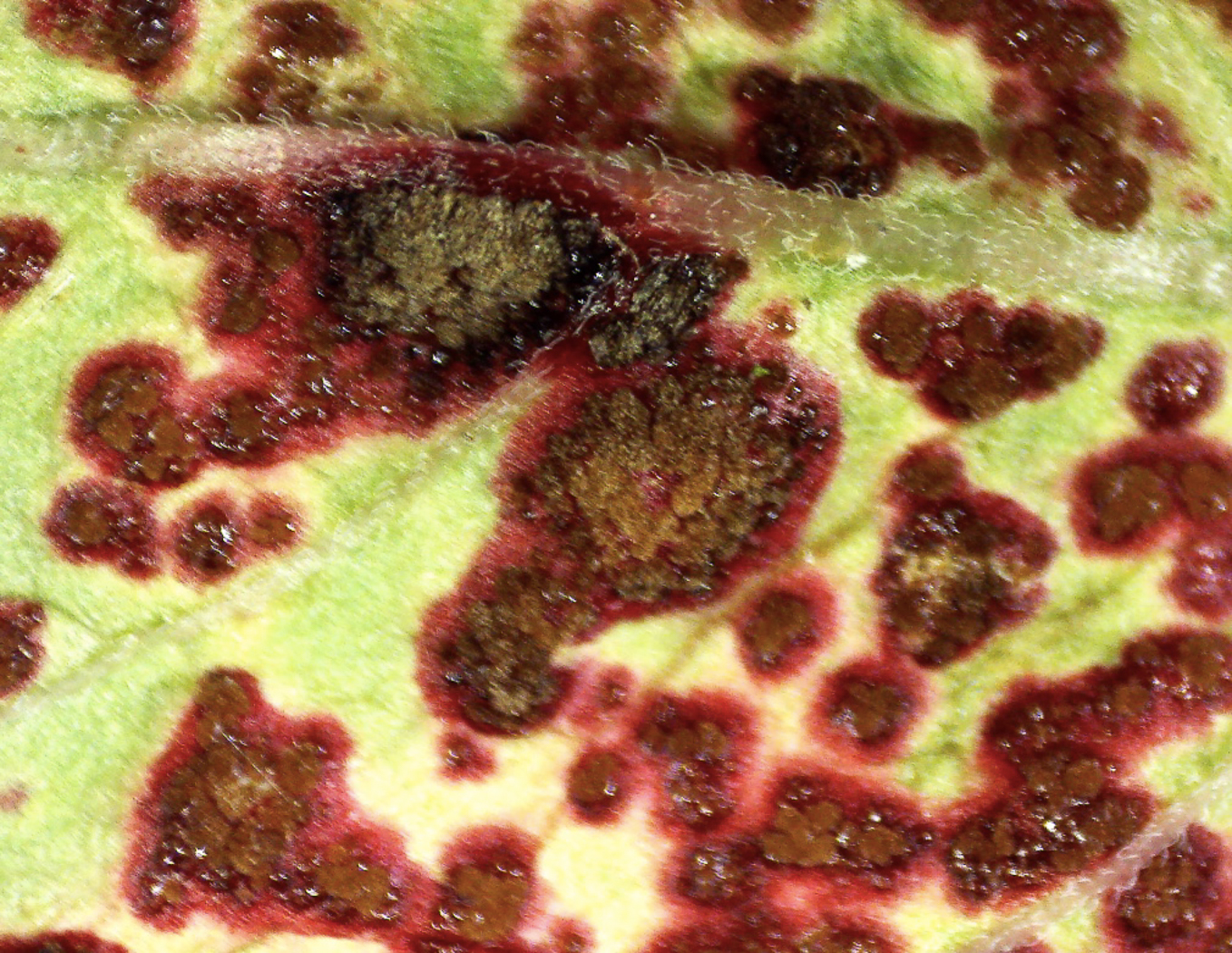 |
July 22nd Puccinia circaeae (Enchanters Nightshade Rust) Bob Simpson comments that he could hardly miss this conspicuous bright red-purple example of a rust smothering some Enchanters' Nightshade in Salden Wood. Our previous Finds photos show a much earlier stage of development (taken in June last year) so Bob's photos make a great comparison with the close-up shot showing the rusty brown spore mass in the centre of each blotch of the rust. Previous finds |
July 21st 2026
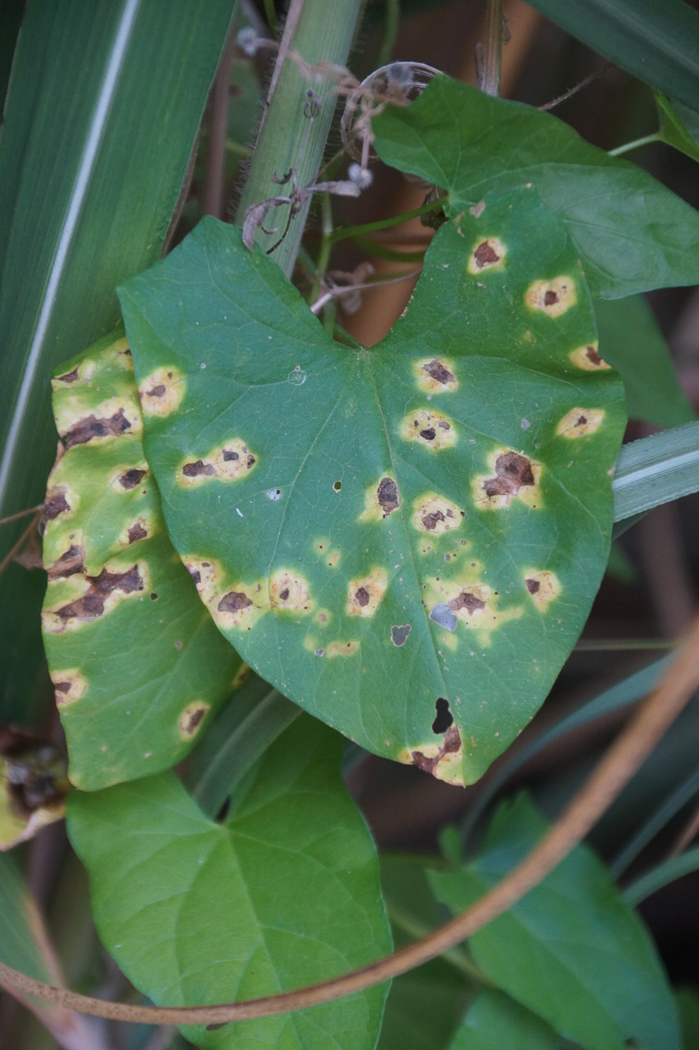
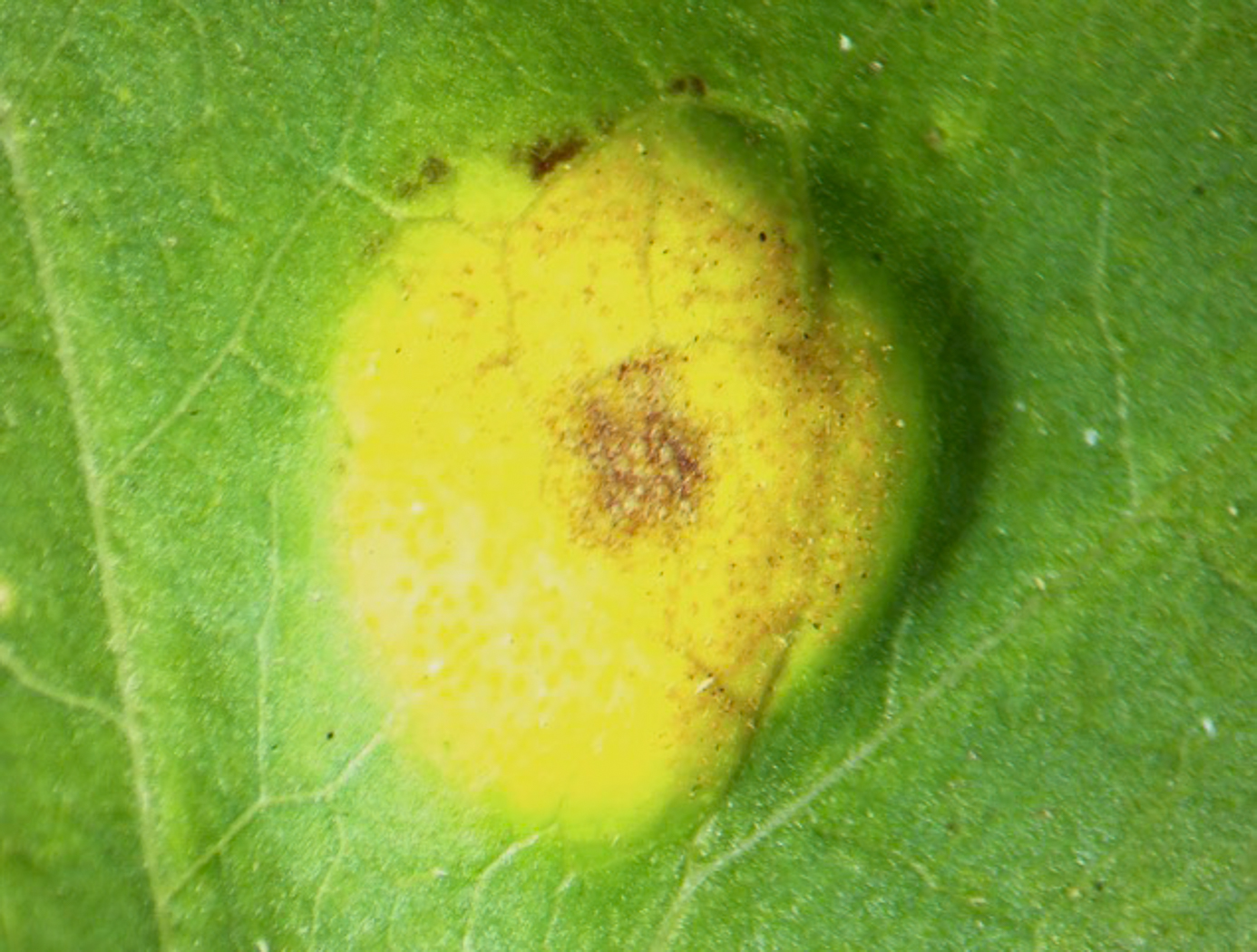
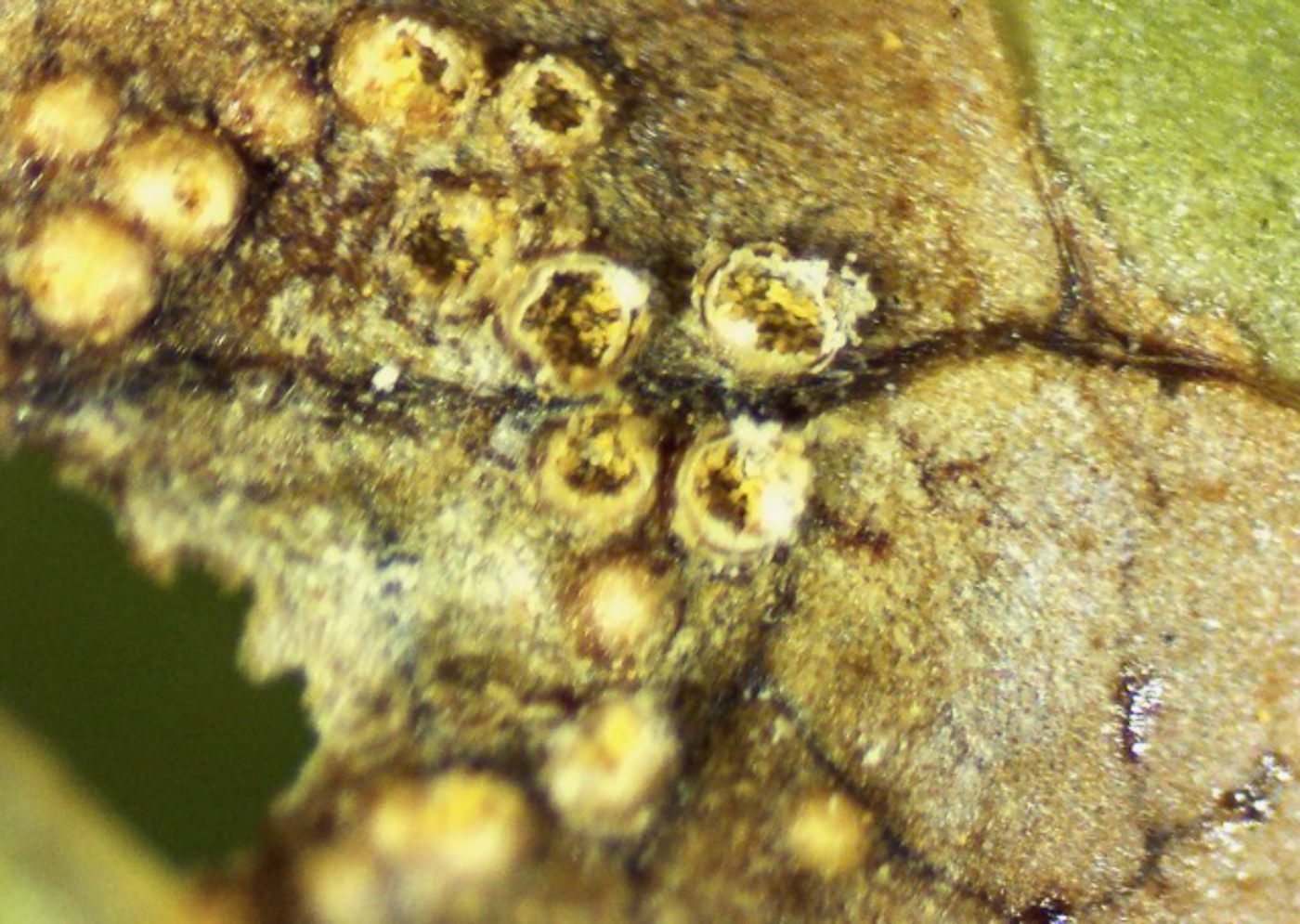 |
July 21st Puccinia convolvuli (a rust with no English name) Having just read about this much under-recorded species of rust in 'Field Mycology', Bob Simpson decided to take a look in his garden at Salden Wood which was full of the host plant (Hedge Bindweed). Bingo - though it was actually in his neighbour's garden that he first spotted it! There can be little doubt of its specific identity as the FM article states it is the only rust to occur on Calystegia (Bindweed) in the UK and neighbouring Europe including all stages of its life cycle with aecia, uredia and telia occurring on the underside of the leaves. Photo 2 shows a close-up of an early spot on the upper side, and photo 3 the spore-bearing part ion the underside. Bob's curiosity and initiative have resulted in yet another first for the county! Members' Finds New Species no. 1299 |
July 20th 2026
.jpg "Photo © Jackie Ewan") |
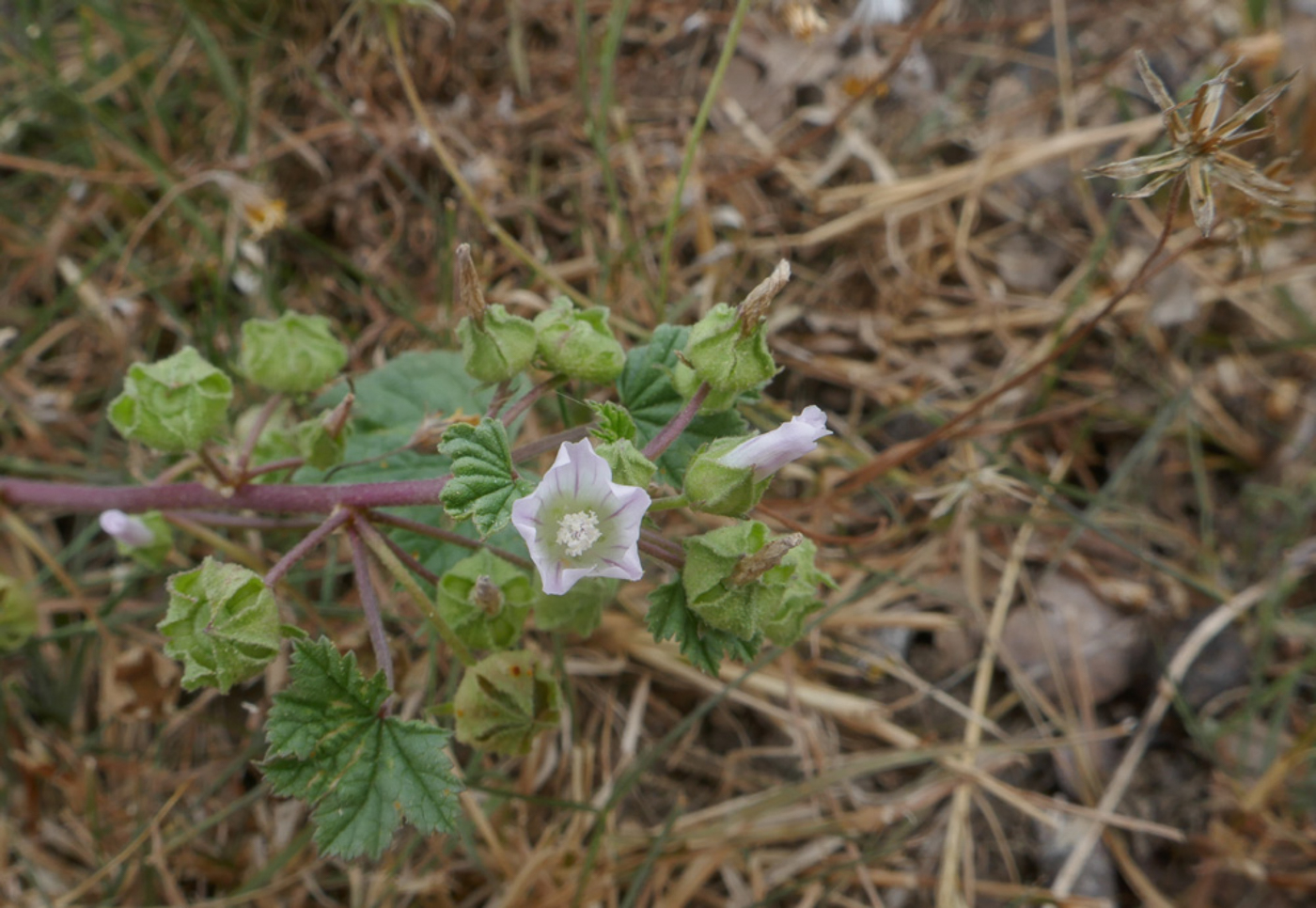
July 20th Puccinia malvacearum (Mallow Rust) At Stampwell Farm Jackie Ewan noticed the telltale rusty spots of this common species on Dwarf Mallow beside a farm track. The green box here indicates the rarity of local recorders who notice such species rather than anything else! This is only our second county record, the first being Sarah Ebdon's two summers ago. Previous finds |
July 14th 2026
 |
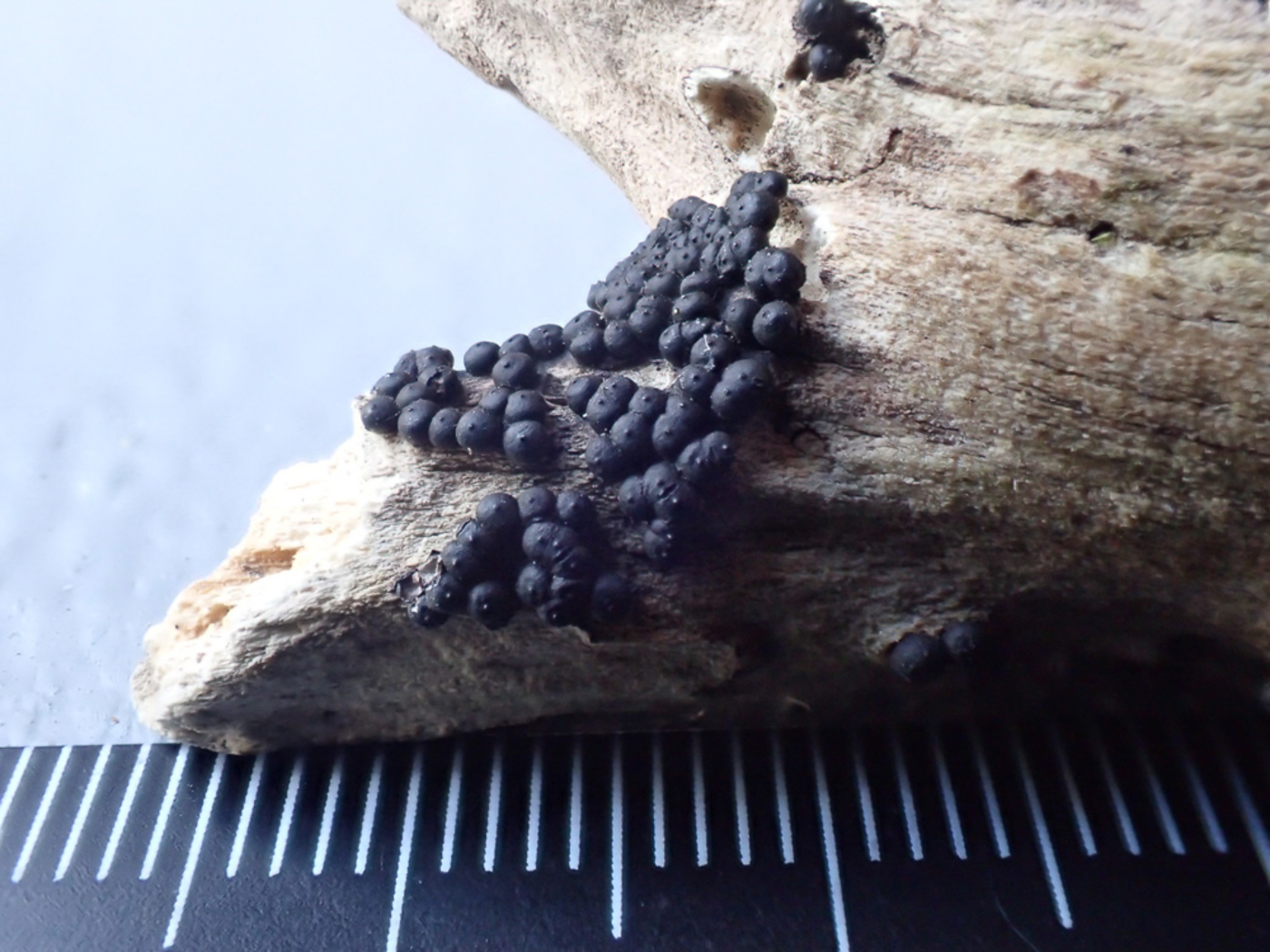
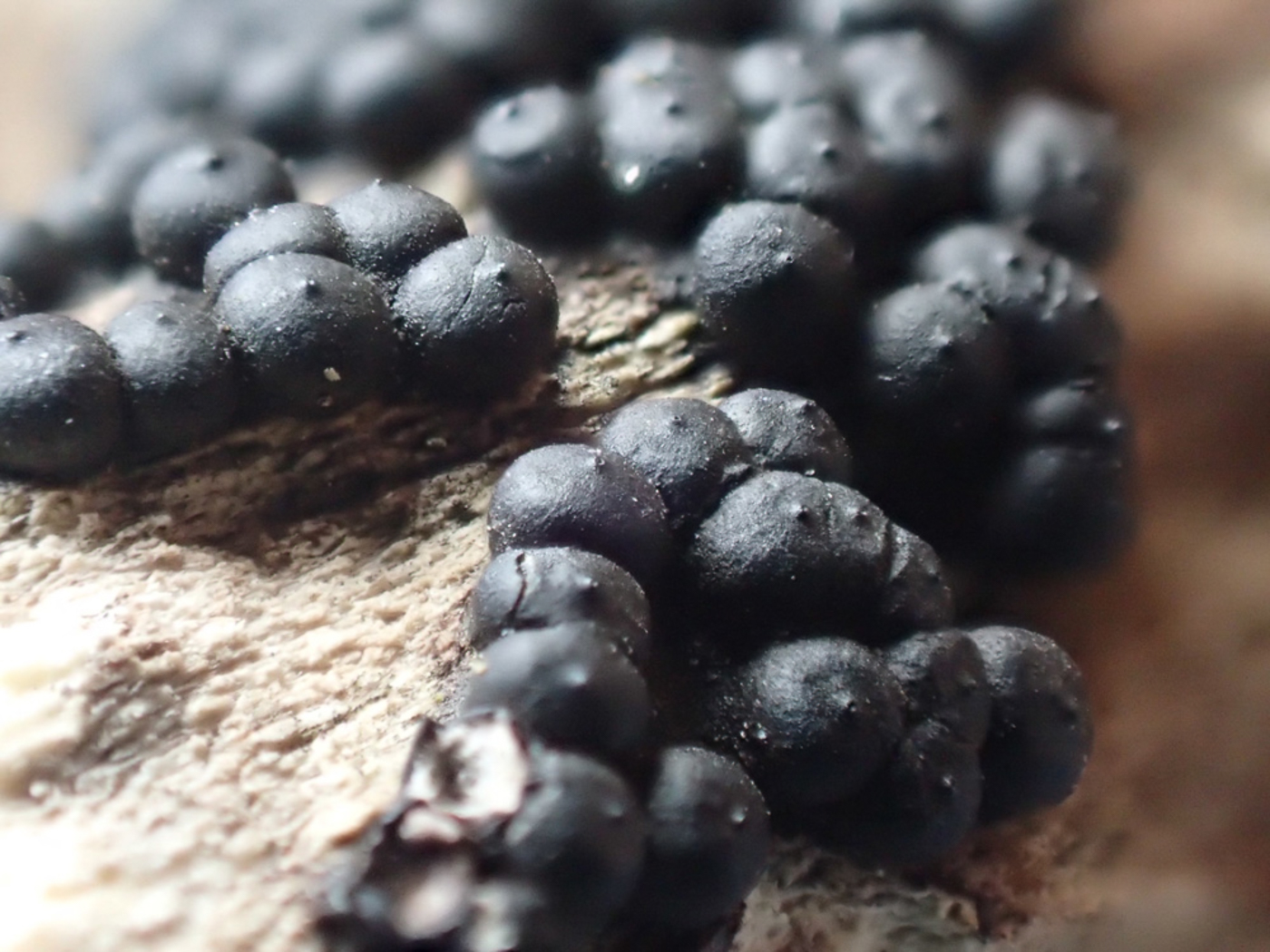
July 14th Rosellinia britannica (an unusual pyrenomycete asco with no English name) Whilst working with the Chiltern Society in Latimer churchyard David Corfield spotted these small crusty black blobs on some fallen dead wood and decided to see if either Penny or Sarah could name them. They looked fairly similar to other more familiar species belonging to genus Hypoxylon but he rightly suspected they might be different and more interesting, and in fact suggested the genus Rosellinia. Sarah investigated and found the typical spores of that genus, and the mammiform smooth fruit bodies with distinct nipple suggested maybe R. mammiformis but the spores were too big for that species. Checking elsewhere she found they were a perfect fit for R. britannica (for some named R. marcucciana) which appears to be a new county record. Luckily Latimer is just within VC24 though very near the Herts border. All credit to David for his persistent curiosity and to Sarah for her identification skills! Members' Finds New Species no. 1302 |
July 12th 2026
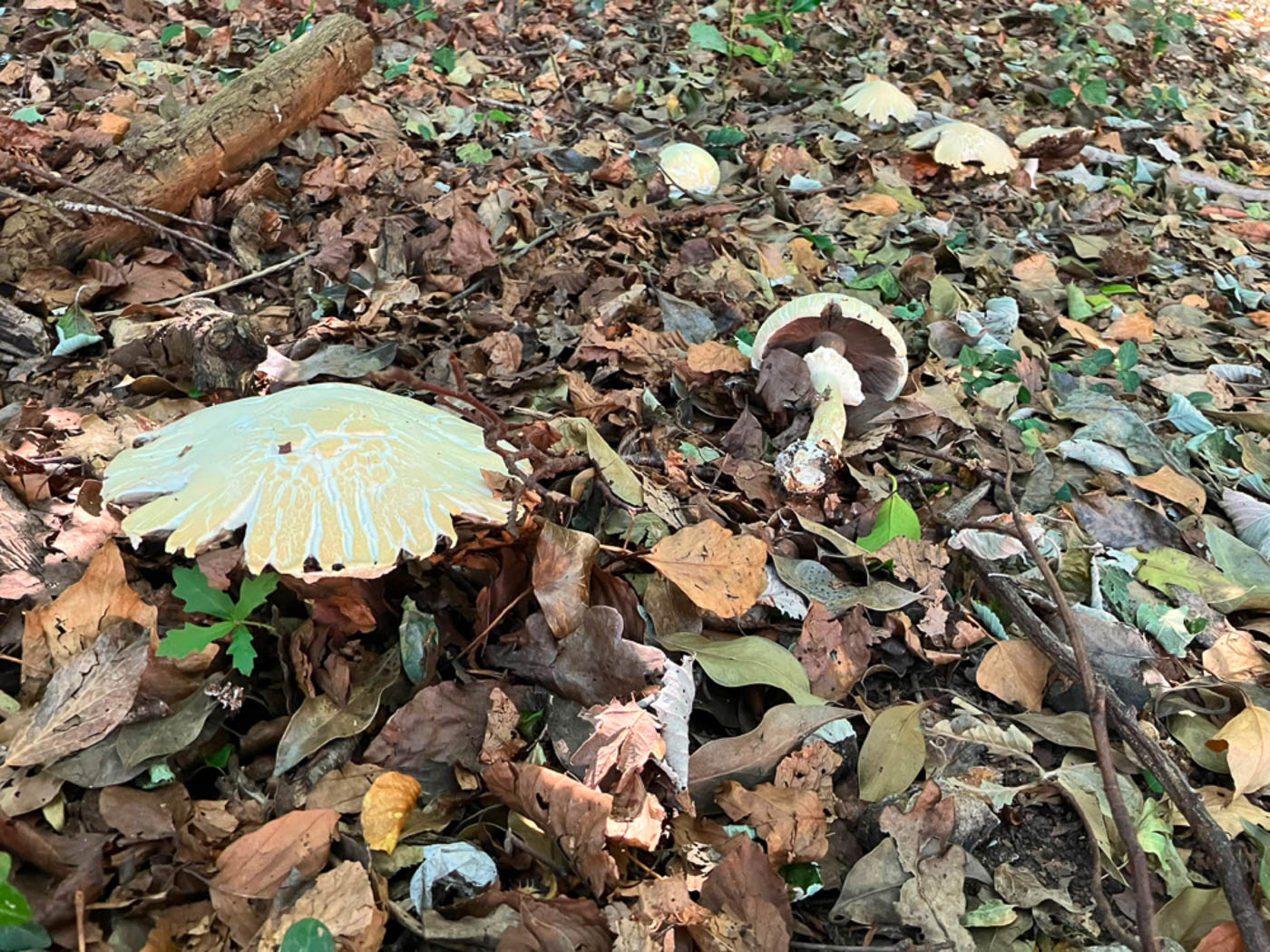 |
July 12th Agaricus sylvicola (Wood Mushroom) During the hottest and longest UK heatwave so far it's not surprising that things fungal have been in short supply recently. However, in Munces Wood nr Marlow Mark Harris noticed this pair braving the sweltering heat and sent his photo to Penny for confirmation of the species name. Not to be confused with the confusingly named A. sylvaticus (which has a brown scaly cap and stains red where damaged, hence the name Blushing Wood Mushroom) this is a large white common woodland species which stains yellow then brownish where damaged and has a sweet aniseed smell, also the gills soon take on a greyish tint rather than the usual pink of the genus. The larger specimen has survived remarkably well considering the tough conditions which obviously account for the splitting at the cap edges as it dries out. Previous finds |
July 3rd 2026
.jpg "Photo © Sarah Ebdon")
 |
July 3rd Cerioporus squamosus (Dryad's Saddle) On a fallen Ash branch near Prestwood Sarah Ebdon noticed this attractive young bracket and sent her photos to Penny suggesting it was Polyporus tuberaster. However, Penny is of the opinion that it is most likely to be the considerably larger though at this stage of development very similar Polypore (now moved to a different genus though surprisingly its smaller relative is so far retained in Polyporus!). To Penny the substantially thick stem seen here together with the Ash host both point to this species rather than P. tuberaster which is less common on Ash though both species share the widely spaced pores running down the stem together with a scaly yellow-brown cap. Previous finds |
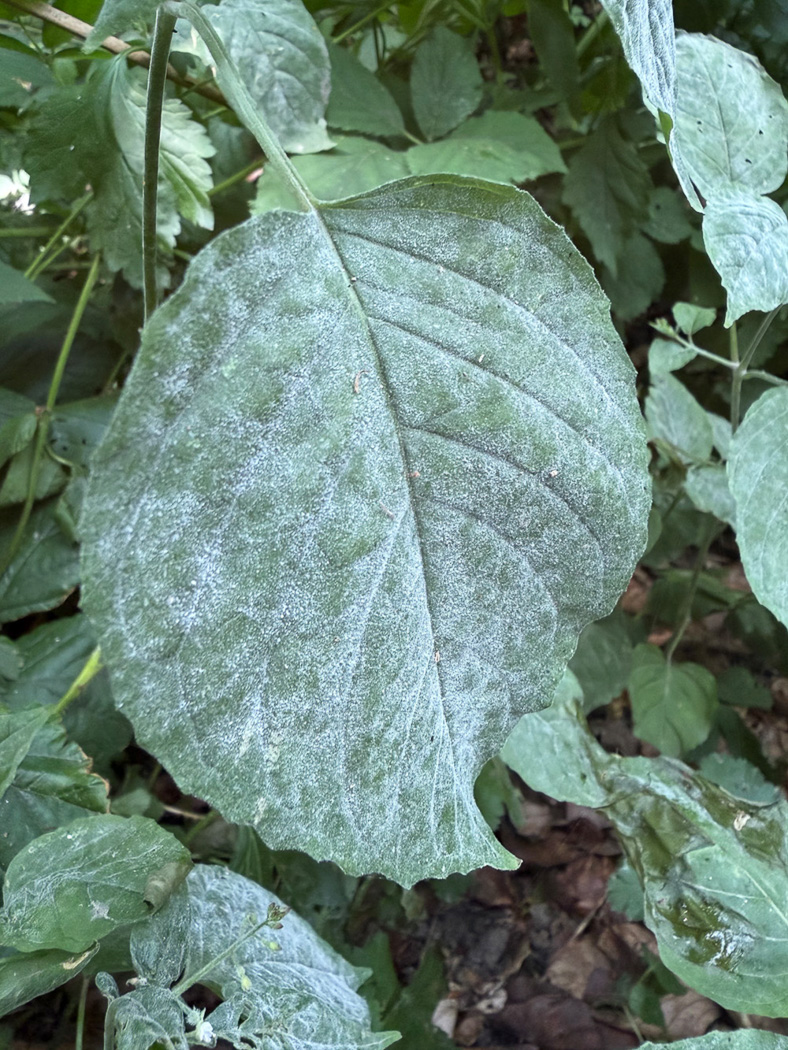 |
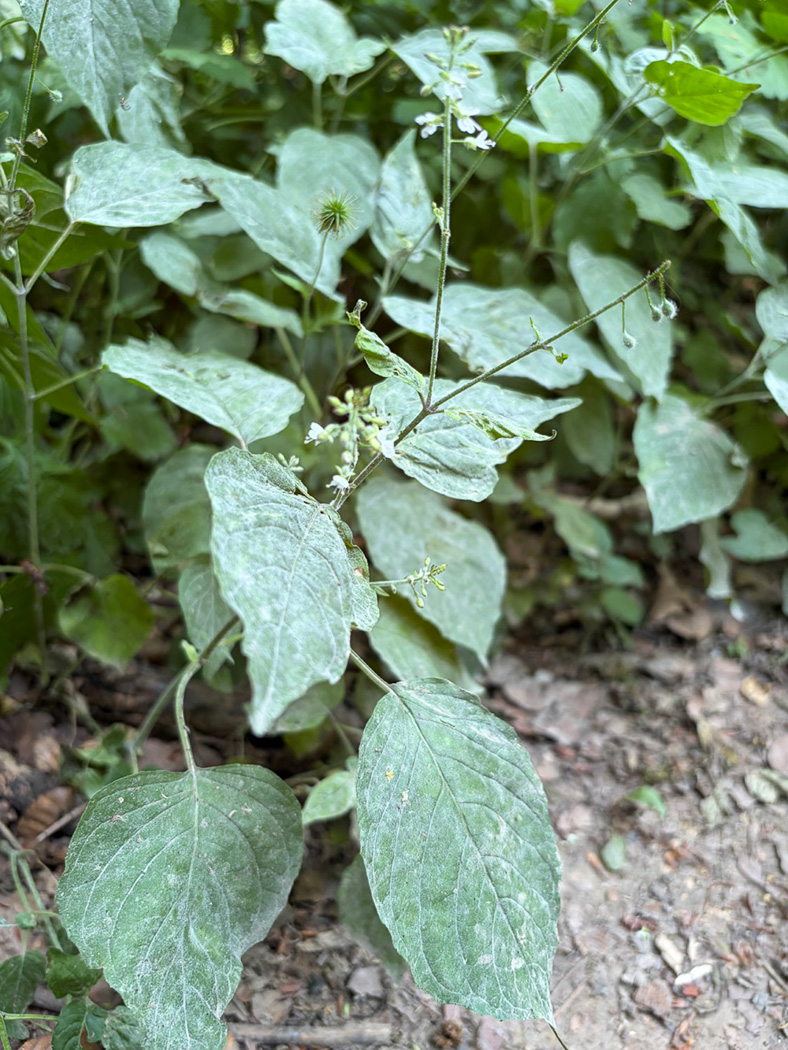
July 3rd Erysiphe circaeae (a Mildew with no English name) In a woodland path edge near Prestwood Sarah Ebdon spotted this common Powdery Mildew affecting Enchanter's Nightshade. Mildews are obligate parasites, ie dependant on their host plant though not seriously damaging. This species occurs wordwide wherever Nightshades are found, and happens to be only our third county record though as is often the case this is not indicative of its rarity! Members' Finds New Species no. 1298 |
 |
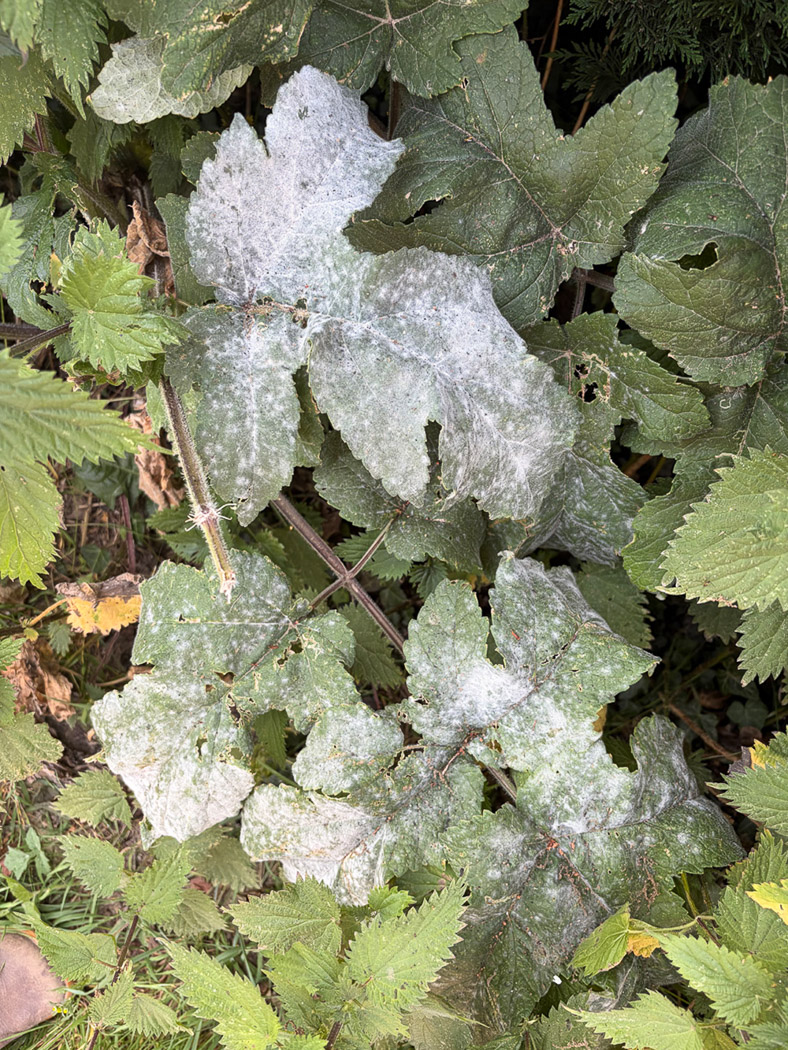
July 3rd Erysiphe heraclei (Umbellifer Mildew) At the edge of a footpath in Prestwood Sarah Ebdon caught her eye in this Powdery Mildew affecting Hogweed, yet another very common but under-recorded species which occurs worldwide on several different umbellifers. Previous finds |
July 1st 2026
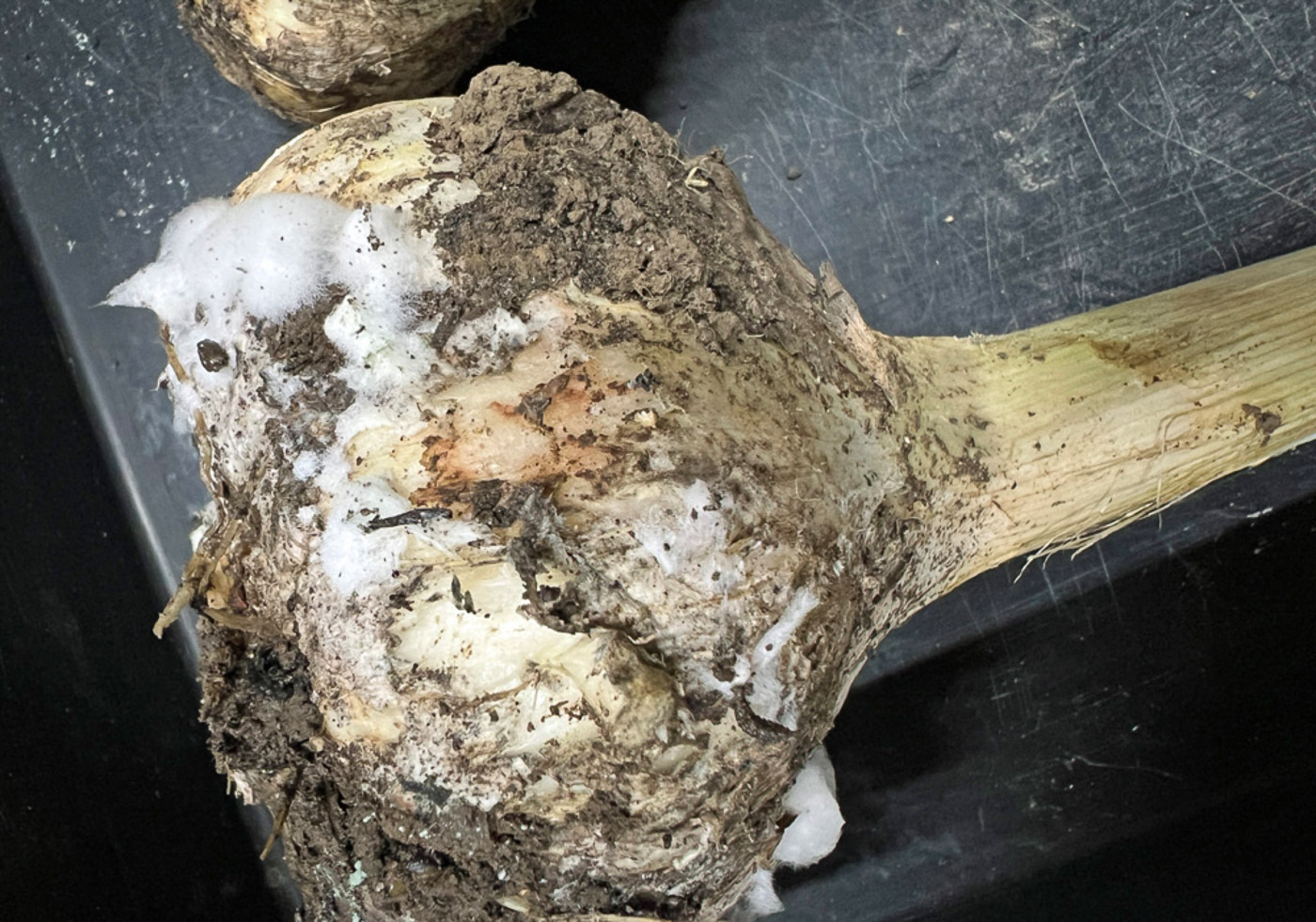 |
July 1st Stromatinia cepivora (White Onion Rot) When digging up his onions in his allotment in Naphill, Neil Fletcher noticed that a few were affected by a white plant pathogen which he tied down to this species online. It is clearly very common but vastly under-recorded with only three FRDBI records and is a first for the county! Members' Finds New Species no. 1297 |
June 21st 2026
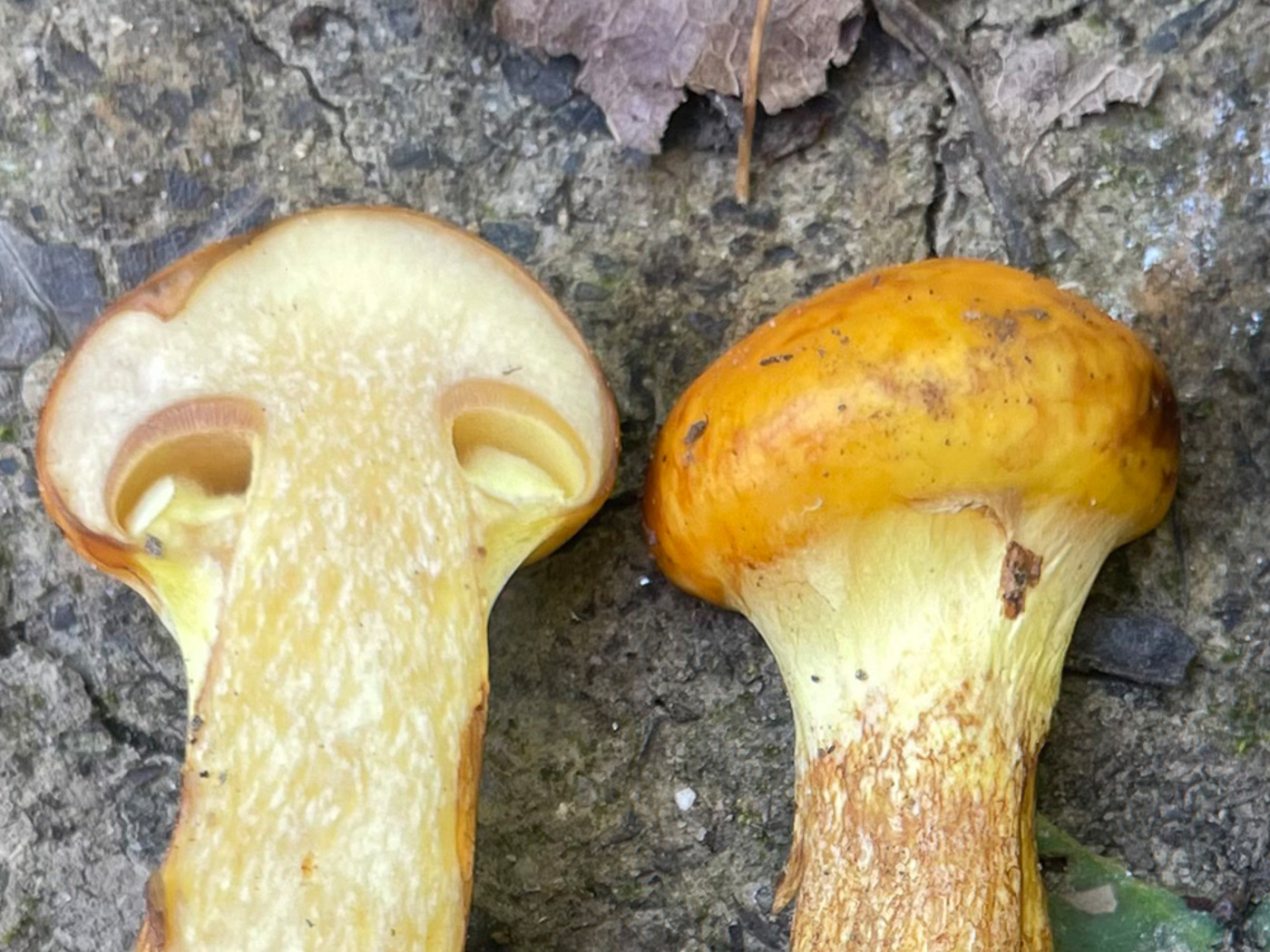 |
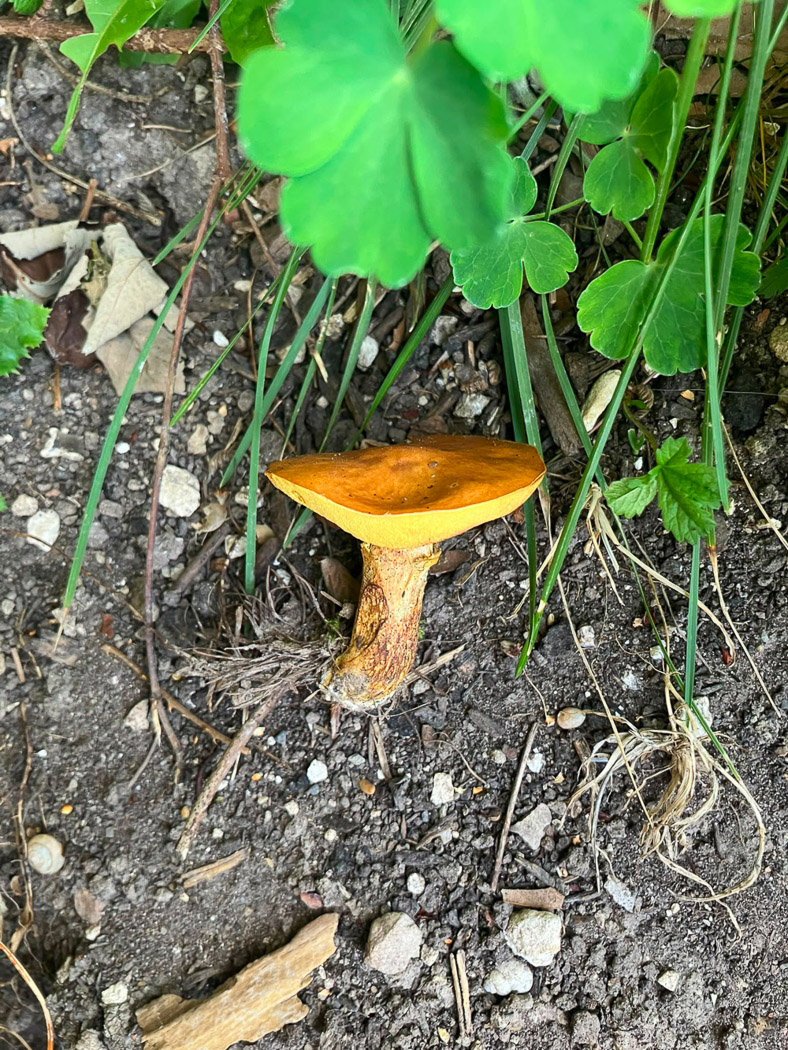
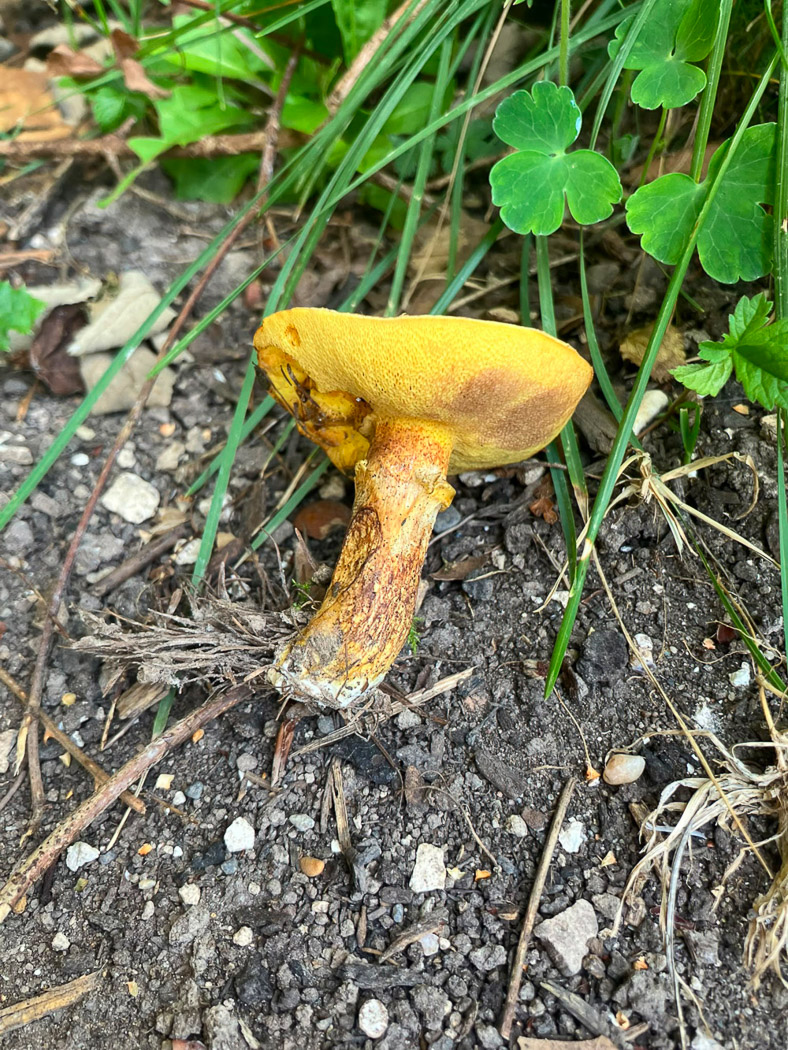
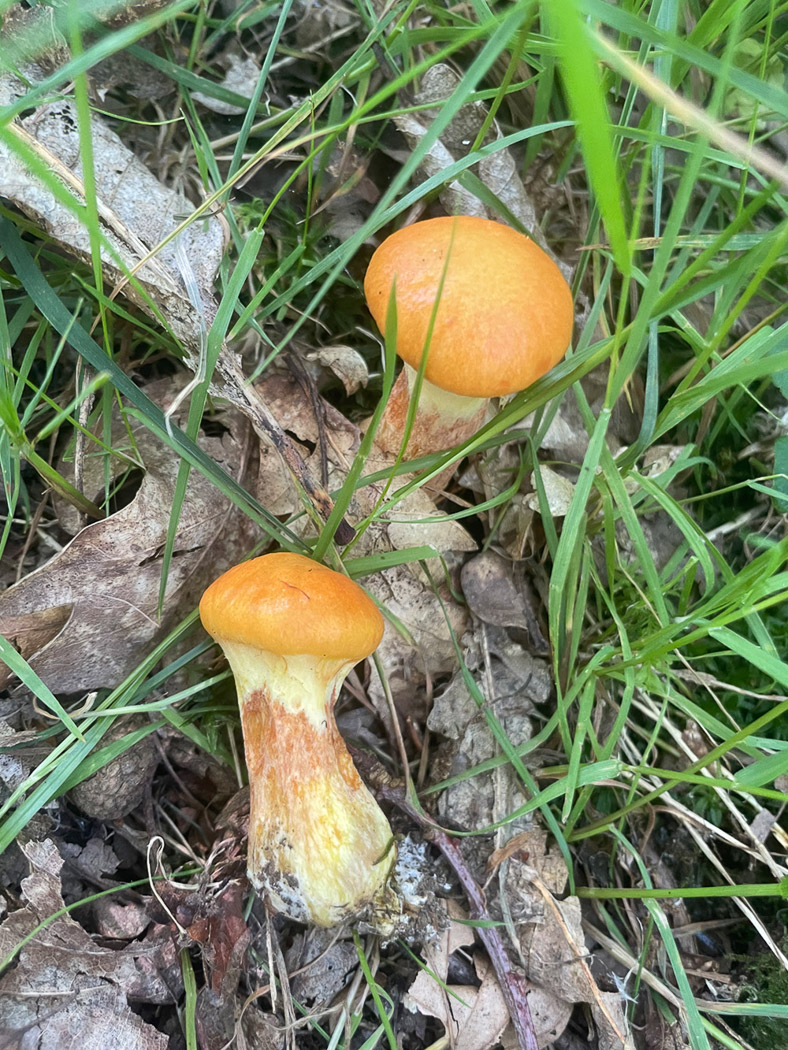
June 21st Suillus grevillei (Larch Bolete) In Munces Wood near Marlow Mark Harris came across this brightly coloured bolete under some conifers, thought it was probably this species and sent his photos to Penny for confirmation. Her first question: was he under Larch, to which he replied with doubt but suspected so. There can be little doubt from his photos that he has the ID correct -0 it is host specific to Larch but surely this is the only Suillus species with a ring and having this combination of bright yellow and tan colouring. Furthermore, as often happens, Sarah Ebdon sent in photos 3 and 4 of immature material found at Amersham Field Centre under Larch just two days earlier - evidence of the woodwide web working again! Previous finds |
June 20th 2026
.jpg "Photo © Jesper Launder") |
June 20th Hortiboletus bubalinus (Ascot Hat) In Denham Village under Oak Jesper Launder found this nice collection of one of our less common Boletes. Though similar to two other species now moved to this genus, all of which are smallish compared to the Xerocomus / -ellus species, slicing one in half is the key to recognising the species which when exposed to the air has pinkish flesh immediately under the cap cuticle but just below this the flesh is clearly blue. Previous finds |
.jpg "Photo © Jesper Launder") |
June 20th Boletus reticulatus (Summer Bolete) In Denham Village under Beech Jesper Launder found this pair of fresh young specimens showing their distinctive mesh network on the stem which helps to separate the species from the otherwise very similar and much more commonly recorded B. edulis. This is a typical early season fruiter though Jesper has found an amazing range of different Boletes in the last few days. Previous finds |
.jpg "Photo © Jesper Launder")
 |
June 20th Neoboletus cf. xanthopus (a Bolete with no English name) In Denham Village under the same Oak as his Hemileccinum impolitum, Jesper Launder found this Neoboletus species pushing up through the soil. His words: 'With marked golden tones to the cap, oak habitat, and very dark staining response, I'm leaning towards N. xanthopus'. This infrequently recorded species is extremely similar to the commonly recorded N. luridiformis (Scarletina Bolete and now renamed N. praestigiator - what a mouthful!), thus the cf. in the name here, and this collection will be sequenced. Previous finds |
.jpg "Photo © Jesper Launder") |
June 20th Hemileccinum impolitum (Iodine Bolete) In Denham Village Jesper Launder found this striking Bolete under Oak, and noting its solid cap and stem, the bright yellow firm pores with no sign of blueing when pressed, he knew to put this specimen to his nose to check for the iodine smell at the stem base which confirmed his ID. This is a chunky beast with a preference for Oak in sandy soil, so conditions were spot on for it here. Previous finds |
June 19th 2026
.jpg "Photo © Jesper Launder") |
June 19th Suillellus queletii (Deceiving Bolete) In Jordans Village Jesper Launder reports having seen several collections of this species recently (and of the similar S. luridus) though today's find was the only reasonably photogenic collection - specimens tend to break up or become deformed when pushing through hard dry soil. The cap colour, strong blueing flesh together with the sharply tapering stem base which has beetroot tendencies are all good pointers to the species which seems to be becoming surprisingly common in our area in recent years. Previous finds |
.jpg "Photo © Jesper Launder")
 |
June 19th Xerocomellus chrysenteron (Red Cracking Bolete) In Jordans Village Jesper Launder found this Bolete under Cedar, and knew straight off that it would be one of the Xerocomellus lookalikes so cut it in half to watch for the speed of any blue staining which with a few other characters would help him decide on the species. The conifer association was already a strong pointer towards X. chrysenteron and this was affirmed by the slow signs of bluing (though this can be a variable character depending on the freshness and maturity of the specimen together with weather conditions - there are always exceptions to the rules!). Nevertheless Jesper knows his Boletes well and was confident of his ID here. Previous finds |
.jpg "Photo © Jesper Launder") |
June 19th Inocybe cf. mixtilis (Yellowish Fibrecap) Under Oak in Jordans Village Jesper Launder found this singleton, recognised the genus and took it home to examine carefully - always necessary with Fibrecaps. The strongly nodulose spores and metuloid cystidia (with thick walls and topped with crystals) together with the yellow brown cap and bulbous stem base led him straight to this species which five years ago he'd have had no qualms about naming. Not so now we know this is a species complex with several extremely similar species involved, with sequencing the only way to be confident about a species name. Watch this space! Previous finds |
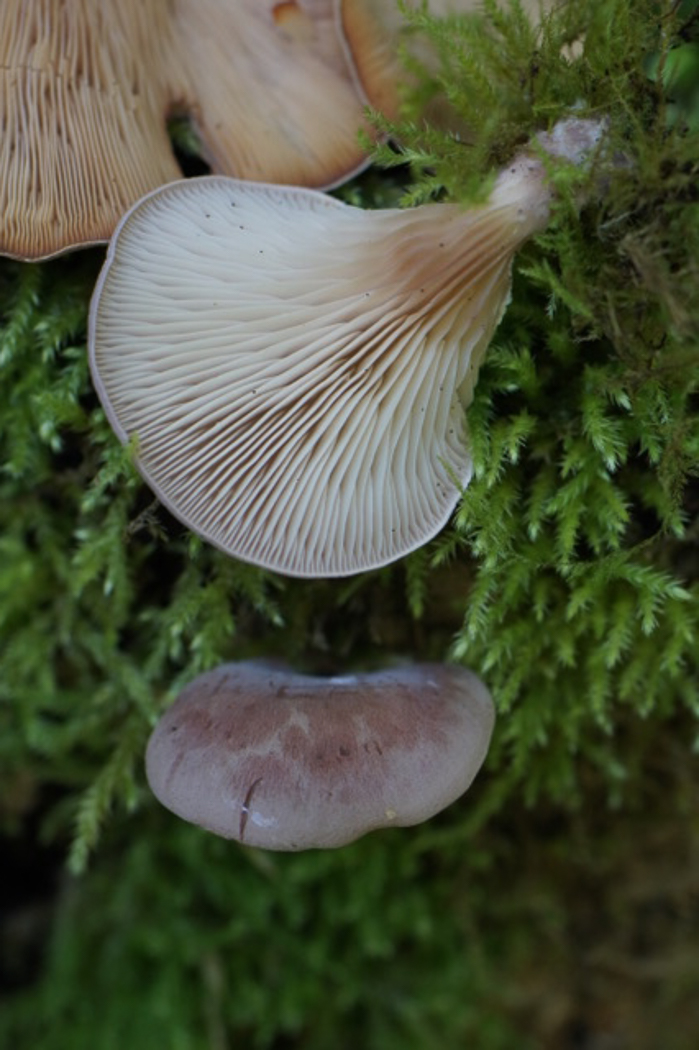 |
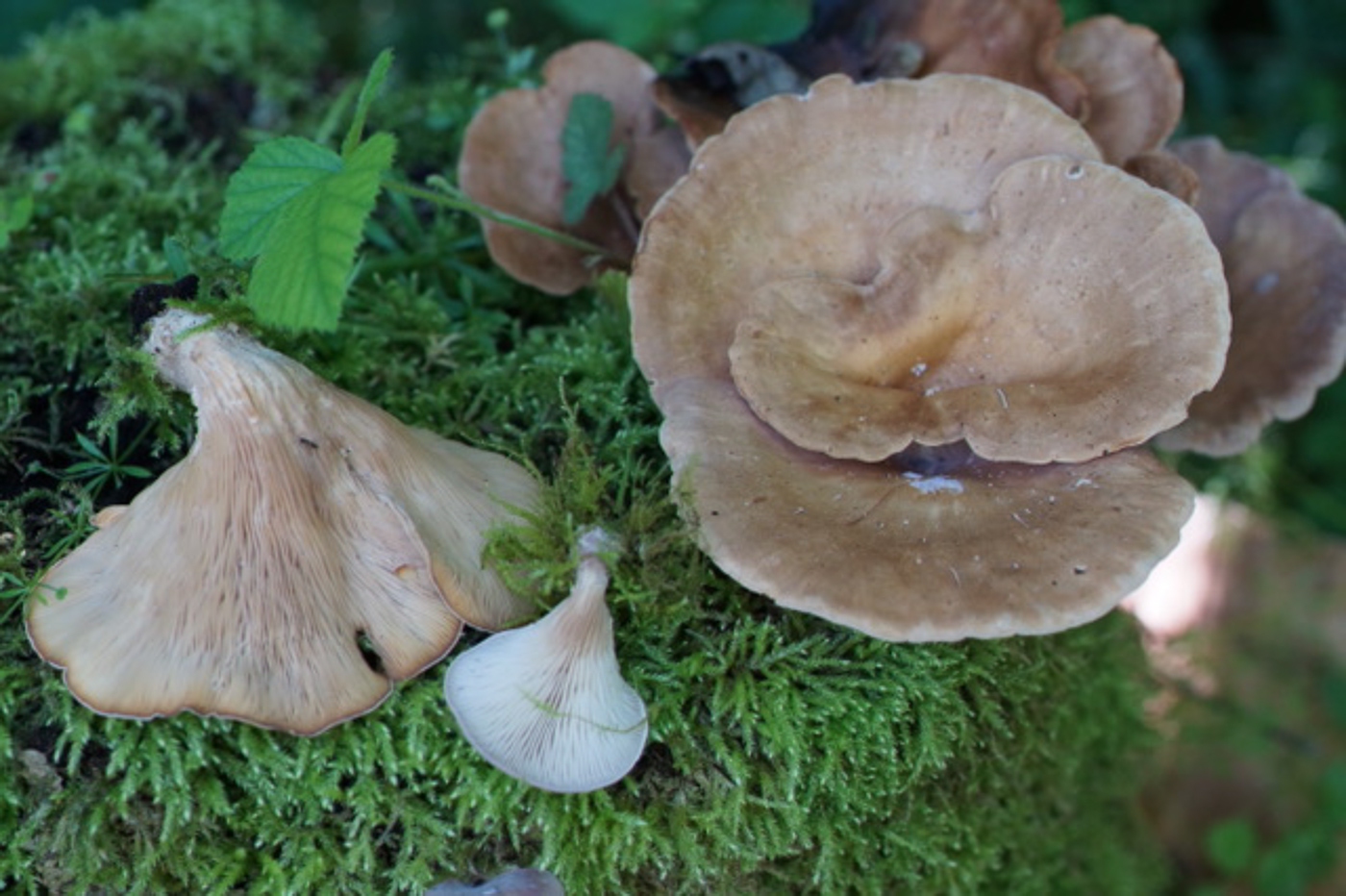
June 19th Panus conchatus (Lilac Oysterling) In Salden Wood Bob Simpson found this fungus fruiting on the same mossy Ash stump where he'd discovered it last year (in May - see his previous entry). The similarity with the genus Pleurotus (Oyster) is clearly apparent but closer inspection reveals its subtle lilac tint (less apparent in older material as here) and it does have a different 'jizz', also a scope reveals much smaller spores than in that genus. Previous finds |
June 18th 2026
.jpg "Photo © Jesper Launder")
.jpg "Photo © Jesper Launder")
 |
June 18th Russula cf. lilacea (a Brittlegill with no English name) In Stoke Wood, Stoke Poges, Jesper Launder found this small pretty Brittlegill under Beech and from its cap colour he suspected it might be the common R. vesca (The Flirt). However, a drop of Guaiac on the stem had a slow reaction (ie not quickly bright blue), also an FE crystal on the stem was not strikingly strong pink - both reactions eliminating that species (see photo 3). At home the almost white spore print together with spore ornamentation and other pointers led him to a possible choice of three species, one of these being quickly eliminated by its cap structure (often crucial in this tricky genus), leaving him with R. emeticicolor or R. lilacea - both considered rare in the UK. On balance he considers R. lilacea the most likely but it is reportedly normally found under Hornbeam, much less often under Beech. This is definitely one for sequencing! Members' Finds New Species no. 1296 |
.jpg "Photo © Jesper Launder") |
June 18th Xerocomellus cisalpinus (Bluefoot Bolete) In Stoke Wood, Stoke Poges, Jesper Launder found this trio of Boletes under Beech, and on slicing one in half noted the quick signs of blueing which is a sure indication of this very common species rather than one of several lookalikes. Kibby vol.1 comments on deep purplish stains in the lower stem also clearly apparent here, though some collections of this genus are not at all easy to name to species with any certainty. Previous finds |
.jpg "Photo © Jesper Launder") |
June 18th Russula insignis (a Brittlegill with no English name) In a roadside verge adjacent to Stoke Common Jesper Launder noted this species which he recalls finding in this same spot last August. See the descriptive notes given with that find for more on this unusual species which is one of a group of dull insignificantly coloured Brittlegills we affectionately call 'the smellies'. Previous finds |
.jpg "Photo © Jesper Launder")
 |
June 18th Melanogaster broomeianus (Fruity False Truffle) At Stoke Poges Memorial Gardens Jesper Launder went searching for dig holes under the sole Holm Oak where he recalled finding truffles previously. (He's discovered from experience that this often pays off, sometimes finding a range of different species under one tree.) Success! This time an unusual species which is new to the site. The English name including the word 'False' indicates this is a basidio truffle as opposed to 'true' truffles which are ascos. It develops a sweet pearlike smell and can get to 4 or 5 cm across and though described as favouring Beech woodland, Jesper's previous finds in the county have been under Lime and Hornbeam, today's find adding a further tree host! Previous finds |
.jpg "Photo © Jesper Launder") |
June 18th Agaricus augustus (The Prince) At Stoke Poges Memorial Gardens Jesper Launder was informed of a 'huge mushroom' growing in some woodchip which had been spotted by the manager. Sure enough following this up he found this beauty, recognising the species from its size, distinctive cap markings and general 'jizz'. Not a common Mushroom (though possibly misidentified and over-recorded?), from our recent records it appears to favour hot spells in early summer which fits pretty well perfectly with today's find where it is a new record for the site. Previous finds |
June 17th 2026
.jpg "Photo © Jesper Launder") |
June 17th Crepidotus autochthonus (Grounded Oysterling) In Gerrards Cross Jesper Launder spotted this unusual species growing apparently on soil on a bank. This particular Oysterling is more often than not reported from soil (though there may well be well rotted woody remains involved), this being an unusual trait and therefore a helpful one when working on identification of a genus where microscopic examination is pretty well always needed. This is just our third county record, the previous find also Jesper's last year from Dancersend. Previous finds |
.jpg "Photo © Jesper Launder") |
June 17th Agaricus bernardii (Salty Mushroom) At the roadside in Little Chalfont Jesper Launder found this little group of quite squat mushrooms with cracked scaly caps. He noted the tightly inrolled caps before expansion which tend to leave ragged remains on the margin - a feature pointed to this particular species, but the clincher was its unpleasant smell with fishy component - not common in this genus. Other pointers: the tapering stem base and flimsy stem ring along with its preference for salty conditions (therefore either coastal or at roadsides where salt has strayed off roads in winter). Of our handful of county records this is the earliest. Previous finds |
.jpg "Photo © Jesper Launder") |
June 17th Agaricus arvensis (Horse Mushroom) On a roadside verge in Little Chalfont Jesper Launder noticed these buttons having pushed up through the recently softened soil. Having seen this mushroom at this spot previously (when mature), even at this stage of development he was able to note their substantial size, the cogwheel sheath margin, smooth stem and brownish staining where damaged, all of which were enough to confirm his ID. Penny had only been thinking that the time was ripe for Agaricus to show up after our hot dry early summer period followed by significant rains, though had failed to turn any up herself. Jesper, however, found three different mushroom species over the space of two days! Previous finds |
June 16th 2026
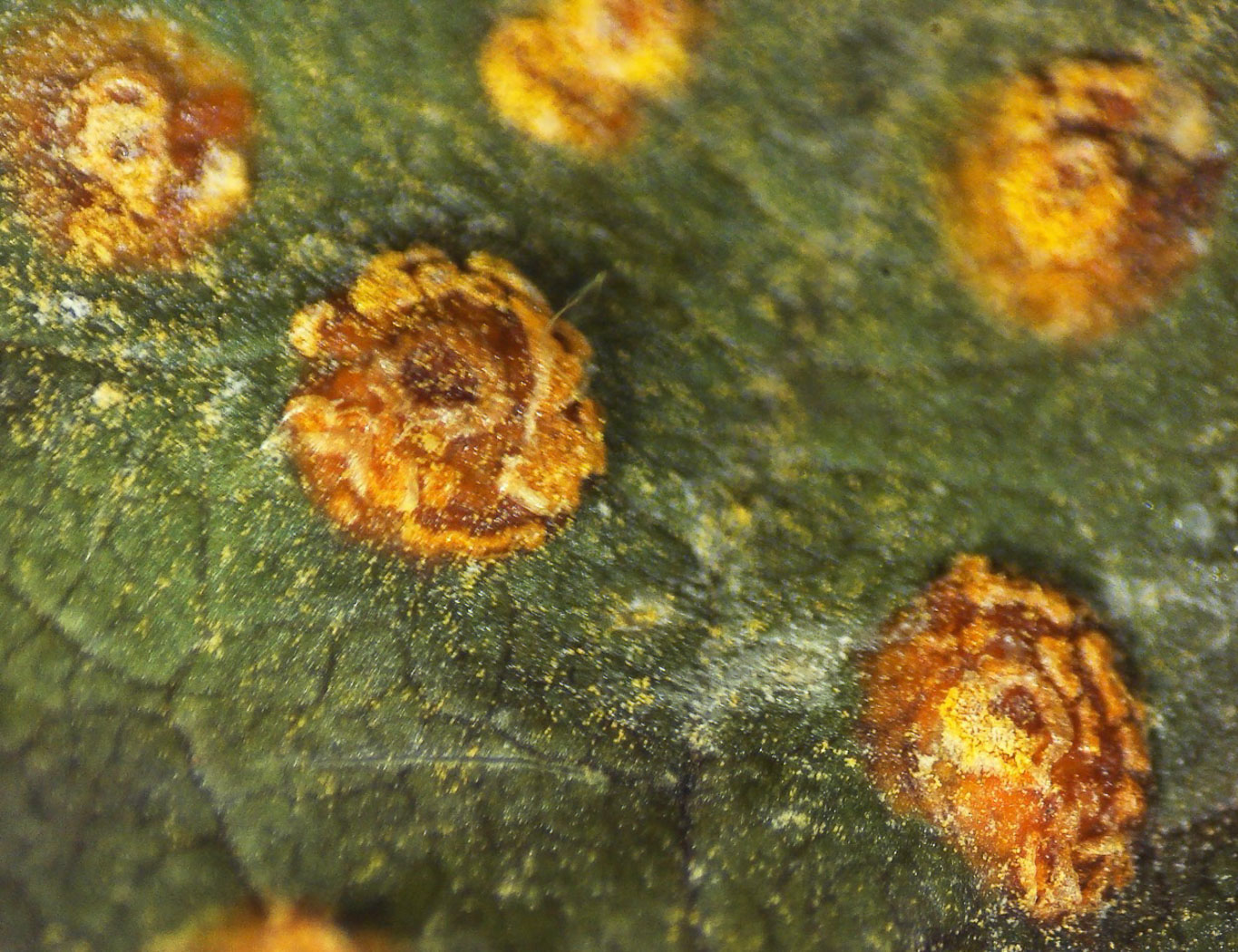 |
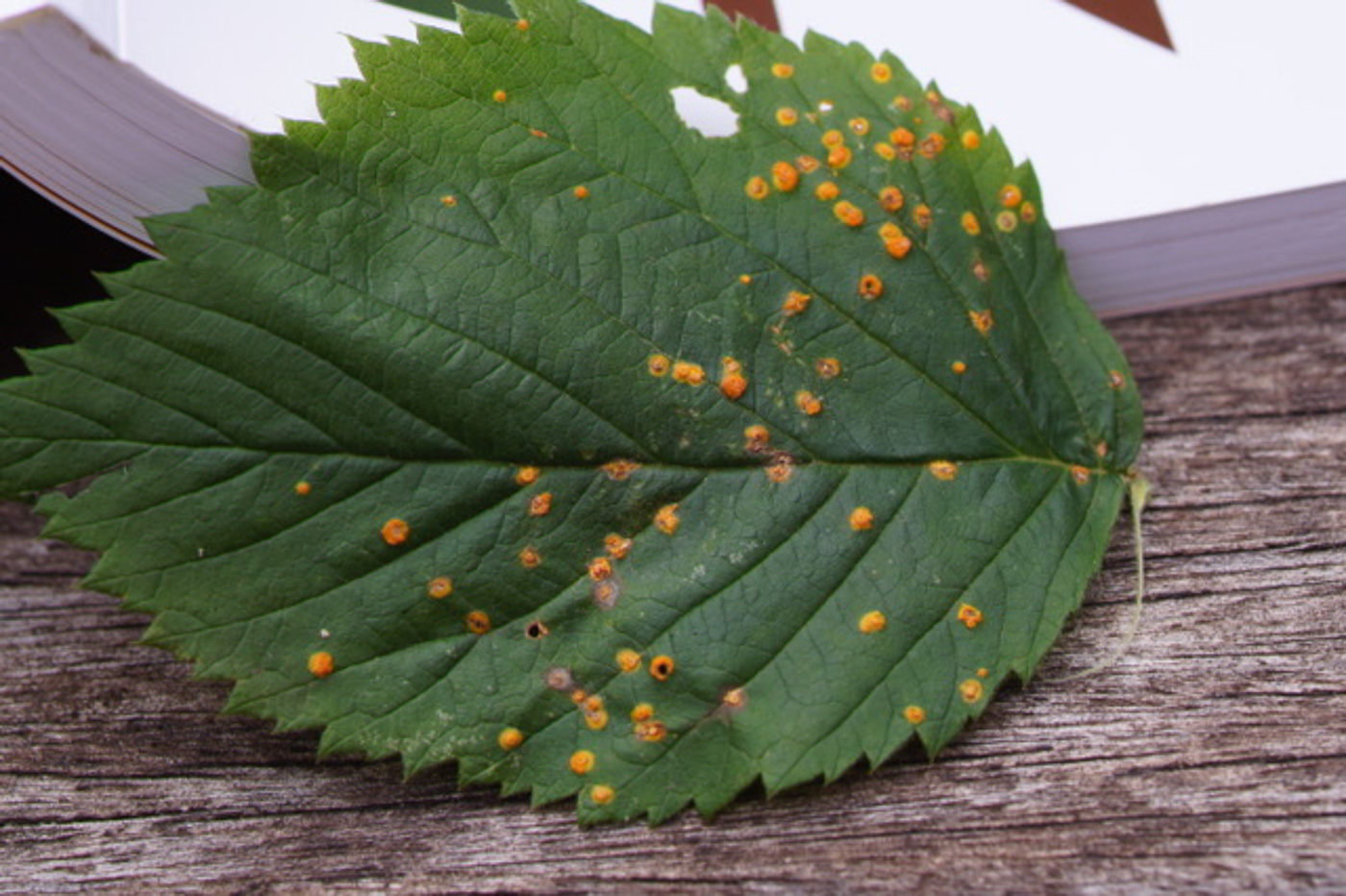
June 16th Phragmidium rubi-idaei (Raspberry Rust) In Salden Wood Bob Simpson came across a raspberry plant (presumably grown from a seed spread by a bird from his nearby garden) which had the telltale signs of a rust on its leaves. Discovering that there is only one rust species which occurs on Raspberry, this made his task of naming it much easier - this is quite often the case with identifying such species: if you recognise the plant you can often identify the fungus affecting it straight off. We have just one previous county record, Stephen Plummer's in 2024 from Hockeridge Wood though this was in October so likely to be of a different stage of development. Members' Finds New Species no. 1295 |
June 15th 2026
.jpg "Photo © Jackie Ewan")
.jpg "Photo © Jackie Ewan")
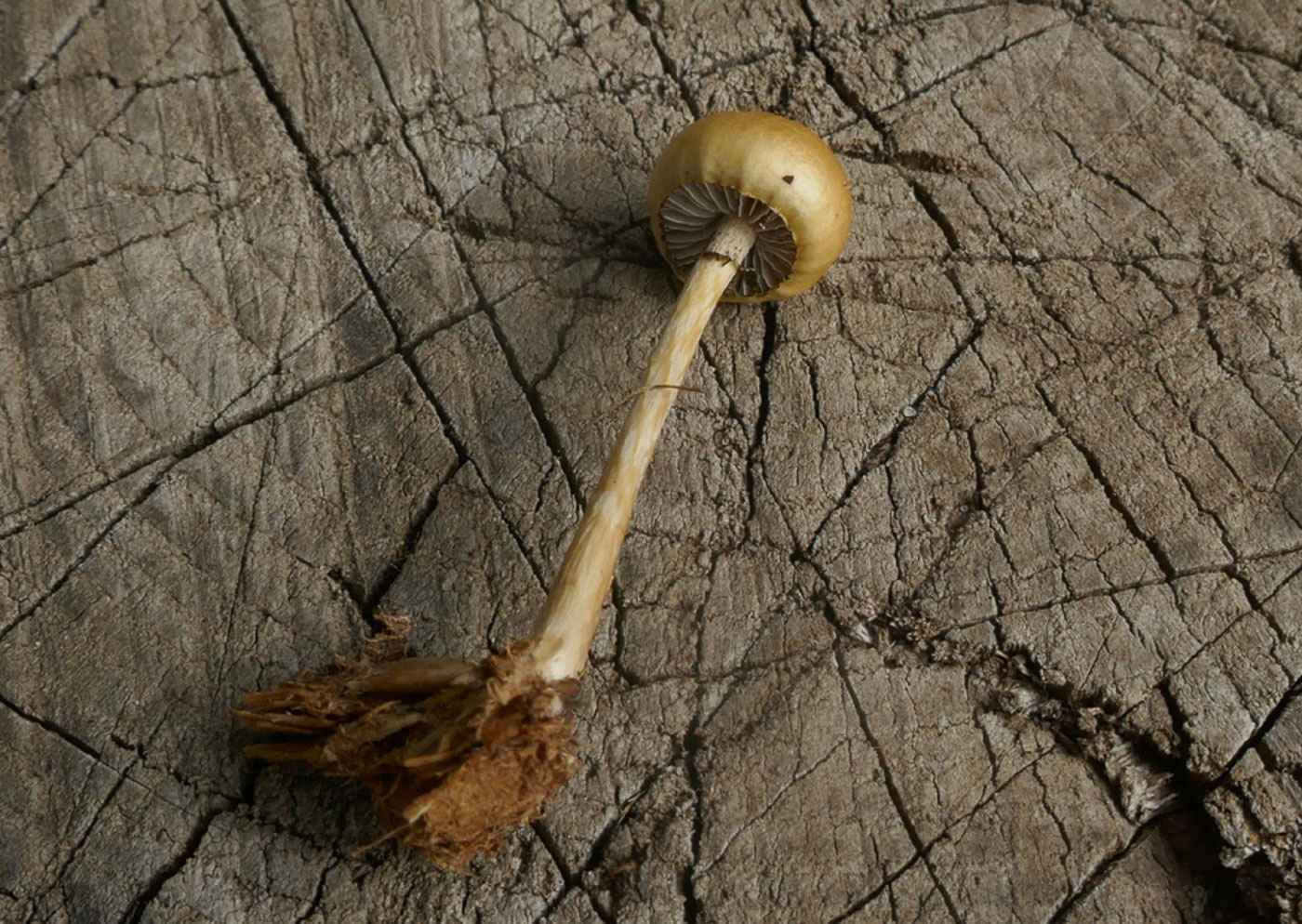 |
June 15th Protostropharia semiglobata (Dung Roundhead) In the sheep paddock at Stampwell Farm Jackie Ewan's 2 yr-old grandson spotted this pristine specimen on some dung. Though probably fitting into the LBJ category this is an instantly recognisable mushroom from its neatly rounded shape, sticky texture, almost convex crowded gills and a ring on the stem which is quickly blackened from falling spores, also of course its common occurrence in grassy areas on dung. The photo is Jackie's (not her grandson's!). Photo 3 - also Jackie's from the farm - was sent in 3 months later and shows a typical example with gills still tightly enclosed by the cap margin before final expansion. Previous finds |
June 14th 2026


 |
June 14th Strobilurus tenacellus (Pinecone Cap) Under Pine in Leygroves Wood - a new site for her near Cadmore End - Penny found first a singleton mycenoid mushroom in the general litter, then a couple more, then once she got her eye in she saw 10 or more caps dotted about amongst the fallen cones. Realising this was very likely to be S. tenacellus and not genus Mycena despite its general appearance she checked for the distinct yellow stem to confirm this (as did the gill cells once checked at home). The three members of this genus are typically mycenoid and occur exclusively on rotting conifer cones (as does the similar Baeospora myusura which, however, is smaller and has notably more crowded gills than Strobilurus), though the cones can be submerged or even completely rotted so not clearly in evidence as was the case today. They are often described as mainly spring fruiting (though this is possibly the first find at this time for Penny). S. esculentus fruits exclusively on Spruce cones but today's species, new to Finds, fruits exclusively on Pine cones as does the third and rarest member, T. stephanocystis. These two Pine species are best separated by their gill cells which are luckily very different and distinct (Penny has never knowingly seen that species). Members' Finds New Species no. 1293 |
June 12th 2026

.jpg "Photo © Jackie Ewan") |
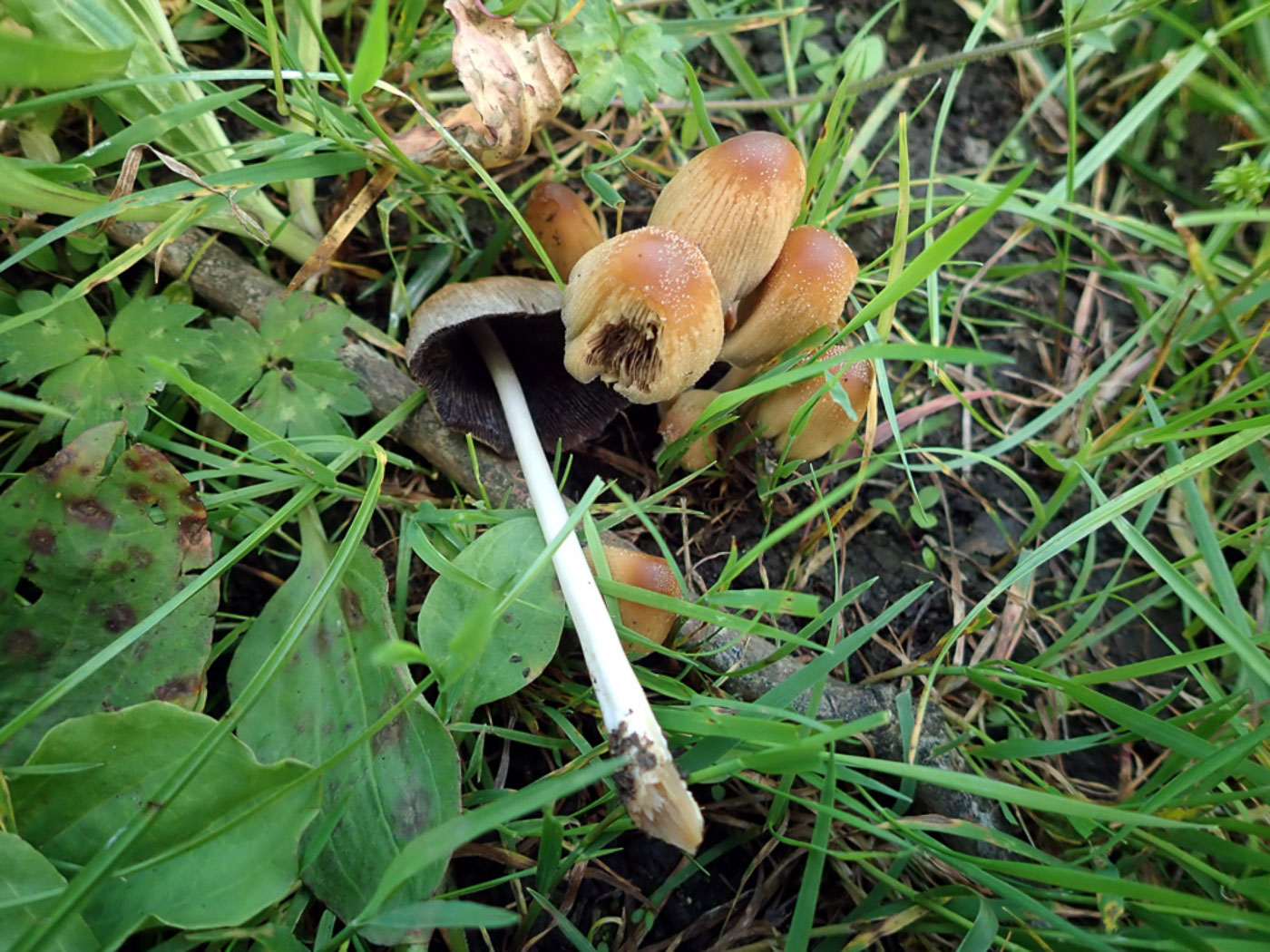
June 12th Agrocybe cf. vervacti (Fallow Fieldcap) At Stampwell Farm in scrubby grass beside a track Jackie Ewan spotted this singleton and recognised the genus, often well represented at this site. Though similar to A. praecox to her it looked a bit different lacking any sign of ring, and sure enough at home the spores were too small for that species also lacking an obvious germ pore. Some online research brought her to the rare A. pusiola which appeared to fit well, so she dried the sample and sent her photos to Penny who then found a key which coupled this name with A. vervacti, clearly very similar though not quite so rare and possibly more likely as described as summer to autumn rather than late autumn. Jackie agrees this is a better bet and the sample will be sequenced in the hope of confirmation. Watch this space! Members' Finds New Species no. 1294 |


 |
June 12th Coprinellus truncorum (Trunk Inkcap) In the central wide grassy ride at Rushbeds Wood Penny was on the lookout for Lacrymaria lacrymabunda (Weeping Widow) which she recalled seeing here at this time, and at one point thought she'd found it. However, not so: on closer inspection this was an Inkcap though not one she recognised. Though with similarities to C. micaceus (Glistening Inkcap and regularly on our lists) it had a different 'jizz' with a distinct smooth hazel brown cap centre which was retained at maturity, and at home the spores were not the correct shape for that species with other microscopic differences also apparent. She keyed it out to this species, new to Finds, though had doubts about her ability with this genus so consulted Derek who was, however, happy with her ID. We will be getting a sample sequenced in view of the fact that Derek informed her there are two separate clades with this name needing further work and clarification. Members' Finds New Species no. 1292 |


 |
June 12th Candolleomyces candolleana (Pale Brittlestem) At Rushbeds Wood Penny was not surprised to find quite a few separate clusters of this early season mushroom in several of the grassy rides as we regularly record it here though with the recent rain it was particularly prolific today. Typical of the genus Psathyrella (where it resided until fairly recently) the gills start really pale but gradually turn grey-brown from the maturing spores, but it is one of few Brittlestems recognisable in the field from its virtually white cap (though pale ochre at first, seen here) and the fact that the fibrous cortina-like veil (photo 3) tends to leave ragged remains along the cap margin into maturity - also just visible here but mainly washed off by recent rain). Penny did check with a scope because another Brittlestem nearby was much less pale and turned out to the Psathyrella spadiceogrisea (Spring Brittlestem), also fruiting at the moment. Previous finds |

 |
June 12th Abortiporus biennis (Blushing Rosette) On an exposed root in the middle of a path at Rushbeds Wood Penny noticed these little white growths, and on closer inspection noted the mazelike furrowed wrinkles indicating this was the very early stages of Abortiporus biennis. Though often found on fallen branches and forming attractive rosettes with a pinkish hue, it is less obvious to recognise when undeveloped, white with no apparent blushing and lacking much shape - just lumpy. It regularly fruits in paths with no apparent sign of wood or roots (though no doubt it will be on submerged wood). For this reason she felt it worth including today's photos here as it may well be fruiting in other similar places at present. Previous finds |
June 10th 2026

 |
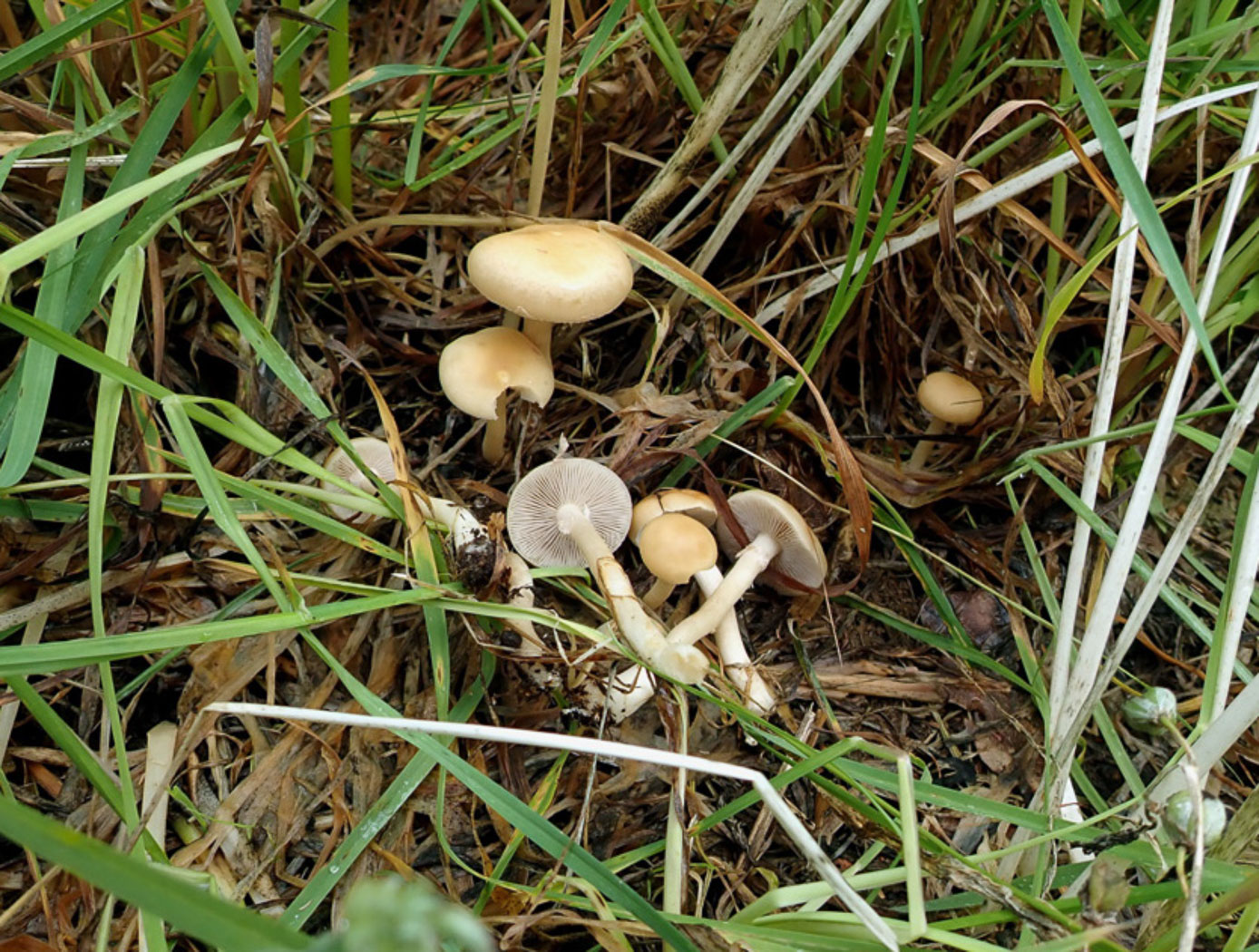
June 10th Calocybe gambosa (St. George's Mushroom) At Turville Heath Penny was surprised to see this singleton in a mown grass verge under Lime. On collecting it she knew straight away what it must be: firm chunky pale cap and flesh, equally pale and firm gills with a substantial white stem, and a strong 'farinaceous' mealy or floury smell to complete the picture. Though often recorded in grassy verges on or around St. George's Day (April 23rd) this year we had virtually no reports of it fruiting. Of our 80 odd county records over the last 20 years all are from April or May except for one previously in June! Previous finds |
 |
June 10th Psathyrella spadiceogrisea (Spring Brittlestem) In a grassy verge in the Lime avenue at Turville Heath Penny spotted this singleton cap, guessed it would be genus Psathyrella, then turned it over to confirm the gills were beginning to turn grey from the maturing spores - a sure sign of this genus. At home their size together with the cells on the gill edge and face confirmed the species she'd assumed it was because it's quite common, favours this time of year (as it's English name suggests) and has been found here several times before. Previous finds |
 |
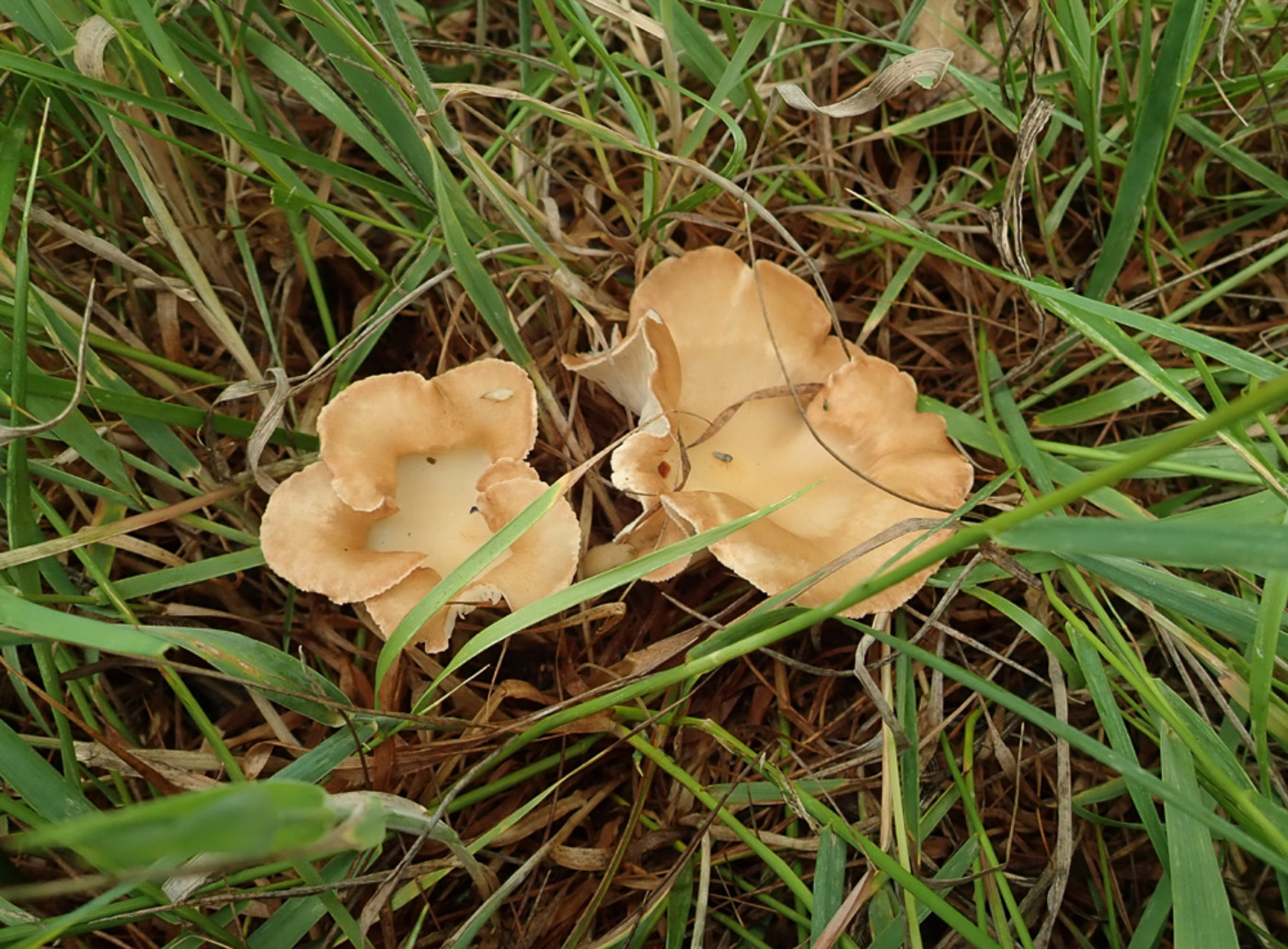
June 10th Infundibulicybe gibba (Common Funnel) At Turville Heath Penny chanced upon two clumps of this species in the middle of a virtual hay meadow with surrounding somewhat wet vegetation at least 2 ft tall. The wavy cap margins raised a slight query that this might be a different species but, turning one over (photo 2), the strongly decurrent gills and thickish stem left little doubt. This is a species which occurs commonly in woodland as well as grassland, often quite early in the season, so it was no surprise to find it today no doubt encouraged by the hot May followed by the cool and damp early June - ideal conditions for early species. Previous finds |
 |
June 10th Agrocybe praecox (Spring Fieldcap) At Turville Heath Penny chanced upon this generous collection in the middle of a virtual hay meadow with surrounding somewhat wet vegetation at least 2 ft tall. The caps (often cracked in this species from exposure to sun) were clearly pristine and protected from weathering and several specimens still had their pendant (dangling) high-up ring in tact. This feature together with the gills gradually turning pale rust were sufficient to suggest the name, but she checked the spore size and distinct germpore, also the scarce cystidia on both gill edge and face to confirm. This genus generally makes an appearance in spring and summer with several species favouring grassland habitats as its Latin genus name suggests. Previous finds |
June 6th 2026
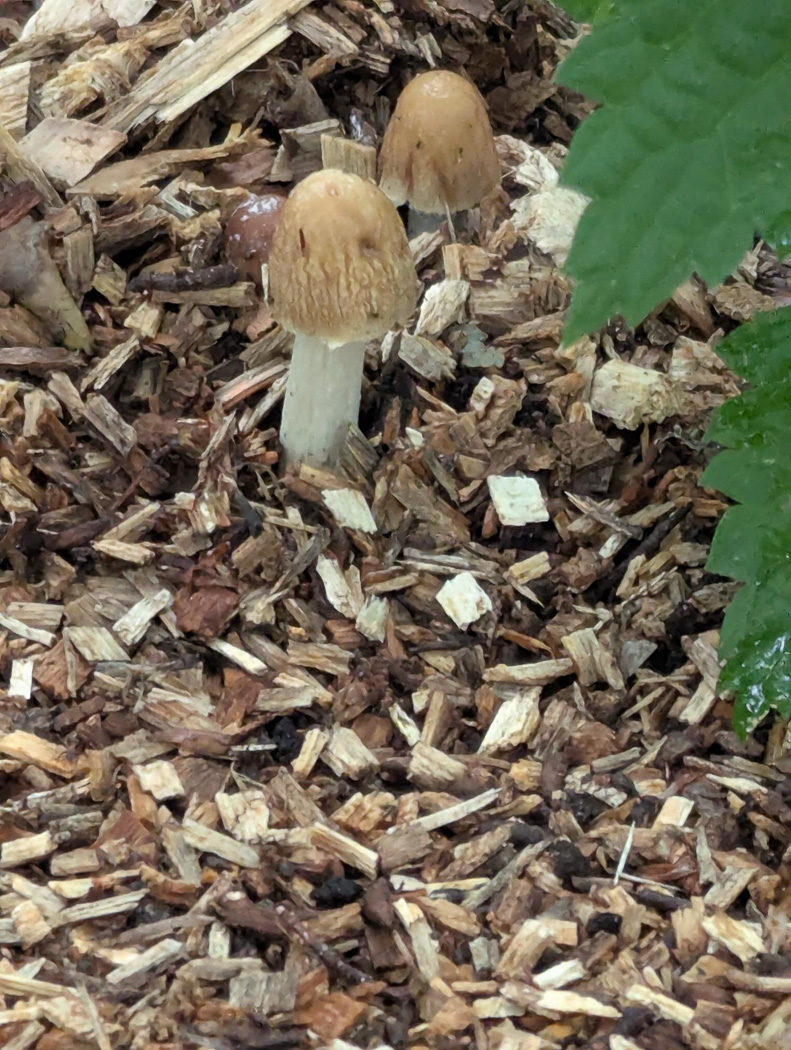 |
June 6th Agrocybe rivulosa (Wrinkled Fieldcap) On a woodchip pile at Burnham Beeches Gill Ferguson spotted these two mushrooms and sent her photo to Penny for ID. So this has not been studied with a scope but Penny is fairly confident from the typically wrinkled caps and the even more typical woodchip substrate that this ID must be correct. Comparing Gill's photo with our earliest Finds entry for this species from Stampwell Farm in 2022 the characteristic wrinkles match nicely. Previous finds |
 |
June 6th Fuligo septica var. flava (a slime mould with no English name) At Burnham Beeches this bright patch of yellow not surprisingly caught Gill Ferguson's eye. Her photo of nice fresh material shows both the earlier plasmodium (slimy) stage at the bottom with the drier more mature stage developing above it. Eventually this species dries off, fades and becomes crumbly with grey contents revealed beneath. Previous finds |
May 18th 2026
 |
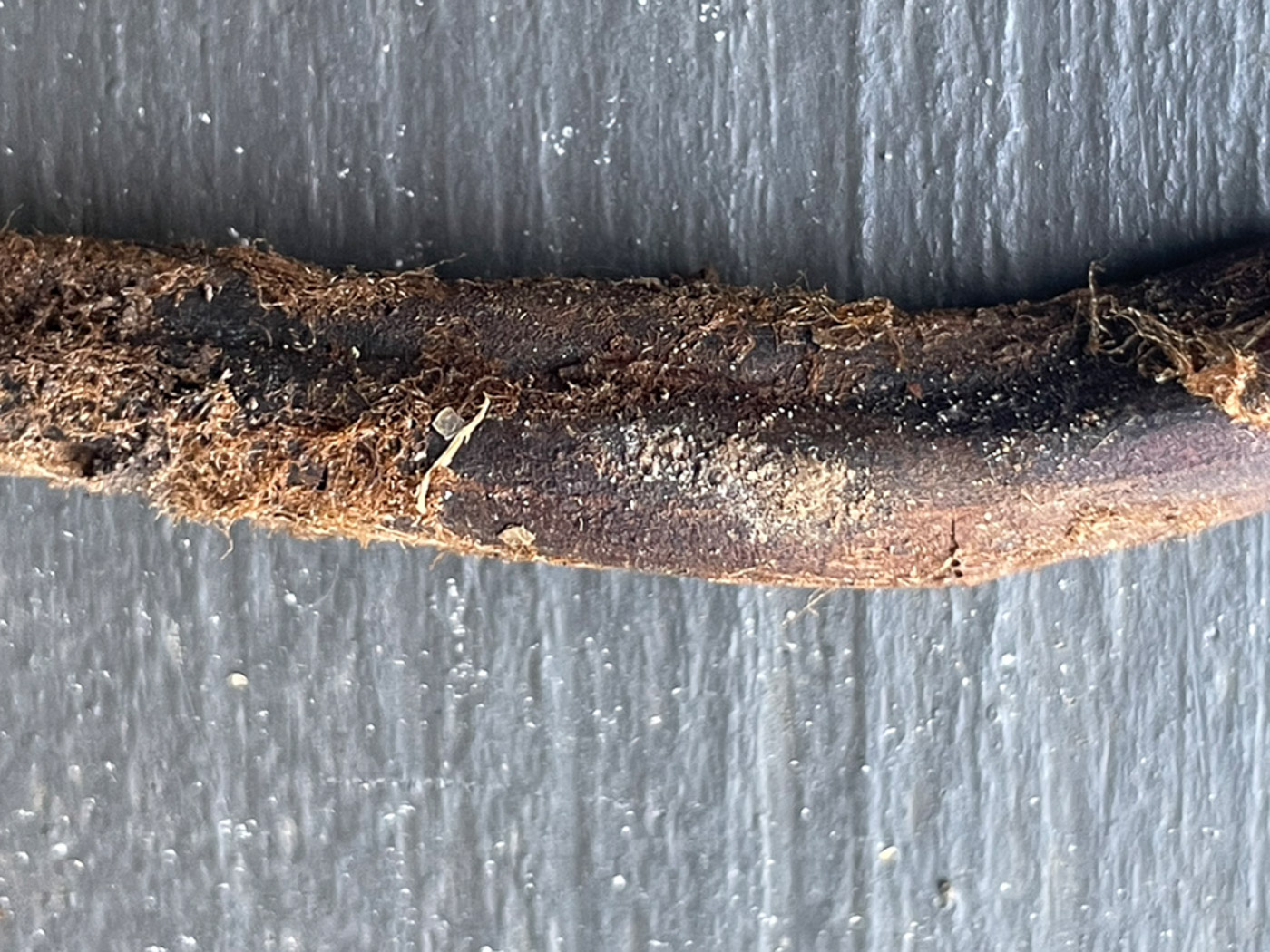
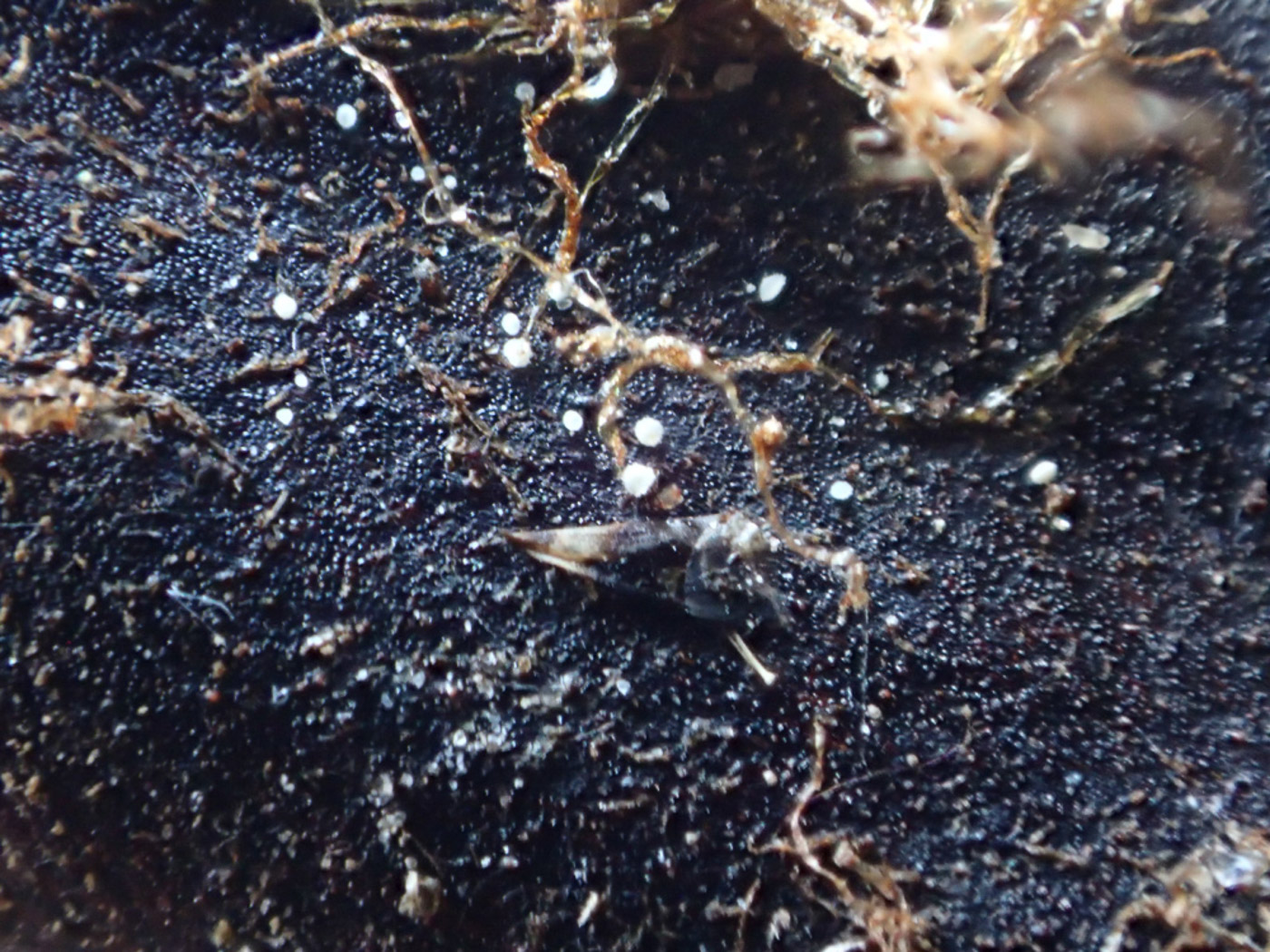
May 18th Micropodia pteridina (Bracken Swarmer) On the edge of Naphill Common (in fact just outside her garden gate) Sarah Ebdon went searching for this species in a stand of Bracken at the suggestion of Stephen Plummer who finds it regularly in spring wherever the host plant occurs. This is a simply minute asco which is common on the blackened tips of dead Bracken stems, and in Sarah's photos you're looking for the tiny white dots! Photo 3 includes a scale showing 0.2 mms and to the left of this look for the black dot indicating that actual size of that measurement which is pretty well equal in size to the white fruitbodies dotted about near it. We have around 10 previous county records though this is a new entry for Finds. Members' Finds New Species no. 1291 |

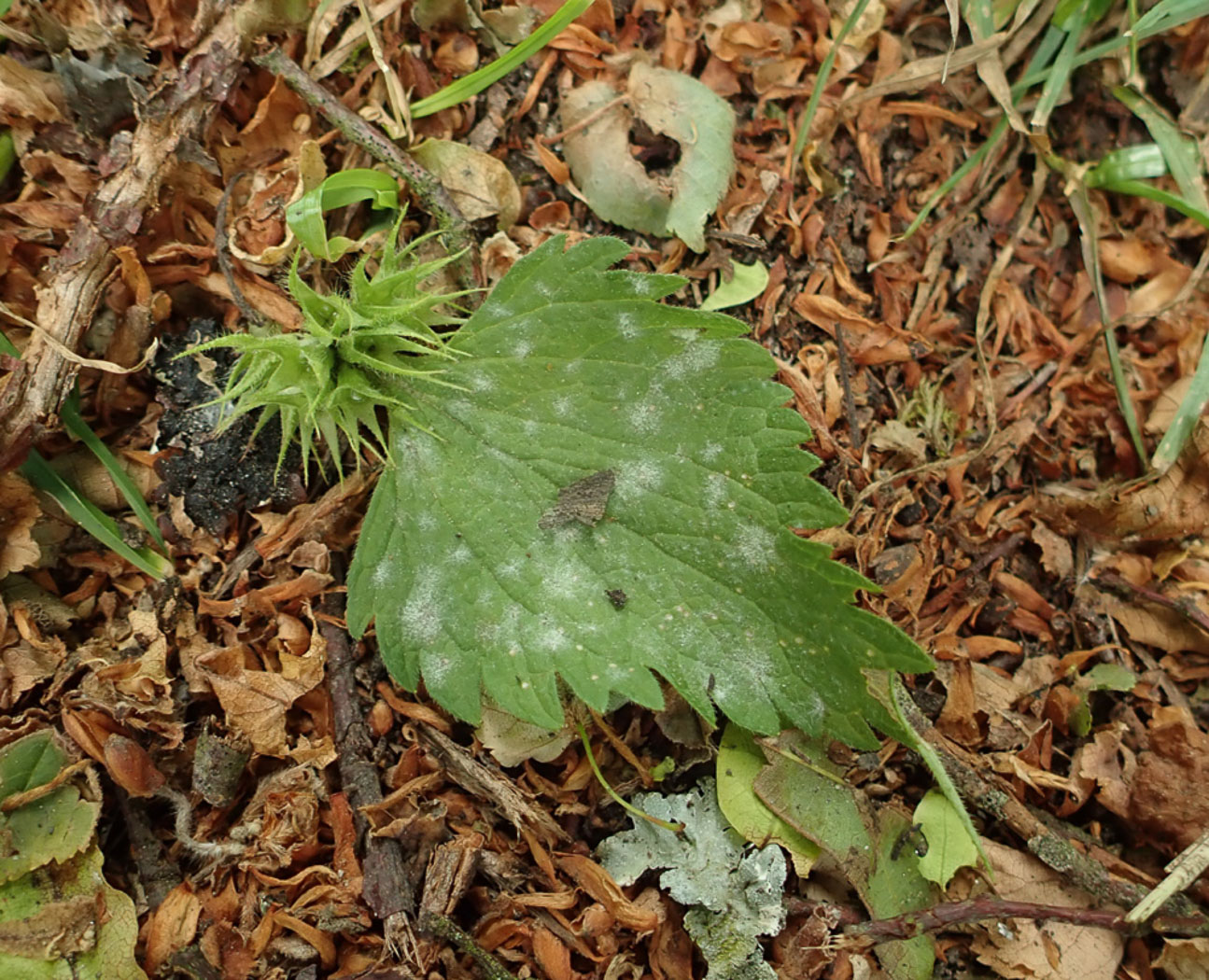 |
May 18th Neoerysiphe galeopsidis (a species of mildew with no English name) At Turville Heath Penny spotted a clump of White Dead Nettle showing clear signs of mildew on its leaves, so took a leaf home to check the species. She found that this was the only mildew to affect this plant, making for a nice easy ID. Previously in genus Erysiphe, this very common species has been recorded previously in the county though not since 2000, thus is new to Finds. Members' Finds New Species no. 1290 |
 |
May 18th Pluteus cervinus (Deer Shield) At Turville Heath at the base of a felled stump of Lime Penny spotted a brown cap lurking under the flourishing Lime suckers. Once collected and overturned, the pink free gills confirmed her thoughts that this was probably this very common Shield species but she took a chunk home just to check that the gill cells, which are topped with 'cat's ears', did not have the forking 'ears' which would make it the rare P. hongoi. No such luck! But at least it was a mushroom - nice to see in this amazingly cold but dry May. Previous finds |
 |
May 18th Hypholoma fasciculare (Sulphur Tuft) At Turville Heath Penny managed to find just two different gilled species today. This one - very common - was on a large pile of woodchip formed when a large Lime was felled last year, and the young fruitbodies were not yet showing gills but still easily recognisable at this stage of development. Previous finds |
May 17th 2026
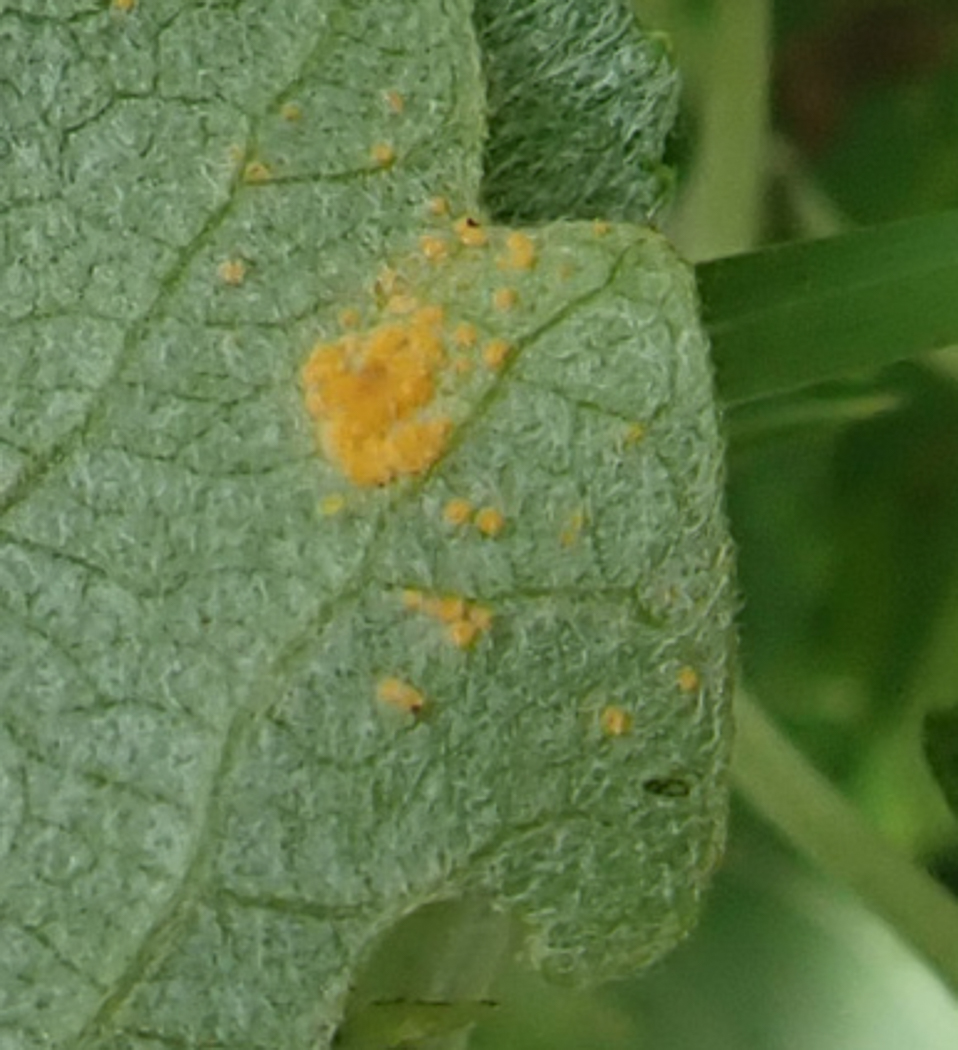 |
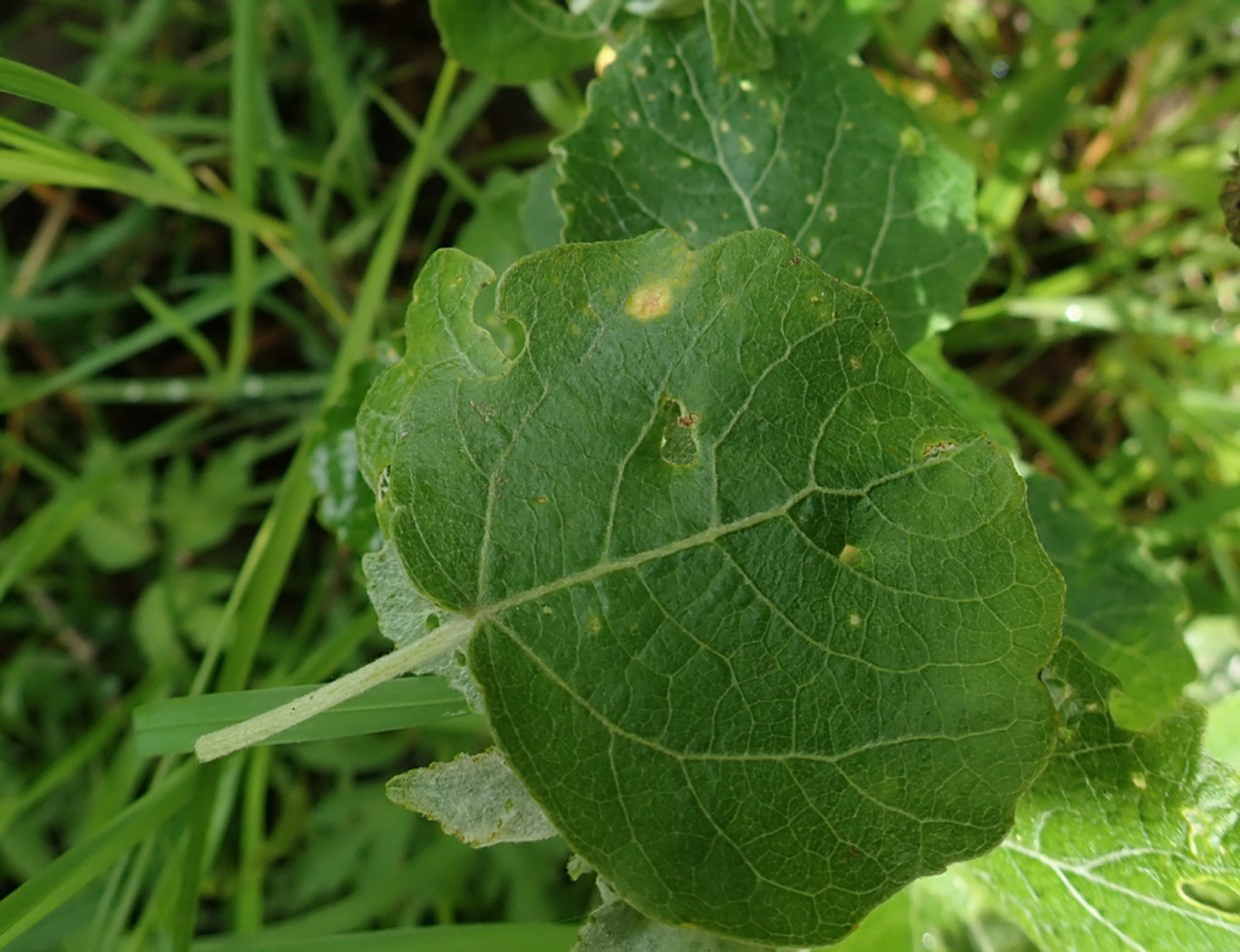
May 17th Melampsora populnea (a common rust with no English name) Rushbeds Wood appeared almost devoid of fungal activity today but this single rusty spot on an Aspen leaf caught Penny's eye as she searched for anything of interest. Photo 2 is a close up of the leaf underside. When attempting to sort out the correct name for this species, however, the available evidence is slightly confusing but after discussion Penny and Sarah are happy that this collection so-named fits with both Roesten and Bladmineerders, other possible species being eliminated as not occurring on Aspen. This is a species complex, however, and as such somewhat complicated owing to the several stages of development occurring on the wide range of different hosts. Members' Finds New Species no. 1289 |
 |
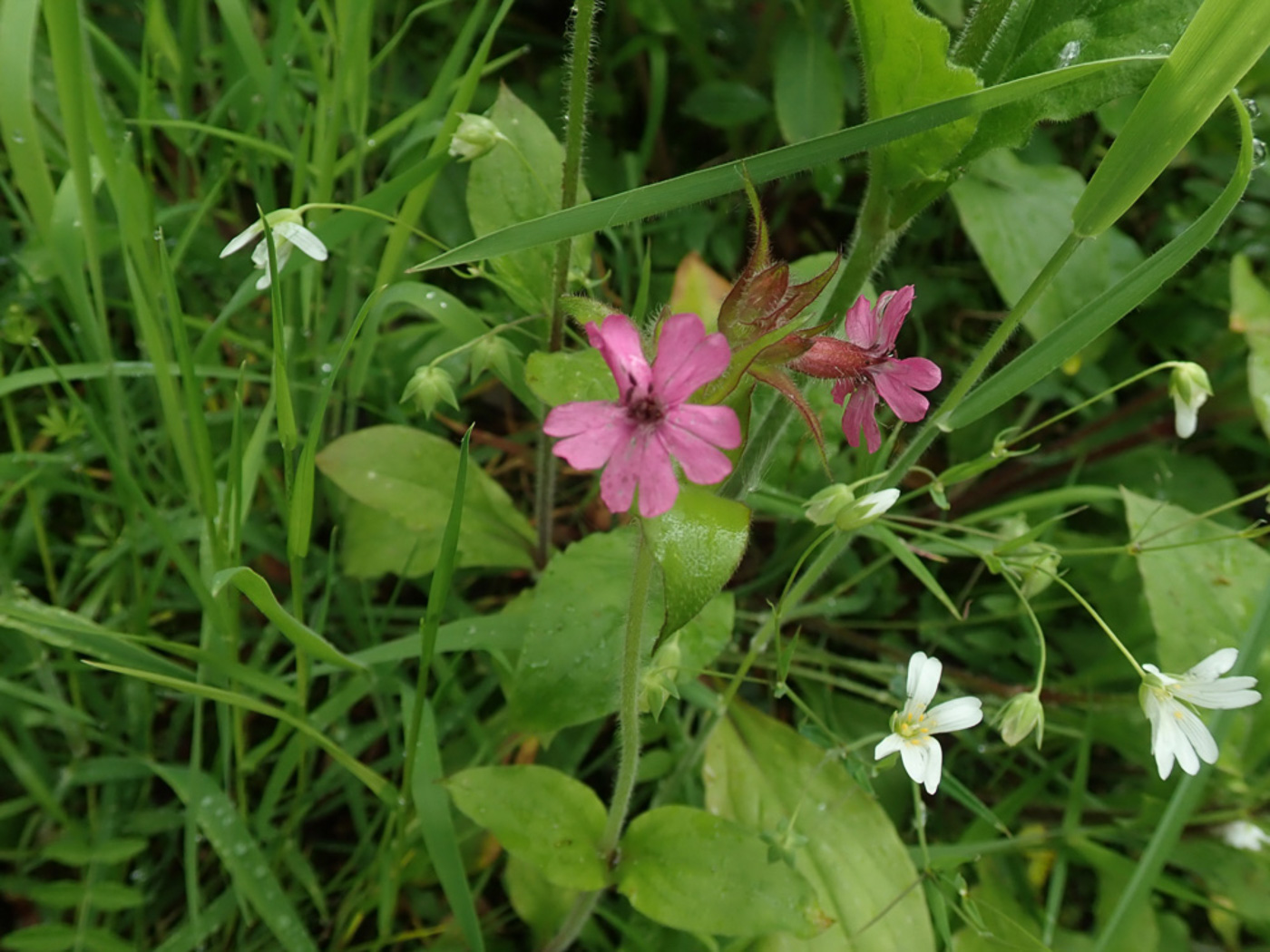
May 17th Microbotryum silenes-dioicae (Red Campion Anther Smut) Rushbeds Wood appeared almost devoid of fungal activity today apart from this smut species and a couple of rusts, found by Penny. Seeing some Red Campions in flower prompted her to check for the telltale black centres to the flowers which give away the presence of this common springtime species, and sure enough it was not long before she spotted a few. Photo 2 shows two affected flowers and for comparison the RH flower which is unaffected. Previous finds |
May 11th 2026
.jpg "Photo © Jackie Ewan")
 |
May 11th Agrocybe praecox (Spring Fieldcap) In a well established woodchip pile at Stampwell Farm Jackie Ewan spotted these mushrooms which, however, had remarkably cracked caps no doubt due to their position open to the elements. She suspected they were A. praecox so checked the microscopic details to confirm, though previously she's found the species at this time in the fields rather than on woodchip. However, we also found it on woodchip a few days earlier at Stoke Poges Memorial Gardens where it was almost our only gilled agaric! There are many online images of this species (also one of our first in Members' Finds) showing similarly cracked caps, so this feature is nothing unusual. Previous finds |
May 6th 2026
| Updated November 8th 2025 |
Ripartites tricholoma (Bearded Seamine) Click here |
| Updated November 6th 2025 |
Leucoagaricus sericifer (a Dapperling with no English name) Click here |
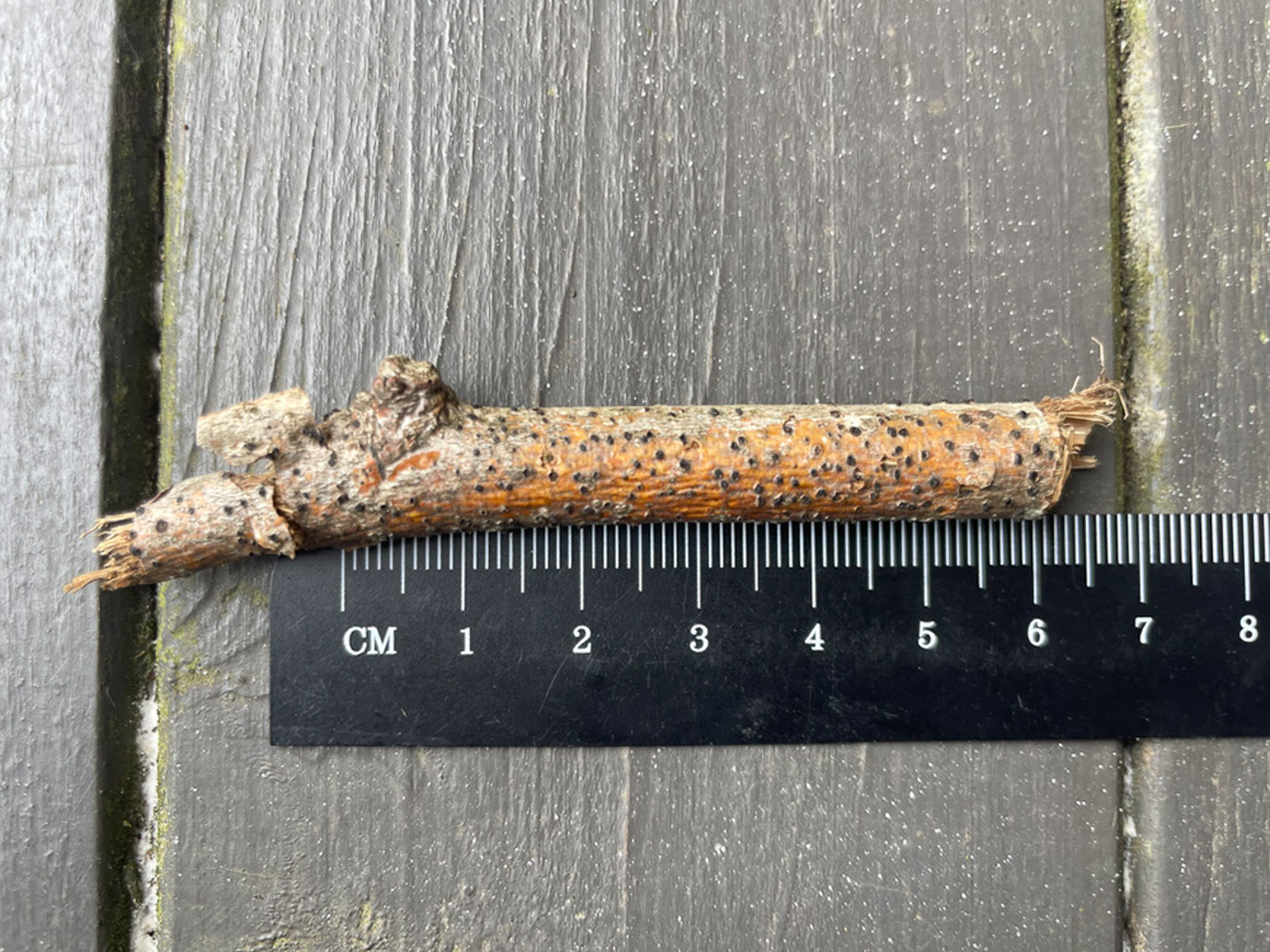 |
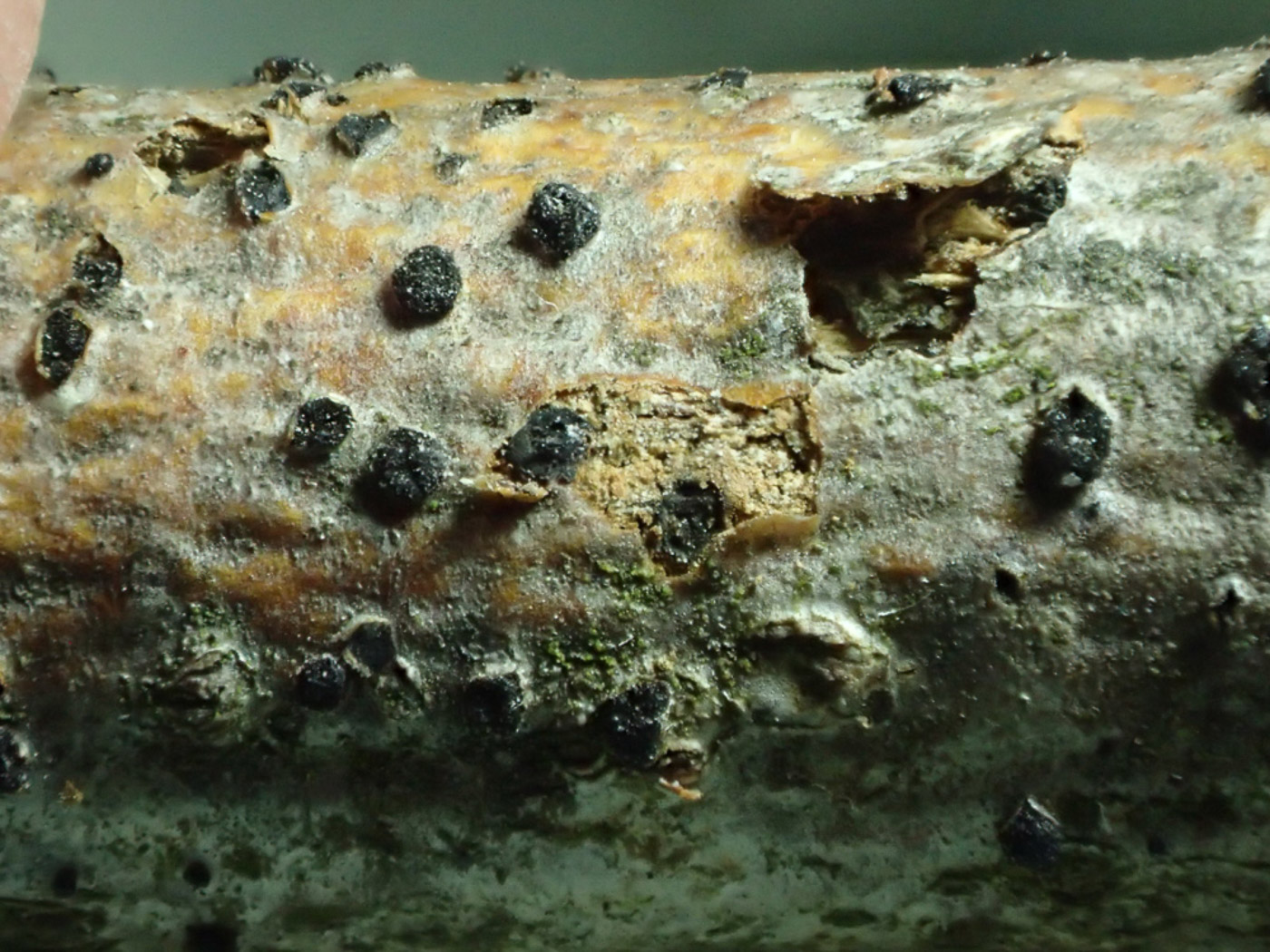
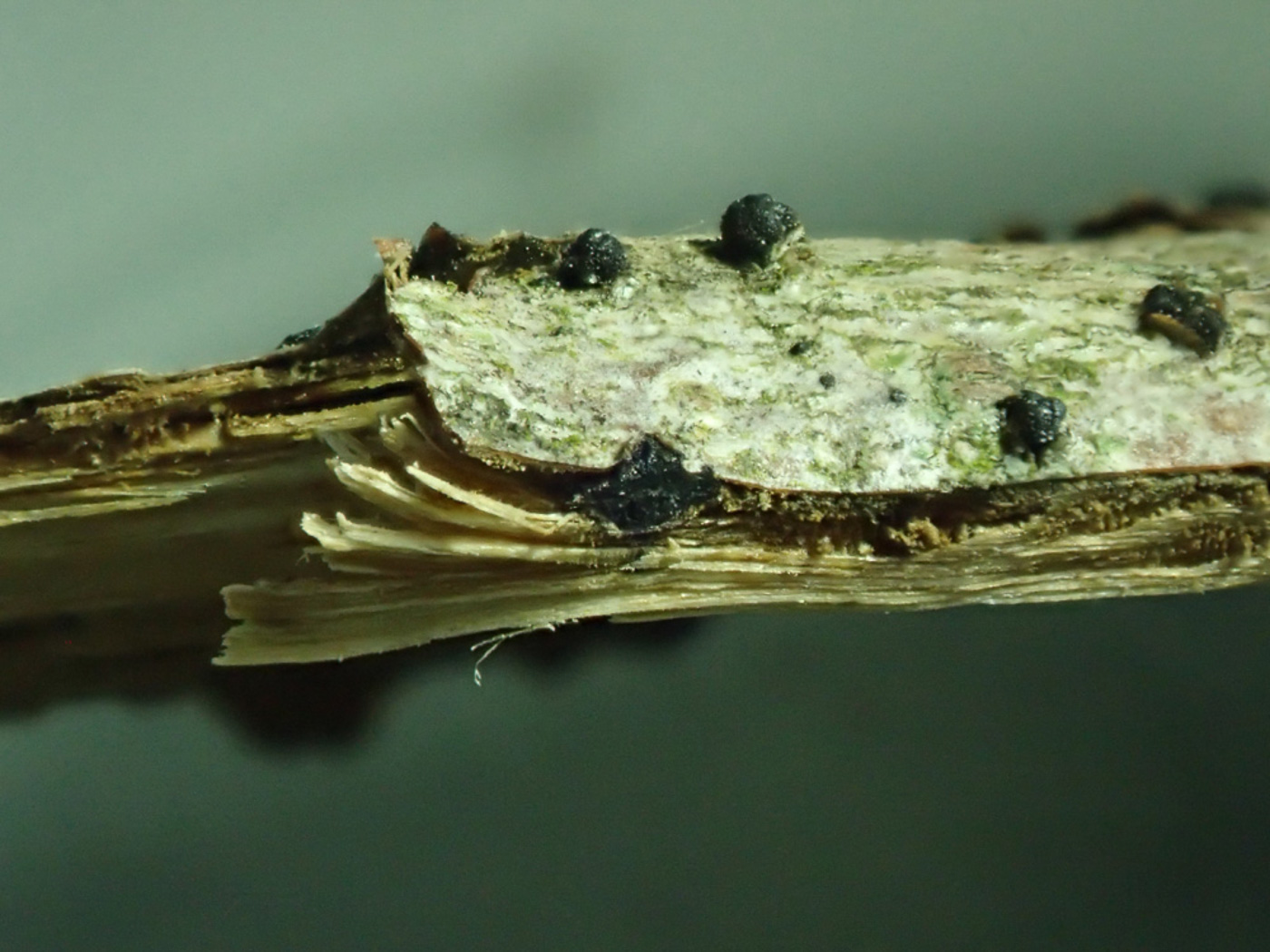
May 6th Coryneum umbonatum (a rare pyrenomycete with no English name) On some fencing constructed from dead wood at Stoke Poges Memorial Gardens Penny noticed a smooth barked deciduous stick which had swarms of tiny pyrenomycete mounds, similar to miniscule woodwarts breaking through the bark (erumpent). This she handed to Sarah Ebdon who four days later after many hours of dogged research and microscopic examination was eventually able to identify it to her satisfaction. From the amazing website Ascofrance she discovered a key to this huge genus which gave her the necessary macro- and microscopic information to this species which appears to have only 19 FRDBI records though under the name Pseudovalsa longipes which Sarah explained was the teleomorph (ie sexual) stage of this fungus rather than the anamorph (asexual) stage present here. Needless to say this is new to the county. As can be seen in photo 3 each 'wart' is barely 1mm across. Members' Finds New Species no. 1288 |
| Updated September 17th 2025 |
Entoloma bryorum (a rare Pinkgill apparently new to the UK) Click here |
| Updated October 11th 2025 |
Pluteus semibulbosus Click here |
.jpg "Photo © Neil Fletcher")
.jpg "Photo © Neil Fletcher")
 |
May 6th Diplocarpon rosae (Rose Spotter) In his Naphill garden Neil Fletcher noticed these spots on his rose bushes and correctly assumed that though this fungus is probably in every garden in the county we have few records for it in our database. We have one, from 1991!! This extremely common plant pathogen causes Black Spot, a disease surely all gardeners are familiar with and many will have sprayed unsuccessfully against. Despite the lack of records it seems hardly suitable to give this entry the green box it deserves. Members' Finds New Species no. 1287 |
May 5th 2026
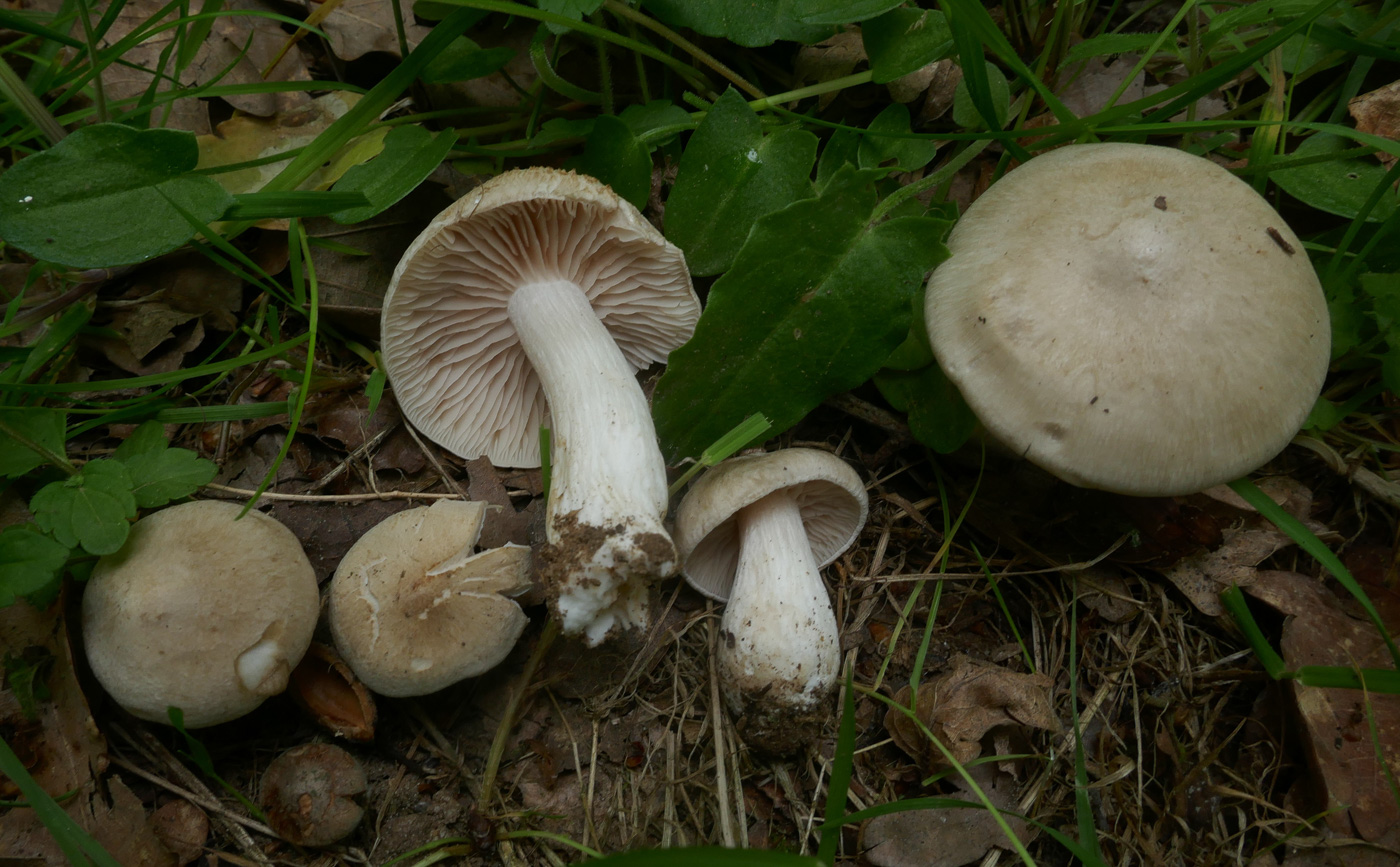
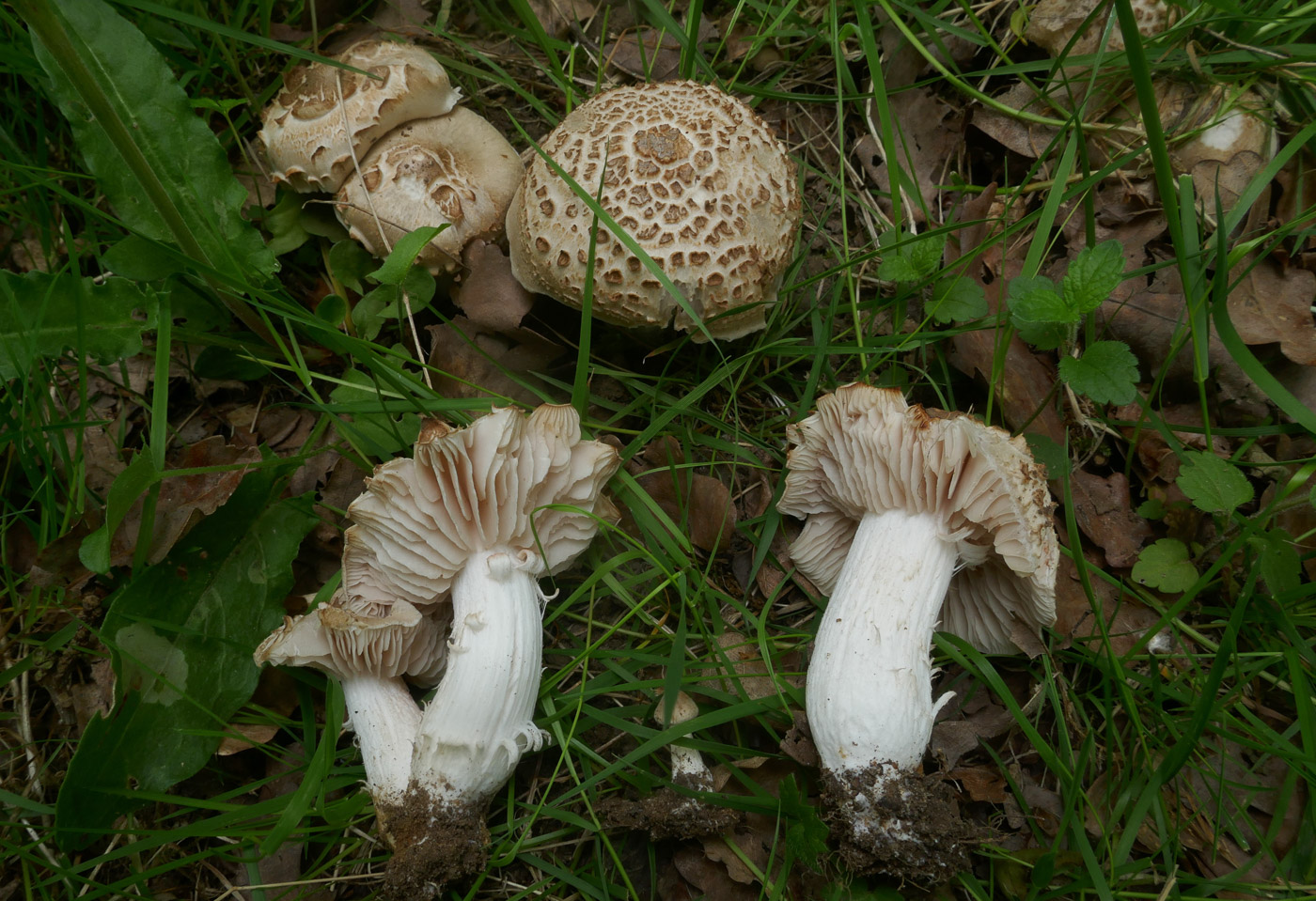 |
May 5th Entoloma clypeatum (Shield Pinkgill) At Stampwell Farm Jackie Ewan noticed this species which comes up regularly at this time in a grassy patch under some Plum suckers. The sunny aspect has clearly caused the cracking on the cap which can also be seen in her entry for this species last year. Previous finds |
May 3rd 2026
.jpg "Photo © Jesper Launder") |
May 3rd Tuber aestivum (Summer Truffle) Under Oak in Gerrards Cross Jesper Launder noticed a large 'dig hole' which once investigated proved to have an absolute whopper of a truffle inside despite it being somewhat early in the season for this species - it weighed in at 50 gms but to his surprise was still far from mature despite its size and had yet to develop the distinctive smell associated with this species. Previous finds |
May 1st 2026
.jpg "Photo © Jesper Launder") |
May 1st Balsamia platyspora (Broadspored Truffle) Under Oak in Seer Green Jesper Launder went searching in a spot where he'd found truffles before, and at the bottom of a 'dig hole' he discovered this tiny pea-sized specimen. Expecting it to be Tuber rufum from past experience here he then noticed the somewhat warted peridium (outer surface) whilst taking his photo (the specimen placed here on an Oak leaf for scale) which eliminated that species and pointed him to this Balsamia. However, it was too immature to have developed the strong smell associated with this species. Previous finds |
April 23rd 2026
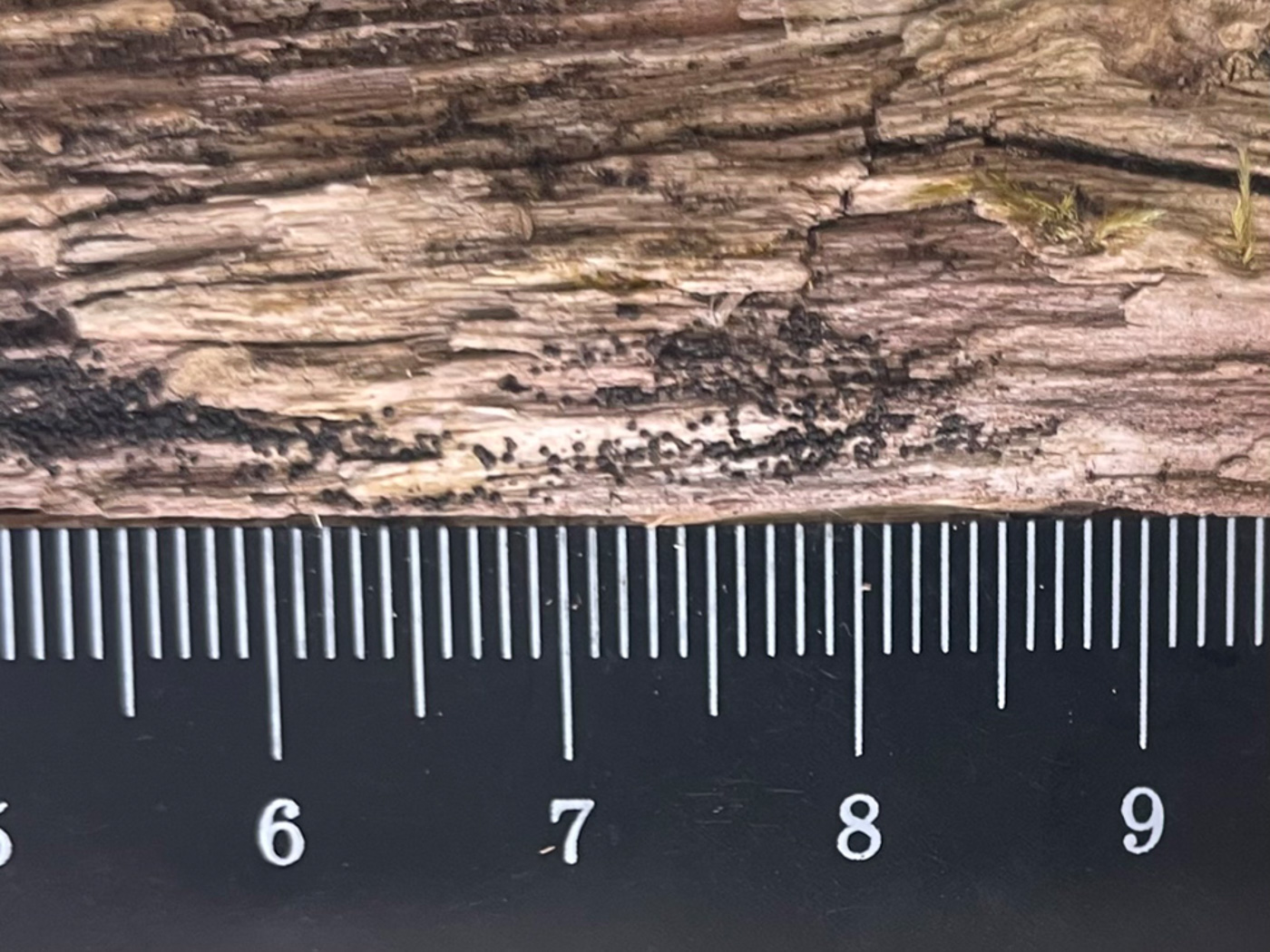
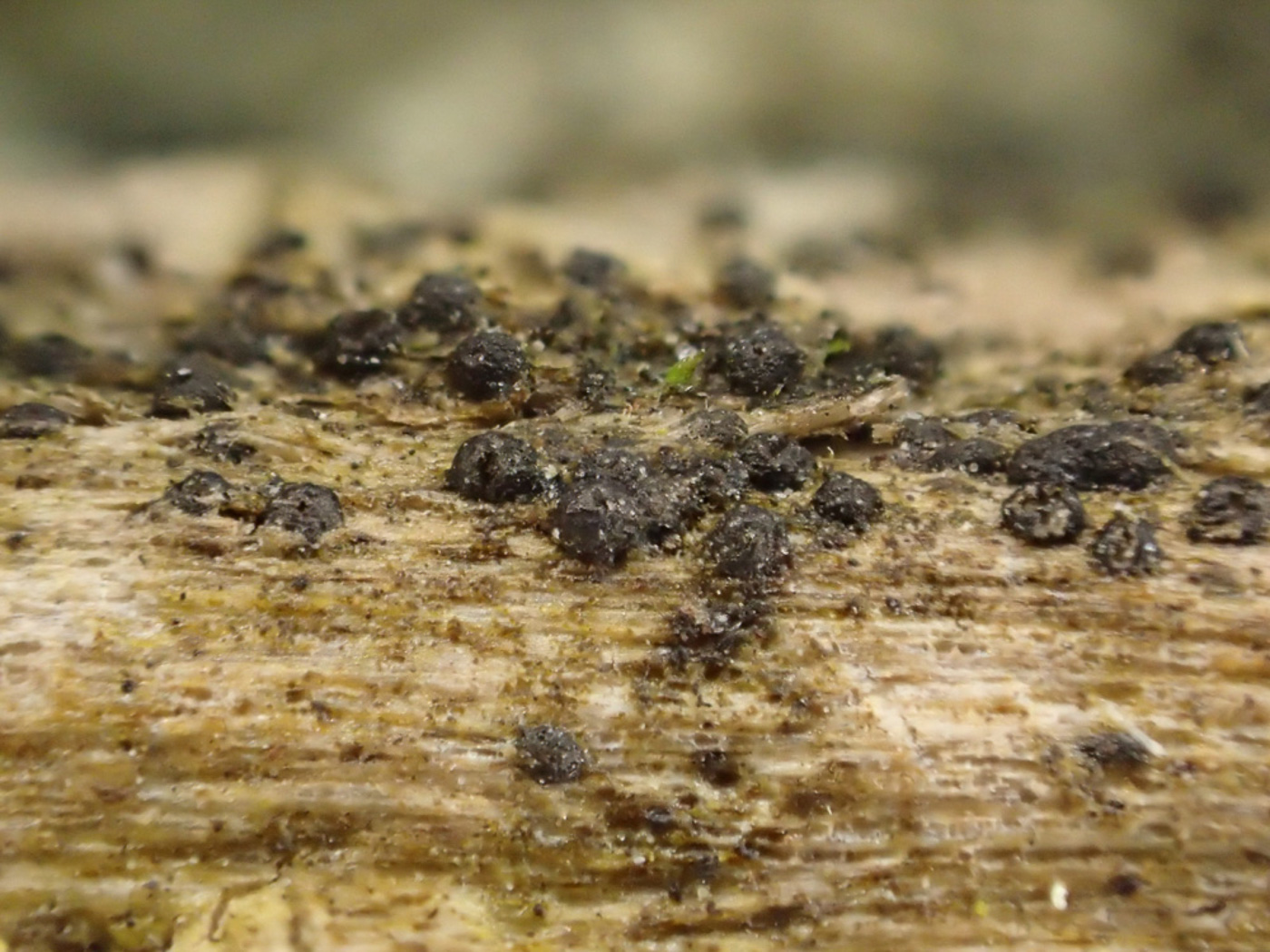
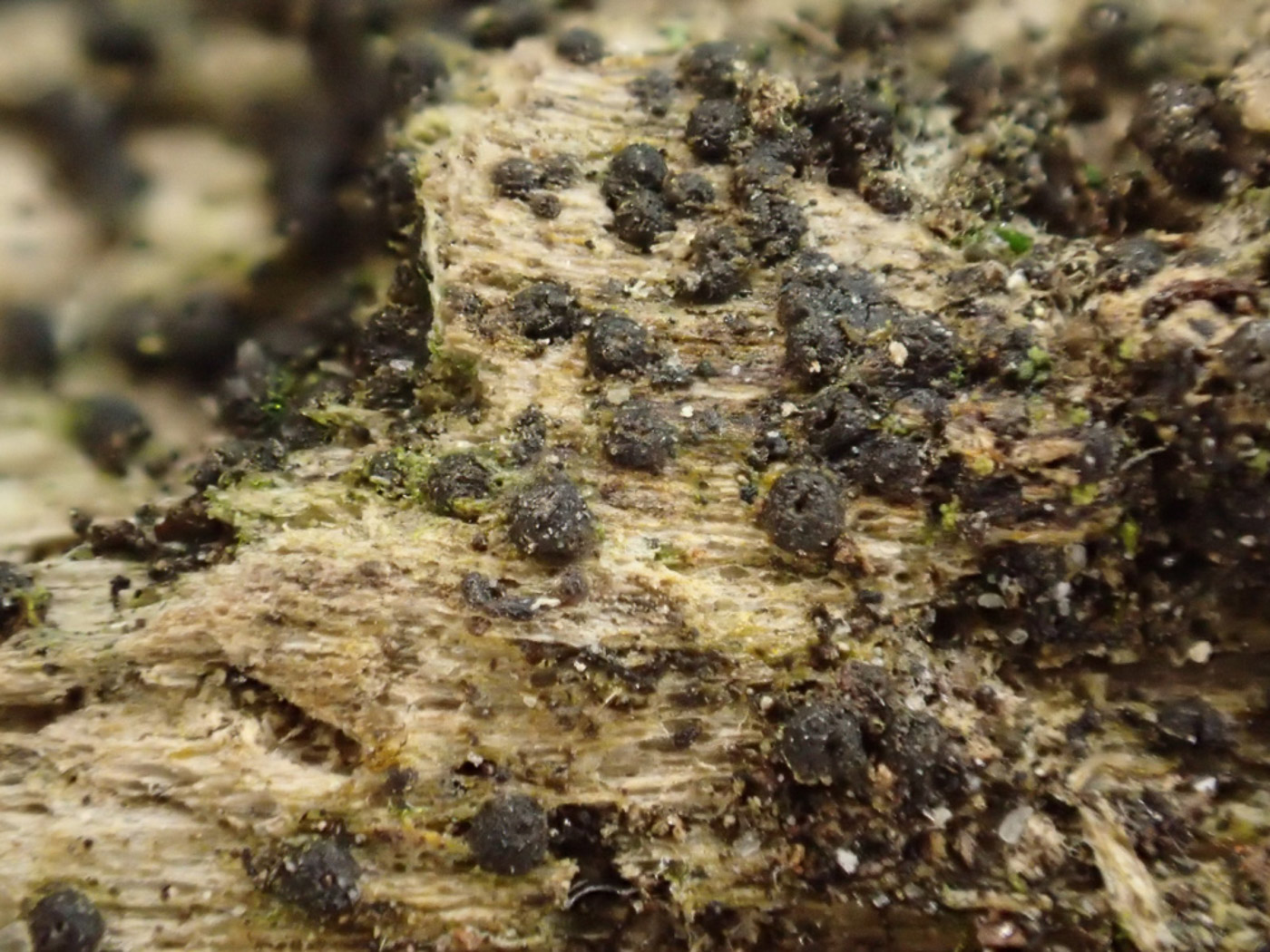
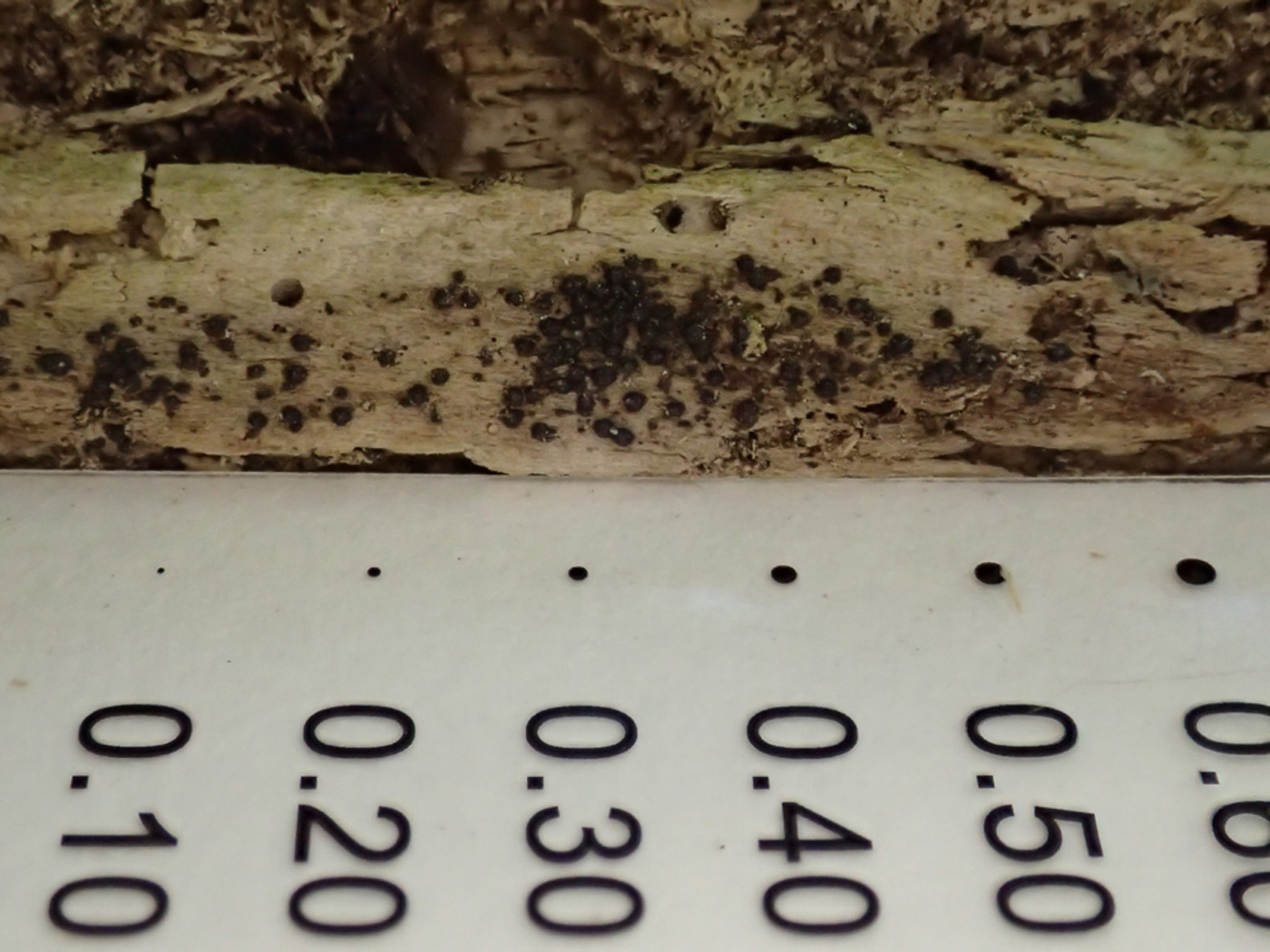 |
April 23rd Lophiotrema cf. nucula (a rare ascomycete with extrememly few UK records and no English name) On a piece of bare indeterminate wood at Stoke Common Sarah Ebdon spotted these unfamiliar tiny black dots. At home she struggled to find help in available books but online found a paper where she discovered this species which then appeared to tick all the boxes microscopically though the spores seem to Sarah be very slightly different from those illustrated. She'd have been happier if there'd been a key to this genus available in order to eliminate any possible similar contenders, also finding only three previous FRDBI records provided further doubt. Thus the inclusion of 'cf' in the name here, meaning 'similar to but not an exact match'. The species appears to favour Aspen and Sarah noted this tree was amongst those present nearby. We shall be getting a sample sequenced. The two scales included in her photos, one with cm divisions, the other with mm divisions, gives a clear indication of the size of this species. Members' Finds New Species no. 1286 |
.jpg "Photo © Jesper Launder") |
April 23rd Neohypochnicium wakefieldiae (a rare corticioid with no English name) Turning over an oak log at Stoke Common, Jesper Launder noticed this powdery grey corticioid and as it looked fresh, therefore hopefully possibly identifiable, he took it home to work on. There he found very finely spiny spores and long slender cystidia which helped considerably, and several books later he was able to confirm his iD from these features. With only 11 FRDBI entries, none from Bucks, this appears to be a rarity or at least an under-recorded species, with existing records showing a range of hardwood substrates as well conifer. Members' Finds New Species no. 1285 |
.jpg "Photo © Jesper Launder") |
April 23rd Podosphaera erigerontis-canadensis (a mildew with no English name) In Gerrards Cross Jesper Launder caught his eye on this apparently very common mildew on a dandelion. He describes it as a 'bums on seats' species though it is new to Finds and, amazingly, to the county! This proves once again how easy it is to add to the county fungus list if you know where to look! This is a pathogen affecting dandelions, mayweeds and hawksbeards. Members' Finds New Species no. 1284 |
.jpg "Photo © Jesper Launder") |
April 23rd Podosphaera leucotricha (a mildew with no English name) In a Gerrards Cross car park Jesper Launder caught his eye on this apparently very common mildew on an apple leaf. He describes it as a 'bums on seats' species though it is new to Finds with only two previous records on our database, proving once again how easy it is to add to the county fungus list if you know where to look! This is a pathogen and a major pest affecting both apple and pear trees. Members' Finds New Species no. 1283 |
April 20th 2026

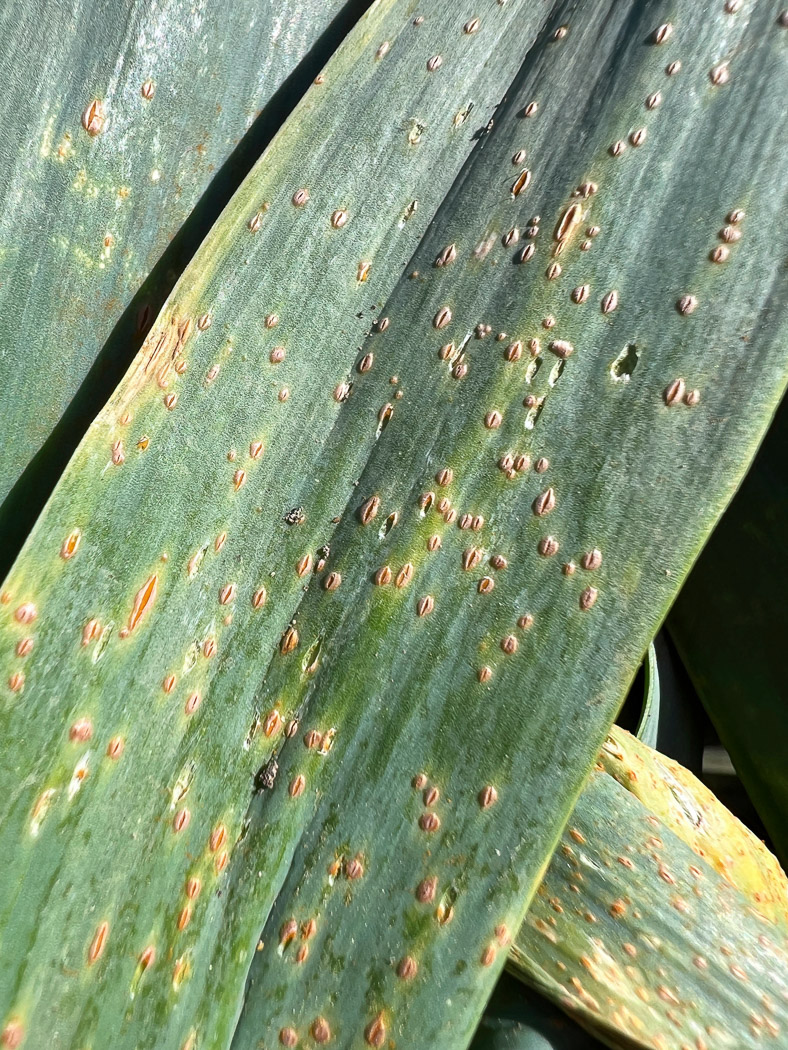 |
April 20th Puccinia porri (Allium Rust) In his Naphill allotment Neil Fletcher lifted some leeks and noticed a species of rust affecting them. Checking online for diseases on leeks led him to the name of this rust species which appears to be a first for the county - no great surprise that it should not have been recorded previously either by BFG or by those from Bucks using FRDBI. Plant pathogens, especially those affecting vegetables, tend to go unnoticed by generalist field mycologists but are still very much part of Kingdom Fungi. Members' Finds New Species no. 1282 |
April 17th 2026
| Just in May 7th 2025 |
Russula inopinata nom. prov. (a species of Brittlegill new to science) Click here |
April 16th 2026
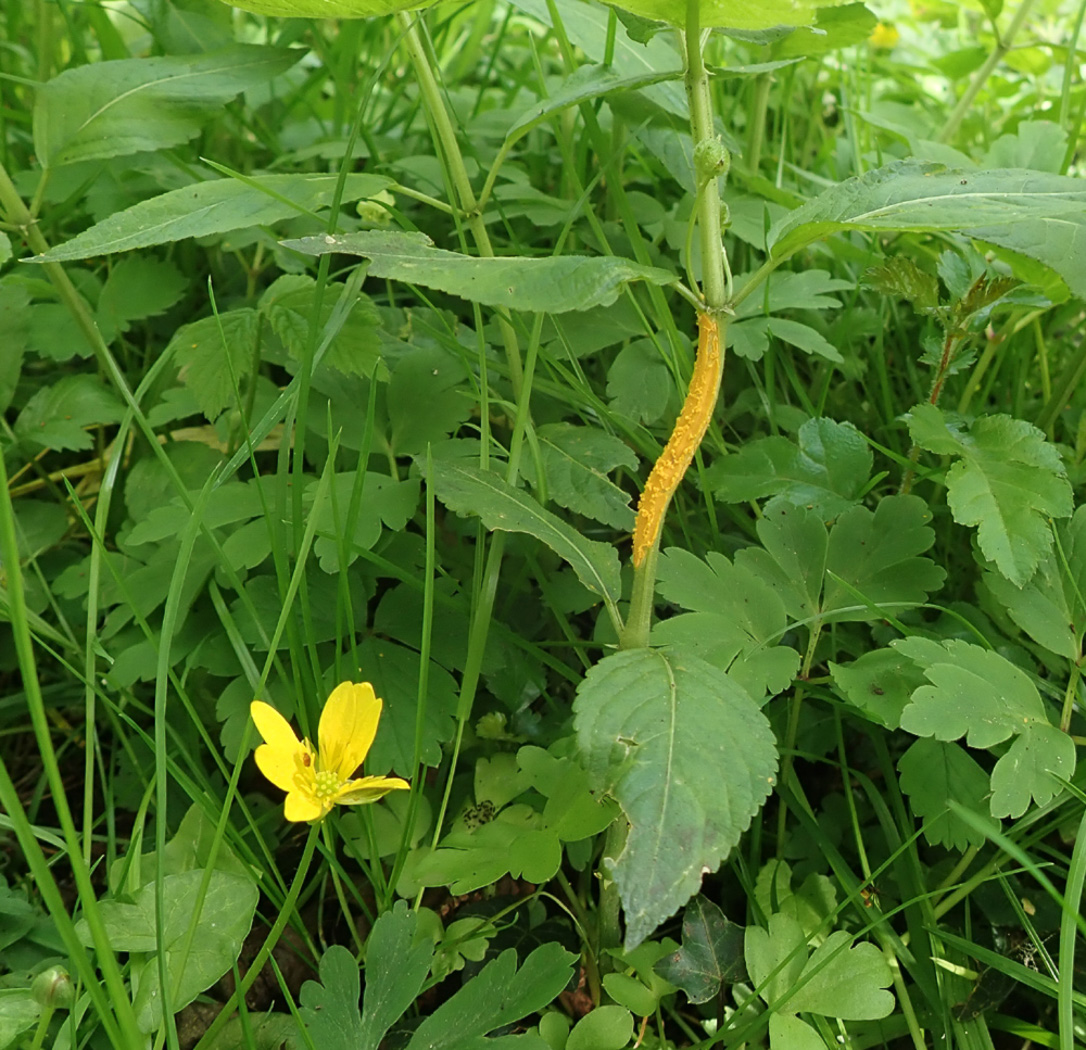 |
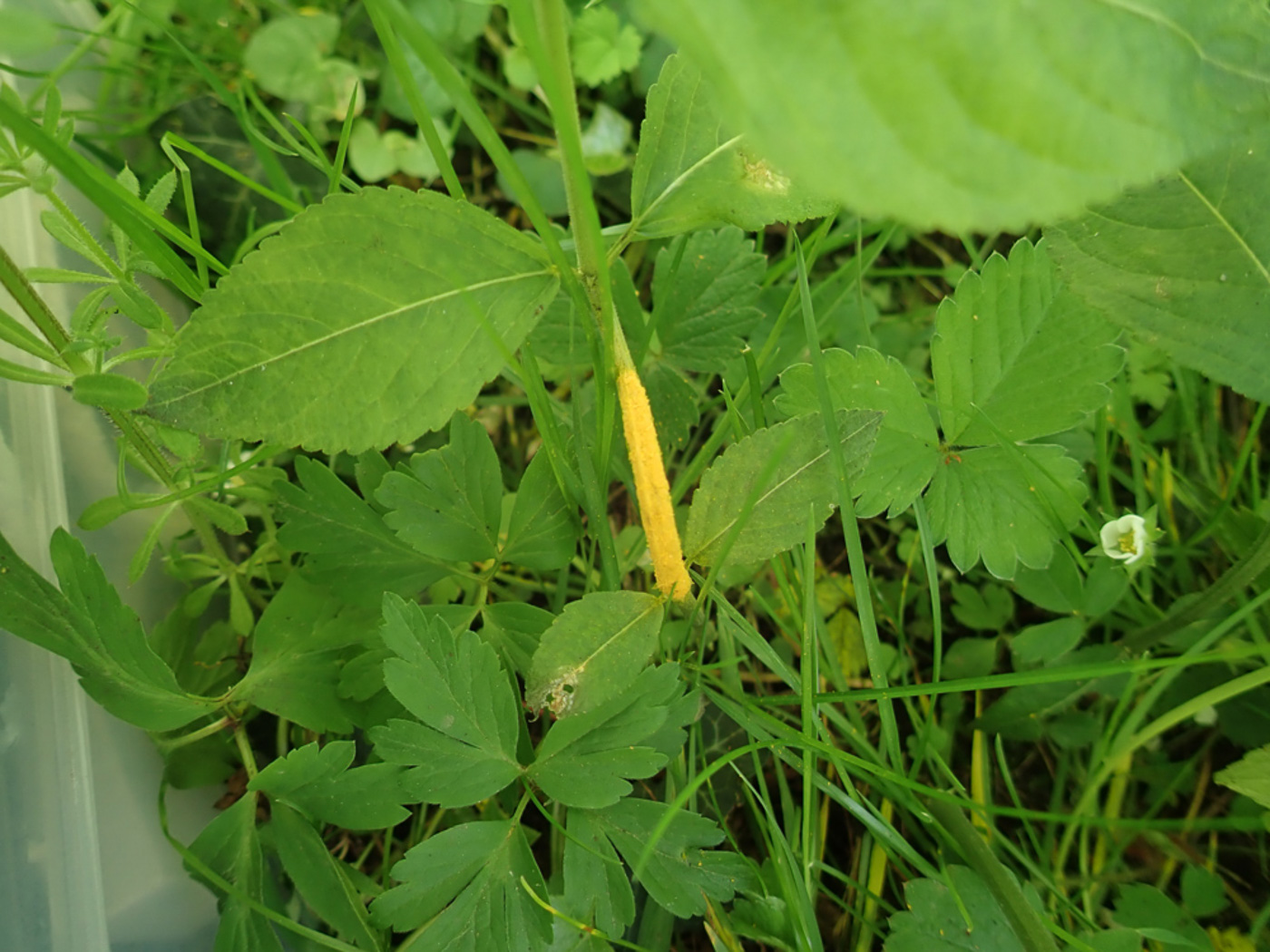
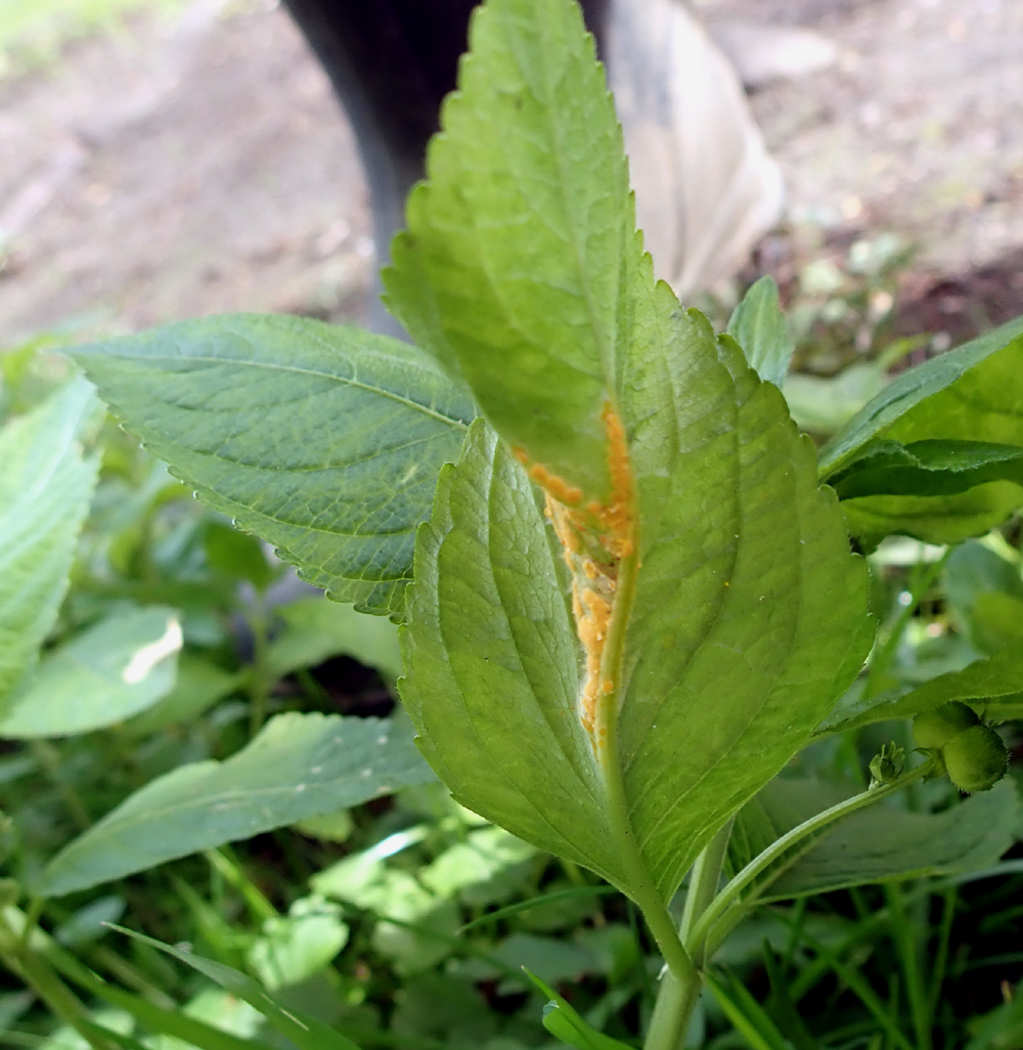
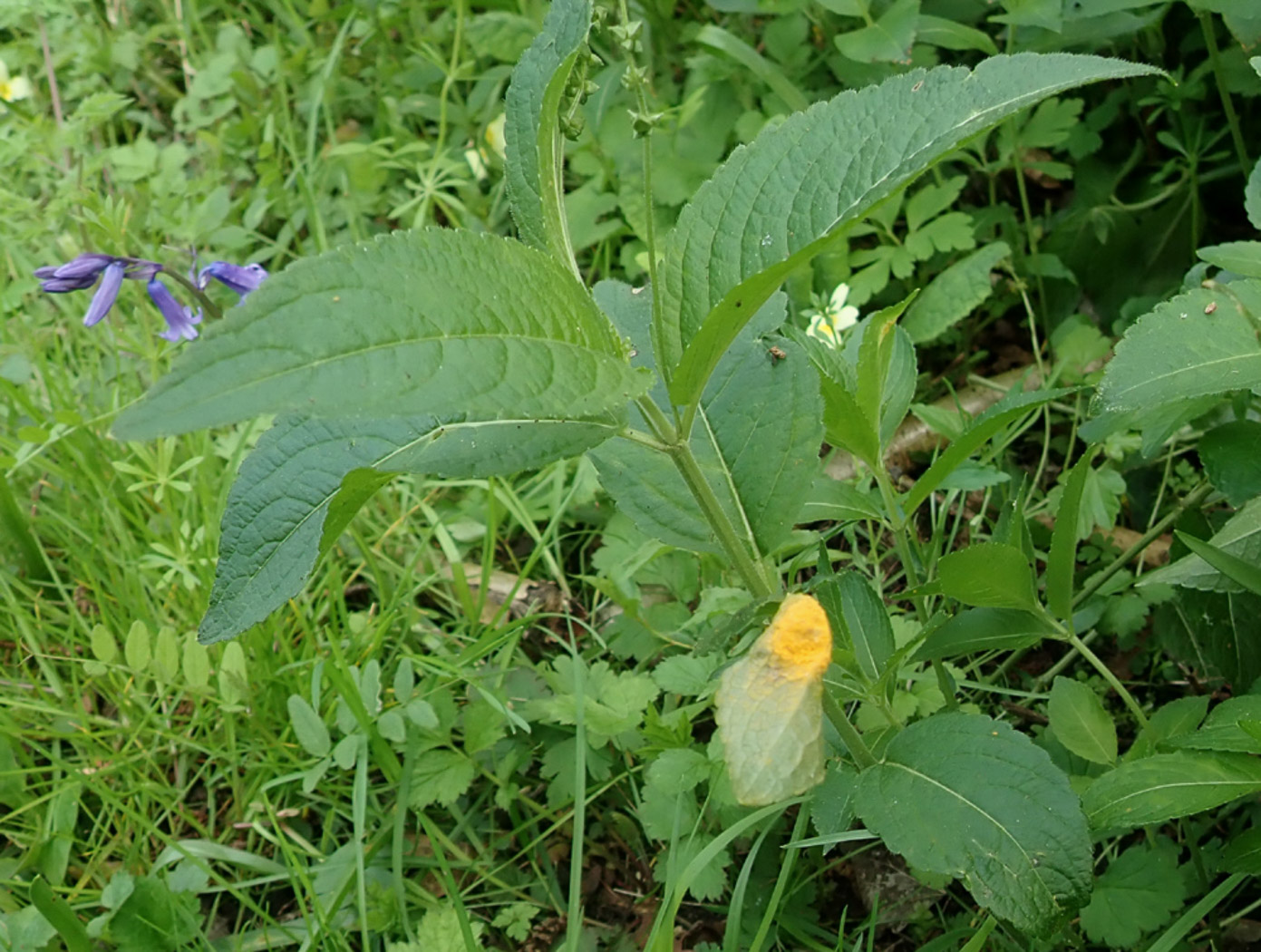
April 16th Melampsora rostrupii (Dog's Mercury Rust) Rushbeds Wood was looking and sounding lovely with a wonderful array of wild flowers and birdsong, but there was extremely little sign of fungi! Penny saw no sign of a mushroom of any sort but did find that just a few of the many prolific patches of Dog's Mercury were showing signs of the rust which occurs commonly on this plant in spring. It affects both stems and leaves but appears to do the plant no lasting damage as the quantities of it on show today surely demonstrate. Previous finds |
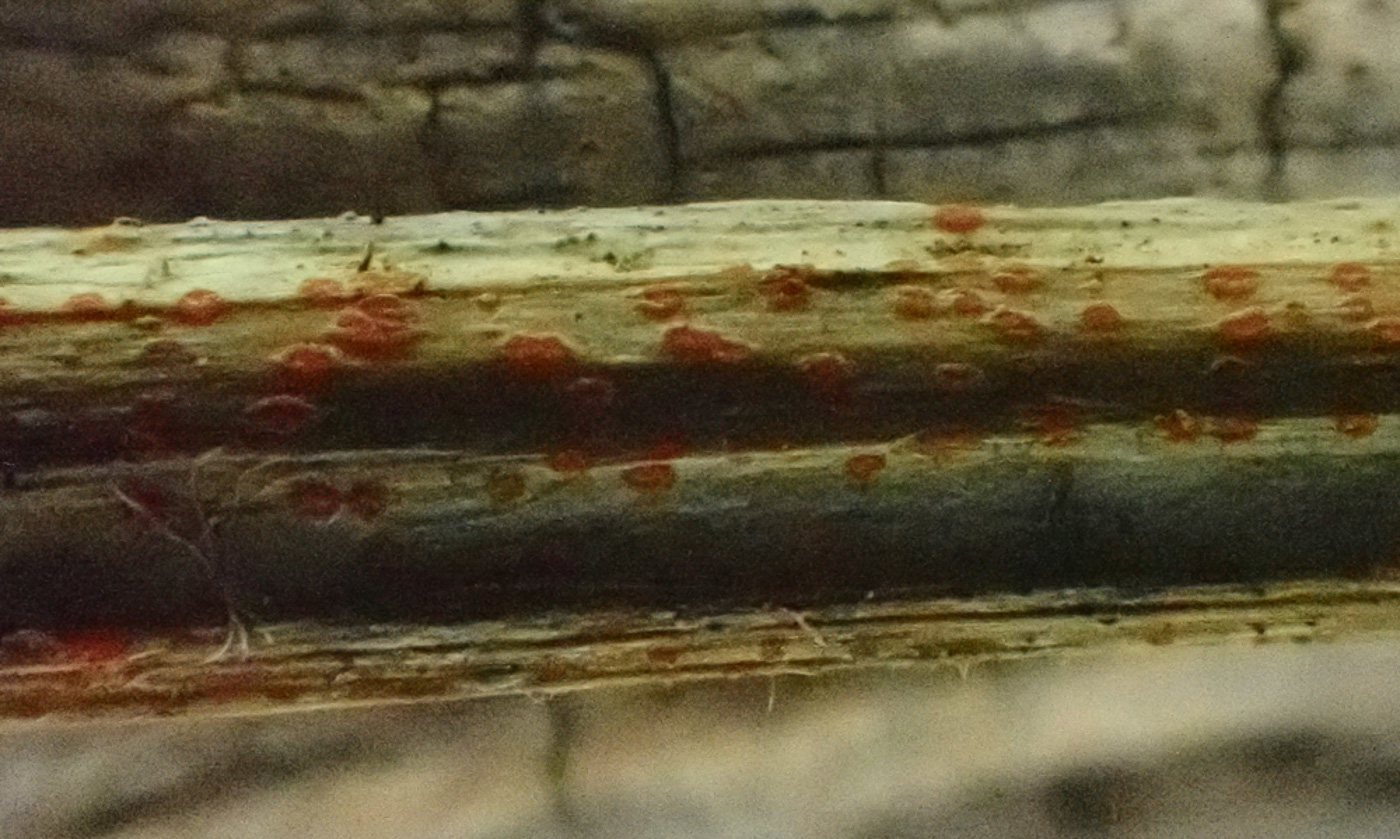 |
April 16th Calloria urticae (Nettle Pox) Rushbeds Wood was looking and sounding lovely with a wonderful array of wild flowers and birdsong, but there was extremely little sign of fungi! Penny saw no sign of a mushroom of any sort but did spot some dead nettle stems, one of which had a good swarm of these tiny orange discs at its base. The species is common but only occurs in spring on last year's stem of this plant. Previous finds |
April 14th 2026
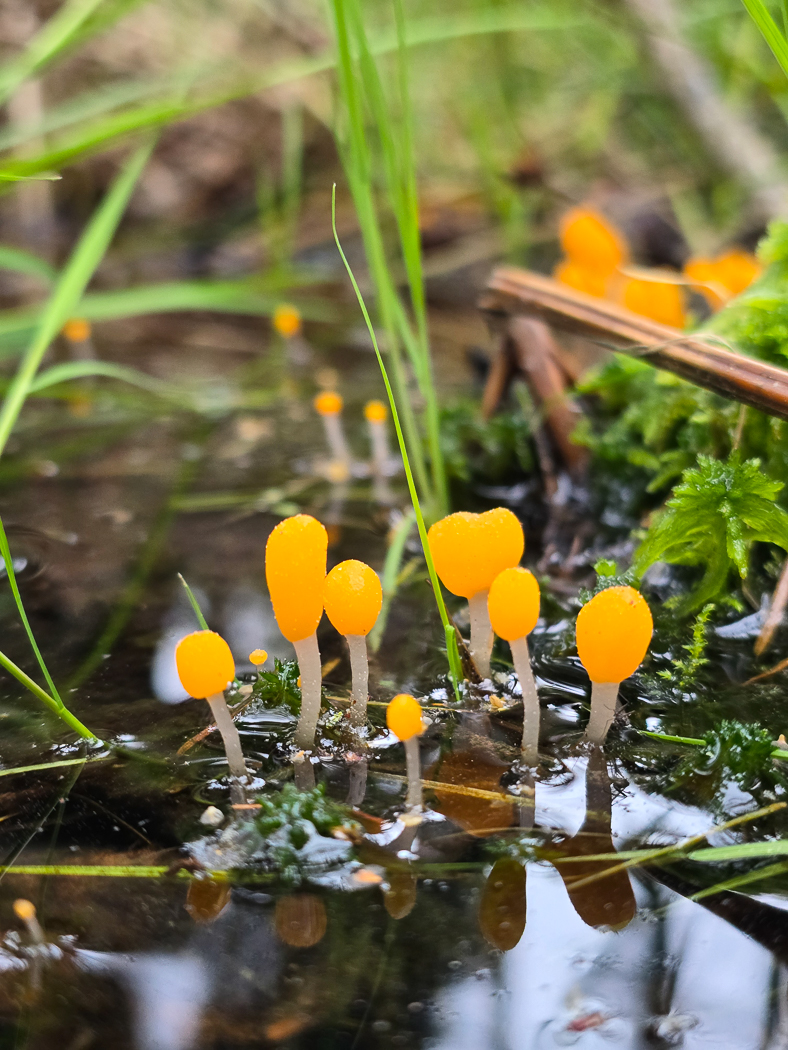 |
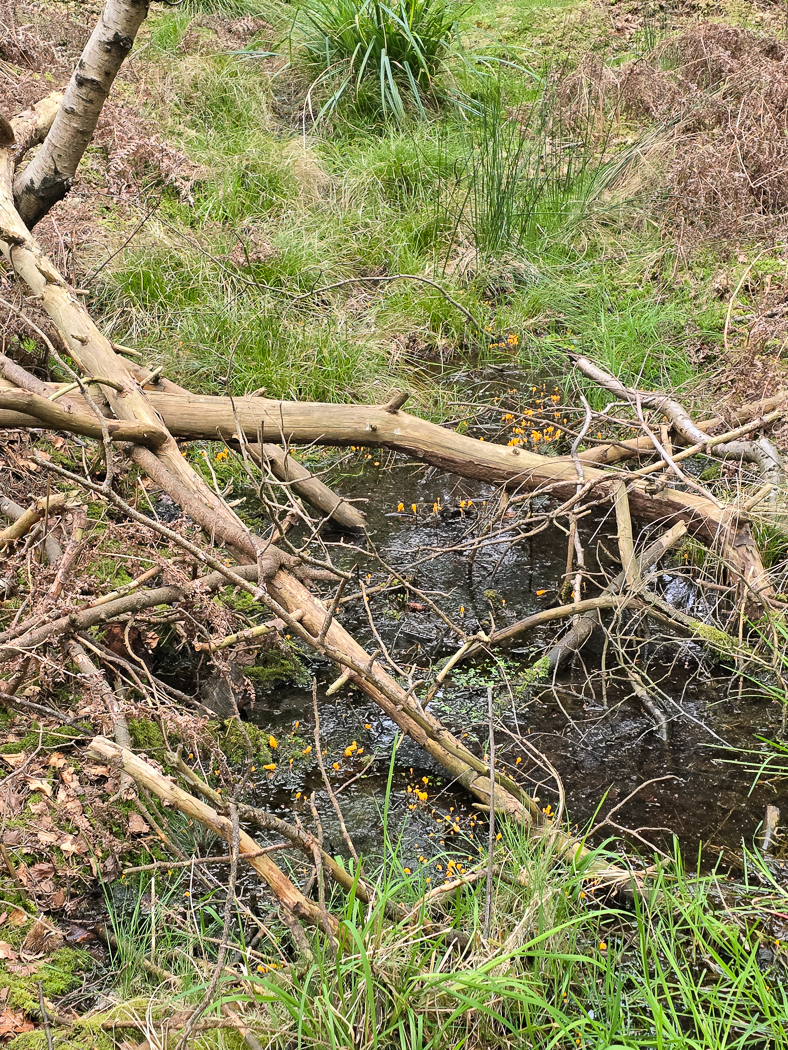
April 14th Mitrula paludosa (Bog Beacon) A friend of Hassan-al-Farhan sent him a photo of this fungus he'd just found in Back Wood in the Brickhills, wanting to know what it was. The species being high up on his wish list, Hassan visited the site the same evening and took these impressive photos. This is a species which we record regularly from the mire at Burnham Beeches during April and May (once in March, once in June) and hope to see on our visit to the site in a few days time, though apart from one sighting in Danesborough - not that far from Brickhill - we have no other sightings within the county. Previous finds |
April 5th 2026
.jpg "Photo © Sarah Ebdon") |
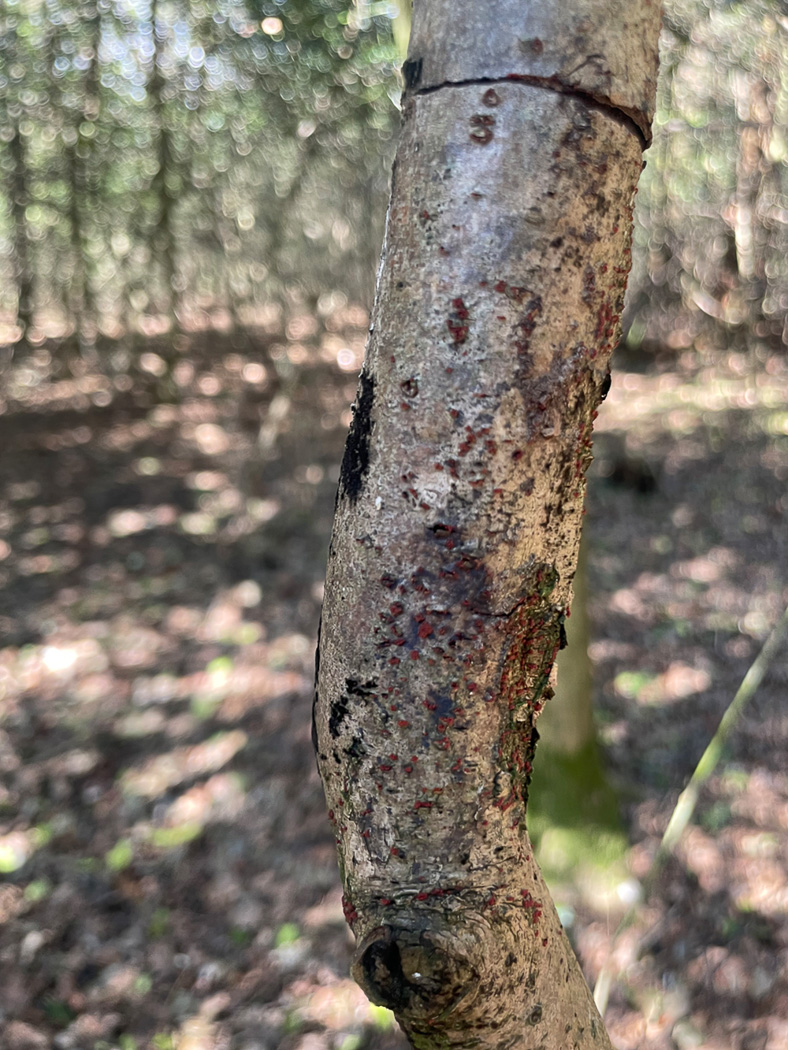
April 5th Neonectria punicea (a relative of the asco Coral Spot with no English name) Having worked on the rare Neonectria ilicis only a few days previously - a species thought to be host specific with mature Holly (see entry dated April 1st), Sarah Ebdon noticed this very similar fruiting also on Holly in Naphill Common but on young Holly rather than over 100 years old as the Burnham Beeches collection had been. She also thought it looked slightly different so decided to check the spore size, knowing this differed significantly between the two species. (Until recently N. ilicis was considered a variety of N. punicea, lacking species status). The spores were indeed notably smaller than those of N. ilicis and with all characteristics matching those of N. punicea, so she then followed this up by checking expert Paul Cannon's website which confirmed that N. punicea occurs on Holly as well as various other broadleaf woods including Buckthorn. (Photo 2 shows the mm bars giving an idea of the tiny size of this species.) A sample will be sequenced but this is a positive ID of yet another interesting species new to the county and also a good spot in the field together with thorough detective work on Sarah's part. Members' Finds New Species no. 1280 |
.jpg "Photo © Jesper Launder") |
April 5th Verpa conica (Thimble Morel) When passing through Bourne End Jesper Launder spotted this singleton spring asco on a bank under Ash and Sycamore, an occasional fruiter related to the morels though lacking their 'honeycomb' surface and having a smoother more wrinkled appearance, also often developing a long stem. Looking for it in grassy path edges or even grassy areas over the next few weeks could be rewarding. Previous finds |
April 4th 2026
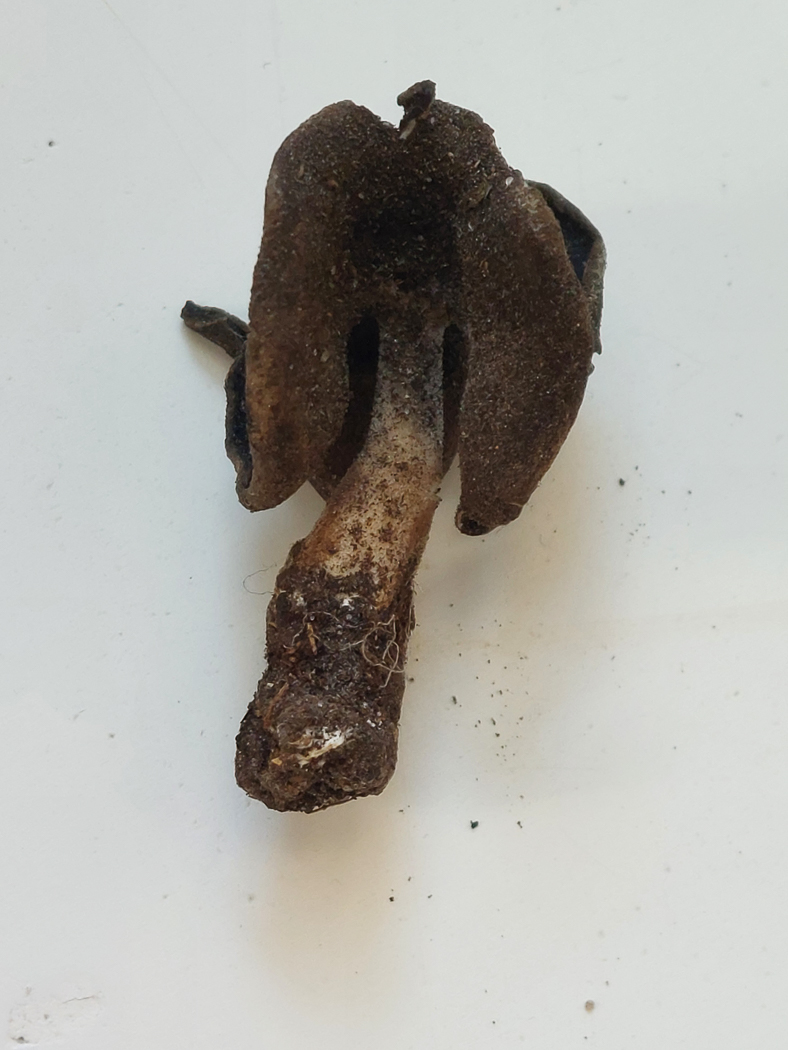 |
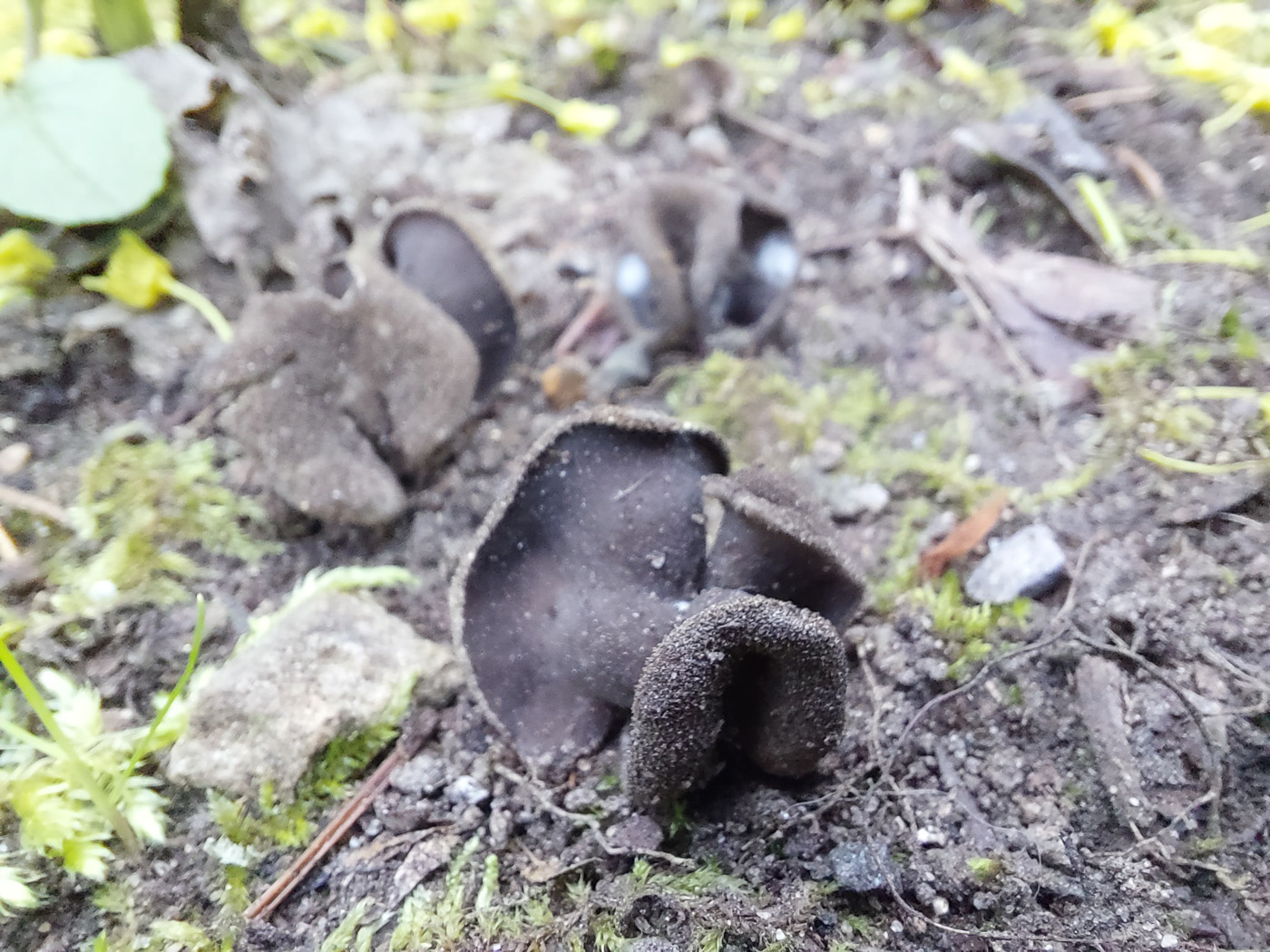
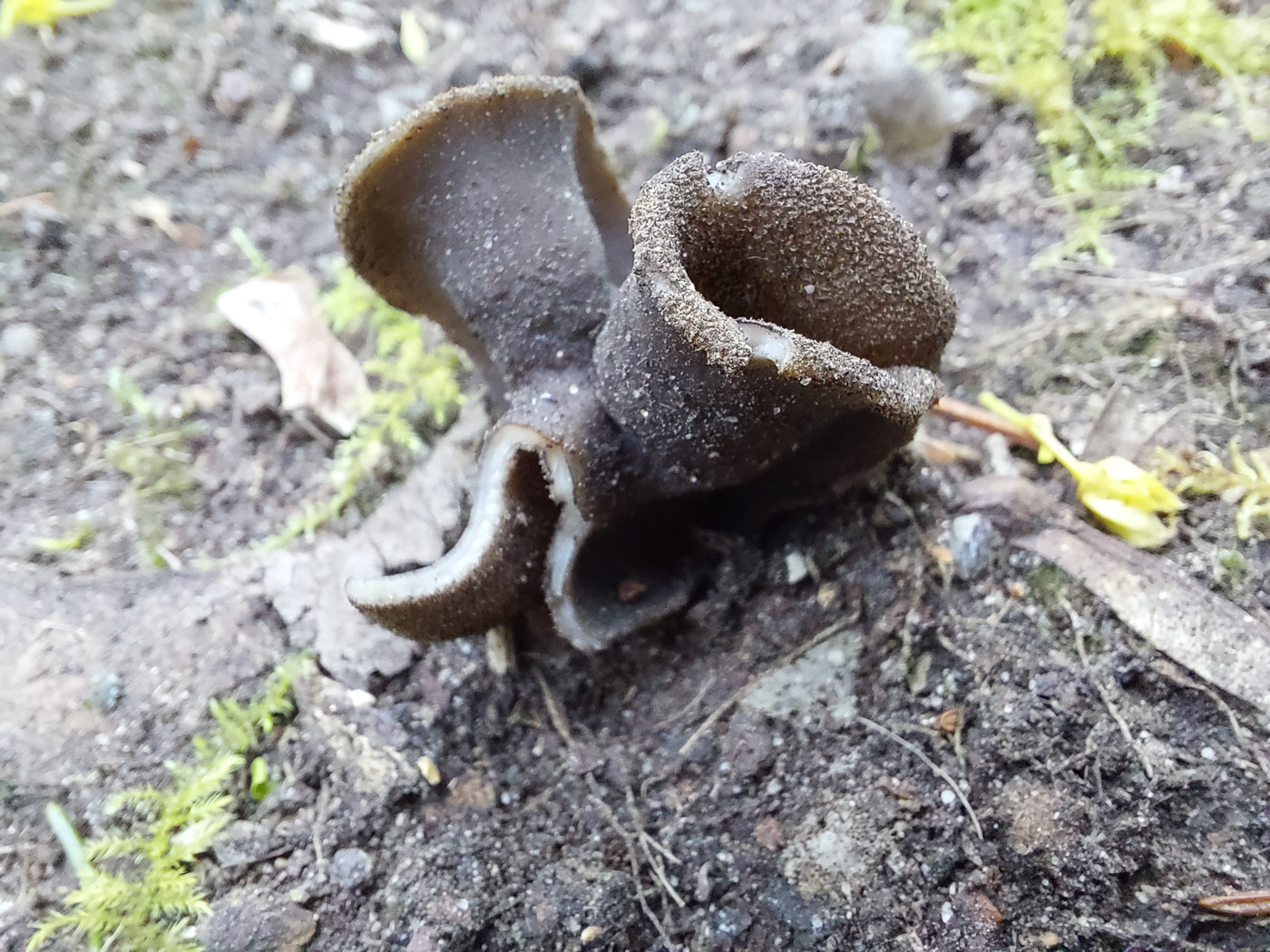
April 4th Helvella cf. pezizoides (a rare cup fungus with no English name) On the same shady mossy bank in Chalfont St. Giles where Jesper Launder had just found an extensive display of Disciotis venosa (see that entry for the same date), he also spotted this unfamiliar and rather dark small saddle-shaped Helvella emerging. At home using a lengthy key recommended by the website AscoFrance he arrived at the name H. pezizoides though with some reservations, hence the 'cf' included here, and a sample will be sequenced to confirm. The species, first described in 1786, has a long list of synonyms, it having been placed in a range of different genera; there are around 30 UK records and this is yet another species new to the county. Members' Finds New Species no. 1279 |
 |
April 4th Disciotis venosa (Bleach Cup) On a shady mossy bank in Chalfont St, Giles Jesper Launder found an extensive display (15+ cups) of this quite common springtime cup fungus. Do not confuse it with the similar Helvella acetabulum also around at the moment (see entry for March 27th) and if in doubt the smell of bleach present in the Disciotis should help! Previous Finds entries for this species and the Helvella contain further descriptive notes. Previous finds |
April 2nd 2026
.jpg "Photo © Jesper Launder")
 |
April 2nd Asterostroma cervicolor (Brown Starweb) In woods near Layter's Green, Chalfont St. Peter, Jesper Launder turned over a log in search of Inkcap ozonium (see his entry for Coprinellus domesticus of the same date) and was rewarded not only with the ozonium but also with this unfamiliar cobwebby whitish corticioid, a rare species and new to the county. He noticed some pinkish purple patches and wondered if they might be a secondary infection, then discovered later at home not only nodulose spores but these remarkable star-shaped brown cells - 'asterosetae' (see photo 2) which lead him to this genus, whereupon further research revealed this particular species which can develop these purple patches. The epithet cervicolor, shared with the very common Pluteus species, pertains to the colour of deer and refers here to the asterosetae. For further information try:- https://share.google/WLV4cZhhoCLokpvSo Members' Finds New Species no. 1278 |
.jpg "Photo © Jesper Launder")
 |
April 2nd Coprinellus domesticus (Firerug Inkcap) In woods near Layter's Green, Chalfont St. Peter, Jesper Launder noticed this pristine Inkcap on a mossy log, The veil was impressive and the microscopic details of both this feature and the spores fitted perfectly at home. On collection he noticed beneath the log the orange rusty matt of 'ozonium' to which the English name of this species refers (see photo 2); ozonium is described as above-ground mycelium and can often though not always be found along with this mushroom. It lasts longer that the quickly deliquescing fruit body and can sometimes be seen on its own on the underside of logs without the mushroom being present. (Note: photo 2 also shows a white corticioid fungus alongside the rusty ozonium - see the entry for Asterostroma cervivolor with the same date.) Previous finds |
April 1st 2026
 |
April 1st Neonectria ilicis (a relative of the asco Coral Spot with no common name) A Burnham Beeches volunteer noticed these tiny coral orange clustered specks generously covering various mature trunks of Holly, wondered if they were unusual and reported back to ranger and BFG member Jordy Payne. Jordy then sent a photo to Sarah Ebdon who guessed from their appearance that they could well be Nectria punicea var. ilicis, new to the site and the county. The site conservation officer Angus Wilkinson then contacted Penny who visited the next day with Jordy to take samples to examine and dry for sequencing. Having compared notes on the microscopic detail, both Penny and Sarah are agreed that by far the likeliest ID is the fungus named here, recently raised to species level and with distinct differences from N. punicea ss. It is thought to be host specific to Holly, occurring on old possibly dying wood; though the age of the host trees here is not known exactly, the trunks are extremely tall and thick with graffiti in places dating from 1930 thus pointing to the likelihood of their being at least 100 years old. The photos are Jordy's. Members' Finds New Species no. 1275 |

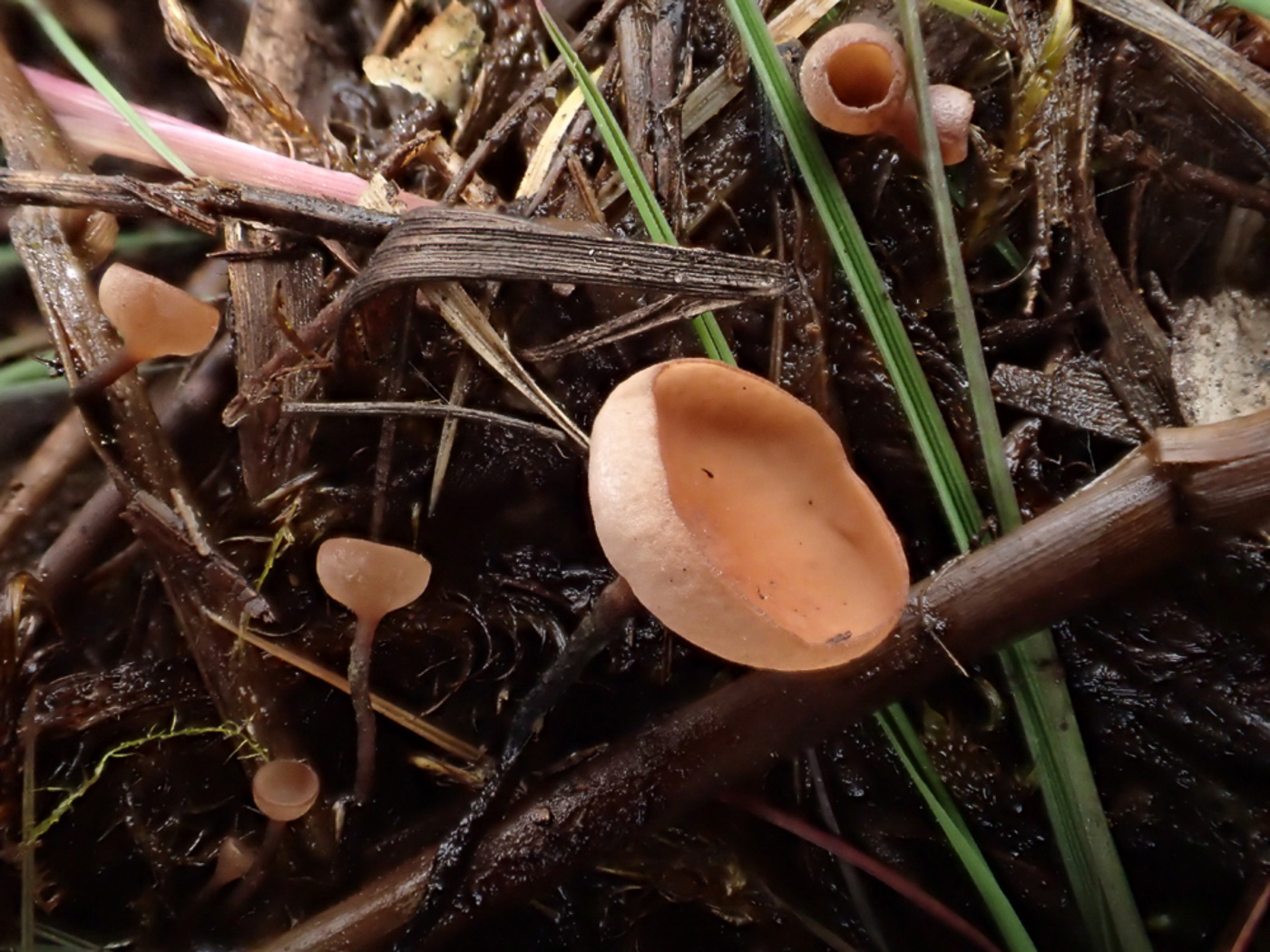
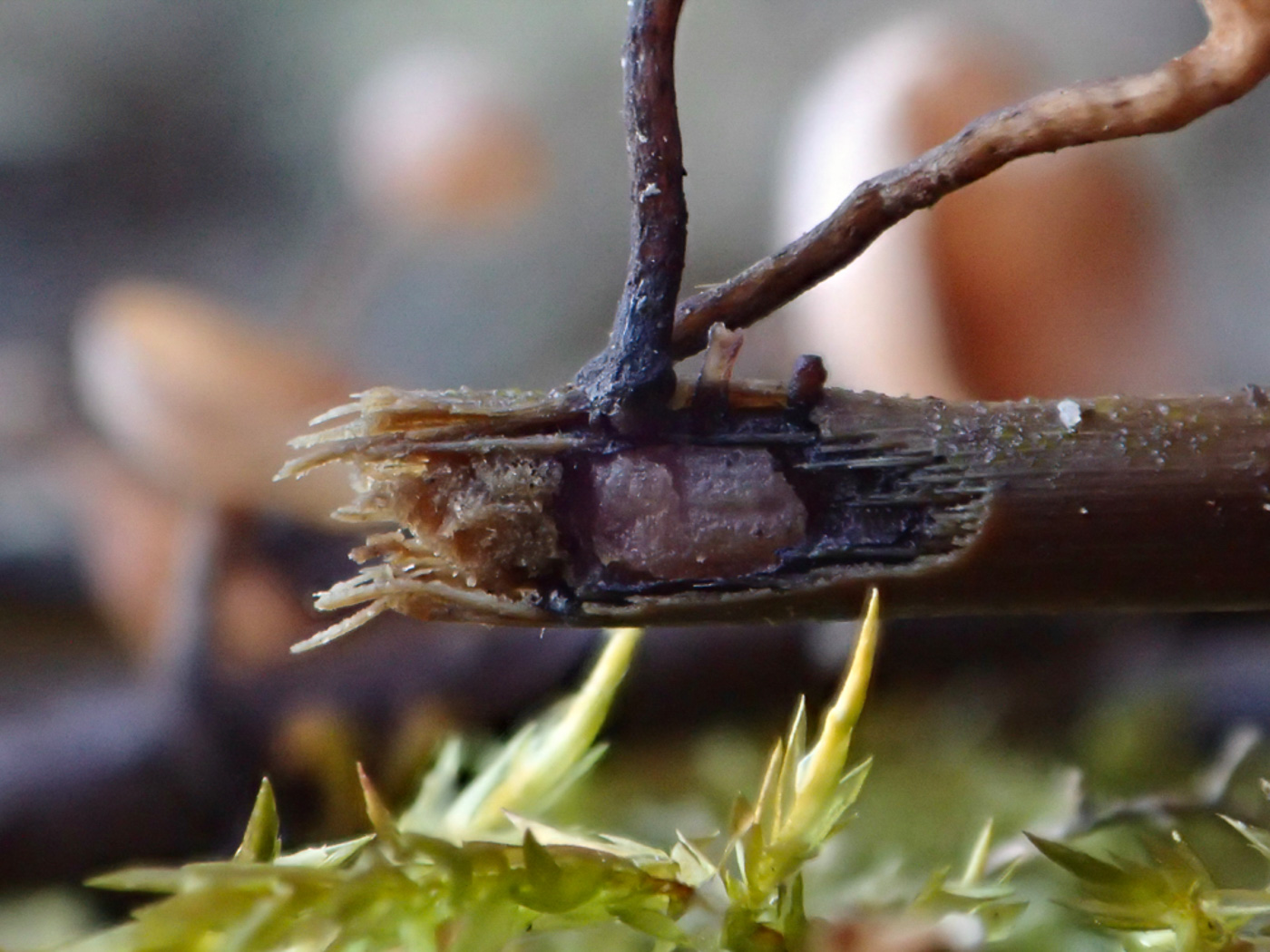
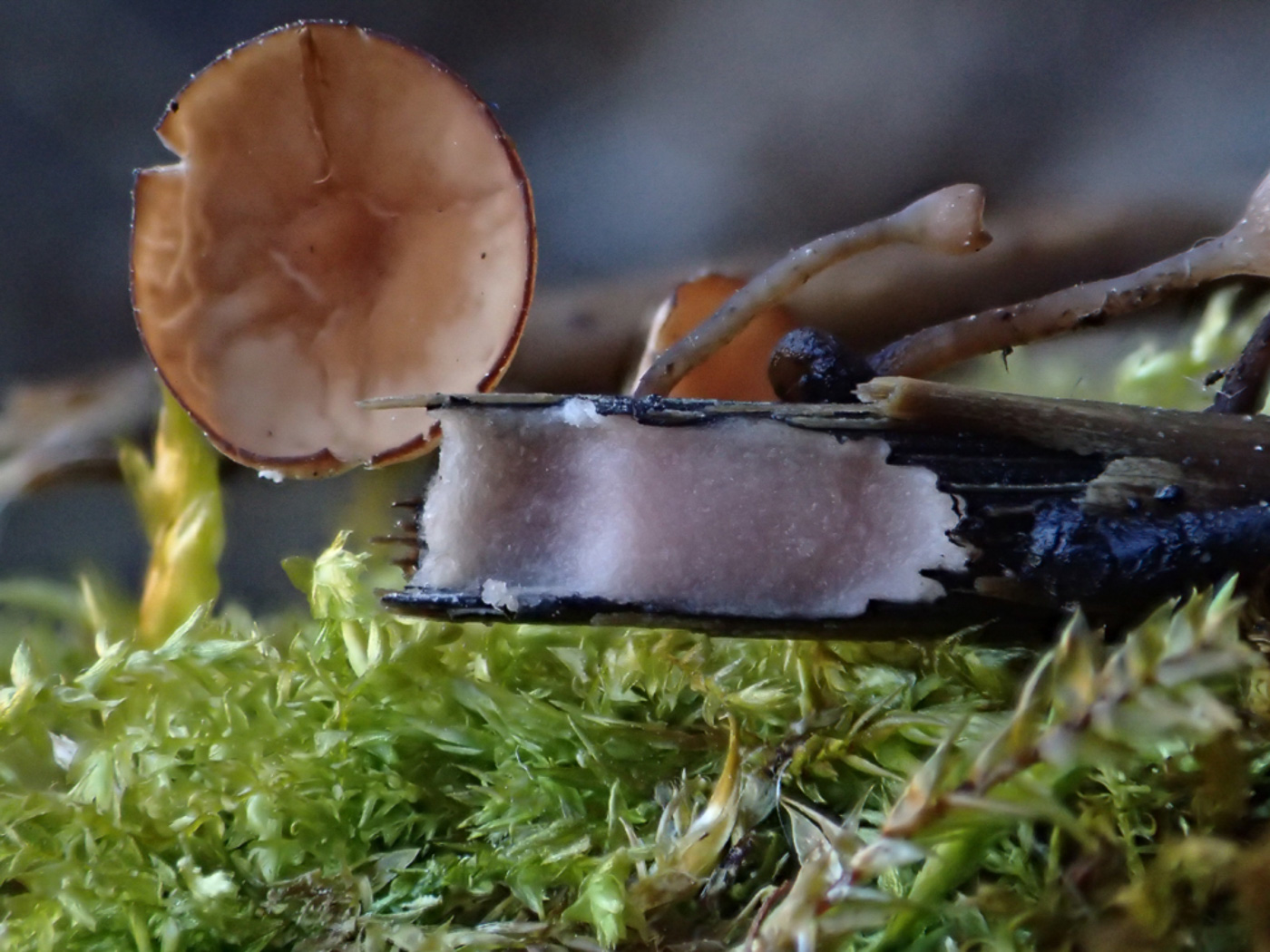
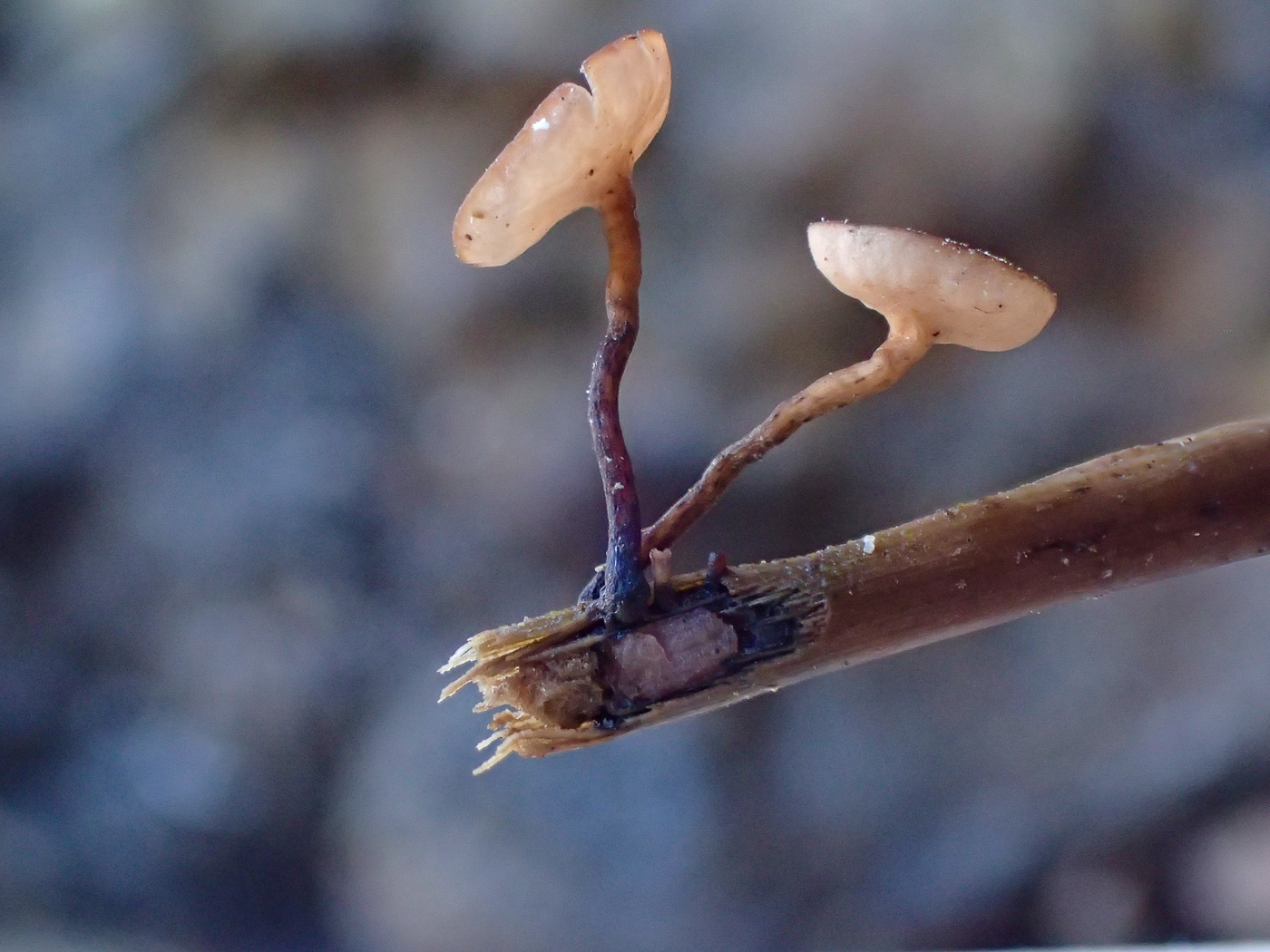 |
April 1st Myriosclerotia curreyana (an asco with no English name) At Stoke Common fungi were hard to find but one useful substrate which gave our small group interest was the plentiful supply of prostrate soggy dead Juncus stems. Amongst the really wet rotting old lying stems Gill Ferguson was the first to spot this hairless cup fungus having a long stem, whereupon careful searching soon revealed these cups were plentiful - we were spoilt for choice. Furthermore, it turned out to be a species Sarah Ebdon had been on the lookout for for several years but had failed to find - she could hardly believe her eyes! Host specific to these rotting old Juncus stems, this species has a small sclerotium (a hardened mass of hyphae providing a food source for use in times of stress) at its base but within the host substrate. Sarah knew to check for this in the field, and was thrilled to be able to reveal the sclerotia with its pinkish contents - a colour unique to the species and clearly visible in three of Sarah's photos here. The mature cups were up to about 1cm across and stems about two to three times that. We have just three previous county records, though - like many such insignificant rather specialist species - it is not rare but regularly overlooked. Members' Finds New Species no. 1274 |
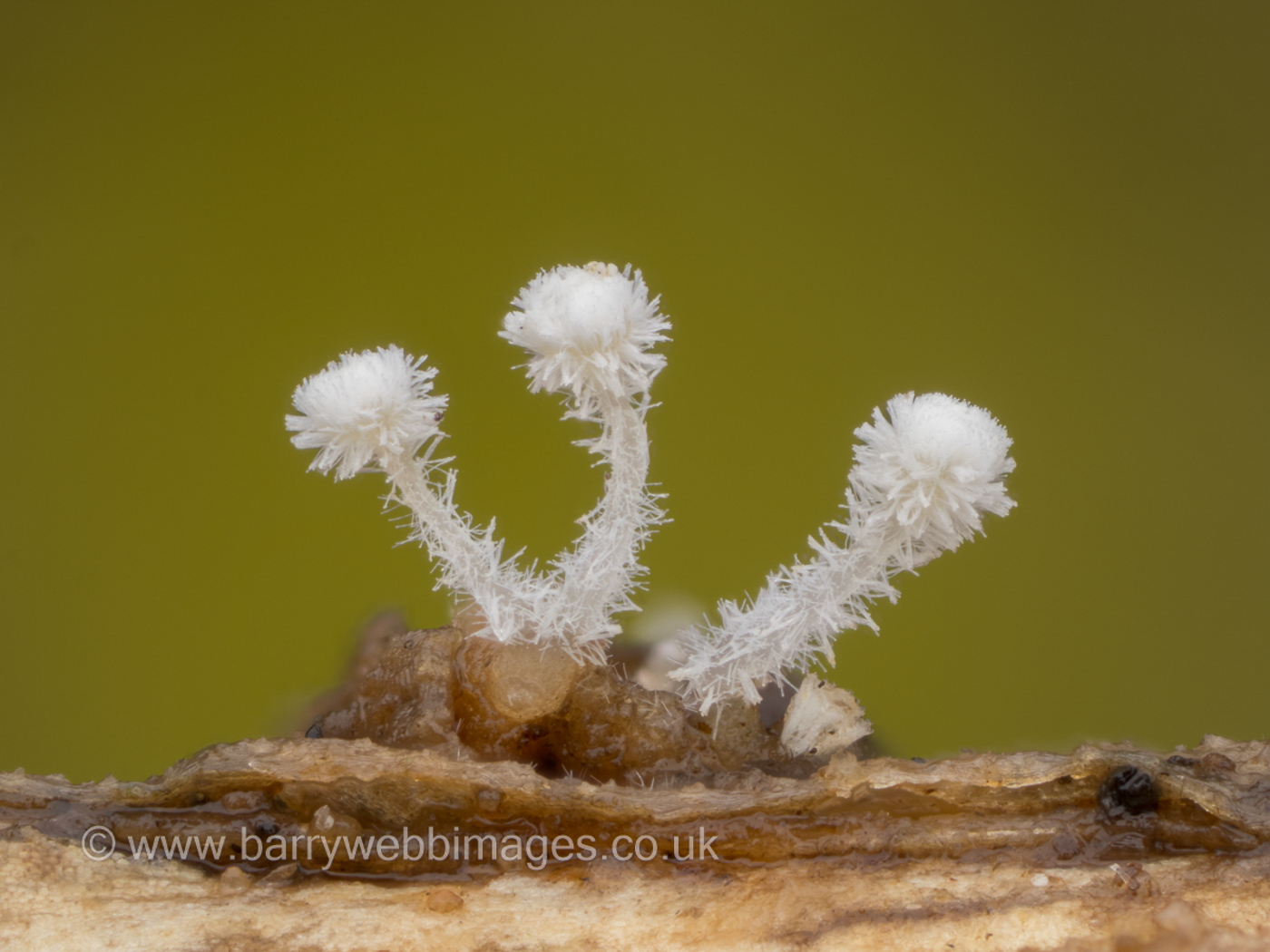
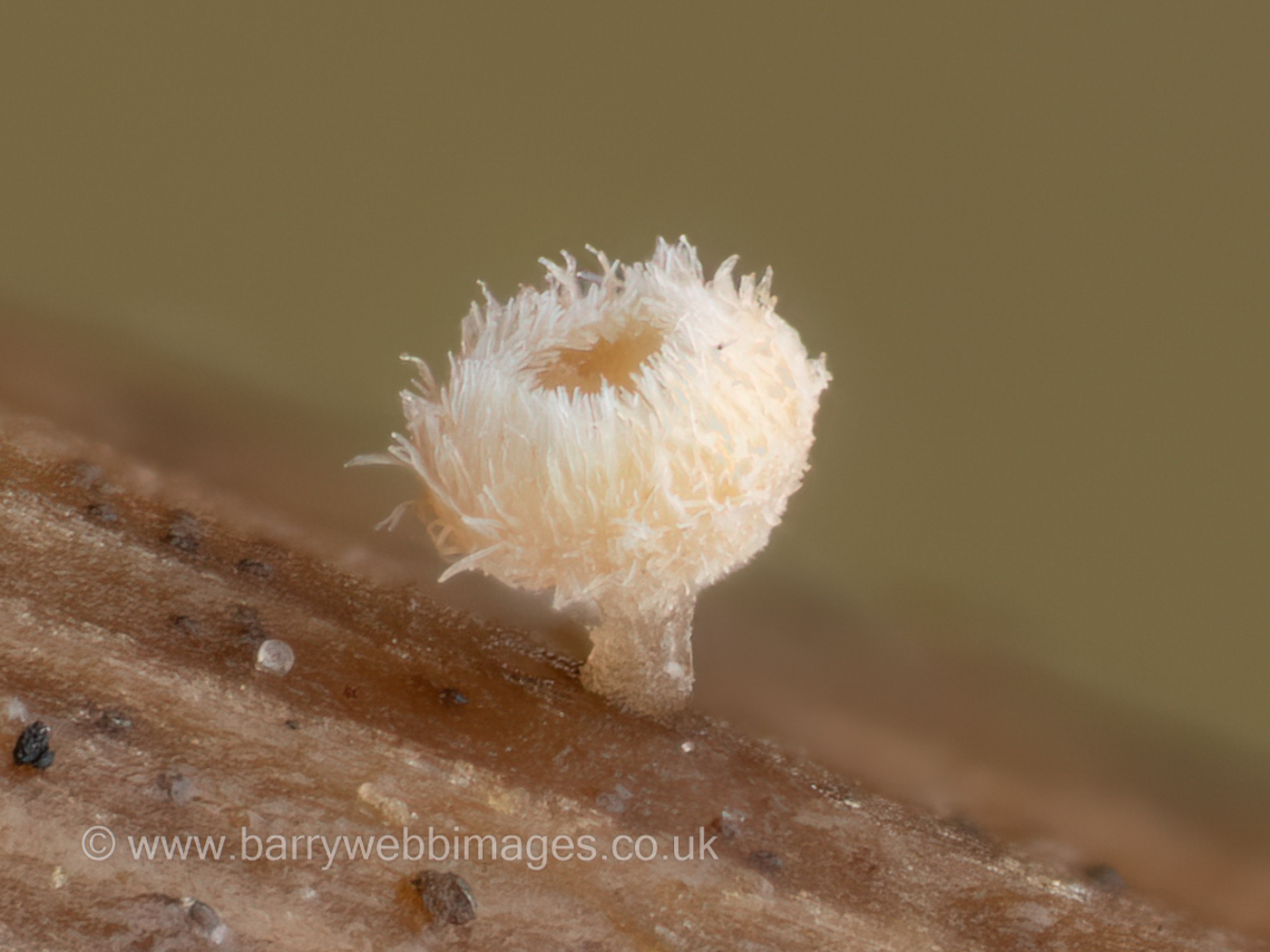 |
April 1st Lachnum apalum (Rush Disco) At Stoke Common fungi were hard to find but one useful substrate which gave our small group interest was the plentiful supply of prostrate soggy dead Juncus stems. One species found on this host by Jesper Launder was only just visible to the naked eye but a handlens revealed the clusters of these telltale hairy white fruitbodies, less than 0.5mm across and host specific to Juncus. It is very common and almost always present if one knows where to look given suitably soggy conditions. This appears to be new to Finds and we were lucky to have Barry Webb on hand to take the photos. Members' Finds New Species no. 1273 |
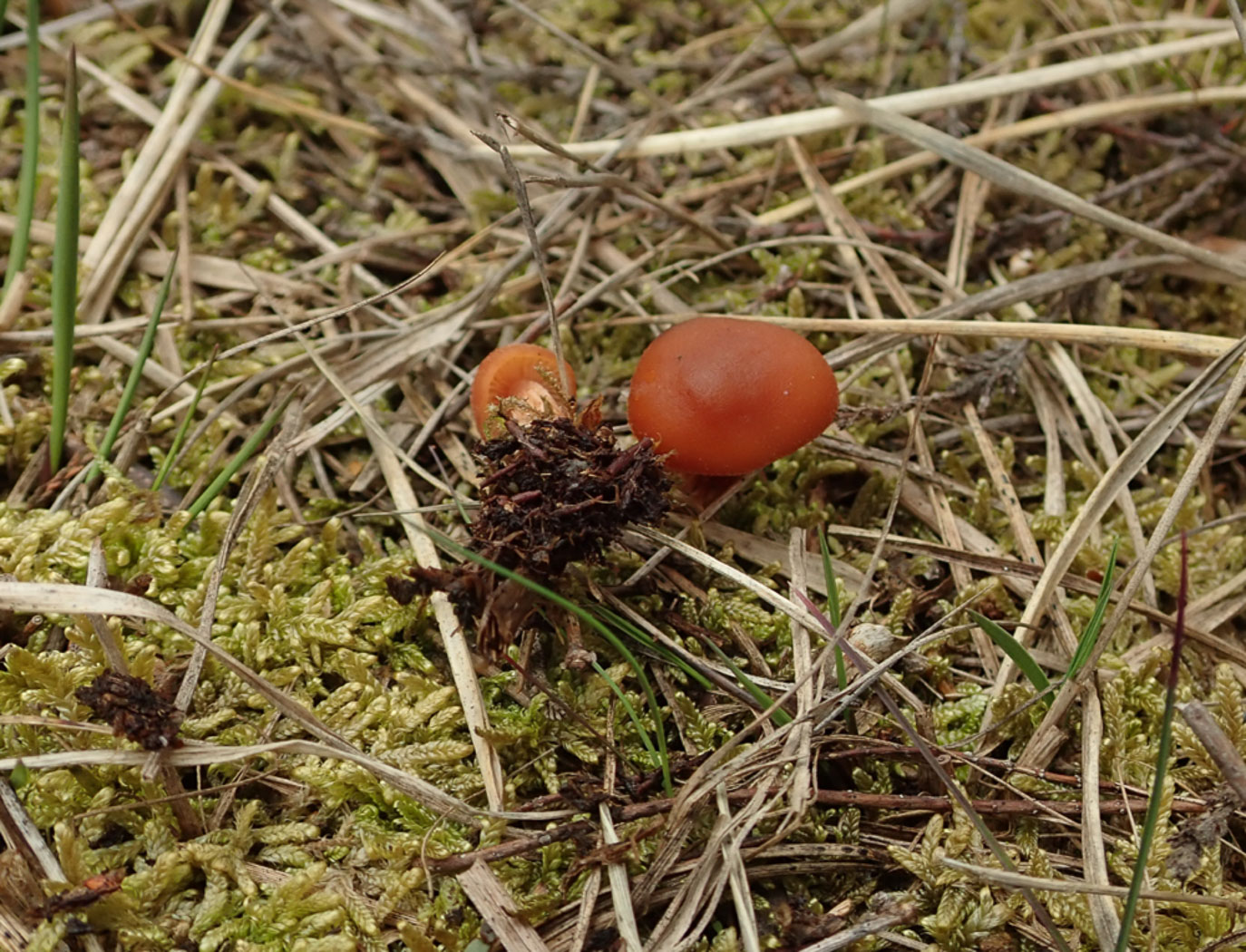 |
April 1st Laccaria proxima (Scurfy Deceiver) At Stoke Common there was extremely little evidence of fungi of any sort but Penny spotted these two (welcome) tiny bright orange fruitbodies in thick litter under Pine. Turning one over revealed not only its somewhat flexible texture but also - even at this undeveloped stage - the widely spaced pinkish gills pointing to the genus Laccaria despite it being an odd time of year for the genus to be fruiting. At home the spiny spores were indeed those of this genus but, to her surprise, were clearly oval in shape instead of round, making it L. proxima rather than the much more common and smaller L. laccata. Of our roughly 100 county records we have only one other found in spring: Stampwell Farm on April 4th last year! What's more, Jackie Ewan's photo of that find looks pretty well identical to Penny's. Previous finds |
.jpg "Photo © Sarah Ebdon") |
April 1st Parasola misera (Least Inkcap) On an old cowpat at Stoke Common Jesper Launder spotted this tiny delicate mushroom, suspected it would be this species - quite common on dung - and checked the heart-shaped spores later at home to confirm it. There are several other Inkcaps, and indeed other genera, that are host specific to dung so care is always needed over their identification. Previous finds |
March 27th 2026
.jpg "Photo © Jesper Launder")
 |
March 27th Cortinarius cf. umbrinolens (Umber Webcap) In Green Acres Chiltern Park Jesper Launder was surprised to come across this genus, normally found in autumn, fruiting under Oak, Birch and Fir. At home he was expecting to find that the spores fitted with C. vernus (Spring Webcap), an unusual member of section Telamonia found at this time, but not so. The spores were both too slender and too long, in fact matching better with this much rarer lookalike named here though all records in FRDBI are from autumn and not spring, furthermore its characteristic strong rank smell of beetroot was missing. So there has to be some doubt here (hence the cf.) and a sample will be sequenced. If confirmed it would be new to the county. Members' Finds New Species no. 1277 |
.jpg "Photo © Jesper Launder") |
March 27th Helvella acetabulum (Vinegar Cup) In Green Acres Chiltern Park Jesper Launder was astounded by the number of these cups which were lining the paths 'in their hundreds' (his words). This is quite a common springtime species occurring in calcareous soil, sometimes grassy, with mixed trees, but surely a fruiting of this magnitude must be exceptional. The ribbing seen here on the underside is the key to recognition, and should be noted as there are other substantial cups which occur in spring commonly but which lack this feature. Previous finds |
.jpg "Photo © Jesper Launder") |
March 27th Hebeloma leucosarx (Pale Poisonpie) In Green Acres Chiltern Park Jesper Launder was surprised to come across this genus, normally found in autumn, fruiting under Birch and Fir. With experience this genus is usually an easy one to recognise; fruit bodies are often domed as seen here with a palish slightly sticky caps, pale beige gills, white stems and a distinctive radish smell, always under trees with which they are mycorrhizal. That, however, is where the easy bit ends! A key using microscopic characters is essential and even so not all collections key out satisfactorily. Jesper is fairly confident of his ID here though we will get a sample sequenced to confirm. The species is not rare and we have a range of county records though only one other found in April. Members' Finds New Species no. 1276 |
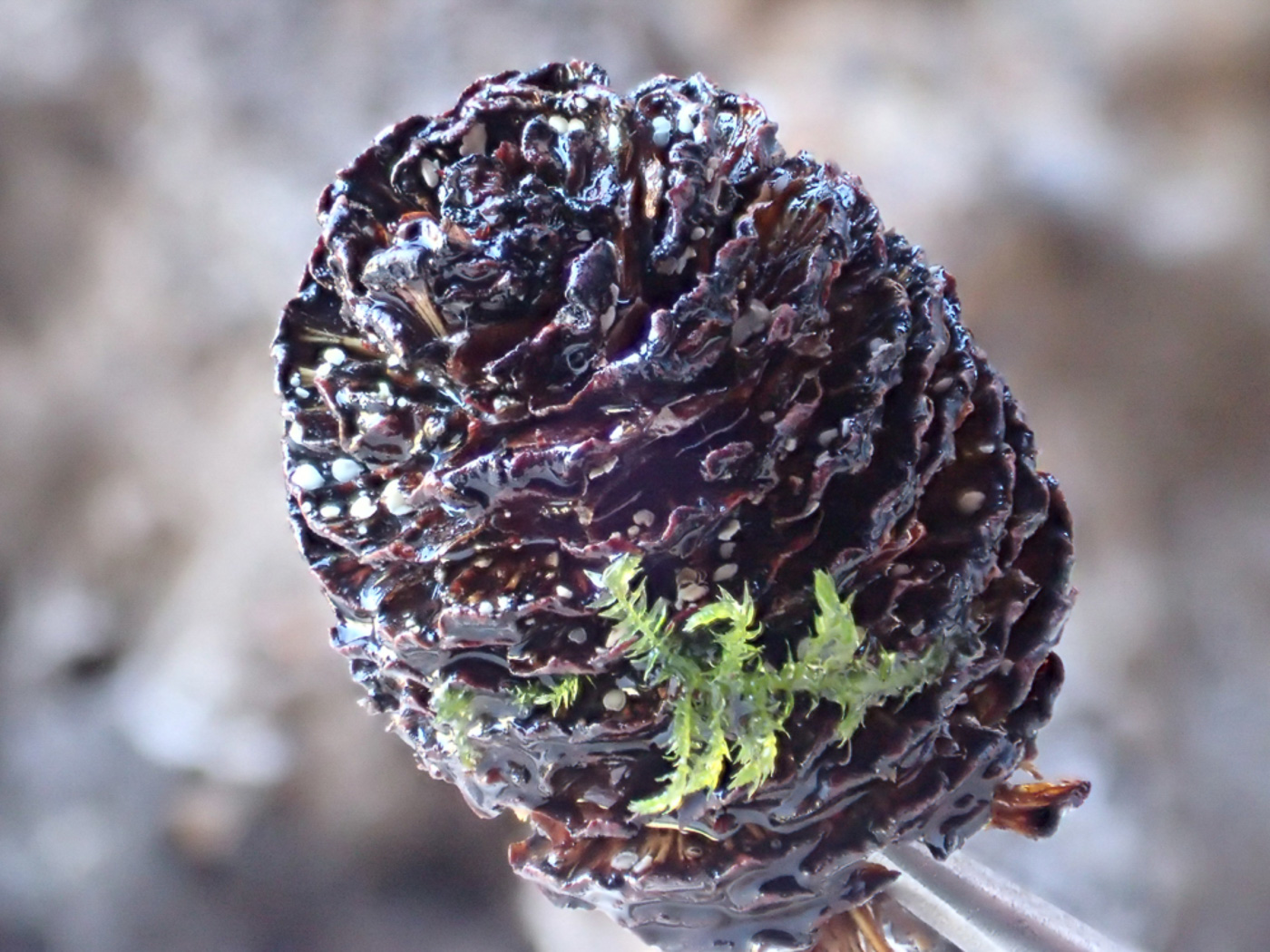
.jpg "Photo © Jesper Launder")
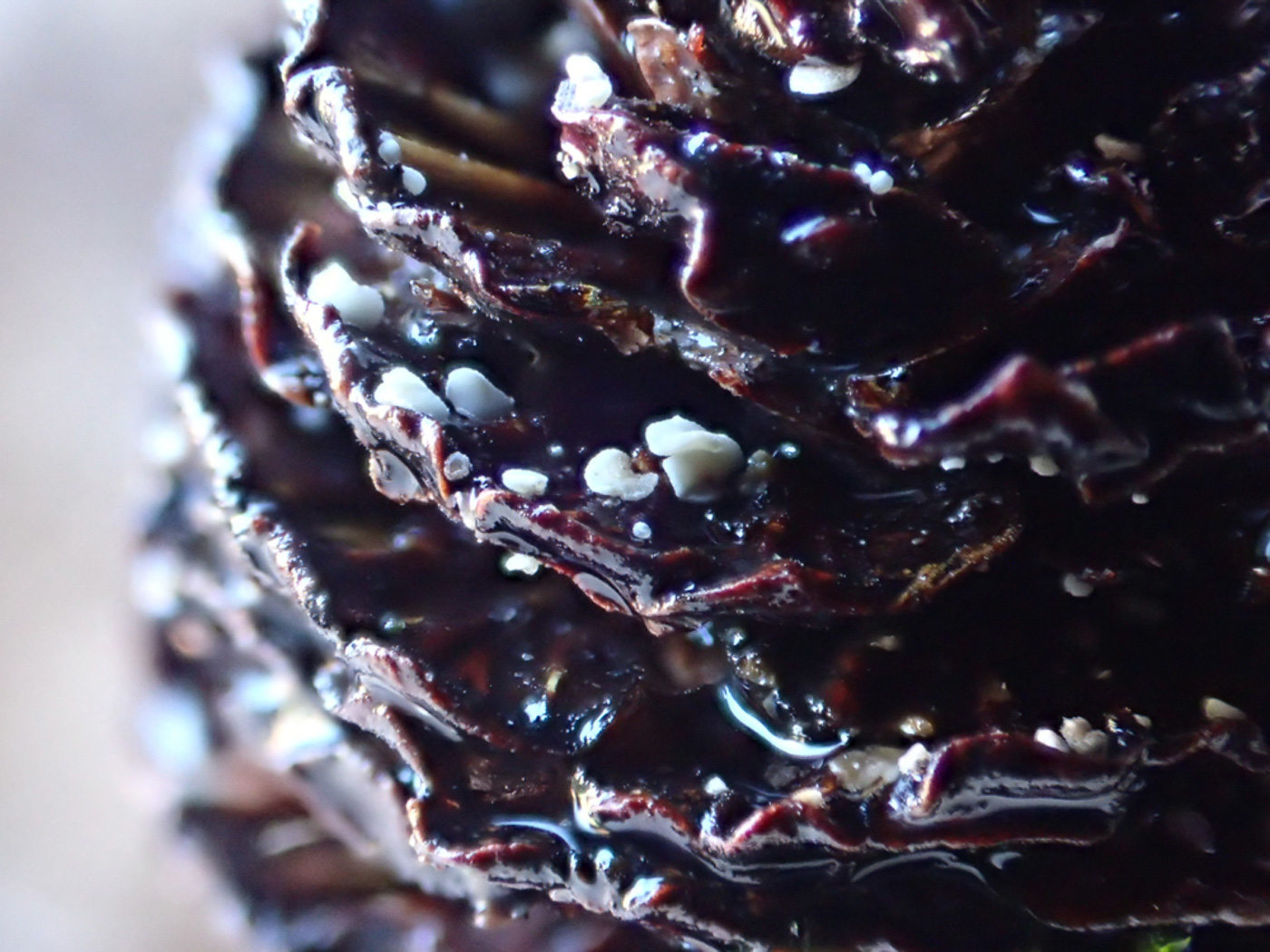 |
March 27th Calycellina alniella (an unusual asco with no English name) On a visit to Green Acre Chiltern Park (nr Beaconsfield) Jesper Launder noticed a female Alder catkin liberally covered in tiny white cup fungi and, knowing that Sarah Ebdon was interested in such species, it was later handed to her to identify and photograph. This is apparently a common species specific to this host, having extremely long thin spores which help to separate it from the very similar Mollisia alnicola which, however, fluoresces blue with a UV torch. Today's sample showed no such reaction when Sarah tested it, further confirming her ID. So she's now on the hunt for this Mollisia which would be new to the county! We have just three earlier county records of today's find (which was previously in genus Pezizella). Members' Finds New Species no. 1272 |
March 25th 2026
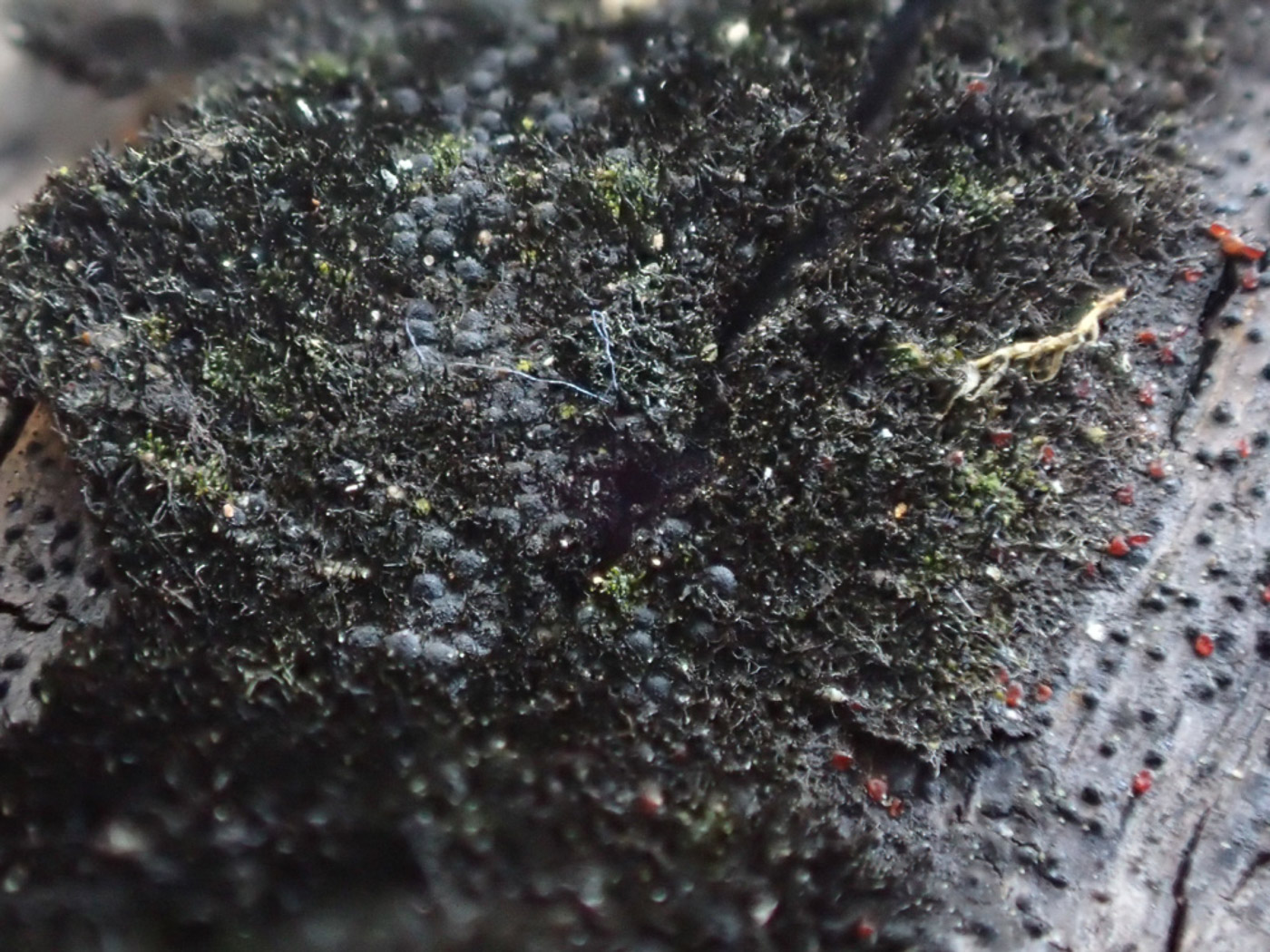
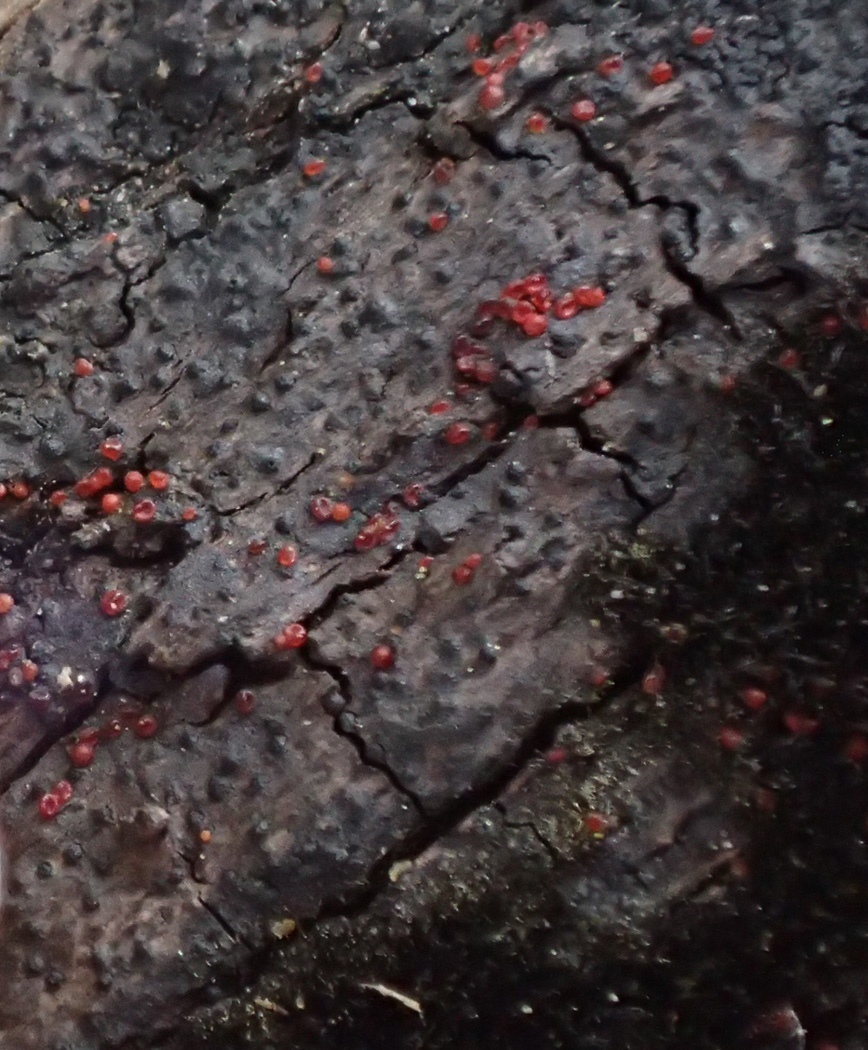 |
March 25th Dialonectria episphaeria (a tiny relative of the asco Coral Spot) Whilst examining the fungus Black Velvet on a Beech log at the edge of Naphill Common, Sarah Ebdon spotted these tiny bright red specks, less than 1mm across, and recognised them as some species of Nectria, a genus which likes to fruit on a range of black pyrenomycetes such as this. On contacting Penny with this find, Sarah was encouraged to examine a squash in the hope of finding some spores which might make for a quick and easy ID - the spores of this particular species (there are many others) are a very individual shape, and luckily she was then able to confirm this suggested ID. Now moved to the genus Dialonectria, this is a common species and it is often rewarding to check black pyrenomycetes with a hand lens for these tiny red dots, but they are genuinely tiny! Previous finds |
March 24th 2026
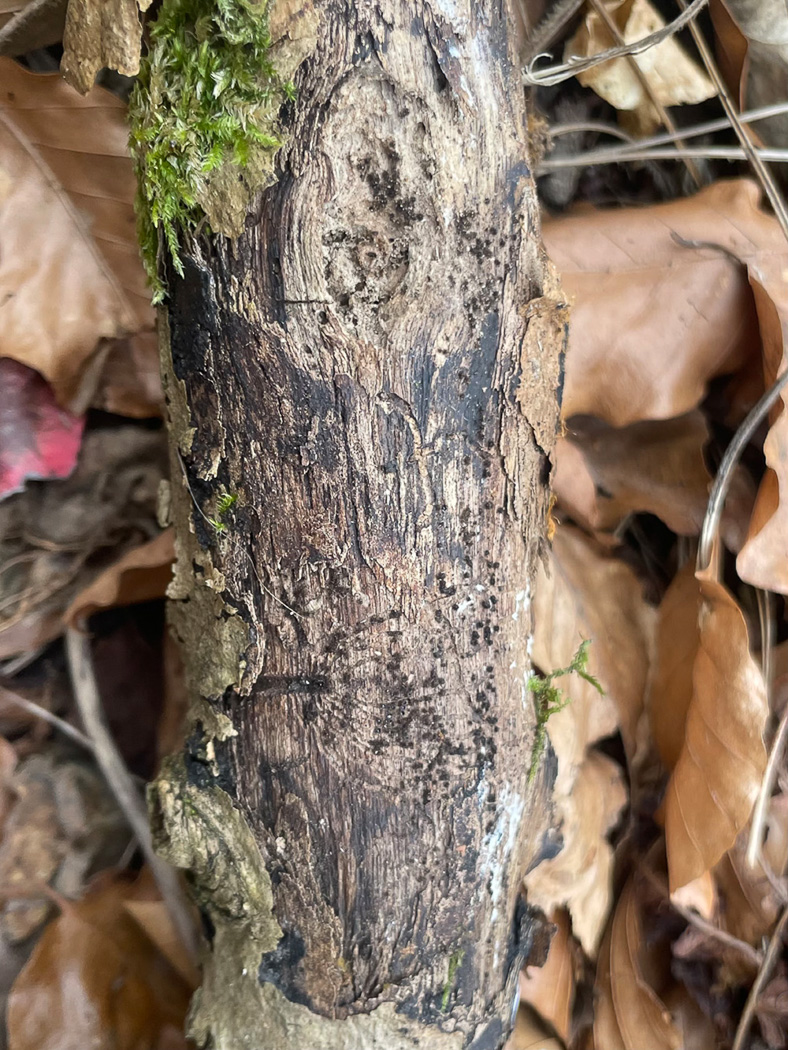
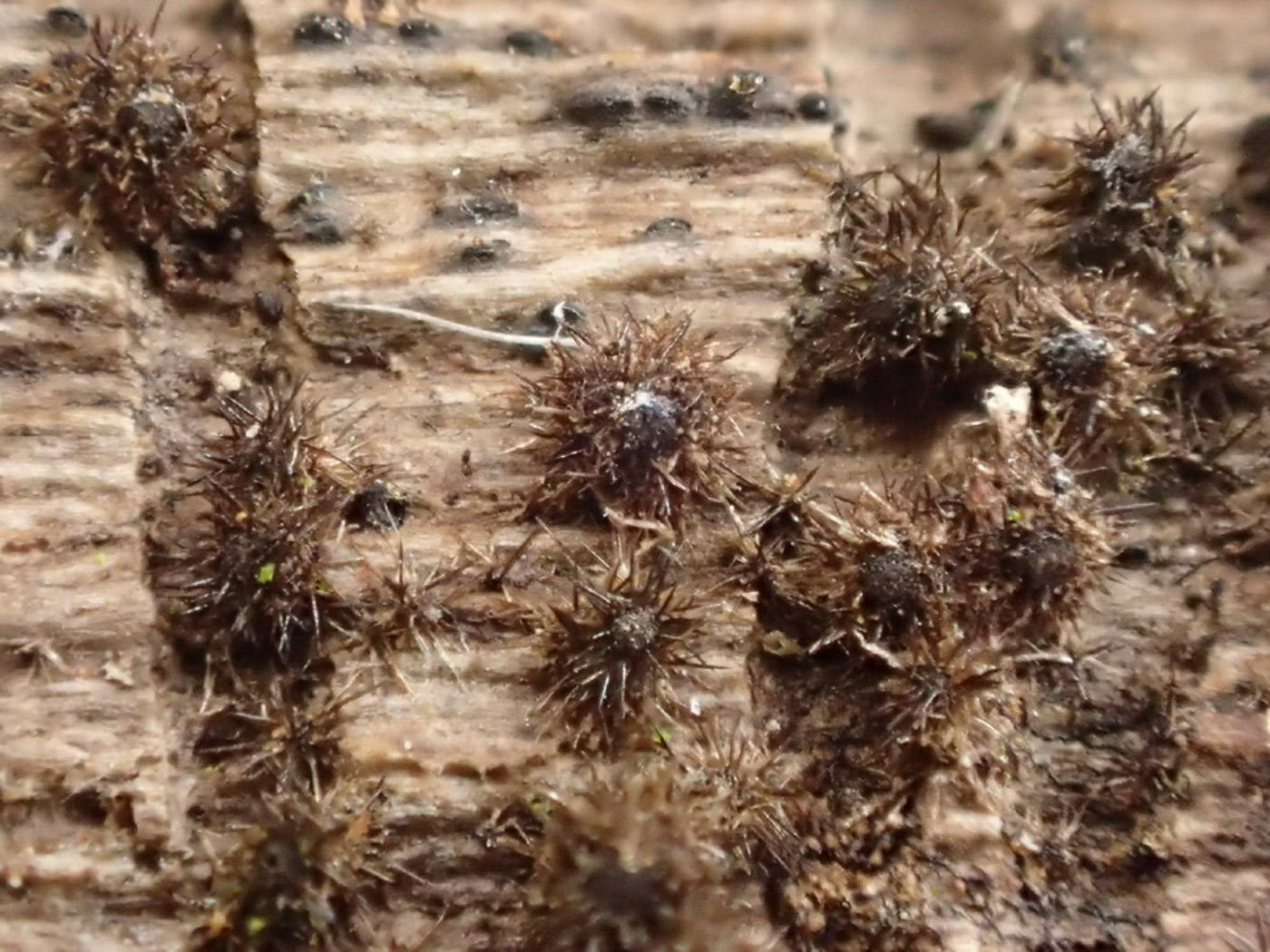
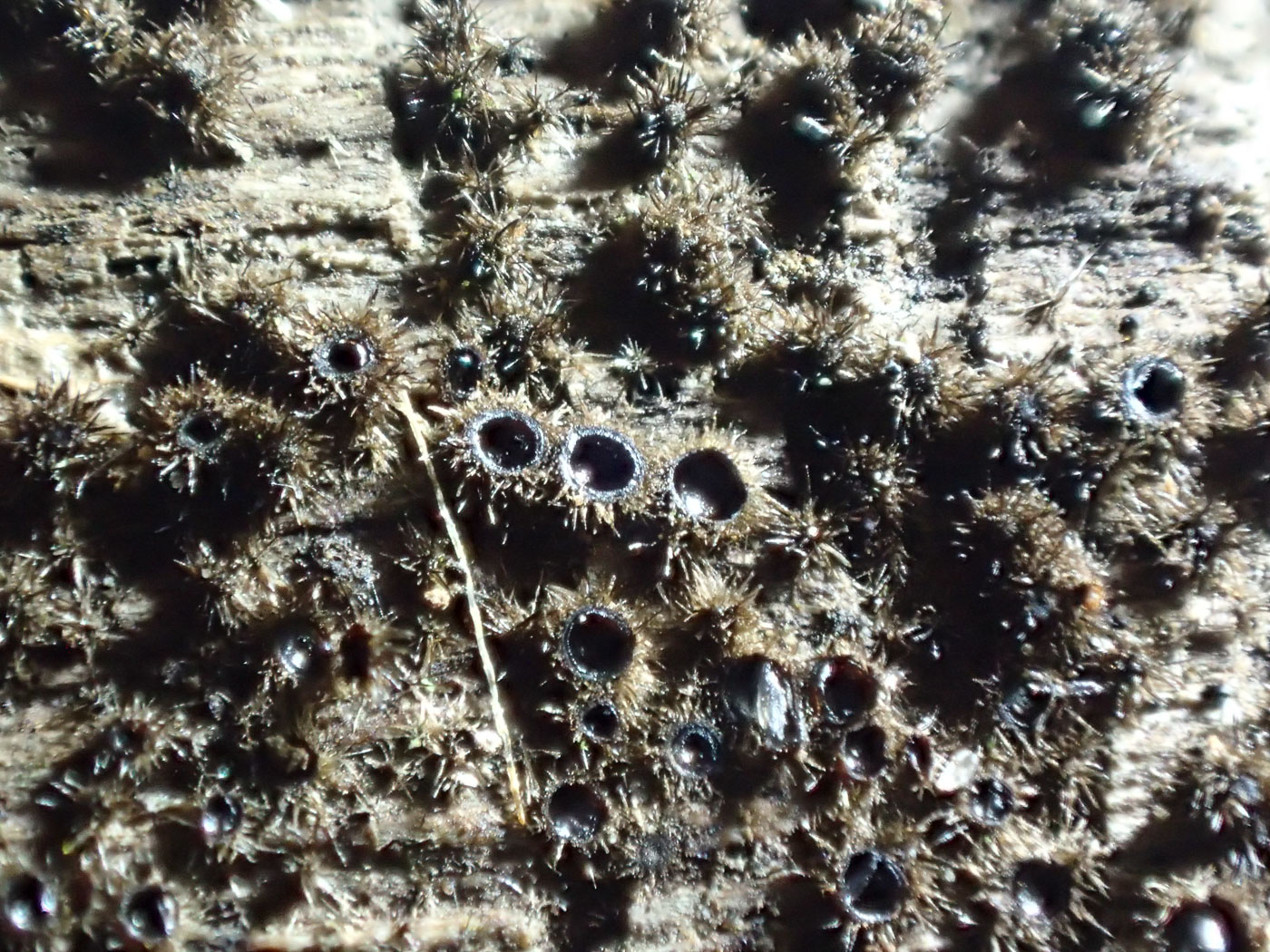
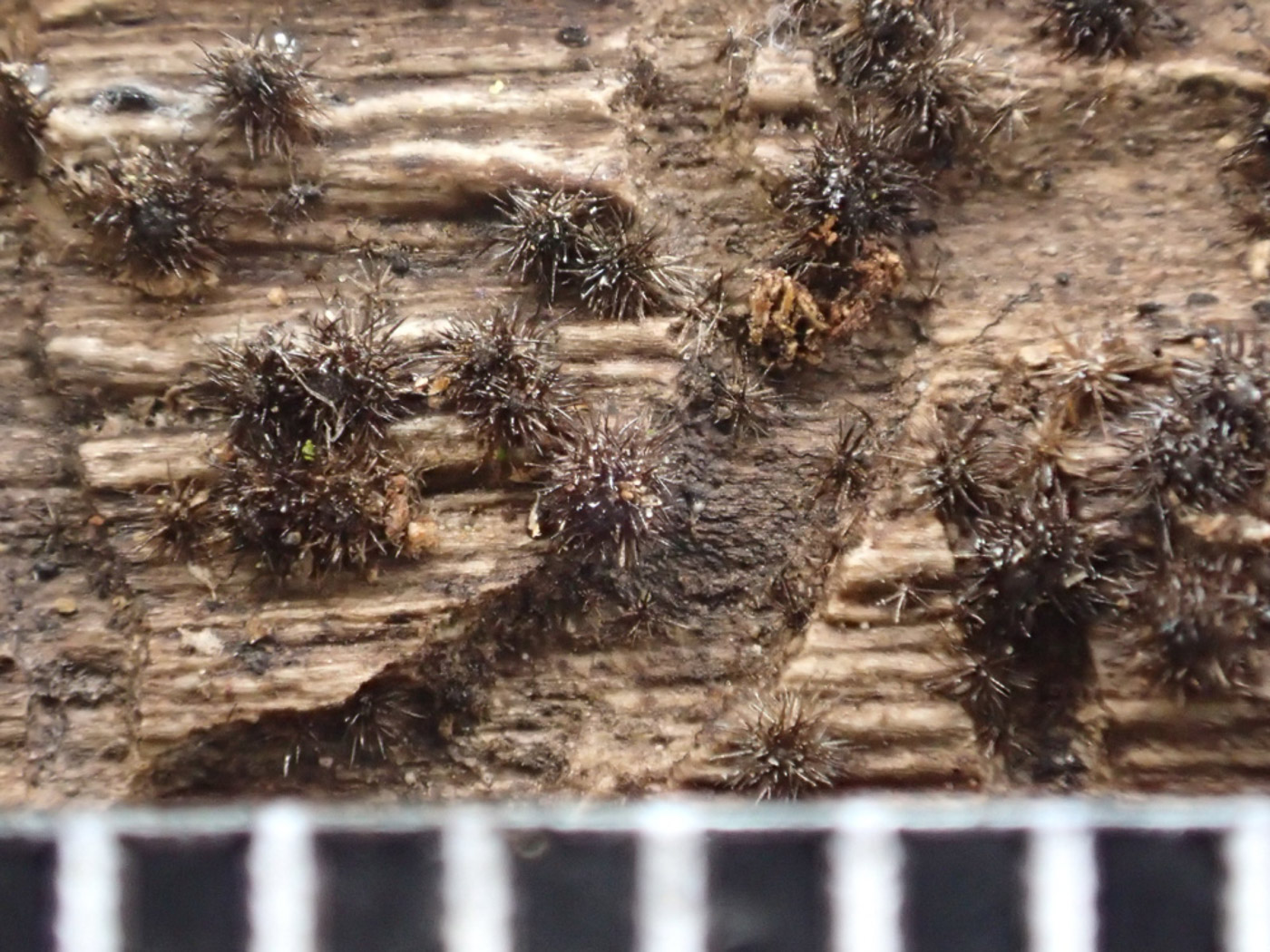 |
March 17th Echinosphaeria canescens (an asco with no English name) On a log pile in her garden in Naphill Sarah Ebdon - ever inquisitive - spotted these tiny 'sea-urchin'-like fungi, and having identified the somewhat similar Corynespora smithii only two days earlier from nearby on dead Holly (see that entry for comparison), she suspected this species was unrelated. This was borne out when she checked it out microscopically, noting the boomerang-shaped spores and soft texture, and in Ellis & Ellis the combination of characters led her straight to Lasiosphaeria canescens - now moved to genus Echinosphaeria. Her photos give a good idea of size, including one with a 1mm scale, and also the more mature fruiting bodies having burst open to disperse the spores. We have just three earlier county records under the previous genus name, but this is new to Members' Finds. Members' Finds New Species no. 1271 |
March 23rd 2026
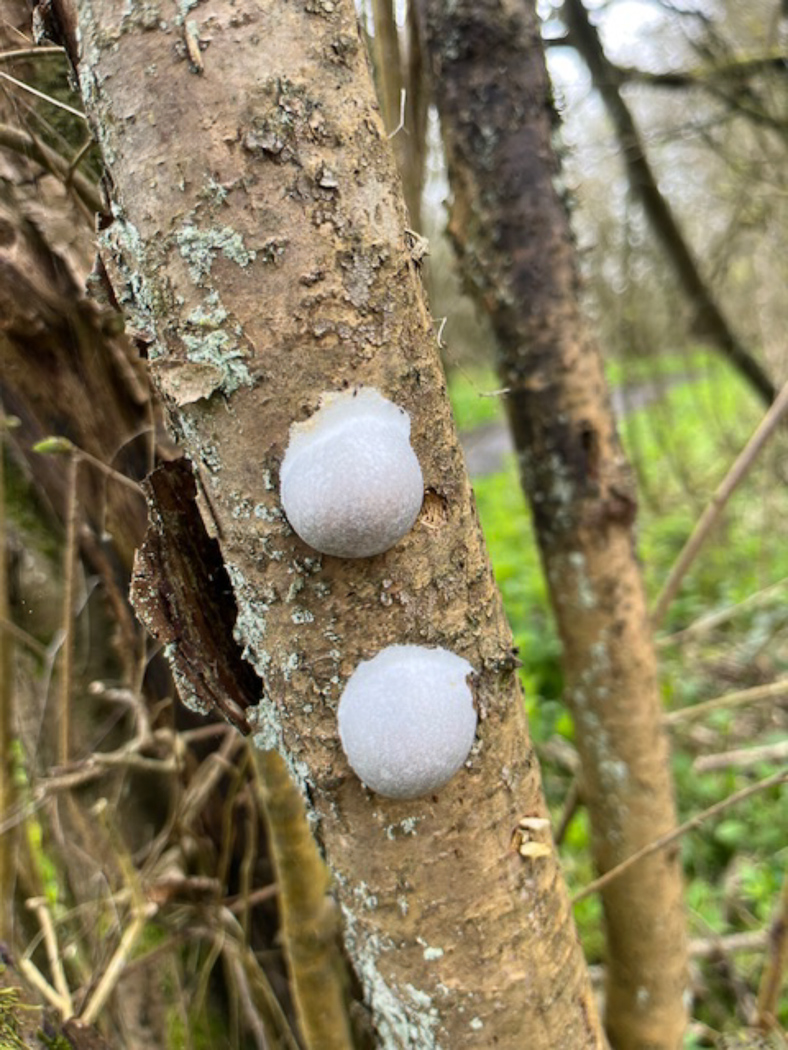 |
March 23rd Reticularia lycoperdon (Moon Poo / False Puffball) On a Hazel trunk in Rushbeds Wood Phil Townsend noticed these unfamiliar strange round blobs and sent his photo to Penny having discovered online that there was something similar called a False Puffball - was this it? Yes! This is a slime mould but is far bigger than many of the miniscule slime mould genera, some of which are barely visible to the naked eye. These eyeball-like blobs can reach up to 10 cm across and start out with a grainy appearance, soon drying off smooth and shiny as here, and eventually cracking open to reveal the cocoa brown spore mass within. This is quite a common species though often confuses until one becomes familiar with its appearance. Previous finds |
March 22nd 2026
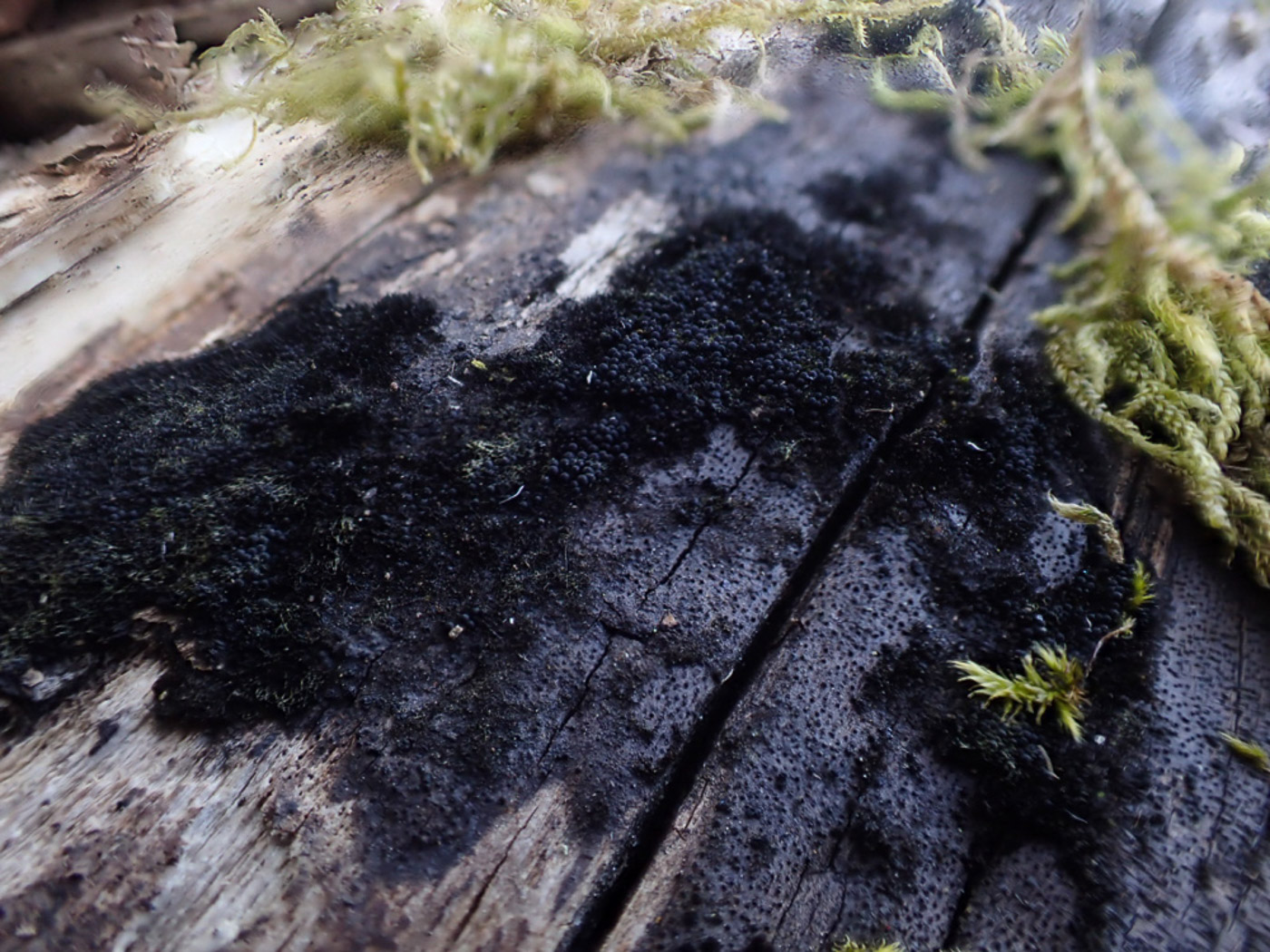
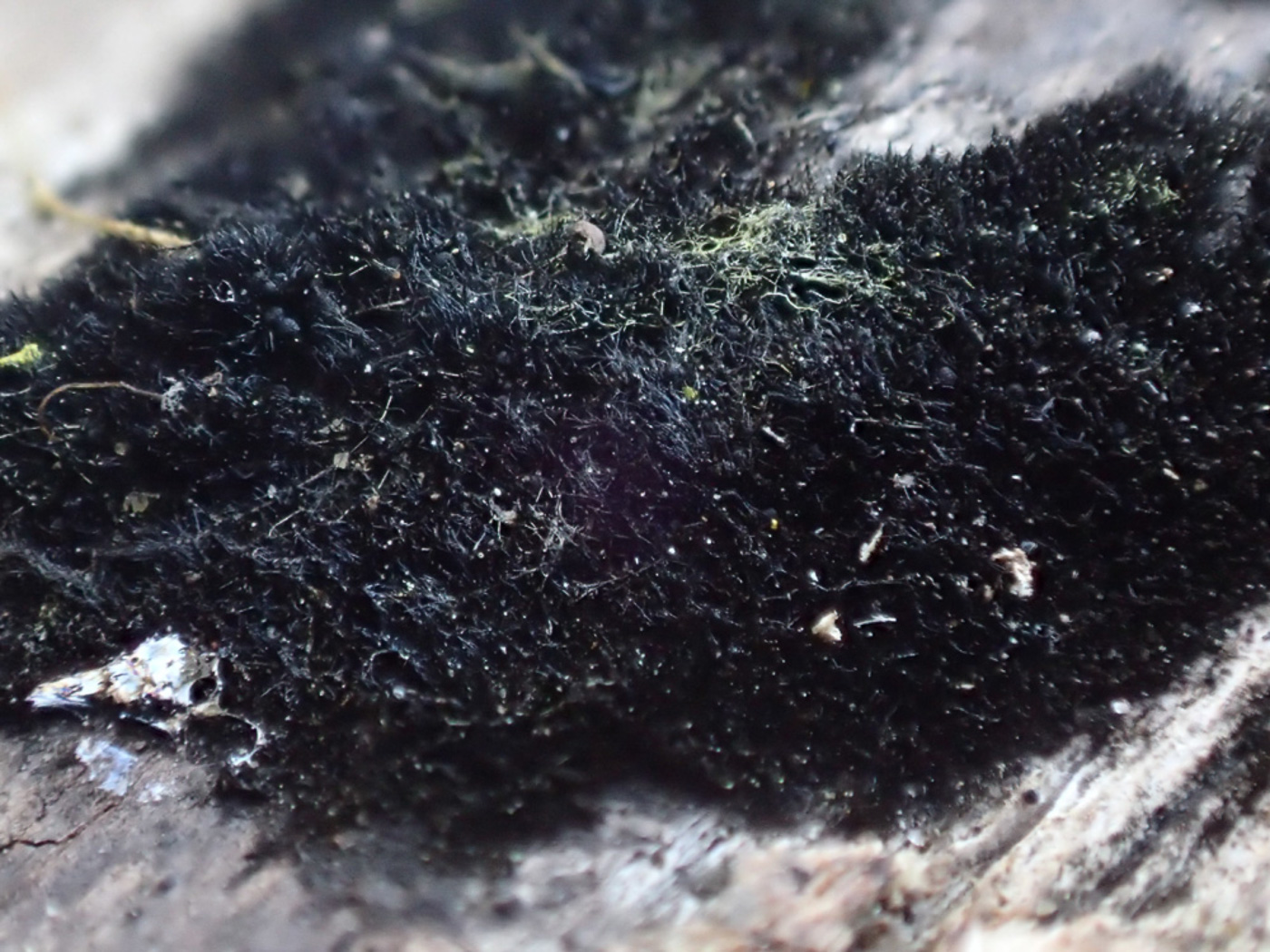
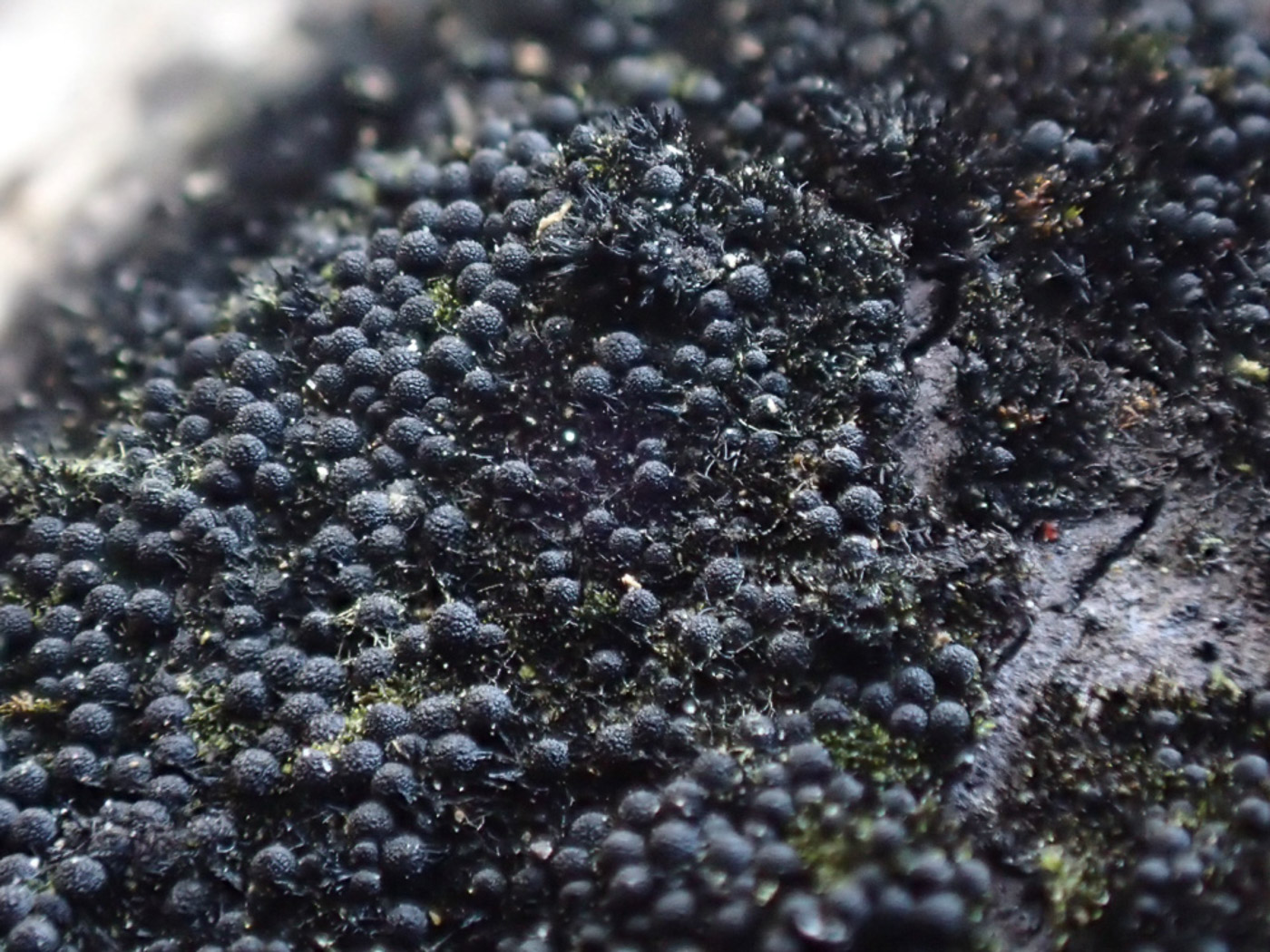
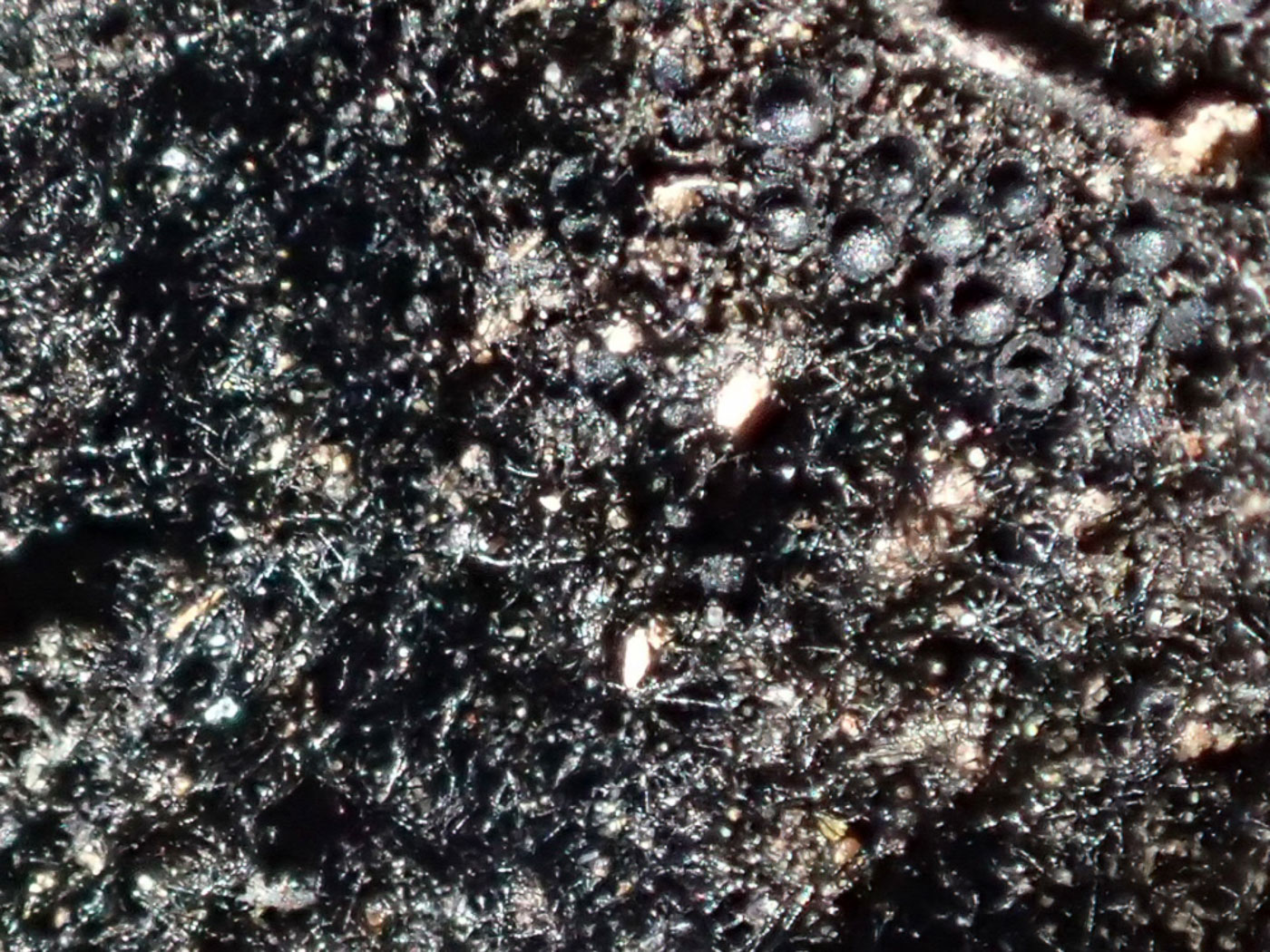 |
March 22nd Chaetosphaerella phaeostroma (Black Velvet) On a Beech log at the edge of Naphill Common, Sarah Ebdon recognised this black velvety patch as a nice example of quite a common pyrenomycete asco though one which is easily overlooked. Her photos show the various different stages of development: the 'blackberry-like' bobbles are the perithecia (bearing the asci with spores) on the subiculum (in this case the black finely hairy velvet mat underneath), and finally (photo 4) the perithecia having burst open to shed the spores. Previous finds |
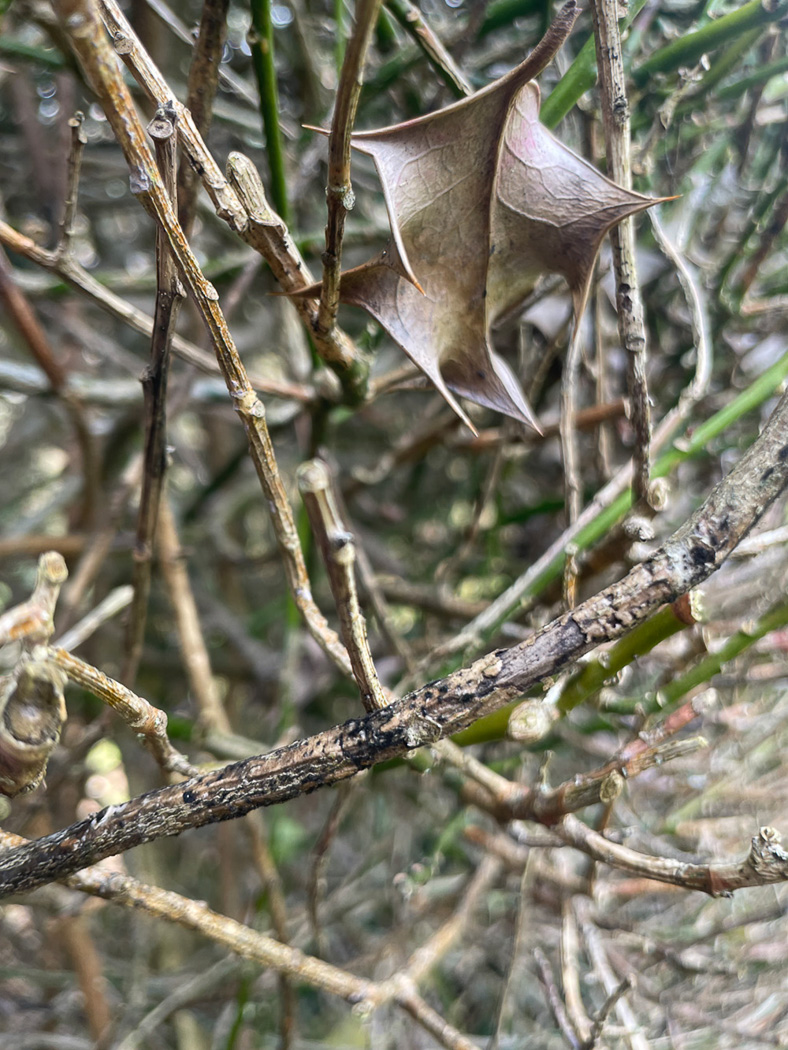
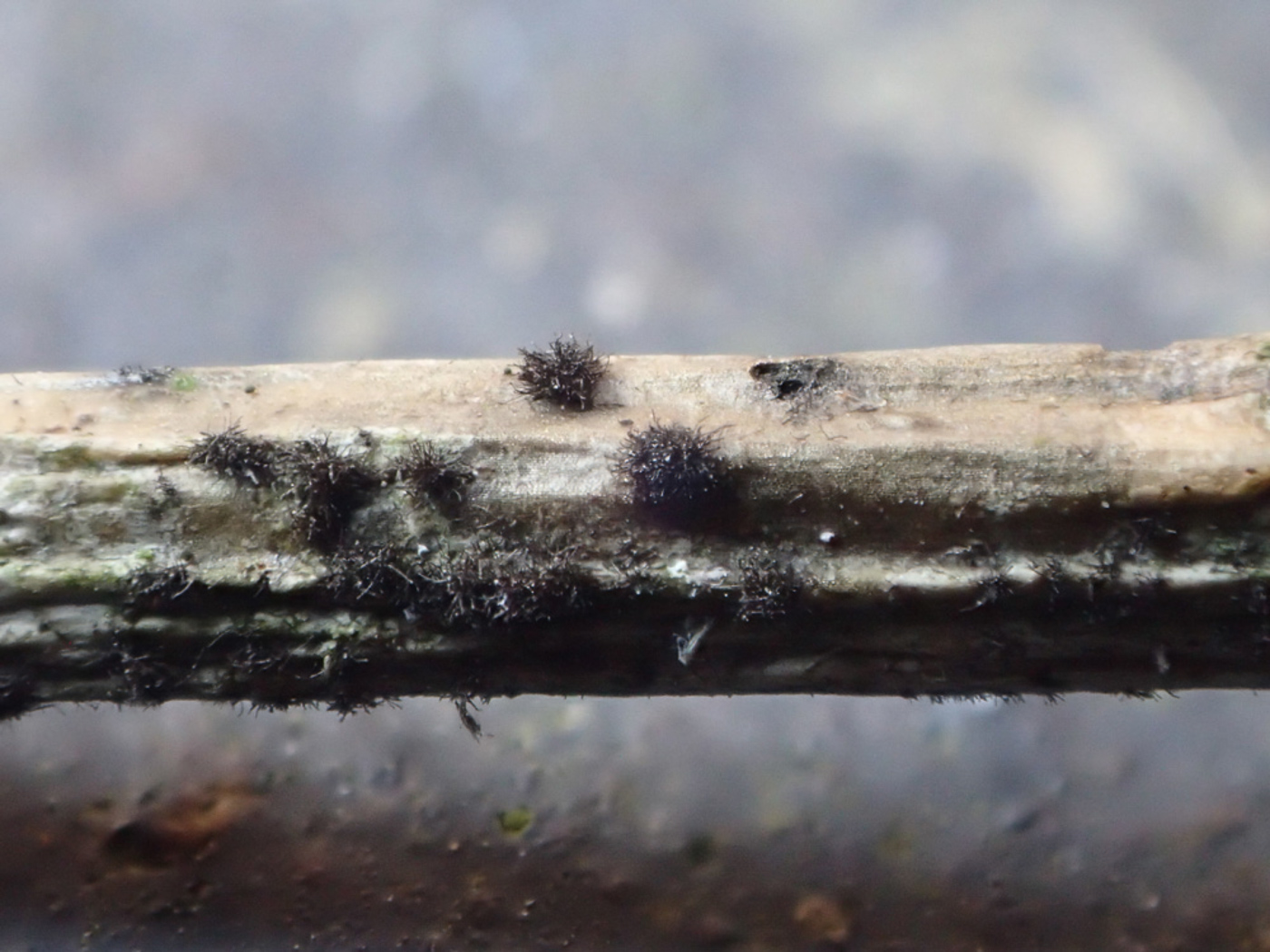
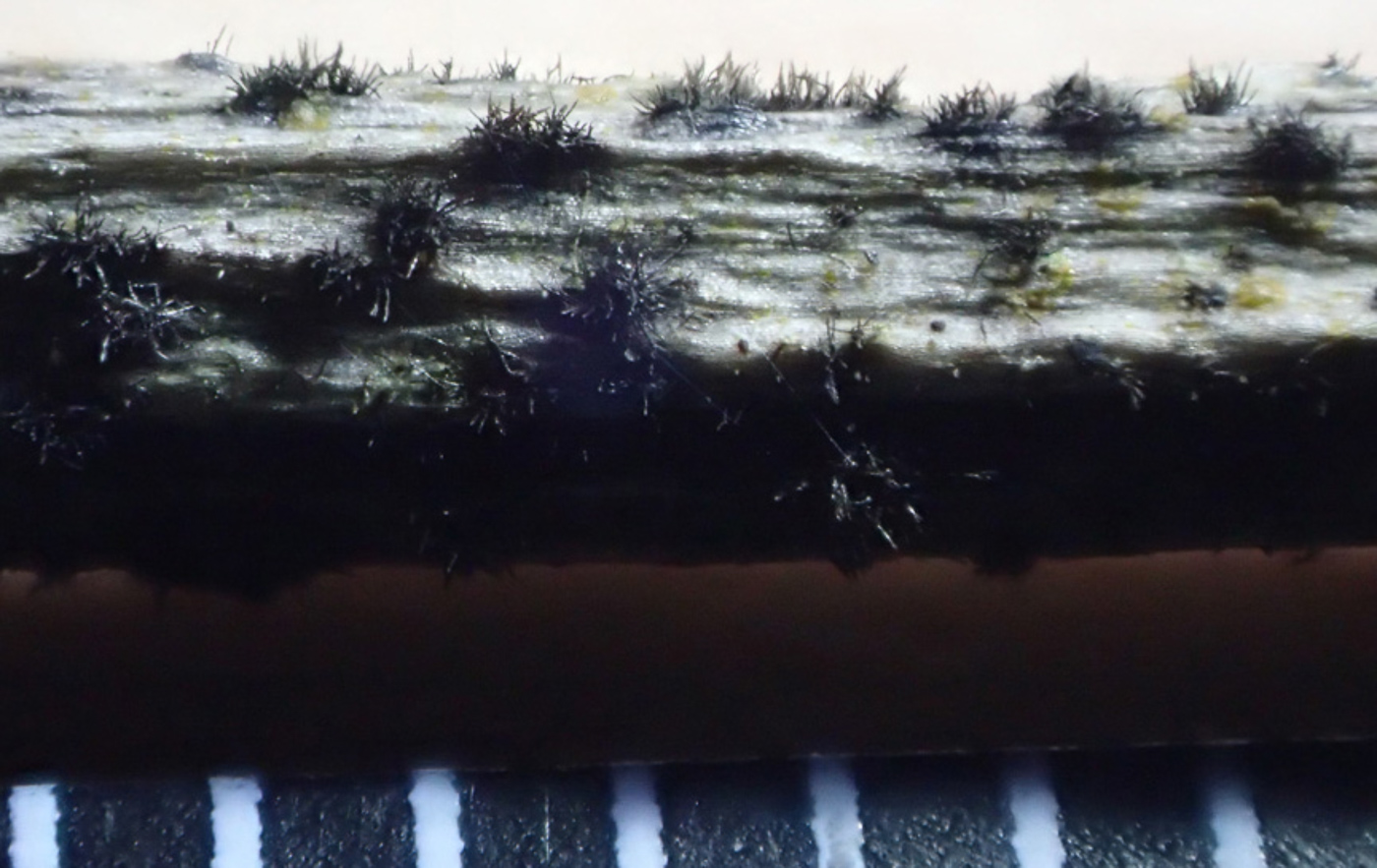
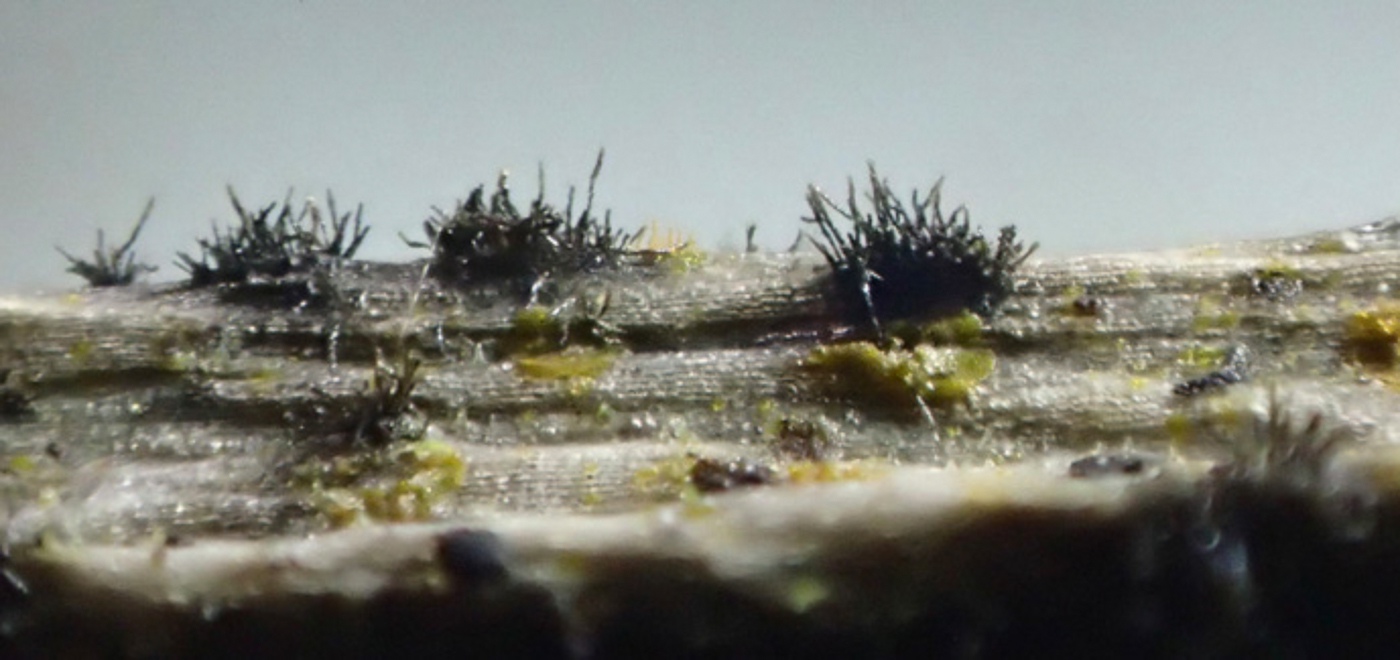

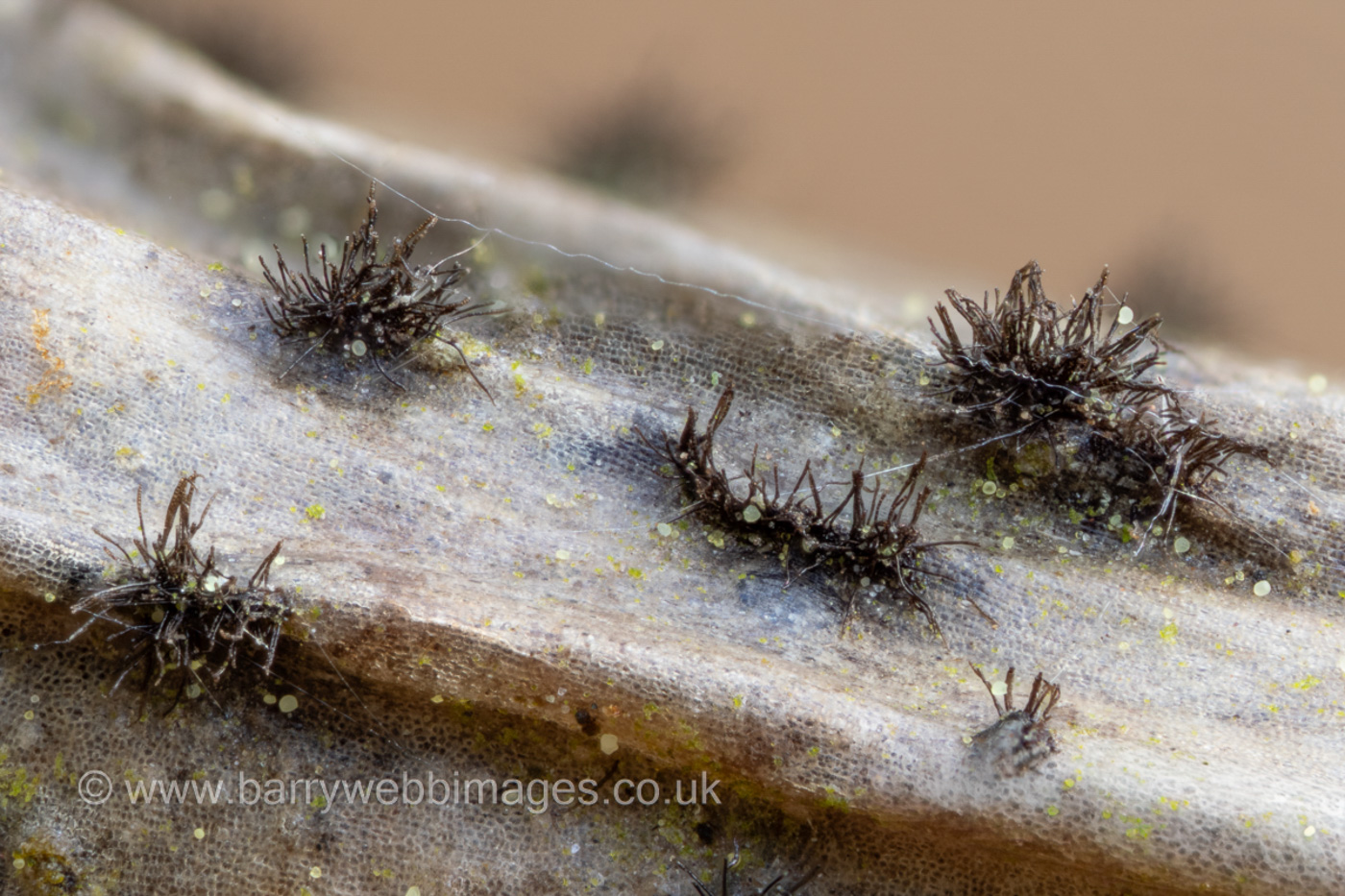 |
March 22nd Corynespora smithii (a hyphomycete asco with no English name) Whilst examining dead Holly twigs on the edge of Naphill Common Sarah Ebdon chanced upon these tiny hairy specks and though having no idea what they might be she decided to have a go at identifying them. She came up with this species of plant pathogen and, though there appears to be only one other source of macrophotos available (online at CEMAS (https://www.centrodeestudiosmicologicosasturianos.org/?p=43583), the micro characters were a perfect match to those given in several sources including Ellis & Ellis. The species can occur on a range of dead woods and is probably very common but massively under-recorded (as are many other similar species, no doubt). It's no surprise that this is new to the county and Sarah's macro-photos seen here are a particularly valuable resource. The scales included show 1 mm divisions to give an idea of size. The final two photos here were taken a month later when Sarah found this species again at Burnham Beeches, the second of these two being Barry Webb's. Members' Finds New Species no. 1270 |
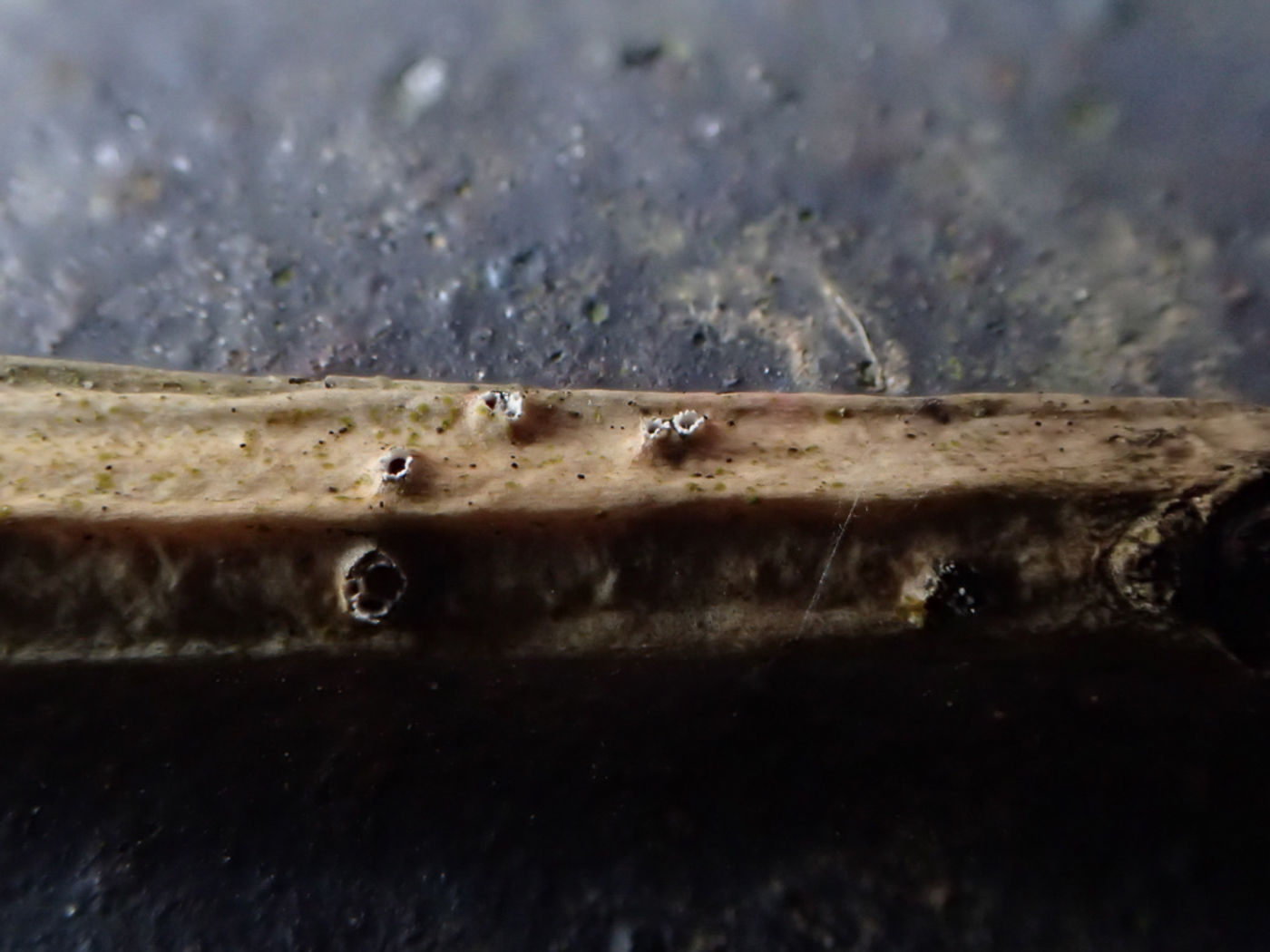
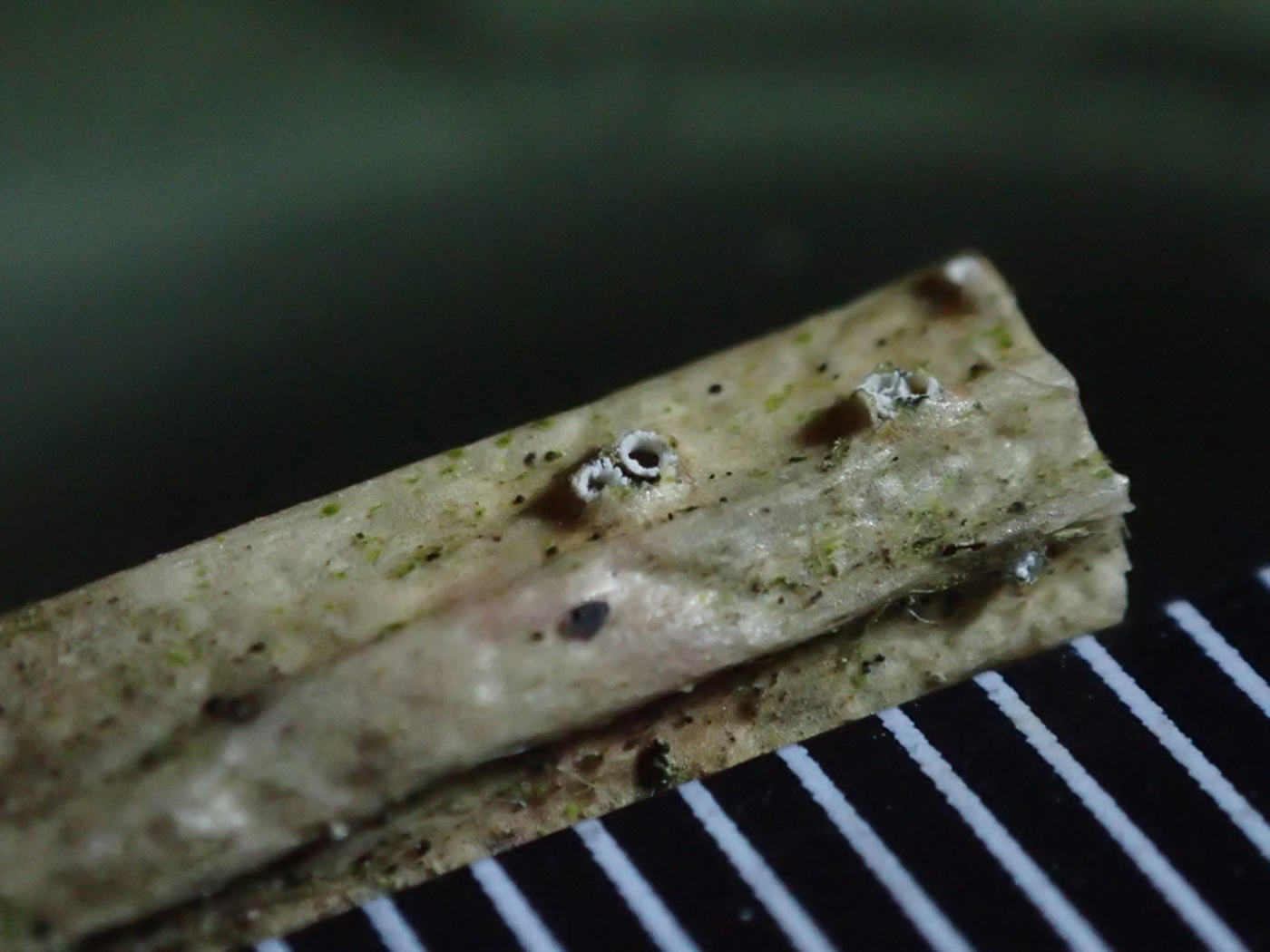
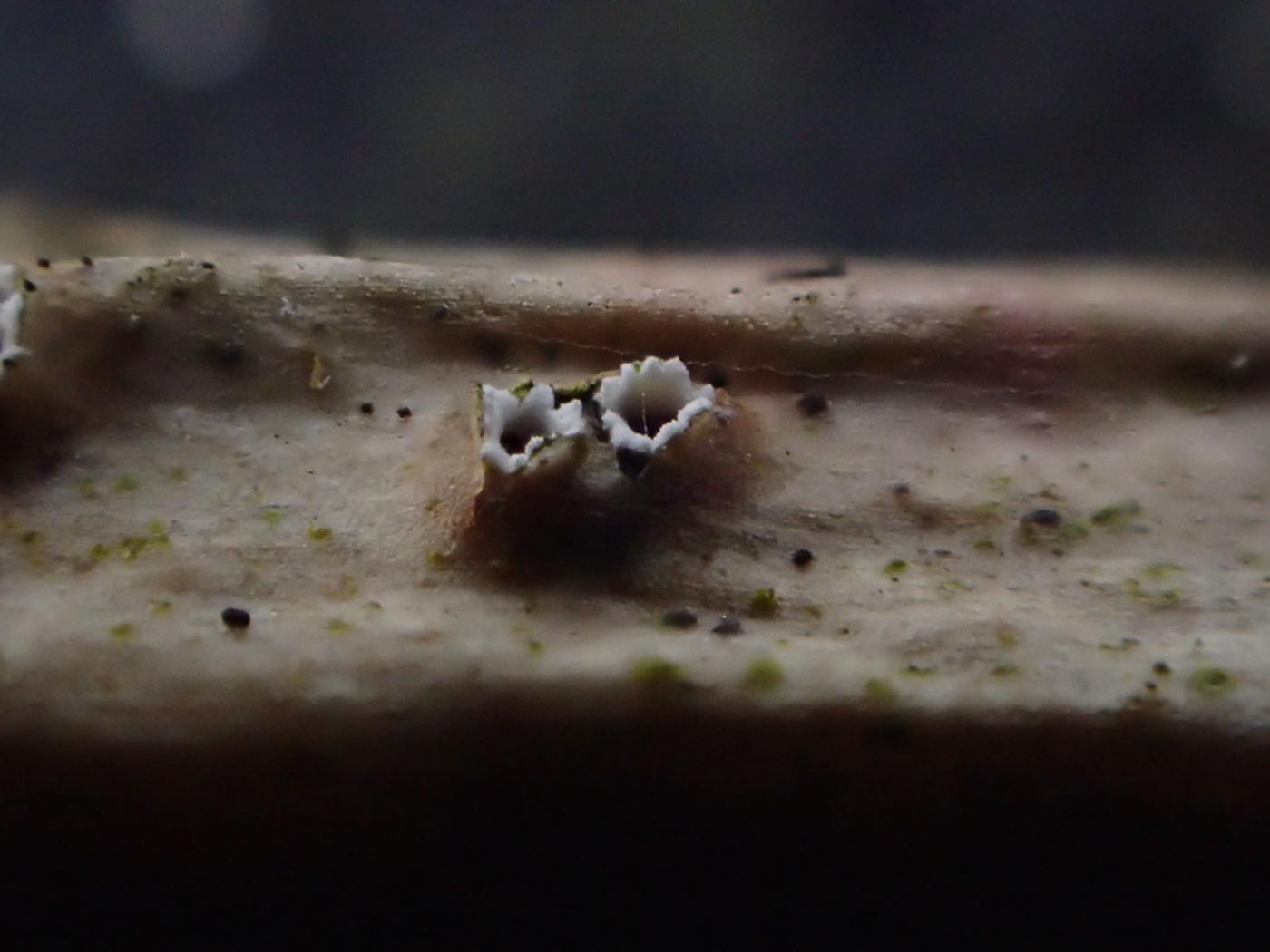
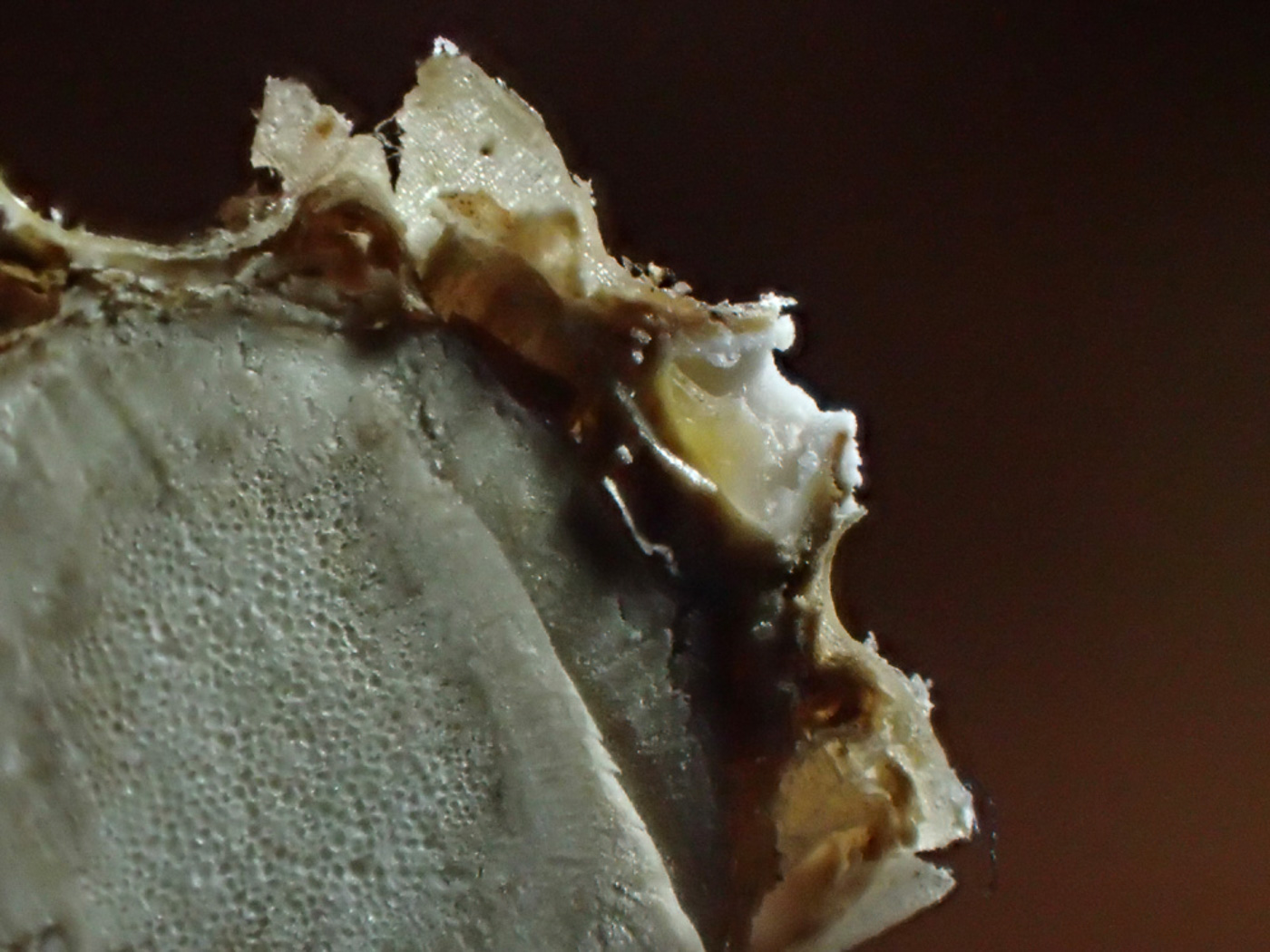 |
March 22nd Stictis radiata (an unusual asco with no English name) In a hedge on the edge of Naphill Common Sarah Ebdon noticed these tiny white dots on an attached dead Holly twig, looked closer with a handlens and decided to investigate further as they appeared quite distinctive being semi-immersed and having a white almost toothed margin. Some careful research into saprotrophic decomposers on Holly revealed this species which has incredibly long thin septate spores like spears - one end pointed and the other rounded. It can occur on dead wood and twigs of many different deciduous trees and garden shrubs. Like many such tiny species, it is probably very common but goes unnoticed and is new to the county. (Sarah's photos include one with 1mm scale and one cross-section.) Members' Finds New Species no. 1269 |
March 21st 2026
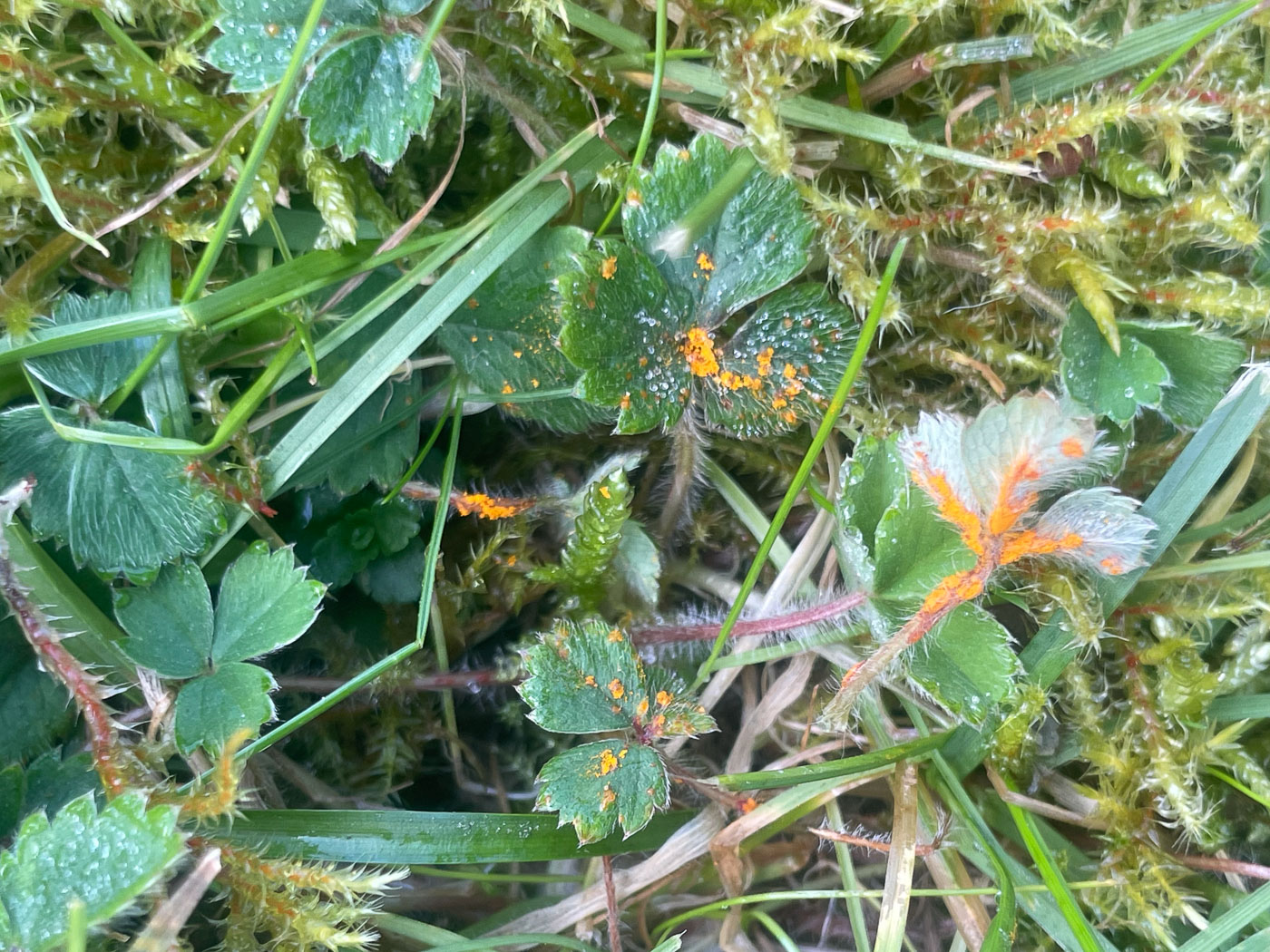
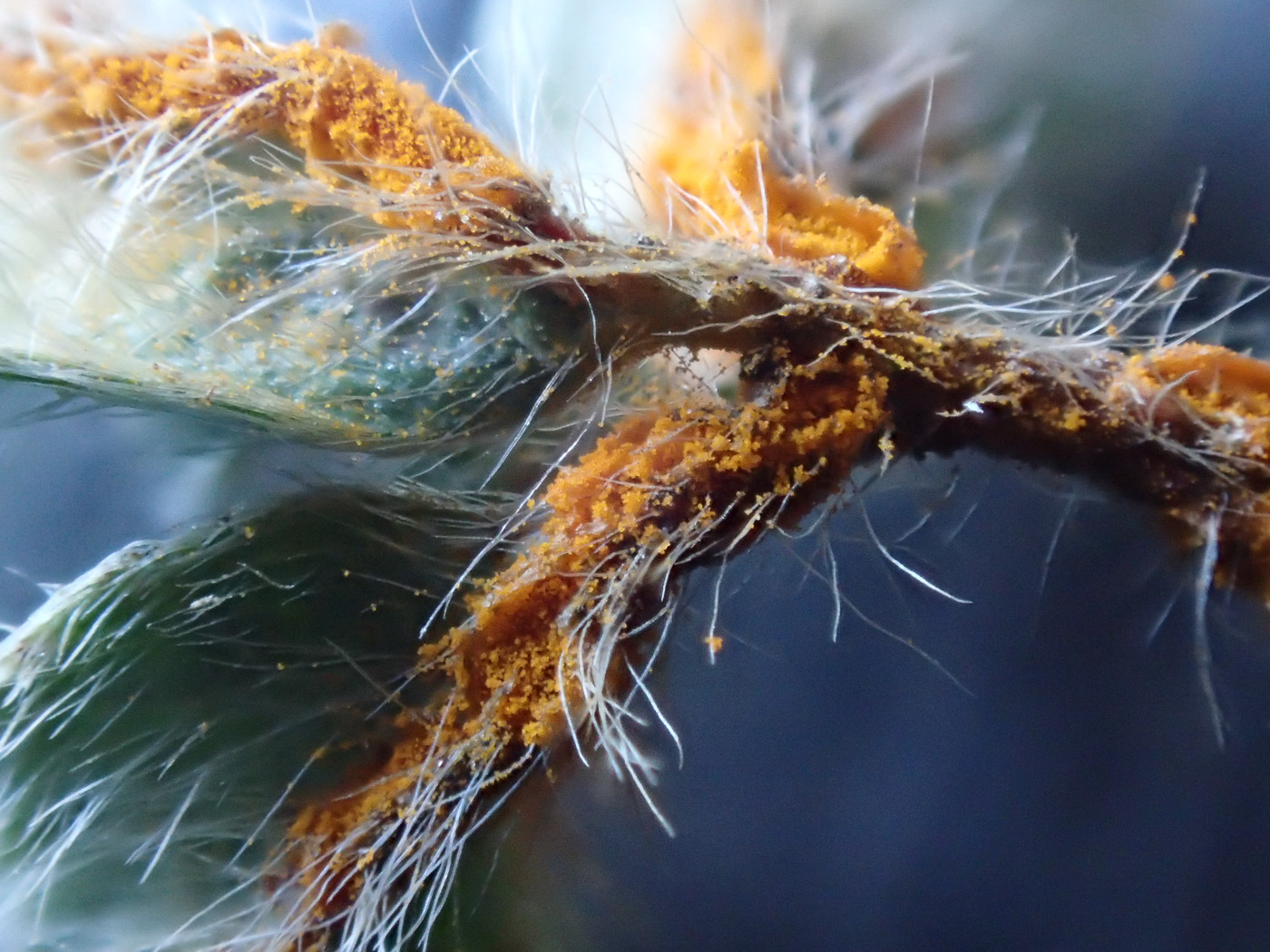 |
March 21st Phragmidium fragariae (a species of Rust with no English name) In Prestwood churchyard Sarah Ebdon recognised this rust on the leaves and stems of Barren Strawberry - a plant almost identical in appearance to Wild Strawberry but having the terminal (central) leaf tooth shorter than the two adjacent teeth either side. Furthermore this rust, despite its Latin epithet, only occurs on Barren Strawberry which, as its name suggests, does not produce tasty fruits! We have only a few county sites where it has been recorded but it is no doubt very common. Previous finds |
March 17th 2026
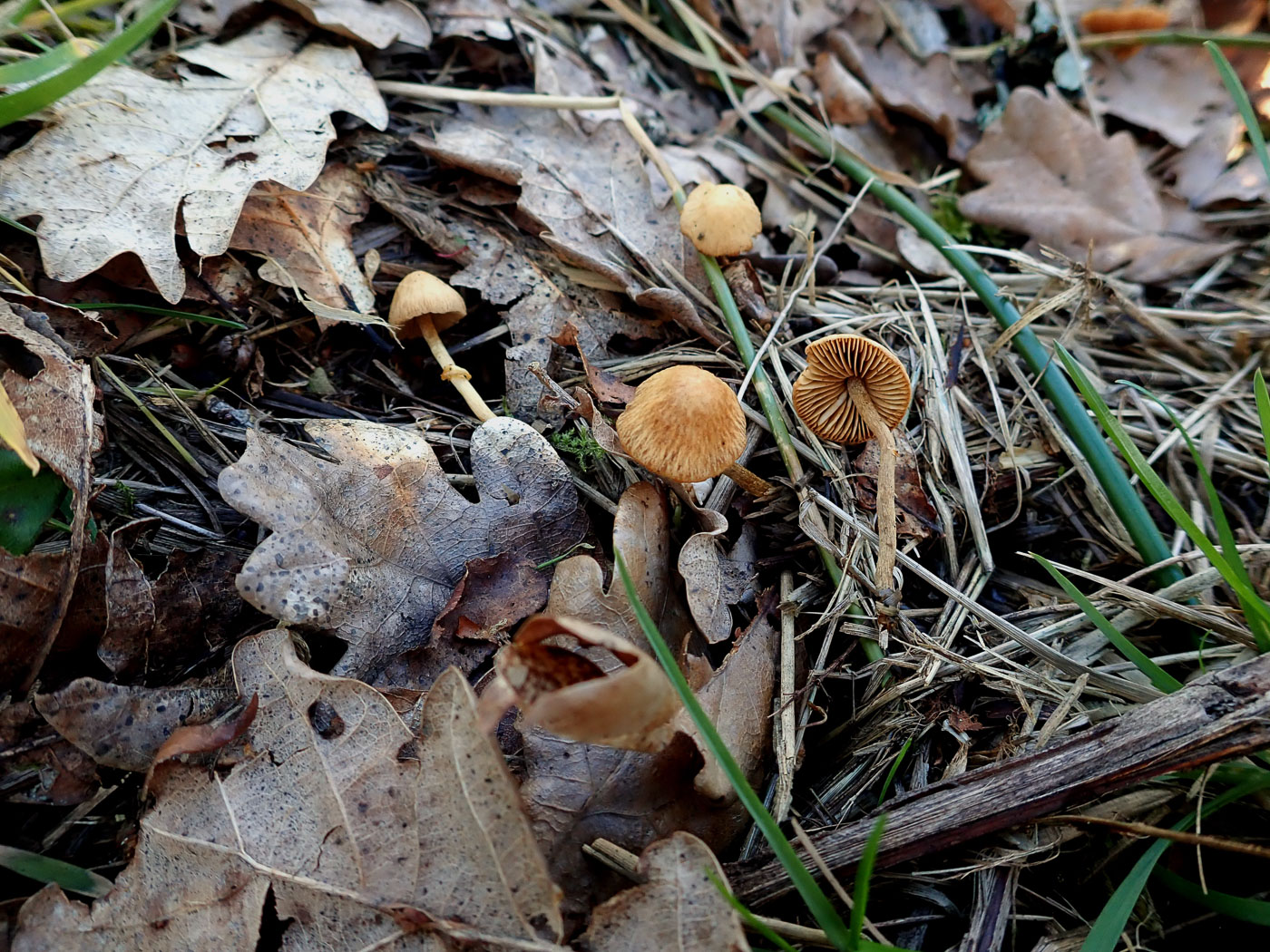 |
March 17th Pholiotina rugosa (Wrinkled Conecap) At Turville Heath Penny found this small cluster of pale LBJs amongst grassy litter and was about to ignore it as a possibly unidentifiable Conocybe (Conecap) until noticing that one of them sported a ring on the stem (seen on the LH fruit body here). That feature immediately makes an ID much more feasible and limits the number of possibilities considerably! The wrinkled cap together with the spores - both their size and having a germ pore - soon confirmed the species. There is some long-standing confusion over the genus name for this group of Conecaps which were placed in a different genus, Pholiotina, some years ago on account of their ring or ring zone, though the species involved were retained in Conocybe for both Species Fungorum and FRDBI. However, checking online today Penny found an unusual situation: normally FRDBI lags behind Species Fungorum with such changes but now has accepted the genus name Pholiotina whereas Species Fungorum has not! Previous finds |
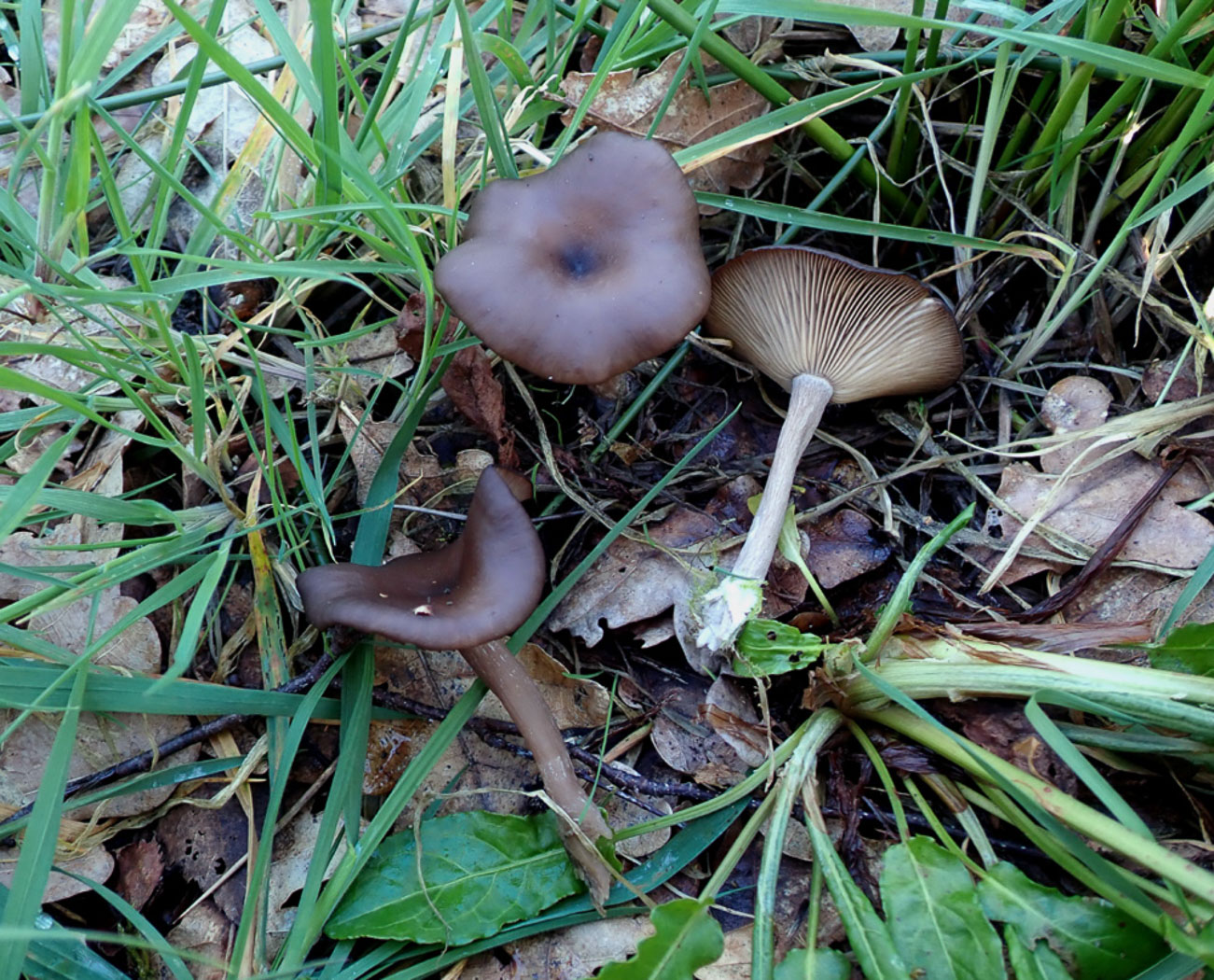 |
March 17th Pseudoclitocybe cyathiformis (Goblet) At Turville Heath Penny noticed this trio amongst damp grass with Juncus. This is a distinctive species with its apt English name describing the shape well; it favours late season fruiting and can quite often be found well into spring as here. Previous finds |
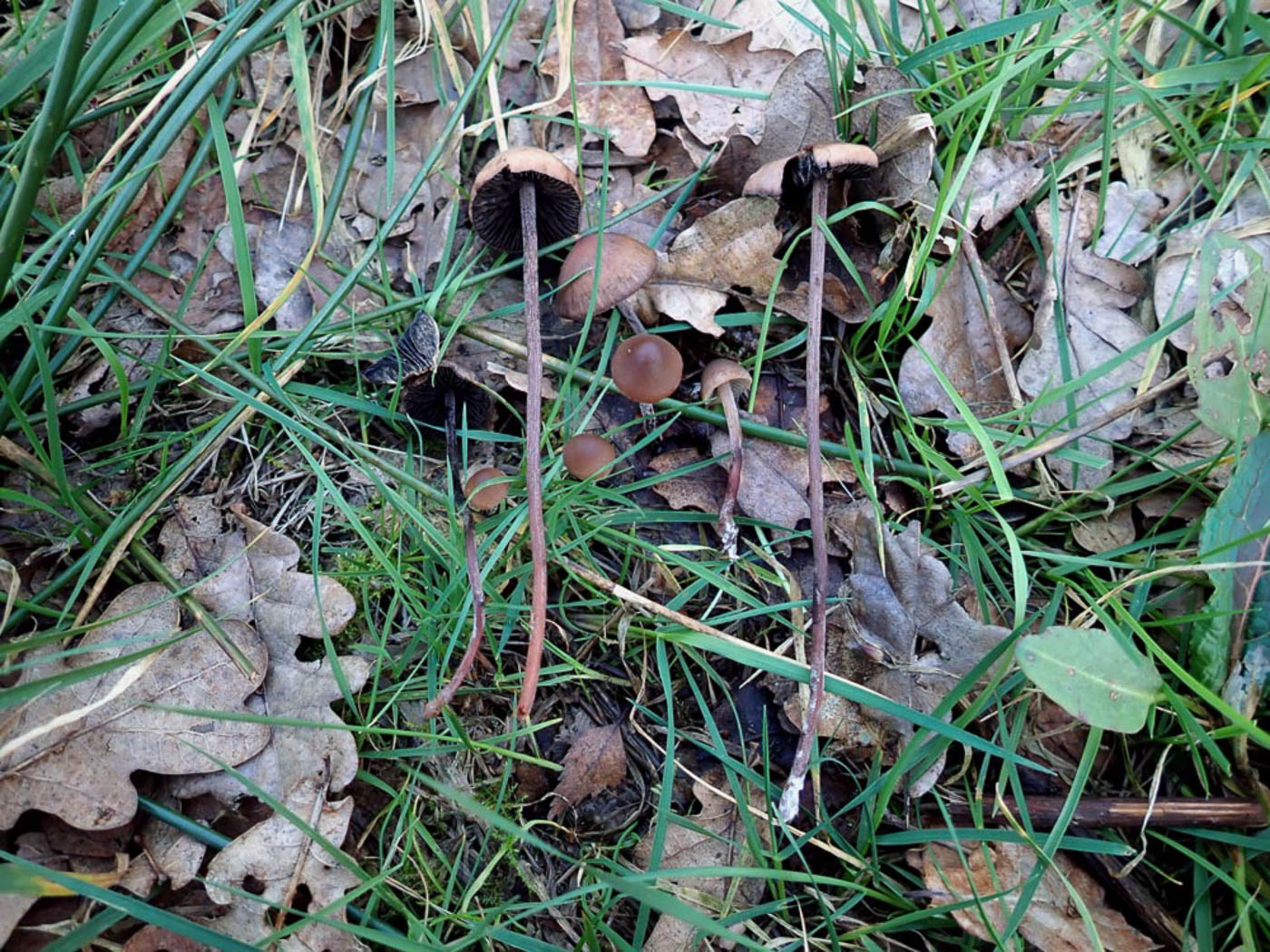
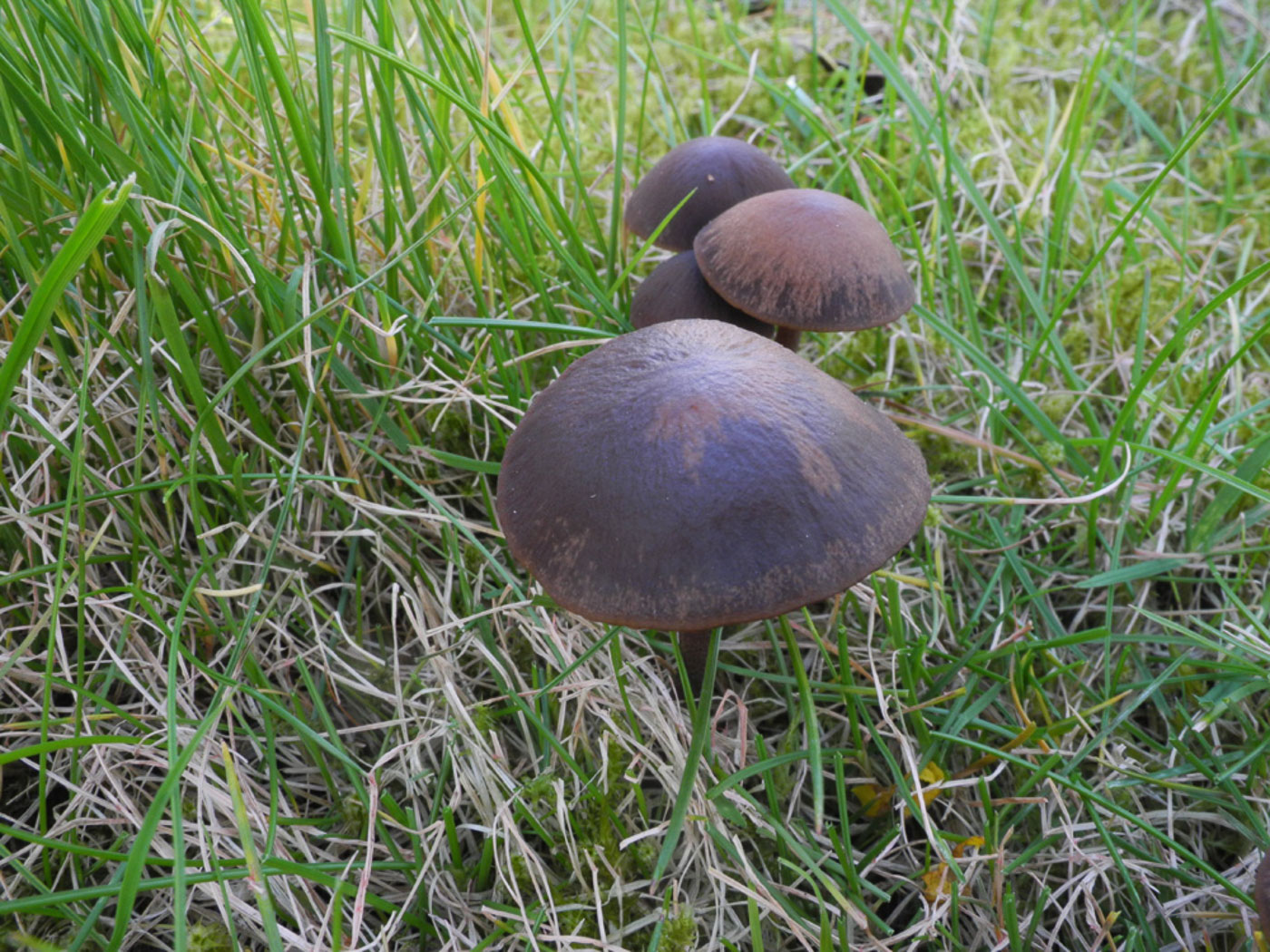
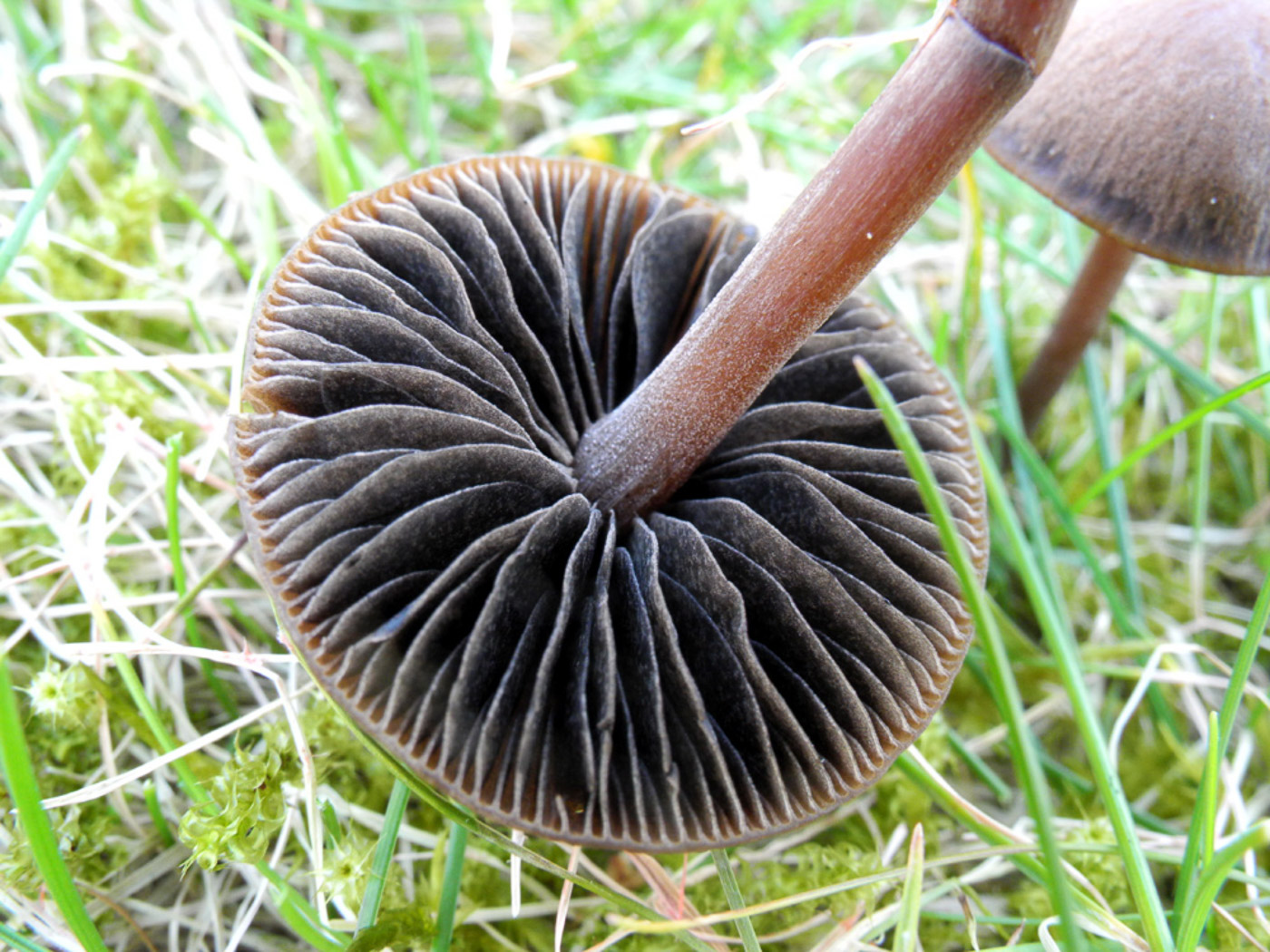 |
March 17th Panaeolus acuminatus (Dewdrop Mottlegill) At Turville Heath in a damp grassy area with Juncus Penny came across a selection of Mottlegills, placed them together to show the variety in size, particularly stem length which can be surprisingly long depending on the surrounding vegetation, then later checked the spores to confirm their ID. This is a common grassland LBJ though not associating with dung as do some others in this genus. A further feature which can help with ID is the presence of tiny droplets on the upper stem though today's (welcome) sun had all but dried them up. On returning home Penny found more photos of this same species (photos 2 and 3) just sent in by Tony Knight from his lawn at Long Crendon. Previous finds |
March 14th 2026
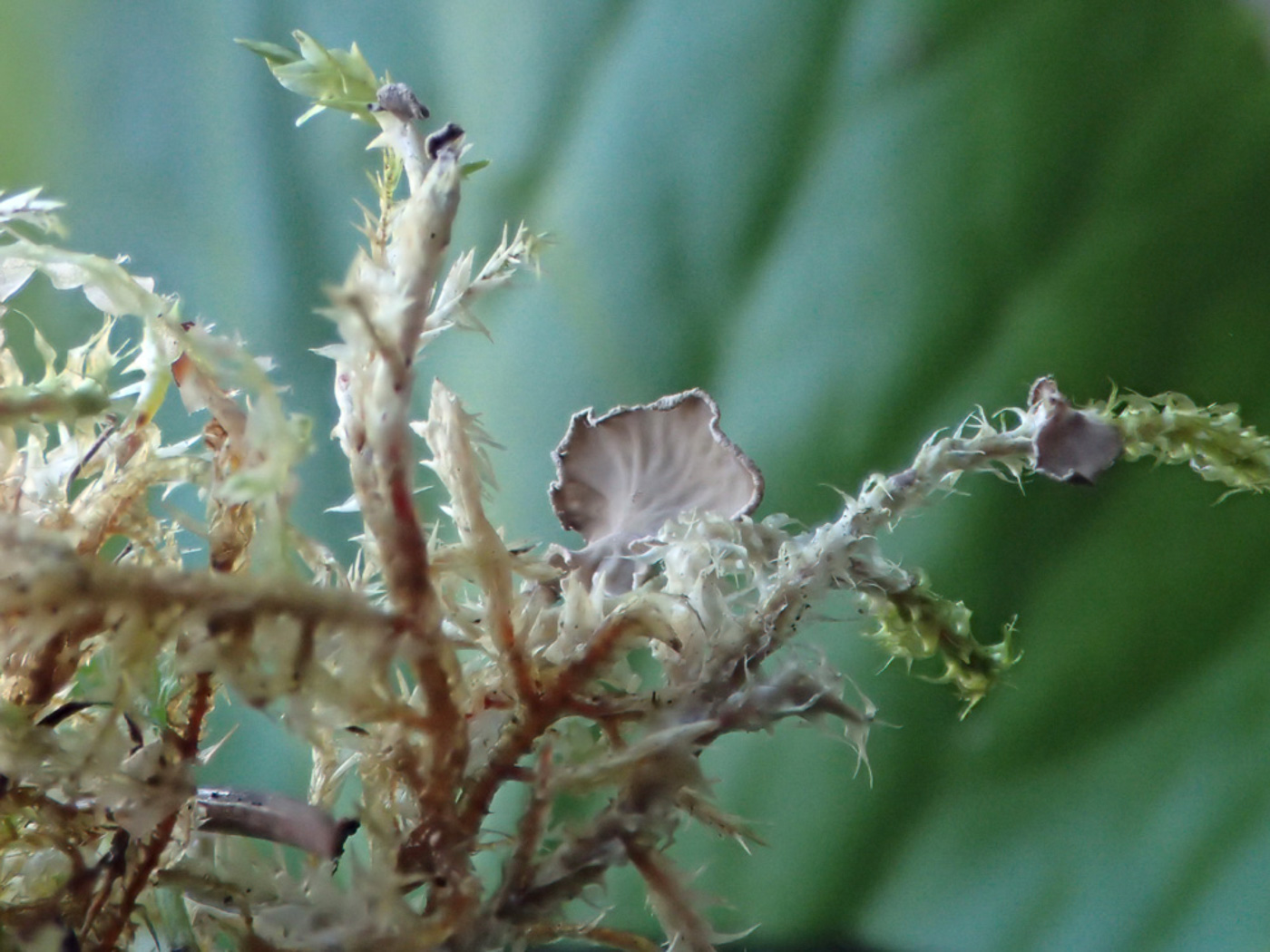
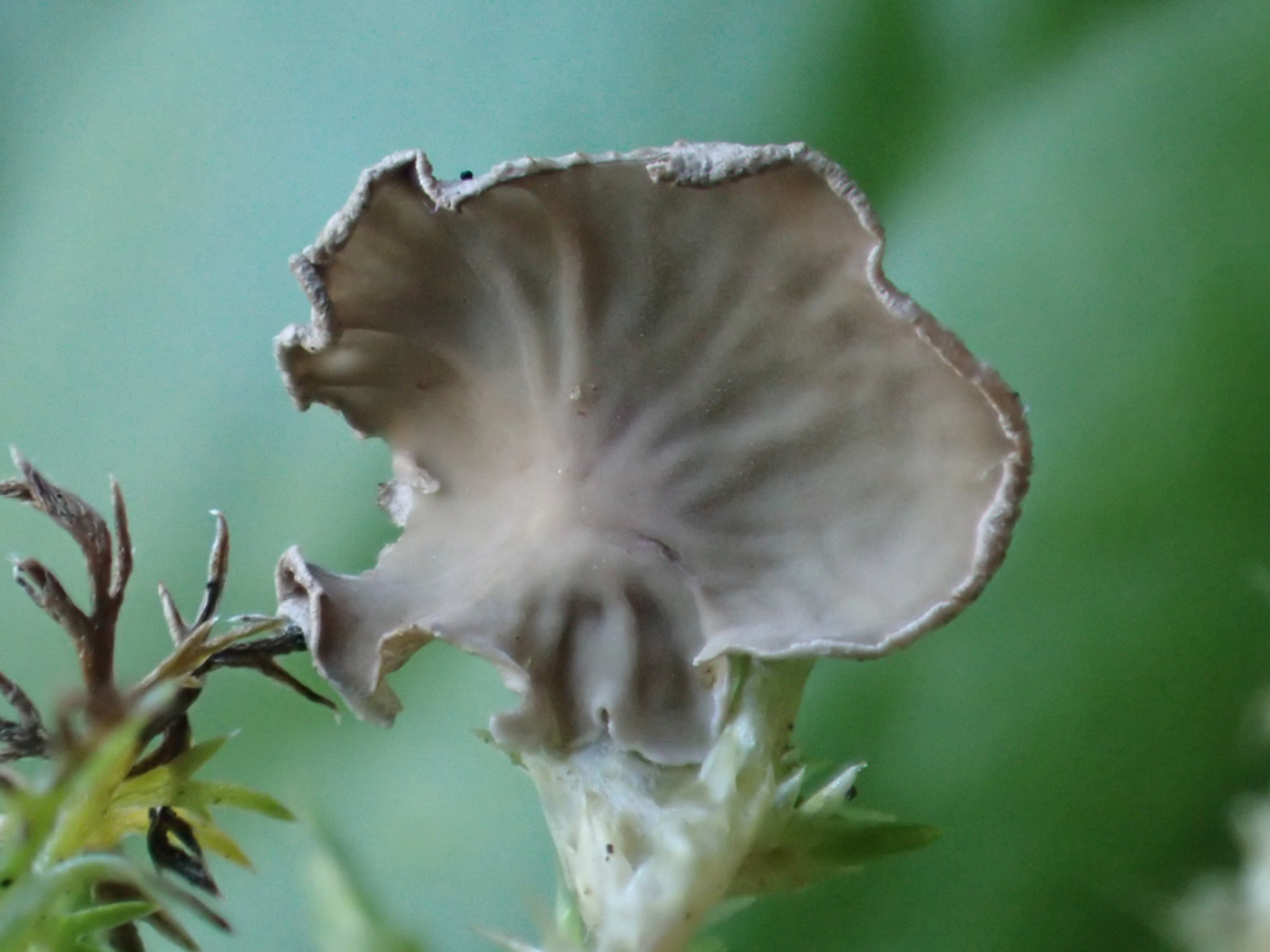
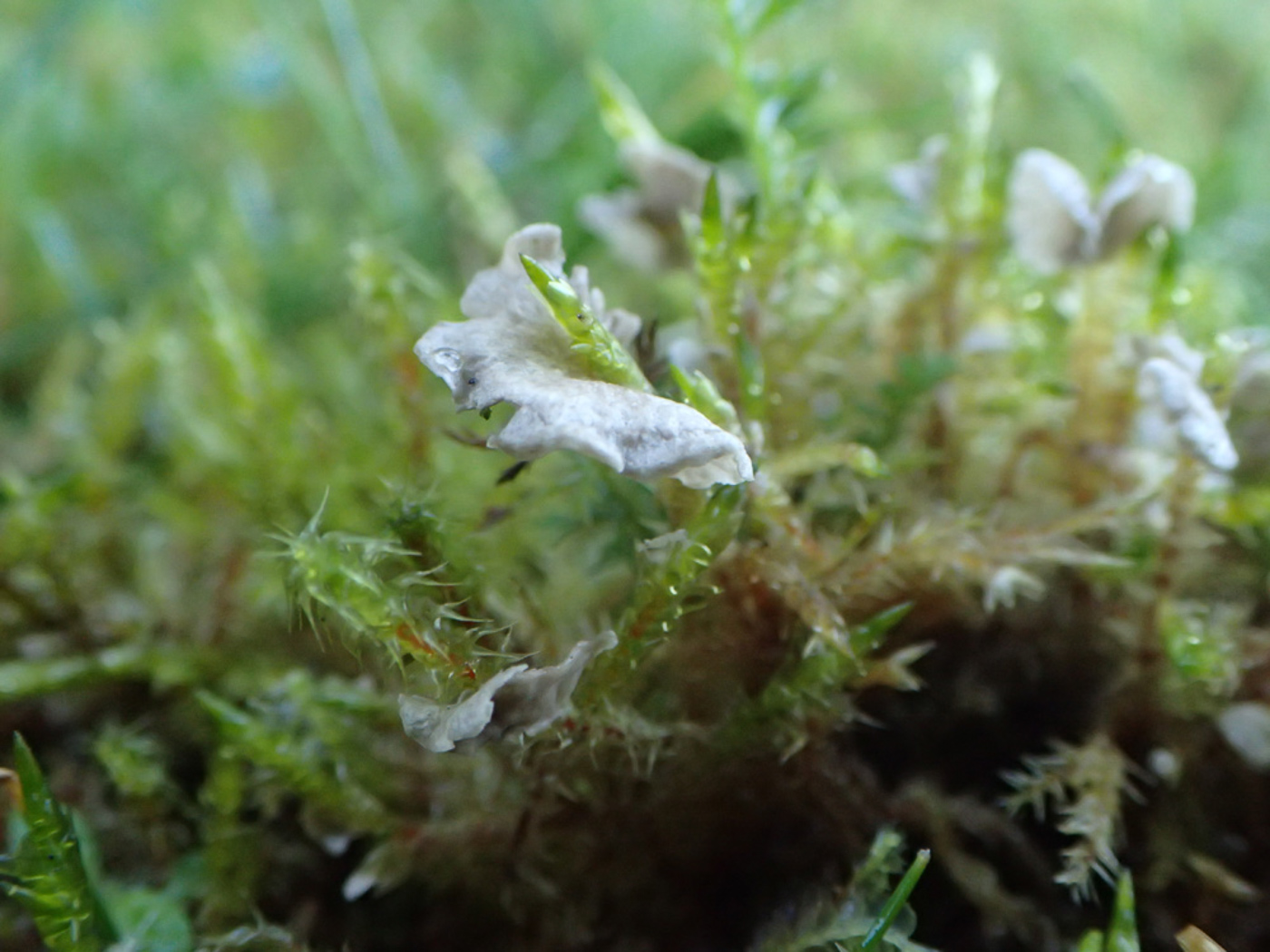
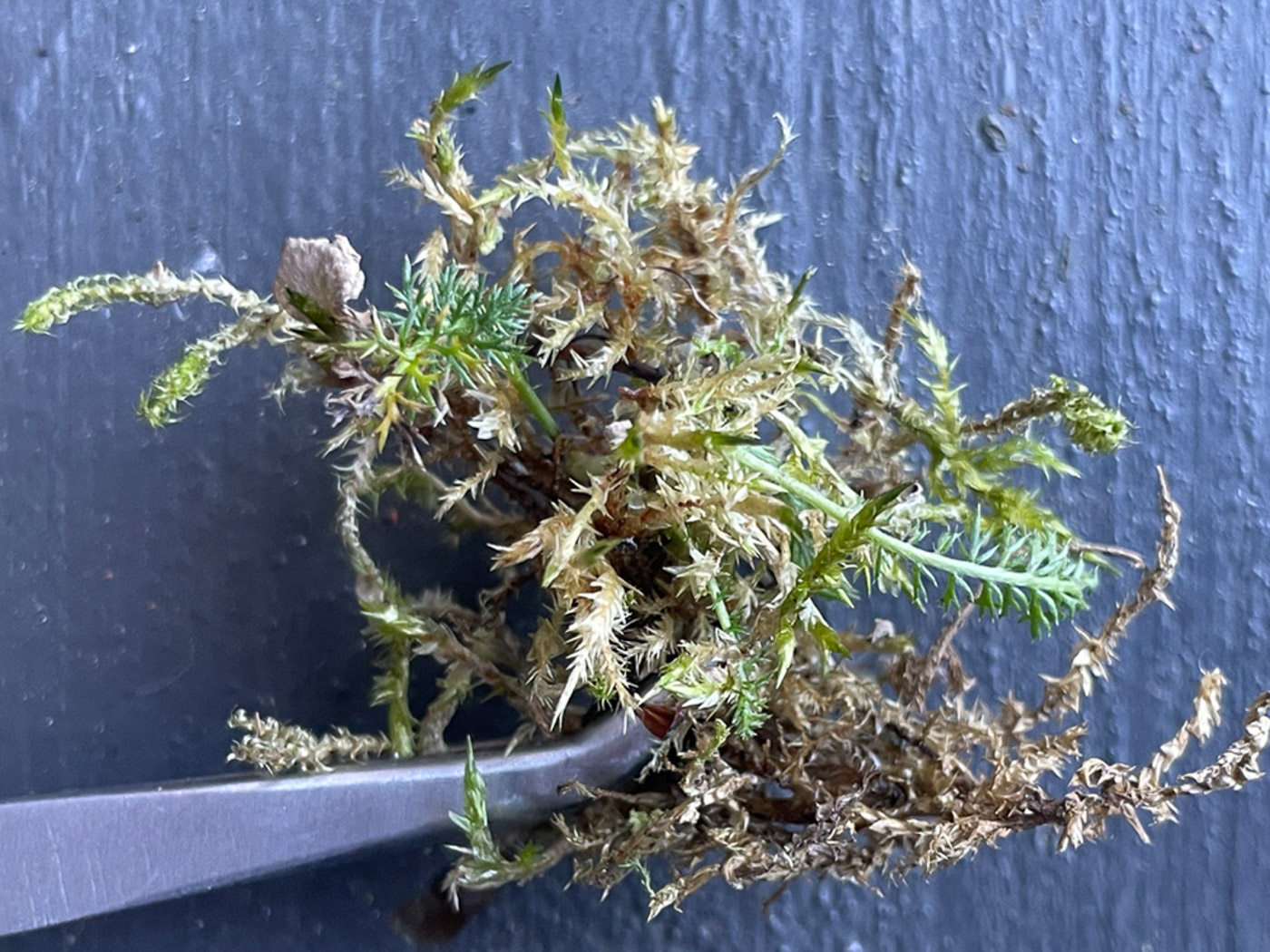 |
March 14th Arrhenia retiruga (Small Moss Oysterling) Saran Ebdon spotted a nicely damp mossy bank near Prestwood churchyard and made a close inspection to see if she could find any bryophilous fungi. She was rewarded with this cluster which she later checked at home as there are other quite similar species which favour this habitat. She then discovered that apparently this plus others in the genus have a faint smell of Pelargonium but could not find any trace of it! Picking up alleged smells of tiny fungi can often be something of a challenge! Her excellent photos here give a good impression of the miniscule size of this species. Previous finds |
March 11th 2026
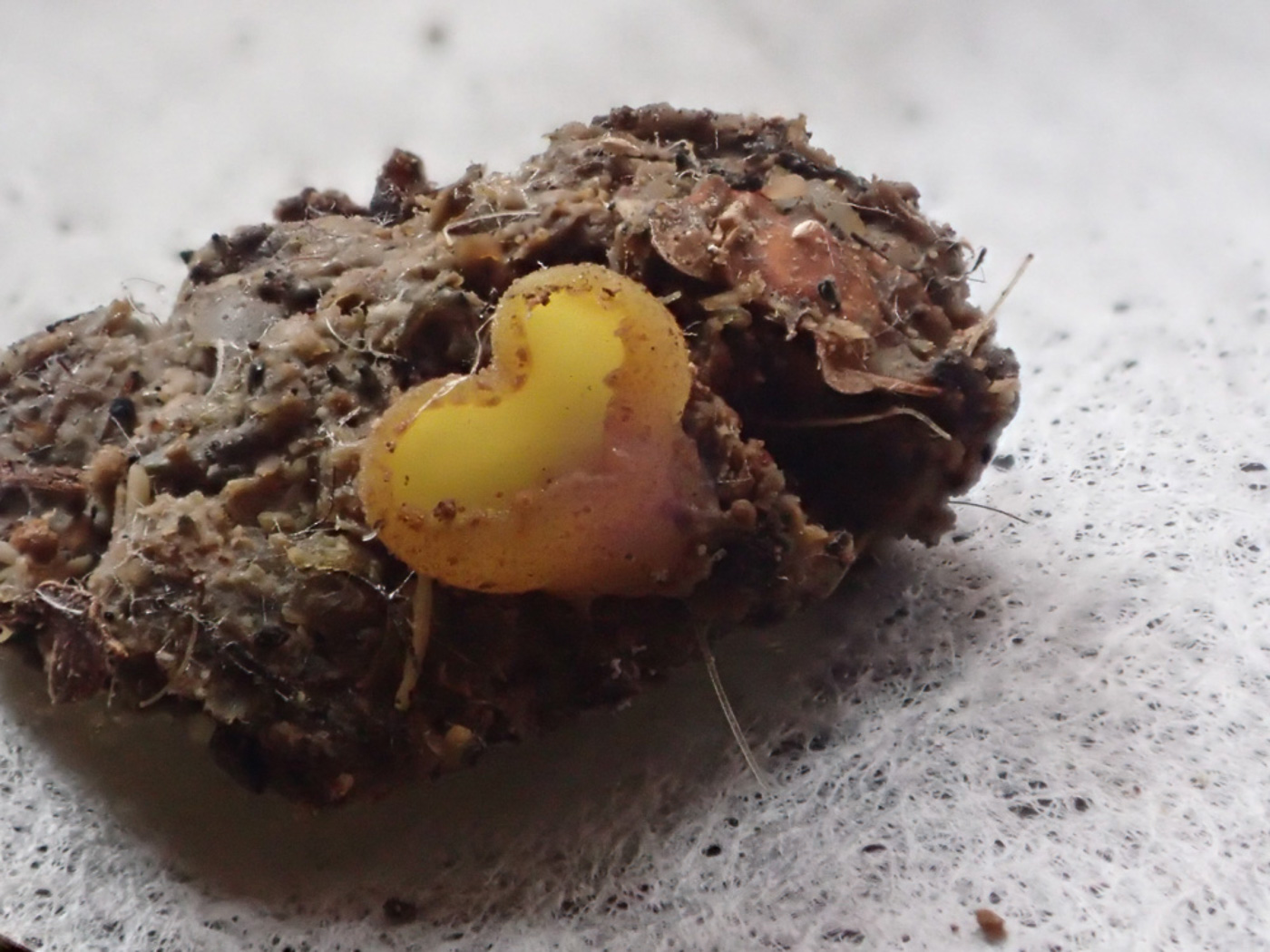
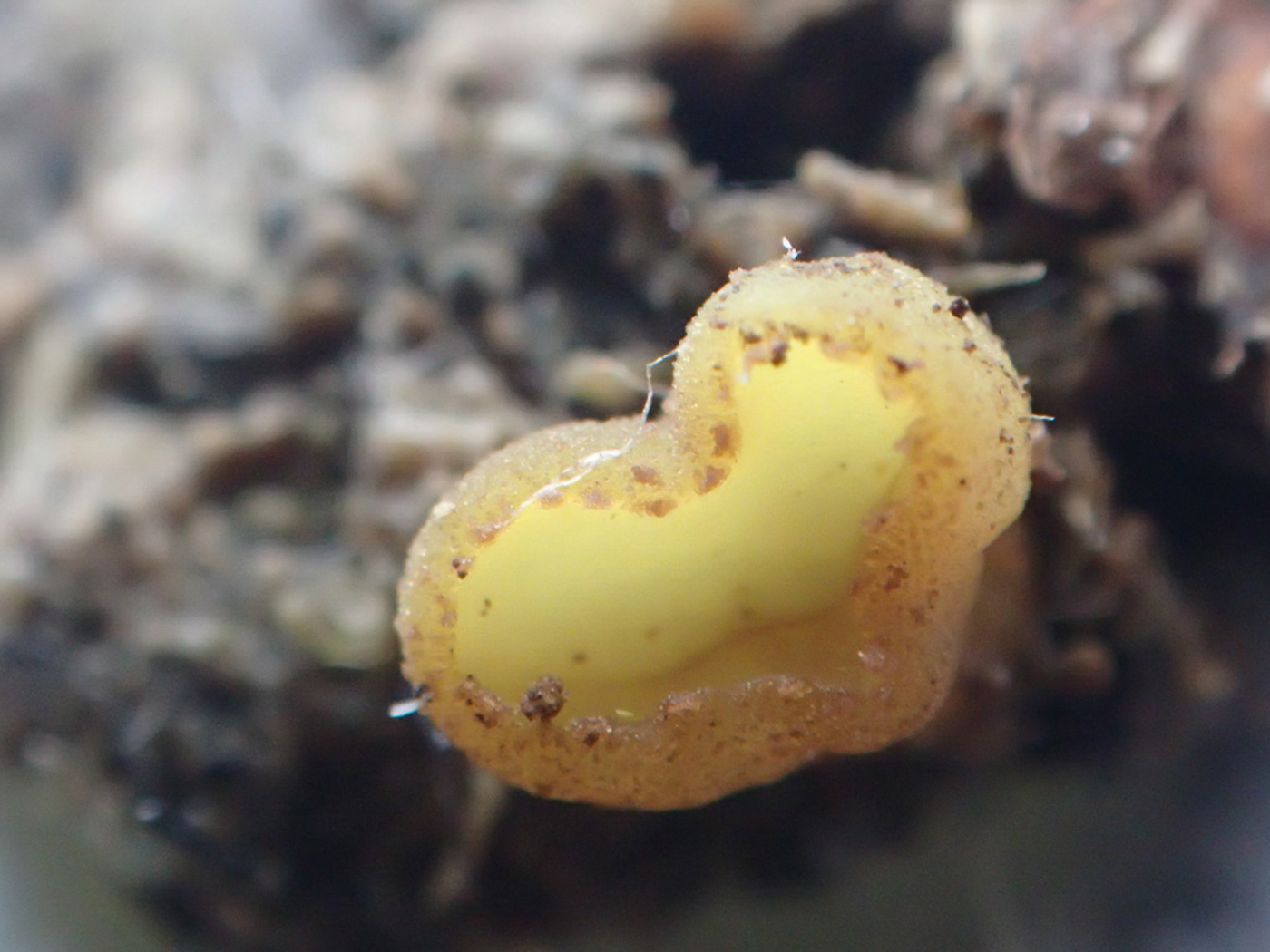
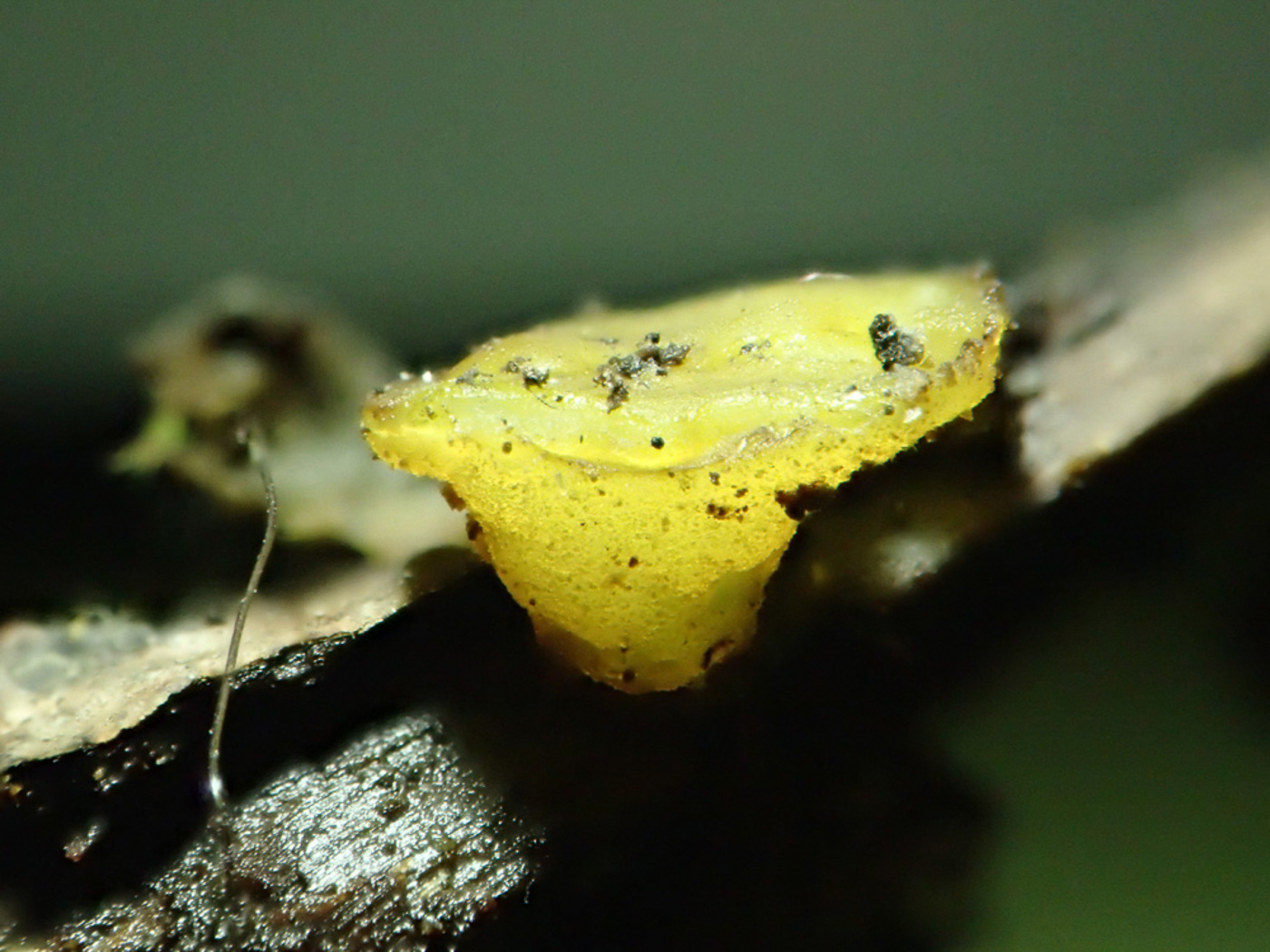 |
March 11th Ascobolus lignatilis (an unusual asco with no English name) At Northmoor Hill Reserve Sarah Ebdon found this small cup fungus growing on two different substrates: very soggy rotten wood and some indeterminate dung. Intrigued by its colour and substrate she took it home to work on. Initial examination showed very few mature spores but just one or two appeared to be purple and ornamented, pointing her to this genus, however she did wonder if these might just be contaminants as there were so few present. Ascobolus is a large genus of tiny cups, having 60+ species of various sizes, colours and shapes, mostly found on dung. So when browsing through 'Ascomycetes in colour' she came across a yellow species which also favoured both rotten wet wood as well as dung, sounding plausible till she read that A. lignatilis reached only 1.5mm across. Her specimens were three times that size! She decided to hang on to the material waiting for it to mature fully in the hope of checking more spores, particularly their size and markings (with distinct lines - hence its Latin epithet) which would be critical to confirming her ID. 8 days later patience was rewarded! BFG colleague Stephen Plummer then provided a useful though frighteningly technical key, and this together with further research revealing the size of this species is in fact up to 12mm across putting her specimens well within range, eventually provided the necessary confirmation. What an achievement and very satisfying! This is new to the county as well as to Finds. Members' Finds New Species no. 1268 |
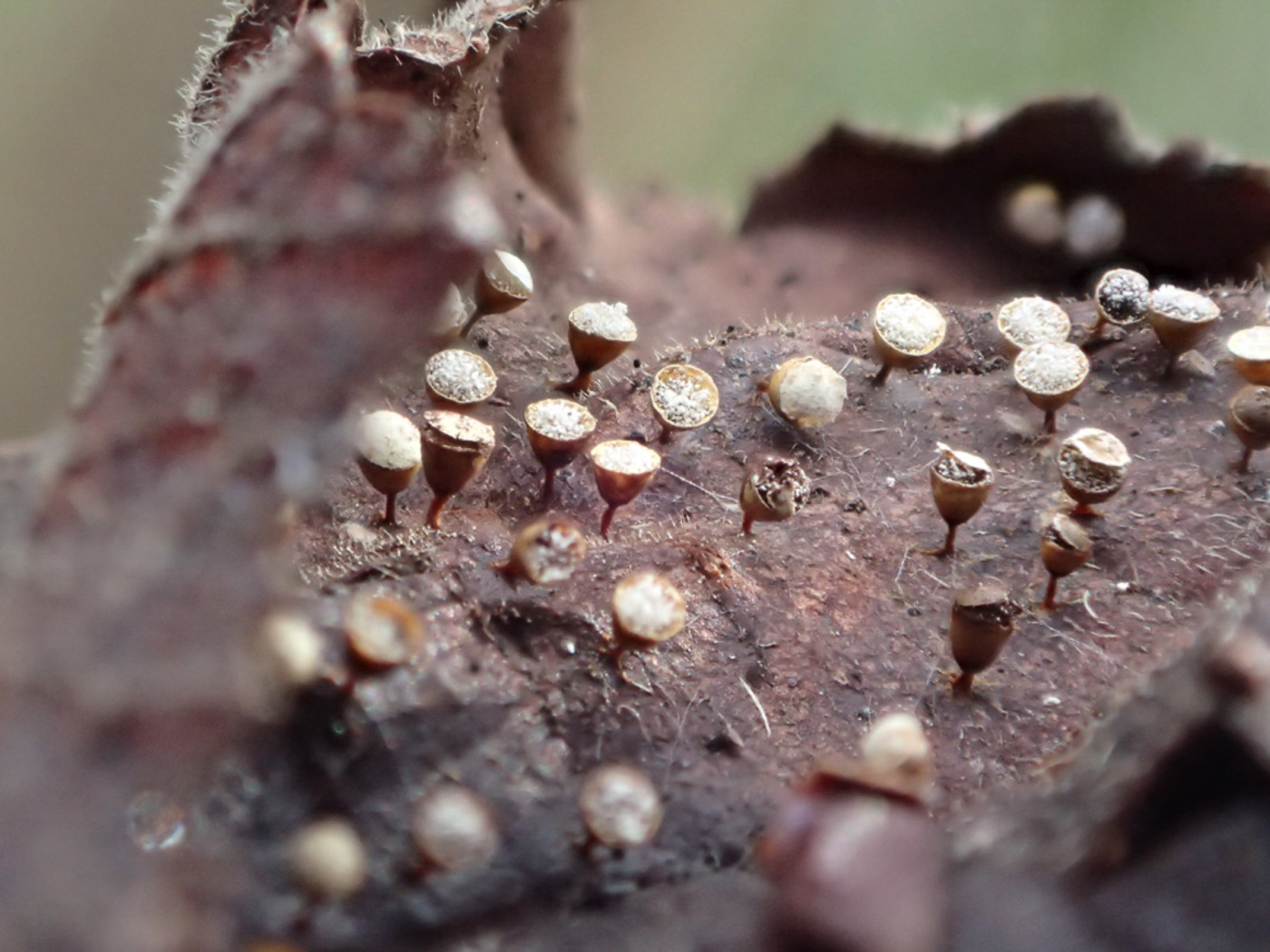
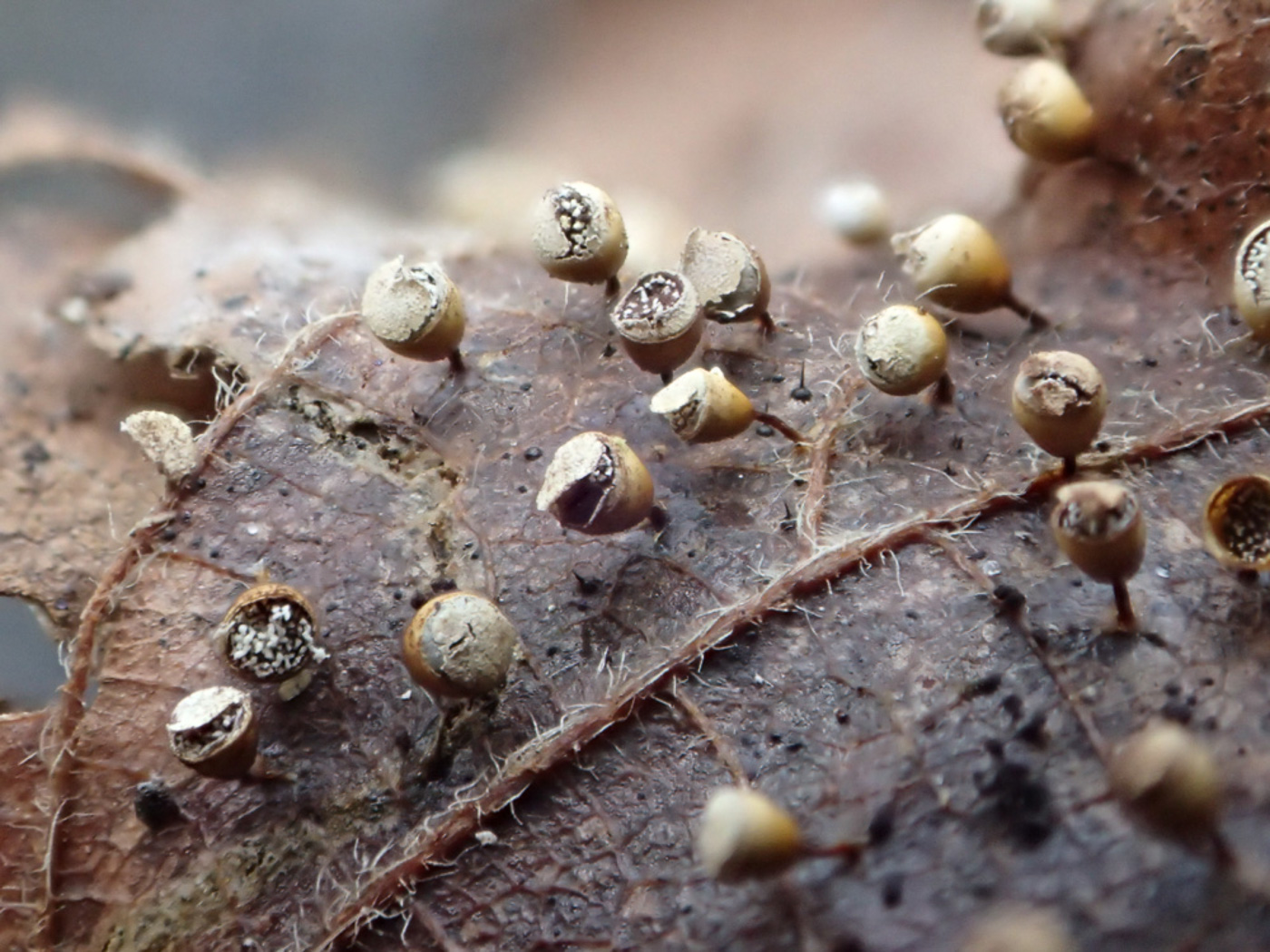
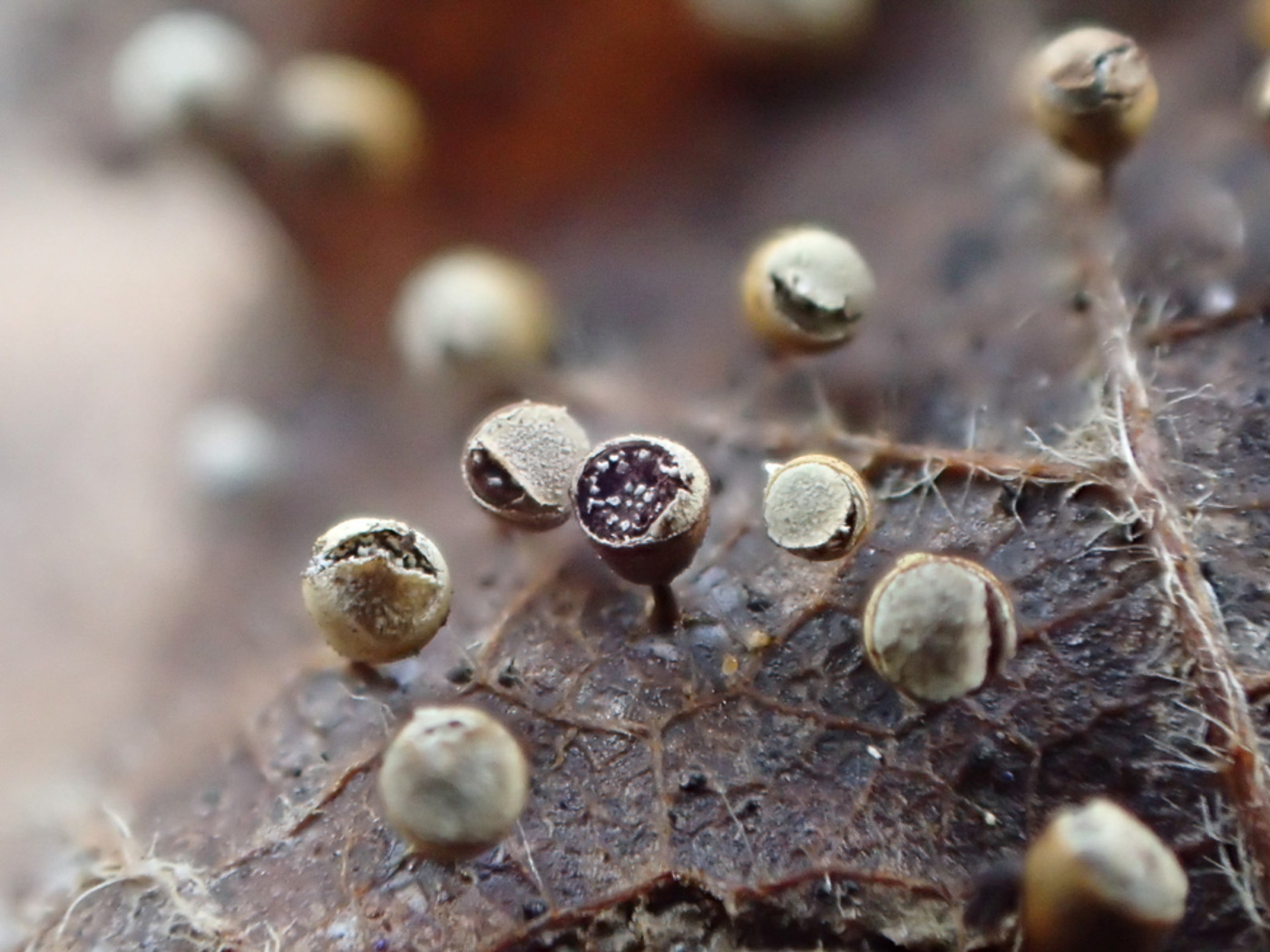 |
March 11th Craterium minutum (a slime mould with no English name) At Northmoor Hill Reserve near Denham Sarah Ebdon and Jesper Launder found this tiny but very distinctive slime mould fruiting 'in astonishing abundance' (Sarah's words) on deciduous leaf litter and stems - they were spoilt for choice! Barry Webb was later on hand to confirm their ID. The photos are Sarah's. Previous finds |
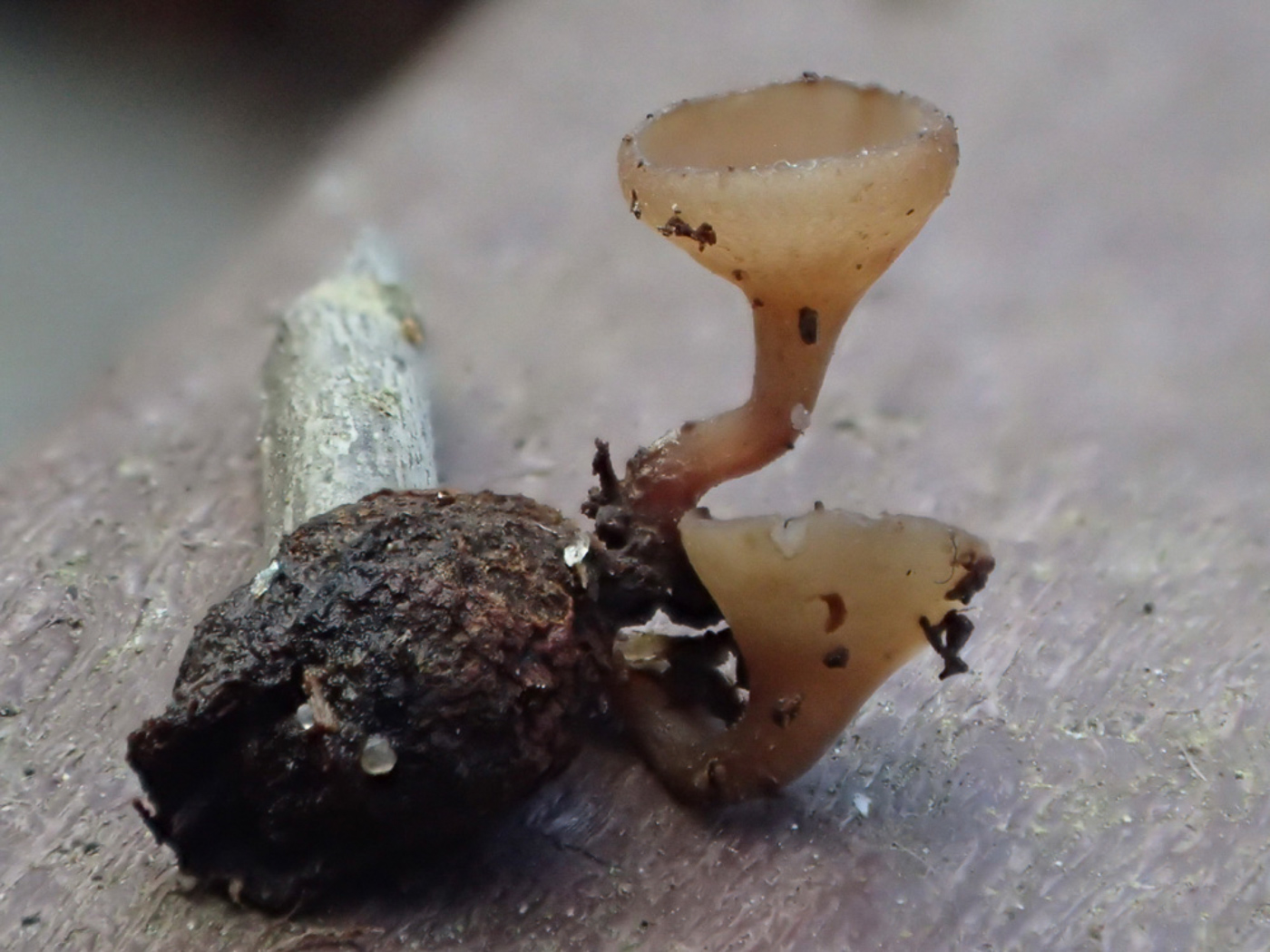
.jpg "Photo © Sarah Ebdon")
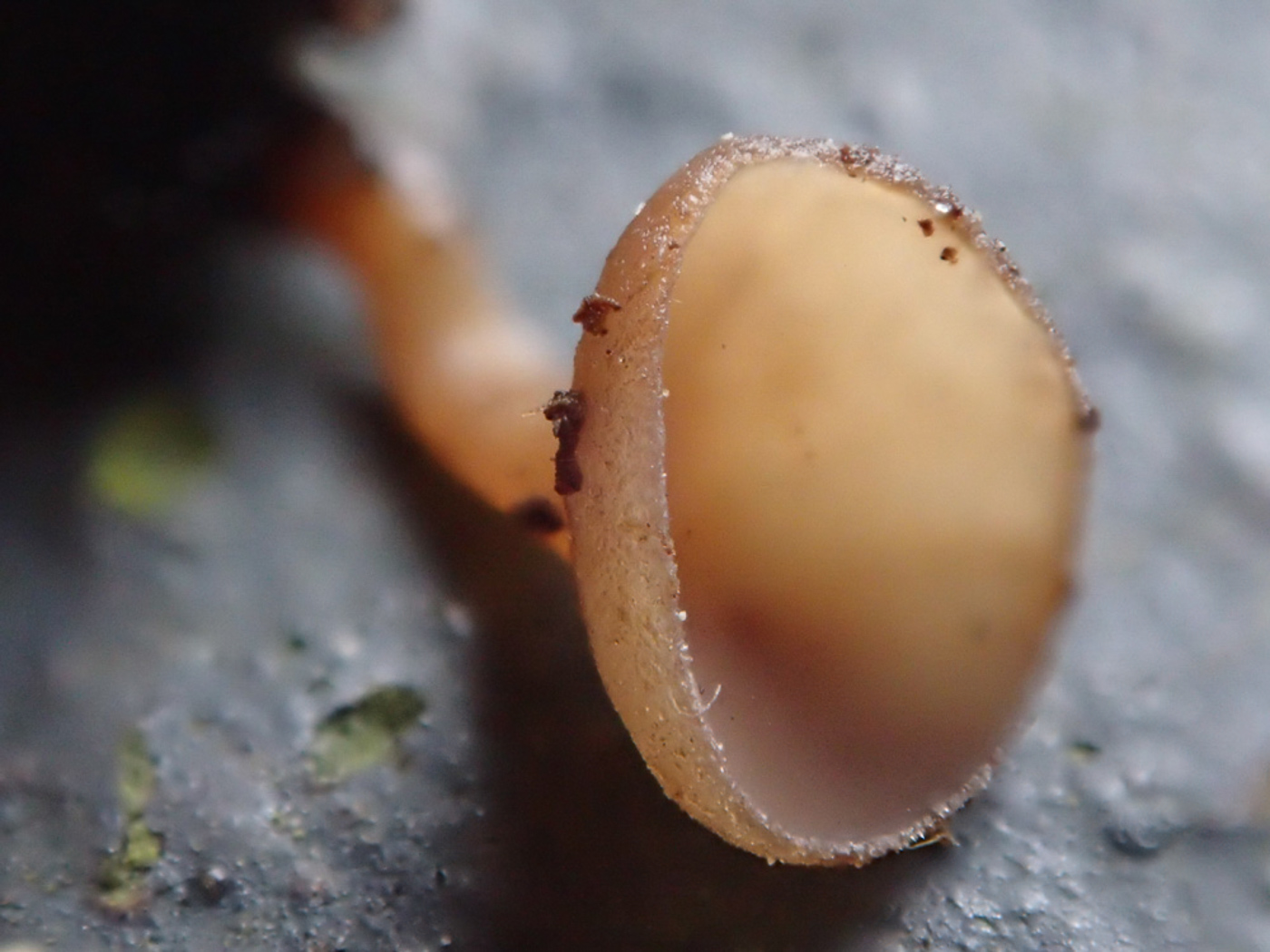 |
March 11th Monilinia johnsonii (Haw Goblet) At Northmoor Hill Reserve this was the target species both Sarah Ebdon and Jesper Launder were hoping to find - not the anamorph stage which causes Leaf Blight exclusively on Hawthorn leaves in late spring, and which they'd found last year, but the teleomorph stage seen here, ie the stemmed cups which occur in early spring on the mummified haws. Success! Having been trawling in vain under Hawthorn hedges for weeks, here it was under a lone Hawthorn and in good numbers as well. This is a wet site with Alder Carr and the conditions clearly suited this elusive species. We have several county records of the anamorph stage now, but this is a first for the actual ' goblets'! The photos are Sarah's. Previous finds |
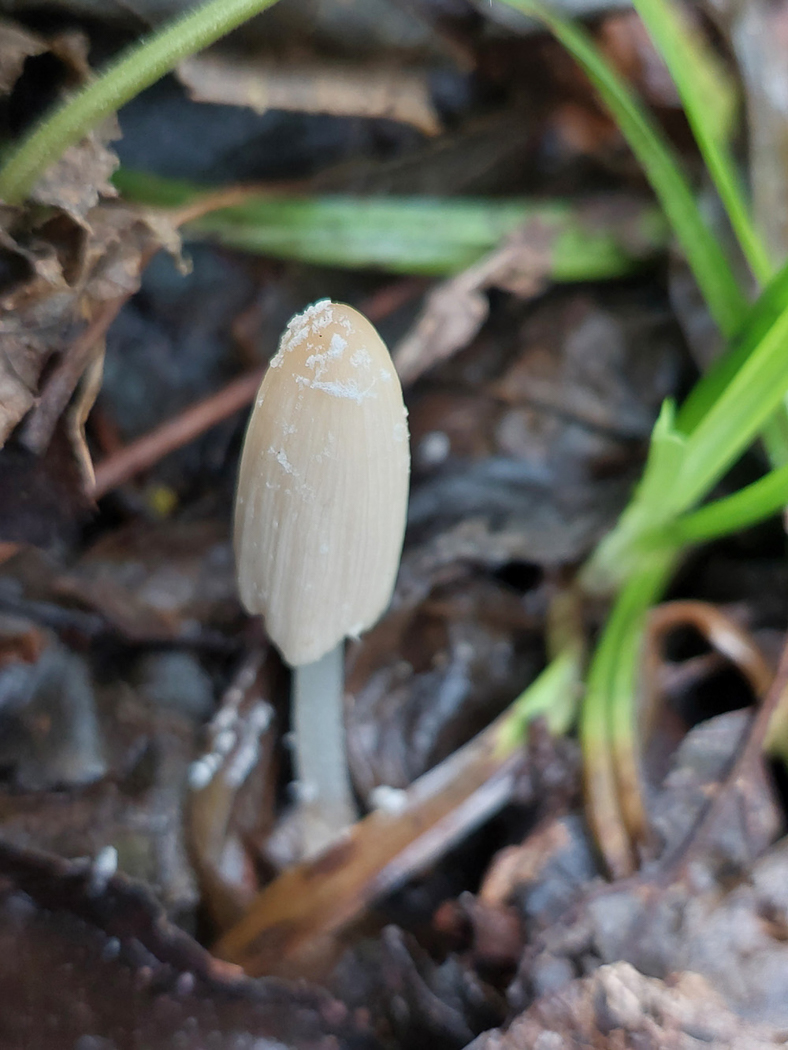
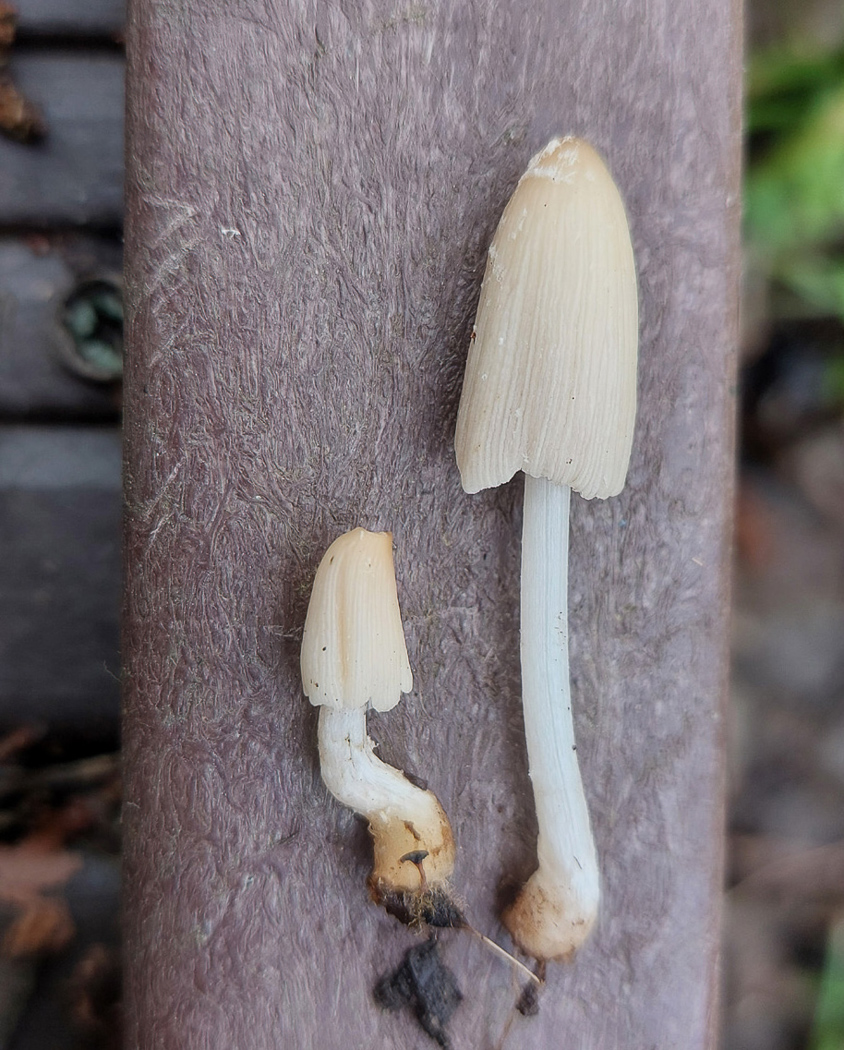 |
March 11th Coprinellus flocculosus (Flocculose Inkcap)  At Northmoor Hill Reserve Jesper Launder found this fresh Inkcap in damp grassy litter and as it looked unfamilar he took it home to work on. Keying it out proved inconclusive so he contacted Derek for advice, who suggested the name given here though the veil remnants (after which the species is named) appeared to be much less substantial than one would expect, though that could have been caused by weather etc. Jesper then found the microscopic features fitted well and having now sequenced the collection Derek's suggestion proved spot on! We have just a handful of previous county records, mostly Derek's. Members' Finds New Species no. 1267 |
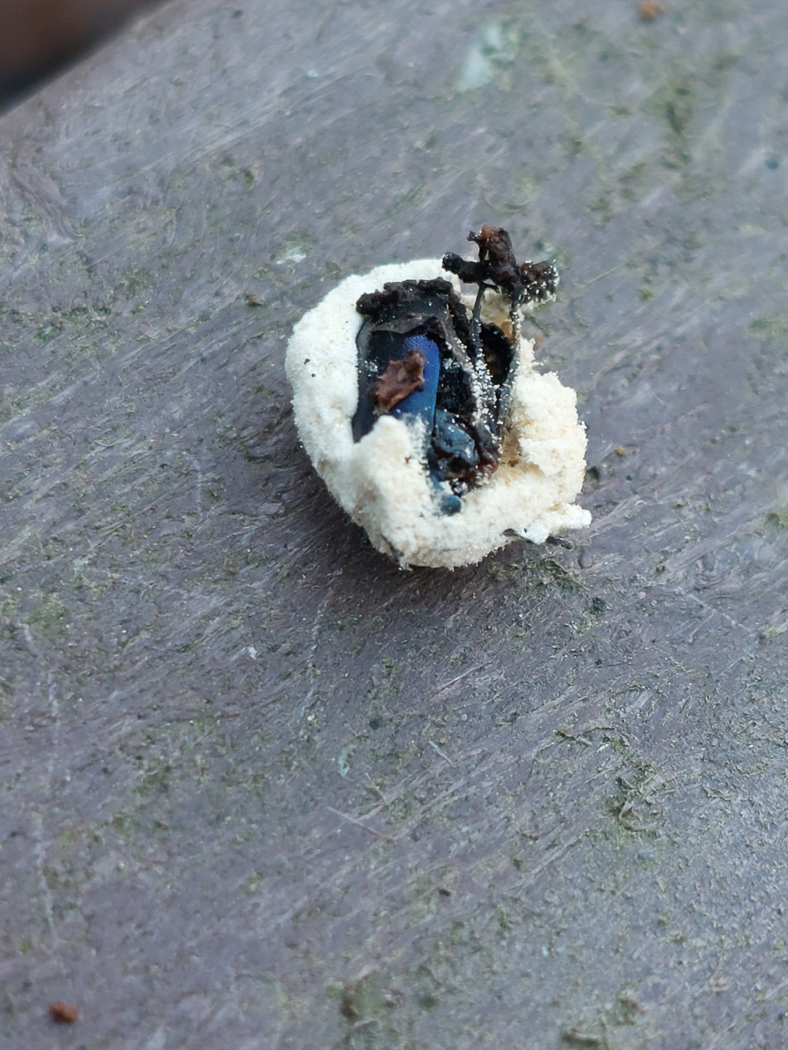 |
March 11th Beauveria bassiana sl. (an unusual ascomycete with no English name) When searching amongst leaf litter at Northmoor Hill Reserve Jesper Launder spotted this tiny asco growing on an unidentified beetle. Members of the genus Beauveria, related to Cordyceps, are insect pathogens, B. bassiana being the most common though there are known to be some similar cryptic species not yet fully understood. Hence though Jesper checked the conidia were within the correct range for this species he prefers to record it with 'sl' here, ie 'sensu lato' indicating ' in the broad sense'. Previous finds |
.jpg "Photo © Sarah Ebdon") |
March 11th Physarum bivalve (a slime mould with no English name) At Northmoor Hill Reserve Sarah Ebdon reports finding a range of different slime moulds (this is a suitably wet site with board walks etc), and took a photo of this one on the underside of a fallen deciduous leaf, her ID confirmed by Barry Webb. This is quite an unusual but distinctive species with very few county records Previous. finds |
.jpg "Photo © Sarah Ebdon") |
March 11th Lachnella alboviolascens (a species of Cyphelloid fungus with no English name) At Northmoor Hill Reserve Jesper Launder found this swarm of tiny 'cups' on damp woody debris looking a bit like the genus Mollisia but with a white finely and densely furry outer surface. Sarah Ebdon undertook to work on it, suspecting that it was not in fact an asco at all but belonging to the mixed group of gillless basidiomycetes loosely known as cyphelloids which are somewhat similar in appearance to discos but their microscopy belies this. Sarah could find no asci, pointing to this group, but to begin with could find no basidia or spores either! However, the blueish-violet pigment contained within her preparations fitted well and eventually she found some basidia confirming her original thoughts. Good detective work, Sarah! We have just 5 previous county records, the most recent from Dancersend found and identified by Kerry Robinson in 2022. Previous finds |
.jpg "Photo © Barry Webb FRPS") |
March 11th Deconica phillipsii (an unusual Oysterling with no English name) At Northmoor Hill Reserve Jesper Launder, searching amongst wet vegetation for small fungi of any sort, noticed this tiny fluffy pinkish mushroom on Kindberbia praelonga (Common Feather Moss), the cap no more than 1mm across. After a fair amount of research he eventually tied it down to Deconica phillipsii, previously in genus Melanotus and also at some stage in Psilocybe. Its closest relative is probably D. horizontalis though that species is found on wood and is not unlike the genus Crepidotus in appearance, ie having an eccentric stem. However, this specimen was still so tiny that the stem still appears almost central but microscopic features together with its pale colour and occurrence in wet vegetation were a perfect match. We have a smattering of previous county records, all on vegetation stems in wet sites such as Rushbeds Wood and Burnham Beeches. The photo is Barry Webb's. Members' Finds New Species no. 1266 |
 |
March 11th Neosetophoma samarorum (an asco with no English name) Whilst examining an Ash key found at Northmoor Hill Reserve near Denham, Sarah Ebdon noticed two different black dots. At the seed end the larger dots were the asco Diaporthe samaricola, but the much smaller dots were those of Neosetophoma samarorum, seen here at the wing tip on the left. Both species are very common though this is only our second county record! (See also the photos for Diaporthe samaricola - same date - for useful comparison.) Previous finds |
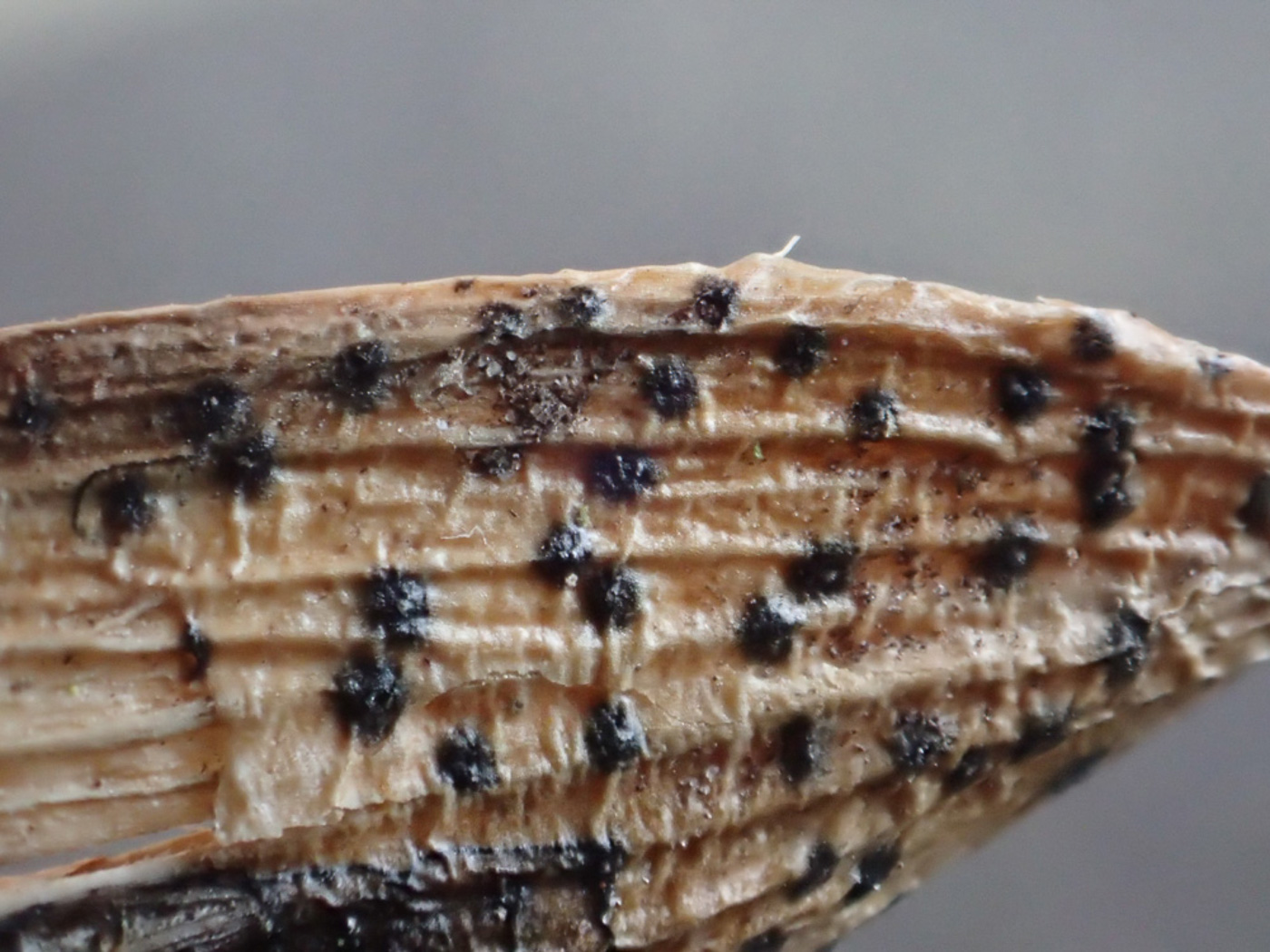
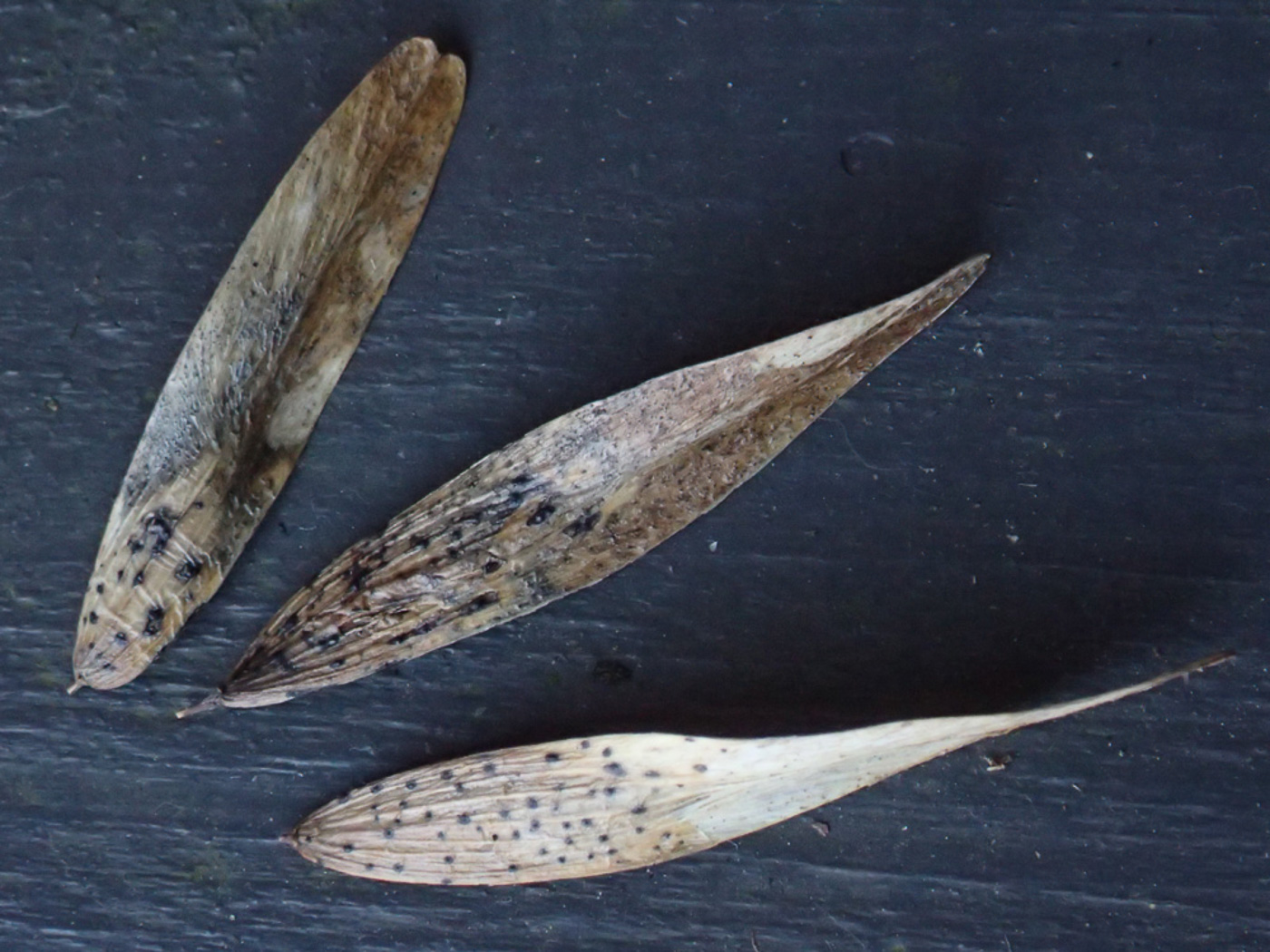 |
March 11th Diaporthe samaricola (an asco with no English name) At Northmoor Hill Reserve near Denham Jesper Launder picked up this fallen last year's Ash key and noticed the distinct black dots at the seed end. Sarah Ebdon then took them home to check, identifying them as D. samaricola, but at the same time noted the much small black dots of Neosetophoma samarorum at the wing tip of the same key. (See the separate entry for that species.) Though very common, these two species were new to the county when discovered by Neil Fletcher in 2021. Photo 2 was of a find made by Sarah at Prestwood churchyard 2 weeks later and demonstrates how the larger D. samaricola colononises the seed end of the key whereas the much smaller N. samarorum colonises the wing end. Previous finds |
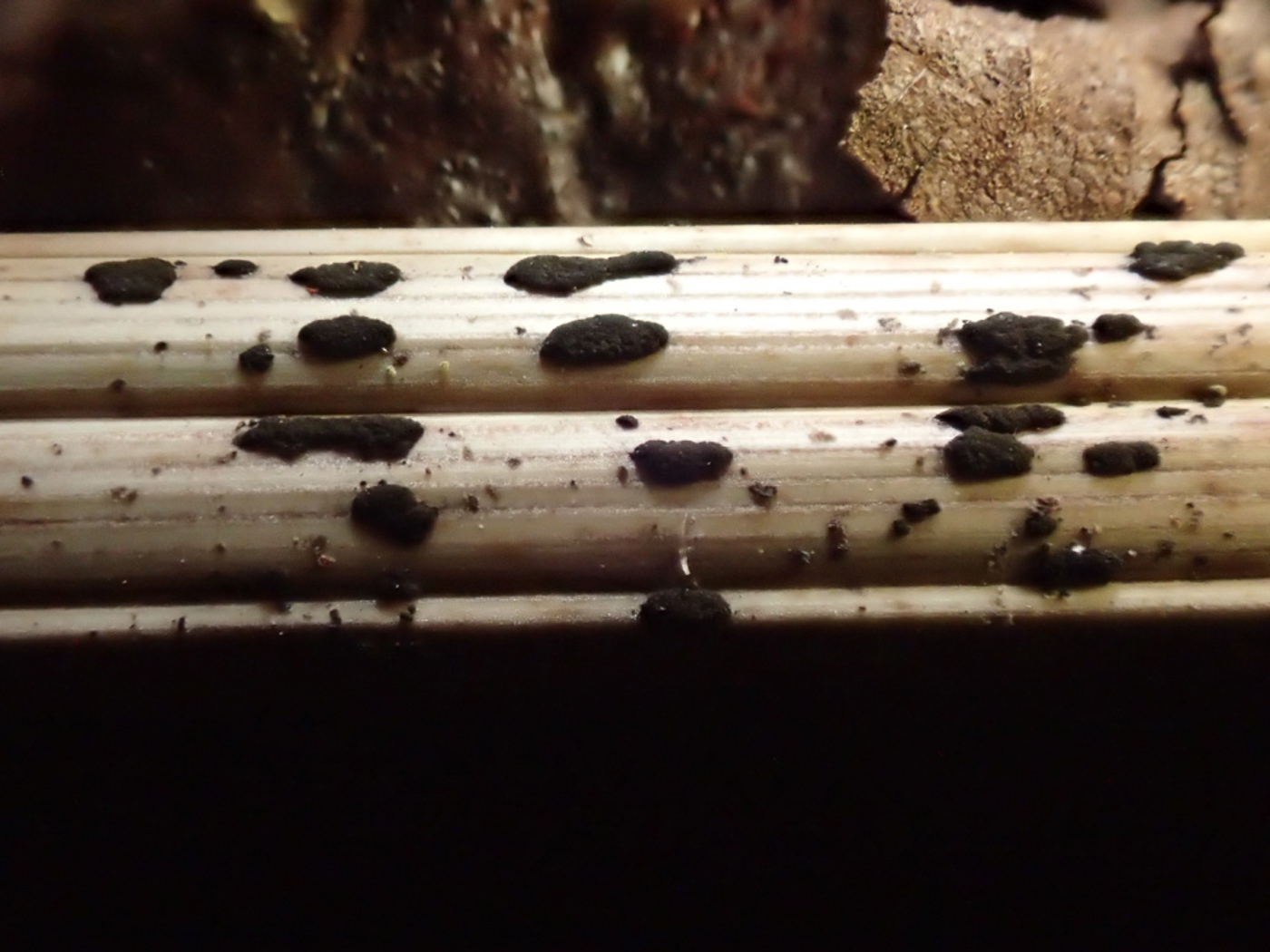 |
March 11th Arthrinium sporophleum (an unusual plant pathogen with no English name) At Northmoor Hill Reserve near Denham Jesper Launder, looking for tiny things on plant stems etc, noticed these unfamiliar black sooty blotches on the stems of Carex pendula (Pendulous Sedge). Both he and Sarah Ebdon worked on the ID, with the Ellis & Ellis section ''Fungi on Rushes, Sedges, Bur-reeds and Reedmaces' eventually providing the answer. The species apparently can also occur on many different grasses and is considered common (despite there being not that many FRDBI records). We have just one previous county record from Rushbeds Wood on the same host plant, found by Claudi Soler back in March 2016. Members' Finds New Species no. 1265 |
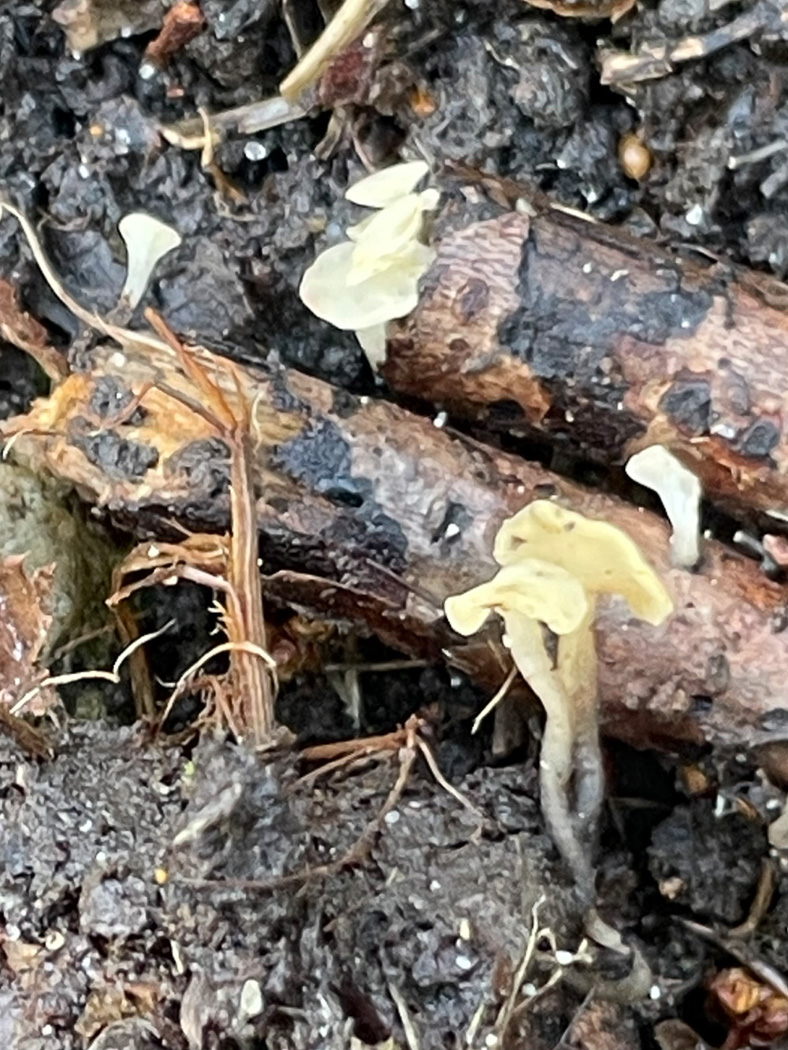
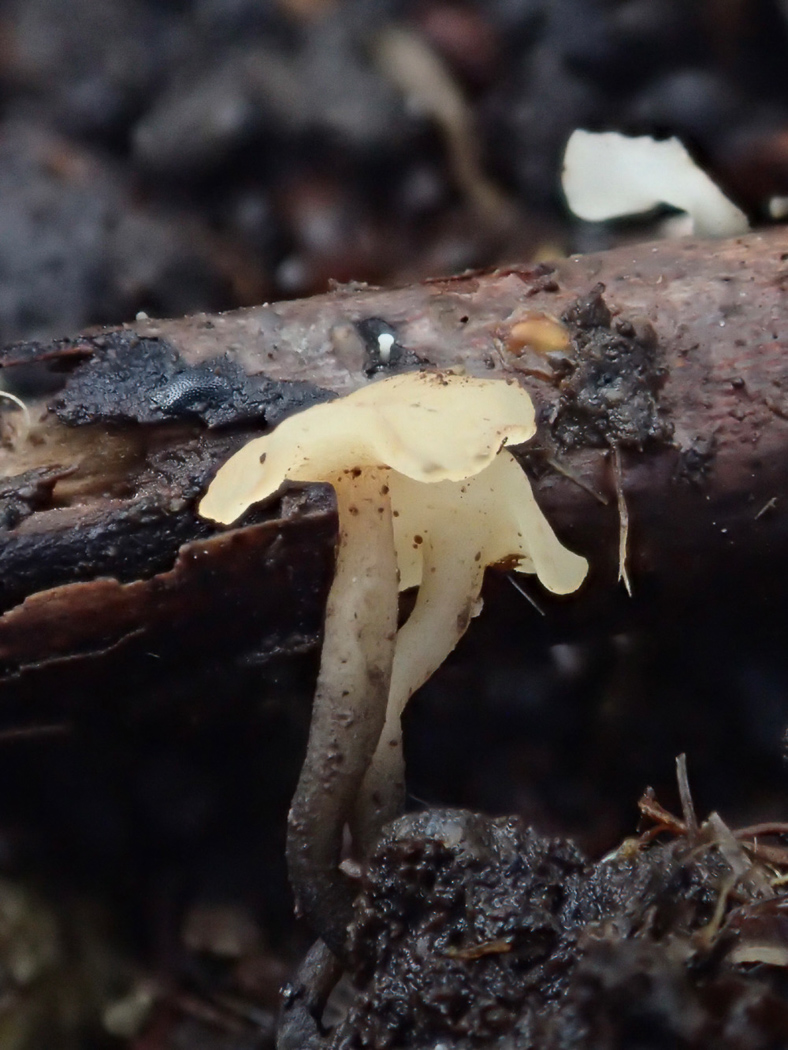
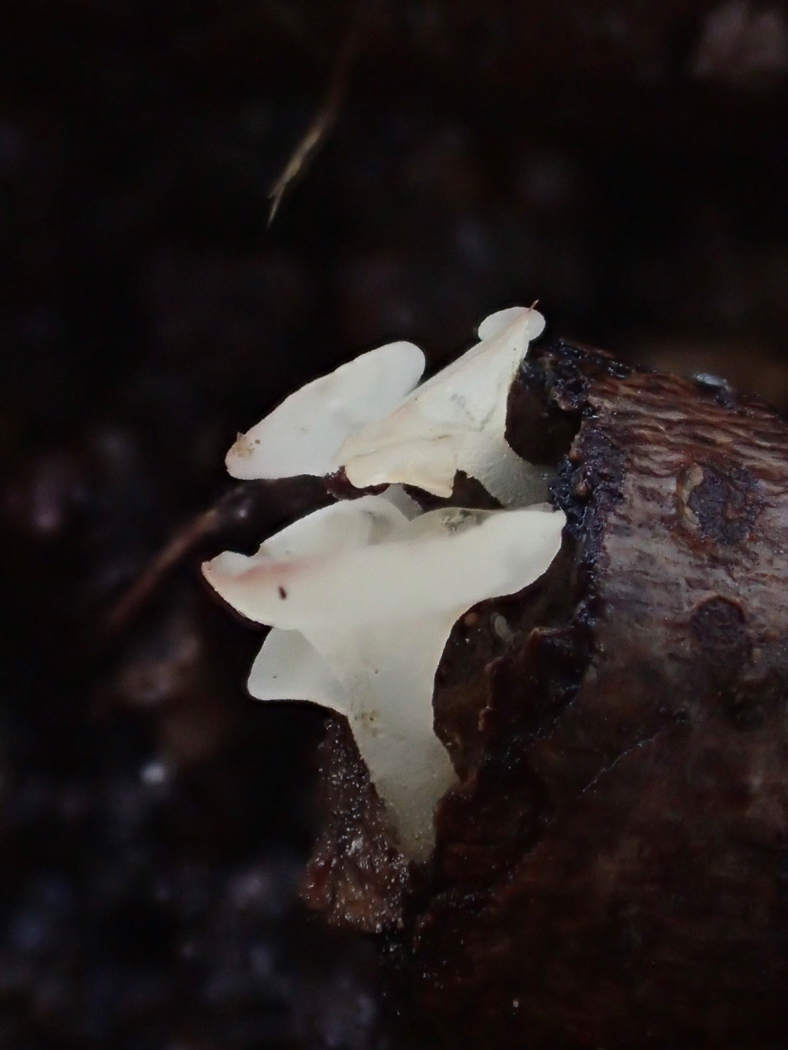 |
March 11th Cudoniella clavus (Spring Pin) On some wet woody debris at Northmoor Hill Reserve near Denham Jesper Launder noticed these small whitish cups with long stems, and promptly thought of the genus Cudoniella. At home Sarah Ebdon, aware of the tiny Cudoniella acicularis which occurs on Oak stumps but is considerably smaller than today's specimens, discovered this larger species, new to her, which favours wet habitats as here and also fruits in spring. Jesper, who checked the material microscopiclly, confirmed her suggested ID. The lower stem apparently tends to darken as seen here though the caps are reportedly more often domed in shape rather than concave. We have a few previous county records from damp sites such as Rushbeds Wood and Burnham Beeches. Previous finds |
March 10th 2026
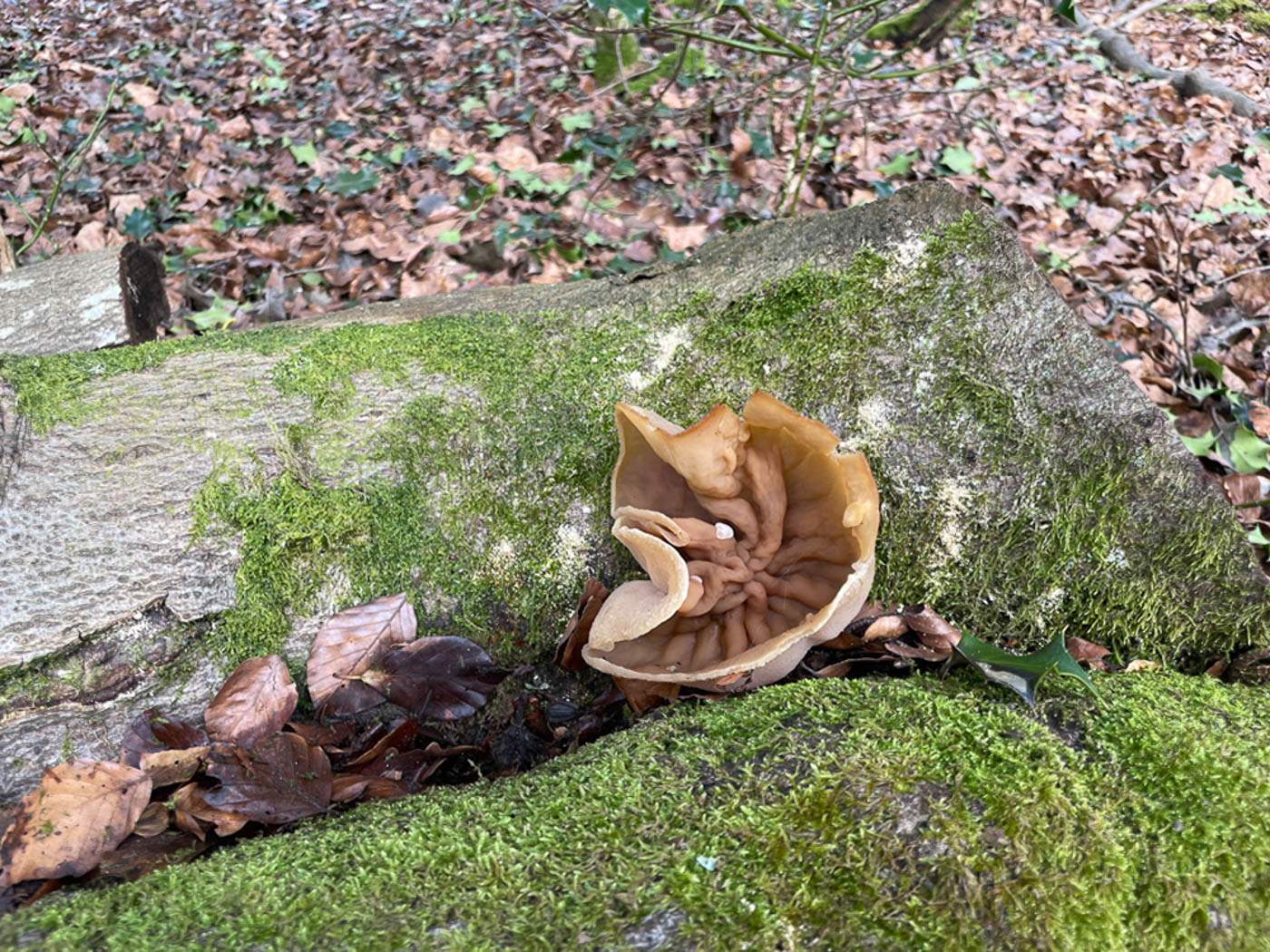
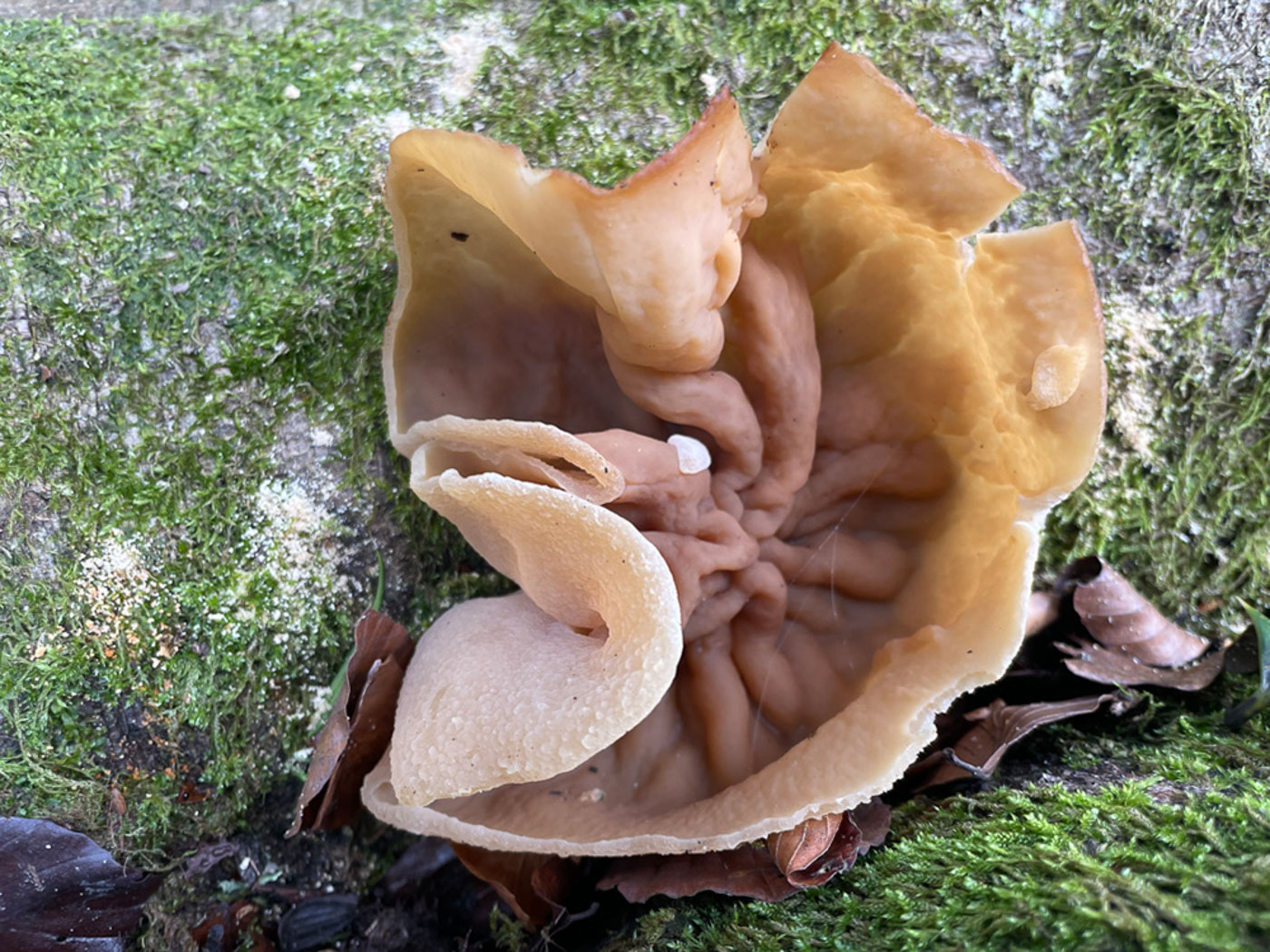 |
March 10th Peziza repanda (Palomino Cup) At Naphill Common Sarah Ebdon could hardly miss this somewhat oversized cup found on some fallen rotten mossy wood and which she reports was a whopping 11 cm across! First impressions were that it might be the spring fruiting Disciotis venosa (Bleach Cup) with all those wrinkles inside, but a microscope soon eliminated all except Peziza when the tips of the asci showed blue when viewed in Melzers reagent. It then keyed out to P. repanda which she discovered can reach up to 12 cm across. There are several species of Peziza which are this pale washed-out fawn colour, and their spore ornamentation and size can overlap making ID not very straightforward. In available keys this species tends to be separated out from others by occurring on soil rather than wood (which rather contradicts Sarah's ID here); however the likeliest alternative occurring on wood is P. micropus which has a small stem (not present here) and furthermore is not reported to get anywhere near the size of this specimen. Some descriptions do include M. repanda occurring on rotting wood (as here), also woodchip, which rather points a possible weakness in the key most of us use for this difficult genus. Previous finds |
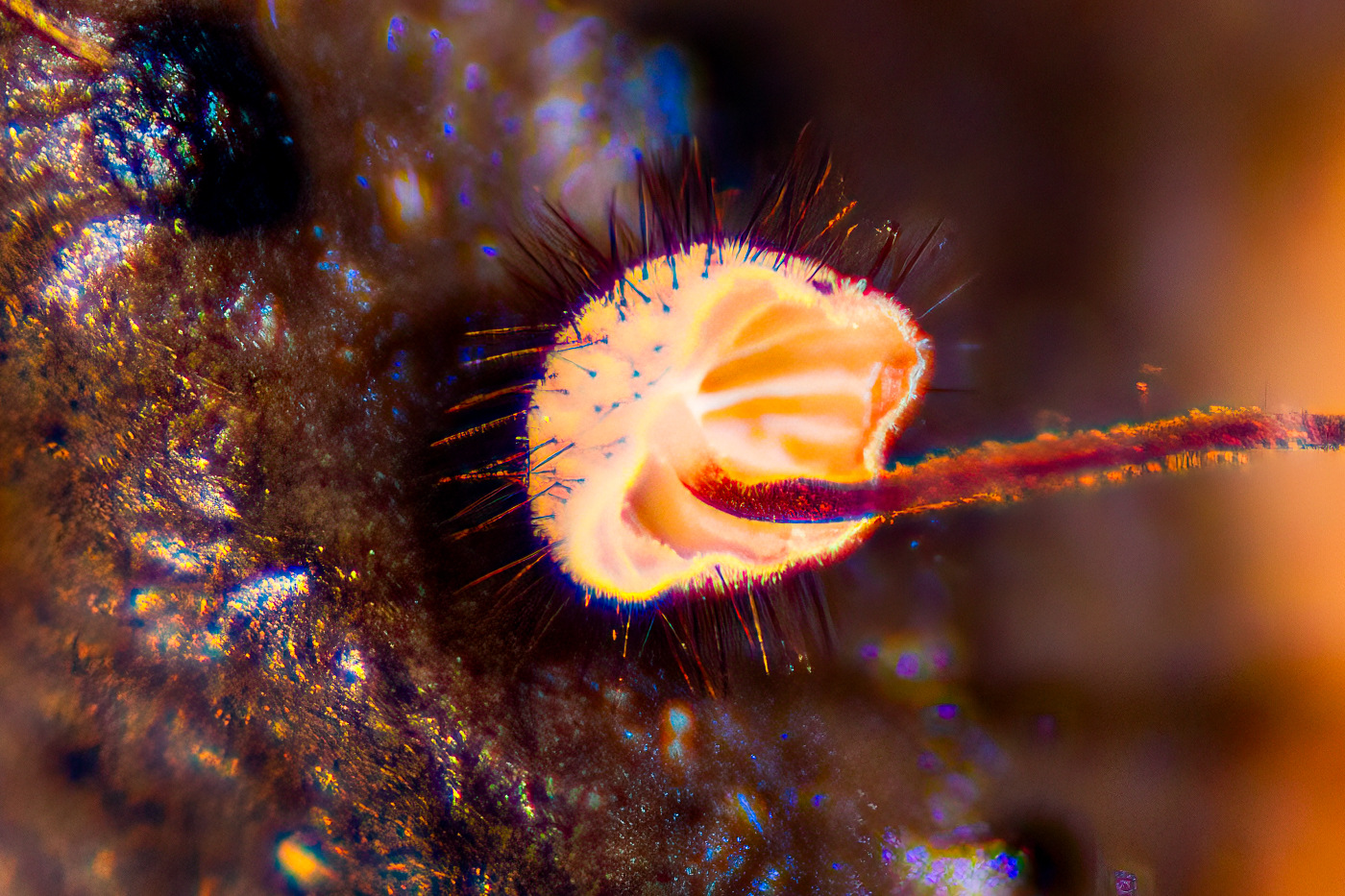 |
March 10th Marasmius hudsonii (Holly Parachute) Whilst looking for slime moulds on Naphill Common Peter Davis spotted this minute mushroom (less than 2 mm across) on a fallen dead Holly leaf and sent his photo to Penny. There is never any doubt with ID when one finds this little beauty - there's just nothing else this size, covered in distinctive reddish bristles and growing exclusively on dead Holly leaves. It seems to favour winter fruiting and proliferates in damp places, under hedges, in ditches, wherever its host leaves are decaying, and not surprisingly has had a bumper season this year! Previous finds |
March 6th 2026
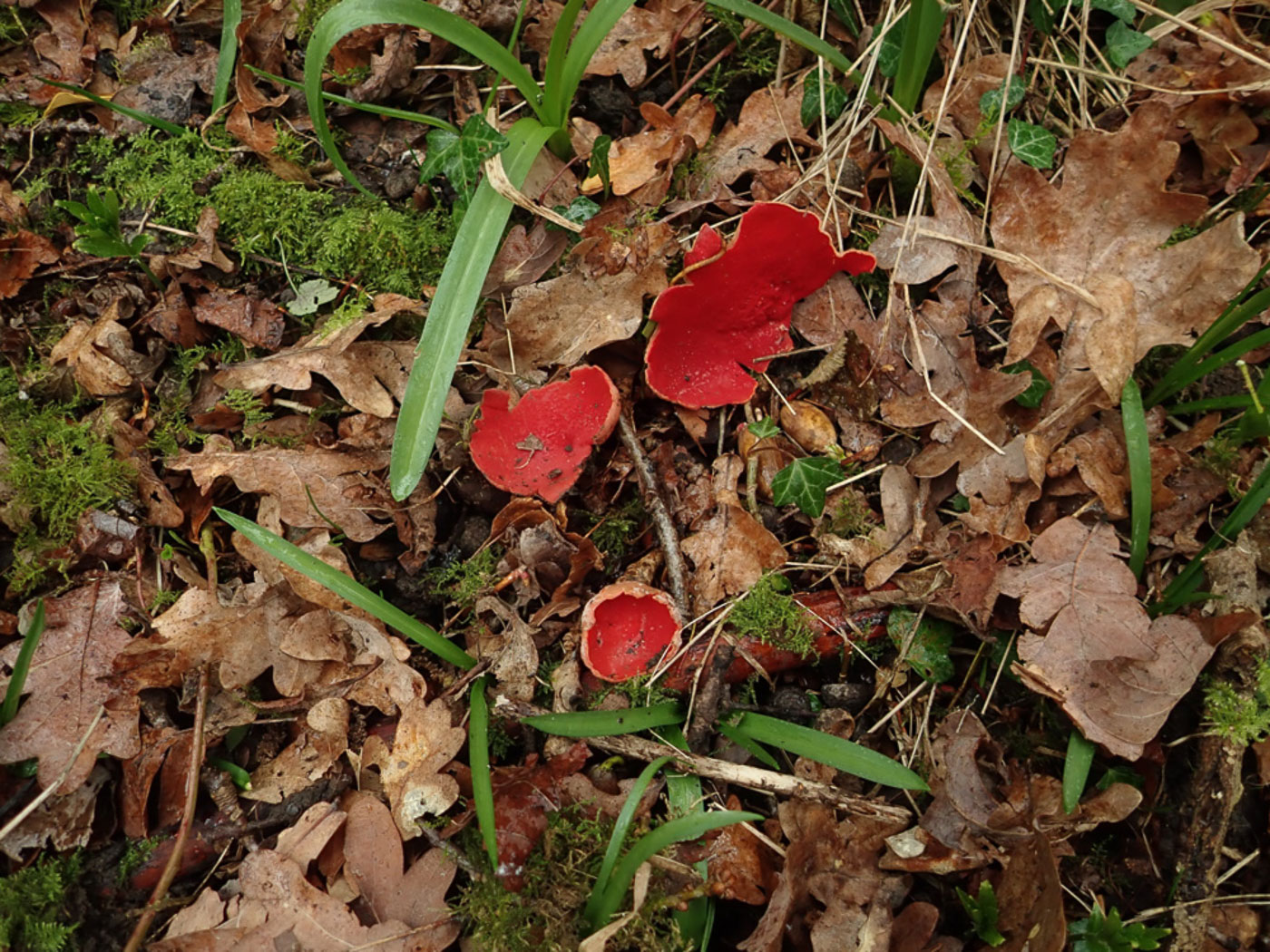 |
March 6th Sarcoscypha austriaca (Scarlet Elfcup) On a cold and drizzly visit to Rushbeds Wood Penny (hoping for signs of early Morels) found very little fungi of any interest but couldn't resist taking a photo of this lovely material of what could be described as the signature species of this site. We certainly have more records of this species from here than anywhere else in the county Previous finds |
March 5th 2026
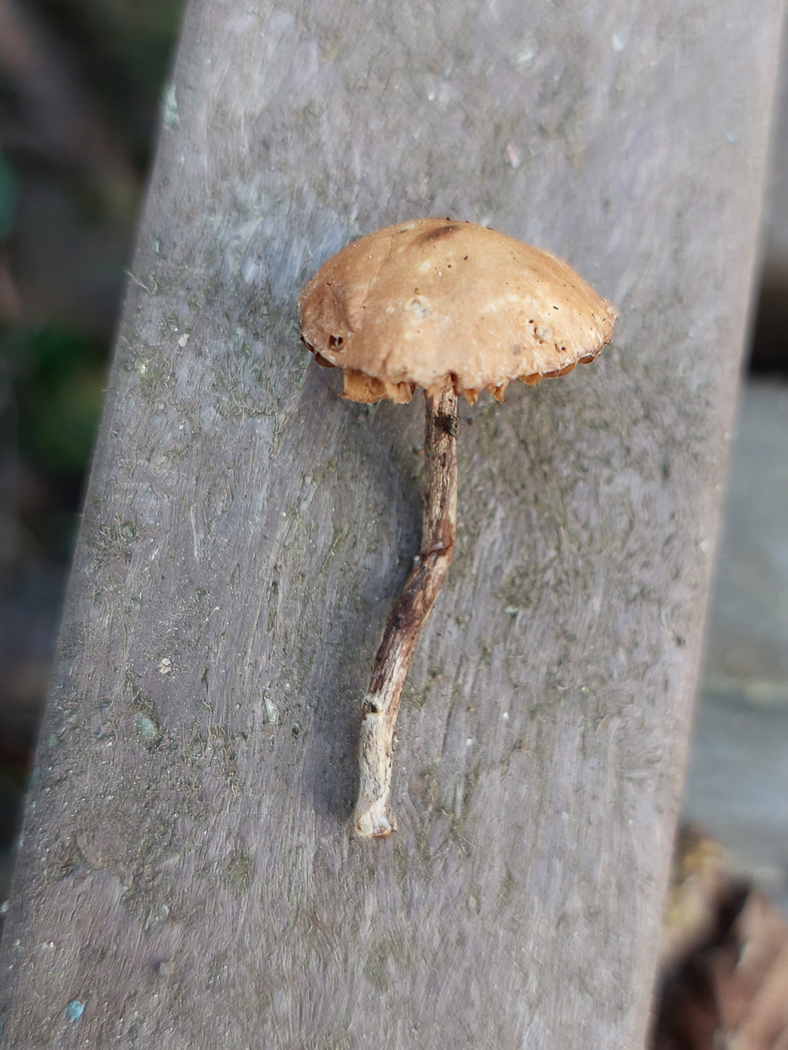
.jpg "Photo © Jesper Launder") |
March 5th Galerina salicicola (a rare species of Bell with no English name) At Northmoor Hill Nature Reserve near Denham Jesper Launder found this singleton LBJ growing very near water in a swampy area apparently in soil though with woody debris a possibility with both Willow and Alder nearby. The unusual habitat prompted him to take the specimen, though a bit past its best, for a possible ID, and a combination of spore size and shape together with the cheilocystidia and habitat lead him to this name. With just 14 FRDBI records this is clearly not often recorded and is new to the county, so the specimen will be dried for sequencing and he'll be back to explore this interesting and unusual habitat further. Members' Finds New Species no. 1264 |
March 4th 2026
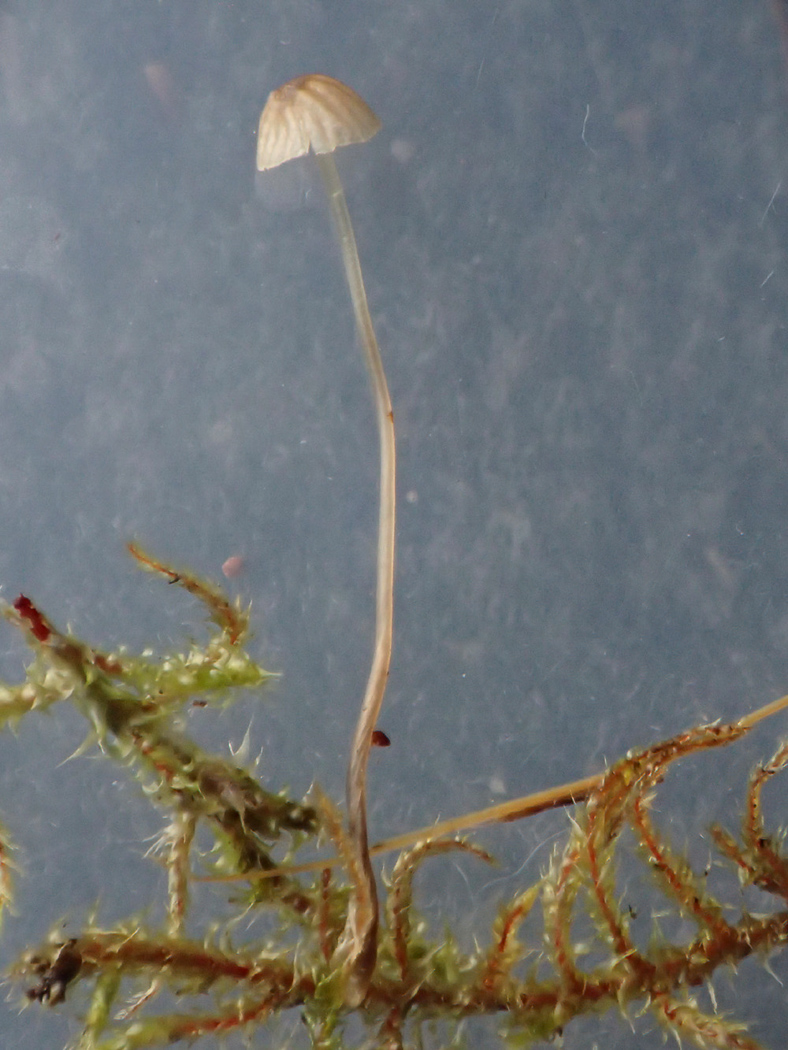
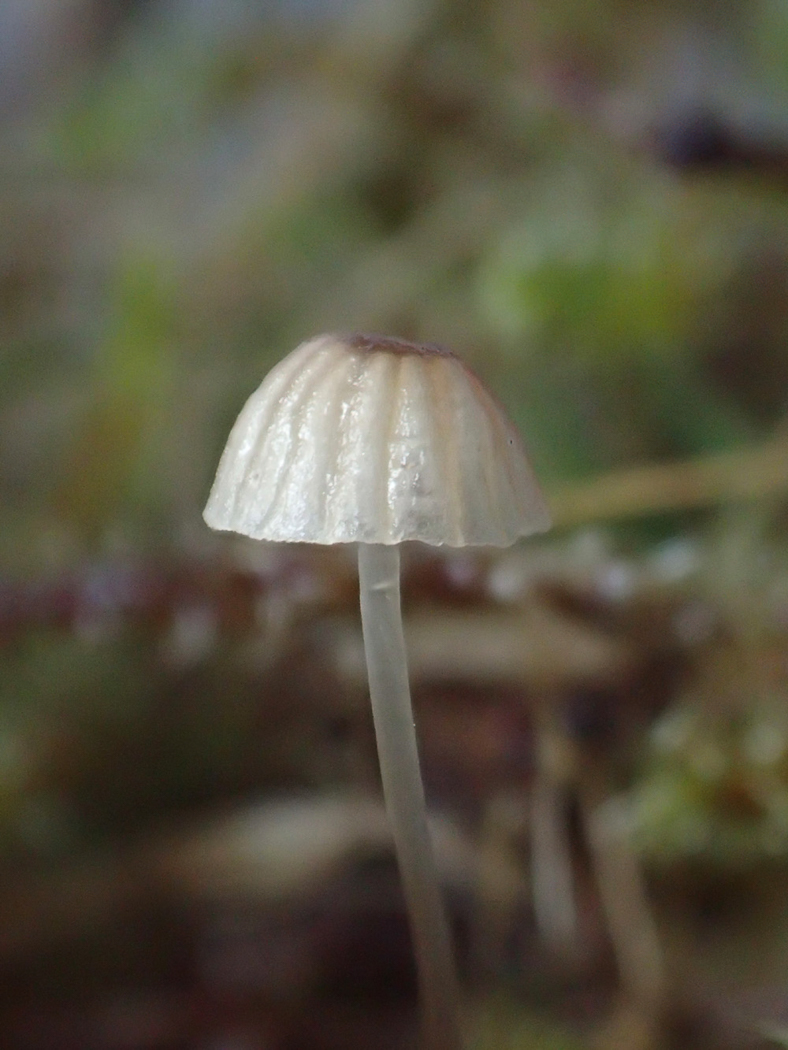
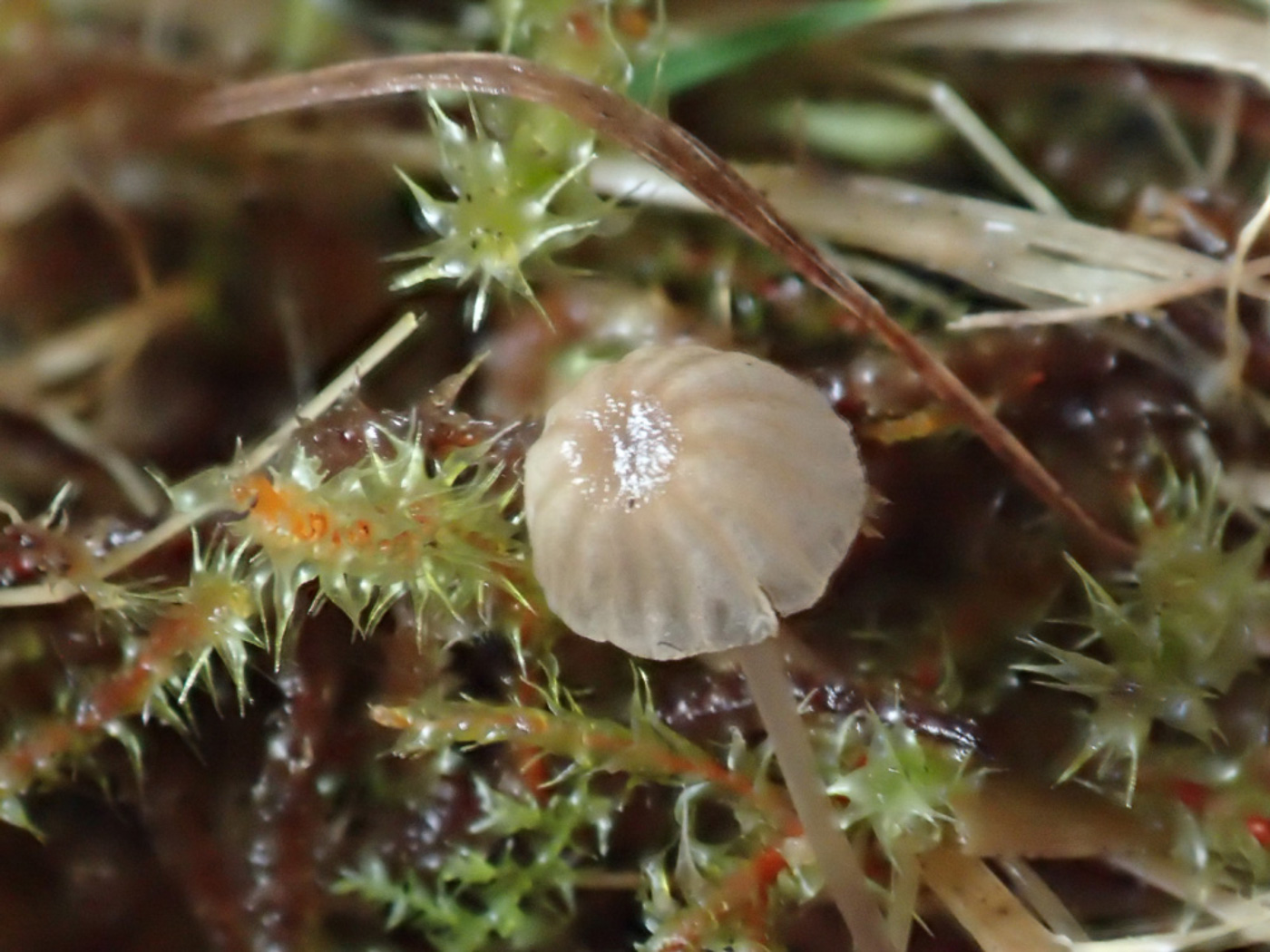
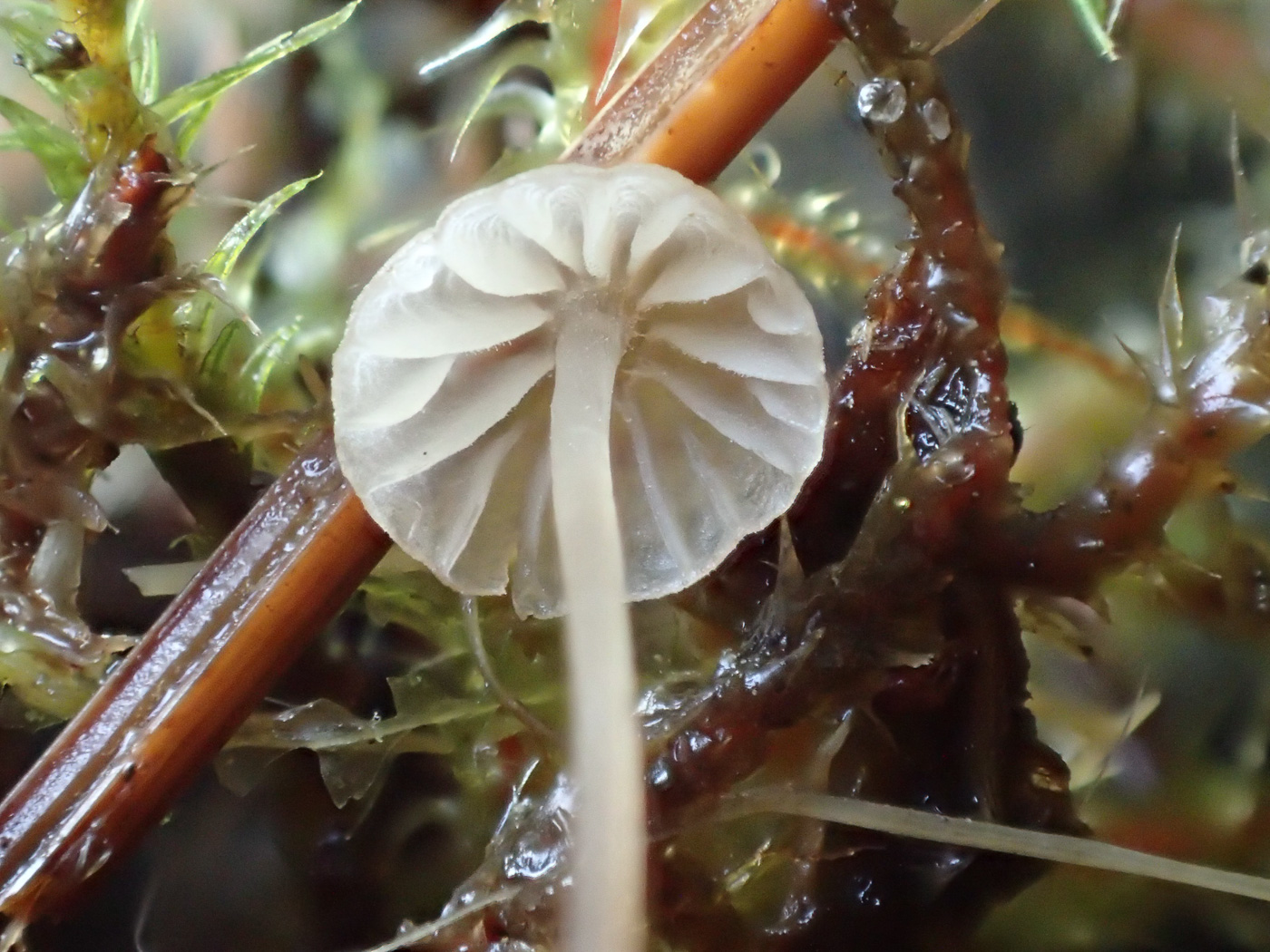 |
March 4th Mycena dasypus (a rare Bonnet with no English name) At the edge of the mire in Burnham Beeches Sarah Ebdon spotted this tiny Bonnet growing in Sphagnum and, knowing the story behind the discovery of Mycena dasypus here several years ago, she took it home to see if she could find the remarkable cystidia on the gill edge which would confirm its identity. Sure enough they were easily found and she agreed with Penny's previous comments that they are so unique in length as to make them unmistakeable with those of any other known species of Bonnet. This is a notable find, being the first time this rare species has been found fruiting at this time of year. Previous finds |

 |
March 4th Mycena smithiana (a rare asco with no English name) In Burnham Beeches Jesper Launder spotted these simply tiny Bonnets on a fallen Oak leaf and Sarah Ebdon instantly recognised them by their distinctive pink tint together with occurring on this particular substrate. Though not rare this easily overlooked species has around 100 FRDBI entries with the vast majority from October to December but extremely few from the spring months, so this was a notable find (and in fact not the only Mycena found today either!) The photos are Sarah's with photo 2 including her fingernail to give an idea of their miniscule size. Previous finds |
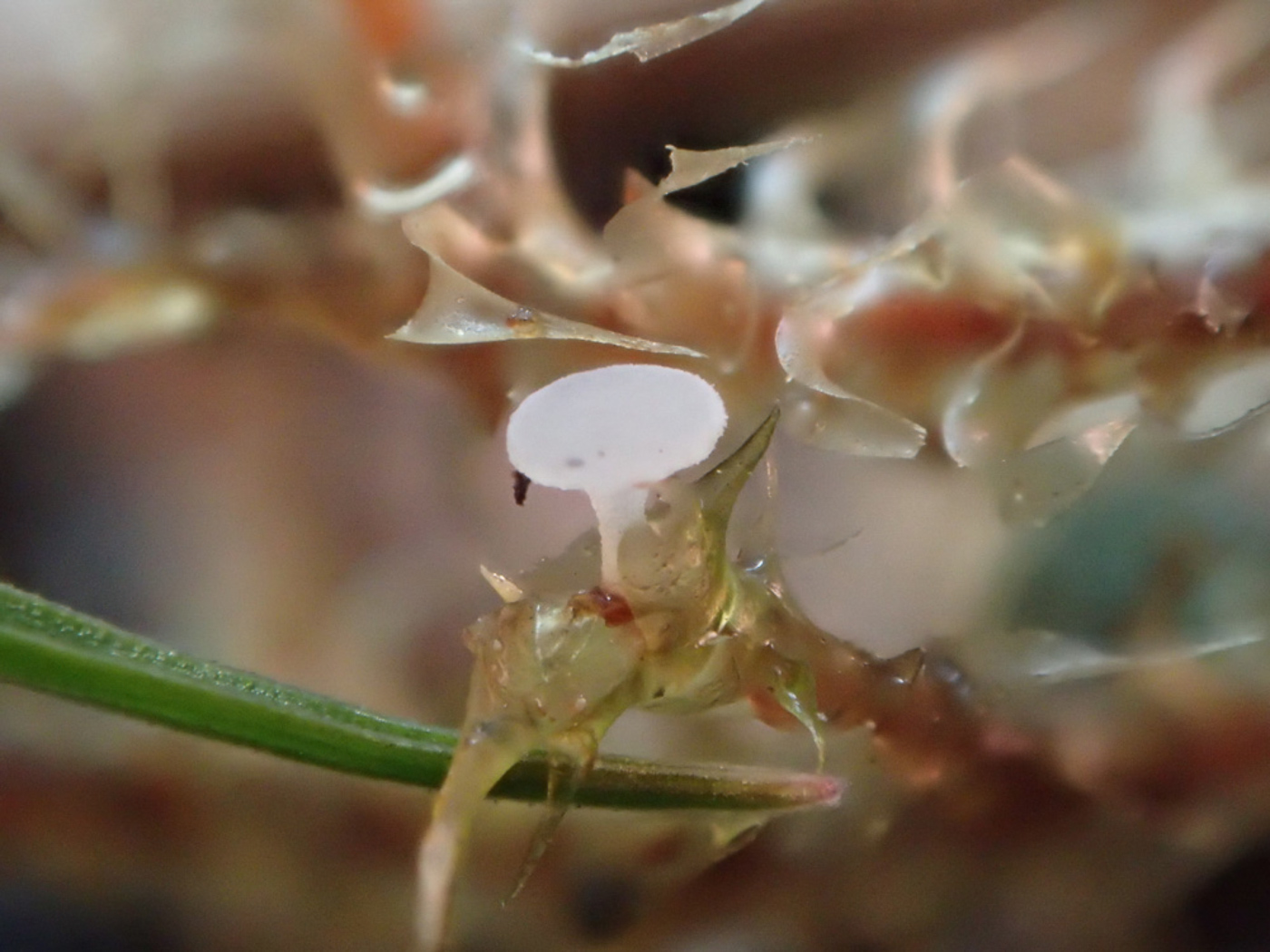 |
March 4th Bryoscyphus phascoides (a rare asco with no English name) In the mire at Burnham Beeches Jesper found this tiny asco which grows specifically on Rhytidiadelphus squarrosus (Springy Turf Moss). He'd worked carefully on several collections of this species made last December (see the entry dated Dec 8th), so knew what to look for. His earlier collection is now being sequenced. This will certainly be a new record for the site, furthermore there appears to be just one record on FRDBI, from 1900! The photo is Sarah Ebdon's. Previous finds |
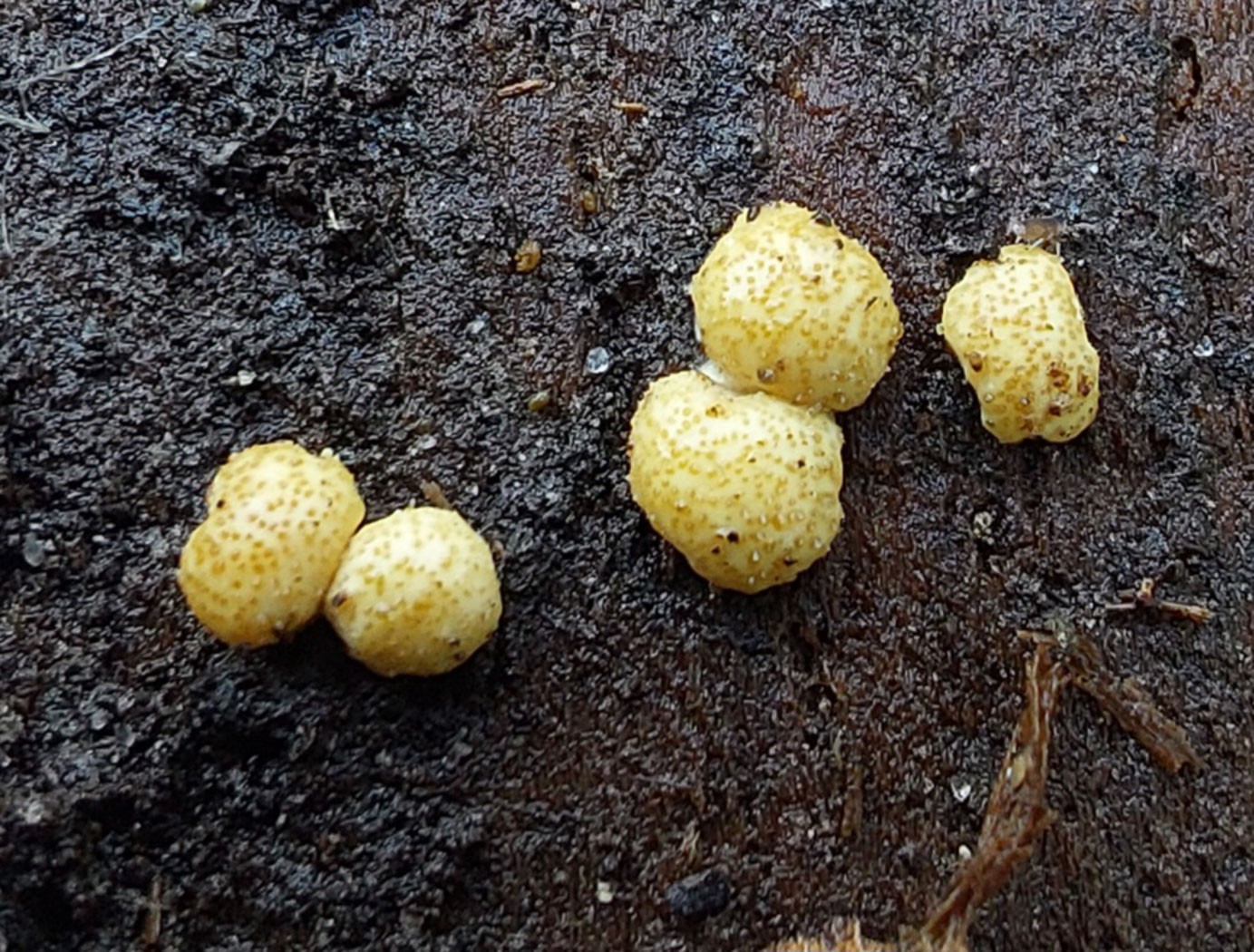 |
March 4th Trichoderma strictipile (an unusual asco with no English name) On a large decorticated (bare) Beech log in Burnham Beeches Jesper Launder spotted these tiny pale round soft blobs, and noting the greenish tinge and pock marks all over the surface recognised what was previously genus Hypocrea, now moved to Trichoderma. There are quite a few similar species, all with unusual spores: not only are they green but each ascus (spore- containing sac) has 16 spores rather than the normal 8. Jesper reports that their size here fitted well for T. strictipile - the most commonly found and recorded, hence his name. The pock marks are in fact ostioles through which the spores are shot out when mature. Previous finds |
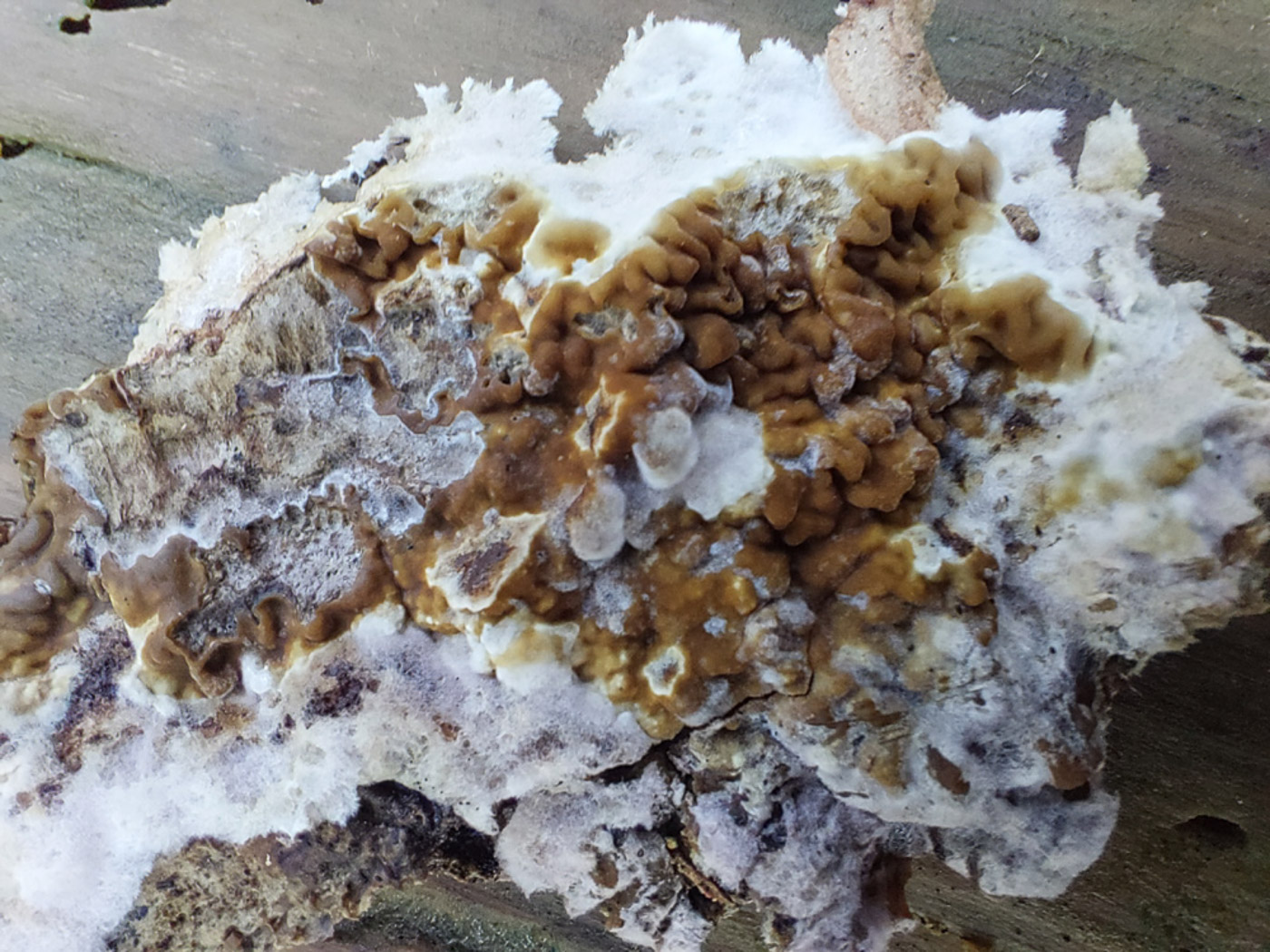 |
March 4th Serpula himantioides (a corticioid fungus with no English name) In Burnham Beeches Jesper Launder recognised this patch of a distinctive corticioid found on a bare Pine log. The species is the lesser known 'wild' relative of S. lacrimans (Dry Rot), a species which is notorious for causing serious damage when it attacks wood in buildings. It can occur on a range of different woods, causing brown rot, and is one of the easier corticioids to recognise with its somewhat deeply ridged 'meruloid' (ie wrinkled and quite soft) mustard brown surface having a white rather feathery margin. Previous finds |
March 2nd 2026
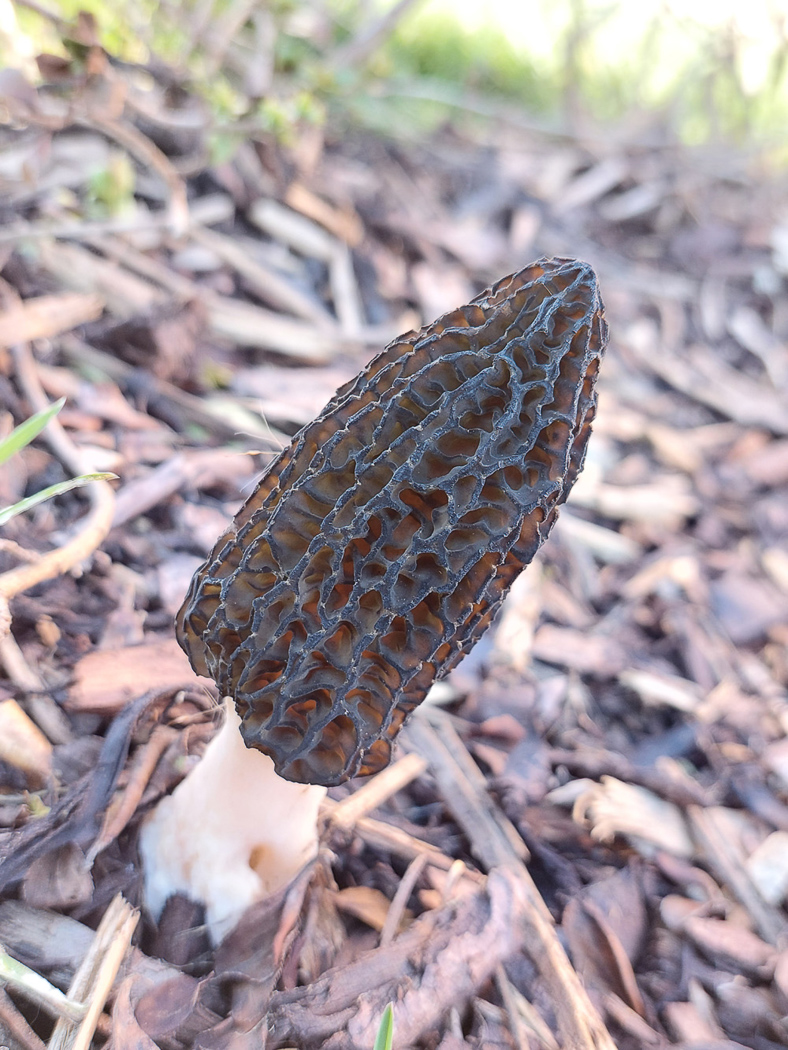 |
March 2nd Morchella elata ss. (Black Morel) In a new build housing estate in Aylesbury Jesper Launder found several specimens of this morel fruiting in woodchip (probably conifer), having previously predicted to Penny that this sometimes elusive and unpredictable springtime genus was likely to be in evidence soon after the wet conditions followed by sun and warmth. (What an inspired and knowledgeable prediction!) The narrow conical shape and dark colour are features of this possibly our commonest Morel which can sometimes be found in amazing numbers on conifer woodchip as supplied by garden centres. However, DNA has shown in recent years that what we've been naming M. elata is in fact a species complex with the name M. importuna thrown into the mix as well though the situation lacks clarity as yet. Today's example is a good example of the typical 'true' M. elata hence the 'sensu stricta' included in the heading here. This find is our earliest county Morel record, and glancing through the 100 or so FRDBI records for M. elata Penny noted the vast majority are from April or May. Previous finds |
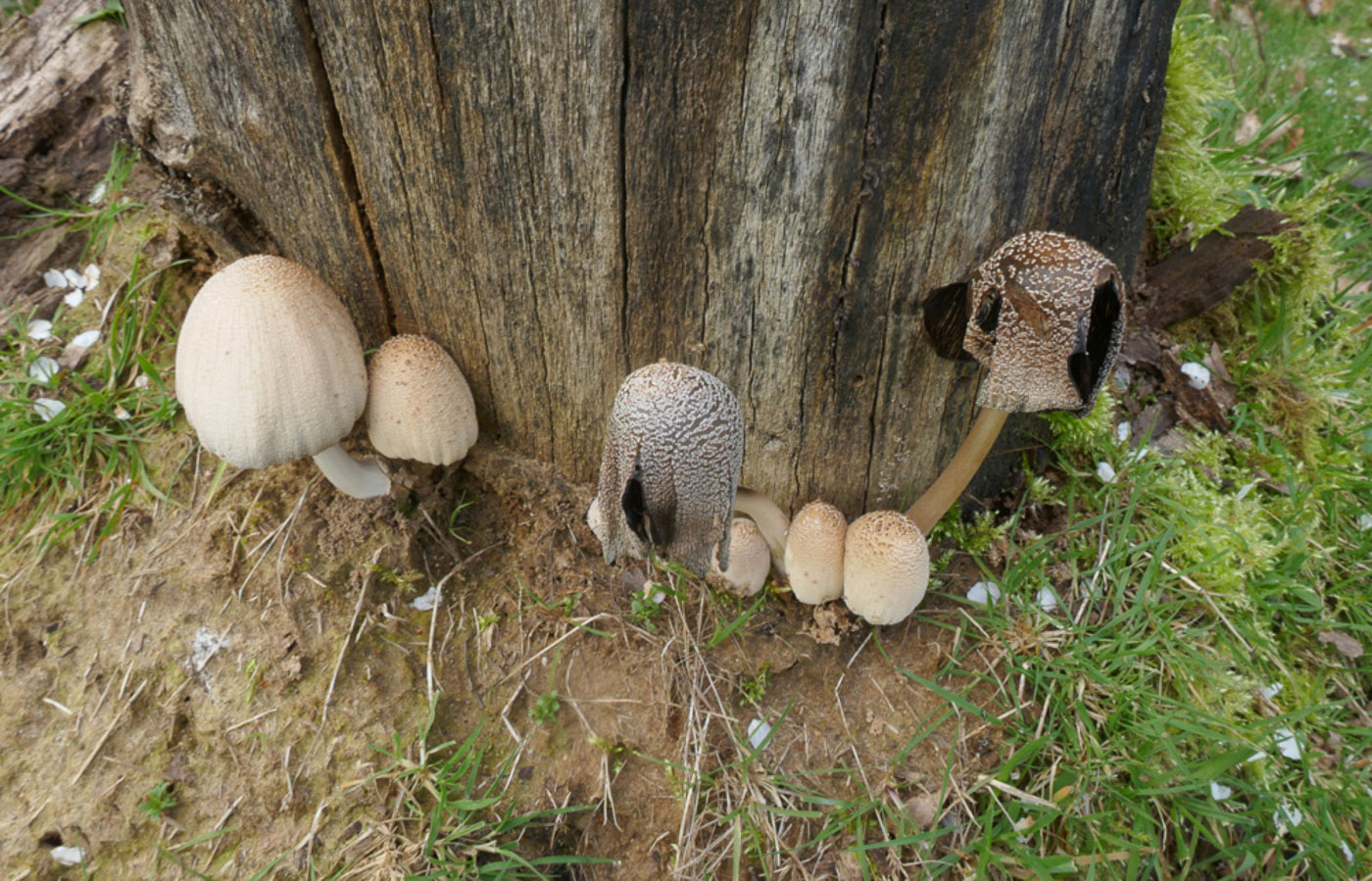
.jpg "Photo © Jackie Ewan")
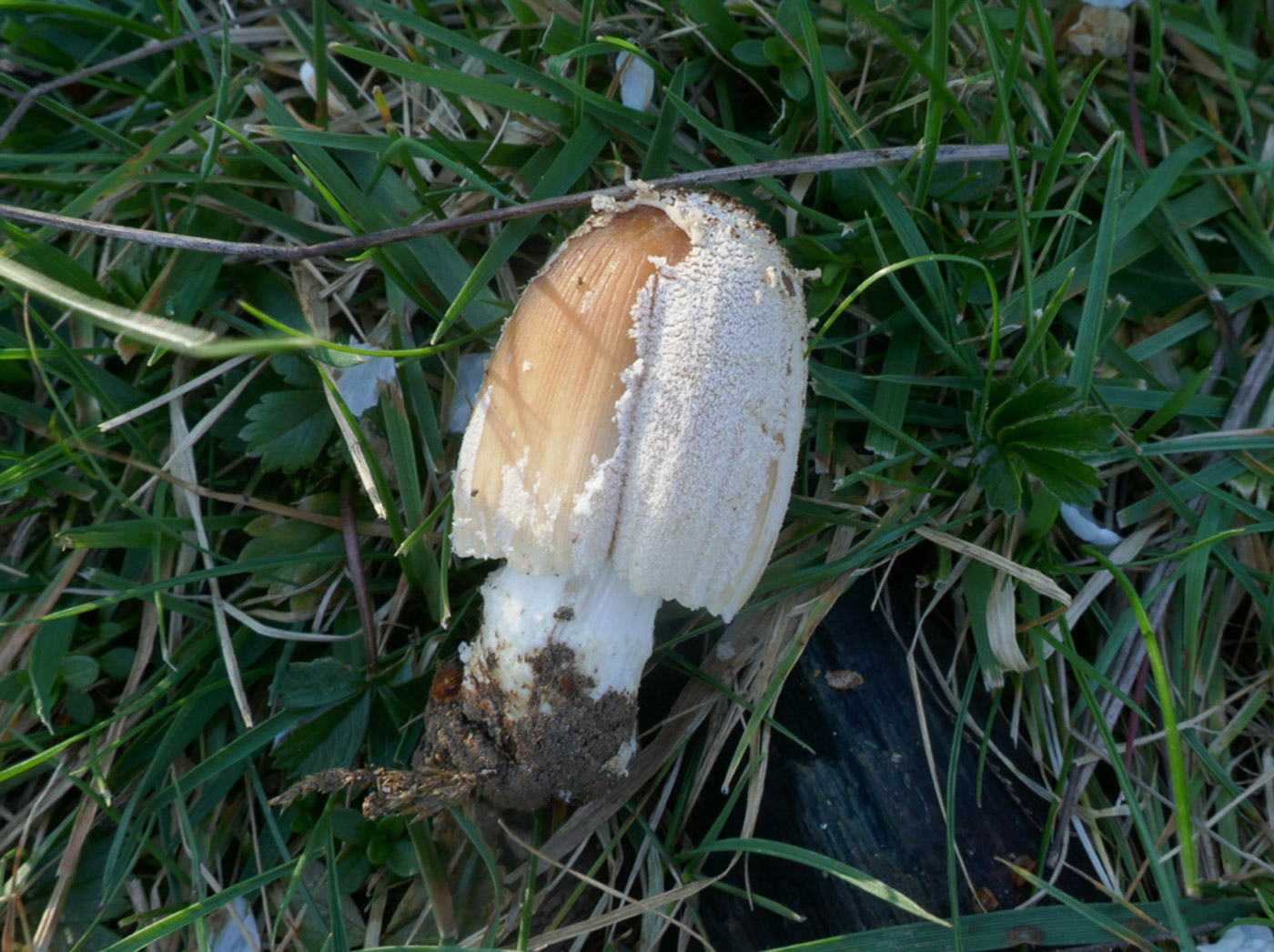 |
March 2nd Coprinellus ellisii (a unusual Inkcap with no English name) Nestling against an old hardwood log at Stampwell Farm was a group of Inkcaps, found by Jackie Ewan who thought they were probably close to C. domesticus in appearance. Sure enough microscopic examination showed the presence of chains of veil cells and large pleurocystidia typical of this group of Inkcaps but the small cylindrical to kidney-shaped spores fitted not with C. domesticus but with C. ellisii. On consulting Derek she is now drying material for him to examine as apparently the species is not well understood (and no doubt in time this will be sequenced also), but if /when confirmed this was a nice find and new to the county. Members' Finds New Species no. 1263 |
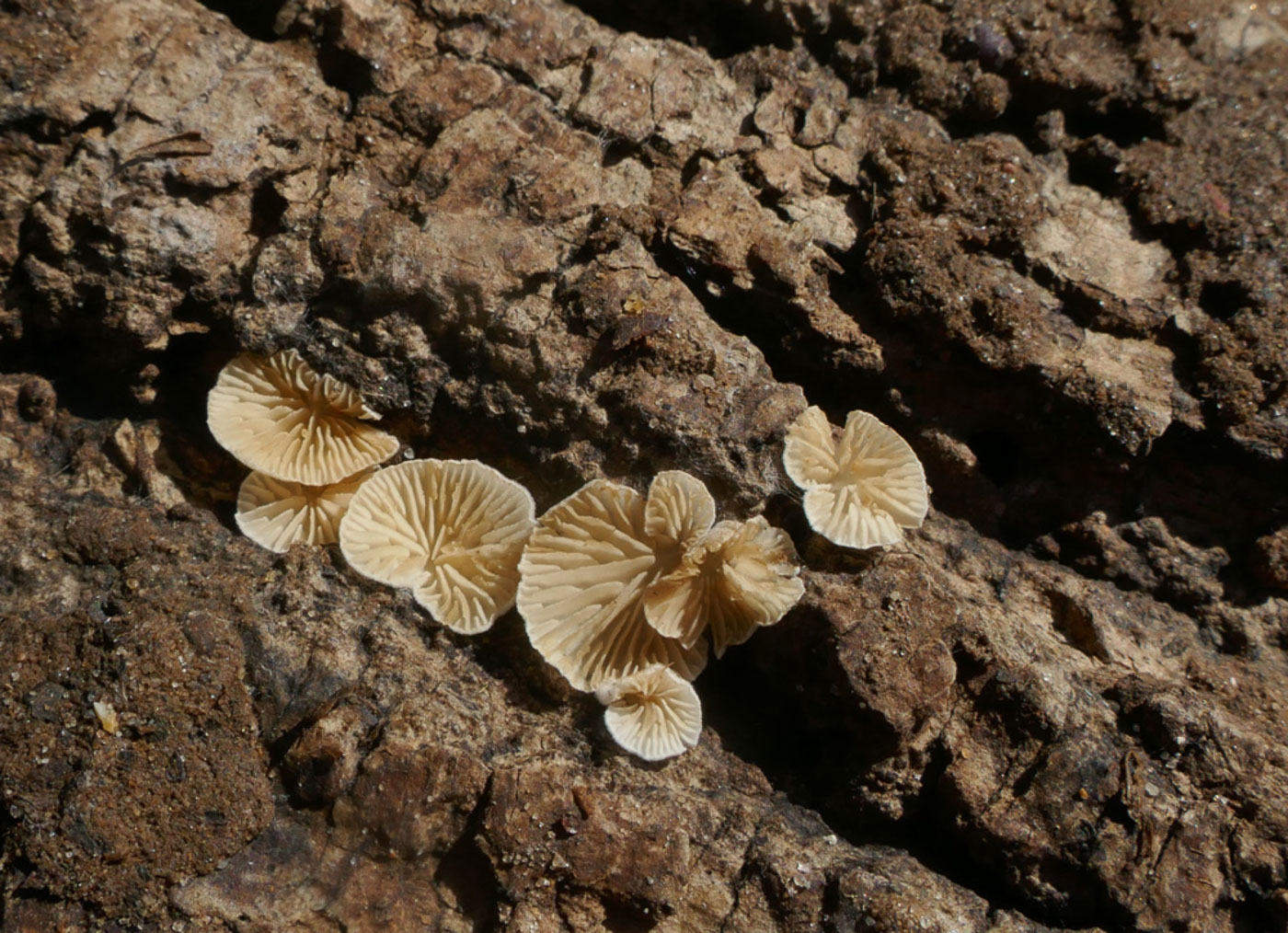 |
March 2nd Crepidotus epibryus (Grass Oysterling) On a piece of loose bark at Stampwell Farm Jackie Ewan found these small stemless mushrooms clearly belonging to genus Crepidotus. Checking the spores left her ID in no doubt because this is the only species within the genus with quite narrow pip-shaped spores though both the Latin epithet and English name imply a rather different substrate. However, Penny notes that the Funga Nordica key gives the substrate as 'plant debris, twigs and decaying deciduous wood' which covers a considerably wider range as acceptable. The species is probably more common on plant debris, however. Previous finds |
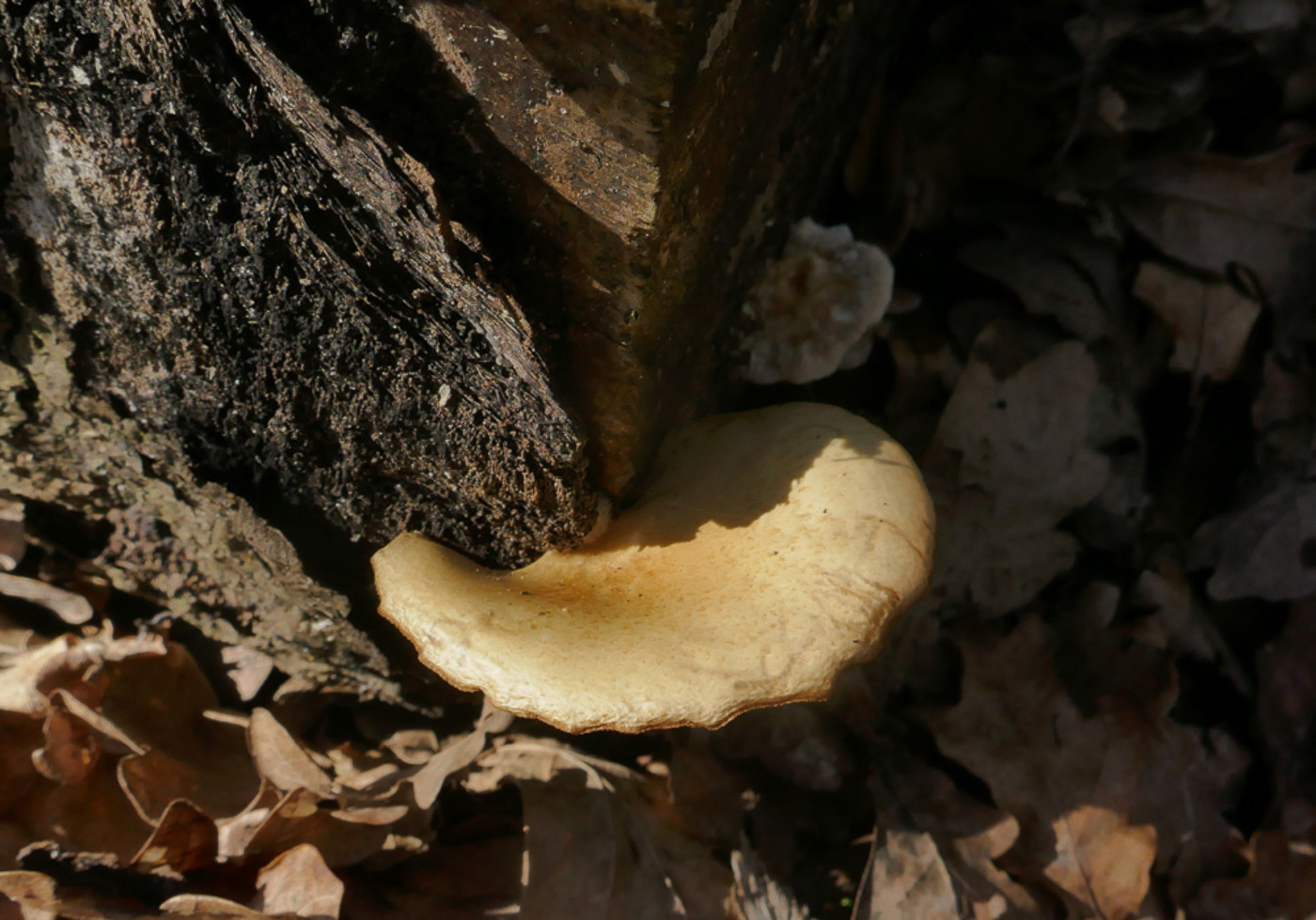
.jpg "Photo © Jackie Ewan") |
March 2nd Crepidotus mollis (Peeling Oyster) On the same Beech log at Stampwell Farm and close to Trametes hirsuta Jackie Ewan noticed a rather dry brown pleurotoid (oyster) type past its prime which confused here (in fact the Trametes is also in shot in her photos here). Was this maybe Pleurotus, Crepidotus, Panellus or what? Checking at home the pale yellow ellipsoid to almond-shaped spores eliminated Pleurotus and Panellus, leaving Crepidotus a possibility though it was too large for all species apart from C. mollis which it didn't look very like! However, she then recalled having found a rather brown example of C. mollis here a few years earlier, so she experimented by soaking the material to rehydrate it in the hope of then testing for the stretchy somewhat transparent cap surface typical of this species and separating it from others in the genus. Sure enough this worked! Good detective work, Jackie! Previous finds |
.jpg "Photo © Jackie Ewan")
 |
March 2nd Trametes hirsuta (Hairy Bracket) On a Beech log at Stampwell Farm Jackie Ewan found another somewhat hairy and pale bracket, but turning this one over revealed the equally pale and clearly pored undersurface - very different from the smooth orange underside of Stereum hirsutum. The pore size she measured at 2-4 per mm and the cylindrical spores then soon confirmed her suspicions that this was T. hirsuta - no doubt quite common but easily mistaken for one of the more familiar common brackets. Previous finds |
.jpg "Photo © Jackie Ewan")
 |
March 2nd Stereum hirsutum (Hairy Curtain Crust) On a fallen Oak branch at Stampwell Farm Jackie Ewan puzzled briefly over this rather pale though hairy small bracket until she turned it over to reveal the typical smooth and rusty orange brown underside of the genus Stereum. This is one of our commonest fungi and one can almost add its name automatically to any foray list in deciduous woodland before even seeing it, but the lack of any coloured zoning seen in this example is certainly unusual and worth noting. Penny would also have been confused if presented with a photo of just the upper surface of this collection. Previous finds |
February 26th 2026
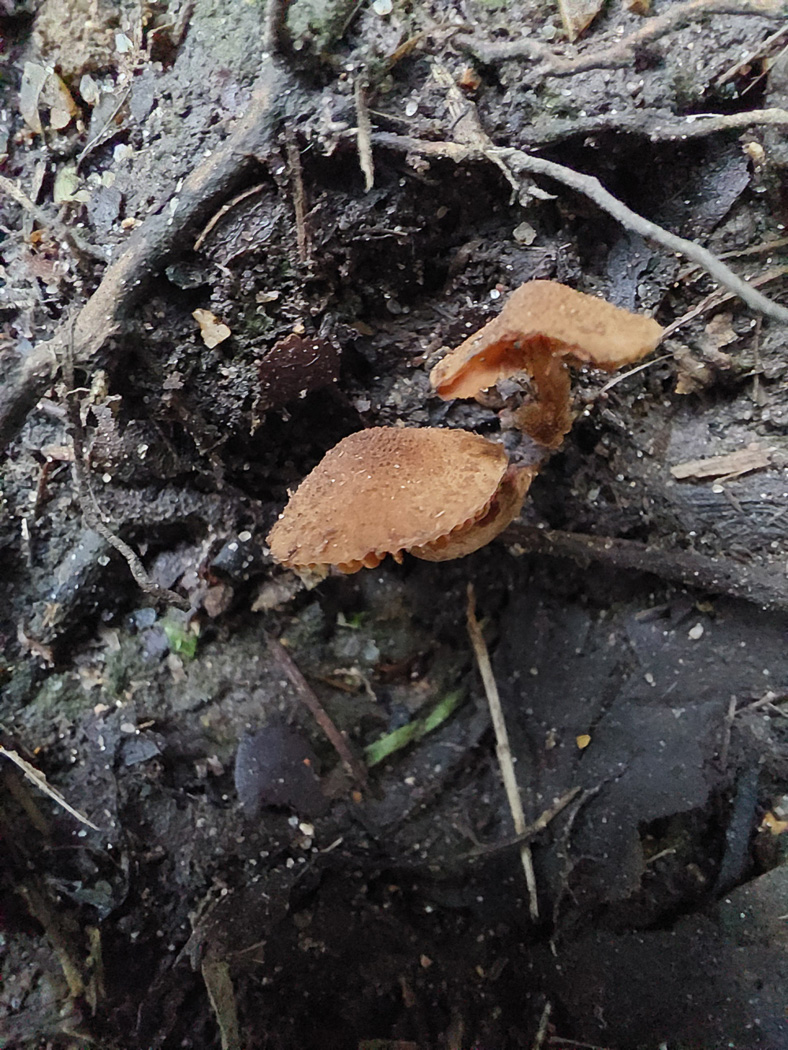
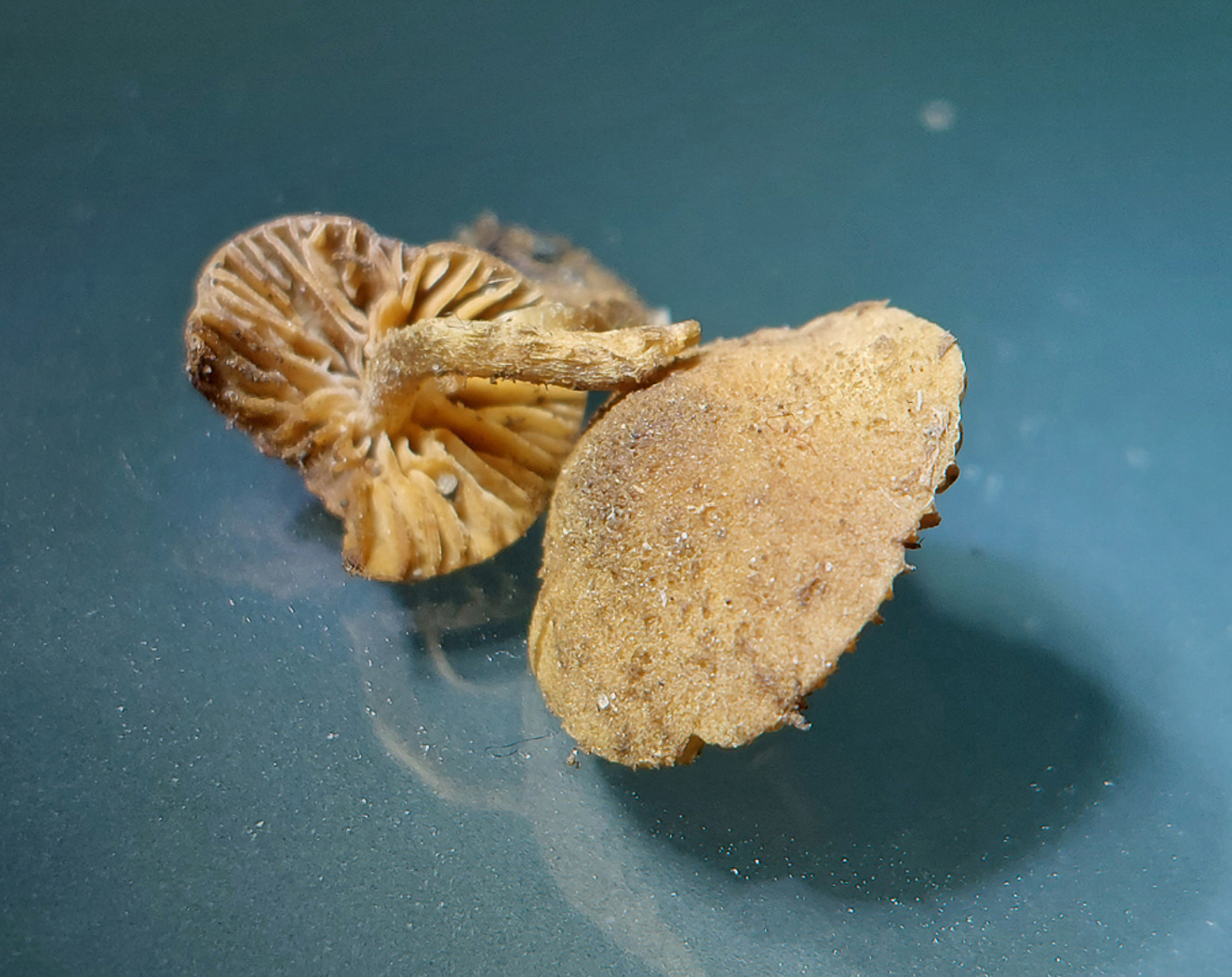 |
February 26th Flammulaster granulosus (Granulose Spark) In soil in a roadside bank between Little Chalfont and Chalfont St. Giles, Jesper Launder spotted these LBJs which appeared very similar to a collection of Flammulaster ferruginea he'd found recently in very similar habitat (see the Feb 18th entry). Working on these at home revealed some important differences from that collection, both macro and micro. The cap surface was granular (visible in photo 2) and lacked the striations seen previously, furthermore the cells in both the cap cuticle and gills were different, making this F. granulosus - a species with only one previous county record from 2008 though not that rare according to FRDBI. Members' Finds New Species no. 1262 |
|
|
February 26th Psathyrella spadiceogrisea (Spring Brittlestem) At Stowe Landscape Gardens Penny found several Brittlestems in grassy soil, some under Pine and others under deciduous trees, and suspected they would all turn out to be this quite common springtime species. All had somewhat faded caps bar one immature specimen (central in photo 2) reflecting the rather open aspect at the site with some recent (welcome) sun having caused the fading. A quick check with a scope confirmed their ID. Previous finds |
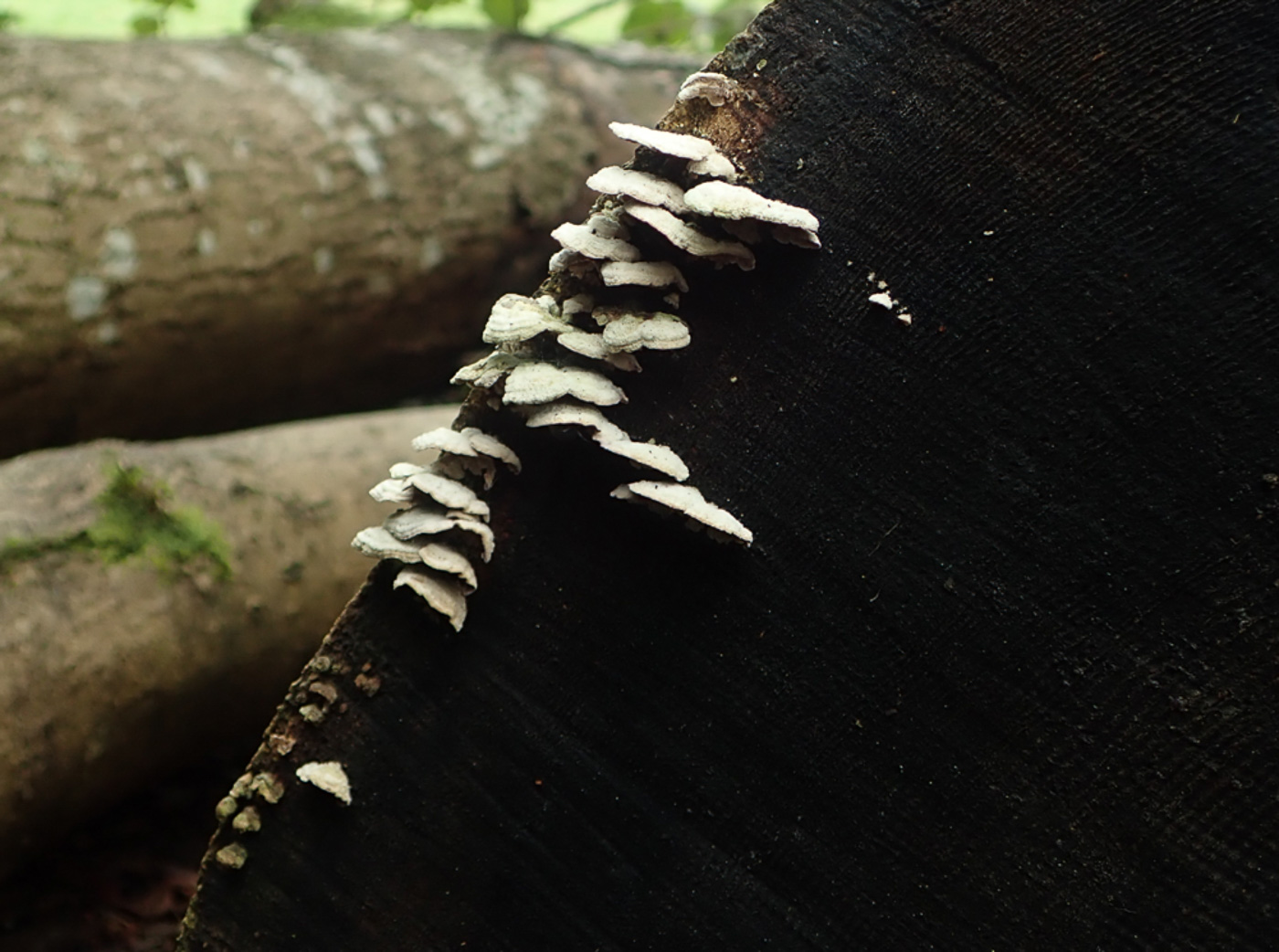
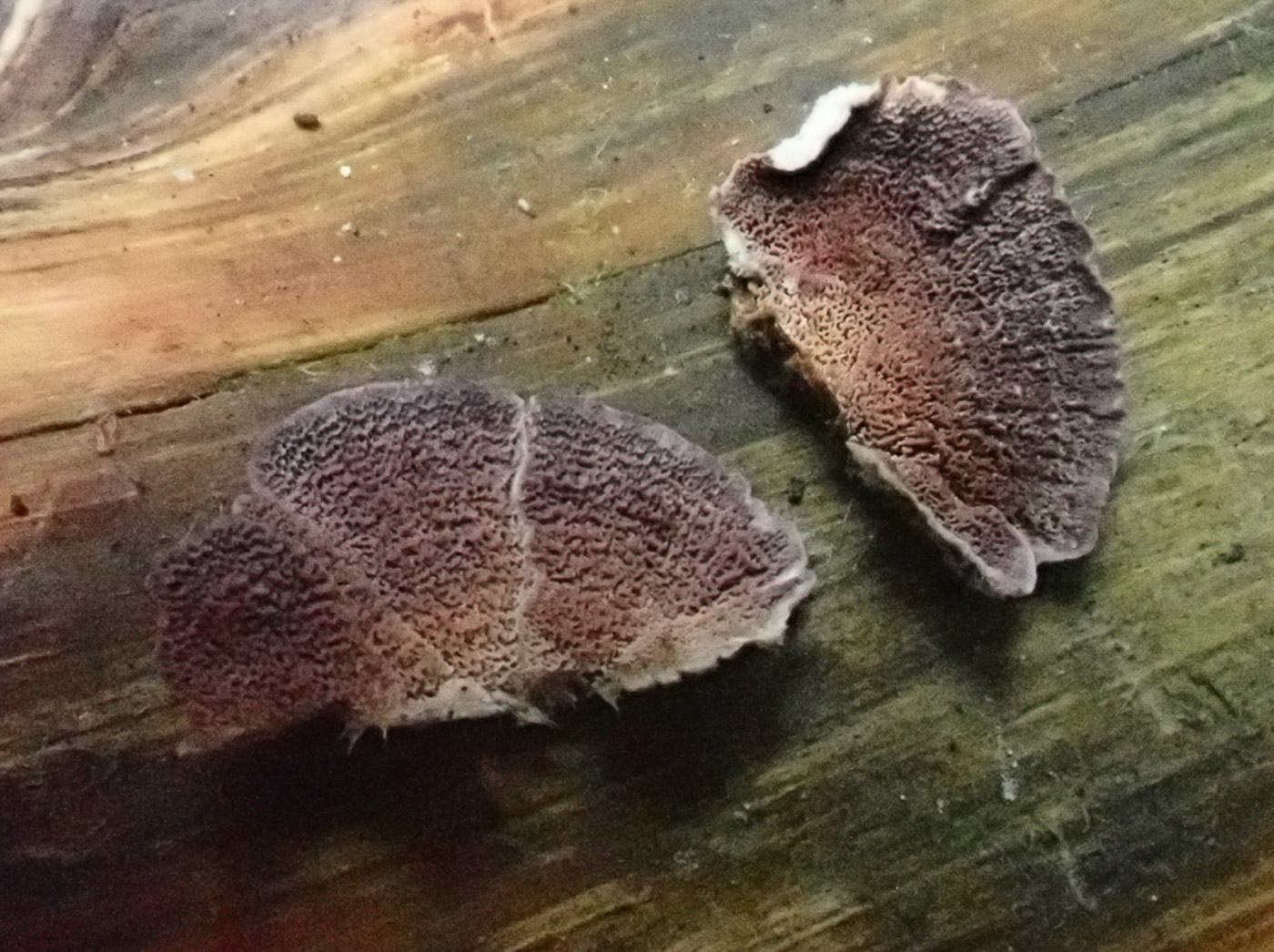 |
February 26th Trichaptum abietinum (Purplepore Bracket) At Stowe Landscape Gardens Penny noticed this row of small white brackets on the sawn end of Pine trunk which, until the underside had been examined, could have been a number of similar 'pleurotoid' fungi. Photo 2 shows the distinctive pinkish purple irregular underside typical of this species, thus eliminating other contenders. it is very common on conifer logs and not limited to Abies (Fir) as the species epithet might imply. Previous finds |
February 25th 2026
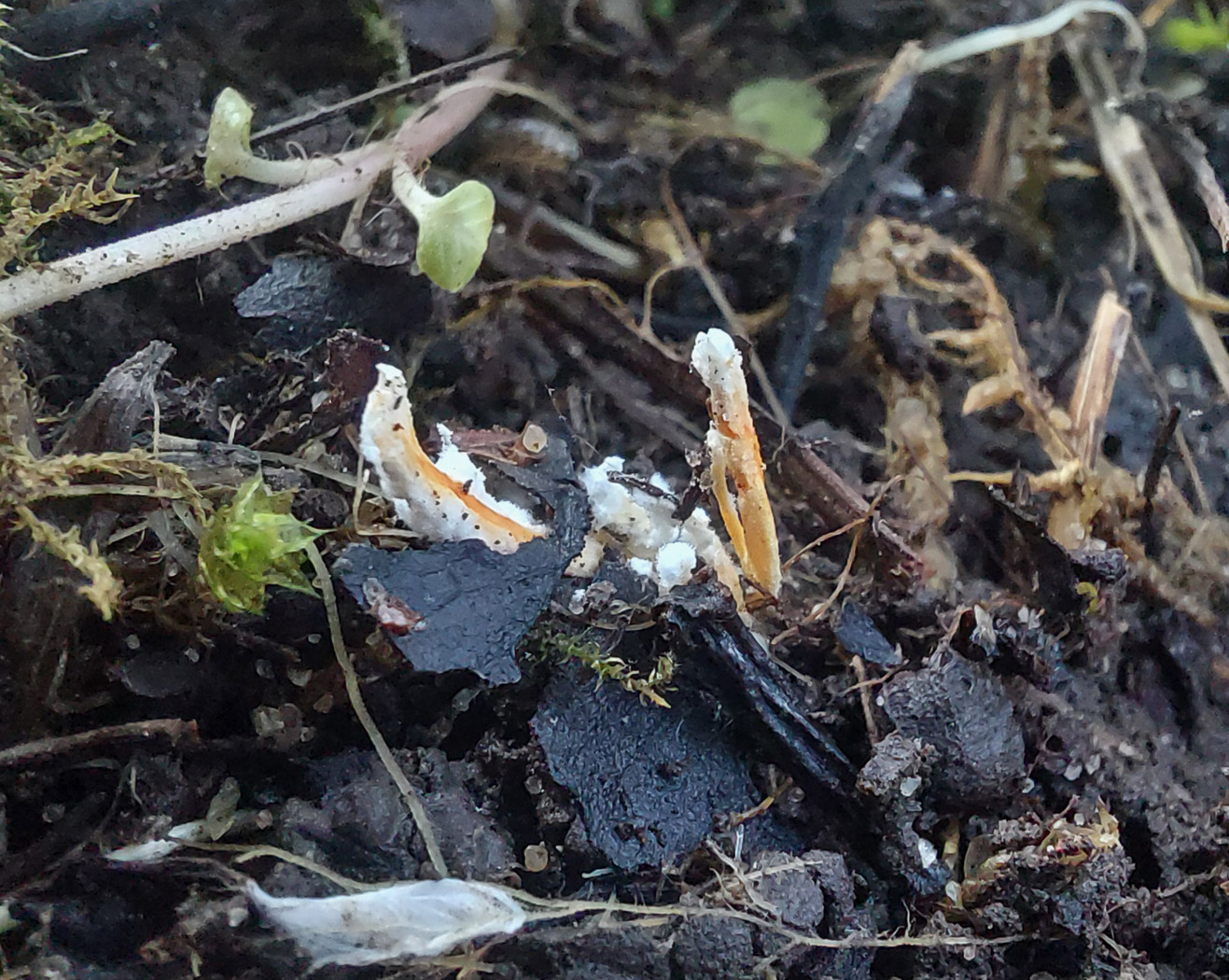
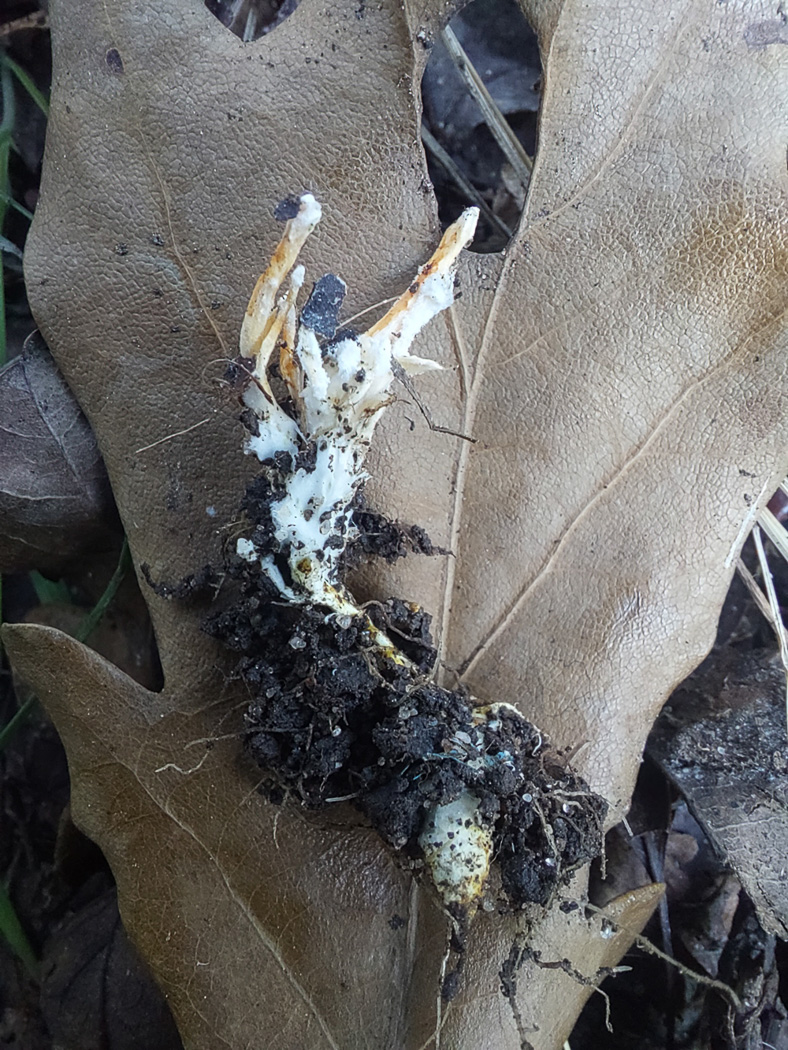 |
February 25th Cordyceps farinosa (a Caterpillarclub with no English name) Near the Beaconsfield Services whilst clearing away leaves looking for anything fungal, Jesper Launder spotted these cream coloured clubs, knew they were familiar but the name eluded him. Sarah Ebdon quickly came up with the name, however. Photo 2 shows it having been carefully disentangled from the soil and debris but with the unfortunate larva still attached and from which the fungus had emerged. We have a handful of previous county records though under the earlier genus names of Isaria and Paecilomyces. Previous finds |
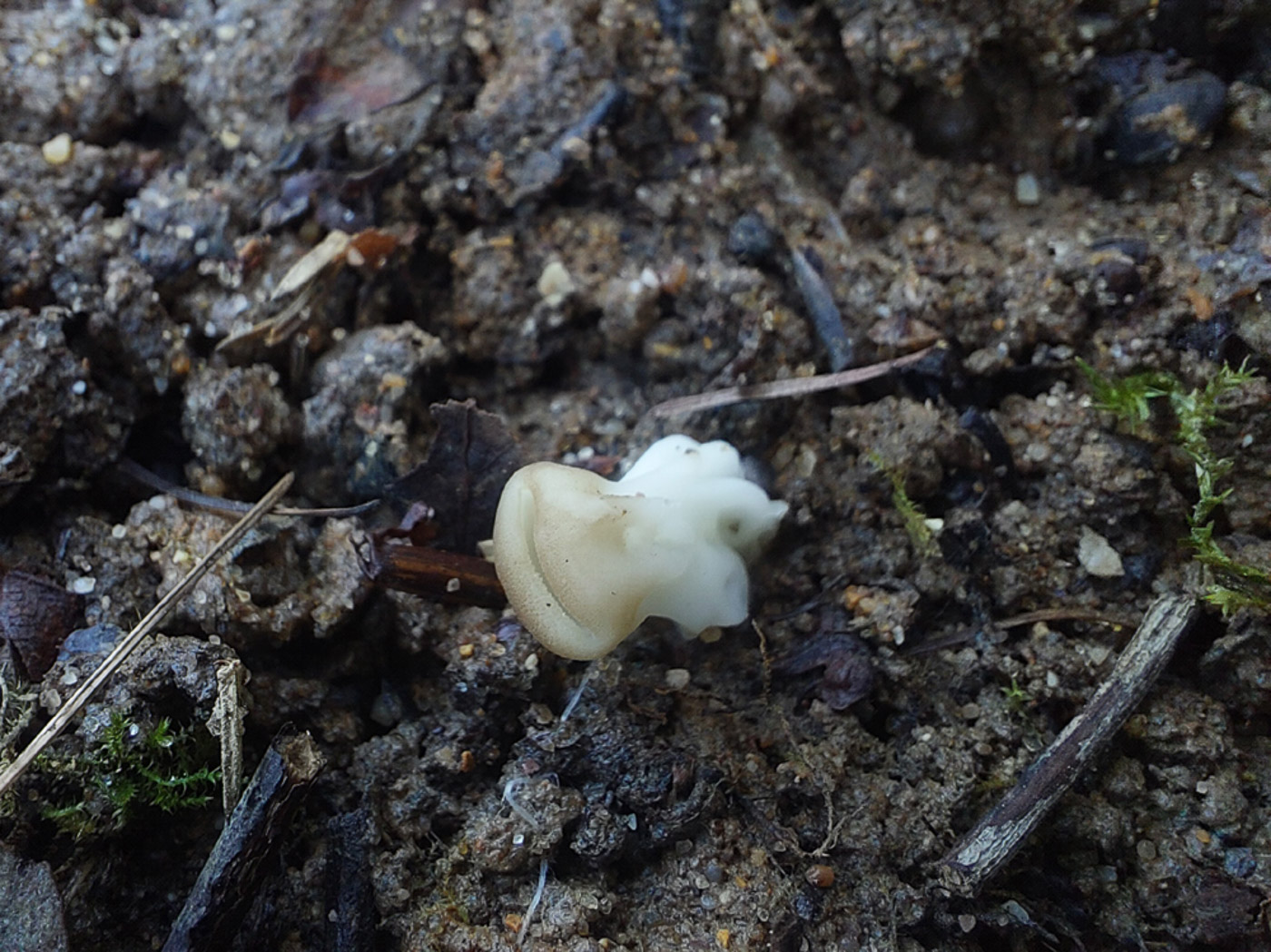
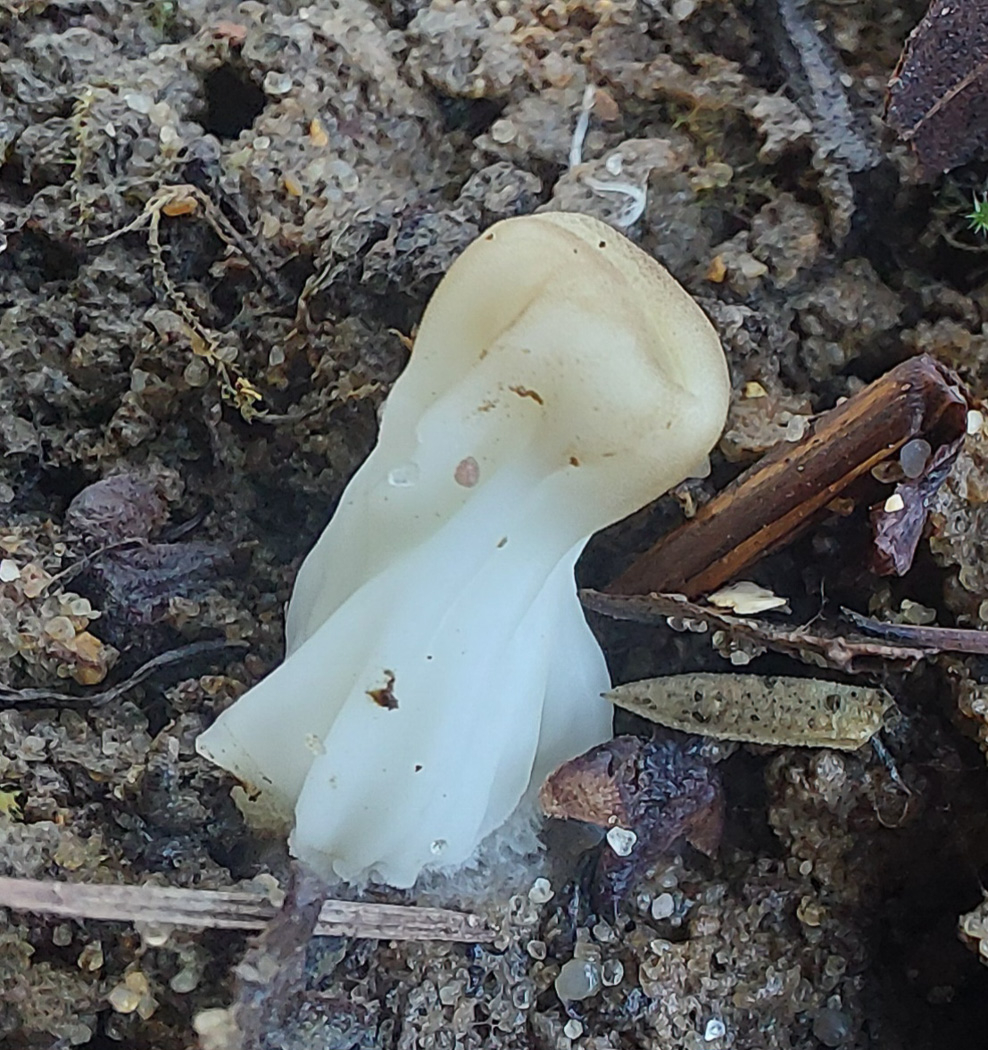 |
February 25th Helvella acetabulum (Vinegar Cup) Under leaves near Hawthorn and Hazel at Beaconsfield Services Jesper Launder caught his eye in this tiny specimen less than 1 cm across and recognised it as the undeveloped stage of H. acetabulum, a cup fungus which fruits in spring with a preference for sandy soils. When mature it becomes typically cup-shaped with a tan brown outer surface which is distinctly veined, not unlike the underside of a Savoy cabbage leaf. Previous finds |
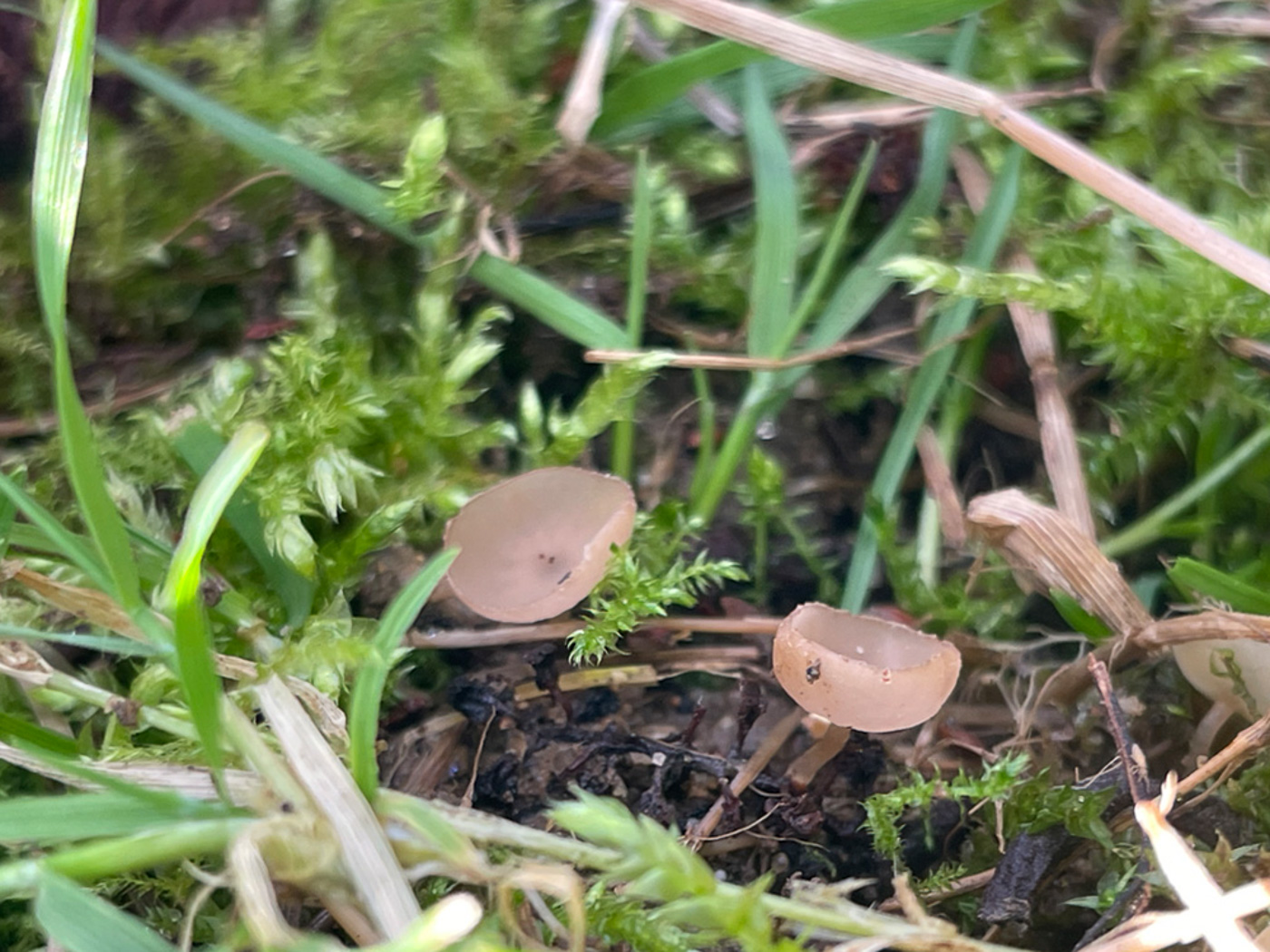
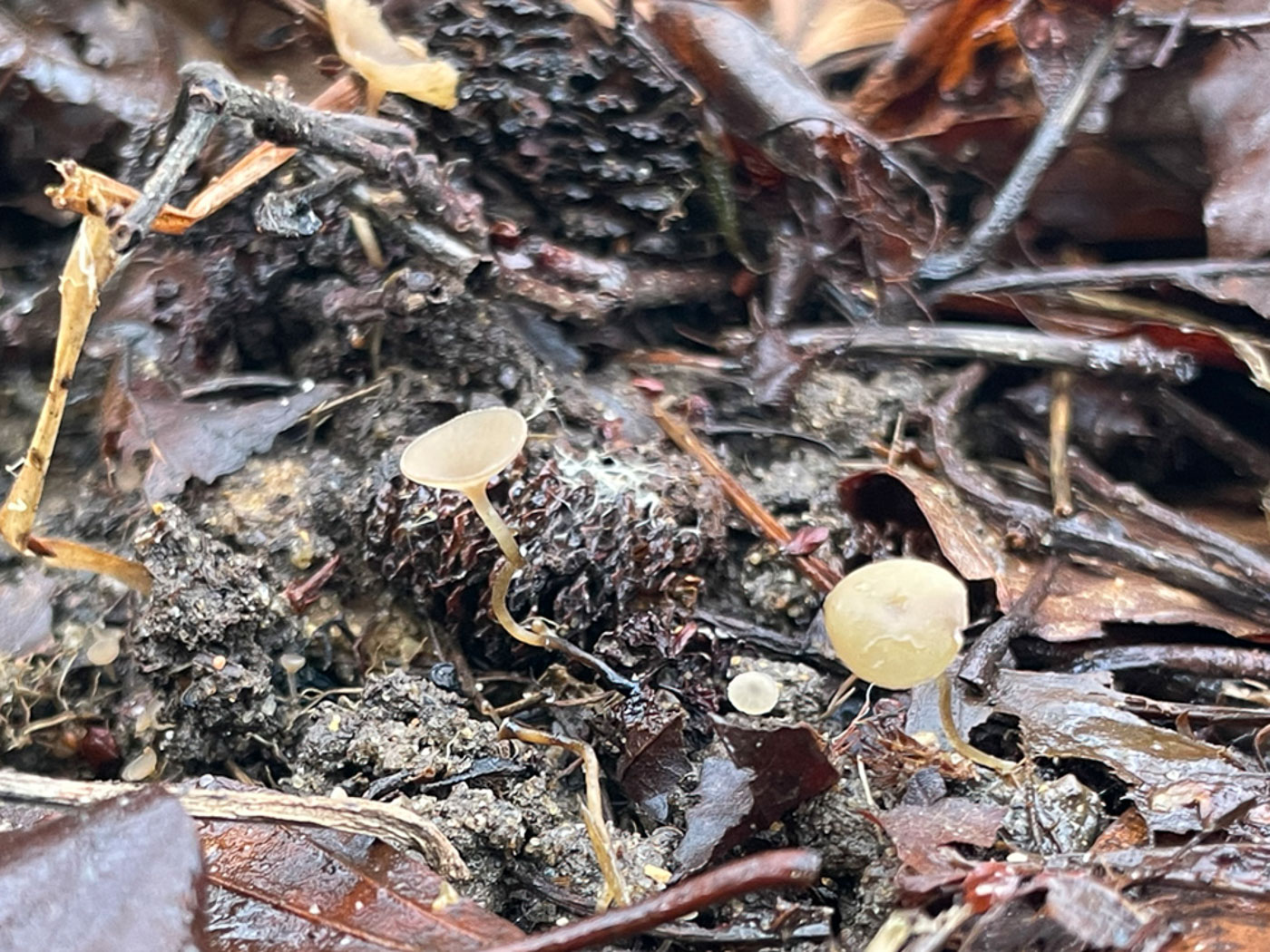
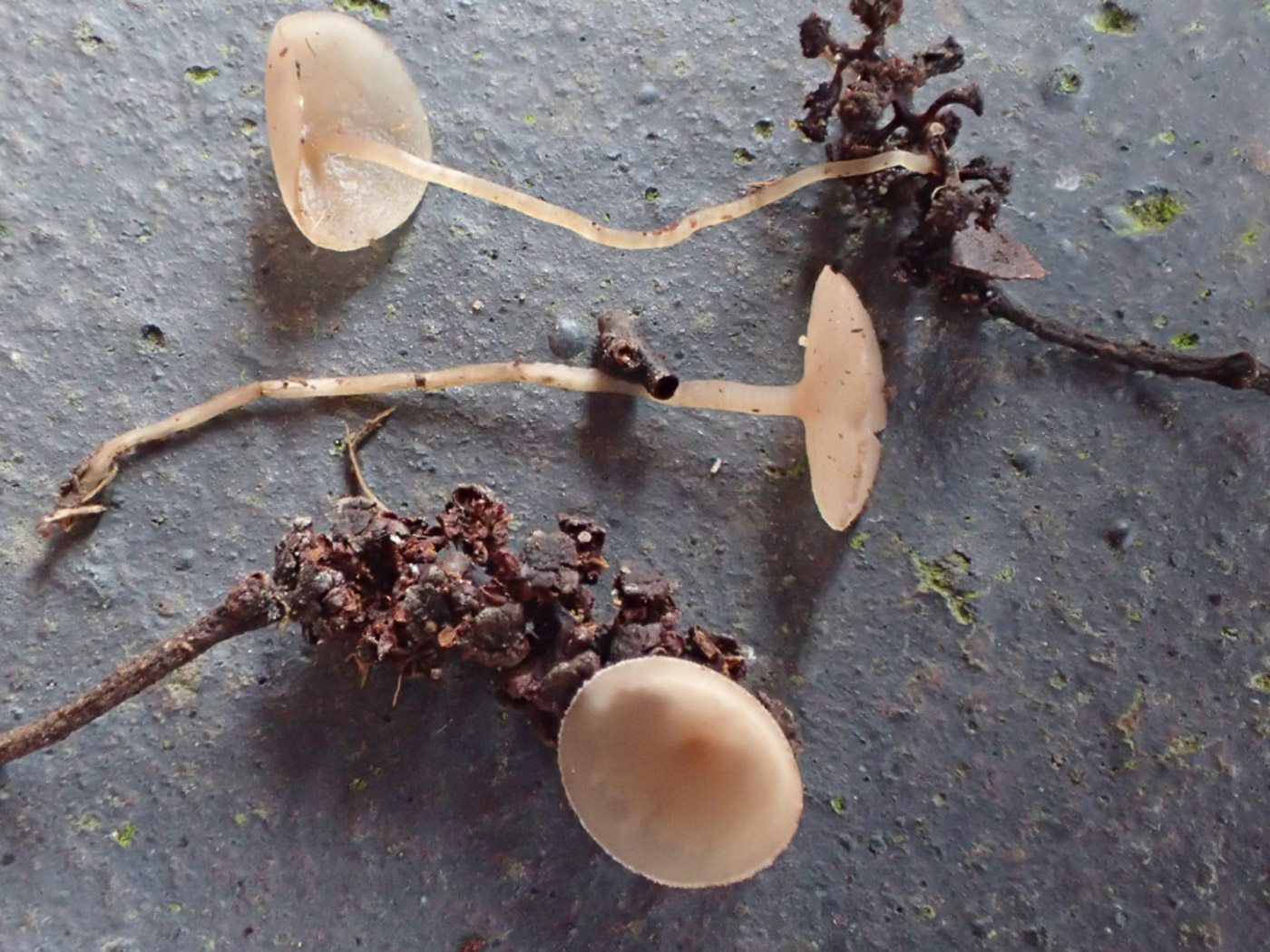
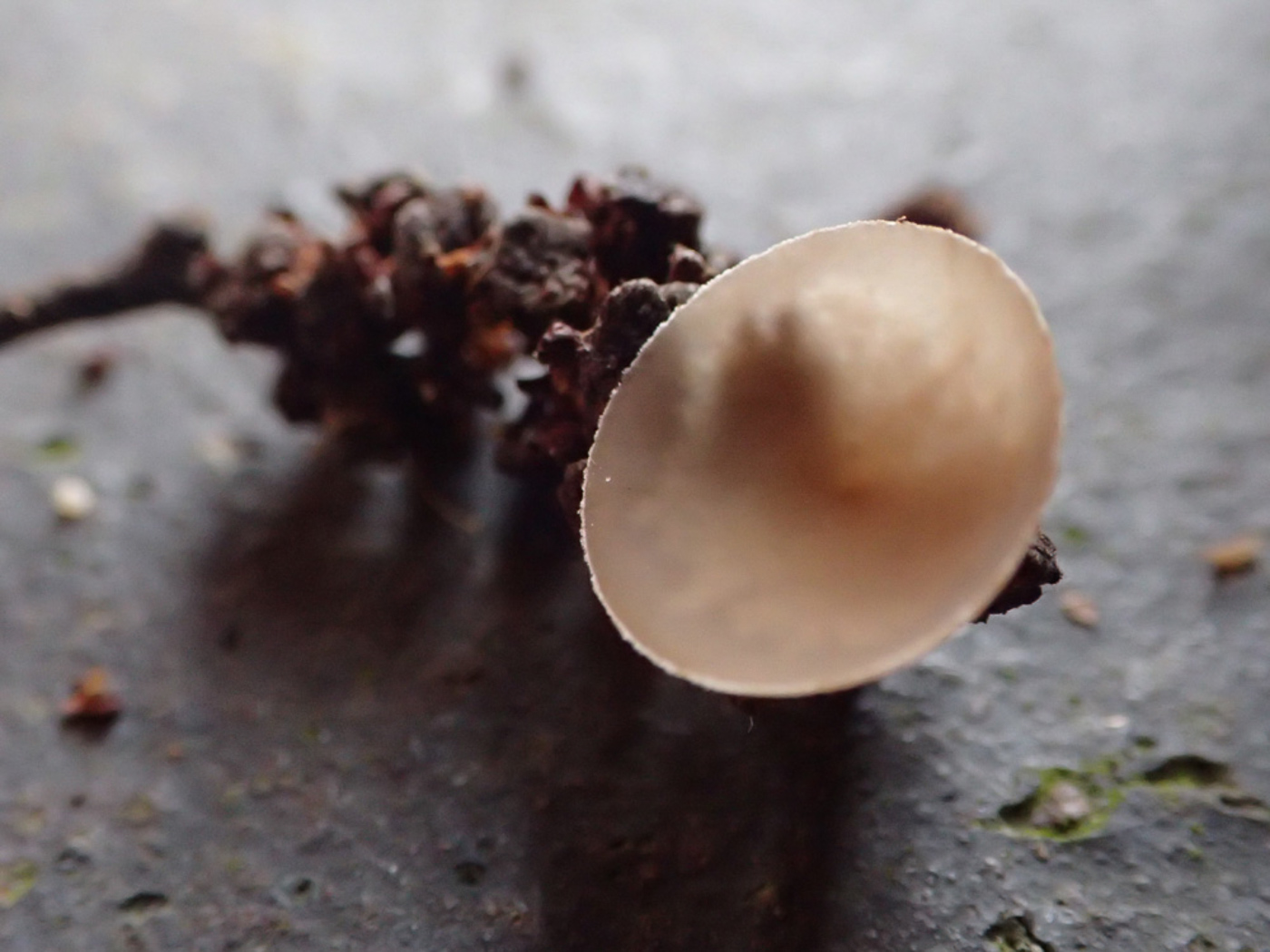
|
February 25th Ciboria amentacea (Alder Goblet) In an area at Beaconsfield Services with Alder, Sarah Ebdon and Jesper Launder went searching for a particular springtime asco which associates specifically with the previous year's decomposing male Alder catkins. To their delight they were rewarded with not just one or two examples but many tens of them. They report that at one point, disturbing some thick vegetation to look underneath it, they noticed a puff of spore dispersal - amazing when one considers that these tiny long-stemmed cups are no more than 6mm across at most. This not surprisingly is a new species for the county as we don't seem to have many areas where Alder occurs, though FRDBI is not short of records. What a lovely find! The photos are Sarah's. Members' Finds New Species no. 1261 |
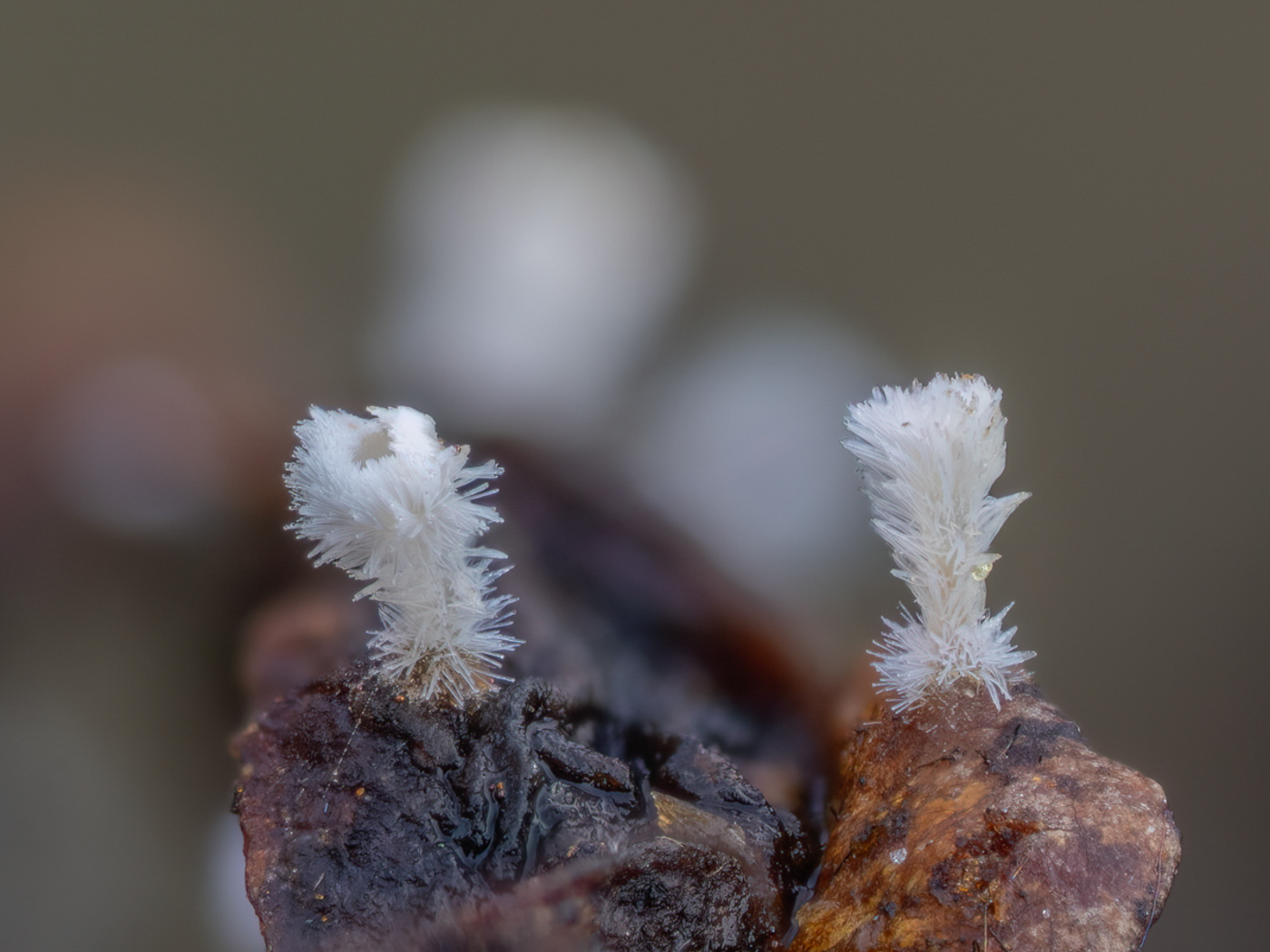
.jpg "Photo © Sarah Ebdon")
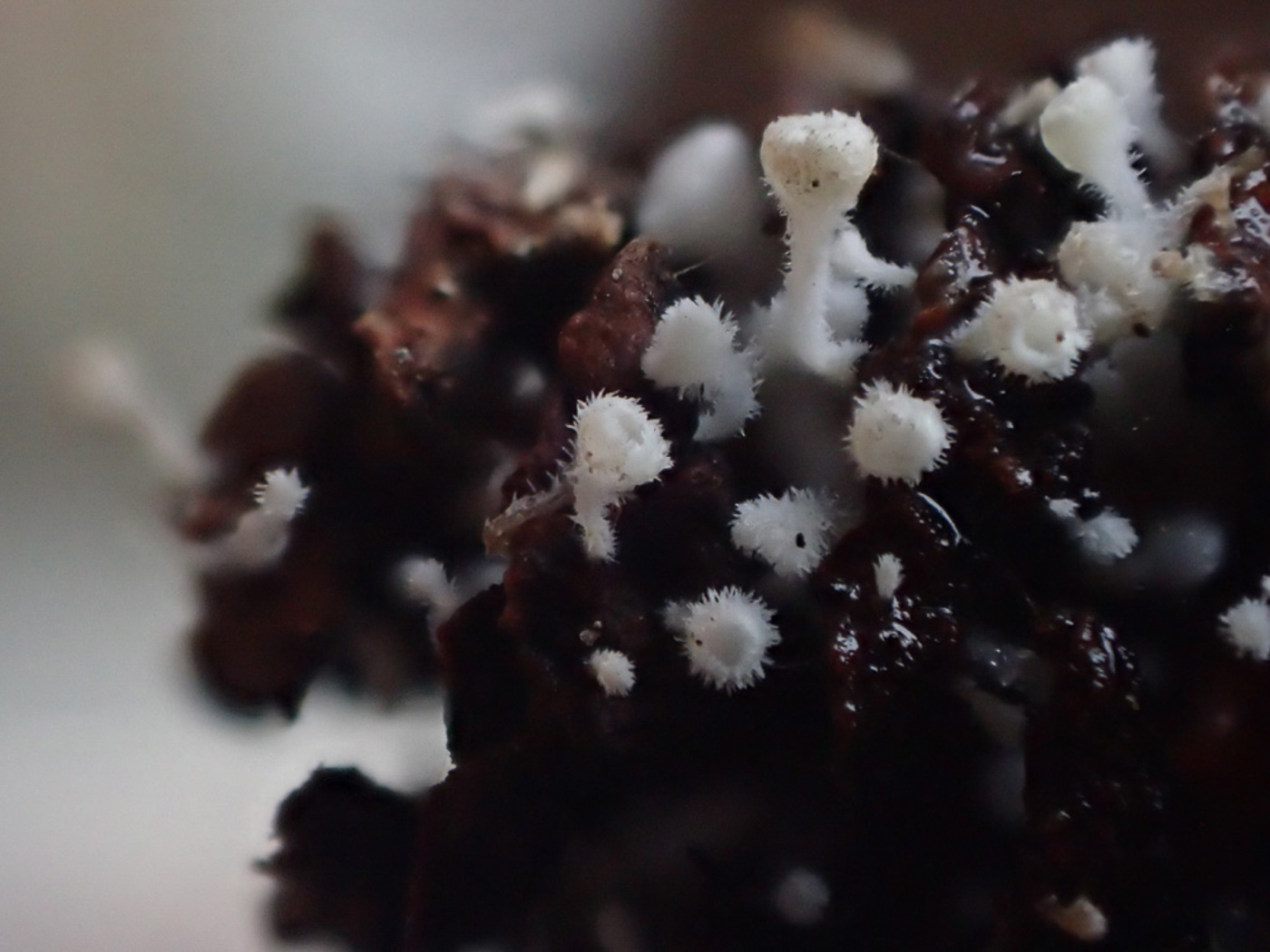 |
February 25th Lachnum virgineum (Snowy Disco) In an area at Beaconsfield Services with Alder, Sarah Ebdon and Jesper Launder went searching for some special fungi which associate specifically with that host on the fallen catkins. To their surprise they came across this tiny white hairy asco colonising one of the cone-like female Alder catkins. Suspecting it might be something unusual given this host, Sarah checked it out with a scope but found that it fitted exactly with Lachnum virgineum - very common on fallen deciduous bare wood, but on this host?! Photo 1 is Barry Webb's. Then a few weeks later when at Northmoor Hill Reserve she found even better examples of this same species literally festooning the female cones of Alder. Photos 2 and 3 are Sarah's from this second site. Previous finds |
.jpg "Photo © Sarah Ebdon")
 |
February 25th Pseudoclitocybe cyathiformis (Goblet) In the lawns at Prestwood churchyard the curate spotted this pair of Goblets when a few of us were visiting. Though damaged and very waterlogged, the upturned small cap which was lying beside them proved useful to show the clear forking of the gills near the margin, a feature often but not always present in this species. Of our 70 odd county records just a few are dated late October but the majority are dated late November continuing well into February, showing this as a species with a preference for the winter months. See also the much rarer P. cf expallens found by Sarah Ebdon three days earlier, though this awaits sequencing to confirm. The photos here are also Sarah's. Previous finds |
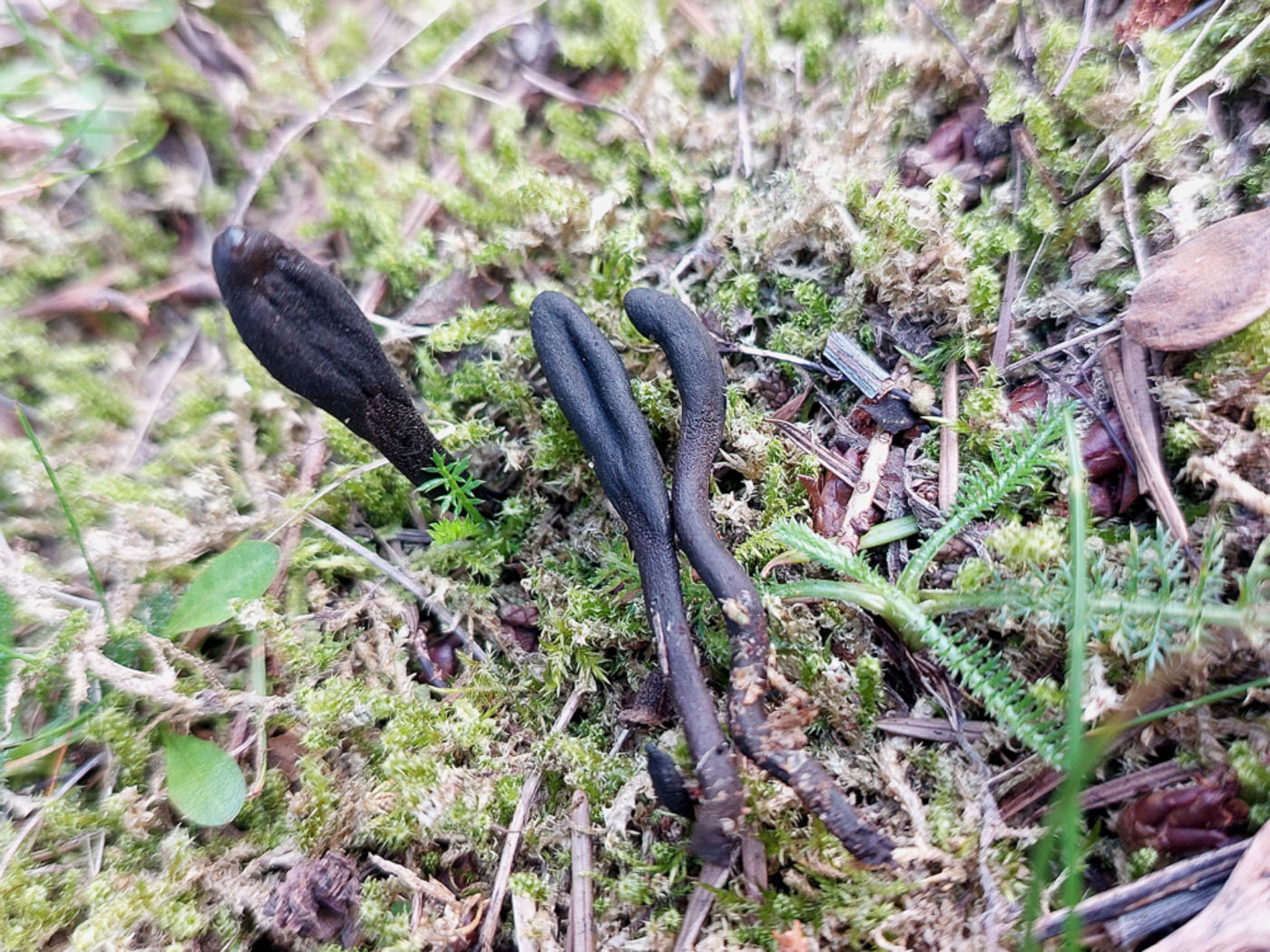 |
February 25th Geoglossum umbratile (Plain Earthtongue) In mossy grass under Oak in the outskirts of Gerrards Cross Jesper Launder found 10 Earthtongues and took them home to work on. This is a genus always needing a check with a scope, with many somewhat similar members. He found the 7-septate spores (imagine a sausage with 7 lines dividing it into sections) and typical paraphyses (cells between the sacs holding the spores, in this species with tips shaped like hockey sticks) which fitted with this particular species - not a rarity, nor apparently that unusual at this time, but we have only a handful of county records. Members' Finds New Species no. 1260 |
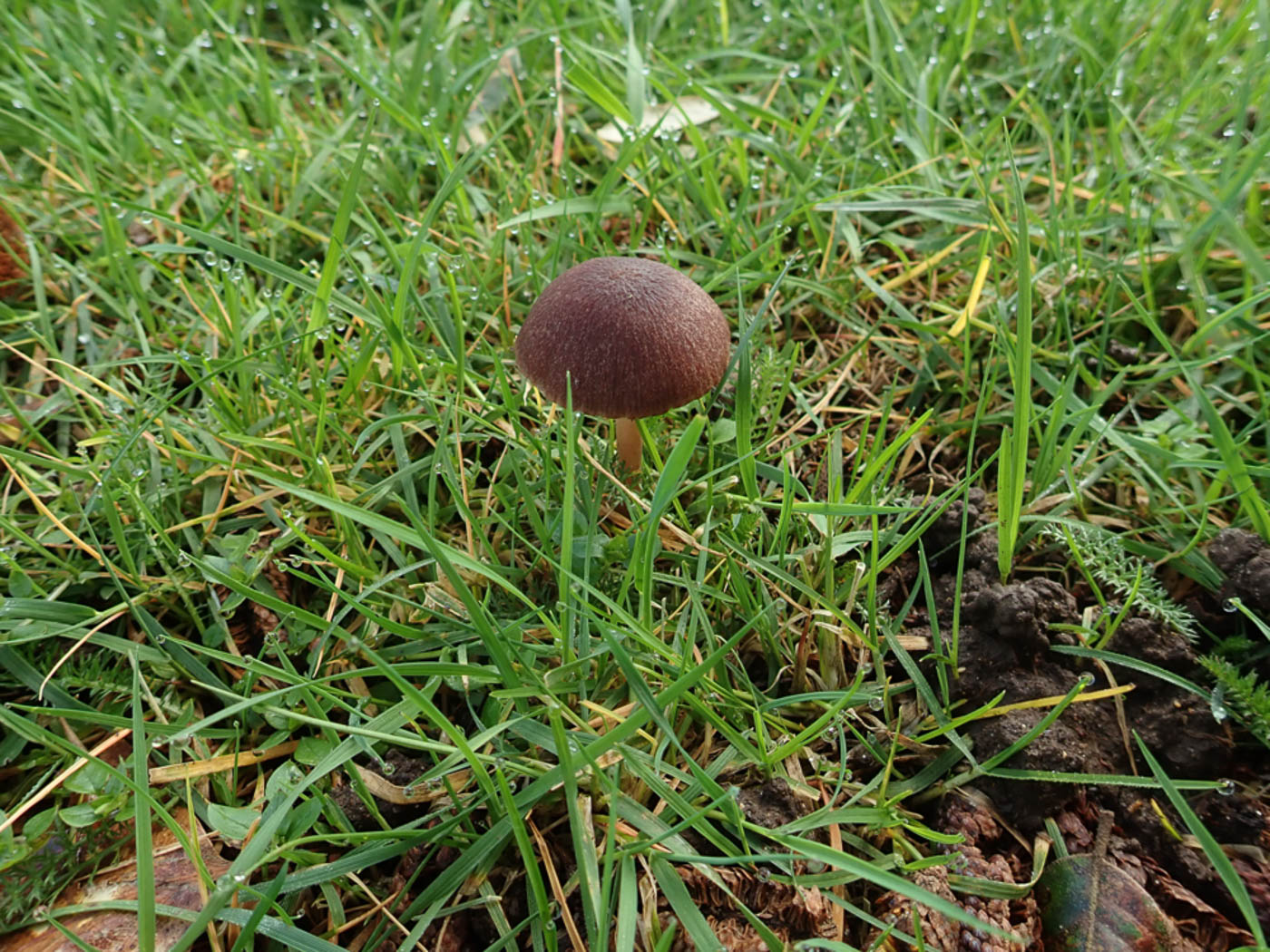
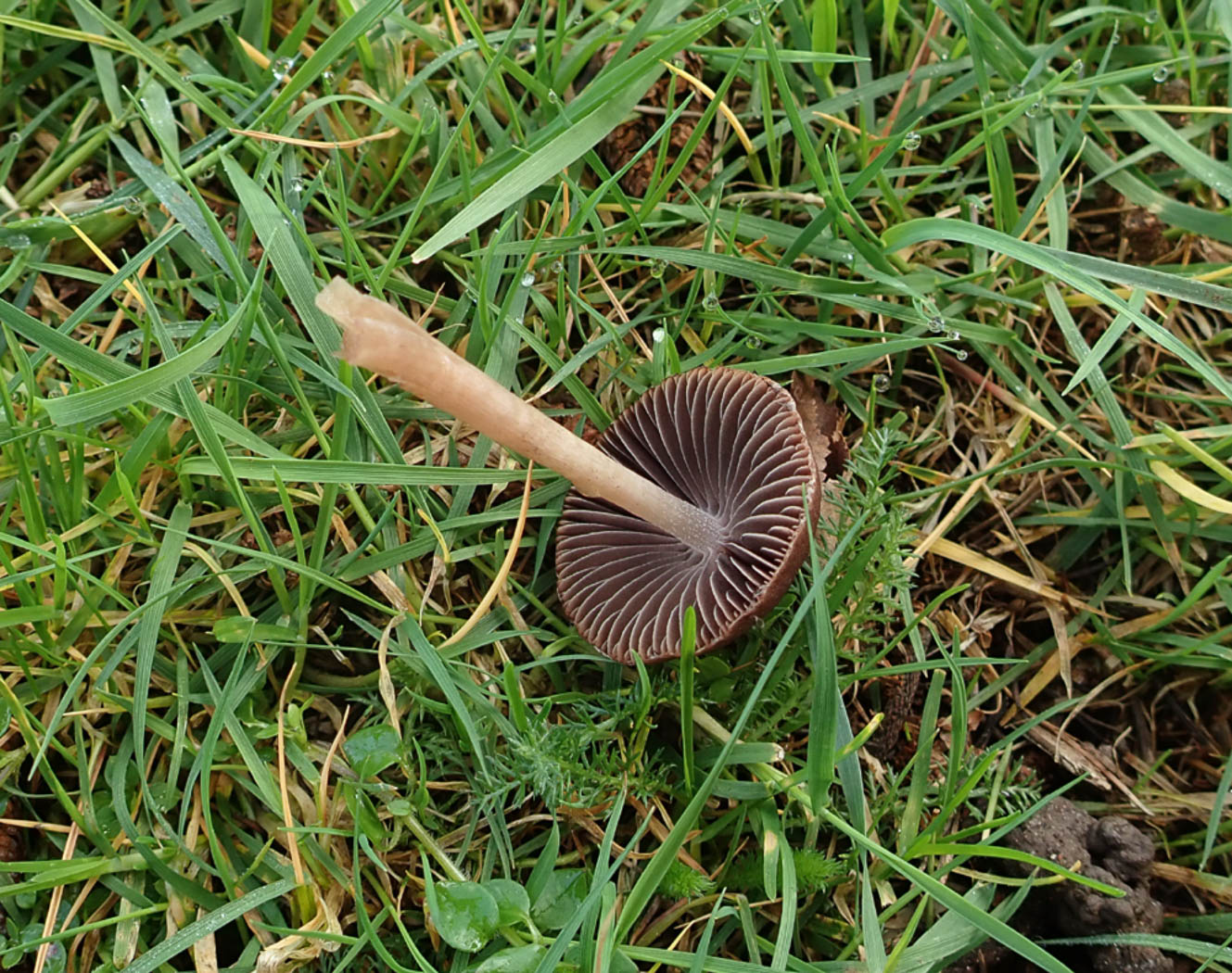
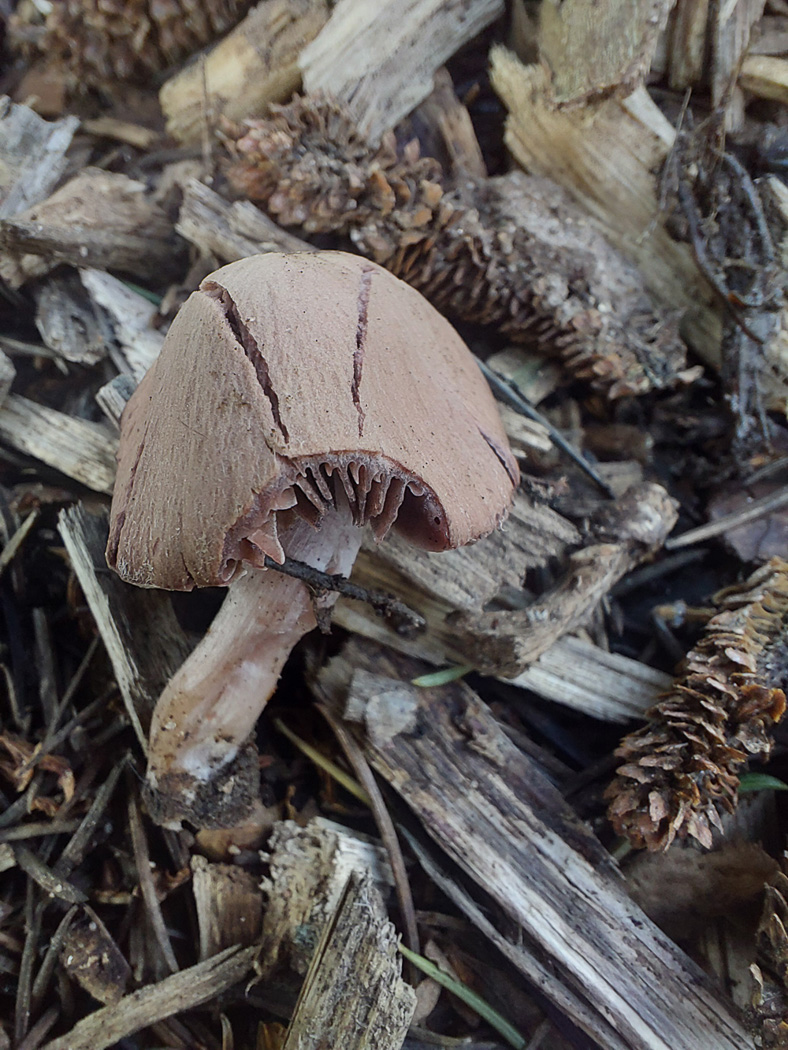 |
February 25th Psathyrella bipellis (Maroon Brittlestem) At Stoke Poges Memorial Gardens - ablaze with stunning daffodils and other spring beauties - Penny found a pristine and rather smart rich brown capped LBJ under Cedar where the thick woodchip merged with grassy soil. Jesper Launder instantly suggested it was probably in genus Psathyrella (Brittlestem), whereupon Penny suggested maybe even P. bipellis on account of its dome shape and rich colour with a hint of red and purple together with white edged but clearly dark gills in contrast to the white stem - these last two characters typical of the genus. Jesper also collected a very faded specimen from nearby (photo 3) suggesting at the time that it might well be the same despite appearing totally different. At home Penny found the large dark reddish brown spores having a clear germ pore at one end fitted well, as did the plentiful large cystidia on both gill edge and face. Sure enough, Jesper's specimen also match these criteria, showing just how tricky these hygrophanous species can be to recognise in the field. P. bipellis is unusual in the genus in having a distinctive smell, variously described as fruity, of peppermint, nettles or cat urine, though it was not until the next morning when the specimens had dried out that any smell became apparent to either Penny or Jesper, who however reported a convincing smell of cat urine! Previous finds |
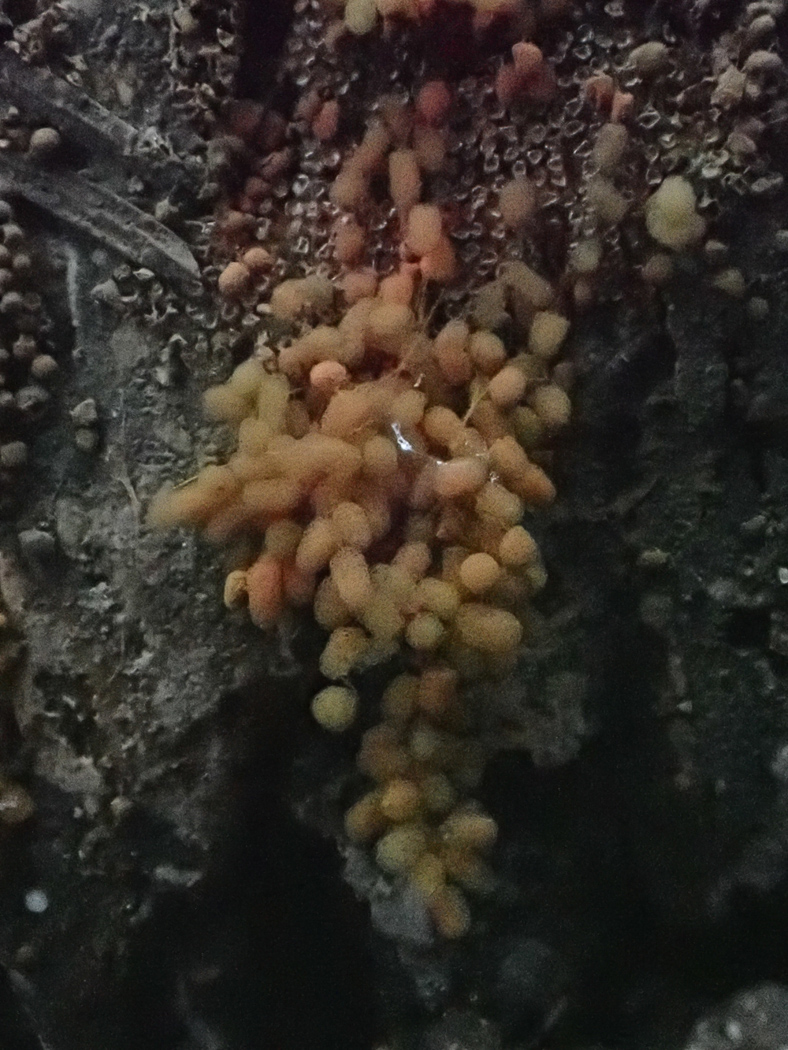
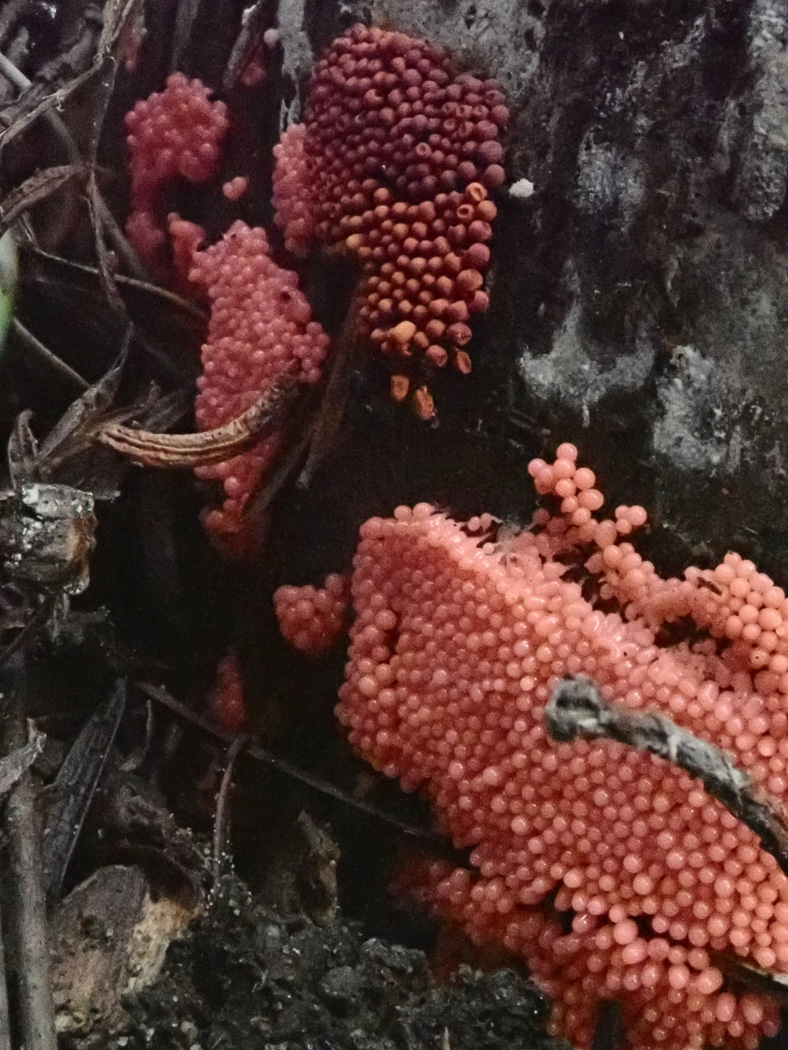
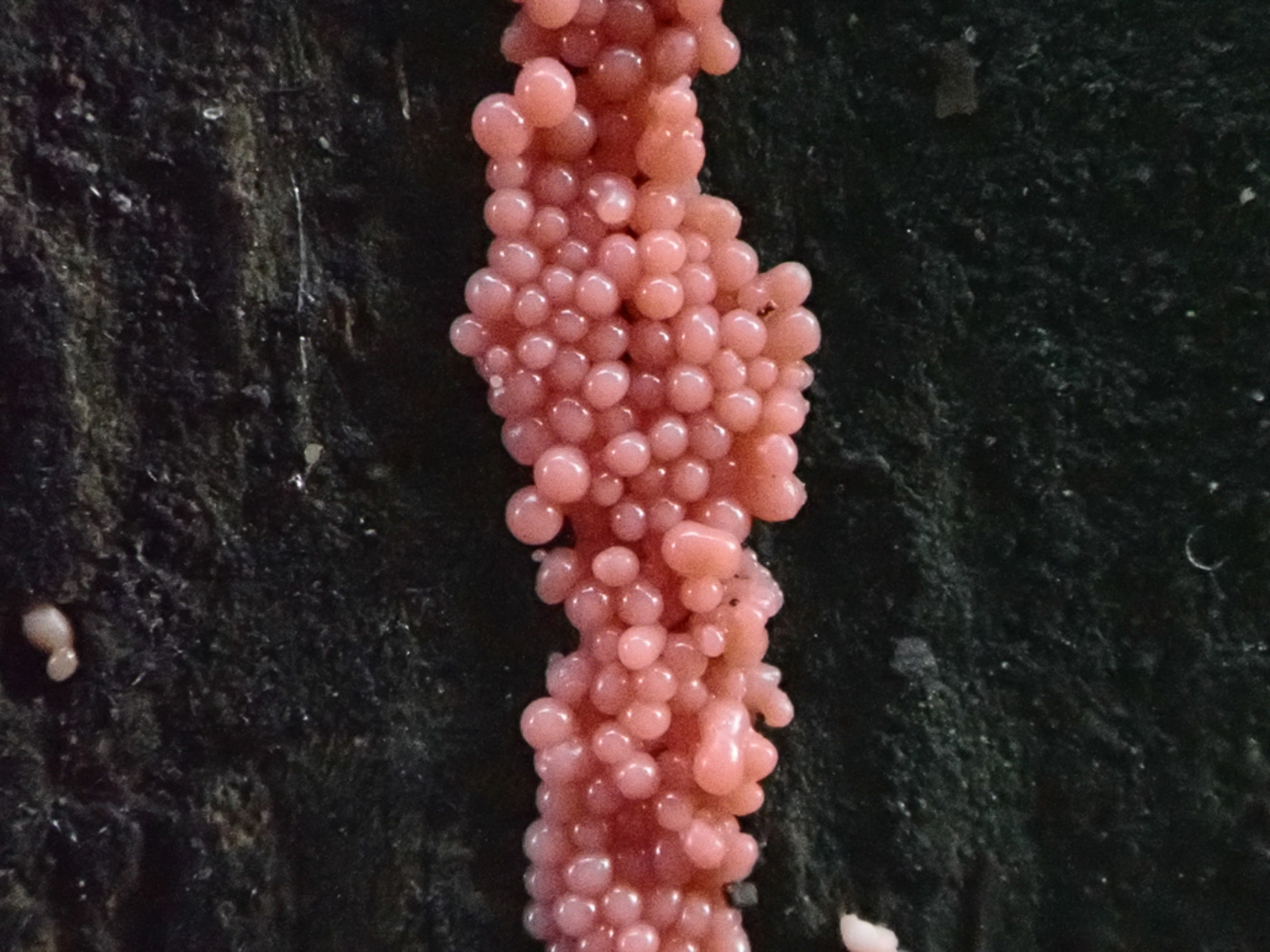 |
February 25th Heterotrichia ferruginea (a slime mould with no English name) At Stoke Poges Memorial Gardens Sarah Ebdon spotted some bright coral pink patches on a rotting bare log and on closer inspection realised it was the developing plasmodium of a slime mould. Further inspection revealed another patch nearby where it had matured into the typical fluffy loofah-like heads of the genus Arcyria. Sarah took her photos and then took a mature sample to show Barry Webb (our BFG slime mould guru) who made the identification from its shape, colour and habit. We appear to have just a handful of previous county records though under the name Arcyria ferruginea, several members of this genus having recently been moved into other genera as here. Previous finds |
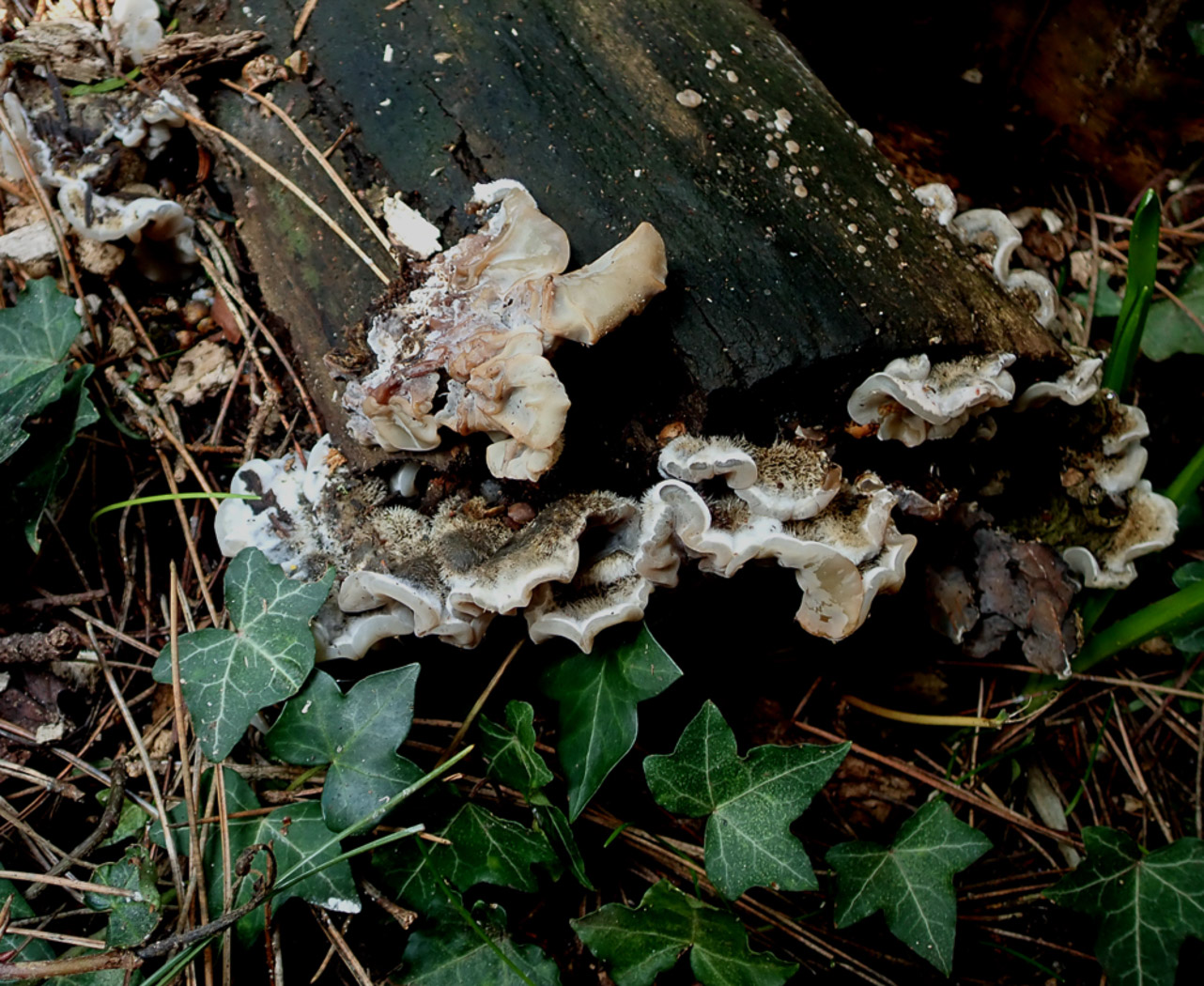 |
February 25th Auricularia mesenterica (Tripe Fungus) At Stoke Poges Memorial Gardens Jesper Launder spotted this flabby cluster of brackets on a bare damp indeterminate log and turning a piece over confirmed his thoughts that it was this species - a relative of the more familiar Auricularia auricula-judae (Wood Ear), common on dying or fallen Elder. The brackets have a zoned hairy upper surface not unlike Stereum hirsutum (Hairy Curtain Crust) but that's where the similarity ends because the soft pliable gelatinous texture becomes apparent when you pick a piece to view the underside which is veined / ribbed in a similar way to Wood Ear. (The photo is Penny's) Previous finds |
February 24th 2026
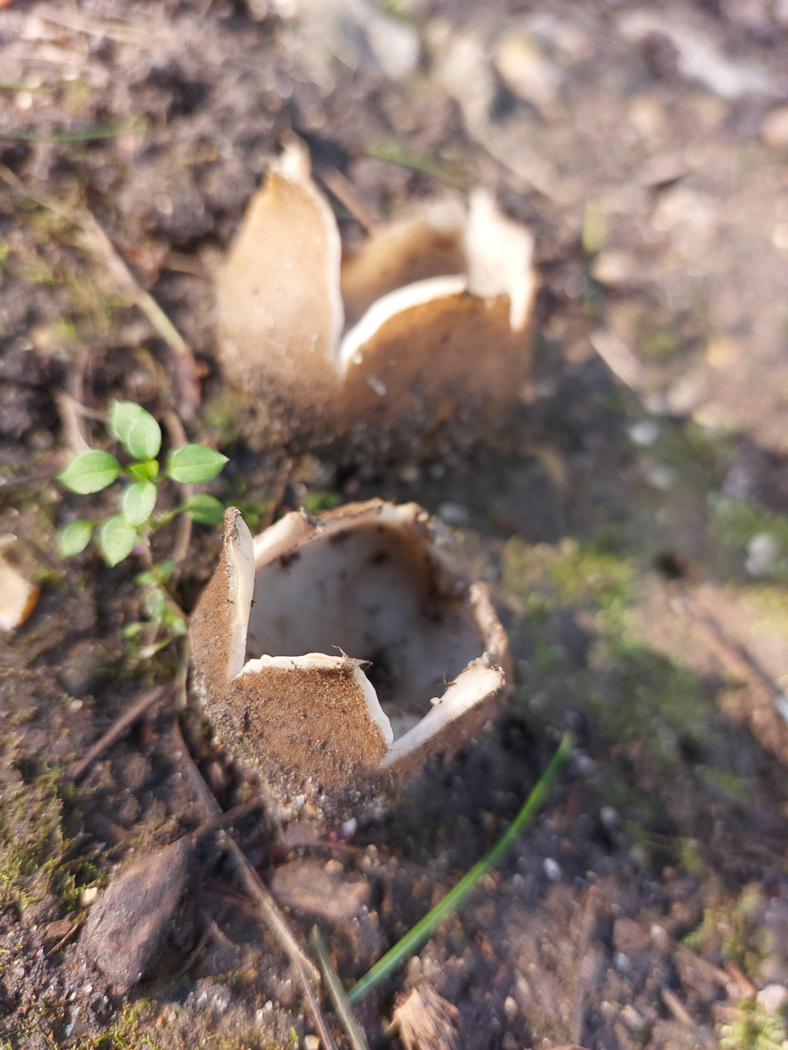
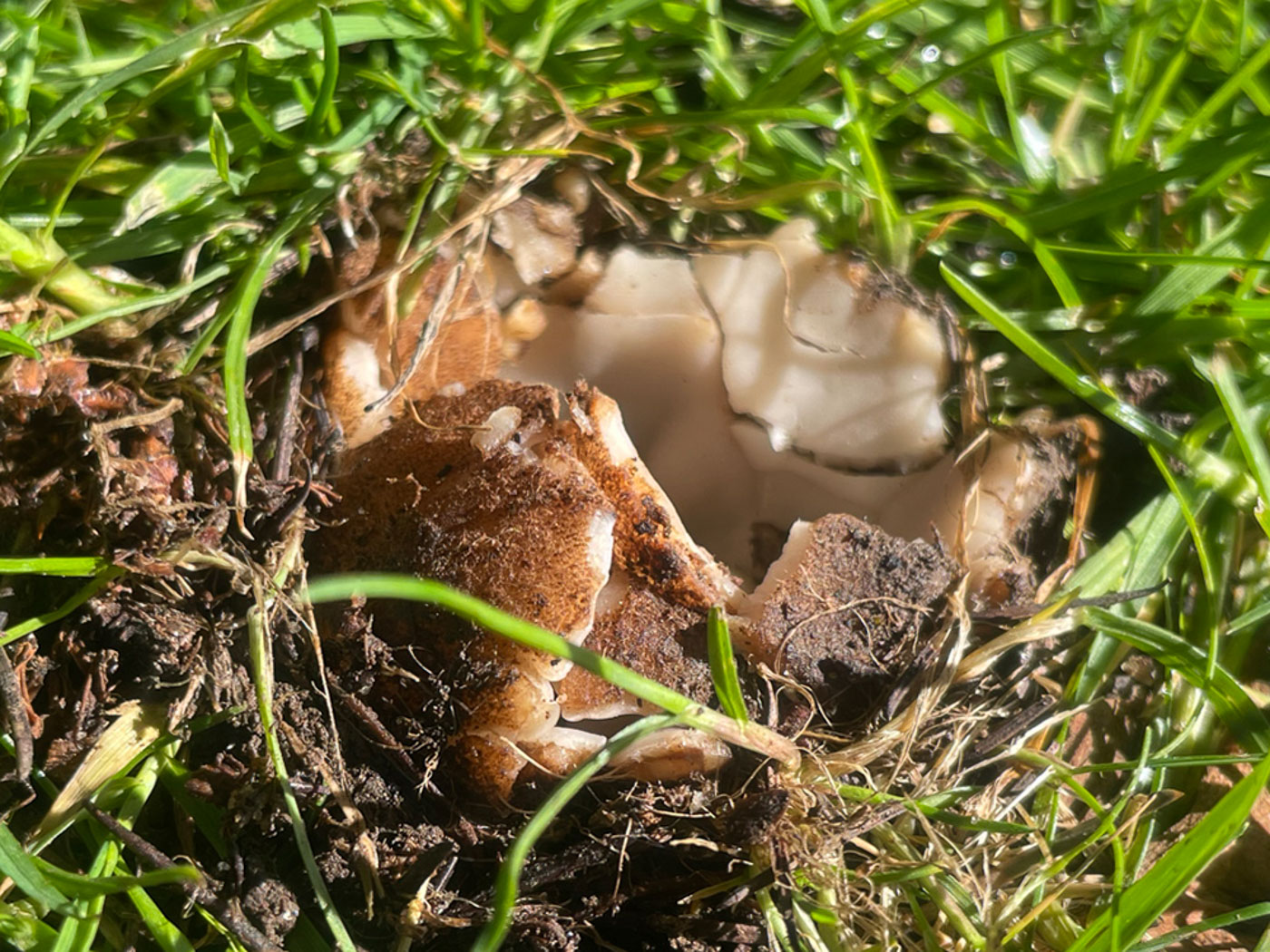
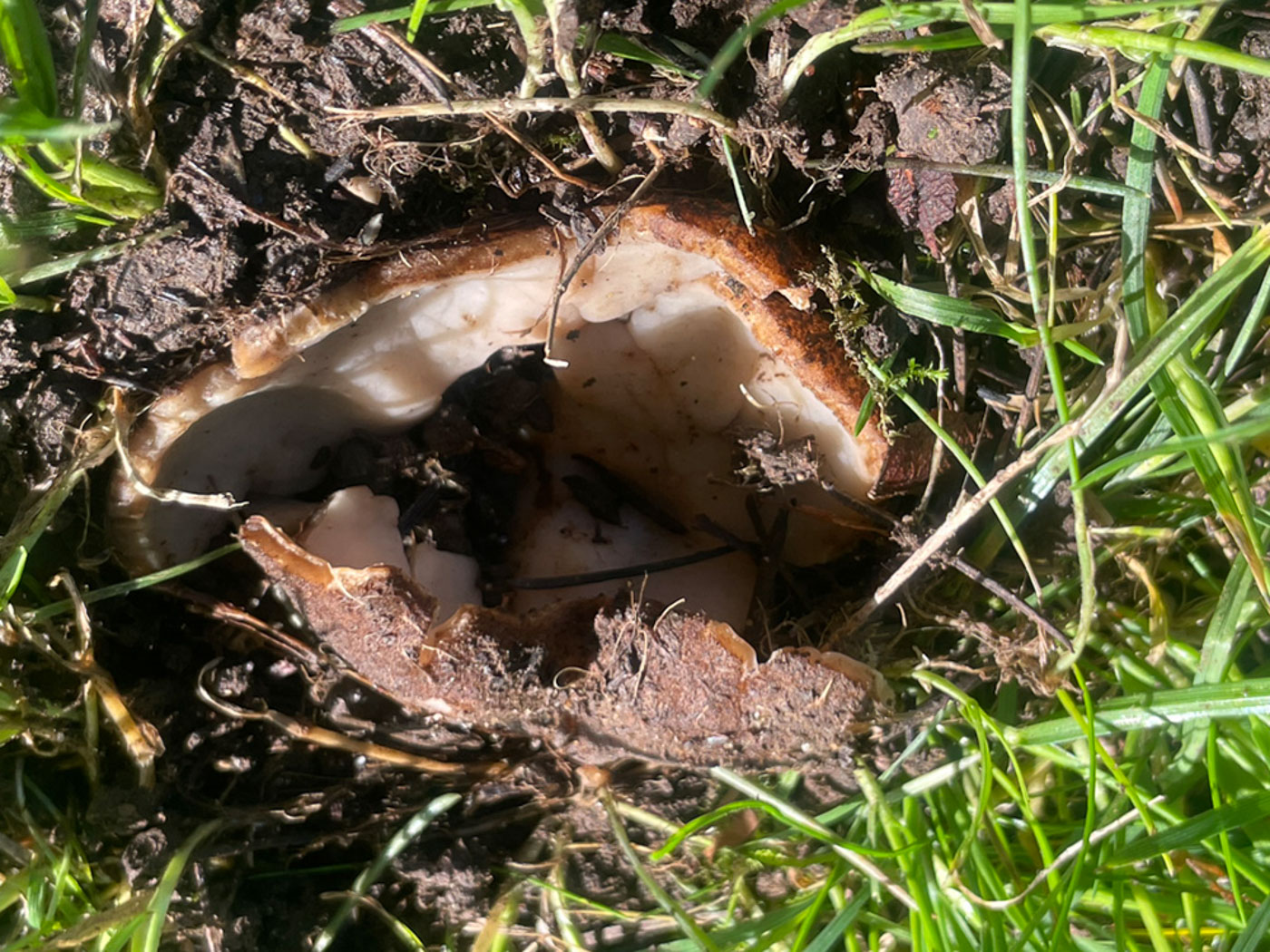 |
February 24th Geopora sumneriana (Cedar Cup) In Gerrards Cross Jesper Launder checked under a large Cedar where he'd found this spring fruiting asco before, and sure enough there it was poking out through the woody litter. It typically remains half submerged in soil and opens out to form petal-like lobes, exactly as seen here, but is not common and is considered host specific to Cedar though with occasional reports under Yew also. Photo 1 is his; photos 2 and 3 are from a find of Sarah Ebdon's under a Cedar near Prestwood churchyard 3 weeks later. Previous finds |
February 22nd 2026
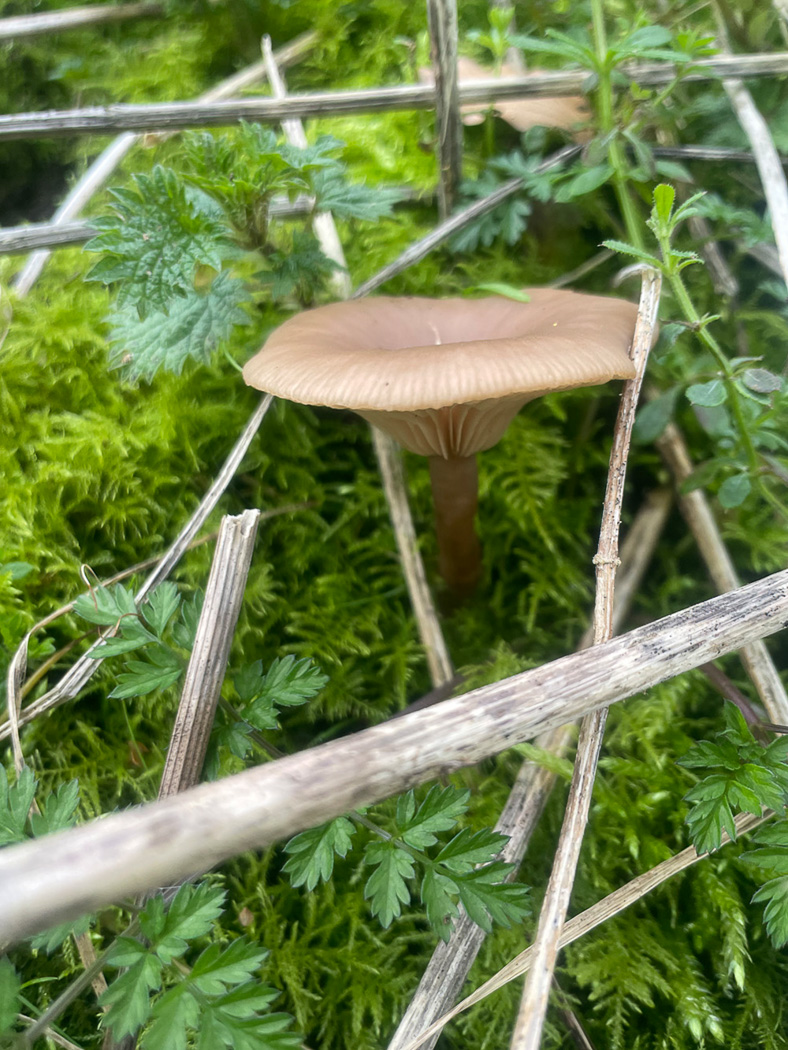

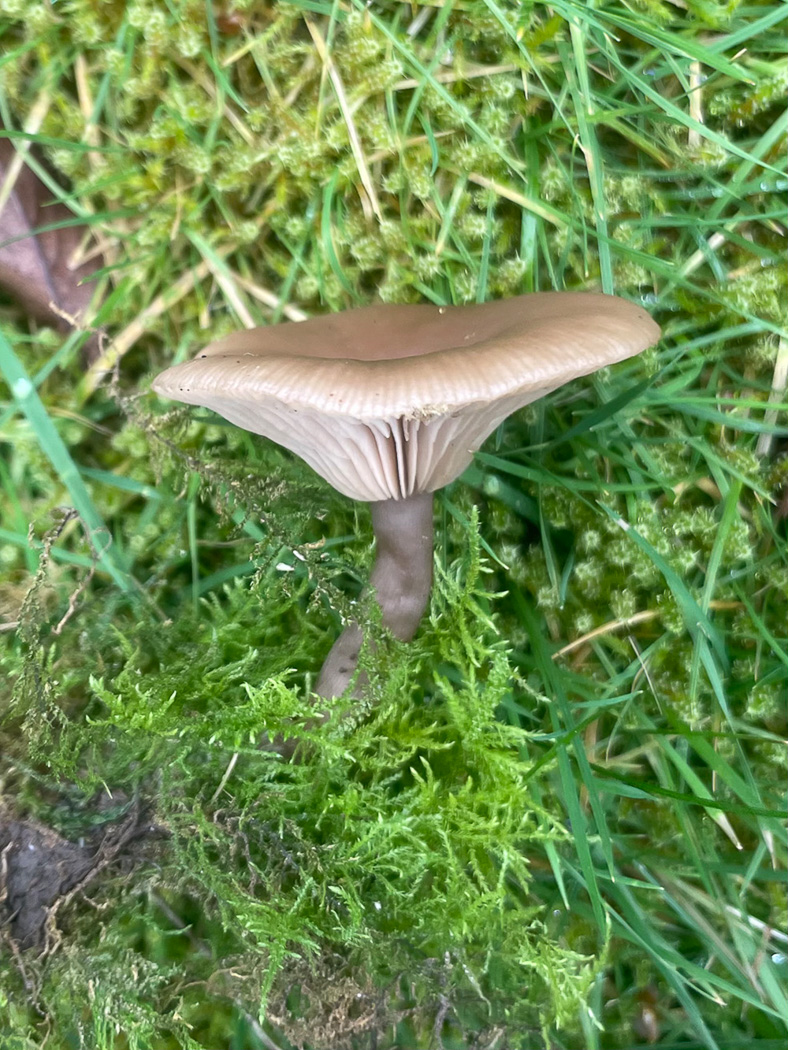
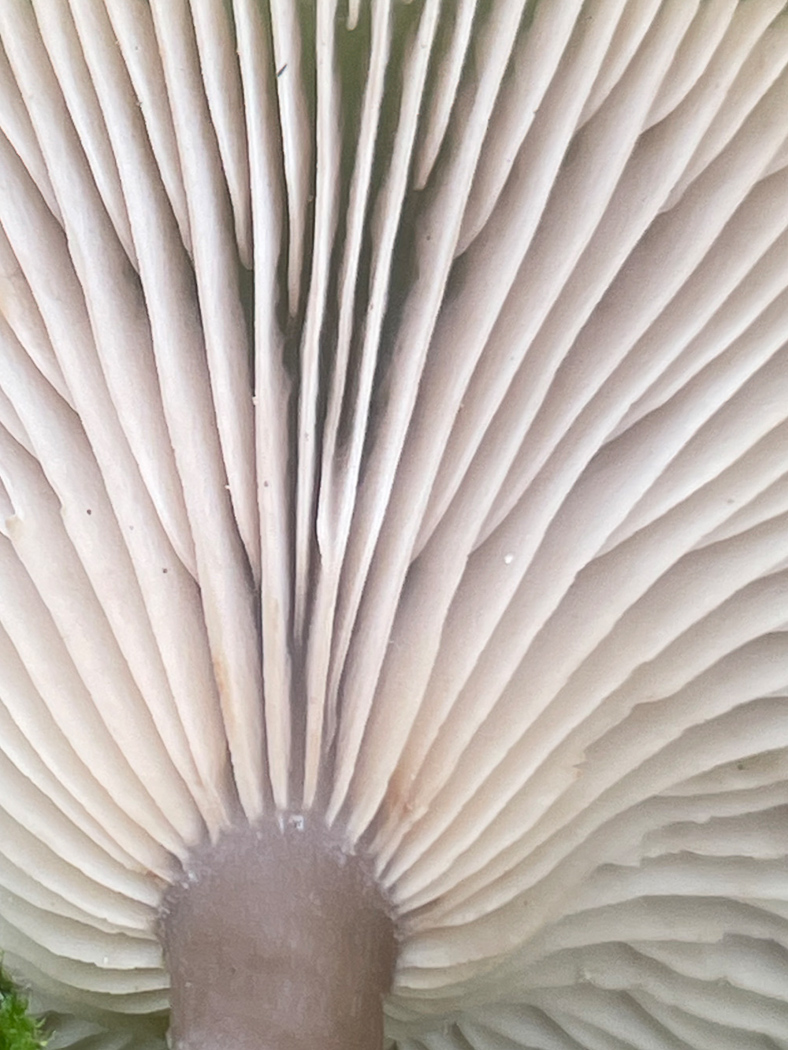 |
February 22nd Pseudoclitocybe cf. expallens (a rare species of Goblet with no English name) On mossy open grassland near Gt. Cookshall Wood Sarah Ebdon saw what she thought at first glance was P. cyathiformis (Goblet) - a regular fruiter in winter and early spring, but to her the jizz just wasn't quite right. It was on the small side, somewhat too pale for the common species and the cap outer surface was distinctly striate and not sharply inrolled, smooth and shiny as one would expect. At home she found that the spores were too small for P. cyathiformis but in fact fitted better with P. expallens though were not an exact match, and reading what she could find about this genus revealed that the two species are very close and often hard to separate. This could account for the far fewer records for this rarely recorded and little known species which could easily be misidentifed as P. cyathiformis. A sample will be sequenced, and if confirmed it will be a new county record. Compare with the entry for the common species found three days later at Prestwood Churchyard. Members' Finds New Species no. 1259 |
February 18th 2026
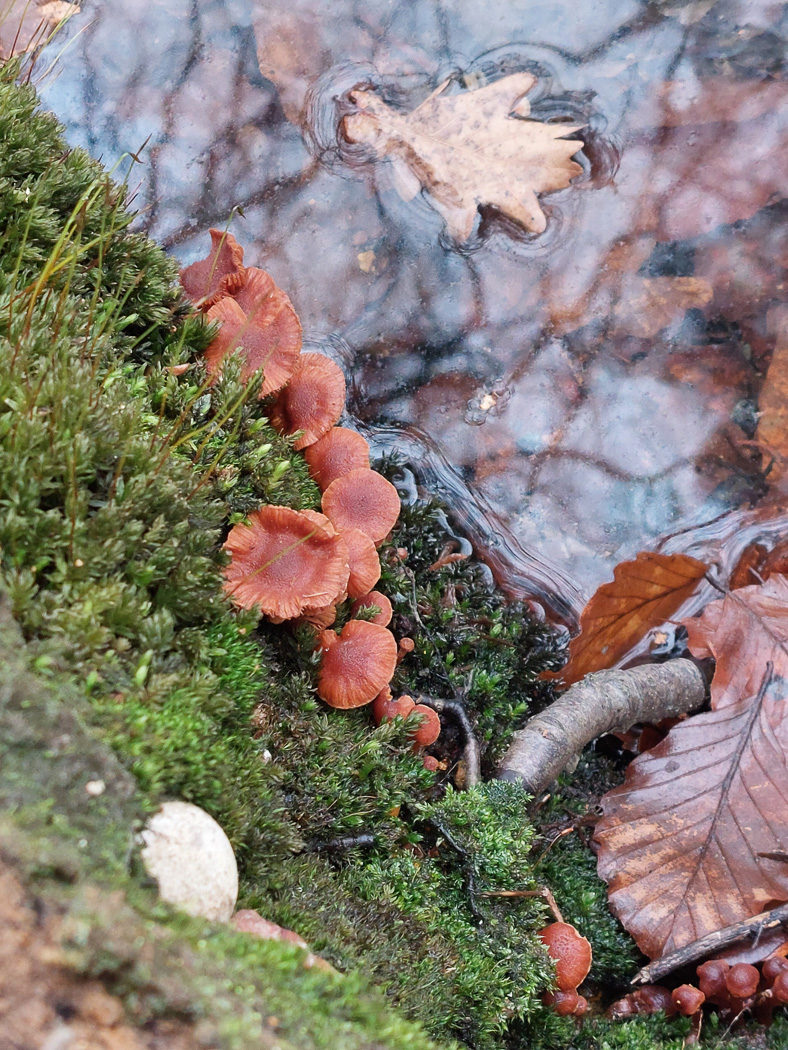
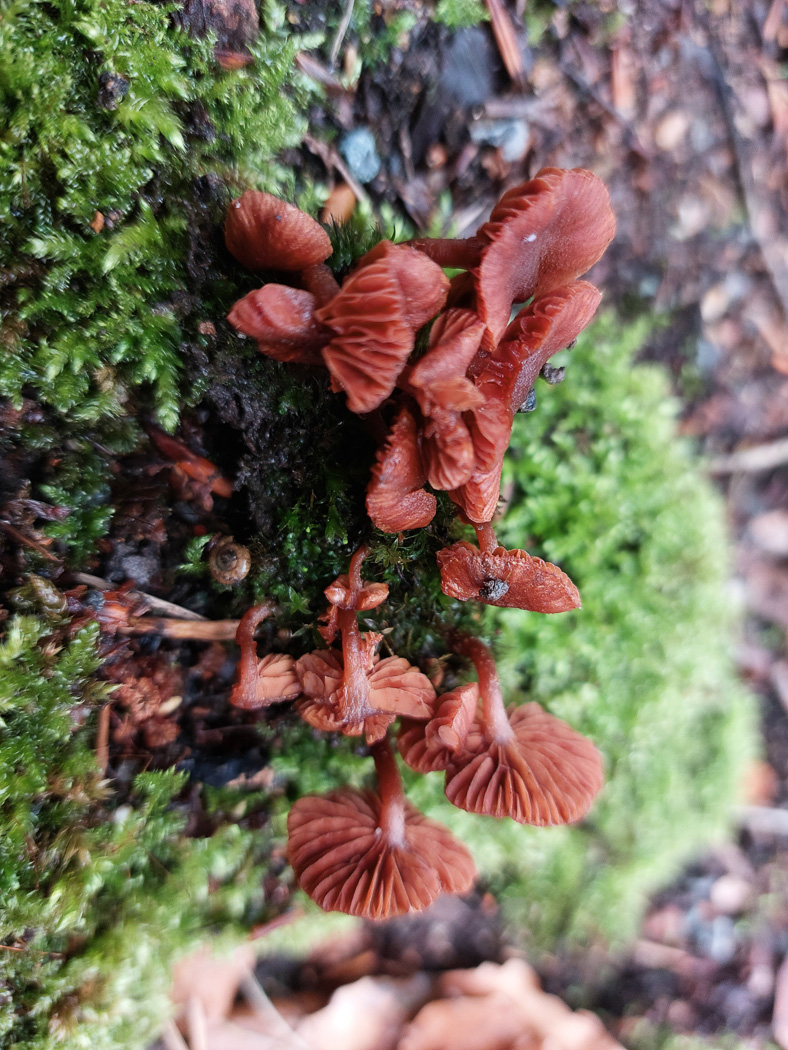
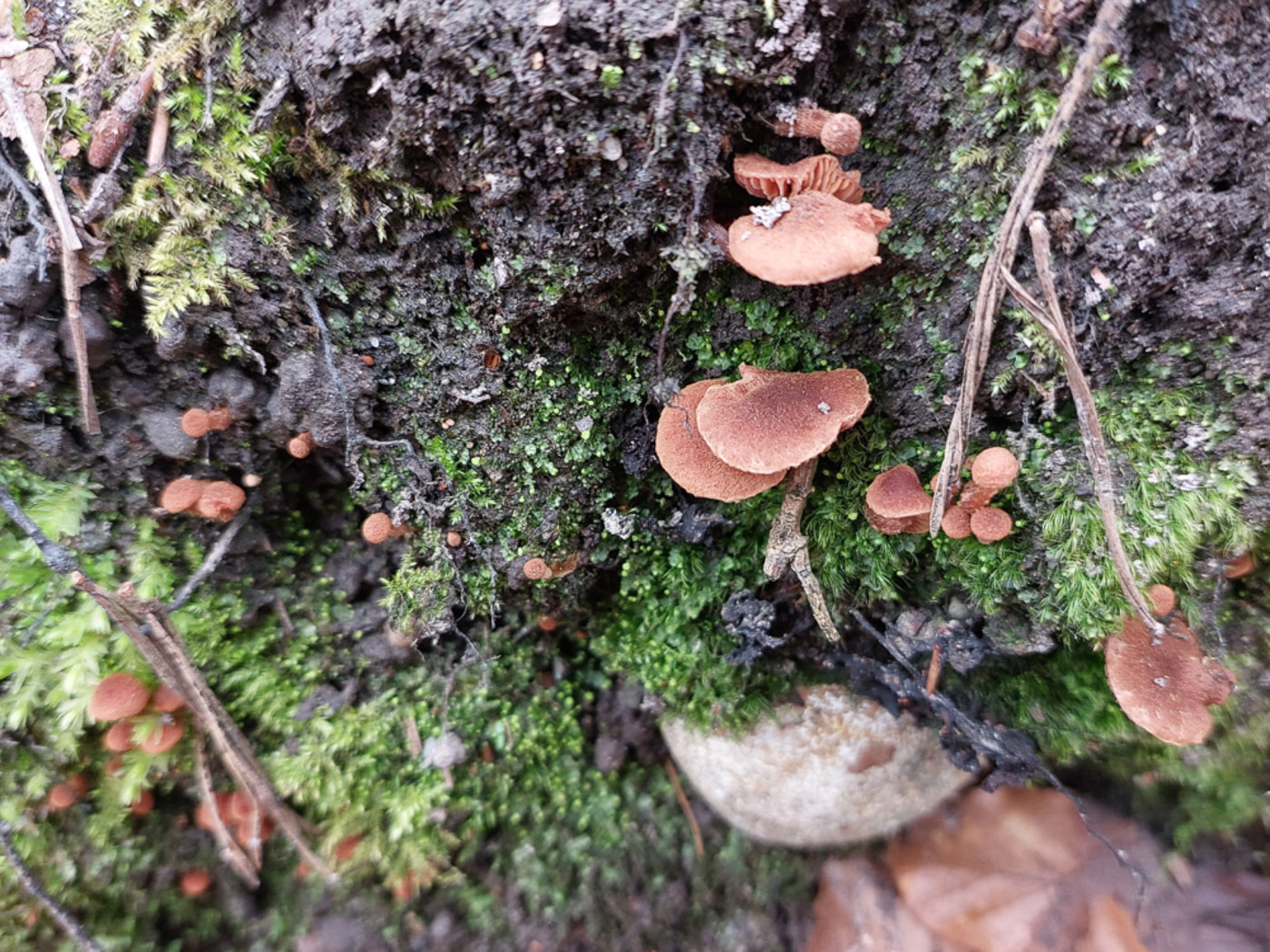
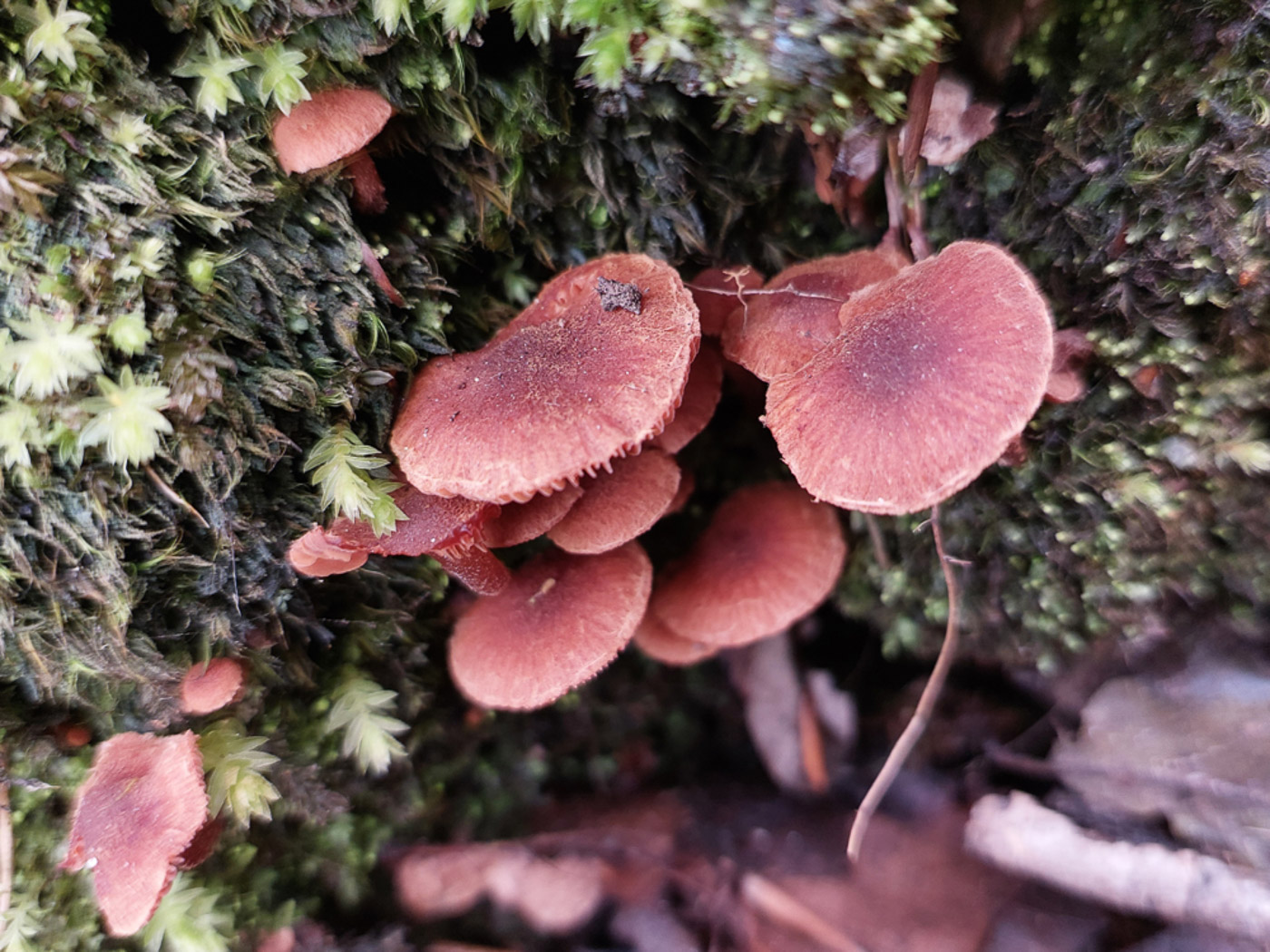 |
February 18th Tubaria (previously Flammulaster) ferruginea (Rusty Spark) At Stoke Common Jesper Launder abandoned exploring the common itself which was largely under water, so tried the adjacent roadside verge instead. Here in wet gully he found this unfamiliar mushroom in amazing numbers along a stretch of 30 to 50 meters growing horizontally out of the bank just above the waterline. He reckons there were at least 200 specimens! He wondered about one of the common Tubaria species but quickly rejected this in view of their distinctly reddish tint (though both spores and cystidia were within range), so it was back to the drawing board at home and in Fungi of Temperate Europe he came across a good possibility in Flammulaster ferrugineus (though only accepted as Tubaria ferruginea in Species Fungorum).The key microscopic character was the cap cuticle consisting of hyphae forming chains of encrusted cells - this fitted perfectly, as did the striation markings on the cap which distinguish the species from the similar F. granulosus. So though only a fairly ordinary looking LBJ, it was sufficiently different and well worth the time spent on working out an ID. This is new to the county. Good detective work, Jesper! Photos 3 and 4 are also Jesper's taken in the same spot but six weeks later when it had a second fruiting. This collection was later confirmed with sequencing (Launder & Mackenzie-Dodds) 100%. Members' Finds New Species no. 1258 |
February 17th 2026
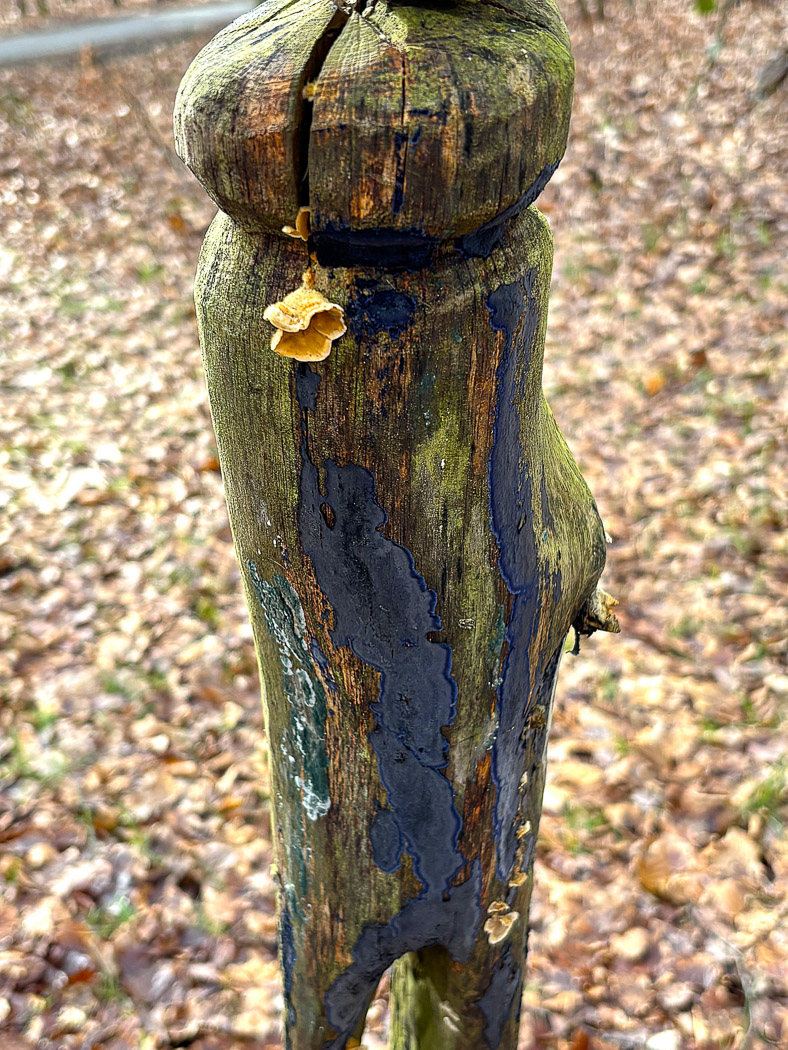 |
February 17th Terana coerulea (Cobalt Crust) At Burnham Beeches on one of the carved statues along the easy access path not far from the cafe Jordy Payne noticed this striking patch of seemingly blue 'paint', and dismissing the likelihood of someone actually having liberally spilt paint on it she realised this must be the rare and beautiful blue corticioid fungus. What a find! This stunning species favours bare dead hardwood such as Ash or Hazel but is not at all common and this looks to be a particularly splendid example. We have about 6 previous county records under this name (though until recently the species name was spelt caerulea) with a few earlier records under the previous genus name Pulcherricium. This is apparently the second record for Burnham Beeches, the first being in 2023. Previous finds |
February 16th 2026
.jpg "Photo © Jackie Ewan") |
February 16th Coprinellus micaceus (Glistening Inkcap) At Stampwell Farm Jackie Ewan spotted this cluster on some woodchip but also spotted that the give-away 'glistening' tiny veil granules for which the species is named were virtually all missing (no doubt washed off by the recent rains). Thus a check of the spores was needed just to make sure it was this species, and sure enough their size and mitriform shape (like a bishop's hat) confirmed it for her. Previous finds |
February 14th 2026
.jpg "Photo © Jackie Ewan")
.jpg "Photo © Jackie Ewan")
 |
February 14th Galerina variibasidia (a rare Bell with no English name) At Stampwell Farm in the Cherry avenue Jackie Ewan found this small Bell species growing as before in the moss Rhytidiadelphus squarrosus (Springy Turf Moss). This is a fungus newly described in 2021 with as yet extremely few UK collections, and as our first attempt to get a sample from Jackie sequenced unfortunately failed, we hope for better results from a subsequent collection she made last autumn in order to confirm it. In fact she comments that she's noticed this species here every month from February to May and again from September to December. (In her photos 1 and 2 the predominant moss visible is in fact Pseudoscleropodium purum (Neat Feather Moss) but she noted that the Rhytiadelphus was also present. However in photo 3 - taken in 2024 when she first became aware of this Galerina - the predominant moss is the Rhytiadelphus.) Previous finds |
.jpg "Photo © Jackie Ewan") |
February 14th Clitocybe fragrans (Fragrant Funnel) At Stampwell Farm, Jackie Ewan reports that this species has been fruiting on and off throughout the winter months, as indeed is quite often the case. A fairly nondescript pallid small mushroom, yes, but with a delicious sweet smell of aniseed though sometimes this needs a bit of time after collection to develop but is then unmistakeable. Previous finds |
February 11th 2026
.jpg "Photo © Jesper Launder") |
February 11th Meottomyces dissimulans (Winter Brownie) In Seer Green Jesper Launder came across a sizeable fruiting (60+ fruit bodies) of this infrequently recorded LBJ which has a preference for this time of year. Jesper apparently knows it from 'up north' but had not seen it in Bucks before today. Penny has only found it once - see the Finds previous entry which includes some description details, so this is one to look out for now as the present conditions must clearly be suitable. Note that the stem ring - a useful pointer to the species - is visible on the two young fruit bodies (bottom left) but is missing on others and is described as fleeting. Though described as widespread, this species is not common with under 50 FRDBI records. Previous finds |
February 10th 2026
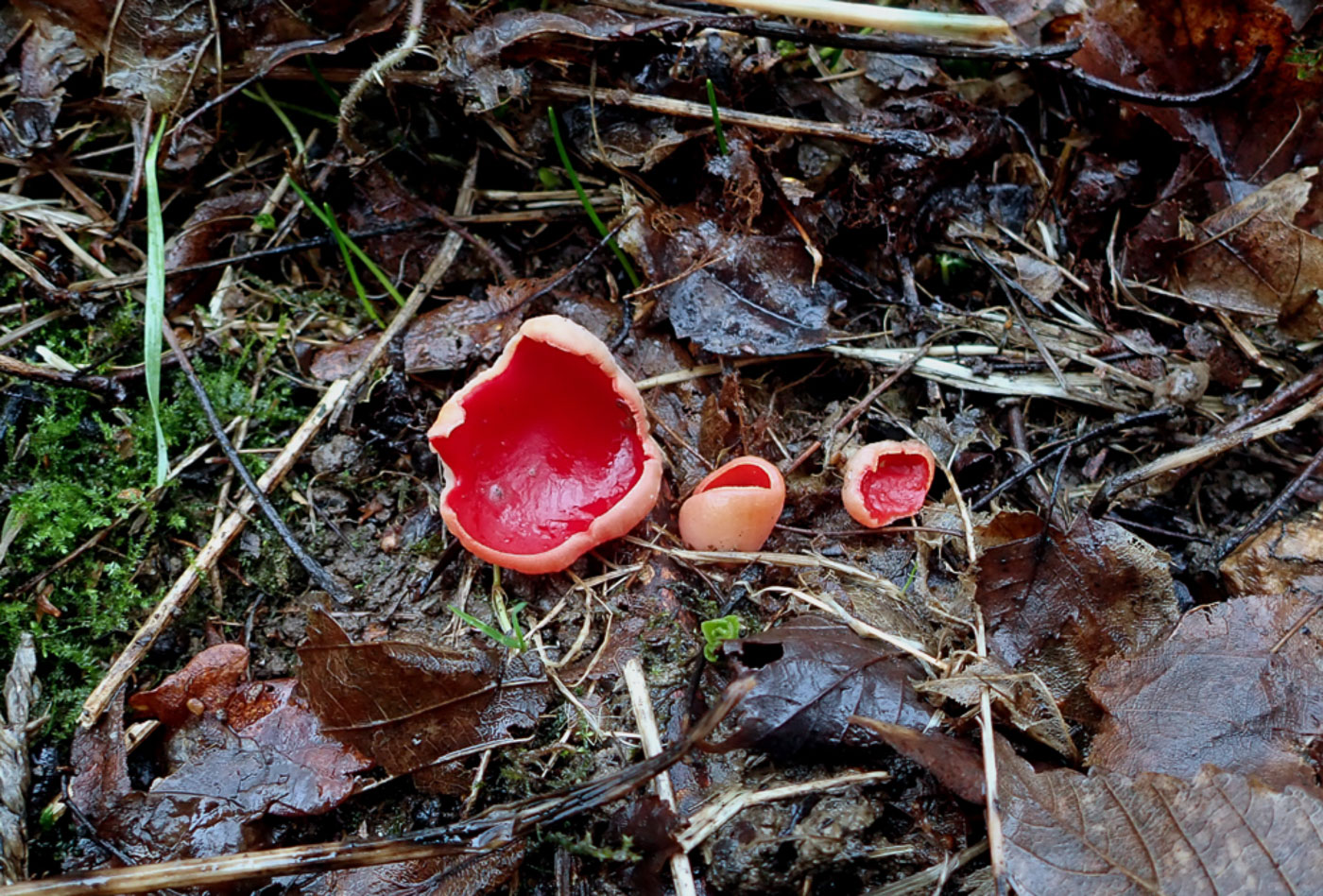 |
February 10th Sarcoscypha austriaca (Scarlet Elfcup) A wander at Turville Heath produced several fungi today but Penny was particularly pleased and also not surprised to find first one, then a couple more examples of this charismatic and eye-catching spring species. It favours damp places where fallen deciduous wood is in contact with soil, and there should be plenty of those around at the moment! Here it was on fallen Lime though it often shows a preference for Willow (though maybe just because Willow favours damp areas too?). We have plenty of previous entries, yes, but Penny couldn't resist putting this one in as she's received no report of it as yet this year. Previous finds |
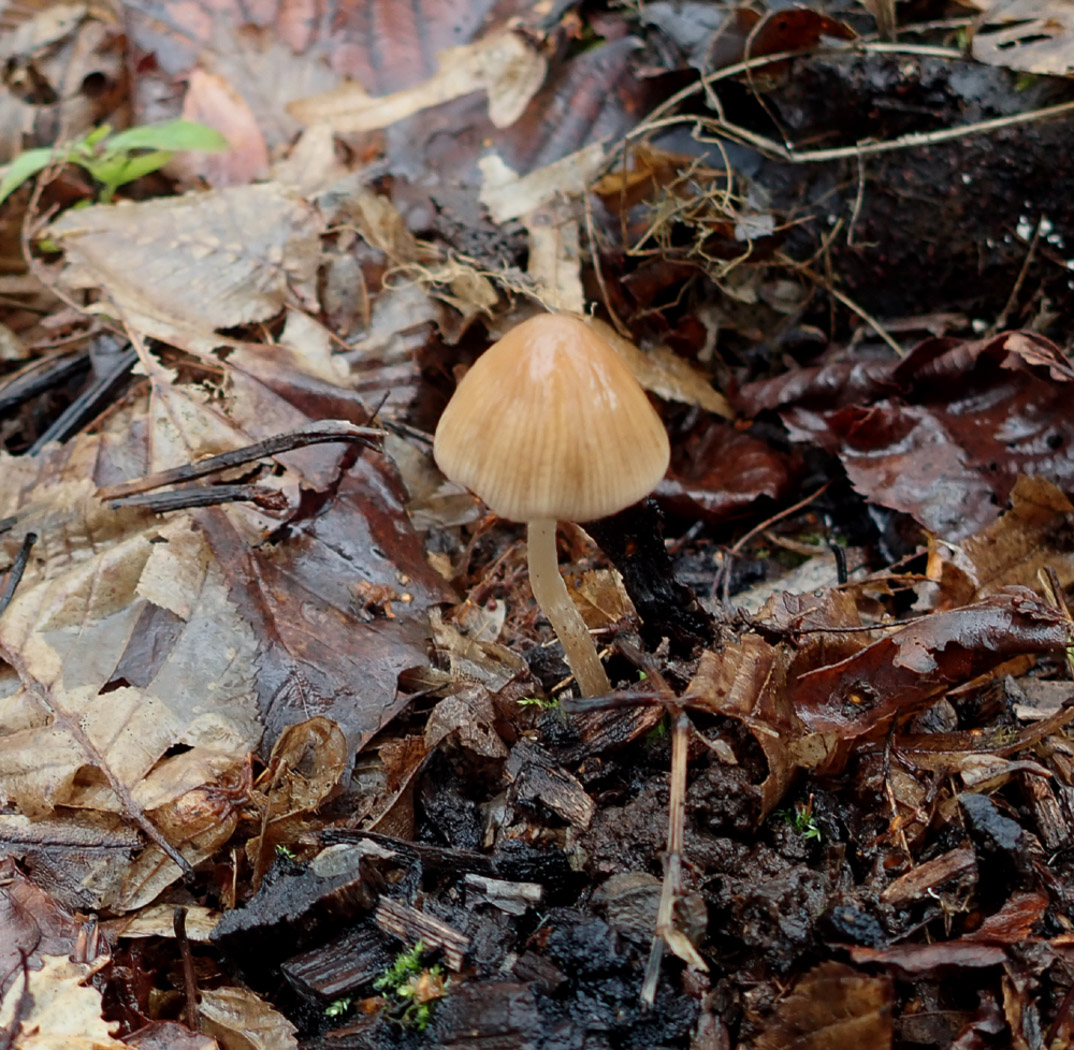
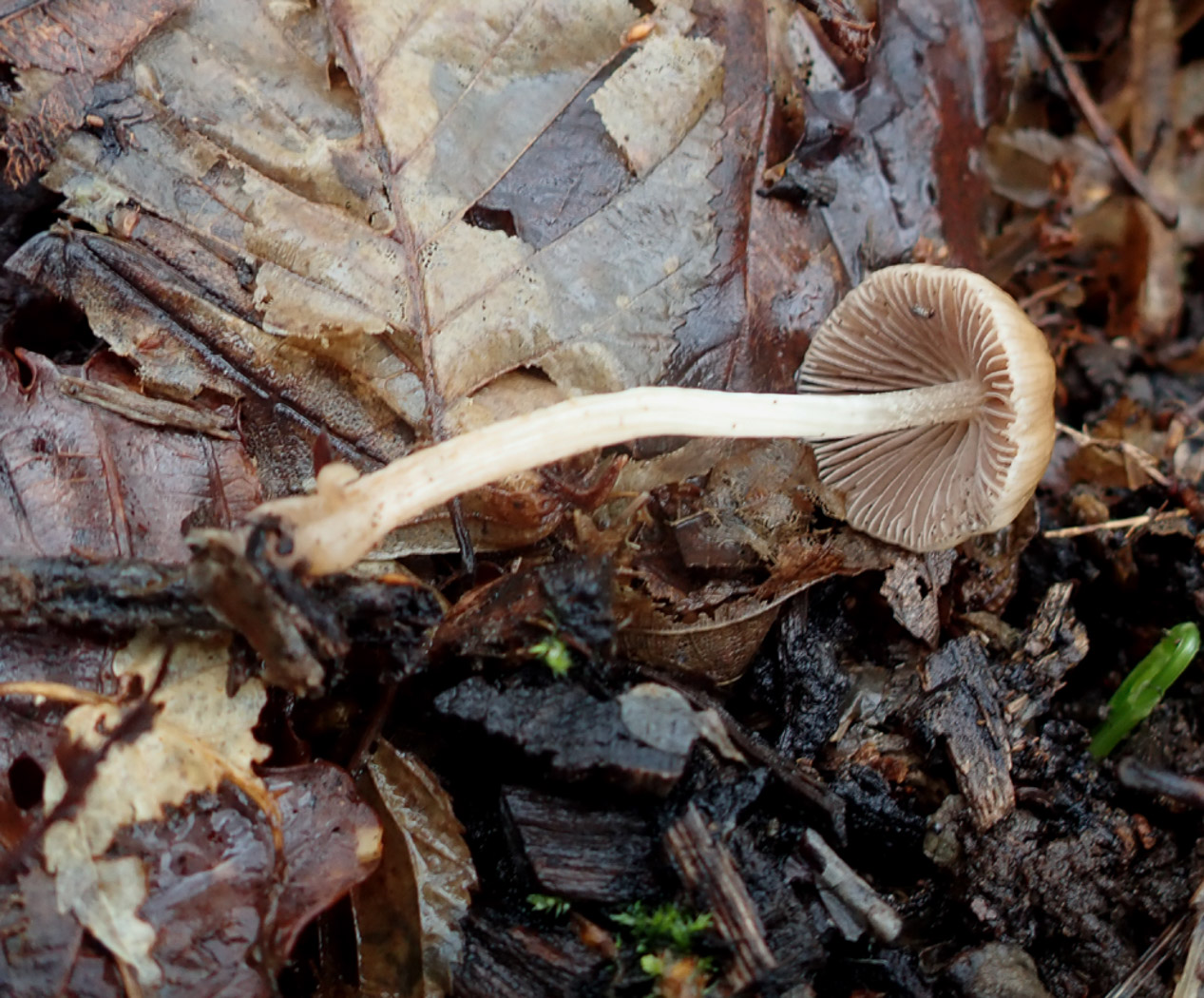 |
February 10th Psathyrella spadiceogrisea (Spring Brittlestem) In woody litter under Lime at Turville Heath Penny found a small singleton, and at home her thoughts that it was a Psathyrella, possibly spadiceogrisea considering the time of year, were confirmed. Our earliest record - we have plenty - is for early March (as it happens from this same site - Finds entry Mar. 3rd 2024), with the vast majority of records for April and May, but considering the recent mild and very damp extended spell it seems hardly surprising that it should be starting to fruit now. Previous finds |
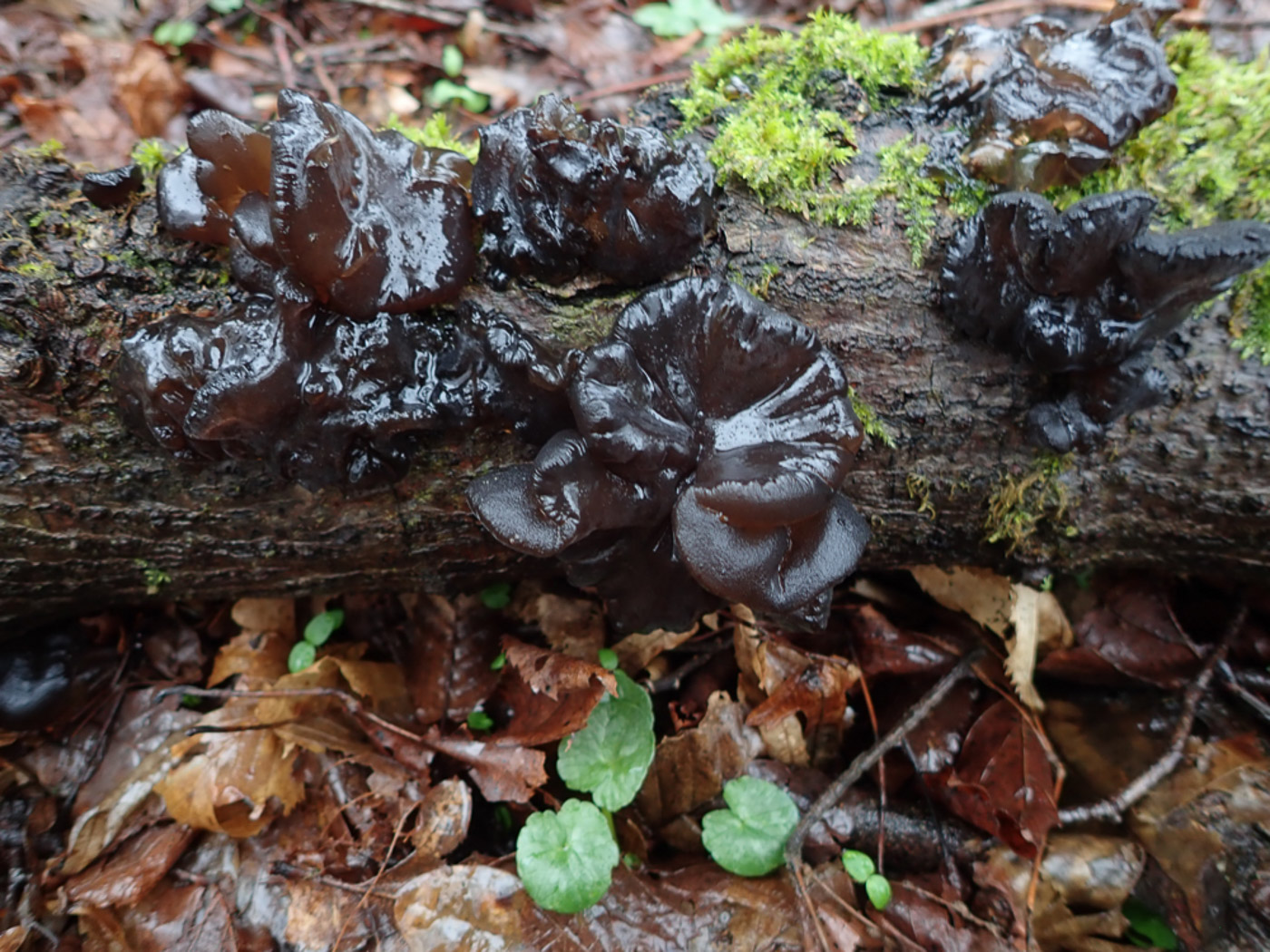
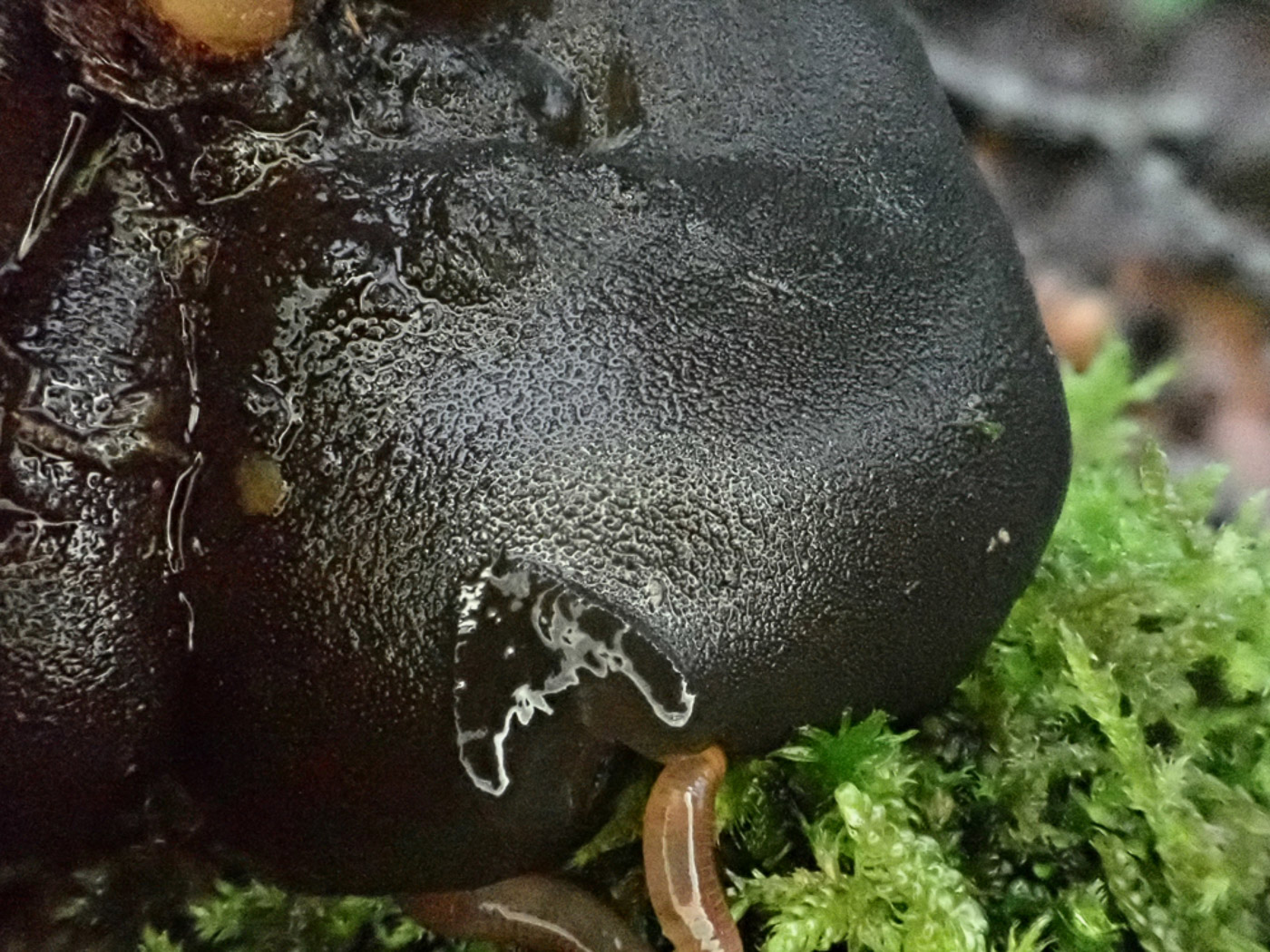 |
February 10th Exidia glandulosa (Witch's Butter) It is perhaps no surprise (after constant rain) that 'jelly fungi' should be thriving at present, and this was born out at Turville Heath where Penny found this fully expanded and extremely soggy and gelatinous example on fallen Lime. The underside (seen in photo 2) shows the finely bobbly surface typical of both this species and the similar E. nigricans (Warlock's Butter), though that species is more 'brainlike', forms clusters of smaller less cushion-like fruit bodies which don't develop into the large individual swellings seen here. If splitting the two is in doubt, there is a difference in spore size between them, though today Penny thought it not necessary to check. (For further explanation re the names of these two species see her comments under the E. nigricans entry dated Jan 17th 2022.) Previous finds |
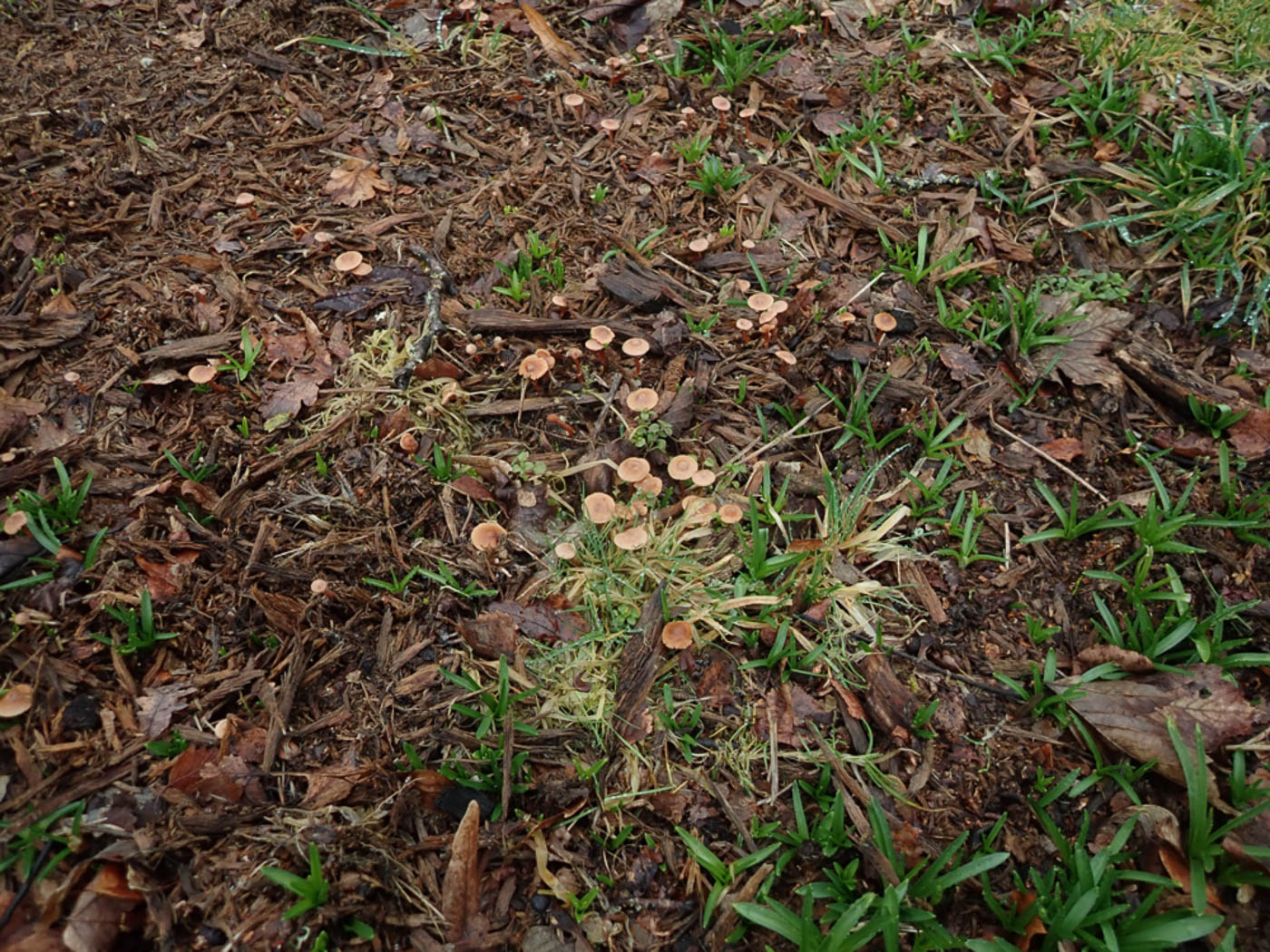
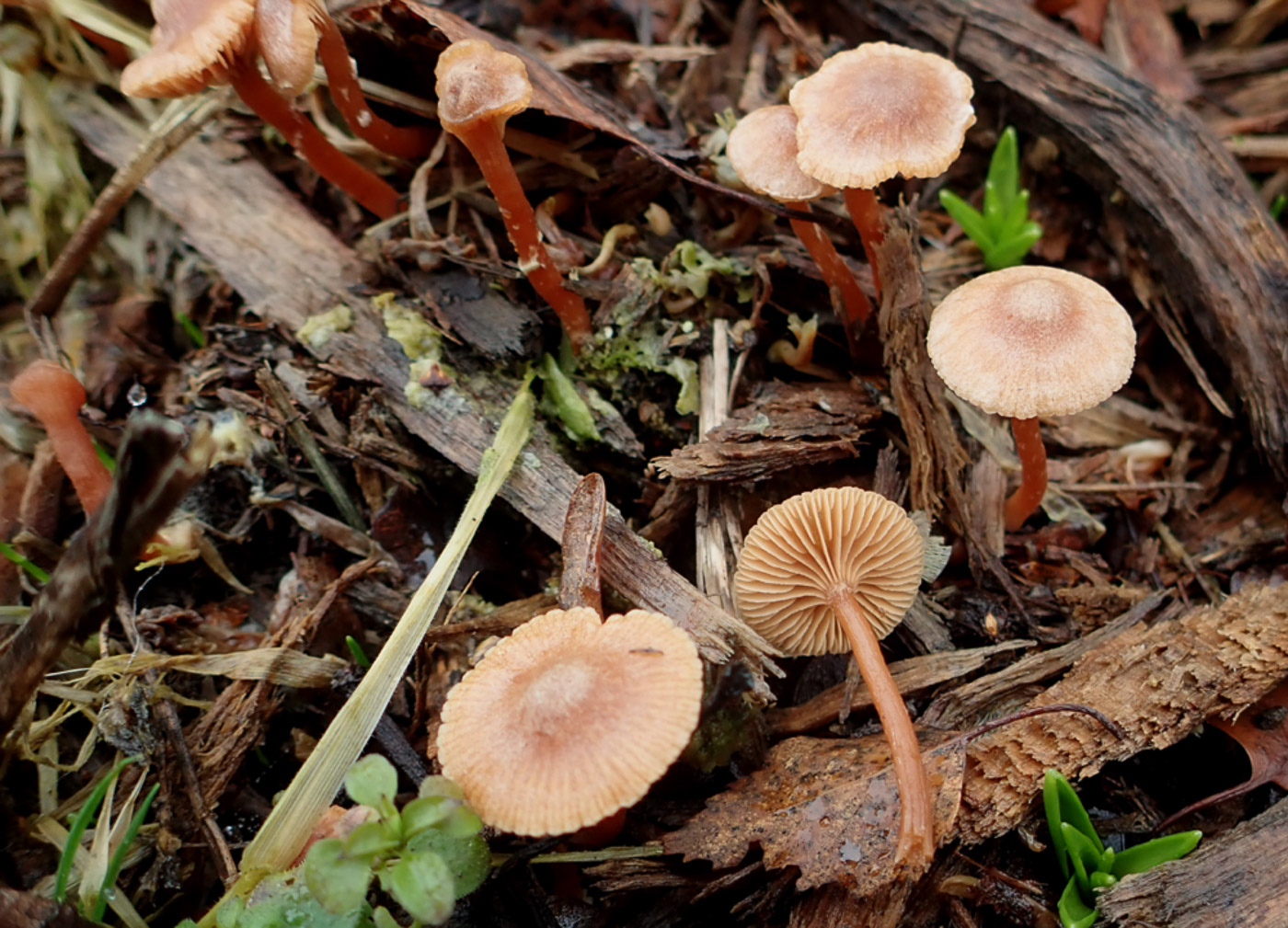
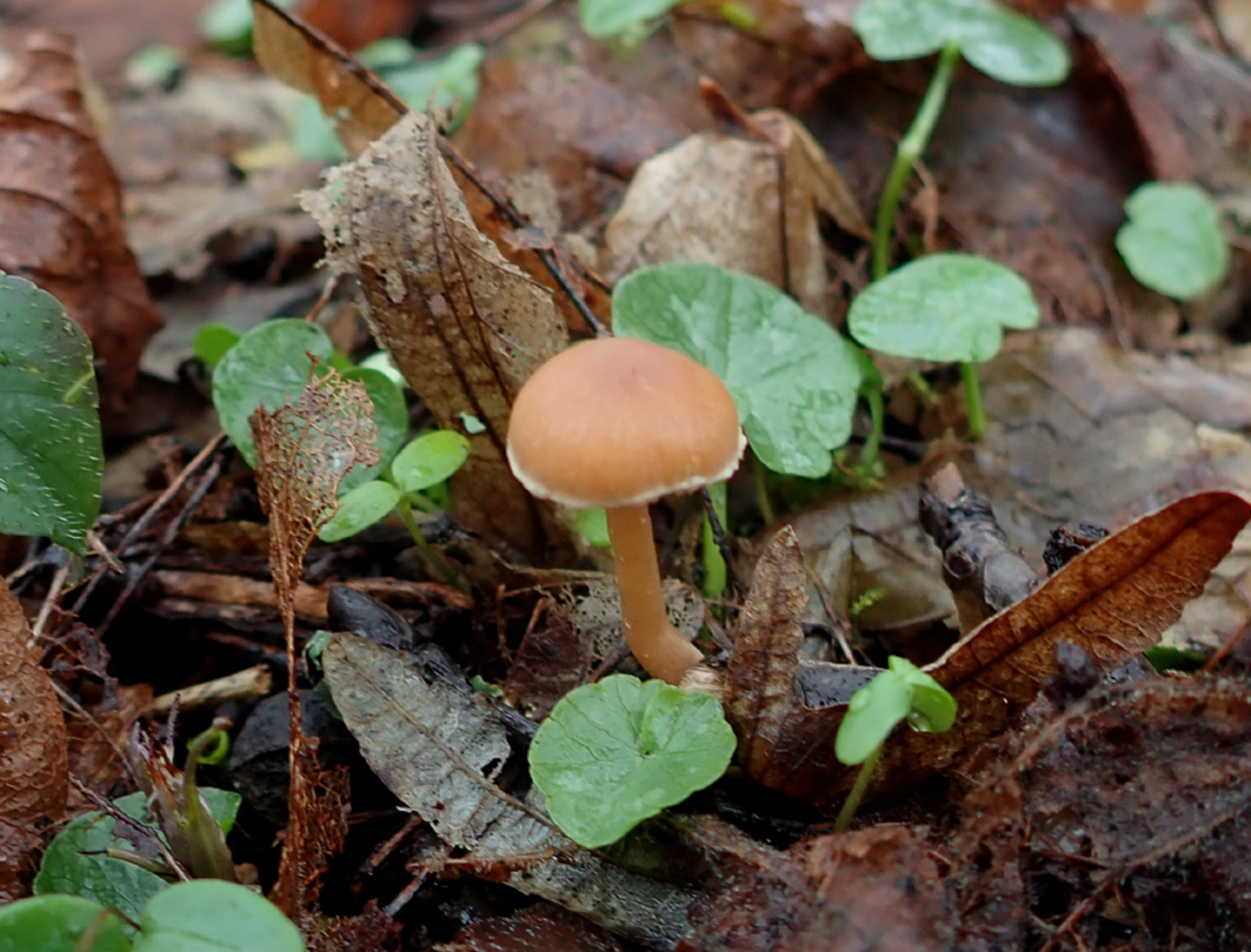 |
February 10th Tubaria furfuracea (Scurfy Twiglet) In a large patch covered in rotting chips and woody debris at Turville Heath (where a Beech had been felled last year) Penny counted upwards of 100 fruit bodies of this common species dotted about. Nearly all were missing the tell-tale white veil remnants around the cap rim which in the field help to separate this species from the similar genus Conocybe or even Galerina - no doubt washed off by rain. However, the slightly decurrent gills (often but not always apparent) seen in photo 2 left no doubt in her mind. Elsewhere in a less exposed spot she found another example less affected by the rain and showing this rim of veil well (photo 3). Previous finds |
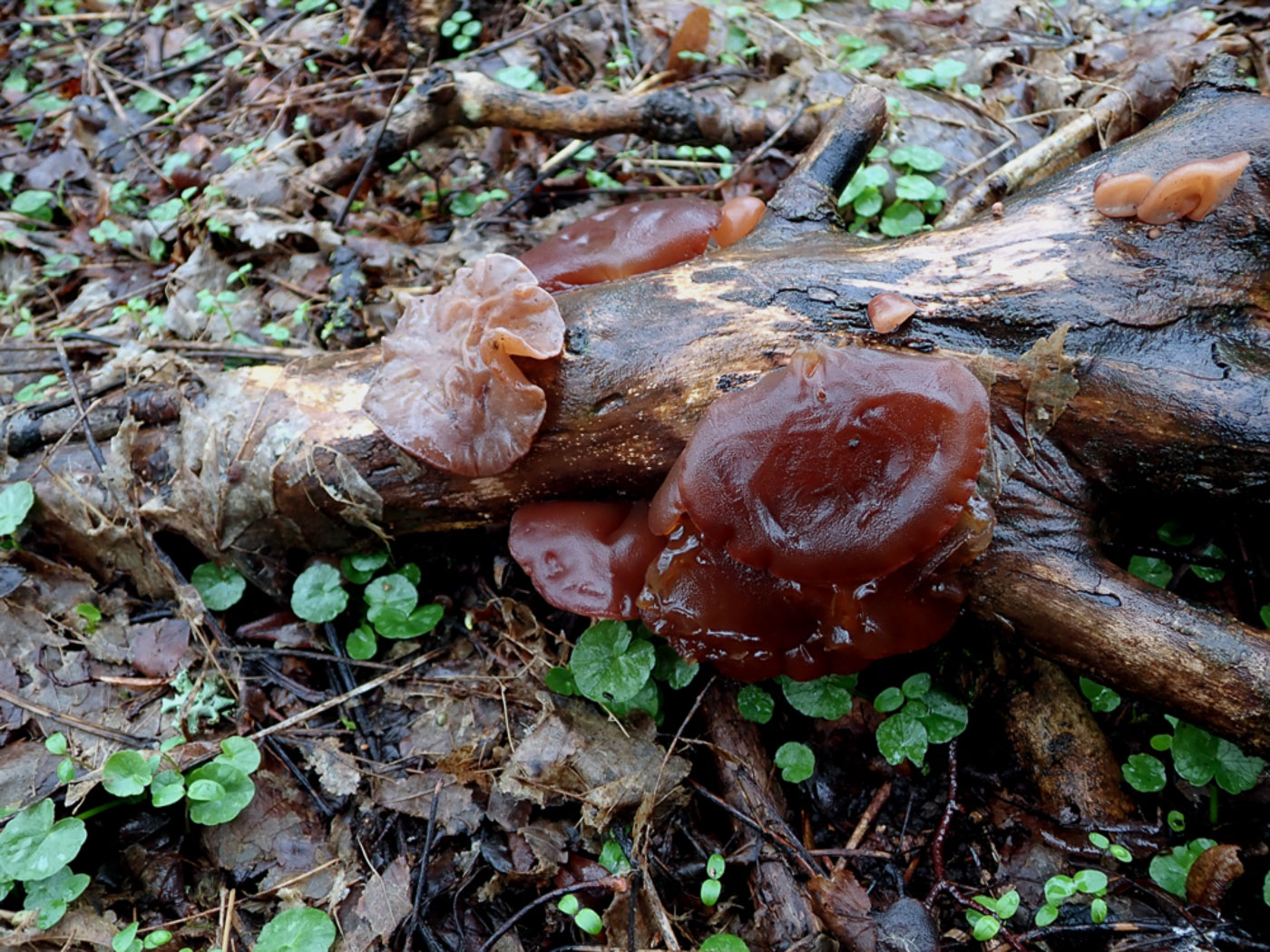
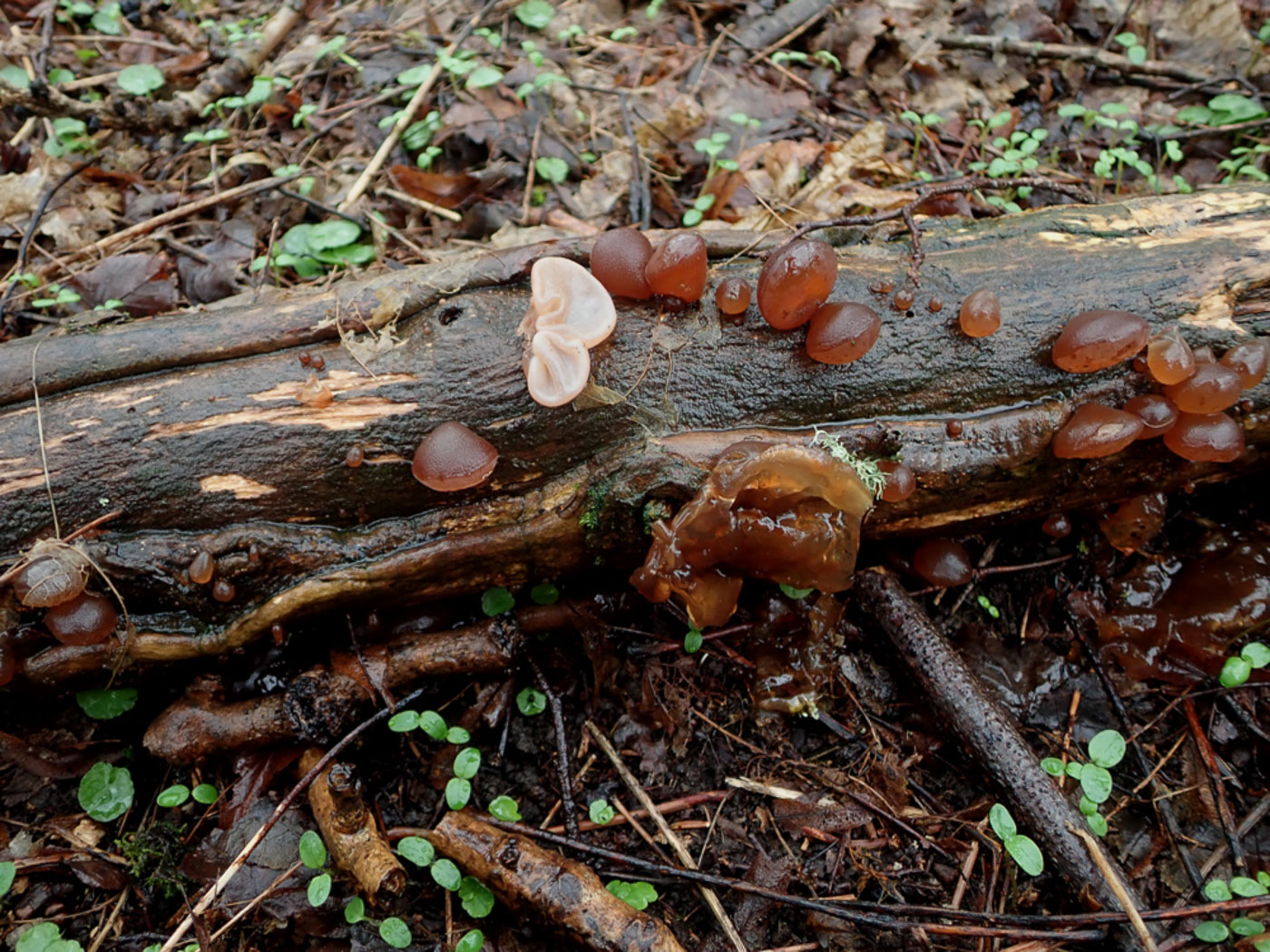 |
February 10th Auricularia auricula-judae (Jelly Ear) In a somewhat drizzly Turville Heath Penny spotted a fallen Ash branch liberally covered with this species - common on Elder, less common on Beech, but with just two previous county records this century on Ash as here. (In all we have around 350 records in the database!) It was not until she'd turned one over to check that she was certain of the ID (see examples of the typical underside in both photos) because none looked typically ear-shaped and all were rather browner than usual with little hint of red - maybe just very washed out. Previous finds |
February 9th 2026
.jpg "Photo © Jesper Launder")
.jpg "Photo © Jesper Launder")
 |
February 9th Cortinarius damascenus (Clustered Webcap) In Chalfont St. Peter Jesper Launder was surprised to find a Cortinarius (Webcap) under Beech - this being a strange time of year for this genus. However, he recalled finding an identical collection from this same spot back in late December 2024 (though his photo never made it into Finds, thus is included here). The species is apparently characterised in the field not only by its tapering conjoined stems (which he'd observed in the first collection) but also by its cap colour suggesting plums or damsons and its raphanoid (radishy) smell. The microscopic features also fitted, thus though today's collection was only a singleton he is confident that the two collections are one and the same. There are scant UK records this century on FRDBI, and prior to that one from 1945 and another from 1915, so it is seldom recorded thus a sample will be sequenced, especially as December and February are somewhat unusual for this genus to be found fruiting. (Photo 1 is of the 2024 collection.) Members' Finds New Species no. 1257 |
.jpg "Photo © Jesper Launder")
 |
February 9th Entoloma cf. sericioides (Satin Pinkgill) In Gerrards Cross Jesper Launder spied a large shiny capped Entoloma in mossy grassy near Oak, noted its distinct rancid mealy smell on collection and took it home to key out. The small spores and silky dark brown cap fitted with the relatively common E. sericeum (Silky Pinkgill), however the slightly sunken cap centre and (microscopically) the lack of clamps suggested the similar but rarely recorded E. sericeoides. Bearing in mind that clamps, if present, are often elusive and easily missed, this specimen will be sequenced to confirm and Jesper is happier to qualify the name with 'cf.' for now. We have just one previous county record: Derek's from Rushbeds Wood back in 1999. Members' Finds New Species no. 1256 |
.jpg "Photo © Jesper Launder") |
February 9th Elaphomyces muricatus (Marbled False Truffle) In Chalfont St. Peter Jesper Launder spotted various dig holes on a residential lawn, and with the owner's blessing he checked the holes for truffles. At the bottom of one, a squirrel-scraped surface of an Elaphomyces truffle was just visible, but only on excavating it did he realise why the squirrel had failed to remove it. It was an absolute whopper! This species is described as reaching 2.5cm across at most, but this one was a good cm larger than that! However, the distinctive garlic smell together with microscopic features left no doubt though it was, in his words: 'far and away the largest specimen I've encountered!'. Previous finds |
February 8th 2026
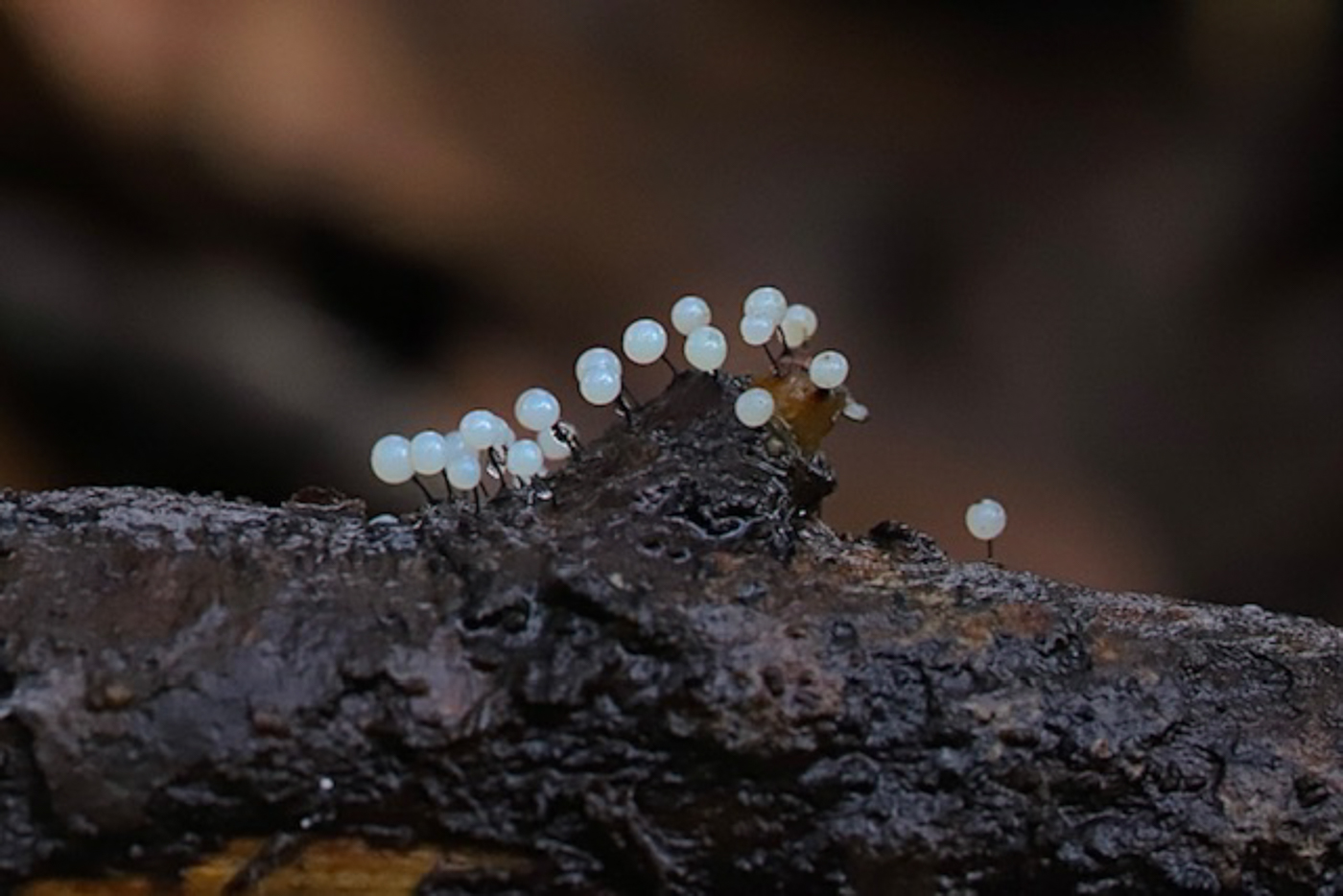 |
February 8th Lamproderma scintillans (a slime mould with no English name) In Ragpits Reserve Phil Townsend noticed these tiny shiny white globes on thin stalks on a piece of rotten wood, thought it was a slime mould and sent his photo to Penny who promptly forwarded it on to Barry Webb and Jackie Mackenzie-Dodds for their thoughts on an ID. Both agreed on this name though it has not been checked microscopically, but Barry comments that he's been finding this species a lot lately and Phil's photo is spot on for what it looks like when immature before it colours up. See previous Finds entries for more mature specimens. Previous finds |
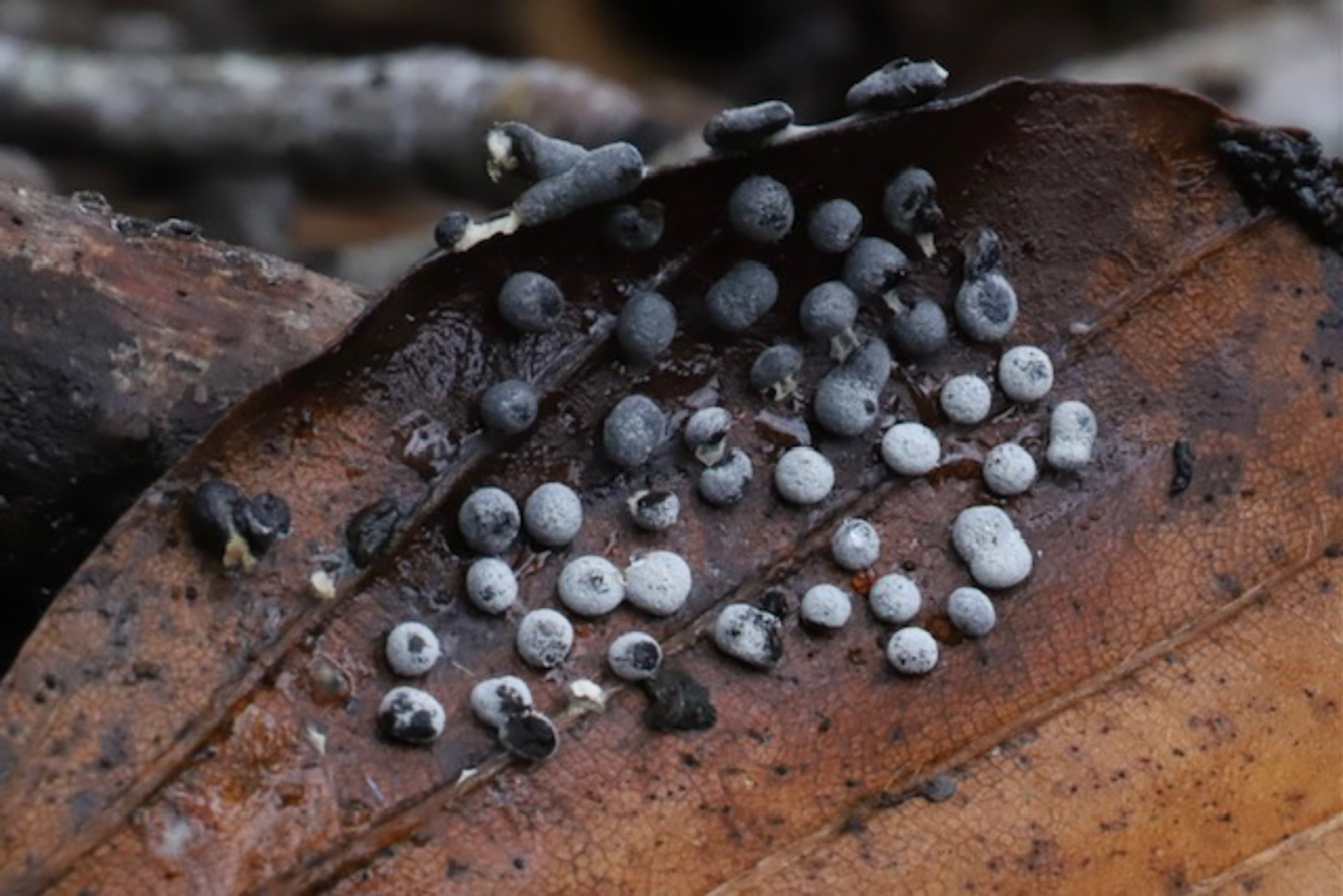 |
February 8th Didymium squamulosum (a common slime mould with no English name) In Ragpits Reserve Phil Townsend noticed these tiny bobbles on a fallen leaf, thought it was a slime mould and sent his photo to Penny who promptly forwarded it on to Barry Webb and Jackie Mackenzie-Dodds for their thoughts on an ID. Both agreed on this name though it has not been checked microscopically but is one of the commonest in this large genus and favours dead leaves in damp conditions - perfect at the moment! Previous finds |
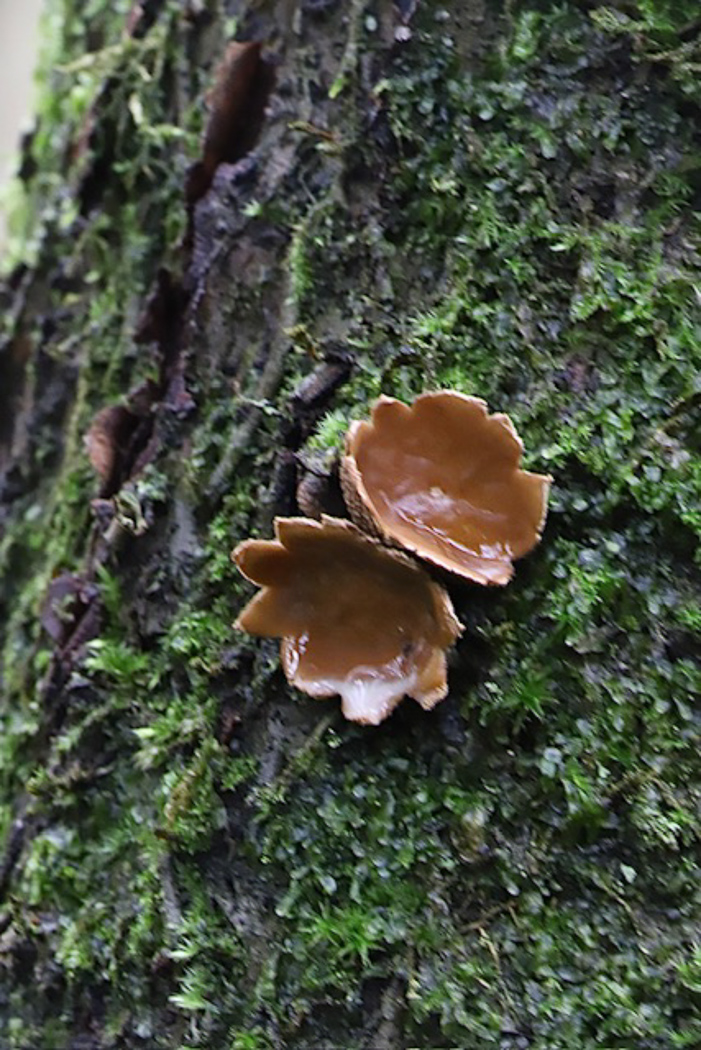 |
February 8th Encoelia furfuracea (Spring Hazelcup) In Rushbeds Wood Phil Townsend found this small cup fungus on a mossy Hazel branch, one which likes to fruit at this time of year. Rushbeds Wood abounds with Hazel and interestingly our first Finds photo of this species was Joanna Dodsworth's from this same site almost to the day in February back in 2021 Previous finds |
February 7th 2026
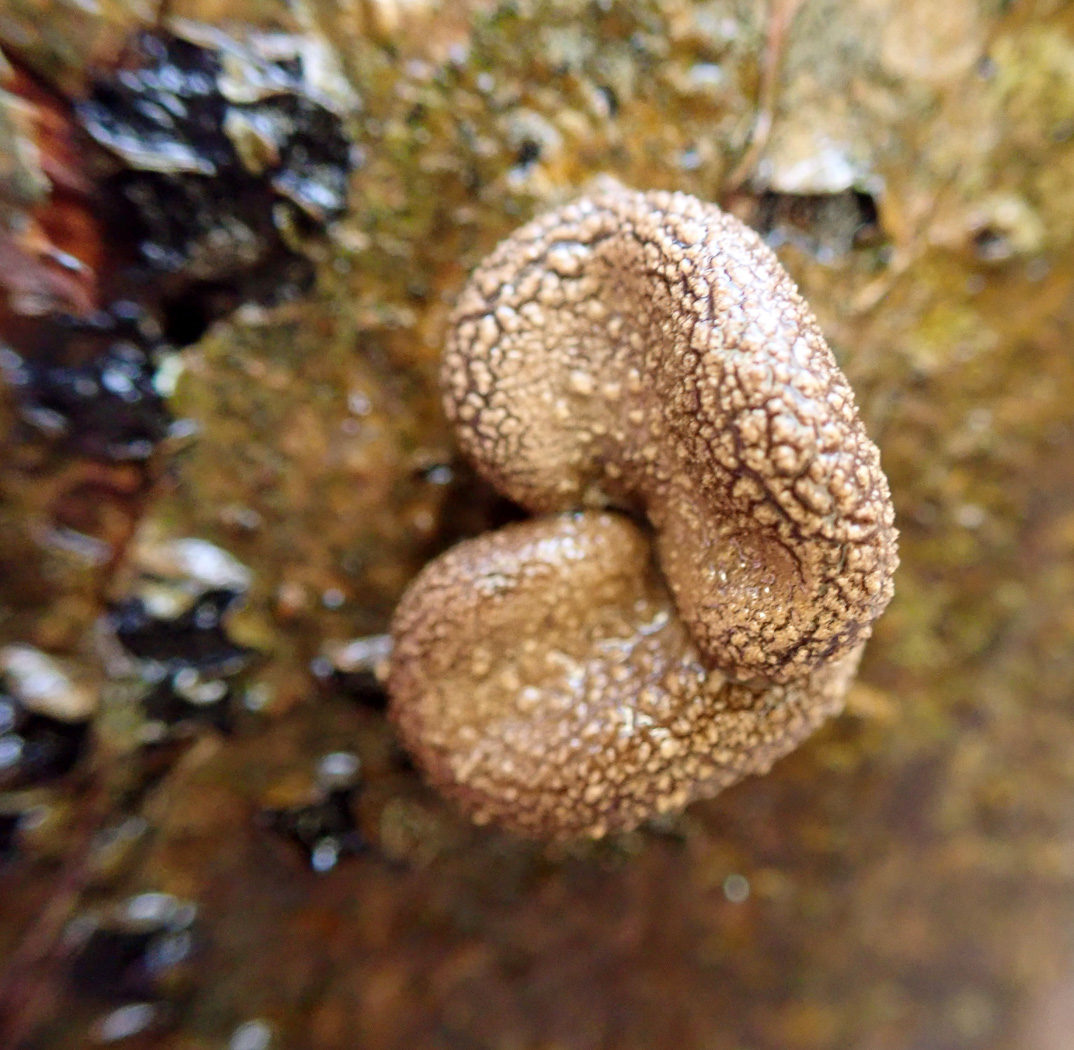 |
February 7th Encoelia furfuracea (Spring Hazelcup) At Dancersend near the Waterworks buildings Mick Jones spotted this asco on an old Hazel trunk and kept his eye on it for several weeks in the hope that it would open up to reveal its typical splitting cup shape. This it stubbornly failed to do, however, and ended up as it often does just shrivelling and curling up but showing its granular outer surface as seen here. This was new to the site and we have around a dozen county records, mostly from December to May but with a few in the autumn also. Previous finds |
.jpg "Photo © Sarah Ebdon")
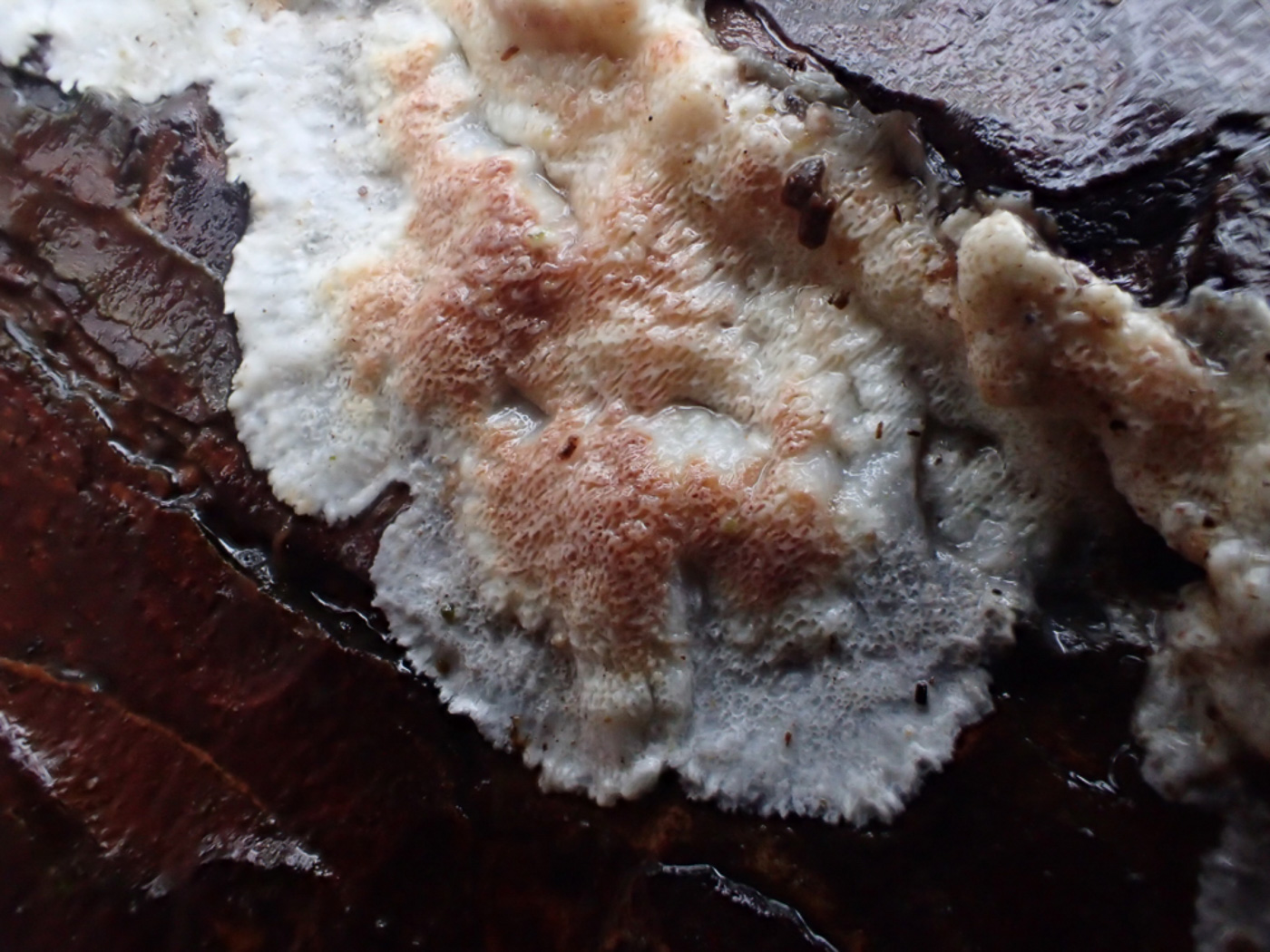
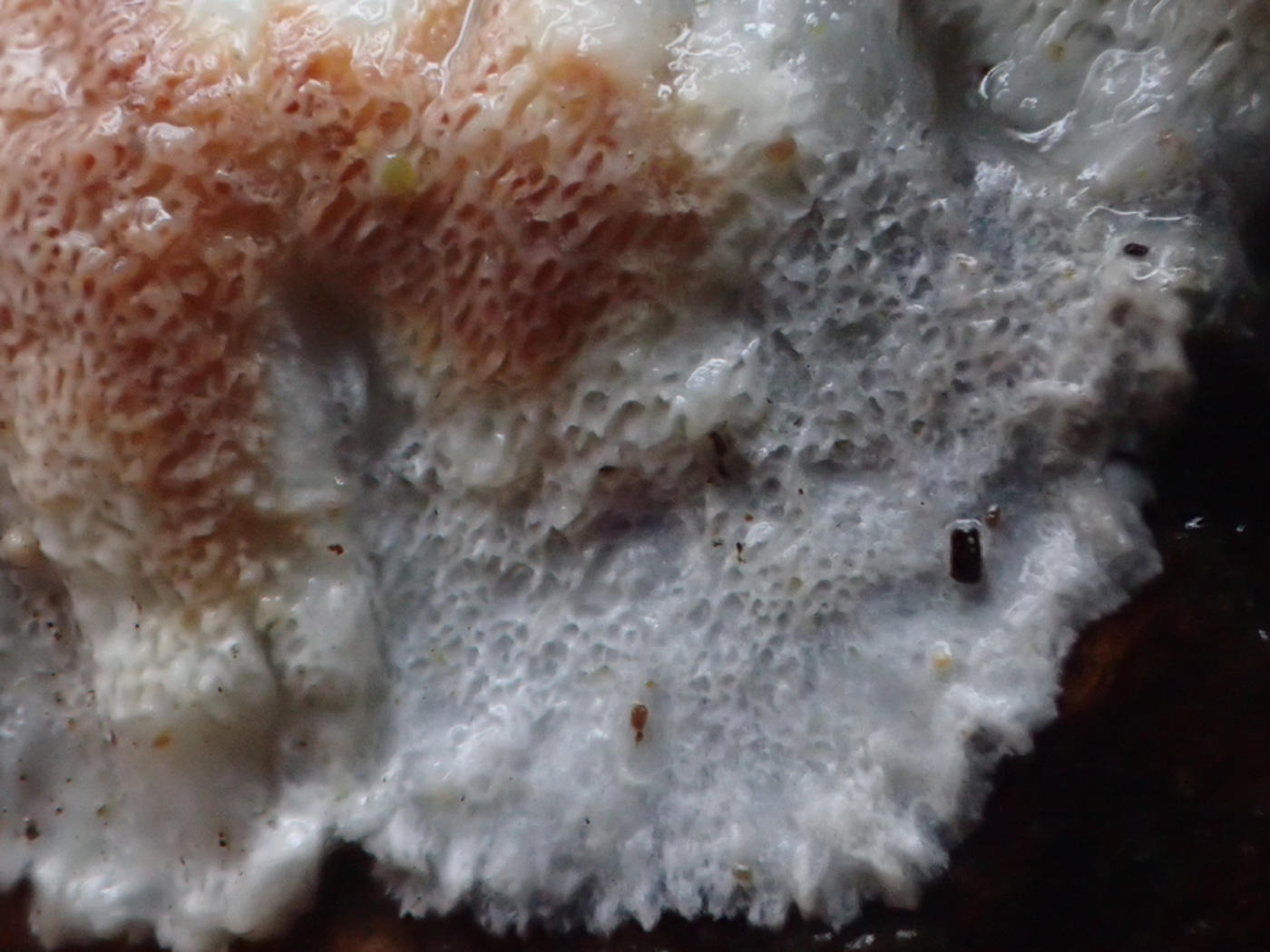 |
February 7th Meripilus sanguinolentus (Bleeding Porecrust) In Cockshall Wood nr Naphill Sarah Ebdon spotting some small patches of a white to cream porous corticioid on fallen Pine, then on closer inspection she noticed that it was bruising reddish brown in places. On testing this out with her finger it immediately responded with reddening, confirming her suspicions that this was the aptly named Bleeding Porecrust. (Please note the recent genus name change here from Physisporinus to Meripilus.) Corticioid species with pores - of which there are plenty - are often tricky to identify, so on finding one it is always worth giving it a press just to check if it reddens in this way thus allowing a quick field ID. The species is quite common but often overlooked, and can occur on many different types of fallen wood, both deciduous and coniferous. Members' Finds New Species no. 1255 |
February 6th 2026
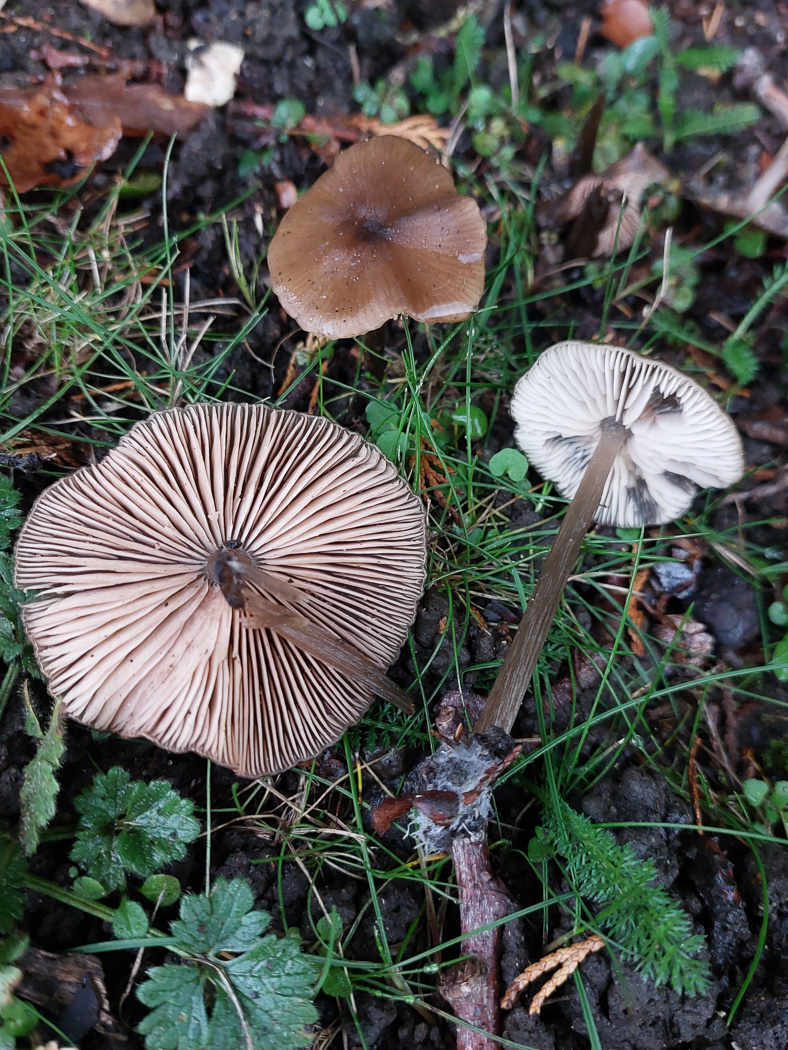 |
February 6th Entoloma hirtipes (Graceful Pinkgill) In Gerrards Cross Jesper Launder was pleased to find some fresh mushrooms fruiting, no doubt encouraged by the copious recent rains. This particular Pinkgill can apparently often appear in spring as well as in late autumn and has a distinctive mealy farinaceous smell with a cod-liver-oil component similar to that of Macrocystidia cucumis (Cucumber Cap). Jesper comments that this smell was very noticeable once the collection had been contained overnight, and this helped to confirm his ID as the caps were a less conical shape than usual for the species - see previous entries for comparison. Previous finds |
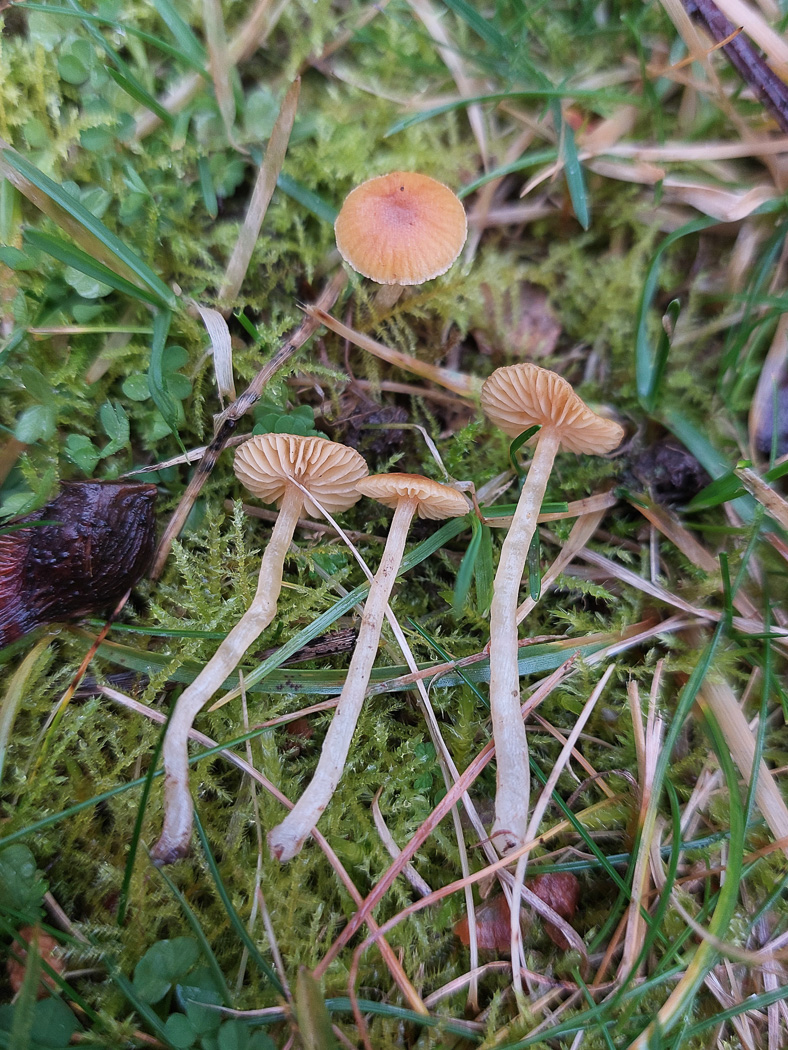 |
February 6th Galerina graminea (Turf Bell) In Gerrards Cross in a grassy verge Jesper Launder spotted this little group and recognised not only the genus but also the species, this being quite a common species of Bell with which he is familiar though he's not come across it for quite some time. It is a new entry for Finds though this in itself is not an indication of rarity but more likely evidence that few of us spend time studying this tricky genus - one which is not that hard to name to genus but having many species which appear almost identical and microscopic characters which are not always easy to interpret. Members' Finds New Species no. 1254 |
February 2nd 2026
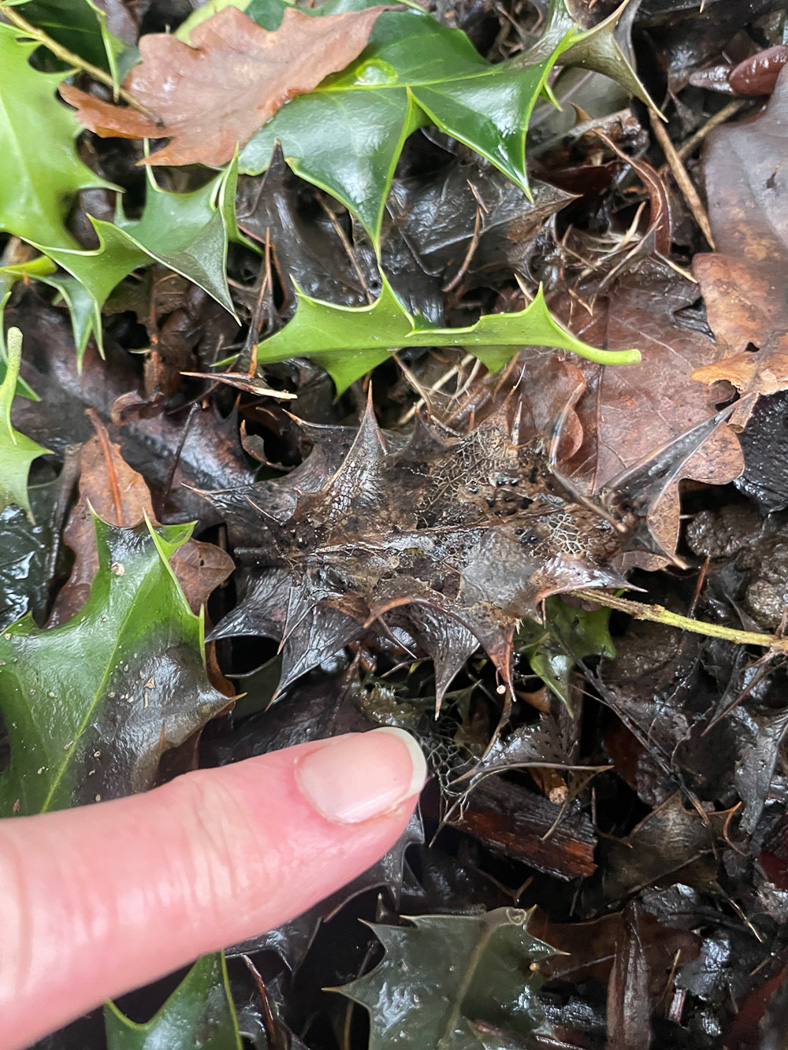
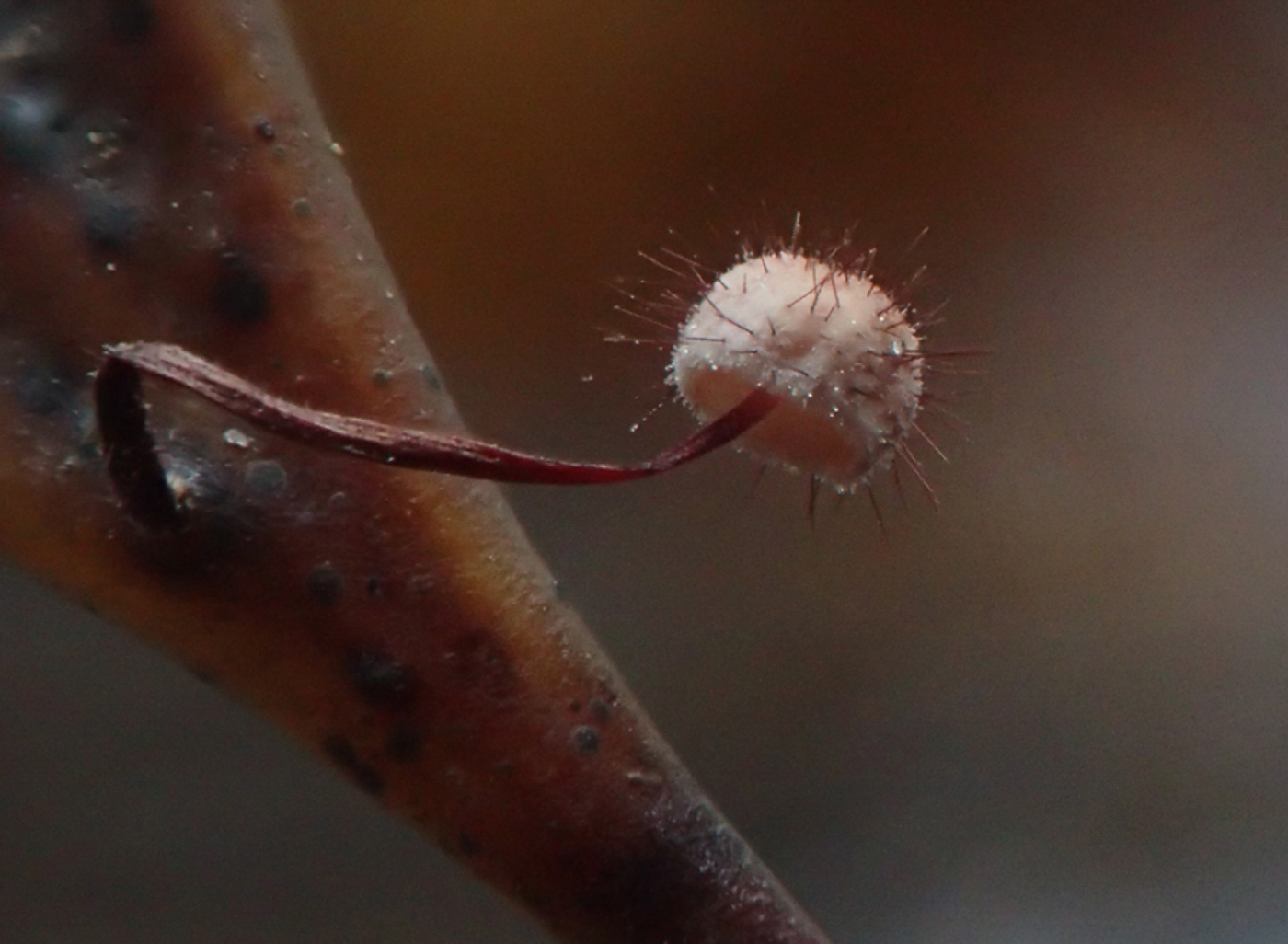
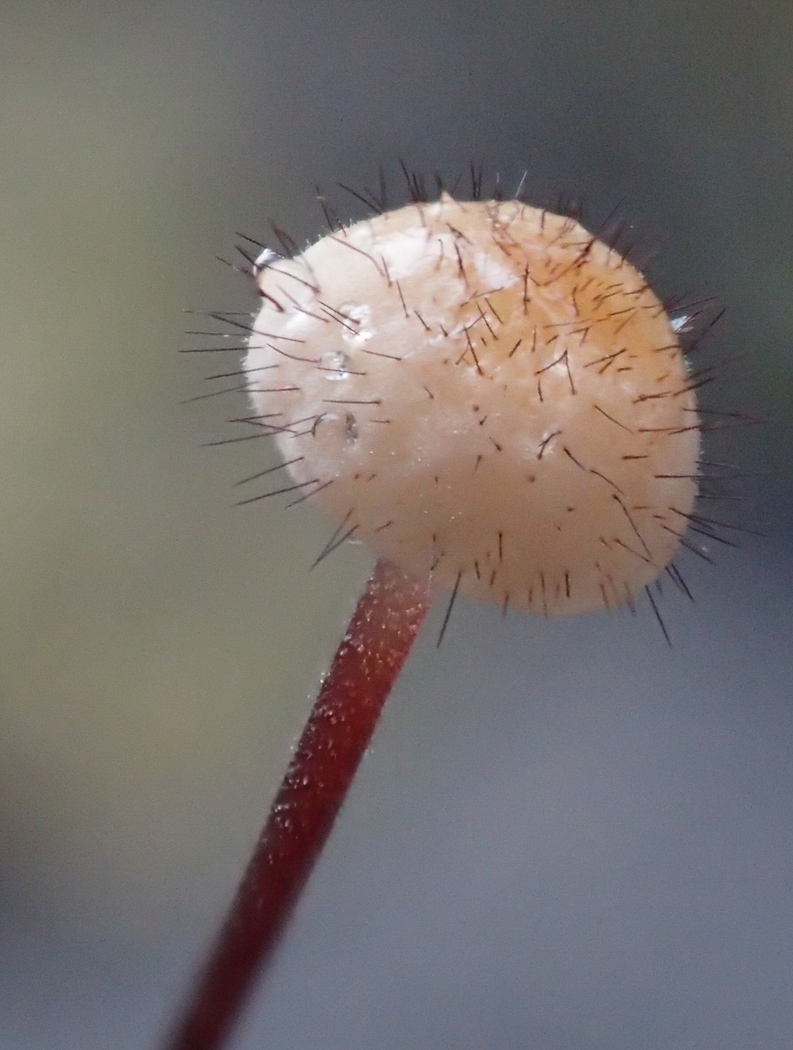 |
February 2nd Marasmius hudsonii (Holly Parachute) Sarah Ebdon reports that this stunning little mushroom - rare in this area until recent years - is now really thriving at Naphill Common in the present somewhat damp conditions and seems to be present under 'every other Holly bush' (her words) including her garden hedge! The photos here were taken both from her garden and on the Common, with photos 1 and 2 showing just how unbelievably tiny they are compared to her finger and the Holly leaf prickle. So it's worth going out now and braving the knees under any Holly bush to see if you can spot it, but you'll need a x10 handlens to appreciate those amazing red spines! Previous finds |
.jpg "Photo ©")
.jpg "Photo ©")
 |
February 2nd Exidia thuretiana (White Brain) In Prestwood Churchyard Sarah Ebdon noticed a deciduous stick with some blobs of an opaque milky white jelly fungus which on close inspection she felt fairly sure was not the common Myxarium nucleatum (Crystal Brain) because it appeared to lack evidence of the tiny white core (or nucleus) which characterises that species though is not always easy to spot. This was born out at home later when she was able to make a comparison between these two very similar species, having by chance come across and collected a sample of the Myxarium elsewhere today. Not only does the Exidia have notably larger spores but in the field it lacks the solid white central core of that species. (See also her entry for Myxarium nucleatum also having today's date. Previous finds |
.jpg "Photo © Sarah Ebdon")
.jpg "Photo © Sarah Ebdon")
.jpg "Photo © Sarah Ebdon")
 |
February 2nd Myxarium nucleatum (Crystal Brain) In Gt Cookshall Wood nr Naphill, Sarah Ebdon found a stick with nice examples of this common jelly fungus which she was then able to compare with the very similar Exidia thuretiana (White Brain) which by chance she'd just found in Prestwood Churchyard. The Myxarium was until quite recently also included in genus Exidia and both species are basically white lumps of jelly occurring on deciduous fallen wood and very easy to confuse. There is a difference in spore size between the two, but in the field to separate them the feature to look out for (though not always showing clearly) is the tiny white central 'inclusion' (a tiny white lump) within the gelatinous mass, and in photo 4 Sarah has actually managed to extract one of these (in this case shaped like a dumbbell) using a dissecting scope - this feature is missing from E. thuretiana but present in M. nucleata (presumably the Latin epithet here indicating the presence of a visible 'nucleus'. Previous finds |
.jpg "Photo ©")
.jpg "Photo ©")
.jpg "Photo ©")
 |
February 2nd Hohenbuehelia grisea (Grey Oyster) Sarah Ebdon has been keeping her eye on a particular dead standing trunk in Naphill Common where she'd previously found this very rare and special Oyster (see Finds Nov 19th, 2023), and was therefore pleased to notice it making an appearance there several weeks ago. She's been waiting for it to develop further before taking today's photos and then making a thorough microscopic examination - it having been previously identified from this spot with sequencing - thus providing a good opportunity to get to grips with the diagnostic differences between this species and the very similar H. mastrucata and H. atrocaerulea, both considered rare but not as exceptionally so as H. grisea. Studying the Funga Nordica key she realised that the grey colour described therein was not a useful difference because she found both today's specimens and those of 2023 not particularly grey. Likewise, the gelatinous layer described (and showing well in her photo 4) appeared to indicate H. mastrucata as in all her collections to date it was significantly thicker than described in the other two species. She concluded, however, that studying in detail the measurement of the metuloid cystidia (characteristic of the genus as a whole) provided the best clue to separating H. grisea: though a number of these cells clearly overlapped in size with the other two species a good number were notably bigger and thicker walled, thus eliminating them. Good work, Sarah! Previous finds |
.jpg "Photo ©Sarah Ebdon")
.jpg "Photo ©Sarah Ebdon")
 |
February 2nd Mycena tenerrima (Frosty Bonnet) In Naphill Common Sarah Ebdon spotted these tiny white mushrooms on a piece of fallen deciduous wood and though pretty sure of their ID she couldn't resist the opportunity to view the very distinctive cystidia found on the gill edge of this species which help to separate it from other similar tiny white Bonnets. (See photo 3 which shows quite how tiny the are.) She aptly describes these cells as 'bellows-like', having swollen rounded bellies half covered in spiky 'brushcells' (as do many in this genus) but what is unique is their extending long protuberance at the tip, indeed just like old-fashioned bellows! In the field, look for the tell-tale combination of dusty frosting covering both cap and stem together with the small swollen disc at the stem base. Previous finds |
January 29th 2026
.jpg "Photo © Jesper Launder") |
January 29th Heteroradulum deglubens (Blushing Crust) In Jordans Village Jesper Launder came across a nice fresh example of this corticioid species on some fallen indeterminate wood and, though his camera failed to pick it up successfully, he noticed the pink flush which gradually developed and is a useful field character, helping to confirm his determination. We have very few county records though this is not a rare species. Members' Finds New Species no. 1253 |
January 28th 2026
 |
January 28th Phaeotremella frondosa (Leafy Brain) In Burnham Beeches Gill Ferguson came across this large frilly seaweed-like gelatinous fungus and sent her photo to Penny who recognised it as what we have previously named Tremella foliacea. Checking her facts with Sarah Ebdon, she recalled that recently not only has the genus name changed but as DNA revealed it as a species complex, it has now been split with the result that P. foliacea is now the name for fruit bodies found on fallen conifer and P. frondosa when found on fallen broadleaf wood, most commonly Beech. In fact it is apparently parasitic on the common Stereum hirsutum (Hairy Curtain Crust), often occurring on the wood once the host fungus fruit bodies have disappeared, and Gill commented that she'd noticed this host further along the branch today. So though this is a new record for the county under its present name, there can be little doubt that most if not all of our records for Tremella foliacea are in fact this species. Previous finds |
January 27th 2026
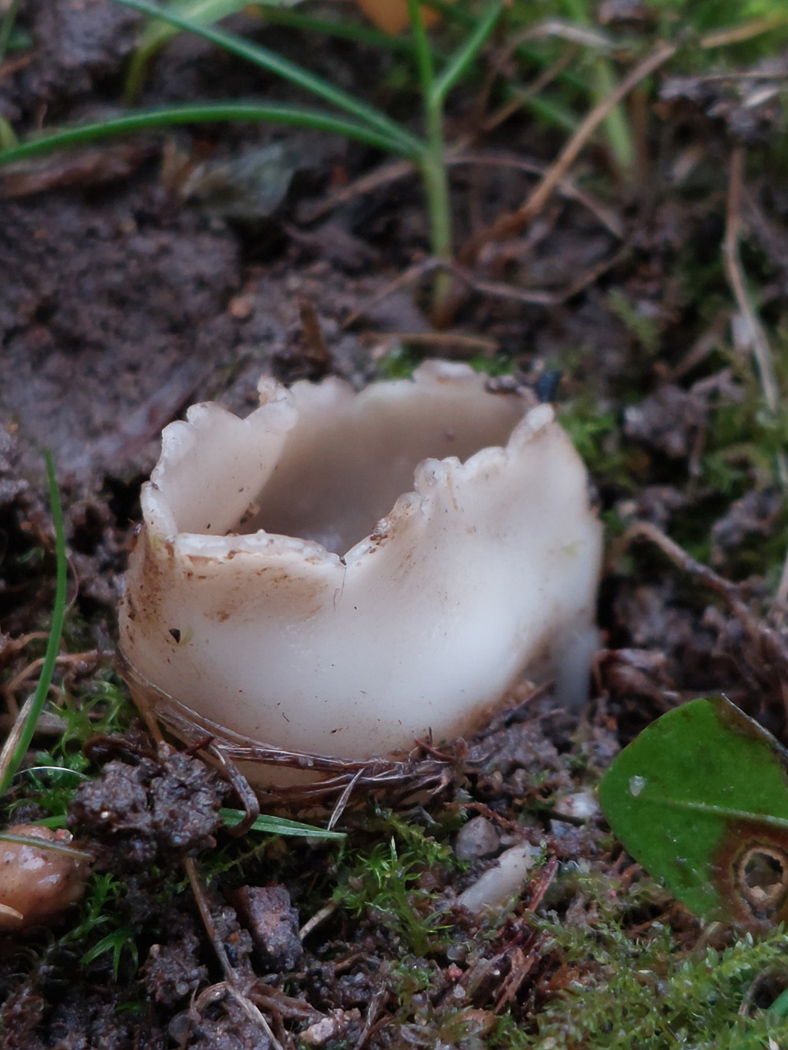 |
January 27th Dissingia leucomelaena (a rarely recorded Saddle with no English name) In Gerrards Cross Jesper Launder investigated a spot under Pine where he'd previously found this rare species several times in Spring, and there it was again. Previously in genus Helvella (though looking more akin to maybe Peziza) this is the earliest date he's found it here. See the notes on previous finds for more information about the species. Previous finds |
.jpg "Photo © Jesper Launder") |
January 27th Balsamia vulgaris (Common Truffle) In Gerrards Cross Jesper Launder visited a spot he knows for a springtime Helvella species (which he successfully located), but whilst there he also noticed a large 'dig hole with truffly scraps in it' - his words - and on further investigation found a large in-tact knobbly truffle. It had a strong aroma of garlic which suggested B. vulgaris and his ID was then confirmed with microscopy later. What was particularly interesting was that the only possible host tree was 2-needle Pine which is not a known host for this species, known to associate with Beech, Hazel or possibly Larch, though Jesper has also found it under Spruce. There are only a dozen or so records for this species on FRDBI, four of these being Jesper's from Bucks. Previous finds |
January 26th 2026
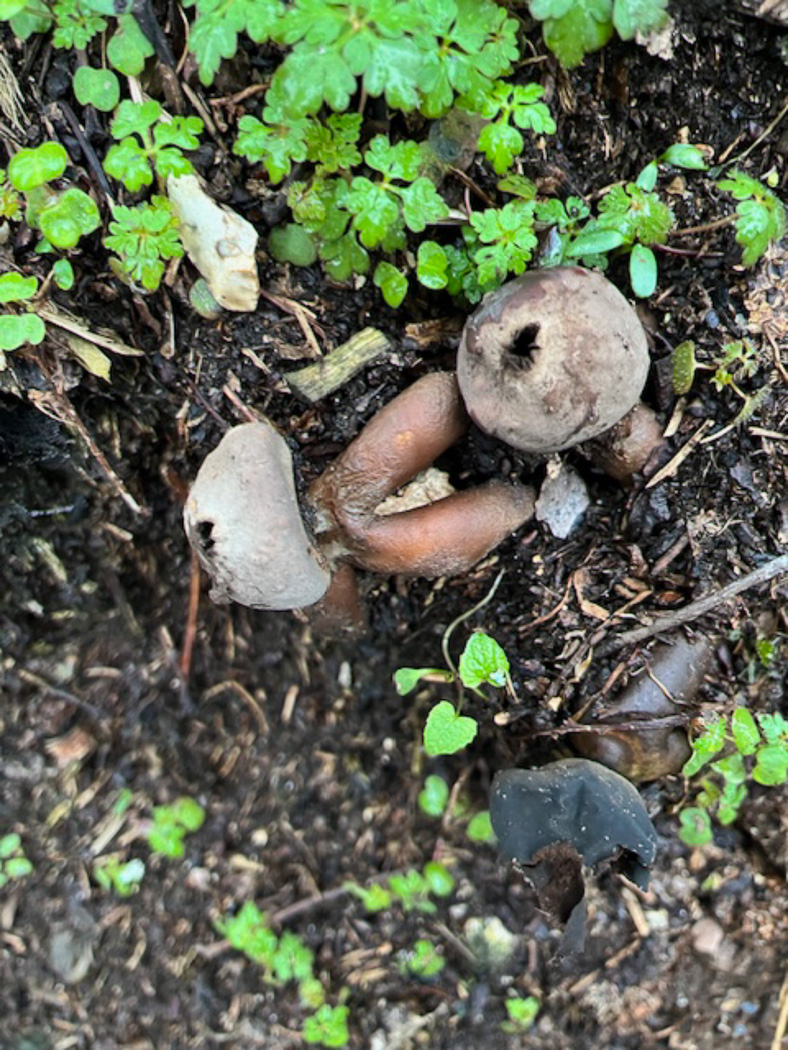 |
January 26th Geastrum britannicum (Vaulted Earthstar) Two years ago at this time Derek Bourne found a collection of Earthstars on a quiet roadside bank in Bourne End which were eventually identified as this rare species first described about 10 years ago. Returning to the same spot today he found them again though rather the worse for wear, presumably as a result of weathering. See the detailed comments for the previous Finds collection for more information. Previous finds |
January 12th 2026
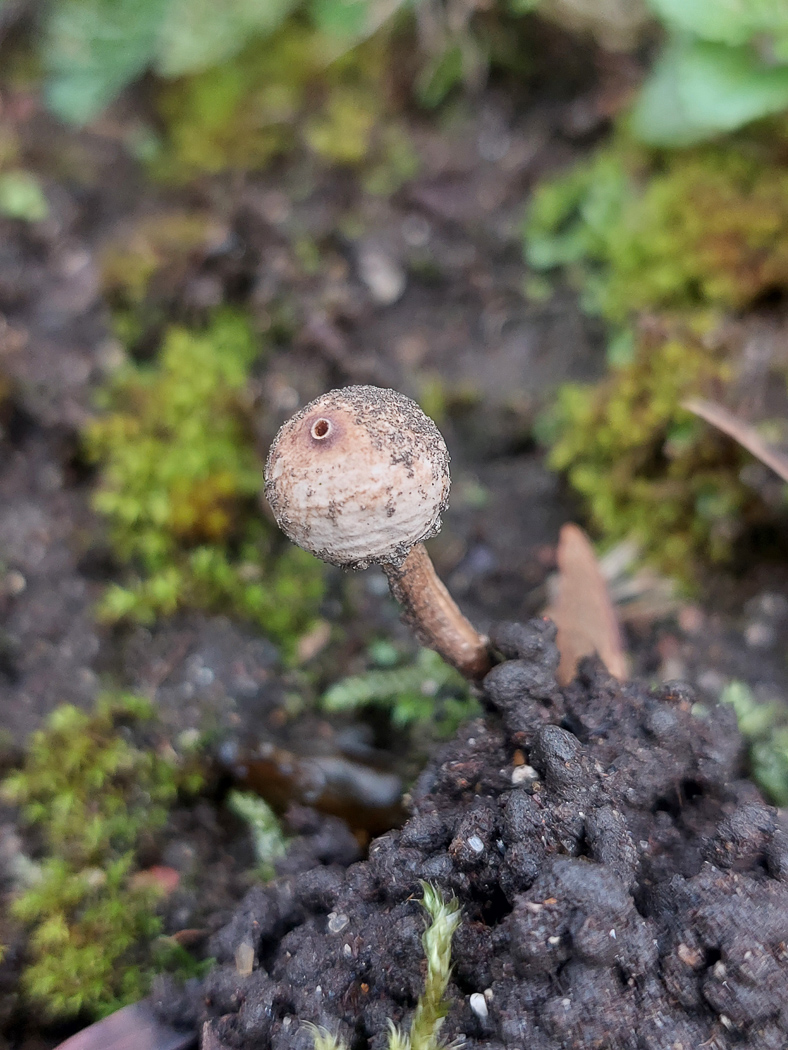 |
January 12th Tulostoma brumale (Winter Stalkball) Jesper Launder went looking for this species on a mossy bank in the carpark of a Gerrards Cross hotel where he'd found it new to the county in November '23', though having failed to find it there last year. He was rewarded with perhaps 10 fruitbodies though not in great condition, the best of which is seen here. These are tiny puffballs on a stalk, less than 1 cm across with the stalk up to about 2.5 cms tall, with a preference for sandy calcareous soil and most commonly found in coastal dunes. As will be ascertained from our other two Finds entries, we now have two county sites where it's been found. Previous finds |
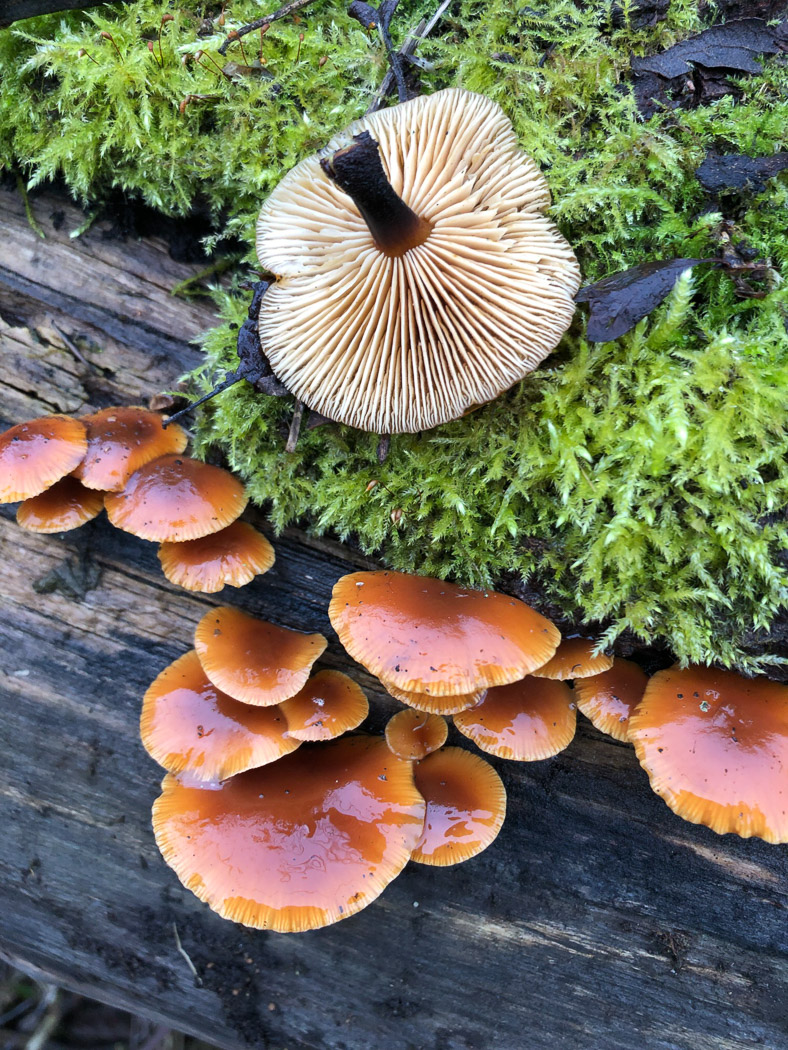
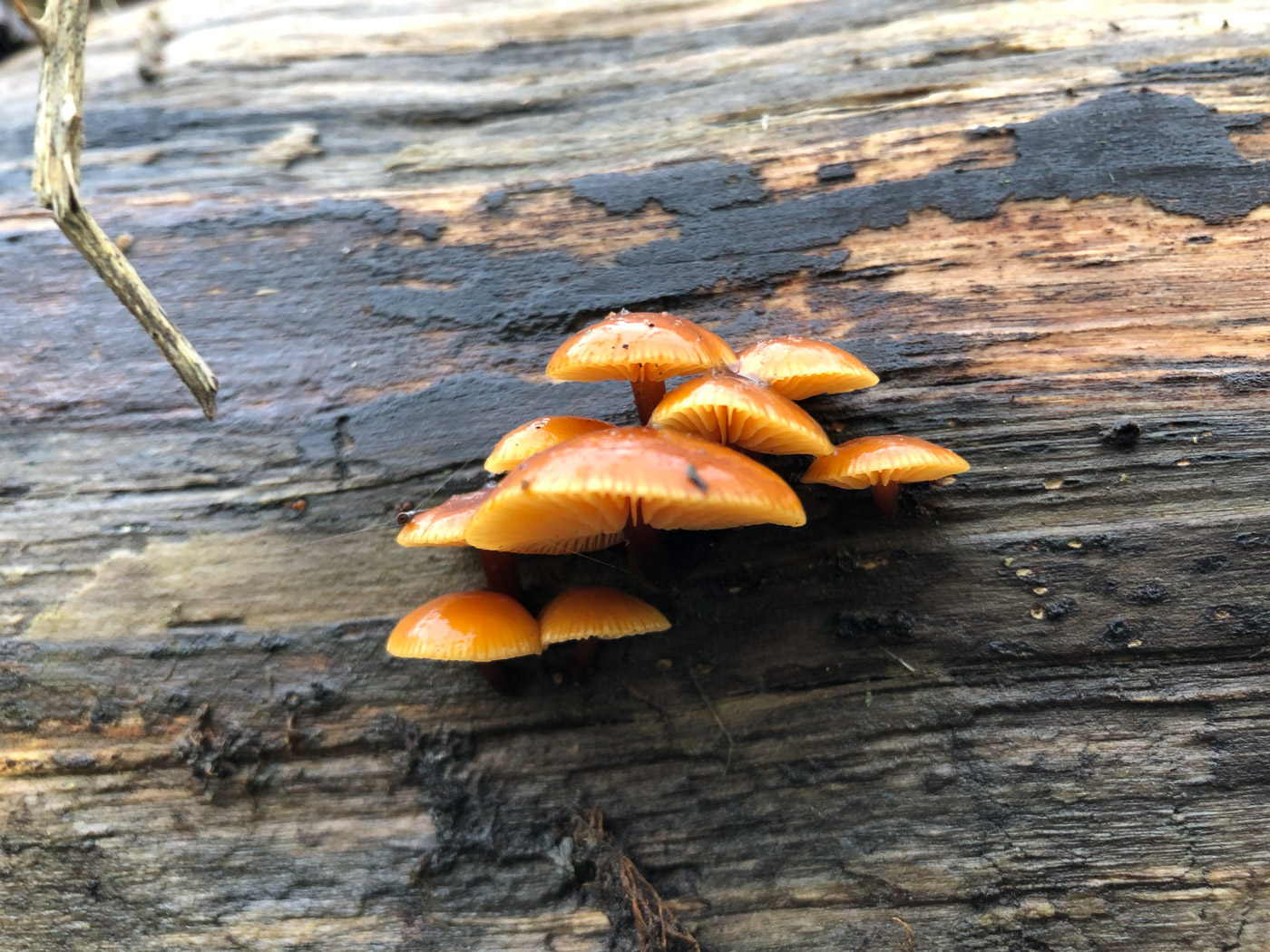
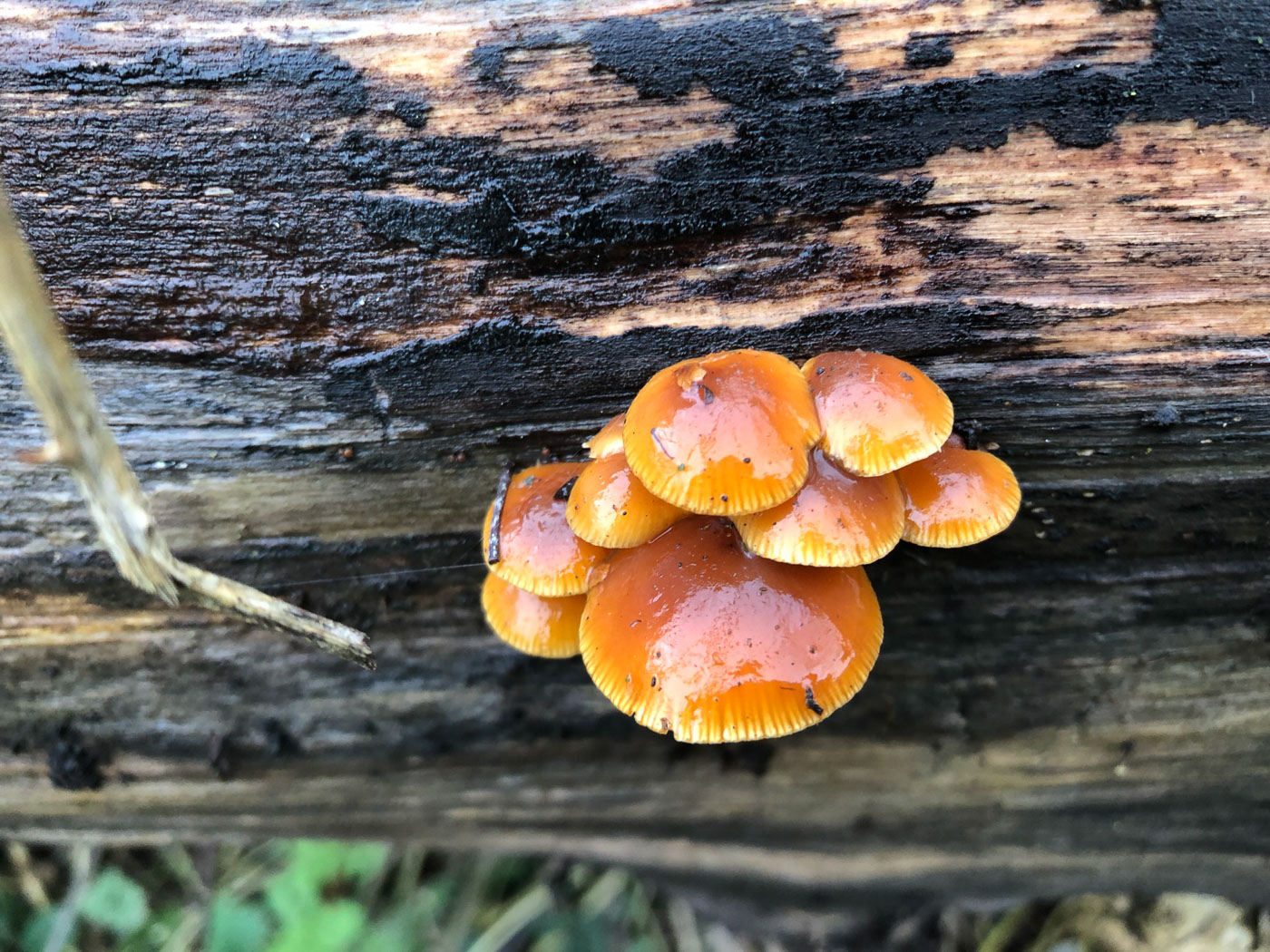 |
January 12th Flammulina velutipes (Velvet Shank) Tony Knight noticed this attractive fresh clump on an old Ash log in Chilton village. This is a species at home in wintry conditions and quite happy with snow and ice, so it's no surprise that our many other Finds entries have similar dates to this collection. Another to keep a look out for, with its brightly coloured caps and dark finely furry stems. Previous finds |
January 10th 2026
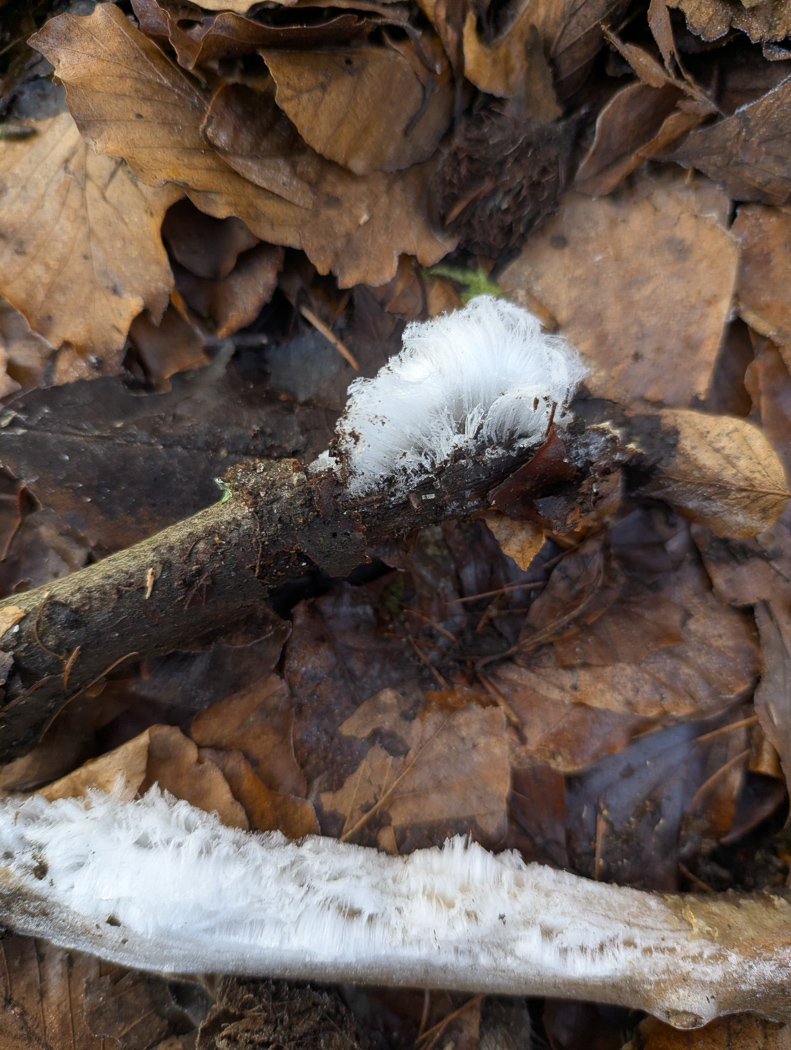
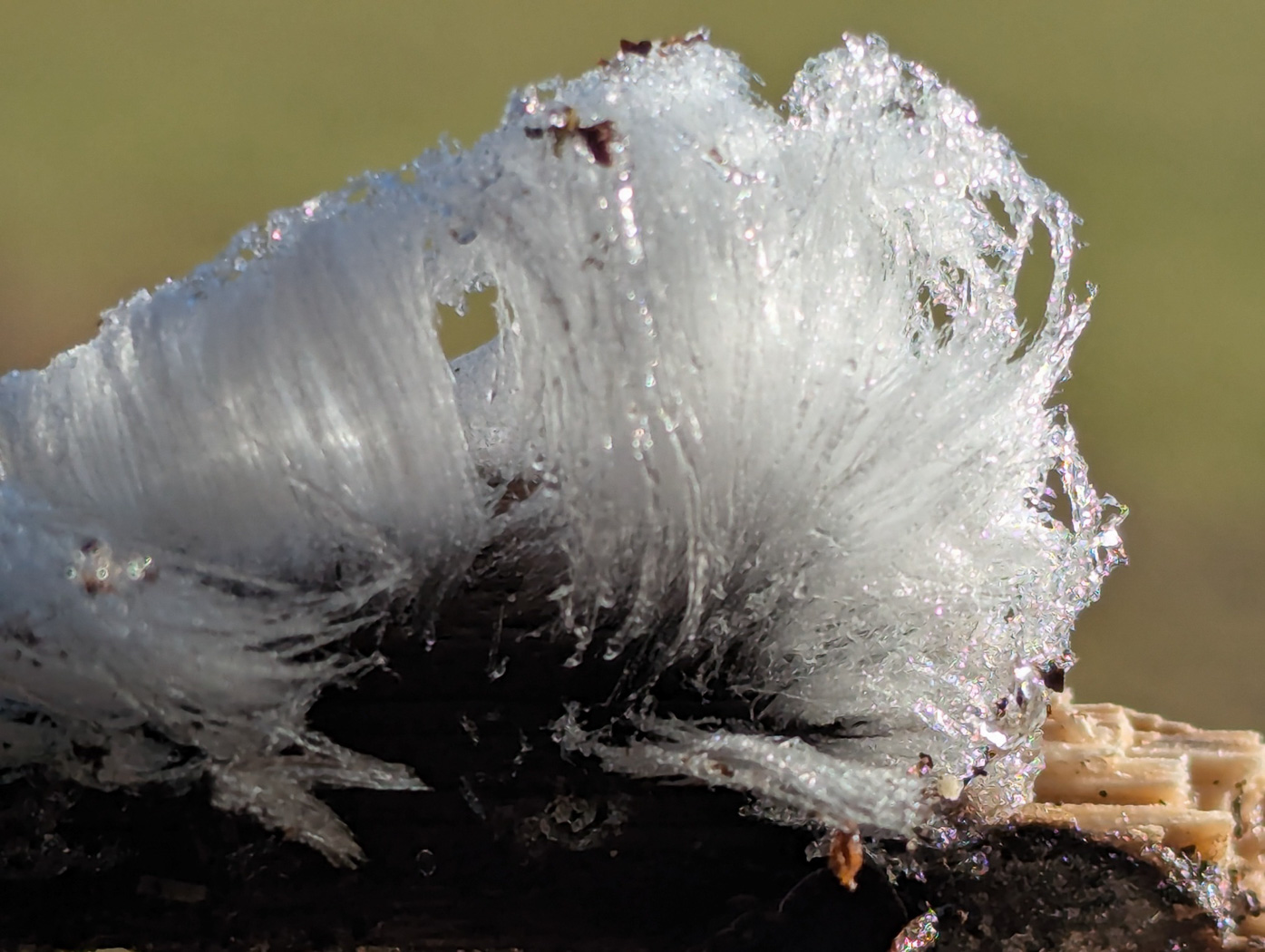 |
January 10th Exidiopsis effusa (Hair Ice Crust) Claire Williams is becoming a dab hand at locating this beautiful and interesting species, though today's photos come from Downley Wood where she's not seen it before. Mid January seems to be the peak time for it to appear, when suitably moist and frosty conditions trigger this remarkable mutation to occur. See previous comments for further information. If we get another really cold spell then this is well worth looking out for on fallen wood. Previous finds |
January 4th 2026
| Just in December 31st |
Hypholoma capnoides (Conifer Tuft) Click here |
| Update December 25th |
Chrysomphalina grossula (Green Navel) Click here |
| Just in December 14th |
Craterium minutum (a slime mould with no English name) Click here |
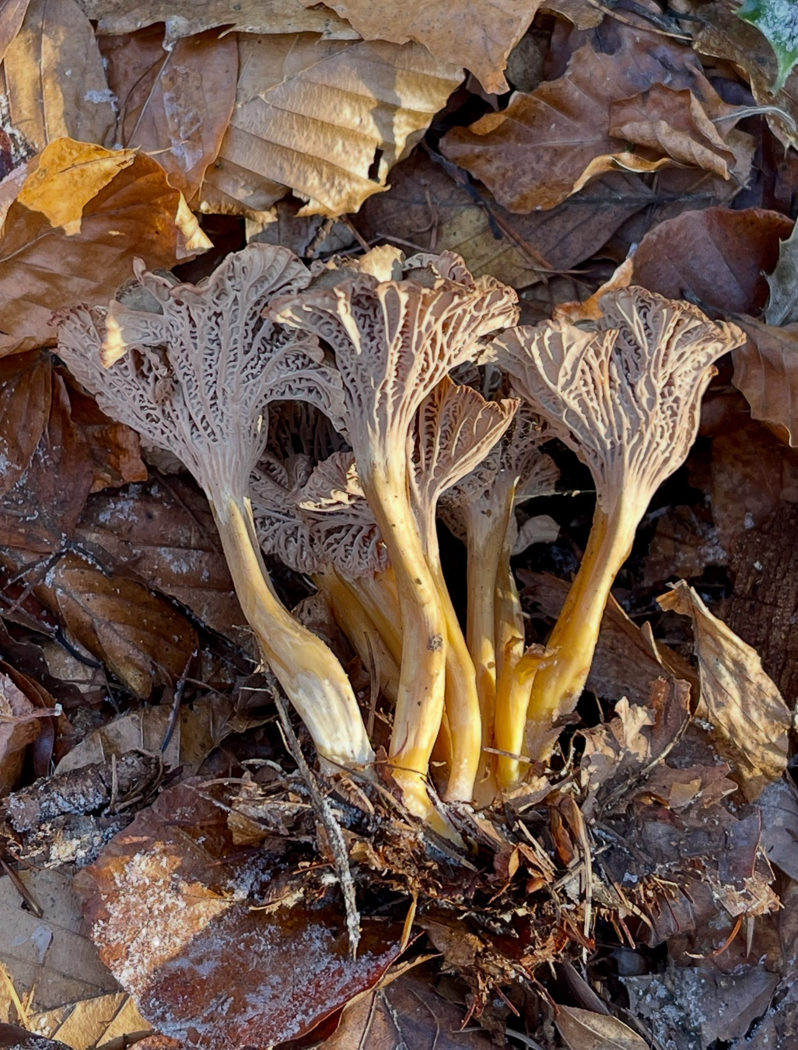 |
January 4th Craterellus tubaeformis (Trumpet Chanterelle) Our first find for 2026! Justin Long found these fruitbodies in Apsley Woods nr Milton Keynes, easily recognisable despite being completely frozen solid! The genus name may surprise a few here as this was previously in Cantharellus; it has also had several different English names including Yellowlegs (very apt) and Winter Chanterelle (also in this case apt) though it is certainly not restricted to fruiting at this time and is often to be found in good numbers during the autumn months. This is a mushroom which, if you come across one, there are nearly always more close by though they're usually surprisingly hard to see and you need to 'get your eye in' as the saying goes! Surprisingly, our previous Finds entry appears to be from 2023 because this is not a rarity. Previous finds |
HOW TO SUBMIT YOUR PHOTOS TO MEMBERS' FINDS
• Only BFG members may contribute; collections must be from Buckinghamshire.
• Please send images as an attachment and not embedded into the email text.
• NB! All photos should be accurately captioned before attaching. Please replace your camera code number with fungus name (a suggestion is fine), site, date, your initials. EG Amanita muscaria Penn Wood 01.10.2025 PC1.
• Aim to show all aspects of the fruitbody, include several photos if available.
• Please include in your email as much detail as possible (eg size, smell, substrate, habitat, microscopic details if available). All clues are vital when identifying solely from photos.
• If possible collect and retain at least one specimen until you've heard back from Penny in case further investigation is required - records of rarities are invalid without voucher material which may well need to be dried for molecular sequencing to confirm.
VIEWING TIPS
• Click on thumbnail to view photos at full size.
• Only entries marked with this symbol have been microscopically examined.
• Entries marked with this symbol have been confirmed or identified using DNA sequencing.
• In the Latest Finds Entries the date on the left outside the text boxes is the date of entry into Members Finds; the date within each text box before the species name is the date of collection.
• At the bottom of each entry, clicking on Previous finds, New find or Updated find takes you to the appropriate entry in the Masterlist Index.
• The quickest way to search for any species is by clicking on the LATIN MASTERLIST INDEX, which now automatically groups all entries for any one species together for convenient comparison.
HOW MEMBERS' FINDS STARTED
Members' Finds was launched in 2020 after the onset of Covid 19 to compensate for the cancellation of the group's outdoor activities during lockdown, its purpose being to encourage members to go out looking for fungi and share their photos here. It proved so popular, especially to those new to learning about fungi, that after lockdown we decided to extend and refine the scheme, using it for members' collections made within the county but separate from those recorded on our Walks - already covered in the reports (available on the Reports & Lists page).
Six years on we now have over 1250 species illustrated, many of which have several images and are not included in popular handbooks, making this an extremely useful resource. Over 50 members have now contributed, adding many rarities including species new to the county and to the UK.
In 2025 we updated the general layout considerably, making browsing easier and information more readily at your fingertips. For the more common species for which we had amassed multiple images we decided to continue including the latest images sent in but started selectively thinning out some earlier images, reducing the number of entries per species to around ten. This enables us to retain the best photos showing a wide range of any one species, making it such a beneficial and unique resource. So please do not be discouraged from sending in entries of species already well subscribed: common or rare, all are still welcome!
ACKNOWLEDGMENTS
Contributors / Photographers: Andrew Dodd; Andrew Padmore; Andy Coulson-Phillips; Ann Pitwell; Annette Powell; Audrey McDade; Barry Knight; Barry Webb FRPS; Bob Simpson; Caroline Lawrence; Chris Grimbly; Claudi Soler; Claire Williams; Derek Bourne; Derek Schafer; Eleanor Page; Gill Ferguson; Greg Douglas; Hassan-al-Farhan; Helen Read; Jackie Ewan; Jackie Mackenzie-Dodds; Jackie Newcombe; Jesper Launder; Jim Wills; Joanna Dodsworth; John Catterson; Jordy Payne; Justin Long; Justin Warhurst; Kerry Robinson; Laura Paterson; Leigh McMahon; Lesley Catterson; Linda Seward; Lisa Dodd; Lisa Rock; Mario Tortelli; Mark Harper; Mark Harris; Matt Vaughan; Mick Jones; Neil Fletcher; Noel Murray; Paul Allan; Paul Cullington; Paul Goby; Penny Cullington; Peter Davis; Phil Townsend; Piermario Maculan; Richard Donnelly; Richard Wright; Rob Corran; Russell Ness; Sarah Ebdon; Stephen Plummer; Stuart Blackhirst; Toni Standing; Tony Marshall; Tony Knight; Trish Glenn; Wendy Nicholson
DISCLAIMER
There is no guarantee on the reliability of identifications made, particularly on those entries lacking the microscope symbol . All photos are checked and selected by Penny to the best of her mycological ability. Basic accompanying notes are also Penny's.